Tag: EMIR

Discover all of Kaizen Reporting’s EMIR resources. Learn more about global regulatory reporting from our team of specialists, covering FCA, ESMA and SEC.

  • ESMA Call for Evidence: Interim Report Signals Direction of Travel for Transaction Reporting Reform

    ESMA Call for Evidence: Interim Report Signals Direction of Travel for Transaction Reporting Reform

    • ESMA signals major changes ahead for EU transaction reporting rules
    • Scenario 1a is the leading near-term option for reform
    • Change will depend on EU legislative updates

    ESMA has set a course towards a more streamlined and efficient trade and transaction reporting regime across European markets with the publication today of its Interim Report on the Call for Evidence on a comprehensive approach for the simplification of financial transaction reporting.

    It has now been ten months since the Call for Evidence (CfE) was launched and five months since ESMA’s Data Day. The interim report summarises feedback from 108 written responses to the CfE, alongside separate insights gathered from 14 meetings involving 25 stakeholders.

    This is not the end of the consultation process nor even the beginning of the end. Rather, it marks the end of the beginning. There is now clear acknowledgement that the current framework is not where the industry or regulators want it to be and that significant change is inevitable. However, that change will neither be quick nor straightforward.

    Cost-benefit analysis

    Much of the report consolidates existing themes; a restatement of the current challenges, a reframing of the objectives and detailed analysis of stakeholder views on the options originally presented in June 2025.

    Given the need for a thorough cost-benefit analysis (CBA), the report does not yet contain policy recommendations. As a next step, ESMA will continue to engage with market participants, including through an open hearing on 28 May before moving towards final recommendations expected by the middle of the year.

    An independent entity is currently conducting an extensive CBA involving 30 participants across four sectors; buy-side firms, sell-side firms, market infrastructure providers and non-financial corporates. In parallel, ESMA is assessing the impact on the public sector through input from National Competent Authorities (NCAs) and other stakeholders. The results of both CBAs will feed into the Final Report, expected in July 2026.

    Key developments

    Despite its interim nature, several clear markers provide greater certainty regarding the direction of travel, if not the final destination:

    • Of the four scenarios originally presented, Scenario 1b (event-based delineation) and Scenario 2b (expanded “report once”) have been ruled out due to limited support.
    • Scenario 1a is emerging as a viable near-term option; offering limited structural change, lower implementation costs and shorter timelines. It may also serve as a phased pathway towards Scenario 2a, which is increasingly viewed as the longer-term target.

    By way of reminder:

    • Scenario 1a – delineation by instrument: separation of ETDs and OTC derivatives across EMIR and MiFIR, alongside revisions to dual-sided reporting
    • Scenario 2a – “report once”: a unified MiFIR framework incorporating EMIR and SFTR within a single reporting template.

    Stakeholders consistently emphasised the need to reduce the burden associated with dual-sided reporting under both EMIR and SFTR while preserving the principle of maintaining the full scope of information.

    Focus on Scenario 1a “sub-variants”:

    Looking ahead to the Final Report, ESMA is expected to select one of the following of Scenario 1a:

    • Option 1ai (with schema changes):
      Retains the CfE approach with targeted schema modifications to preserve supervisory capabilities (e.g. market abuse monitoring and systemic risk oversight). Includes expansion of mandatory delegated reporting and removal of reconciliation processes linked to dual-sided reporting.
    • Option 1aii (without schema changes, no delineation):
      Focuses on reducing costs associated with dual-sided reporting through expanded delegated reporting, without introducing ETD/OTC delineation.
    • Option 1aiii (without schema changes, with delineation):
      Introduces partial separation between ETDs and OTC derivatives (e.g. excluding EU ETDs from EMIR), while maintaining current MiFIR scope. Also includes expanded delegated reporting and associated reconciliation processes.

    Direction of travel

    Across all variants, there is a consistent trajectory:

    • Expansion of delegated reporting obligations
    • Removal of reconciliation requirements linked to dual-sided reporting
    • Continued emphasis on data quality through mechanisms ensuring alignment between counterparties.

    Importantly, these sub-variants are not alternatives to Scenario 2a, but potential intermediate steps designed to deliver earlier relief while preserving a path towards a more comprehensive “report once” framework.

    While the longer-term end-state of Scenario 2a remains even less precisely defined, ESMA has been clear that intermediate steps will not be reversed as the framework evolves.

    Critical dependency: Level 1 change

    A key takeaway from the report is ESMA’s explicit acknowledgement that meaningful reform will require Level 1 legislative change, “provided that the relevant changes to the Level 1 framework are made to enable ESMA to progress this simplification exercise”.

    This means that while the Final Report will set out policy recommendations, implementation will depend on action by the European Commission, Parliament, and Council. As such, timelines are for now uncertain and will be measured in years. 

    Final thoughts

    We have deliberately avoided speculation at this stage as the Final Report is on the horizon and this is when ESMA will provide more concrete proposals. We need to bear in mind that these will be policy recommendations not legal change. We are also deliberately avoiding specific analysis vis-a-vis the FCA’s agenda in the UK although it is clear that both regulatory bodies have a very similar objective in mind.

    A key difference in the EU is that political will and space in the legislative timetable is also required, whereas the FCA can, for the most part, act without recourse to Parliament.  

    Momentum is building but this will play out over years not months.

    • Read the report in full on ESMA’s website
    • For a conversation with Matthew or one of our regulatory specialists to discuss your regulatory change challenges, please get in touch.
  • EMIR Inter-TR reconciliations in the EU and UK: what firms need to know ahead of April and September deadlines

    EMIR Inter-TR reconciliations in the EU and UK: what firms need to know ahead of April and September deadlines

    Two years on from the go-live of EMIR Refit, additional Inter-TR (trade repository) reconciliation requirements are coming into force for firms operating under EU EMIR and UK EMIR. The upcoming EU deadline at the end of April is followed by the UK in September.

    EMIR Refit’s reconciliation requirements were introduced in a phased approach:

    • Phase 1 fields – went live at the start of EMIR Refit (approx. 80 fields)
    • Phase 2 fields – two years on from go-live, a further 61 fields, bringing the total number of reconcilable fields to 148.

    What are Inter-TR reconciliations?

    Inter-TR reconciliations require trade repositories to compare derivatives reports submitted across different TRs to ensure consistency between counterparties for the same trade. Where both sides of a trade are reported to different repositories, regulators expect certain data fields to match.

    Many of these additional ‘phase 2’ fields, particularly valuation and lifecycle-related data, bring stricter matching requirements, with many requiring exact alignment between counterparties.

    In practice, this means more data to get right, less tolerance for differences, and a much higher likelihood of reconciliation breaks if firms are not fully aligned.

    Why this matters now

    Regulators have been clear that data quality remains a significant issue, and that they are using EMIR data (and that of other regulatory reporting regimes) not just to detect systemic risk but for a much wider set of supervisory measures and policies. Pairing rates, field consistency, and lifecycle reporting often fall short of regulatory expectations which is consistent with the outcomes seen in our own testing of hundreds of firms’ data.

    Inter-TR reconciliation is designed to address this by:

    • Identifying mismatches between counterparties
    • Highlighting systemic data quality issues
    • Increasing transparency across the reporting ecosystem.

    For firms, this introduces a new level of visibility. Errors that may previously have gone unnoticed internally will now be surfaced externally.

    Key challenges firms will face

    • Data alignment across counterparties

    With a significantly expanded data set under EMIR Refit, aligning reporting interpretations across counterparties becomes more complex. Even small differences, such as formatting, timing, or field population, can result in reconciliation breaks.

    • Lifecycle event consistency

    Lifecycle events remain a key challenge. Amendments, compressions, and terminations must now be reported consistently across both sides of the trade and across repositories.

    As more lifecycle-related fields are brought into scope for reconciliation, firms without strong controls in this area are likely to see a growing volume of breaks.

    • UTI and pairing accuracy

    Accurate UTI generation and sharing is critical. Failures here will directly impact pairing rates, which underpin successful reconciliation. Firms should not assume that existing UTI processes will hold up under increased scrutiny.

    • Operational readiness

    Inter-TR reconciliation introduces new workflows, including exception management and remediation. With a larger volume of reconciled fields, firms should expect a corresponding increase in breaks particularly in the early stages. Clear ownership, prioritisation frameworks, and scalable processes will be essential.

    What does good look like?

    Firms that approach inter-TR reconciliation effectively will focus on three key areas:

    • Proactive testing of data to catch issues before submission
    • Counterparty engagement to align on reporting approaches
    • Structured exception management to investigate and resolve breaks efficiently.

    Final thoughts

    Inter-TR reconciliation is a clear signal that regulators are moving towards a more data-driven, holistic view of reporting compliance. For firms, the challenge is no longer just to report but to report consistently, accurately, and in alignment with counterparties. With deadlines fast approaching, now is the time to ensure that reconciliation processes are robust enough to stand up to this new level of scrutiny.

    Kaizen’s Completeness Controls provide a comprehensive, independent reconciliation from source system data to reports made to end points, covering eligibility, reportability, pairing and matching, and timeliness. Contact us for a demo of our platform or for a conversation with Tim or one of our regulatory experts.

  • Kaizen RegTalk 2026

    Kaizen RegTalk 2026

    Kaizen RegTalk 2026, our flagship conference for the regulatory reporting community, returns on Tuesday 2 June at Drapers’ Hall, London.

    We are pleased to welcome back Tom Soden from the Financial Conduct Authority (FCA) as our keynote speaker, alongside specialists from across the industry, including firms, trade associations and Kaizen’s regulatory experts.

    The regulatory landscape is entering a new period of transition, with significant changes proposed across UK and EU regimes.  As these changes develop, firms will face increased scrutiny on the accuracy and quality of their reported data.

    This year’s event will bring the industry together to share practical insights, examine what the changes mean for firms, and explore what comes next.

    Join us to:

    • Hear directly from the FCA
    • Gain practical insight into UK and EU regulatory developments
    • Prepare for upcoming changes to UK MiFIR Transaction Reporting
    • Explore how firms are strengthening reporting quality and controls
    • Connect with peers across the regulatory reporting community
    • Experience the next evolution of the Kaizen Hub platform, including enhancements available now and a preview of what’s to come.

    View the Kaizen Regtalk 2025 highlights in the video at the top of the page.

    Places are limited to clients and invited guests but if you would like to attend, please email your interest to communications@kaizenreporting.com and we will do our best to accommodate you.

  • Key themes from our webinar: The Regulatory Reporting Landscape in 2026

    Key themes from our webinar: The Regulatory Reporting Landscape in 2026

    Regulatory reporting is entering a new phase as the era of large-scale refits and rewrites across G20 regimes comes to an end but the pressure on firms has not let up.

    In our recent webinar, The Regulatory Reporting Landscape in 2026, our regulatory specialists explored what this shift means in practice and where firms should be focusing their attention now.

    Below are some of the key themes discussed during the session.

    From regulatory change to regulatory scrutiny

    Following several years of extensive refits and rewrites across G20 reporting regimes, regulators are now entering a period of reassessment. While proposals for change are on the table including the Financial Conduct Authority’s (FCA) MiFID transaction reporting consultation and ESMA’s Call for Evidence on reporting simplification, firms are operating in a landscape where scrutiny is increasing.

    Across jurisdictions, regulators are placing increased emphasis on the quality, consistency and usability of reported data. But firms should be aware that ‘simplification does not mean deregulation’. Regulatory data remains key to market abuse detection, financial stability monitoring and risk-based supervision and has an increasing number of other uses, making the quality of reported data even more important. Regulators are actively using today’s data to assess risk and exposure, so firms cannot take their eyes off the ball.

    Diverging timelines but shared direction of travel

    One of the central themes of the webinar discussion was the differing pace of change between the UK and the EU.

    In the EU, the European Markets and Markets Authority (ESMA) is currently in a period of reflection following its Call for Evidence on transaction reporting, with no immediate changes to reporting expected in the short term. By contrast, the UK’s FCA is already moving forward with proposals to simplify MiFID transaction reporting, including descoping certain instruments, removing reporting fields and revisiting existing guidelines.

    Despite these different timelines, the underlying direction of travel is the same: simpler frameworks, fewer data points and reduced costs of reporting, but higher expectations around data quality and controls.

    Data quality is the focus for all regulators and firms

    Live polling during the webinar revealed that improving reporting accuracy is the top priority for firms heading into 2026, ahead of preparing for future regulatory change or investing in new reporting platforms.

    Common reporting errors highlighted in the webinar included:

    • Inconsistent counterparty data

    • Collateral and valuation reporting

    • Reference data quality

    • Repeated or overlapping data fields that do not reconcile cleanly.

    These issues can occur even in mature reporting environments and often only come to light through deeper data quality analysis.

    EMIR and other G20 regimes – expanded requirements

    Although EMIR and other OTC derivative reporting regimes are no longer in rewrite mode, the webinar highlighted that 2026 will still bring operational challenges. There are expanded reconciliation requirements for EMIR, evolving guidance and increased supervisory focus. This means that firms cannot afford to treat these regimes as ‘business as usual’.

    Regulators in North America and APAC are also shifting attention towards data governance, control frameworks, UTI and UPI usage, and delegated reporting oversight.  A recent report from ASIC that reviewed the CFD sector, shows how reporting quality is increasingly being used as a proxy for governance.

    What does this mean for firms? 

    A consistent message throughout the webinar was the importance of knowing your current state. Firms that have a clear understanding of their reporting processes, data lineage and controls will be far better placed to respond to both supervisory scrutiny and future regulatory change.

    Rather than waiting for what comes next, firms should use this period to stabilise business-as-usual reporting, remediate known data issues and strengthen governance foundations.

    Watch the on-demand webinar to hear the full discussion, including regulator-focused insights, live polling results, and audience Q&A with our regulatory reporting specialists.

  • WATCH: Introducing Kaizen’s Regulation Dashboard

    WATCH: Introducing Kaizen’s Regulation Dashboard

    Kaizen’s Regulation Dashboard is new feature of our ReportShield™ solution – providing clients with a complete, single view of their regulatory reporting quality, making it easier to understand where the top errors are, what to prioritise and how data is improving over time.

    What the Regulation Dashboard delivers:

    1. A clear dashboard summary of reporting completeness and accuracy:
      Demonstrating the overall health of regulatory reporting data, without the need to analyse detailed testing outputs.
    2. Top reporting errors at a glance:
      Highlighting the most significant issues instantly and automatically allows firms to prioritise remediation efforts.
    3. Status tracking across reporting data:
      Tracking shows which issues are new, which have been resolved, and which are recurring or trending – all in one dashboard.

    The Regulation Dashboard helps firms:

    • Reduce time spent analysing results
    • Improve confidence in regulatory reporting submissions, and
    • Support better, faster decision-making across compliance, data and ops teams

    Contact us for a demo or a conversation with one of our regulatory experts. 

  • WATCH: The Regulatory Reporting Landscape in 2026

    WATCH: The Regulatory Reporting Landscape in 2026

    Why watch?

    As regulatory reporting enters a new phase in 2026, firms are navigating potential changes to reporting data alongside increased regulatory scrutiny. The session provides regulatory reporting and compliance professionals with the insights needed to align their 2026/27 reporting with regulatory expectations.

    ● Audit-ready insights: Understand the areas regulators are likely to target this year.

    ● Multi-jurisdictional updates: A one-stop briefing on MiFIR Transaction Reporting, EMIR, ASIC, MAS, HKMA and North American developments.

    ● Money Markets in focus: How to prepare for heightened transparency in short-term liquidity reporting.

    ● Expert Q&A: Get direct answers to your most pressing reporting challenges directly from Kaizen’s subject matter experts.

    Speakers:

  • Webinar: The Regulatory Reporting Landscape in 2026

    Webinar: The Regulatory Reporting Landscape in 2026

    Date: Wednesday 28 January | Time: 15:00 GMT / 16:00 CET / 10:00 EST

    Watch the recording

    As regulatory reporting enters a new phase in 2026, firms are navigating potential changes to reporting data alongside increased regulatory scrutiny. With regulators continuing to rely on high-quality data to meet their statutory objectives, expectations around accuracy and control are increasing.

    In Kaizen’s annual Year Ahead webinar, our regulatory experts will explore what this means across global trade and transaction reporting regimes, including MiFIR, G20 reporting (EMIR, ASIC and MAS), North America and money markets. 

    Speakers:

    Watch the recording

  • Market Watch 84: Insights from the FCA and Bank of England Livestream

    Market Watch 84: Insights from the FCA and Bank of England Livestream

    Date: 20 November | Time: 09.30 GMT | Location: Livestream

    Following the publication of Market Watch 84 on EMIR Refit, we are pleased to invite you to a livestream of our breakfast briefing exploring what it means for firms.

    Register

    With senior representatives from the Financial Conduct Authority and the Bank of England joining our panel, this session offers a unique opportunity to hear directly from – and put questions to – the regulators on their expectations and priorities for EMIR reporting in the months and years ahead. 

    Speakers:

    • Richard Kind, Technical Specialist, Financial Conduct Authority
    • Will Parry, Leading the Data Team in the Financial Market Infrastructure Directorate, Bank of England
    • Tim Hartley, EMIR Reporting Director, Kaizen.

     Attendees will gain: 

    • A clearer understanding of the FCA and Bank of England’s latest expectations on EMIR reporting data quality 
    • Insights into how Market Watch 84 signals a shift in supervisory focus and compliance expectations 
    • Key actions to take to strengthen data quality and governance in response to the Market Watch and the recent Q&As.

    Register

  • EMIR Refit: Five Key Takeaways from Kaizen RegTalk

    EMIR Refit: Five Key Takeaways from Kaizen RegTalk

    EMIR Refit is one of the most significant pieces of regulatory change in financial services in recent years. At our recent Kaizen RegTalk conference, we hosted a panel discussion: “EMIR Refit – One Year On” bringing together speakers from the Financial Conduct Authority (FCA), Bank of England, HSBC as well as Kaizen’s subject matter expert Tim Hartley, to share their experiences of the implementation. The panel was hosted by John Graham from the Futures Industry Association (FIA). 

    To set the scene, the EMIR panel commenced with a live audience poll asking how firms felt about their EMIR Refit experience one year on. The results painted an interesting picture: 

    • 47% said it went “about as expected,” 
    • 20% found it “smoother than expected.” 
    • 20% are “still working through issues,” and 
    • 13% found it “more challenging than expected.” 

    These results confirm the broad industry view that firms made good progress in ensuring compliance at go live, and were able to submit successfully, but that momentum has slowed down as firms focus on their ‘day two’ book of work. 

    Here are five key takeaways from our panel discussion:

    1. Learning from the challenges of EU go-live 

    Firms with dual reporting obligations in the UK and EU had the advantage of going live first with EU EMIR Refit and then five months later with UK EMIR Refit. The staggered go-live dates meant that firms had the chance to see what worked and what didn’t in the EU regime, providing them with the opportunity to rectify errors and improve processes in time for UK implementation. 

    The majority of UK firms reported successfully on day one with high acceptance rates and minimal disruptions, which is reflected above in the total 67% of firms who highlighted a positive experience of go-live (i.e. “about as expected” and “smoother than expected”).

    2. Now is the time to focus on data quality

    While the initial focus was on acceptance rates, the panel participants made it clear that getting technically connected and having reports accepted was only the beginning. Many firms are meeting the validation rules, and trade repository rejection rates are thankfully low. However, firms can be compliant with the validation rules BUT still have inaccuracies in their data – the focus for firms now must be to identify and locate issues and remediate them.   

    Many firms are now spending significant time and resources on fixing errors that are still ongoing, and the industry is grappling with the much more difficult task of ongoing data quality management. 

    Key issues that firms continue to face include: 

    • Matching Problems: while pairing rates are getting better, reconciliation breaks still create significant work. Different interpretations between counterparties on certain fields are causing ongoing headaches. 
    • Counterparty Data Issues: this is especially problematic when firms use delegated reporting, where maintaining oversight while relying on third parties creates practical challenges with reporting for the same legal entity. 
    • More Changes Coming: additional reconciliation fields will be rolled out in phases, indicating that firms need to stay prepared. 

    3. Resilience during periods of increased volatility 

    One area discussed by the panel participants was how well systems are coping under pressure for example, during the recent ‘Liberation Day’ market stress and volatility, reporting volumes jumped from 30 million to 76 million reports per day – more than double average volumes. But firms’ systems and teams across the industry managed the increased reporting volumes smoothly.

    4. ‘Regulatory decay’ 

    The panel highlighted something that is often underestimated: the ongoing effort required to continue to align with regulatory requirements after implementation and go-live. Budget pressures and limited team resources means firms need to prioritise which problems to fix first. 

    A major concern raised was “regulatory decay” – losing knowledge as team members move onto new projects. Firms realise they need strong processes in place to maintain standards and grow the expertise they’ve built in-house. 

    5. Regulators ARE using the data

    Regulators from the Bank of England and FCA gave insights into how they are actually using EMIR data, which reinforces why it’s so important to get reported data correct: 

    • Policy Decisions: the data goes directly to the Financial Policy Committee and Monetary Policy Committee 
    • Watching Markets: real-time monitoring of risks and market concentration 
    • Crisis Response: quick analysis when firms fail (like Silicon Valley Bank) — results in minutes, not days 
    • Stress Testing: using detailed derivatives data for policy planning 
    • Market Abuse: every FCA investigation in the past decade has started with data from transaction reports. 

    Looking Ahead 

    Panel participants made it clear that the key lesson from the EMIR Refit implementation is that it wasn’t a one-time project. Meeting the regulatory obligation is an ongoing process that requires constant attention to data quality and systems management, especially given how important this data is to regulators and what it’s being used for. 

    Concerned about the quality of your EMIR Reporting data? More than 200 firms from tier 1 banks to small fund managers rely on Kaizen’s quality assurance to meet – and exceed – their regulatory obligations. Contact us to request a demo or for a conversation with one of our regulatory experts. 

  • WATCH: Highlights of Kaizen RegTalk 2025

    WATCH: Highlights of Kaizen RegTalk 2025

    We’re thrilled to share the highlights of Kaizen RegTalk, our annual event for our client community, which took place on Tuesday 10 June at Merchant Taylor’s Hall, London. 

    More than 200 clients, partners and industry specialists joined us for an afternoon of networking, insights and best practices on regulatory reporting, with speakers from the FCA, Bank of England, ISDA, Regis-TR, FIA and many client firms. 

    Tom Soden, Manager, Markets Reporting Team at the FCA gave the keynote address.

    Key topics for the afternoon included the MiFIR Review, EMIR Refit lessons learned, delegated reporting best practices, and the growing role of AI.

    Once again, a huge thank you to all our speakers and panellists, and of course to our valued community of clients who make events like this possible.

  • WATCH: Introducing Kaizen Insights

    WATCH: Introducing Kaizen Insights

    Kaizen Insights is an exciting new feature of our ReportShield Accuracy Testing. Clients can now navigate from Accuracy Testing results on the Hub to view explanatory texts for incident codes written by our subject matter experts and links to the regulations in Single Rulebook.  Kaizen Insights provides clients with greater transparency of the tests themselves, as well as directing to the section of the regulation where the test is derived.

    Gain immediate access to:

    • Expert interpretations of error codes from our subject matter specialists
    • Clear regulatory definitions and source references
    • Industry best practices to resolve compliance issues
    • Direct links to the relevant regulations within Single Rulebook

    Contact us for a demo or a conversation with one of our regulatory experts. 

  • ESMA’s 2024 Data Quality Report: EMIR Refit under the Microscope

    ESMA’s 2024 Data Quality Report: EMIR Refit under the Microscope

    ESMA released the fifth iteration of its Report on Quality and Use of Data (DQR) late last month, which highlights the use of reported data across multiple regimes, critiques submission quality, and references some of the enforcement actions carried out in 2024. This analysis focuses on the DQR’s EMIR data quality findings and their implications for firms. We have also published our SFTR analysis of the report.

    Focus on EMIR Refit

    Last year’s DQR placed a heavy emphasis on the potential for the EMIR Refit reporting changes to improve data quality. 12 months later, ESMA provides a mixed assessment:

    • ‘Positive assessment of go live’ in April 2024
    • Concerns regarding preparedness of Trade Repositories and reporting entities
    • Ongoing ‘need for further engagement for corrective actions’.

    EMIR Reporting was described by ESMA in last year’s DQR webinar as being ‘much more complicated’ under EMIR Refit. From Kaizen’s view of post-Refit reporting, many firms still have significant work to do to uncover hidden reporting issues and apply successful remediation procedures. This report may still be too early to provide a true reflection of data quality under the EMIR Refit regime.

    Limited Data Quality Indicators (DQIs)

    The EMIR metrics provided in the report give a limited and somewhat lacklustre view on where EMIR data quality currently rests.  Of the seven DQI metrics displayed:

    • Six show a mild improvement in data quality metrics (such as the Number of Outstanding Trades in Chart 3)
    • One indicates declining quality – percentage of missing valuations (Chart 7).

    A more comprehensive analysis of all the EMIR DQIs would be extremely useful for the industry and help us to gain a more accurate evaluation of data quality. ESMA’s Data Quality Dashboard for EMIR Refit document details (approximately) an additional 18 DQIs (c.25 in total) that are being actively monitored and discussed between supervisory authorities. The DQIs are a key tool within their regulatory arsenal and it is disappointing only a small number appear in the public report.

    Key DQI findings

    Rejection rates

    ESMA highlights the rejection rate of derivatives, which sits at approximately 1-2.5% across EU submitters. The rejection rate is described as ‘critical for authorities’ to ensure data is complete and accurate. ESMA’s expectation is for a ‘close to zero’ rejection rate.

    For me, the late report statistic is far more important, as firms are required to report trades in a timely and accurate fashion. Late submissions by some counterparties can lead to the view of unpaired submissions that distort the visibility of derivative exposure. Firms are required to report by end of day T+1, and are not in breach of any regulatory requirements if they resubmit a rejected derivative within that timeframe. In the absence of any material increases in this statistic, I question the value of emphasising it.

    Legacy format upgrades

    The DQR states that ‘36 million’ submissions needed upgrading to the new EMIR Refit format within 180 days from April 2024. At the end of February 2025, 2% of those submissions had not been converted. Firms with a UK EMIR reporting obligation should take note of the focus on updating old submissions and enforcing the strict schemas under EMIR. ESMA states firms should ensure ‘swift upgrading’ of any old format derivatives.

    Maturity date issues

    Abnormal or blank maturity dates continue to cause confusion (as shown in Chart 6), despite a small reduction to approximately 10% of submissions. Due to products such as CFDs, the maturity date fields have not been mandatory under EMIR Reporting’s validation rules, long prior to EMIR Refit. Regulators fully expect these ‘optional’ fields to be populated where applicable to the derivative. It is worth repeating:

    Optional fields do not mean the entity has a choice as to whether they are populated or not.

    Abnormal or blank maturity dates is a relatively high figure at 10% and ESMA explicitly expects a ‘lower percentage going forward’. Firms must ensure that this data point, and all further ‘optional’ fields are fully reviewed and are being reported for all submissions in a timely and consistent manner.

    Missing valuations

    Chart 7 shows that missing valuations are increasing (currently at 12.36%), even though daily valuations are required for a large majority of EMIR reporters and have been since August 2014. 

    Entity Responsible for Reporting (ERR)

    The DQR also places emphasis on a new field from EMIR Refit, the Entity Responsible for Reporting (ERR). This OTC field is described as a ‘crucial addition under EMIR Refit’ and ESMA appears dissatisfied with the volume of misreporting of this field (as shown in Chart 6).

    Trade Repositories’ (TRs) challenges

    ESMA gives mention to the reporting difficulties of TRs as well as entities, including issues such as:

    • Difficulty with reporting portability
    • LEI updates from M&A activity
    • Inter-TR reconciliation delays
    • Challenges providing complete reports to the NCAs.

    In my opinion, this highlights the complexity of EMIR Refit for firms and TRs alike, notably given the vast range of reportable products and lifecycle events, under a complicated reporting regime.

    The simplification paradox

    ESMA makes efforts to explain its desire to simplify reports and reduce the regulatory burden for firms. Very few firms will agree that this objective has been achieved in practice or in the spirit of the regulation. While many aspects of reporting have received welcome clarification, additional reporting requirements have been introduced and made the overall regulatory regime much more complex.

    What does this mean for firms?

    Based on the DQR findings, firms should focus on:

    1. Ensuring proper population (where applicable) of maturity data fields
    2. Valuation reporting – review processes to stop the increasing trend of missing valuations
    3. ERR field accuracy – verify the correct implementation of this ‘crucial’ addition
    4. Legacy migrations – complete any remaining pre-Refit format submission upgrades
    5. Rejection rates vs late reporting – while ESMA focuses on rejection rates, firms should also prioritise timeliness.

    Assessment

    Overall, I welcome the DQR’s attention to data quality critique and its motivation to help firms achieve regulatory compliance through complete, accurate and timely reporting. The justification of how data is used is particularly valuable, as this large operational burden is often questioned by firms.

    Going forward, the DQR would benefit from further transparency and metrics across the full suite of DQIs. This would help firms understand how their reporting is being reviewed by supervisory authorities and allow them to focus their limited remediation resources on improving the most material parts of EMIR Reporting.

    Better guidance and clarity would also ensure firms are better equipped to ensure reporting is complete and accurate at point of submission, negating the need for costly remedial action for firms and regulators alike.

    Concerned about the quality of your EMIR Reporting data? More than 200 firms from tier 1 banks to small fund managers rely on Kaizen’s quality assurance to meet – and exceed – their regulatory obligations. Contact us to request a demo or for a conversation with one of our regulatory experts. 

  • Kaizen’s Alan McIntyre and Tim Hartley speak to DerivSource on trade reporting changes

    Kaizen’s Alan McIntyre and Tim Hartley speak to DerivSource on trade reporting changes

    Kaizen’s North America Reporting Director Alan McIntyre and EMIR Reporting Director Tim Hartley, spoke to Bob Currie at DerivSource about the implications of the significant changes for derivatives reporting globally over the past few years.

    ‘While firms have broadly met the challenge of reporting trade data into the trade repository, Hartley is clear that the hard work still continues from this point. “Although the firm may be meeting validation rules, it is possible that their reporting may be valid but wrong,” he says.’

    Read the full article at DerivSource.

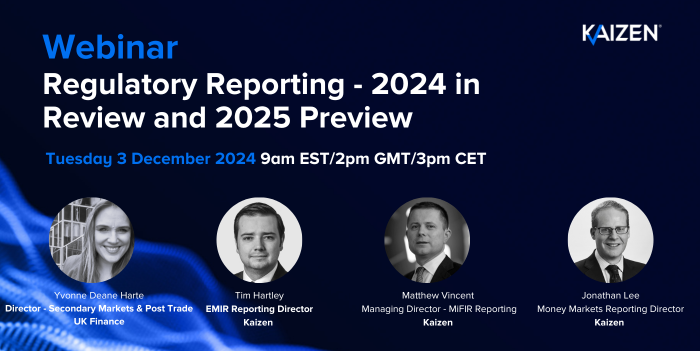
  • WATCH: Regulatory Reporting – 2024 in Review, 2025 Preview

    WATCH: Regulatory Reporting – 2024 in Review, 2025 Preview

    On MiFIR transaction reporting, there were significant changes announced by ESMA and a new discussion paper launched by the FCA, and new regimes are being introduced in the money markets space.

    Watch Kaizen’s regulatory experts as they reflect on 2024, and look ahead to what’s in store for regulatory reporting in 2025.

    The webinar was hosted by Yvonne Deane Harte, Director, Secondary Markets & Post-Trade at UK Finance and featured:

    Please note, we accept business emails only.

    For any queries relating to the upcoming regulatory changes or to speak to one of our subject matter experts, please contact us.

  • Kaizen and RegGenome Announce Strategic Partnership using AI to expand regulatory content on Single Rulebook

    Kaizen and RegGenome Announce Strategic Partnership using AI to expand regulatory content on Single Rulebook

    London, December 3, 2024 – Kaizen, a leading provider of regulatory compliance solutions for global financial institutions, announced today that it has entered into a strategic partnership with RegGenome, a UK based provider of global financial regulatory data, to use artificial intelligence (AI) to vastly expand the coverage and content of Kaizen’s Single Rulebook platform including new jurisdictions and regulatory domains.

    The collaboration between Kaizen and RegGenome will support the digitisation of regulation where both parties will work together to provide fast and efficient access to a vast array of global regulatory rules, jurisdictions and taxonomies on the Single Rulebook platform. By combining Single Rulebook’s front end user interface with RegGenome’s AI powered regulatory data and information structures, the firms will provide clients with a new standard of regulatory intelligence and change management.

    Many financial institutions operate across multiple locations and global regulatory jurisdictions. Today’s announcement means that firms will be able to navigate and respond quickly to the complex landscape of regulatory change and divergence more easily and efficiently.

    In early 2025, Single Rulebook clients will be able to access regulatory content covering all major global financial markets. This includes coverage of US federal regulators and agencies, European national law and global G20 members.

    In addition to core financial services regulations, Single Rulebook users will also be able to investigate emerging compliance requirements for cryptocurrency, cyber security and digital operational resilience.

    Mark Johnston, CEO, RegGenome commented: “We are delighted to announce our strategic partnership with Kaizen’s Single Rulebook. This collaboration will make RegGenome’s comprehensive structured regulatory data available through Single Rulebook’s innovative platform. By combining our extensive regulatory content with Single Rulebook’s advanced search and analytics capabilities, we’re enabling financial institutions to better navigate the complex regulatory landscape.”

    Chris Dingley, CEO, Single Rulebook said: “We’re excited to announce our partnership with RegGenome today. Working with RegGenome’s AI solution for regulatory data and information means that we will be able to expand the Single Rulebook platform and content rapidly for our clients, continuing and enhancing our efforts to support them with the burden of managing global regulation.”

    RegGenome processes global regulation using artificial intelligence (AI) to transform what is human-readable into machine-readable and machine-consumable data. It is part of the Regulatory Genome Project (RGP), a public-private initiative between the University of Cambridge, Judge Business School, and RegGenome. RGP aims to build and review a set of open-access regulatory information structures, known as the Cambridge Regulatory Genome (CRG), and make available a global repository of aggregated, structured regulatory data.  

    Single Rulebook is Kaizen’s digital solution for searching and navigating global regulation. The platform helps firms manage regulatory change with front end functionality such as rule maps, labels and annotations which can be pinned to regulatory rules and shared across global organisations.

    About RegGenome

    RegGenome is a regulatory data technology company and a leader in computational regulation, changing how the world produces and consumes regulatory information. We process the world’s regulation using AI to transform what is human-readable into machine-readable and machine-consumable data. 

    www.reg-genome.com

    For more information, please contact James Dunseath, Communications Director, on +44 (0) 7557 955795 or media@kaizenreporting.com

  • Kaizen wins Best Transaction Reporting Solution at the RegTech Insight Awards USA 2024

    Kaizen wins Best Transaction Reporting Solution at the RegTech Insight Awards USA 2024

    New York, London, 22 November 2024 – Leading regulatory technology firm, Kaizen, has won ‘Best Transaction Reporting Solution’ at the RegTech Insight Awards USA 2024 for its ReportShield™ Accuracy Testing service. This is the fourth year in a row that Kaizen has won a RegTech Insight USA award.

    Kaizen’s ReportShield™ Accuracy Testing is an automated, managed solution that tests the quality of trade and swap transaction data reported to the regulator. What makes the solution unique is the comprehensive deep testing of all records, which provides financial firms with full visibility of their reporting quality. Accuracy Testing is available via the Kaizen Hub, Kaizen’s easy to use web-based portal. It is the only assurance service that is tailored to all global reporting regimes including the CFTC and SEC swap data reporting rules as well as MAS, HKMA, ASIC, MiFIR, EMIR, and SFTR.

    Angela Wilbraham, CEO at A-Team Group and host of the 4th annual RegTech Insight Awards USA 2024, commented “Congratulations to Kaizen for winning the Best Transaction Reporting Solution award in this year’s A-Team Group RegTech Insight Awards USA 2024. These awards celebrate providers of leading RegTech solutions, services and consultancy and are uniquely designed to recognise both start-up and established providers who are creatively finding solutions to help with regulatory challenges and span a wide range of regulatory requirements. Our congratulations to Kaizen for their achievement in winning this award in a highly competitive contest.”

    Ian Rennie, Managing Director and Co-founder of Kaizen, commented: “I would like to thank everyone who selected Kaizen as the Best Transaction Reporting Solution at this year’s RegTech Insight USA Awards. As part of our recent £42 million minority investment, the US will be a key focus for us as we look to help firms with the challenges in adhering to the CTFC and SEC rules and other regulations. This year we have seen an unprecedented amount of change not only in the USA but globally and we are as committed as ever to providing the very best in solutions that help firms meet their regulatory requirements of accurate, complete and timely reporting.”

    The CFTC has been one of the most active of the global regulators over the past few years, fining six registered swap dealers US$60m in the past year, for reporting violations, making it clear that failure to comply with supplying accurate and complete data comes at a cost.

    (ends)

    For more information, please contact James Dunseath, Communications Advisor, on +44 (0) 7557 955795 or media@kaizenreporting.com

  • Kaizen’s Tim Hartley speaks to Risk on the deadline to backload EMIR derivatives reporting

    Kaizen’s Tim Hartley speaks to Risk on the deadline to backload EMIR derivatives reporting

    Kaizen’s EMIR Reporting Director, Tim Hartley spoke to Sam Wilkes at Risk about how firms are dealing with backloading their EU EMIR Refit derivatives reporting following the go-live on 29 April.

    “What we’ve seen from speaking to trade repositories and looking at our own data is that roughly 75-80% of derivatives that were open before Refit went live have been updated, which sounds positive, but to get the other 20% updated. That’s cutting it very fine to get those trades updated.”

    Read the full article at risk.net (subscription needed)


  • WATCH: Is your regulatory reporting valid but wrong?

    WATCH: Is your regulatory reporting valid but wrong?

    A large majority of the reports that Kaizen tests are ‘valid but wrong’. The valid but wrong scenario occurs when reports pass the validation rules by the regulator or intermediary entity (ARM, SDR or TR) but the data within the reports is inaccurate. 

    Watch our video above to find out more or contact us for a free healthcheck to find out how many of your reports are valid but wrong.


  • Tim Hartley speaks to FOW a week after the UK EMIR Refit implementation

    Tim Hartley speaks to FOW a week after the UK EMIR Refit implementation

    How did the first week of UK EMIR Refit go? How did it compare to the EU go live in April?

    Kaizen’s EMIR Reporting Director, Tim Hartley spoke to Luke Jeffs at FOW about how the go live is going and the challenges that firms now face with both sets of reporting rules.

    “The challenge is finding the things that are wrong. When a trade gets submitted, you’ve met the validation rules, which is great, so you’ve formatted in the right way but is the data right? Does it reflect your firm and your derivatives in the right way? That is a much harder question.”

    Read the article on FOW’s website.

  • Tim Hartley speaks to FOW on the UK EMIR Refit go-live

    Tim Hartley speaks to FOW on the UK EMIR Refit go-live

    Kaizen’s EMIR Reporting Director Tim Hartley spoke to Luke Jeffs at FOW about UK EMIR Refit go-live, what lessons have been learned from the EU Refit and what’s next.

    Tim told Luke that while some firms are fine-tuning their European reporting, many are also having to prepare for the UK version of the reporting rules that take effect on September 30

    “There should be economies of scale for firms that have been through mill with EU Refit in their preparations for UK Refit. The validation rules are very similar and the joint Q&A from the Bank of England and the Financial Conduct Authority (FCA) do not contain any show-stoppers. There are things to be taken into account but there shouldn’t be a heavy impact on EU firms impacted by UK EMIR,.”

    Read the article on FOW’s website. 

    Want to see how accurate your reporting data is? For a free heathcheck of your reporting please get in touch.

  • Watch our ‘Regulatory Reporting 2024’ conference highlights

    Watch our ‘Regulatory Reporting 2024’ conference highlights

    Watch the highlights of our annual regulatory reporting conference where we welcomed more than 200 clients, the FCA, trade organisations and industry specialists to Banking Hall, London for an afternoon of engaging talks, panels and audience discussions.

    Tom Soden, Markets Reporting Manager, FCA delivered the keynote speech on MiFIR Transaction Reporting data quality. 

    Panellists included Carmel Deenmamode, Market Conduct & Post Trade Policy Manager at the FCA, as well as representatives from the ISDA, FIA, Regis-TR, BMO,  HSBC, Deutsche Bank, ABRDN and our very own industry experts.  The panel discussions covered a wide range of issues facing the industry today including MiFIR, EMIR Refit go live, and upcoming ASIC and MAS ReWrites.

    A huge thank you to our speakers, clients and everyone who attended for making it such a fantastic afternoon! 

    • If you would like to learn more about how Kaizen can help you with your regulatory reporting, please get in touch.
  • Kaizen and LPA partner to provide transaction reporting assurance solutions

    Kaizen and LPA partner to provide transaction reporting assurance solutions

    London, Frankfurt am Main – 26 June 2024 – Leading regulatory technology firm, Kaizen and Lucht Probst Associates (LPA), the German capital market technology and advisory firm, have partnered to offer a range of compliance solutions to international clients.

    The new partnership will allow Kaizen and LPA to work with clients offering them independent transaction reporting assessments and regulatory reconciliations solutions.

    Kaizen’s ReportShield™ Accuracy Testing is an automated, managed solution that tests the quality of trade and transaction data reported to the regulator. What makes it unique is the comprehensive deep testing of all records, which provides financial firms with full visibility of their reporting quality. In addition to Accuracy Testing, Kaizen offers an Advanced Regulatory Reconciliation solution that provides an independent assessment of the completeness of a firm’s regulatory reporting to identify under and over-reporting.

    LPA offers a broad range of consulting services for banks, asset managers, and exchanges, with a strong focus on capital markets. Our expertise extends to the implementation of regulatory requirements in transaction reporting. Beyond the initial setup of transaction reporting regimes, we place a significant emphasis on data analysis, optimizing data quality, and enhancing the efficiency of reporting processes.

    Jean-Marie Mamodesen, Managing Director – Head of European Sales at Kaizen, commented: “LPA has a strong reputation in Germany and we are delighted to be working with them. By bringing the skillset and expertise of the two companies together we are able to provide solutions that ensure that the data which firms are reporting to the regulators is of the highest quality.”

    Hans Joachim Lefeld, Senior Partner – Head of Transaction Reporting from LPA said: “We are delighted to be working with Kaizen, who offer an array of market leading compliance solutions. By joining forces with Kaizen we extend our eco system and will be able to better serve our clients and help them navigate the complexity of the global regulatory reporting landscape.”

    (ends)

    About LPA

    Founded in 1999 by Stefan Lucht and Roland Probst, LPA was one of the first financial services providers to focus on technology solutions and consulting that optimize processes and guarantees regulatory compliance. LPA’s success is based on sound capital market expertise combined with ongoing technical innovations. Following the integration of Modelity, EffCom and AAAccell, the rapidly growing software and consulting company employs around 400 people at twelve international locations.

    www.l-p-a.com

    For more information, please contact James Dunseath, Communications Advisor, on +44 (0) 7557 955795 or media@kaizenreporting.com

  • Kaizen partners with Suite2Go to offer regulatory reporting quality assurance solutions in APAC

    Kaizen partners with Suite2Go to offer regulatory reporting quality assurance solutions in APAC

    London, Sydney, 5 June 2024 – Leading regulatory technology firm, Kaizen and Suite2Go, the Australian financial software consultancy have partnered to offer Kaizen’s ReportShield™ quality assurance solutions in APAC, as part of its continued expansion in the region.

    Kaizen’s ReportShield™ Accuracy Testing is already used by 18 firms in Australia, including some of the largest banks and asset managers. This means that 50% of ASIC’s systemically important banks use our assurance solutions.

    Accuracy Testing tests the quality of trade and transaction data reported to the regulator. What makes it unique is the comprehensive deep testing of all records, which provides financial firms with full visibility of their reporting quality. The solution is available via the Kaizen Hub, Kaizen’s easy to use web-based platform. It is the only assurance solution that is tailored to all global derivative reporting regimes including ASIC, MAS, HKMA, MiFIR transaction and post-trade reporting, EMIR, and SFTR.

    In addition to Accuracy Testing, Kaizen offers an Advanced Regulatory Reconciliation solution, which is an end-to-end solution that provides an independent assessment of the completeness of a firm’s regulatory reporting to identify incorrect interpretation or application of the regulations, enabling all under and over-reporting to be detected. The solution also identifies mismatches across all the reported data fields (e.g.  price, quantity, product difference etc).

    Dario Crispini, CEO of Kaizen, said, “This new partnership with Suite2Go is an important step in our plans to bring our ReportShield solutions to the wider APAC region. With the constant evolution in the global regulatory landscape, including the upcoming ASIC, MAS and HKMA ReWrites, firms face the challenge of being able to report their trade and transaction data in an accurate, complete and timely manner. Kaizen’s ReportShield™ solutions help firms deliver the quality of data that the regulators have come to expect, and by partnering with Suite2Go we look forward to supporting organisations in the APAC region.”

    Andrew King, Principal at Suite2Go, commented, “We are delighted to have the opportunity to work with Kaizen in the Asia Pacific region. The solutions they offer will be invaluable to the many firms that have reporting obligations in APAC and we look forward to helping develop their presence in the market.”

    (ends)

    For more information, please contact James Dunseath, Communications Advisor, on +44 (0) 7557 955795 or media@kaizenreporting.com

    About Suite2Go

    Based in Sydney, Australia, Suite2Go is a financial software consultancy team of experienced professionals with deep working knowledge of the financial services industry and how to best solve for workflow challenges through technology solutions. 

    We were founded in 2017 with a team of 8, comprising principals and consultants with an average of 20+ years experience who have expertise across; capital markets, data management, regulatory and risk reporting, superannuation, asset, and wealth management, including front and back office, asset servicing and payments. We look to assist world class fintech organisations to achieving success in their chosen target market by bringing solutions to the financial services industry to overcome challenges and address problems while saving cost and time for both buyers and sellers.

    Press Contact: Leanne Bradley, Co-CEO leanne@suite2go.com

  • Three top tips for implementing regulatory reporting rewrites

    Three top tips for implementing regulatory reporting rewrites

    Implementing regulatory change projects is never a straightforward journey and although the list of tasks may seem never ending, it can sometimes benefit a firm to pause and assess how their implementation is going. A key area of focus can be how the current project integrates new information. We have seen numerous examples of this in the past few months. In March, ASIC scoped in seven additional data elements from CP361. In May, MAS finalised its OTC derivatives reporting regulations which contained differences from its original consultation and more recently published its FAQ and Guidelines.  

    If this process is left unchecked, this can often derail project delivery and risk regulatory breach. 

    Here are our top three tips to thrive in this environment.

    1. Monitor ongoing changes

    Although regulators have provided the core requirements on rewrites, firms still need to remain attentive to any late changes. This can be achieved by connecting with industry working groups, trade associations and signing up for notifications at respective NCA websites. However, attending the meetings and analysing all of the variable outcomes from industry discussions can be time consuming. Committing adequate resources to this task will enable a firm to gather and evaluate new information prior to translating them into new requirements where necessary.

    1. A consistent approach

    Whenever new requirements do surface, firms are forced to decide whether to include or exclude for go live. Choosing to delay means firms go live with a reporting process that contravenes the rules. Conversely, adding new requirements midway can also jeopardise the final delivery. When any decision could lead to potentially undesirable outcomes, it’s the criteria rather than the decision that increases in importance. There can be many ways of doing this, ie. trading volumes, field materiality, IT effort, source system dependencies or anything else a firm feels appropriate. Whatever that may be, applying this framework consistently will help with prioritising work in line with a firm’s risk appetite within the context of regulatory reporting.

    1. Spotlight the issues

    Design a project status dashboard that provides transparency on how new requirements impact project deliverables. When issues do arise, make them stand out within the project status summaries so that project stakeholders automatically give their attention to the most pressing issues. This allows them to quickly identify situations that may require intervention or escalation to senior management. The key here is that the issues are effectively disseminated to the people that are empowered to make key decisions in relation to resourcing or even approving a risk accepted strategy.

    The bottom line is that firms have a clear go live date and there is always new information that needs to be evaluated. Firms that have a strategy to evaluate changes consistently will allow new issues to quickly come to light and remedied in time for go live. This can only increase their chances of success in achieving regulatory compliance at go live.  

    To find out more about how we can help you prepare for the upcoming UK EMIR Refit, MAS or ASIC ReWrites, please get in touch.

  • EMIR Refit implications for the SFTR Review

    EMIR Refit implications for the SFTR Review

    With the go live of EMIR Refit this week, ESMA’s attentions will surely turn next to what to do about SFTR. Next year, SFTR will be five years post-implementation and it will be time for the delayed SFTR Review to commence.

    Having studied the EMIR Refit, it’s apparent that quite a few of the changes were piloted by the SFTR introduction in 2020. Lessons learned by ESMA from the original EMIR regulation and implementation subsequently fed through to SFTR. And it seems likely that many of the developments rolled out in the EMIR Refit will find their way into the SFTR Review.

    Opposite directions

    As a bit of an EMIR outsider, it’s somewhat alarming the extent to which EU regulation and the industry dynamic are moving in opposite directions. The industry is focused on adopting standards, the Regulatory Oversight Committee’s (ROC) common data elements, common booking models, common domain models (CDM), simplification and far greater automation through machine reading and blockchain. CDMs focus on non-proprietary, non-licensed fundamental transaction, position and lifecycle data, an approach that is about achieving fully matched, perfectly replicable trade data with relatively few fields and no complications. CDMs should in theory dramatically reduce the number of manual touchpoints on any trade, significantly reducing operational costs.

    However EU regulators are looking for more data, extensive embellishment and enrichment, to not only achieve a truly forensic analysis of a firm’s balance sheet, processes and operations, but also to negate the need for them to hold any reference or static data at all. Indeed, thinking that 155 fields for SFTR was a lot, we now face up to 203 fields under EMIR Refit (a 65% increase on the original). There are ‘just’ 110 common data elements listed by the ROC…

    Which EMIR Refit elements are likely to be incorporated into the SFTR Review?

    • Bilateral variation margin reporting. Back in 2016 at the Paris hearings on SFTR technical standards, I suggested that there be a separate table to report bilateral variation margins for repo transactions, as ESMA insisted that Table 3, the Margin Table, was exclusively for CCP margins. This motion wasn’t carried and consequently, it is evident that SFTR bilateral variation margin reporting is currently flawed and frequently underreported. The approach required under SFTR v1 of providing trade level collateral updates with UTIs and bilateral variation margin collateral updates without UTIs does not appear to ever have been fully understood. Therefore, the EMIR Refit change that incorporates both CCP margins together with bilateral variation margining in the same margin table would be a welcome step forward, removing confusion and enhancing regulatory certainty.
    • Executing Agent field. The introduction of an executing agent field (as per EMIR Refit) would also significantly enhance the trade repository reconciliation process, particularly when reporting or facing funds as one of the counterparties. This should mitigate current misreporting, where the agent lender or broker fields are often misused to represent fund managers.
    • Intra-group trade identifier. Another party to the transaction field that may carry from EMIR is an Intra-group trade identifier. This omission was something highlighted in the recent ESMA Market Report on EU Securities Financing Transactions Markets 2024. While not strictly necessary (intra-group entities can be identified by their LEI), it would further reduce the burden on regulators to establish this relationship themselves. 
    • Waterfall guidance on UTI. EMIR Refit was written post-Brexit and consequently, they have taken account of the fact that many transactions in Europe today are single sided, being cross-jurisdictional. Therefore, there is a new waterfall providing guidance about responsibility to generate and share unique transaction identifiers (UTIs) when trading across borders. This measure should reduce late reporting (where there is uncertainty about UTI generation and sharing and consequently late reporting) and again provide clearer direction and certainty for reporting counterparties.   
    • Effective dates are another EMIR Refit feature that are likely to benefit SFTR.  At present the need to delay reports until agreed contractual modifications take effect certainly presents a timing challenge to complete and accurate reporting. The revive action type (allowing the reopening of matured or terminated/cancelled by mistake trades) may also be broadly welcomed, aiding in dealing with trades failing over their maturity date/end date for example.
    • Additional EMIR Refit changes that are likely to be mooted include event types complementing certain action types, package identifiers (useful for identifying products such as collateral swaps) and the requirement to report the nature and corporate sector of the other counterparty in addition to the reporting counterparty.

    There is no better way to prepare for SFTR 2 than to get your house in order for SFTR 1. For help addressing your SFTR data quality concerns, please get in touch.

  • Tim Hartley speaks to FOW on EU EMIR Refit go-live

    Tim Hartley speaks to FOW on EU EMIR Refit go-live

    Kaizen’s EMIR Reporting Director Tim Hartley spoke to Luke Jeffs at FOW about EMIR Refit go-live, what firms have been doing to get over the line and what’s next.

    Tim told Luke that regulators’ tolerance for inaccurate reporting would be low because of the significant length of time firms have had to prepare. 

    “Because the implementation period has been 18 months rather than the usual 12 and we’ve seen guidance documents from the regulators, the grace period for implementing the changes correctly will be very small so firms should not expect a grace period around getting the data right,” said Tim. 

    Read the article on FOW’s website. 

    Want to see how accurate your reporting data is? For a free heathcheck of your reporting please get in touch.


  • Tim Hartley speaks to Thomson Reuters on EMIR Refit go-live

    Tim Hartley speaks to Thomson Reuters on EMIR Refit go-live

    Kaizen’s EMIR Reporting Director Tim Hartley spoke to Rachel Wolcott at Thomson Reuters Regulatory Intelligence about EMIR Refit EU go-live and the challenges firms with dual reporting face.

    “Many firms will have an obligation in both the EU and the UK. This introduces new challenges for them in that they’ve probably got one reporting system, but it now needs to be separated. One will go live for the new format on the 29th of April, and the other catches up to that new format on the 30th of September. Having two dates is quite tough from a technical point of view,” said Tim. 

    Read the article. 


  • ESMA Data Quality Report 2023: What does it say about EMIR?

    ESMA Data Quality Report 2023: What does it say about EMIR?

    As well as seeing the much discussed EMIR Refit, 2024 also marks 10 years of EMIR reporting. That’s 10 years of submissions, rejections, errors, omissions, reconciliations, assurance checks, process improvements, revised rules, webinars, seminars, conferences etc. 

    As a general trend, Kaizen has seen (and helped facilitate) the improvement of reporting data quality, via assurance controls, improving industry understanding, checks and balances implemented, explanatory guidance and improvements to the validation rules. Yet this year’s 2023 Report on the Quality and Use of Data (DQR) focuses on the most basic of data quality concepts that firms should easily adhere to by now, accompanied with equally lacklustre expectations for meeting those reporting requirements. Whilst Kaizen are supportive of the DQR findings, we feel ESMA could have gone further.

    Data quality indicators 

    Many EMIR reporting firms will find this year’s DQR useful, as ESMA includes a reasonable range of data quality issues under scrutiny such as large notional amounts, incorrect maturity dates, mismatch of trades and positions between counterparties, and even late or missing valuations. Helpfully ESMA has also included a description of its implemented 19 Data Quality Indicators (DQIs) in Appendix 6.1.1, although reporting counterparties would greatly benefit from a little more granularity to quantify the empirical checks used, but for now, this is a good start.

    The DQR provides useful descriptions and examples of how EMIR reporting is used in practice by national competent authorities (NCAs) as shown in Section 3. ESMA describes how the data influences a wide range of policy decisions, interestingly many of which differ from its original intended use of monitoring risk and derivative exposure. Critics that still question the benefits of EMIR reporting may take comfort in the non-exhaustive list of documents in Appendix 6.3 which show ways in which the derivative data is used.

    Reconciliation issues

    Firms should however not take comfort in the differing volume of outstanding transactions between counterparties. This notion of the number of open transactions between the two counterparties to the trade, is very basic, and after 10 years, firms should be getting this right. Reporting firms should have suitable reconciliations in place to monitor and remediate both the execution of derivatives vs those reported and to monitor the Inter-TR reconciliation reports, which highlights such discrepancies. The same can be said for position level submissions reported differences between counterparties. The submission of derivatives and agreement of how many trades or positions are to be reported is arguably the most basic part at the very origin of a firm’s reporting journey. Market participants, reporting vendors and ESMA (with regulatory oversight) should expect more, namely that firms are far more able to report matched reports to a trade repository.

    Valuations and collateral

    Valuations and collateral continue to be a data quality theme, as seen in all previous DQR iterations. ESMA notes a positive reduction in late and missing valuations, but again, such an improvement on a very basic aspect of EMIR reporting should not be applauded, but expected to be held at a higher standard to ensure the completeness, accuracy and usability of reported data. ESMA and NCAs should be asking why, after 10 years, can the simple notion of “daily valuation updates” not be easily achieved?  In previous years, ESMA used a 15-day calculation as an indication of late valuations in order to judge the change in data quality, rather than calculate using true daily updates required, and it would be useful to have a little more calculation transparency here too.

    Maturity dates

    ESMA comments on the issue of abnormal maturity dates, which admittedly is a little more advanced than some of the other data quality issues described. For maturity dates, the findings are not quite so favourable, as the abnormal maturities are not falling at a rapid rate, indicating data quality is not correspondingly rising for this statistic. ESMA does however miss a useful opportunity to mention EMIR reporting’s confusing notion of ‘optional fields’, of which ‘maturity date’ is one such example. Optional fields do not mean the reporter has a choice to complete that field, but that the field should be populated where relevant to the derivative executed. Optional fields are often (incorrectly) chosen not to be reported, and cause confusion over the true requirements of an already complicated reporting regime. Notably, ESMA also apportions blame for the notional values differences and number of trades outstanding between clearing members and CCPs on to this maturity date field on page 17.

    Great expectations

    The DQR describes overall NCA activity and targets of data quality discrepancies over the last 12 months. Unfortunately, expected standards are not necessarily shown to be any more rigorous.  For example, ESMA explains that when NCAs addressed with firms, only 34 of 163 identified issues were resolved. Then, to add insult to injury, of 116 issues not resolved, ESMA describes ‘substantial improvement’ in 15% of issues. Both statistics seem pretty mediocre, notably when, these are issues being actively chased by the regulators.

    Such statistics erode confidence and motivation of market participants to pursue a high standard of data quality. However with the introduction of the EMIR Refit, firms can expect this to change and will see a much higher level of scrutiny for their EMIR reporting going forward.  

    Over and under reporting

    And finally, another reoccurring theme is the issue of over and under reporting when trade repositories relay reported data to ESMA. Whilst ESMA acknowledges this is a key issue, such occurrences must be stamped out. Market participants spend a huge amount of time, money and other resources to report these required derivatives, and as a minimum should have confidence that the reports will be routed correctly, according to agreed reporting mandates.

    What’s next?

    Overall, the detail included in the latest DQR is most welcome, and shows whilst there are some data quality improvements, such improvements have only been seen on the most basic of reporting requirements. As we head into year 11 of EMIR reporting and get to grips with the wholesale change under EMIR Refit, market participants should expect a high level of data quality scrutiny to be analysed, commented on and enforced by those with regulatory oversight.

    • Read our analysis of the MiFIR aspect of the report from Matthew Vincent or the SFTR angle from Jonathan Lee.
    • EU EMIR Refit is now live.  But is your reporting accurate? For an independent, forensic review of your firm’s new EMIR reporting, please get in touch.
  • EU EMIR Refit – one month to go!

    EU EMIR Refit – one month to go!

    With just over one month to go until EU EMIR Refit, it will be all hands on deck for regulatory reporting teams to ensure a smooth go live.

    What are some of the last-minute things that firms should be considering? Here’s our top three:

    1. XML Files

    Make sure that you have the ability to read and review XML files or convert XML into something you can read because it’s not just submissions impacted, the results files will also be in XML. 

    2. Trade State Report

    From 29 April, under EU EMIR, the trades successfully submitted on T or T+1 will be shown on the T+2 ‘trade state report’, rather than being reported on the next day’s trade state report, as seen under current EMIR reporting. 

    This differs from how the trade state report will be generated under UK EMIR Refit, which will not alter from today’s process.

    3. Timing – 26/29 April

    Many of the trade repositories are planning to close their doors over the weekend of 27/28 April to update all systems to only accept new trades via the new reporting format.

    Why does this matter? Many cleared trades executed on Friday, get reported on the Saturday. But on this occasion, the trades will need to be reported on Monday when the TR re-opens, and can only be reported in the new EMIR format. 

    How we can help 

    Here at Kaizen, our award-winning assurance solutions are ready to support firms to assess their reporting quality. Firms are already utilising our on demand Accuracy Testing in the lead up to go live, to check the quality of the data that will be submitted from Monday 29 April. 

    After go live, regulators will expect accurate, complete and timely data to be reported by firms. Our ReportShield™ assurance includes Accuracy Testing which provides comprehensive, independent checking of all 203 data fields in the new regime, as well as Advanced Regulatory Reconciliations to check for completeness.  We can also help with a review of your control framework too. 

    We wish everyone preparing for EMIR Refit all the best for the next month! 

    • For a conversation with Tim or one of our regulatory specialists about any aspect of EMIR Refit, or for an independent assessment of the quality of your reporting under the new requirements, please contact us. 
  • What does daylight saving mean for regulatory reporting?

    What does daylight saving mean for regulatory reporting?

    On 31 March, in the early hours of the morning, clocks across the UK and the majority of mainland Europe will go forward an hour. Since Europe spans several time zones, the switch will occur at different local times. 

    Whilst you may need to adjust the clocks at home or spend another six months with different times on the microwave and oven, please remember that the time fields for UK & EU MiFIR trade and transaction reporting and UK & EU EMIR trade reporting should continue to be populated in Coordinated Universal Time (UTC).

    Trade time is of significant importance to regulators. As we have highlighted before, UK and EU NCAs are unlikely to be sympathetic if you make errors following these time transitions.  The UK’s FCA has warned firms of such mistakes for many years:

    “The time when the transaction was executed should be reported in Coordinated Universal Time (UTC). We continue to see errors in transaction reports when UK clocks transition to and from British Summer Time, as well as errors driven by inaccurate clock synchronisation. Firms should have arrangements in place to ensure consistent and accurate reporting of trading date and time.”  Market Watch 59.

    The CSSF in Luxembourg has also commented as to the importance of this field:

    “In the context of data quality tests performed on transaction reports, the CSSF identified that in several transaction reports the time indicated in field 28 “Trading date time” was the local time instead of UTC. Investment Firms have been informed that, within the framework of the transaction reporting obligation, dates and times shall always be reported in UTC.”

    • For more details or a discussion with one of our regulatory experts, please contact us. 
  • Tim Hartley speaks to FOW: ‘no honeymoon period for EMIR Refit’

    Tim Hartley speaks to FOW: ‘no honeymoon period for EMIR Refit’

    Kaizen’s EMIR Reporting Director Tim Hartley told the Eurex conference in Frankfurt on Thursday that regulators will be very focused on data quality post EMIR Refit go live.  

    Tim was speaking as part of a panel of experts that discussed the EMIR Refit reporting requirements that take effect across EU member states on April 29.

    “There will be no honeymoon period with EMIR Refit and some of the other G20 reporting regulations that are changing this year as well. Firms have had at least two years notice for EMIR Refit and, while it is tough, I think there will be no honeymoon period,” Tim said. 

    Read the article in full on FOW’s website. 

  • WATCH: Ten years of EMIR Reporting

    WATCH: Ten years of EMIR Reporting

    EMIR Reporting went live on 12 February 2014.

    To mark its 10 year anniversary, we asked our EMIR Reporting Director Tim Hartley a few questions:

    • Looking back has EMIR Reporting achieved what it set out to do?
    • Have we seen the improvements in data quality that the regulators were expecting?
    • Will the introduction of EMIR Refit help address some of the challenges firms are facing?  Will Refit provide the regulators with the level of data quality that they expect?

    Kaizen is offering firms pre go live testing for EMIR Refit.  Please contact us to register your interest. 


  • Tim Hartley speaks to FOW on EMIR Refit preparations

    Tim Hartley speaks to FOW on EMIR Refit preparations

    Kaizen’s EMIR Reporting Director Tim Hartley spoke to Luke Jeffs at FOW about where firms should be with their EMIR Refit preparations now that the EU go-live is fast-approaching.

    “As we move towards the development date, firms still have a lot to do and they are now at the point where they are looking at the low level details, so the four or five things that they still have to do before the April deadline.”

    Read more

  • Regulatory Reporting – 2024

    Regulatory Reporting – 2024

    Watch our webinar replay to find out what you need to do to stay on top of 2024’s unprecedented regulatory change.

    • Proposed changes to MiFIR Transaction and Post-Trade Transparency Reporting
    • EMIR Refit go live in the EU and UK
    • APAC derivative reporting rewrites and global harmonisation of reporting rules
    • MMSR expansion and new rules on securities lending and uncleared bilateral repo in the US
    • Proposed changes to CFTC Part 43 and 45 reporting.

    Speakers

    Hosted by Kaizen’s Co-Founder and Managing Director Ian Rennie, the webinar features: 

    For any queries relating to the webinar or to speak to one of our subject matter experts, please contact us.

  • Kaizen’s CEO Dario Crispini speaks to FinTech Global

    Kaizen’s CEO Dario Crispini speaks to FinTech Global

    Following Kaizen’s inclusion in the 2024 RegTech100 listing, our CEO Dario Crispini spoke to FinTech Global about the key challenges facing the industry today, including staying connected in a post-Covid world and how the Kaizen Community is bringing compliance professionals together by combining technology and regulatory expertise with in-person networking opportunities.
     

    “We’re trying to have more touch points across our client base and use our position in the industry to bring clients together so they can share their war stories and their pain points… There is an appetite to get back together and to start chatting and networking with peers. We are facilitating that.”

    Read more

  • Kaizen selected as RegTech100 Company

    Kaizen selected as RegTech100 Company

    London, 6 December 2023 – Leading regulatory technology firm, Kaizen today announced that it has been selected for the RegTech 100 listing, an exclusive directory of the world’s leading RegTech companies, for the fourth time. The RegTech100 companies are chosen by a panel of analysts and industry experts as the world’s most innovative and disruptive businesses in the regulatory technology space that are seeking to help financial institutions manage the fast-paced changes brought on by ongoing regulatory updates and technological advances.

    Chosen from a longlist of over 1,400 companies worldwide, Kaizen was selected for its RegTech solutions which provide a network of services for the compliance and reporting community on one platform.

    Dario Crispini, CEO of Kaizen, said,

    “We are very proud to have been selected as a RegTech100 company for the fourth time and to be recognised for the range of solutions we now offer our clients. Our aim is to make working with regulation easy and cost effective and ensure clients stay on top of their compliance obligations through the introduction of new technologies and product innovation.”

    RegTech Analyst director of research Mariyan Dimitrov said, “With the tougher economic climate and the continued rise of AI, financial institutions are re-examining the compliance software’s true cost, namely whether a given RegTech solution truly will free up compliance staff for higher-level tasks and whether the software can scale, adapt, and get implemented efficiently. This year’s RegTech100 list highlights the leading companies in areas such as information security, compliance, risk management and fraud prevention working on the forefront of innovation and new AI implementations who have demonstrated a strong track record delivering regulatory and operational improvements in financial services.”

    Since last being listed as a RegTech 100 company, Kaizen has expanded its product offering. Our ReportShield™ suite of regulatory reporting assurance services, which includes Kaizen’s award-winning Accuracy Testing, is now complemented by solutions for monitoring and reporting of Shareholding Disclosures, Trade and Communications Surveillance, Research Management, and Single Rulebook, a digital platform for managing regulatory rules.

    (ends)

    • For more information, please contact James Dunseath, Communications Advisor, on +44 (0) 7557 955795 or media@kaizenreporting.com.
  • Join us for the EMIR Refit Rundown with LSEG Regulatory Reporting

    Join us for the EMIR Refit Rundown with LSEG Regulatory Reporting

    As we approach the end of the year, join LSEG – Regulatory Reporting and Kaizen’s Tim Hartley for a fast-paced and practical “check-in point” on the transition to EMIR Refit, specifically on where you should be on the journey, how to tackle key challenges and how your firm’s preparations align with your peers.

    This is the third of a three-part series on preparing for EMIR Refit.  

    Date: 30 November 2023

    Time: 10-10.30 GMT

    Location: Virtual


    Book here

  • ISDA Regulatory Reporting Conference

    ISDA Regulatory Reporting Conference

    Our EMIR Reporting Director, Tim Hartley will speak on EMIR Refit as part of panel at the ISDA Regulatory Reporting Conference on Wednesday 29 November.

    With the major financial jurisdictions implementing significant changes to their regulatory reporting rules with the intention of delivering greater harmonisation between jurisdictions and more standardisation in how trade data is reported, the virtual event will help ISDA members to identify and prepare for these major updates to reporting requirements.

    Tim and his co-panellists will discuss what firms should be doing in the lead up to the EU EMIR Refit go-live on 29 April 2024.

    The conference will also cover the Unique Product Identifier and digital regulatory reporting. 

    For the full agenda and to register, please click the button below.  

    Register

  • The RegTech Convention 2023

    The RegTech Convention 2023

    How effectively have regulation and technology combined to help forge a more secure and stable world? Find out at Regnology’s RegTech Convention 2023 taking place virtually on 21 – 22 November. 

    With the theme “The Balancing Act of Reg and Tech”, the event will discuss if regulation has become too complex and too costly to be effective, and look at the consequences of digital transformation.

    On the second day, the conference will split into five different streams with industry experts deep diving into different topics. Kaizen’s EMIR Reporting Director Tim Hartley will share his insights on the ‘Adapting to the ever-increasing focus on data quality, reporting completeness and accuracy’ panel.

    Find out more

  • Tim Hartley speaks to Thomson Reuters on EMIR Refit

    Tim Hartley speaks to Thomson Reuters on EMIR Refit

    Originally published by Thomson Reuters.

    EMIR reforms: New EU reporting rules and proposed changes to CCP clearing

    The 2008 financial crisis showed the desirability of intermediary central counterparties (CCPs) covering default and other derivative trade risks and collating details about all deals so regulators can spot potential market risks.

    The 2012 European Market Infrastructure Regulation (EMIR) introduced the requisite rules. Its reporting requirements change substantially in 2024, and proposals for more fundamental reform, EMIR 3, have advanced.

    EMIR applies to any EU-based entity that is a counterparty to a derivatives contract. It divides counterparties into financial counterparties (FCs), which are financial institutions, and non-financial counterparties (NFCs).

    NFCs whose total positions in over-the-counter (OTC) derivatives exceed a qualifying threshold are essentially under the same, more onerous requirements as FCs.

    EMIR contains a clearing obligation and a reporting obligation. The former obliges FCs and qualifying NFCs that are party to OTC derivatives contracts of a type designated by the European Securities and Markets Authority (ESMA) to use a CCP.

    There are exemptions for certain intragroup transactions. The reporting obligation requires details of all derivative deals to be reported to a trade repository. These act as registries and provide collated information to relevant financial regulators.

    EMIR refit

    EMIR underwent a refit with regulation (EU) 2019/834. ESMA was mandated to draft new implementing technical standards (ITS) and regulatory technical standards (RTS) on the reporting obligation. These are the source of major changes that apply in the EU from April 29, 2024. Similar UK reforms apply from Sept. 30, 2024.

    The reporting changes are designed to better align EMIR reporting with guidance on critical data elements set by the Committee on Payments and Market Infrastructures (CPMI) and the International Organisation of Securities Commissions (IOSCO).

    The International Regulatory Oversight Committee (ROC) has overseen this harmonisation work since 2020.

    The core change is a requirement for EMIR reports to use the ISO 20022 messaging standard XML methodology, already introduced for other reporting, including under the Securities Financing Transactions Regulation (SFTR).

    The EMIR refit also introduces unique product identifiers (UPIs), and its overall aim is to improve data quality and compatibility. More details can be found here.

    “By aligning reporting with the ROC’s critical data elements guidance, the EMIR Refit should produce more efficiency and efficacy by improving data quality, which has been lacking since EMIR reporting began,” said Tim Hartley, EMIR reporting director at Kaizen.

    “A major benefit is that the Refit comes with more regulatory guidance than the current regime, including guidelines issued by ESMA last December that nicely back up the RTS and ITS by justifying and explaining many of their requirements.”

    The ESMA guidelines span 329 pages and give firms copious information about their obligations, reducing the scope for disparate interpretations. Firms are dependent on ESMA Q&A documents, which many have found inadequate.

    Burden for firms

    Standardised reporting should prove a boon for firms, but moving to the new regime will not be easy. The number of reporting fields rises from 129 to 203, but this is not a straightforward increase. More fields must be reconcilable; some old fields are withdrawn, and many others are amended. Firms must also migrate live deals concluded under the old rules to the new format.

    “There’s no avoiding the fact that the EMIR Refit will involve a lot of work,” Hartley said.

    “Pre-existing live trades must be converted to the new format within six months, and the number of reconcilable fields rises from approximately 56 to 149 over time. But it is a good opportunity for firms, as they have better guidance and will be able to see whether the risk profile they’re giving regulators is fit for purpose.”

    The main UK EMIR refit rules are in joint Bank of England- Financial Conduct Authority (FCA) policy statement PS23/2. The regulators said they tried to align with EU requirements as far as possible, but the UK will have 204 reportable fields, not 203, and the new rules take effect five months later.

    “Except for their implementation dates, the EU and UK Refits are generally structured in the same way, with only minor differences, but we may see them diverge more with time,” Hartley said.

    “Unlike ESMA, the FCA is covering tolerance levels in non-legally binding guidance, which it can change easily. Furthermore, the FCA will be issuing Refit Q&As periodically until around June 2024, and there’s potential for more divergence during that process.”

    EMIR 3, proposed by the European Commission last December, would make major changes to EMIR’s clearing obligation. Its stated purpose is to reduce EU exposures to third country CCPs, meaning ones in the UK.

    Bank for International Settlements figures show London still dominating global OTC FX and interest-rate derivative (IRD) clearing in 2022. The previous year, UK CCPs handled 94% of euro-denominated IRDs.

    The EU sees this as a threat to its financial stability and autonomy and wants EU CCPs to replace UK ones, which have access to EU markets under a temporary equivalence determination.

    Brussels hoped to end that determination in June 2022, but the deadline was extended to 2025, due to the lack of any adequate EU CCP. Meanwhile, a working group that included the European Central Bank (ECB) examined ways to end that weakness.

    Controversial ‘active account’ requirement

    EMIR 3 aims to encourage EU CCPs’ development by easing some regulatory requirements and boosting their market share with an “active account” requirement under new article 7a. This would require FCs and NFCs subject to the clearing obligation to clear an as yet unspecified proportion of deals through an EU CCP.

    “There has been concern in the EU over the very high proportion of euro-denominated transactions cleared through London, especially by LCH,” said Kirsty McAllister-Jones, an expertise counsel at the law firm Ashurst’s global markets practice.

    “The ECB says the proposed ‘active account’ requirement is necessary to improve financial stability, but it is only one of two arms of EMIR 3 aimed at reducing third country clearing,” McAllister-Jones said.

    “The other is the introduction of measures that would make it easier for EU CCPs to expand their offering, including streamlining and clarifying the application process and related documentation requirements.”

    The active account proposal has been controversial, especially as many firms want to keep a free choice of clearing venue.

    The ECB’s official opinion on EMIR 3 endorsed it, subject to active accounts having an appropriate phasing-in period. Politicians were lobbied about the obligation, but the EU Parliament approved the proposal in its June report on EMIR 3 whilst recommending amendments.

    “What the active account requirement will ultimately look like is very much up in the air,” McAllister-Jones said.

    “The European Parliament has suggested softening the Commission’s proposals with a two-stage introduction, the second ‘quantitative’ stage only applying if an initial ‘qualitative’ one does not increase EU clearing. There is widespread concern about the requirement among market participants, who would like it to be as soft and unobtrusive as possible.”

    The active account requirement is not the only controversial measure in EMIR 3. It contains several proposals intended to tidy existing rules, but they include scrapping the reporting exemption for intragroup transactions involving an NFC or third country equivalent.

    “Some proposals are helpful, such as the suggestion that only transactions that are not cleared by an appropriate CCP should count towards the clearing threshold and giving NFCs that become subject to the margin requirements for the first time a four-month grace period to complete the necessary arrangements,” McAllister-Jones said.

    “Others are less helpful, like removing the reporting exemption for intragroup transactions involving an NFC. The parliament picked up
    on this and asked the Commission for an impact report and cost-benefit analysis of this proposal.”

    (Tim Hitchcock, Regulatory Intelligence)

  • Kaizen to speak at REGIS-TR’s Annual Client Event 2023

    Kaizen to speak at REGIS-TR’s Annual Client Event 2023

    We are looking forward to taking part in our partner REGIS-TR’s Annual Client Event on 26 October in London.

    Kaizen’s EMIR Reporting Director Tim Hartley will speak on one of our favourite topics, regulatory reporting data quality, alongside Will Parry, Senior Data, Financial Market Infrastructure Directorate, Bank of England and Laura Rodríguez Molina, Institutional Relationship Manager, REGIS-TR.

    Click the button below to visit REGIS-TR’s website.

    Find out more 

  • January 2024 – UPI and CFTC ReWrite Phase 2

    January 2024 – UPI and CFTC ReWrite Phase 2

    The bad news

    January 2024 kickstarts a truly tumultuous year for transaction reporting. January 29 more precisely sees the implementation of the CFTC ReWrite Phase 2 which means the adoption of UPI (Unique Product Identifier). After many years in the making the UPI might be having its debutants ball in the USA but that really just gets the ReWrite/Refit party circuit started.

    At the time of writing, the calendar for 2024 also entails implementation go-lives for:

    Jurisdiction  Regulator Status Description Date
    Japan JFSA Confirmed ReWrite 1 April 2024
    EU ESMA Confirmed EMIR Refit 29 April 2024
    UK FCA Confirmed EMIR Refit  30 September 2024
    Australia ASIC Confirmed ReWrite 21 October 2024
    Singapore MAS Expected ReWrite “October 2024”
    Canada CSA Expected ReWrite Q1 2025
    Hong Kong HKMA Expected ReWrite  Q3 2025


    The (somewhat) good news

    Back in 2015 I wrote an article describing transaction reporting as “the gift that keeps giving”. With eight major implementations planned for next year that’s as true today as it was back then. The 2024/5 reporting ReWrites’ schedule is without a shadow of a doubt the toughest we’ve seen since the inception of OTC derivative transaction reporting. But it’s not all bad news. Challenging as this will be there is some good news. The purpose driving all these implementations is harmonisation and they, for the most part, share a lot in common including the adoption of:

    • UPI to provide a consistent product taxonomy for reporting derivative products
    • CDE (Critical Data Elements) to globally agree the fields, the values and the definitions
    • ISO 20022 XML messaging standards for submitting to trade repositories
    • Global UTI standards to enforce common transaction identifiers across the various reporting regimes.

    Therefore the difficulties of managing multiple implementations across various reporting regulations is somewhat offset by the fact the reporting requirements are becoming more standardised and many of the data elements are converging on common globally agreed definitions. Reporting solutions, data dictionaries, analysis and reporting flows in theory become a bit simpler to manage. In theory at least.

    What does UPI mean for reporting?

    Anyone hoping that reporting with UPIs means simply replacing the current product identifier taxonomies with a new shiny UPI and sitting down with a nice cup of tea is going to be sorely disappointed.

    Reporting firms need to map all their current product attributes and then use these attributes to source a UPI from ANNA-DSB for each product. They’ll need to do this for all the product types they currently trade and any open positions previously reported to a trade repository (TR) or swap data repository (SDR).

    Some firms may opt to integrate the UPI data in their reporting solution only. Whereas others may integrate it further upstream in their trading, confirmation and associated systems as well. Either way, care will need to be taken to ensure the correct products are mapped to the correct UPIs. Unlike the current simple taxonomies such as FX Forward, the UPI is comparatively opaque and as such it won’t be easy for a human to see if the wrong UPI is on the trade without first looking up the reference data behind that UPI.

    Finally, firms will need to take a lot of care to ensure the other fields being reported on any given transaction are consistent with the UPI’s product characteristics. For example, if your UPI relates to a GBP/USD FX Forward then you need to ensure Notional Currency Leg 1&2 also contain GBP & USD.

    What does 29 January 2024 look like for CFTC & UPI?

    CFTC Rewrite Phase 2 contains two items of good news:

    1. The CFTC descoped UPI for commodity asset class. So UPI is being implemented for credit, equity, FX and interest rates but not commodity
    2. The CFTC also descoped ISO 20022 messaging because they wanted to wait until UPI is also ready for commodities.

    Some may argue it’s only postponing the pain as the above postponements will result in a Phase 3, likely in 2025, but for the time being given the evident confusion around UPI, this is probably best for most firms reporting to the CFTC.

    Once firms have designed and implemented a functioning UPI process, they will have the joy/pain of ensuring that UPI info is accurately incorporated into regulatory reporting processes given that:

    1. UPI will be required on all* Part 43/PPD submissions to the SDR
    2. UPI will be required on all* Part 45 trade submissions to the SDR
    3. UPI will be required on all Part 45 valuation submissions to the SDR.

    *Terminations and Erroring out (Action Types TERM & EROR) will not require UPI for either Part 43 PPD or Part 45 trade submissions. This is to accommodate removing previous submissions that may have been reported prior to UPI being applicable.

    Looking at the message specifications for one leading SDR, a handful of previously submittable fields have been deprecated. For example, Underlier ID is no longer required as this information is now embedded within the UPI.

    A new paradigm

    More interestingly there are fields which will be reported to the CFTC based on data that is derived from the UPI but are not submitted by the reporting firm, such as UPI Status, UPI Instrument Type and UPI Delivery Type. This is essentially a new paradigm for transaction reporting where a range of fields will be sourced from an external data provider (ANNA-DSB) and reported to the regulators despite not being submitted into the SDR by the reporting firm.

    This will also impact firms’ control frameworks as they need to ensure that the various product attributes within their systems are aligned to the correct UPI which they’ll submit to the SDR. They’ll also need to consider reconciling fields the SDR derived from the UPI to their source systems despite not having actually submitted these fields.

    Conclusion

    The CFTC may be the first off the mark with UPI in January next year but there are several other implementations coming, not least for both the EU & UK versions of EMIR. With only four months to go there is a worrying amount of confusion around UPI. Hopefully the UAT process will help to iron out the kinks and figure out the edge cases. Whether UPI achieves the regulatory aims of standardisation and interoperability, time will tell. Meantime 2024 is looking like a doozy for many reporting firms, ourselves at Kaizen included.

    • To understand the fundamentals of UPI, read Alan’s recent guide, UPI Explained
    • Still scratching your head over UPI?  For a conversation with Alan or one of our regulatory specialists, please get in touch. 
  • Join us at FIA Forum 2023 in Frankfurt

    Join us at FIA Forum 2023 in Frankfurt

    We’re delighted to be taking part in the FIA Forum: Frankfurt 2023 on 12 October 2023.  The event will address key issues impacting listed and cleared derivatives markets and participants in the region.

    Our EMIR Reporting Director, Tim Hartley will be joining the Regulatory Compliance: Data Quality and the Drive to Improve It panel.  The panel will discuss how firms are prepared for 2024, their primary concerns and dependencies and the challenges that lie ahead.

    We hope to see you there.

    Book here

  • How to navigate UK and EU EMIR Refit reporting changes

    How to navigate UK and EU EMIR Refit reporting changes

    EMIR Refit introduces wholesale change at a granular level for EMIR reporting. Firms must be compliant with the new standards from 29 April 2024 in the EU and 30 September 2024 in the UK. Each of these implementations is a large lift, and a headache for all firms concerned.

    Even the lucky firms with just a single UK obligation will need to source regulation from a whole new set of documents and sources. With this comes inefficiency in navigating the material, as well as potential divergence created in the final drafting.

    The main potential source of divergence is in the reporting guidelines themselves. The EU document was published in December 2022 and is currently being digested by firms. We expect the FCA to publish a series of smaller guideline articles for the UK, in contrast to the sizeable Reporting Guidelines published by ESMA in December 2022.  The FCA will use feedback from its industry engagement working groups to help steer the topics and direction of the aforementioned guideline articles.

    Many of those who work within transaction reporting in the UK will only have worked with EU documentation up until this point. Due to the different approaches of publishing documentation between the EU and UK regulators, it can leave compliance and reporting teams asking questions such as “where are the field requirements for the UK?”, “where are the requirements in the FCA handbook?” or, even “how does the UK differ from the EU”?

    The Single Rulebook platform hosts the latest UK and EU EMIR Refit rules, guidance and related documentation. Its intelligent literal and semantic search functionality means that the relevant UK and EU EMIR Refit rules can be located in seconds with the functionality to also find the corresponding UK or EU rule at the same time.

    What are the key changes of EMIR Refit?

    The new regulation will standardise messaging on the ISO 20022 format, implement UPI for more robust product identification, clarify the UTI generation waterfall and crucially, increase the number of reportable fields to 204 in the UK and 203 in the EU.

    How will the UK publish rules for UK EMIR Reporting?

    UK EMIR reporting falls under the FCA’s remit and all new rulemaking is published via policy statements and legal instruments. The following publications relate to UK EMIR Refit:

    • PS23/2 – Changes to reporting requirements, procedures for data quality and registration of Trade Repositories under UK EMIR
    • FCA 2023/3 – EMIR Rules (Procedures for Ensuring Data Quality) Instrument 2023
    • FCA 2023/4 – FCA Standards Instrument: The Technical Standards (EMIR Reporting and Data Quality and Miscellaneous Amendments) Instrument 2023
    • FCA 2023/5 – Technical Standards (EMIR Registration of Trade Repositories and Miscellaneous Amendments) Instrument 2023

    Where are these rules available in the FCA Handbook?

    These rules are not currently available in the FCA Handbook; they will only be published when they enter into force. For the interim period, these PDFs are the only published versions of the new requirements. When published, the main guidance will appear in two places.

    • EMIRR will be published as a new “Specialist Sourcebook”. This contains rules applicable to trade repositories.      
    • Two new FCA Technical Standards will be created:
      • Technical Standards on the Standards, Formats, Frequency and Methods and Arrangements for Reporting
      • Technical Standards on the Minimum Details of the Data to be Reported to Trade Repositories  

    There are also a number of less substantive amendments that will be made to the FCA Handbook, for example adding definitions to the glossary.

    Finally, FCA 2023/4 and FCA 2023 make changes to other “onshored” FCA technical standards. The complete extract is as below.

    Legal Instrument

    Change

    Comment

    FCA 2023/3

    The Glossary of definitions is amended in accordance with the Annex A to this Instrument.

    Add EMIRR definition

    FCA 2023/3


    The General Provisions sourcebook (GEN) is amended in accordance with the Annex B to this instrument.

    Legal administrative update

    FCA 2023/4


    The FCA revokes the following technical standards insofar as they apply in all cases, except in the case of central counterparties:

    (1) Commission Implementing Regulation (EU) No 1247/2012

    and,

    (2) Commission Delegated Regulation (EU) No 148/2013 of 19 December 2012 supplementing Regulation (EU) No 648/2012.

    Partial disapplication of previous rules


    The FCA amends the following technical standards in accordance with the relevant Annexes to this instrument:

    ●       Commission Delegated Regulation (EU) No 149/2013 of 19 December 2012 supplementing Regulation (EU) No 648/2012

    ●       Commission Delegated Regulation (EU) No 151/2013 of 19 December 2012 supplementing Regulation (EU) No 648/2012

    ●       Commission Delegated Regulation (EU) No 2016/957 of 9 March 2016 supplementing Regulation (EU) No 596/2014

    Administrative updates to document references and updates to ensure consistency of field names and action types.

    FCA 2023/5

    The following technical standards are amended in accordance with the Annexes to this instrument.

    ●       Commission Delegated Regulation (EU) No 150/2013 of 19 December 2012 supplementing Regulation (EU) No 648/2012

    ●       Commission Implementing Regulation (EU) No 1248/2012

    ●       Commission Delegated Regulation (EU) No 151/2013 of 19 December 2012 supplementing Regulation (EU) No 648/2012

    Administrative updates to document references and updates to operational risk and control requirements for trade repositories.


    To date, changes to onshored RTS and ITS have not been made available in consolidated form by the UK Government. As a result, firms will need to establish other ways of navigating and retaining control over this type of change.

    You can now find these documents on the FCA’s website by setting a future date and navigating through the folders.

    The EMIRR specialist sourcebook can be found here by opening the Specialist Sourcebooks folder.

    The new technical standards can be found here by opening the European Markets Infrastructure Regulation > 2023 folder.

    Mapping UK to EU rules

    As the rules were drafted within similar timeframes, we can build a map of the rules in the UK with the corresponding EU rules. This helps firms ensure that their reporting is aligned from day one. Firms will also need to monitor and manage the impact of future divergence between these requirements.

    Document

    UK

    EU

    TR Validations and inter-TR reconciliation

    FCA 2023/3

    Annex C

    (EMIRR Sourcebook)

    RTS 2022/1858

    Minimum Details of the Data to be Reported to Trade Repositories

    FCA 2023/4

    Annex A

    RTS 2022/1855

    Standards, Formats, Frequency and Methods and Arrangements for Reporting

    FCA 2023/4

    Annex B

    ITS 2022/1860


    In order to demonstrate control and compliance in both jurisdictions, it is also important to map the rules at a more granular level which the Rule Maps functionality in the Single Rulebook platform can provide. 

    Other Content that You Will Need

    The rules themselves are not enough to complete the migration. The full suite of ancillary regulatory documents is below. Firms will also need to refer to the documentation published by their chosen repository and follow their precise instructions.

    Document

    UK

    EU

    Guidelines


    EMIR Refit Reporting Guidelines

    Validation Rules

    UK EMIR Validations

    EU EMIR Validations*

    xml Schemas

    Incoming Messages

    Outgoing Messages

    Incoming Messages*

    Outgoing Messages*

    Mapping Table


    Mapping table

    Breach Notification

    UK European Market Infrastructure Regulation (UK EMIR) – reporting errors and omissions notification form (fca.org.uk)

    Contained within EU EMIR Validations

    * Please note that the EU Validations, Incoming Messages and Outgoing Messages were updated by ESMA on 6th September 2023 but the version number of each zip file remains 1.0.0.


    Conclusion

    Implementing the EMIR Refit transaction reporting changes will require close attention to the fine detail of the changes between EU and UK jurisdictions. Subject matter expertise will again be in short supply and firms will need to plan their project well to decrease the risk of reporting errors and non-compliance.

    Kaizen’s EMIR Refit Toolkit provides support at every stage of your project:

    1. Validations – Firms can test the validity of their submission files to ensure that reports meet the validation rules as defined by the regulator.
    2. Accuracy on Demand –  A new service, ‘Accuracy on Demand’ utilises Kaizen’s award-winning testing methodology to check whether your TR submissions are not only valid but accurate.
    3. Accuracy Testing – Kaizen’s flagship product is the gold standard in regulatory assurance, delivering a complete set of testing, down to every field of every record, tailored to your business.
    4. Single Rulebook – in addition to providing the regulatory content, Single Rulebook’s online platform also provides visual rule maps, traceability and annotation tools for EMIR Refit that can help firms manage the regulatory change brought about by the revised regulation.
    5. EMIR Refit Core Training – Training is an integral part of the systems and controls required for accurate reporting. Our interactive half-day course provides a comprehensive understanding of the EMIR Refit reporting requirements.
    • For a conversation with Chris Dingley on how to navigate your EMIR Refit reporting changes, contact us.
  • Kaizen hosts FCA and industry specialists at Ready, Steady…Refit!

    Kaizen hosts FCA and industry specialists at Ready, Steady…Refit!

    We were delighted to host more than 120 clients and industry experts at Merchant Taylor’s Hall, London on 14 September 2023 for an afternoon of discussion and information sharing on all things EMIR Refit.

    Speakers included Carmel Deenmamode, Market Conduct & Post Trade Policy Manager at the FCA as well as representatives from the Investment Association, FIA, LSEG Post-Trade, ISDA, DTCC, HSBC and our very own EMIR Reporting Director, Tim Hartley.

    The panel discussions focused on the go-live of EMIR Refit in both the UK and EU and how market participants can best prepare for the changes ahead, including how to navigate the nuances between the UK and EU regimes. 

    An insightful audience Q&A session covered the main pain points and queries that firms are still facing, such as:

    • What should reporting firms do when counterparties do not or cannot agree on consistent reporting fields for matching?
    • Will the UK publish similar guidance to ESMA’s Guidance and Q&As for EMIR Refit?
    • What is the UK’s general approach to publishing guidelines and documentation?
    • Will there be a new errors and omissions process in the UK for EMIR Refit?
    • Can firms apply their EU processes to their UK reporting to judge the quality of their submissions, for example using EU calculations for materiality?
    • How do reporting entities and their clients identify errors and what’s causing the errors when they’re using delegated reporting?

    We address some of these questions and more in our guide: How to Navigate UK and EU EMIR Refit Reporting Changes. 

    A huge thank you to our speakers and all our attendees! 

    • If you would like to learn more about our ‘Ready, Steady…Refit’ event or how our EMIR Refit Toolkit can help you prepare, please get in touch.
  • How to interpret the EMIR Reporting Broker ID Field

    How to interpret the EMIR Reporting Broker ID Field

    With all the focus on EMIR Refit, it is easy to forget that firms still have a day-to-day EMIR reporting obligation that they have to attend to!   

    Earlier this year, ESMA made a useful and important update to its EMIR Q&A ‘Level 3’ guidance, which impacted the ‘Broker ID’ field.  This short article explores what that means for firms, and how Kaizen can help with ongoing regulatory changes.

    Background

    This is what the ‘Broker ID’ field in both ESMA and the FCA’s RTS for EMIR reporting currently says:

    In the case a broker acts as intermediary for the reporting counterparty without becoming a counterparty himself, the reporting counterparty shall identify this broker by a unique code.

    Despite being a reasonably straightforward field, the Q&A previously included wording (shown below) that threw open the interpretation of what a ‘Broker’ actually was under EMIR reporting, indicating that the Broker ID should always be populated, which was a somewhat controversial interpretation.  March’s update helps to clarify how firms should be populating this field.

    Previous ESMA Q&A

    TR Question 9(e)

    If a broker is itself the counterparty (legal principal) to a trade, should it be reported in both the “broker” and “counterparty” fields?

    TR Answer 9(e)

    Yes

    Latest ESMA Q&A

    TR Question 9(e)

    If a broker is itself the counterparty (legal principal) to a trade, should it be reported in both the “broker” and “counterparty” fields?

    TR Answer 9(e)

    No, when a broker is a counterparty to a derivative, it should report the derivative and identify itself as a counterparty. In line with the RTS on reporting and more particularly with regard to the details to be reported in the field 1.8, the broker is then not required to report its LEI in the field ’Broker ID’.

    Sadly, the validation rules include no corresponding update to help firms adhere to this change, and so it is possible to make submissions to a trade repository, which will contradict the wording under TR Q9(e).  Such submissions fall under trap of being valid, but wrong.

    How can Kaizen help me with this change?

    Kaizen’s award winning Accuracy Testing is constantly being improved and updated in line with regulatory and industry changes.  With this in mind, we immediately amended our testing, so that for all Kaizen clients, we could now check that the Reporting Counterparty field and Broker ID field are no longer populated with the same value, in line with TR Q9(e).  This is a good example of where Kaizen’s assurance testing will capture ‘valid but wrong’ reporting scenarios, as the existing validation rules will not prevent firms from having the same LEI repeated in both the Reporting Counterparty and Broker ID field.

    And finally, this change provides a useful opportunity to remind firms that even though some fields, such as the Broker ID, are listed as ‘optional’, regulators still very much expect them to ‘be populated if applicable’ to the derivative – which is something I have heard regulators and NCAs stress many times.  Where Kaizen sees important optional fields reported without a value, this is highlighted within the thorough results we provide, highlighting potential further ‘valid but wrong’ scenarios.

    Conclusion

    The Reporting Counterparty and Broker ID fields should never be populated with the same value, which may require some firms to amend their current EMIR reporting workflow, but is nonetheless a welcome clarification from ESMA for a field that will continue to be required under EMIR Refit.

    • The EMIR Q&A can be found on ESMA’s website
    • For help preparing for EMIR Refit or to discuss your EMIR reporting data quality with one of our regulatory experts, please contact us.


  • Join Kaizen and the FCA for an EMIR event ‘Ready, Steady…Refit!’

    Join Kaizen and the FCA for an EMIR event ‘Ready, Steady…Refit!’

    We are delighted to host ‘Ready, Steady…Refit!’ on Thursday 14 September 2023.  With seven months to go until EMIR Refit goes live in the EU, and a year to go until UK go-live, we will discuss where firms should be with their preparations.

    The event will bring together regulatory reporting experts from all facets of the industry for an afternoon of information sharing on all things Refit including:

    • View from the regulator – featuring Carmel Deenmamode, Market Conduct & Post Trade Policy Manager, FCA
    • Insights from different industry participants including sell and buy-side firms, trade repositories and trade bodies
    • Lessons learned from previous go lives including the recent CFTC ReWrite
    • Industry pain points, how to tackle them and where your peers are with preparations
    • Practical tips to take your preparations to the next level.

    If you are interested in finding out more, please email us with your name, job title and company.

  • UPI – Unique Product Identifier Explained

    UPI – Unique Product Identifier Explained

    The Unique Product Identifier (UPI) is the long-awaited new taxonomy for better describing OTC derivative products and the various characteristics of how each derivative is structured.

    At its simplest level the UPI replaces the current simplistic OTC derivative taxonomy values such as “FX Forward” or ISDA’s “ForeignExchange:Forward” with an identifier mapped to far more granular attributes in a centralised database.

    That database is run by ANNA-DSB and much like ISIN codes, will mean that various parties can be sure they are talking about the same OTC derivative because they can look up that UPI in the database and all see the same attributes.

    ROCking out with ANNA

    Alphabetti spaghetti time for the acronyms.

    The ROC gave the mandate to ANNA to establish and run the DSB for UPI.

    Clear?

    No?

    Ok. The Regulatory Oversight Committee (a supranational group of financial market regulators and authorities that amongst other duties oversees the LEI framework) is leading the global rollout of UPI. As well as helping to establish the UPI protocols and taxonomy, the ROC has mandated the Association of National Numbering Agencies (ANNA) with establishing and operating a facility for obtaining and maintaining UPIs. This facility is called the Derivatives Service Bureau (DSB) and is essentially a paid-for service where users can obtain an existing UPI if one already exists or have a new UPI generated if it doesn’t. Think of it as a big centralised Excel spreadsheet that debits your credit card every time you glance in its direction.

    Taxonomies? Attributes? What?

    This stuff is admittedly hard to visualise so let’s break it down with examples.

    Let’s take good old Credit Default Swaps (CDS). Because had they not crashed the world’s economy in 2008 we wouldn’t be here today discussing UPI as part of the remedy for that misadventure.

    A firm has a CDS in its systems with various product attributes that describe things like what the underlying asset the CDS is based on and it wants to obtain the UPI for that CDS.

    The firm submits a query to ANNA-DSB with various inputs describing the CDS.

    The UPI query inputs for a CDS on a corporate bond are shown below:


    ANNA-DSB searches the UPI database to see if a UPI already exists for a CDS matching these various inputs. If no UPI exists, the DSB will assign a new UPI and create a new record in the database for subsequent users to see.

    The DSB then responds to the query with the resulting UPI (highlighted) and additional characteristics as shown below.


    Now whenever the firm communicates with another firm, regulator or party they can all use DSB data to know that UPI QZ2093849381 refers to a Credit Default Swap on a European corporate bond with ISIN GB2093849381, with CFI code SCUCCA and issued by LEI 39120071DMHXS09CI766.

    So similarly to the LEI where the database maintained by GLEIF means that firms can use an LEI code to ensure that they are talking about the exact same legal entity, the rationale behind UPI is that a central database of products provides clarity that firms are talking about the exact same OTC derivative product.

    FX Example

    The UPI query inputs and outputs vary based on the asset class and product type.

    If we consider Foreign Exchange then, if a firm has an FX Option in its systems and it wants to obtain the UPI for that FX Option.

    The firm submits the below query to ANNA-DSB with various inputs describing the various characteristics of the FX Option.


    DSB then responds to the query with the resulting UPI (highlighted) and additional characteristics as shown below.


    Now all parties can use DSB data to know that UPI QZV9SHRJ8KZG refers to an FX Option on a EUR vs USD, with CFI code HFTAVP, that’s a European-style physically settled call option.

    Interest Rates Example

    Next if we look at interest rates, if a firm has a cross-currency fixed-float swap and it wants to obtain the UPI for that swap.

    The firm submits the below query to ANNA-DSB describing the rates swap.


    DSB then responds to the query with the resulting UPI (highlighted) and additional characteristics as shown below.


    Now all parties can use DSB data to know that UPI QZ7M47SKZL15 refers to an cross-currency fixed-float swap on USD vs JPY, with CFI code SRCCCP that’s physically settled.

    So UPI is like an ISIN then?

    UPI essentially sits between a CFI code and an ISIN in terms of how granular or specific it gets.

    The CFI code describes the basic attributes but does not get as far as underlying assets, currencies etc.

    Taking the CFI from the previous rates example, we see that SRCCCP is the CFI code for a physically settled, cross-currency, fixed-floating, rates swap.

    Diagram below generated using ISDA’s CFI Code Generator:


    The UPI takes it to the next level of granularity by telling us this rates swap is also based on USD vs JPY, uses the USD-LIBOR-BBA floating rate and has a six-month period for that reference rate. So the UPI is far more specific than the CFI which just outlines the broad characteristics.

    ISIN would take it even further in terms of granularity because ISIN also tends to reference the trading venue where it traded and any venue specific characteristics such as the currency it’s traded/priced in.

    Why not just use ISIN?

    Two main reasons…

    1. The more forgiving reason is that since ISINs are often specific to the trading venues this means that using ISINs makes it more difficult to aggregate products with the same characteristics that are traded on different venues. Given the whole OTC derivative reporting framework is geared towards systemic risk, the regulators want the ability to aggregate transactions at product level, rather than venue level, when examining counterparty exposure. So UPI being venue agnostic is beneficial for this surveillance.
    2. The less forgiving answer is that outside of EMIR (EU & UK versions) no other regulators use ISINs for OTC derivatives. EU and UK reporting is therefore the outlier and much like the reporting of Exchange Traded Derivatives (ETDs) that underpins it, the use of ISINs for OTC was widely considered crazy but nonetheless made it into the rulebooks.

    So whilst ESMA and the FCA pushed ahead with ISINs for OTC derivatives the remainder of the regulators globally have patiently waited for UPI to be ready as a global solution much like the LEI.

    UPI Pay to Play

    Unlike LEIs (where the legal entity obtaining an LEI has to pay an annual fee for that LEI but the database and data is essentially free to all), ANNA-DSB will charge users for creating UPIs and accessing the UPI data in general. This is a little more controversial as UPI’s adoption across many of the OTC derivative reporting regimes amongst other use-cases means that many firms will have no alternative other to register with ANNA-DSB and pay for the privilege.

    Time will tell whether other cottage industries and resources pop up around UPI data in much the same way as you see a plethora of LEI websites and utilities whenever you search for an LEI these days. I personally hope so because ANNA-DSB needs remuneration for creating and maintaining the UPI services, that much is reasonable. But everyone having to repeatedly pay to access the same data seems a lot less reasonable in the long run.

    Similarly to the LEI rollout, we’d expect an explosion of new UPIs at the start (when the CFTC goes live with UPI in January) and another explosion when EMIR Refit follows in April next year. But that growth in new UPI population will theoretically tail off and eventually slow right down where only exotic edge-case UPIs are requested, or UPIs on newly created credit or equity underlying instruments.

    Conclusion – The Big Short rerun

    The UPI is a good concept in general and, after what seems like a very long time in the making, it is finally becoming a reality. It should help to improve clarity and consistency across the industry and for regulatory reporting in general. However we see a great deal of confusion around what UPI really means and with six months to go until the CFTC UPI go live, this is concerning. 

    If the UPI allows various regulators to aggregate similar derivative contracts together to better assess the systemic risk then that can only be a good thing. I’ll happily watch the excellent The Big Short film again but I don’t need to relive the crisis itself. There is clearly a great deal of work ahead to get UPI up and running and fully integrated across many firms and many systems.

    Tables (apart from ISDA’s) sourced from ANNA-DSB.

    • Still scratching your head over UPI?  For a conversation with Alan or one of our regulatory specialists, please get in touch. 
    • Is your firm prepared for EMIR Refit? To find out more about our EMIR Refit Toolkit, please contact us.
  • LISTEN: Tim Hartley on EMIR Refit for the Regis-TR RoundUp podcast

    LISTEN: Tim Hartley on EMIR Refit for the Regis-TR RoundUp podcast

    Tune in to Tim Hartley on the second episode of series 9 of the Regis-TR RoundUp!

    He joins Regis-TR’s John Kernan and Nick Bruce with a very special guest appearance from an AI Tim Hartley, putting his own knowledge of regulatory reporting to the test! But can he beat the bot?

    They discuss market readiness for the upcoming EMIR Refit, the importance of data quality and dual reporting obligations.

    “Having reconciliations and assurance services in place to make sure that you’re reporting something… it’s a lot of work to get done and it’s almost just as important as reporting the original trade.”

    Listen now

  • Webinar: Preparing for EMIR Refit with The Investment Association

    Webinar: Preparing for EMIR Refit with The Investment Association

    Date: Tuesday 4 July 2023
    Time: 2:00-3:00pm BST

    Join Kaizen’s EMIR Reporting Director Tim Hartley and The Investment Association’s Alex Chow for a webinar on preparing for EMIR Refit. 

    The webinar will provide an understanding of:

    • Reporting requirements to help with preparations for go-live
    • A summary of timelines
    • An overview of key changes for both the UK and EU Refit
    • Specific challenges of delegated reporting and new UPIs & UTIs.

    Register your interest

  • Join Kaizen at FIA’s Compliance & Regulation Member Briefing 2023

    Join Kaizen at FIA’s Compliance & Regulation Member Briefing 2023

    Date: Tuesday 6 June 2023
    Time: 8:30am – 12:00pm
    Location: London Pl, London, SE1 2AQ

    Kaizen’s Tim Hartley joins a panel of trade reporting industry experts on a panel at the FIA Compliance and Regulation Member Briefing as they discuss strategies to ensure firms are fully prepared for EMIR Refit.

    This is a FIA members’ only event.

    Book here

  • ESMA’s spotlight on data quality – Part 1: a missed opportunity for EMIR?

    ESMA’s spotlight on data quality – Part 1: a missed opportunity for EMIR?

    ESMA’s latest Data Quality Report (DQR) presents a noticeable change in style and content from previous years.  Out are the detailed areas of concern or ‘tellings off’, and in are optimistic future endeavours, coupled with over-comforting graphs and statistics, and importantly the promise of systematic warnings of data quality breaches!  This blog discusses the key EMIR aspects of this year’s DQR.

    The best is yet to come

    With high quality data absolutely essential for the monitoring of derivative exposures, and reporting data quality known to be lower than desired, substantial changes are needed to address the previously admitted shortcomings.

    Change comes via the finalisation of EMIR Refit, bringing wholesale change to the reporting of derivatives in Europe, aligning standards more closely with the CDE guidance. Revised technical standards and a reasonable volume of guidance documentation will assist firms greatly, and ESMA is correct to highlight this important regulatory change.

    ESMA highlights its own process and controls. Since May 2022, ESMA has been implementing a data quality ‘dashboard’, which uses 19 data quality indicators (DQIs) to compare EMIR data on a monthly basis against an ‘EU benchmark’, which focuses on metrics including:

    • Under/over reporting
    • Inconsistent reporting v the other counterparty
    • Incomplete key fields
    • Late reports
    • Abnormal values
    • Lack of correct identifiers of counterparties

    Data is then shared with National Competent Authorities (NCAs), who in turn target and remediate ‘significant’ issues with entities, via a prescribed ‘NCA Engagement Framework’.  The framework aims to promote efficacy and efficiency of ESMA and the NCAs’ limited resources, stating that for remediation, they will focus on a ‘limited subset of entities with the highest volume of incorrect reports’.

    So firms with reporting obligations will and are being targeted for data review and remediation with the implementation of ESMA’s DQIs and Engagement Framework.

    Minor telling offs and comforting graphs

    Previous versions of the DQR discussed targeted areas of concern, whereas the ‘key developments’ section this year provided a far more watered down view of issues seen in the last 12 months.

    The majority of statistics provided a tale of decline in certain offending activities, such as late or missing valuations.  But this section misses a vital opportunity to critique existing reporting issues, such as the difficulty of reporting ‘CFI’ codes, poor interpretation of collateral fields, and unrealistic reported exposures.  Admittedly many of these areas will be targeted under EMIR Refit, but most entities are actively trying to remediate reporting issues well ahead of 2024, so that such problems do not become exponentially hard to fix once the regime is updated. More detailed examples of areas of concern are not easy for firms to hear, but provide important regulatory insight and help significantly with workload prioritisation for firms who are equally limited in resources.

    Could do better

    Overall, this year’s DQR represents a missed opportunity to give valuable insight into the key areas of concern for the quality of EMIR regulatory reporting.

    Significant changes via the DQIs, Engagement Framework and EMIR Refit updates are clearly crucial for significant and accelerated improvements to data quality going forward, as ESMA and NCAs adopt a more data driven approach to their supervisory duties. Impacted firms will be systematically targeted for their data quality issues, from which NCAs will expect to follow remediation projects until resolution.

    ESMA has provided some useful insights into areas of improvement, such as the completeness, timeliness and accuracy of submissions, but as a ‘flagship’ regular report in the regulator’s arsenal, future iterations would greatly benefit from more detailed examples of the issues across a much wider array of reporting topics.

     
  • Does your firm have an SMF for trade and transaction reporting?

    Does your firm have an SMF for trade and transaction reporting?

    The Senior Managers and Certification Regime (SM&CR) may be under review but that doesn’t mean it’s not still in place.

    The FCA and PRA recently published a joint discussion paper which asks for feedback on the operational aspects of the SM&CR.  At the same time HM Treasury also published a Call for Evidence seeking views on the legislative aspects of the regime.  This follows the announcement in December 2022 that there would be a review of SM&CR as part of the Edinburgh Reforms.  Responses to the discussion paper are due on 1 June.

    This could not come at a more crucial time for the industry with so much regulatory change afoot with expected divergence in MiFID II reporting, EMIR Refit upcoming, as well as various other rewrites concluding. 

    But in the meantime, we wanted to remind firms of their SM&CR responsibilities. Do firms have a Senior Management Function (SMF) in place for their trade and transaction reporting requirements, accuracy and approvals?  Who is your SMF16?

    SM&CR takes three key elements:

    • Senior Managers Regime – Understanding and mapping out of the SMF responsibilities and consequences of actions, personal accountability
    • Certification regime – Documenting, demonstrating, and certifying that SMFs are suitable and ‘fit & proper’ for the role, with annual assessments. “Have my SMFs been trained?”
    • Conduct Rules – Governance and documentation, procedures & policies that have been brought into line for SM&CR and controls in place for recording the implementations, steps and the decisions made by your firm to comply with the Conduct Rules across all staff within your organisation.

    Kaizen can help firms through the understanding of the accuracy of their regulatory reporting, so SMFs have a valued and independent view of their reporting.  We also provide governance and controls with our structured Control Framework services, designed by former regulators and our industry specialists experts, making sure internal GRC structures and procedures are acceptable.

    Only a few months ago, the FCA issued a Dear CEO letter to wholesale brokers reminding them of their regulatory obligations and to take proactive steps towards ensuring compliance, in particular highlighting that individuals in compliance risk personal liability when something goes wrong under the SM&CR.

    • If you’d like some help getting the right controls in place to ensure your firm meets the requirements of the SM&CR from regulatory reporting perspective, please get in touch.


  • UK gilt market crisis leads regulators to dig deeper

    UK gilt market crisis leads regulators to dig deeper

    Bank of England working paper underlines the importance of getting regulatory reporting right

    The Bank of England’s recently released working paper ‘An anatomy of the 2022 gilt market crisis’ reminds us why regulatory reporting is so crucial to the healthy operation of the financial markets.

    The paper, published in March, is a subject for further debate rather than a policy document. Nevertheless, the production of a 95-page document has clearly been prompted by a very keen interest.

    A quick recap – what happened last year?

    The Bank of England intervened on three separate occasions during September and October 2022 in order to maintain financial stability and prevent pension funds collapsing, following the Kwarteng/Truss ministerial statement, ‘The Growth Plan’ of 23 September 2022.

    The paper’s author identified such extreme concentration in the liability driven investment (LDI) pension insurance industry that just 3 firms were accountable for 70% of UK gilts they were forced to sell to primary dealers in the eye of the storm.

    Rapidly rising interest rates and inflation expectations at this time played havoc with the balance of assets and liabilities at these funds, particularly as real yields plummeted to new extreme negative levels.

    The demands of future pensioners necessitate real, rather than nominal returns, i.e. pension funds need to be able to lock in a certain level of future spending power for their members, irrespective of the future path of inflation. When you discount future liabilities with ever more negative real yields, those liabilities grow alarmingly.

    The LDI pension insurance industry faced the double whammy of significant bond market losses being compounded by margin calls on repo, inflation swap and OIS swap positions, meaning that they had to sell yet more gilts in order to cover these margin calls. Subsequently, the gilt market entered into something of a downward spiral, that it took BoE intervention to bring to a close. 

    What does this mean for regulatory reporting?

    On the first page of this working paper, the author places a quote prominently at the top of the page:

    “It was not quite a Lehman moment. But it got close.”

    (ref: Sep 2022, senior London-based banker).

    One of the outcomes of the last financial crisis was the additional regulatory reporting obligations that were placed on firms to ensure that both prudential and conduct regulators had sufficient transparency of derivative markets, securities financing markets and greater transparency of securities markets.

    This was achieved through the regulatory reporting regimes introduced post-crisis – EMIR, SFTR/MMSR/SMMD (financing & money markets) and a significant broadening of the MiFID transaction reporting requirements via MiFID II.

    These obligations allow regulators to quantify and respond effectively to the macro-systemic risks around solvency, market stability and concentration risks.  The Bank of England has been able to use this data; MiFIR RTS 22 transaction reporting (UK government bond, inflation linked and conventional ‘gilt’ markets), EMIR reporting (inflation & OIS swaps, UK gilt futures) and Sterling Money Market Daily (SMMD) reporting (UK gilt repo market) to produce this.

    Clearly, if the bank’s efforts were thwarted by low quality data stemming from firms’ transaction reports, the firms’ CEO and compliance officers would be the first to hear about it in no uncertain terms! Any reporting errors could lead to costly audits or investigations and potentially substantial fines and reputational damage. Firms need to ensure they have robust controls and procedures in place, including how accurately they report under these regimes.

    • Read the full working paper on the Bank of England’s website
    • If you have concerns about the quality of your transaction reporting under any of the regimes referenced in this blog or for a conversation with Jonathan Lee. Please contact us. 


  • UPDATED: A tale of inflation, solvency & regulatory jeopardy

    UPDATED: A tale of inflation, solvency & regulatory jeopardy

    We first published this article in November 2022 but given current market events, we’re republishing it this week with some updated opening paragraphs. 

    There is a common perception in securities trading that getting the timing right when taking positions in the market is far more difficult than having the right idea to begin with. In hindsight, the below blog, written in November 2022, was a classic example of this. Regulatory concerns I raised five months ago in relation to rising interest rates, badly positioned market counterparties, bond market losses, capital adequacy, solvency issues and fears of contagion were well placed, but four months too early…

    In a similar manner to government preparations for a flu pandemic in 2020, following the 2008-2011 financial crisis, regulators were well prepared for a series of credit events. Unfortunately, the pre-cursor to the current situation is not a credit event but an interest rate event, for which preparations are far less appropriate, regulators simply find themselves looking in the wrong direction. Regulators will be quantifying counterparty exposures, collateral concentrations, leverage, levels of collateralisation and evidence of any further systemic risks. The principal tools for identifying these risks include SFTR, MMSR, SMMD and the likes of PRA Liquidity Reporting. If this data is poor, regulators will be active in their response. For a conversation about your data quality, please contact us.

    ***

    21 November 2022

    The deflation that followed rapid Chinese industrialisation has kept interest rates on a declining and ultimately stagnant path for decades since the 1990s.  In recent years, interest rate and government bond markets could have been politely described as being as dull as ditch water.

    However, as with all things in the market, the trend is your friend, until it isn’t…

    UK Treasury 2050, 0 5/8% Bond Price – theoretically one of the safest investments…

    Source: London Stock Exchange


    Supply chain and booming inflation

    Supply chain issues stemming from Covid, compounded by the emergence of China as a new superpower with massive domestic consumption and to a lesser extent Brexit, saw the price of the long dated UK Gilt (above) dip from around 100 (or par) into the 80s in February 2021. This c.20% fall in value accelerated as war broke out in Ukraine in February 2022 resulting in a dramatic jump in global inflation, with central banks increasing official interest rates in an attempt to ensure that this inflation is transitory. The downward trajectory in UK bond prices troughed with the fallout from the misguided September UK mini-budget on 8 October 2022 when the price hit 36.40 – a fall of 64% in the 2050 Gilt price from its high to low.

    Rates markets have become sexy again

    Higher interest rates, volatility, differing views on inflation expectations all of a sudden bring bond markets, money markets and securities financing markets back into sharp focus. While this may be to the delight of rates traders, it will have been highly unwelcome by the pensions industry as the value of many of their key ‘low risk’ assets are needed to service pensioners of the future evaporated. The moves were so dramatic, some pension funds’ solvency was called into question, resulting in intervention by the Bank of England to support the Gilt market in October.

    What does all this mean for regulatory reporting?

    Central banks and regulators will be on heightened alert to identify large interest rate exposures, the effective transmission of official central bank interest rates, solvency issues, credit default risk and the potential for contagion. Trade and transaction reporting regimes are among their principle means of performing this supervisory oversight and analysis. This will encompass everything from MiFID, SFTR, EMIR, MMSR, SMMD, CFTC, FinfraG, SESTA and many more besides. When faced with something of a crisis or an emergency situation, there is a risk that regulators need to react quickly with punitive measures if their investigative work is thwarted by reporting data quality issues.

    Enforcement has been notable in its absence for a number of years, just don’t be too surprised if this now goes the way of the bond market.         

    • If your money markets reporting (under SFTR, MMSR & SMMD), your bond market transaction reporting (under MiFIR) and your interest rate derivatives reporting (under EMIR, CFTC, MAS & HKMA) is not in perfect order or you are unaware of how good (or bad) it is, please get in touch.
  • Join us at the EUREX Derivatives Forum 2023 in Frankfurt

    Join us at the EUREX Derivatives Forum 2023 in Frankfurt

    Join the Kaizen and Single Rulebook teams in person at the EUREX Derivatives Forum Frankfurt 2023 on 22-23 March.  The event will take place at the Congress Center Messe Frankfurt and will also be available virtually with thought leadership insights, industry debates and keynote speeches, focusing on trading and clearing for derivatives and securities financing across asset classes.

    We will have an exhibition stand, so please come and say hello!

    To register, follow the link below and enter the following token: Kaizen-DFF

    Register here


  • WATCH: Kaizen client conference 2023 highlights

    WATCH: Kaizen client conference 2023 highlights

    Watch this video to see highlights of our Kaizen client conference ‘Regulatory Reporting – where are we now?’ at Banking Hall in the heart of the city of London. 

    More than 180 clients, staff and industry experts joined us for an afternoon of all things regulation and reporting. 

    We were delighted to host the FCA’s Markets Reporting Team Manager Tom Soden as the keynote speaker, as well as speakers from HSBC, DTCC, FIA, and our very own Advisory Board and subject matter experts. 

    Panel discussions included:

    • The current regulatory landscape
    • Data quality and the drive to improve it
    • Regulatory reporting in 2023 and beyond.

    A huge thank you to everyone who took part in or attended the event and we look forward to seeing you next year.  For suggestions for topics you’d like us to cover, please get in touch. 

  • Kaizen Reporting acquires majority stake holding in London Reporting House

    Kaizen Reporting acquires majority stake holding in London Reporting House

    Tuesday 7 March 2023 – Leading regulatory technology firm, Kaizen Reporting today announced that it has acquired a majority stake in London Reporting House, a new service that brings unrivalled insight into the repo market.

    London Reporting House’s platform anonymises, aggregates, enriches and analyses raw SFTR trade data from multiple sources to provide unprecedented views over, and depth into, the EU and UK repo markets. There are six key elements to London Reporting House’s offering which provide clients and market participants with analytics and metrics on GC repo curves and spreads, specials, collateral haircuts and prices, flows of new transactions and open interest.

    The new London Reporting House products and analytics tools will be available via the Kaizen Hub, a web based RegTech platform for accessing a range of compliance tools.

    Dario Crispini, CEO of Kaizen Reporting, commented: “Our partnership with London Reporting House shows our commitment to expanding the services we can offer our clients.  It also highlights our belief in the expertise and creativity that Danny and Richard [Danny Corrigan: CEO and Co-founder and Richard Comotto: Head of product and Co-founder at London Reporting House] bring to LRH and the products they are building at LRH.  The products they are creating provide invaluable information for trading and risk teams at a time when financial institutions are looking for enhanced transparency and data across all markets.”

    Danny Corrigan, CEO and Co-founder, London Reporting House, commented: “We are delighted to be a part of Kaizen and by joining forces we are able to enhance our offering and build out our platform which leverages Kaizen’s IT infrastructure and legal framework for onboarding. Bringing their expertise and technology together with ours, we are able to offer the repo market a unique service that creates a transparent and deep view of the UK and EU repo markets.”

    The terms of the acquisition were not disclosed.

    (ends)

    About London Reporting House

    London Reporting House was founded by a team of repo specialists who saw an opportunity to bring a new level of transparency to the repo markets. Having access to granular, detailed and timely data is invaluable for making superior investment decisions. London Reporting House’s repo analytics tools provide a deep and granular view of the market for front and back-office functions across the industry. Our products and analytics tools are available via the Kaizen Hub, a web based RegTech platform for accessing a range of compliance tools.

    www.londonreportinghouse.com

    • For more information, please contact James Dunseath, Communications Advisor, on +44 (0) 7557 955795 or media@kaizenreporting.com
  • EMIR Refit 2024 – Five key changes every EEA & UK company should know

    EMIR Refit 2024 – Five key changes every EEA & UK company should know

    ESMA recently published the final reporting validations for EMIR Refit for European (EEA) based firms.  As firms prepare for the go-live date of 29 April 2024 (Europe) and 30 September 2024 (UK), this article highlights some of the key changes that firms face for derivatives reporting under EMIR.

    1. A large number of changes to the reportable fields

    There’s no better place to start than the data fields themselves. In short, the vast majority of fields will change. The addition of 89 new fields, the withdrawal of 15 and updates to the name, definition or format of how to report a field. 

    This brings the total number of reportable fields from 129 to 203, which is twice the size of MiFIR trade and transaction combined, and even outstrips the weighty SFTR reporting requirements.

    A lot of the additions are logical, such as asset class specific fields, the removal of ‘Beneficiary’ and ‘Trading Capacity’ (something I’ve championed for some time). Other fields will be more of a challenge for firms, specifically ‘Clearing Threshold of Counterparty 2’, ‘Reporting Obligation of Counterparty 2’ and ‘Corporate Sector of Counterparty 2’ require firms to know more detail on the counterparties they have traded with in order to fulfil their own reporting obligation.  I expect that ‘Prior Unique Trade Identifier’ and ‘Subsequent Position Unique Trade Identifier’ will be difficult for many firms.

    2. EMIR reporting via XML

    Next, the way to report these fields will change. Firms have long favoured the flexibility of reporting in CSV, chiefly due to its ‘pick up and go’ style.  With no need for specific CSV training, organisations could simply populate fields and amend the same submissions when they encounter validation errors. 

    EMIR reporting will be the latest derivative regime to adopt XML submissions using ISO 20022 standards, as favoured in the CDE Guidance.

    But the move to XML submissions is a heavy lift, and is the primary reason why the proposed changes will be implemented in 18 months, rather than the usual 12. The corresponding benefits of this change are important. They include a much more ‘level playing field’ for reporting to a trade repository (TR), whichever repository you use. And porting between TRs will be much easier given the uniform format across jurisdictions.

    On the flip side, multiple TR specific submission specifications across the same derivatives reporting regime is far from ideal. Further to this, the ability to add repository specific fields in my opinion only adds work, confusion and ambiguity for reporting firms within a regulation that is already complicated enough.

    3. Inter-TR reconciliation pulled into regulatory documentation

    This change has been a long time coming, but the Inter-TR reconciliation process is now being formally dictated. I remember being present at the first Inter-TR reconciliation meeting between EMIR trade tepositories, who, in earnest, wanted to create a suitable reconciliation process for separate submissions, but with virtually no guidance from the regulators on what was required or how to achieve it. Six trade repositories, six different preferred ways to achieve it! That said, the smart folk at the TRs agreed on a process reasonably quickly, but the formalising of this inter-TR reconciliation process is welcome, and comes with some significant improvements –  such as the minimum time requirements (10am next day), and later, explicit requirements for the TRs to send mismatched fields with corresponding data to the firms each day.

    One subtle but sensible proposal from the FCA/BoE for UK EMIR reporting has been not including the reconcilable fields and their tolerance levels in the technical standards. Instead they will be provided as guidance, allowing for relatively quick amendments, and avoiding any unduly high mismatches relating to the reconciliation criteria.

    This trial and error approach is unusual, but sensible in its rationale, indicating that the slow and steady approach may be the most pragmatic going forward.

    4. Unique Product Identifiers (UPI)

    Long before EMIR came into force in 2012 and reporting began in 2014, the industry had not been able to agree on a unique reference type for identifying product types. As a result, EMIR has had over seven years of reporting with a mix of ISINs, Classification of Financial Instrument (CFI) codes with other fields, and sometimes nothing at all! Interpretation of these identifier related fields has been widespread, often confused and almost always inconsistent.

    The use of CFI codes is often wrong, and simply doesn’t correspond to the same data reported elsewhere in the same report (such as delivery type). Indeed populating just the first two characters of six, leaving the remaining characters as XXXX (for example JRXXXX) is unfortunately an all too common misconception. The introduction of the UPI under ANNA DSB is therefore a welcome improvement. One centralised place for UPIs will surely reduce inconsistency and importantly, will hopefully reduce the volume of reportable fields in the future, as many separate data fields can be obtained from the UPI.

    But these advantages will not be without cost and effort for firms. Firms will need to apply for UPIs, and will be charged for the pleasure of doing so.

    They will also need to allow enough time to have a UPI allocated and still adhere to its T+1 reporting requirement, or otherwise need to make regulatory notifications for missed/late reporting. This will require planning with checks and balances in place for derivatives trading firms, banks and asset management houses, especially when new derivatives are executed.

    5. Unique Trade Identifiers (UTIs)

    Rounding up the top five important changes, the consultation paper has made changes to the use of the Unique Trade Identifier. Unlike the UPI, reporting firms are well versed on the use and merits of the UTI, which has been used since reporting inception.

    The changes to the UTI’s format are not ‘show stoppers’ (e.g. no special characters), and are generally welcome, but the revision of the UTI generation waterfall will prove challenging for many reporting counterparties.

    Today, firms are expected to agree bilaterally who will create and disseminate a UTI, so that both counterparties to a trade can meet their T+1 reporting requirement. Where no agreement exists, firms fall back on the UTI waterfall for generation of this identifier. Under these new proposals, the bilateral agreement between firms is no longer the default choice, and falls much further down the waterfall, following Critical Data Elements (CDE) guidance, with significantly more prescriptive steps inserted above, dictating which firm should create the UTI for different reporting situations. Market participants will argue the benefits of such an approach are primarily aimed at global reporting harmonisation, and many will comment that the flexibility of the bilateral agreement as default option is the strength of the process, and the most flexible option too. One welcome change here has to be the specification that the UTI must be provided to the other firm by 10am T+1, allowing both firms to report their trade on time.

    One more thing…

    I hope this blog has helped to highlight the significant size and scope of the amendments under the EMIR Refit, and the granularity to which changes are being applied. One notable addition to this list is the requirement to amend all outstanding derivatives to adhere to these new technical standards within six months from go-live.  This easily missed requirement is no small feat, and could present problems for firms that may not have all the required data points for historically executed derivatives.

    The move to harmonise derivatives reporting globally via the Regulatory Oversight Committee’s CDE Guidance (formerly issued and overseen by CPMI IOSCO) is a welcome enhancement, and will hopefully help to achieve a high quality of reported data, as desired by ESMA, but may undoubtedly result in a significant change request for firms caught by EMIR reporting.

     
  • Help Kaizen win at the Hedgeweek European Awards 2023

    Help Kaizen win at the Hedgeweek European Awards 2023

    Help us win at the Hedgeweek European Awards 2023 where we have been shortlisted for two awards:

    Best Outsourced Solution

    Best Regulatory Reporting Solution

    The Hedgeweek European Awards 2023 recognise excellence among fund managers and service providers in Europe across a wide range of categories. Voting closes Monday 23 January 2023.

    All you need to do is follow the link below, fill in your details and select yes for question 9, and select Kaizen Reporting for questions 41 and 53.  And press submit! 

    A huge thank you in advance for your support. 

    Vote here


  • Join us at the Asset Management Derivatives Forum 2023 in California

    Join us at the Asset Management Derivatives Forum 2023 in California

    Join the Kaizen team in person at the eighth Asset Management Derivatives Forum, hosted by FIA and SIFMA in California on 8-10 February 2023. The conference will take place at The Ritz-Carlton, Laguna Niguel in Dana Point, California and offers a comprehensive review of the most critical derivatives issues across a series of panel discussions, keynote addresses and roundtables.

    We look forward to seeing you there.

    Register here

  • Dario Crispini speaks to WatersTechnology on ESMA’s expanded supervisory powers

    Dario Crispini speaks to WatersTechnology on ESMA’s expanded supervisory powers

    Kaizen’s CEO Dario Crispini spoke to WatersTechnology on ESMA’s expanded supervisory powers and big data capabilities that have caused some confusion on how the data will be used and how its new role will shape reporting regimes.

    “Esma has a revenue-based fee process and all the DRSPs were smarting at the level of those fees, but at the end of the day, those fees are going to get passed on to the investment firms and potentially down to the consumer.”

    Read the full article 

     (You must be a subscriber to view the article in full).

  • Regulatory reporting industry expert Matthew Vincent joins Kaizen Reporting

    Regulatory reporting industry expert Matthew Vincent joins Kaizen Reporting

    London, 18 October 2022 – Leading regulatory technology firm, Kaizen Reporting today announced that Matthew Vincent is the latest senior hire to join the team.  Matthew joins as a managing director, bringing with him 30 years of experience in finance, including more than 10 years’ experience working in regulatory reporting functions at tier 1 banks.

    Prior to joining Kaizen, Matthew spent three years at the London Stock Exchange – UnaVista where he was the director of regulatory reporting strategy.  This included providing MiFIR reporting subject matter expertise to clients in the UK and EU.  Matthew was also Head of MiFID Regulatory Reporting at Credit Suisse for five years, and previously worked for Barclays Investment Bank in the operational compliance team advising on MiFIR transaction and EMIR reporting.  He has also worked at Citigroup and Deutsche Bank.  He is a member of the Consultative Working Group supporting ESMA’s Market Data Reporting Working Group and chaired the UK Finance Transaction Reporting Working Group for over ten years.   

    Dario Crispini, CEO of Kaizen, commented: “Matthew is a well-known and respected industry specialist and it is great to have him on board.  He brings a wealth of experience and a deep understanding of the industry and reporting regimes.  Regulators across the globe are being increasingly vocal that they expect the highest quality of regulatory reporting data from all firms and with the addition of Matthew, we can continue to meet the demand from our clients for high quality services that help them to meet their reporting obligations and manage their reporting risks.  It’s the expertise of people like Matthew and the team here at Kaizen that enables us to deliver the deepest and most comprehensive assurance services to the financial community.”

    Matthew Vincent, who joined the company on 17 October, said: “Kaizen Reporting has established itself as a market leader within the regulatory reporting industry and I am delighted to be joining the talented team at a time when the company is growing so rapidly and we are seeing so much regulatory change.  I look forward to being part of the Kaizen team as we continue to develop and enhance products that make working and complying with regulation easier for financial firms.”

    (ends)

    • For more information, please contact James Dunseath, Communications Advisor, on +44 (0) 7557 955795 or media@kaizenreporting.com
  • Errors and omissions notifications: the regulatory reporting confession letter

    Errors and omissions notifications: the regulatory reporting confession letter

    Regulatory reporting is hard, and mistakes inevitably do happen. But knowing what action to take once you’ve discovered errors and omissions in your reported data is equally challenging. Sometimes issues are found via internal means, but they can also be discovered by regulators who then begin asking questions.  At Kaizen, we regularly help firms in this position, supporting them with their communication to the regulator and correcting and re-reporting the transactions via our Accuracy Testing.  Here, we share some of our insights on errors and omissions notifications and what to do once your firm finds regulatory gremlins lurking.

    1. Regulatory clarity – clarify your mis-reporting

    Before enthusiastic (or defensive) emails are sent to the regulator, you must clarify exactly how deep the problem goes.  What volume of trades have been missed or impacted, over what time period?  Coupled with this is the need to understand exactly what the mis-reporting actually was.  Vague explanations will inevitably lead to further questions from a puzzled regulator.

    At this stage of issue discovery, many firms choose to perform assurance and accuracy testing on their reporting population, to ensure that any other hidden powder kegs are uncovered well before further regulatory scrutiny prevails.  Independent assurance testing is the most efficient and complete way of undergoing such checks and can also help paint a good picture to the regulators when it comes to submitting an errors and omissions notification.

    Regulatory reporting is the counterparty’s responsibility. Firms must be able to understand and explain why the reporting was wrong or incomplete. Importantly, this is true for those making direct reporting submissions to a trade repository/ARM/SDR, and it is equally true for those utilising a form of ‘delegated reporting’.

    2. Preparing the Errors and Omissions notification

    If you’ve completed the above, now it’s time to own up to all the things you’ve got wrong. To do this, most regulators expect firms to fill in an errors and omissions notification.  The ideal point to draft the notification is not the same for all situations. Generally though, only once a firm has performed satisfactory checks and is confident with the known scope of the errors, can the notification be drafted. The UK FCA Errors and Omissions form* and the Central Bank of Ireland’s form* are good starting points to illustrate what details you should include, but each regulator will have its own variation on this theme and some even simply ask for a free format email.

    The notification should ideally confirm:

    • The full scope of the mis-reporting
    • Remediation steps undertaken
    • The cause of the issues
    • How these errors will be avoided in future.

    The regulator needs to see that you have control over these issues and over the reporting in general.  Failure to demonstrate strength in this area will undoubtedly prompt the regulator to probe for more information and place demands on how and when further data is provided, often citing how and when remedial actions are carried out.

    In our experience, it is exponentially better to provide all the information in advance. The motive here is to answer all the questions the regulator may have before they are asked.  Providing the bare minimum of detail, in an evasive or defensive manner, can backfire and lead to further scrutiny and the possibility of fines.  

    In all cases, you should be ready for follow up questions from the regulator.  The more thorough and prepared you have been with your scope investigation, the more comfortable you will be in answering such questions. In addition, it’s important to remember that the aim here is to close out as many questions as you can before there is a chance to ask them.  Therefore, the deeper the dive in reviewing existing reporting quality and completeness, the better prepared you will be and fewer questions will arise.

    3. Frequency and strength of notifications

    In our experience, fewer but stronger, notifications is the optimal strategy here.  As mentioned earlier, the aim of the notifications is to demonstrate the strength of your regulatory reporting, and control over the errors at hand.  Some firms have legal and compliance policies in place to notify their supervisor for each and every error uncovered on an ad-hoc reactive basis. However when it comes to the regulator, too frequent notifications risk demonstrating a lack of control over issues and procedures, and can lead to further regulatory scrutiny.  Some regulators may request regular updates for known issues or existing independent reviews, but usually only for many errors across large data arrays.

    Whatever frequency is explicitly committed to, you must ensure that any deadlines are adhered to, or give reasonable written notice with clear sensible justifications as to why a specific date is no longer feasible.

    4. Remediating errors and other useful actions

    Notifications should demonstrate an organisation’s remediation plans, taking into account factors such as technology build requirements, prioritisation alongside existing commitments, and it is always a shrewd move to add contingency for unforeseen delays.  Firms would also be wise to use this opportunity to:

    • Create or enhance deep, tailored and universal accuracy and completeness testing controls incorporating all fields and all reports submitted
    • Ensure supporting policies and procedures are up to date and fully cater to avoid a repeat of the identified issues
    • Check that reporting errors are escalated appropriately with clear and written action points for defined responsible stakeholders
    • Confirm access to the reported data from the regulator or trade repository/ARM/SDR which is regularly saved down for future endeavours
    • Engage in annual regulatory training to ensure that all impacted internal parties are up to date on reporting requirements.

    5.  Final thoughts

    Demonstrating the appropriate controls and strength of process regarding how you approach errors and omissions notifications, and the manner in which information is relayed to the regulator, is absolutely crucial to that working relationship, and will proactively influence the nature of any further regulatory scrutiny, fines or demands that follow. Having a well thought through errors and omissions notification policy will help ensure that communication with the regulator is open and effective.

    • If you find yourself in this position and would like a discussion with one of our regulatory specialists about this process, please get in touch.

    *Both forms will download rather than open in a webpage.

  • Collateral Reporting – Past, Present and Future

    Collateral Reporting – Past, Present and Future

    The year is 2012

    Rising K-pop star Psy has just released Gangnam Style (but you probably haven’t heard it yet). London is preparing to host the Summer Olympics and if you’re not reading 50 Shades of Grey you’re probably reading Appendix 1 of CFTC’s Part 45: The minimum primary economic terms of a swap.

    The CFTC simply wants to know how each reportable contract is collateralised using a simple code to indicate partially, fully, one-way collateralised etc. There is no need to report any collateral valuations or margin data.

    This should be easy.

    The year is 2014

    Gangnam Style has reached 1 billion views on Youtube (you can do the dance too).

    England fail to bring football home at the Brazil World Cup and if you’re not taking part in the ‘Ice bucket challenge’ you’re probably getting up to speed with the new craze of ‘EMIR reporting’ that has swept Europe by storm.

    EMIR reporting goes live in February and six months later collateral & valuation reporting begins.  Firms are required to report how each trade is collateralised and the ‘value of the collateral’ is required to be updated daily.  Many questions are asked about whether this should be a combination of initial and variation margin or something in between.

    The ‘collateral portfolio code’ is introduced to link multiple trades to the same collateral pool.

    It’s a bit more complicated than the CFTC requirements but should be manageable.  Surely the CFTC will follow suit soon?

    The year is 2017

    The world is trying to figure out what Donald Trump means by his ‘covfefe’ tweet.

    After weeks of analysis, the only conclusion is that he was trying to tell us ‘Collateral Valuation Fields Expand For EMIR’.

    He is referring to the EMIR RTS 2 go live of course. The number of collateral fields has increased from 4 to 15.  Reporting parties now need to split out the reporting of initial and variation margins.  They also need to report margins that were received as well as posted. Excess collateral needs to be reported separately.  There is still confusion as to whether margins reported should be pre or post haircut values.

    Fittingly, LaLa land has won the Best Picture Oscar, hasn’t it?

    The year is 2018

    Gangnam style is a thing of the past.  You are now learning how to do The Floss instead.

    England fail to bring football home at the Russia World Cup and if you’re not attending Harry and Megan’s Royal Wedding you’re probably reading ‘Harmonisation of critical OTC derivatives data elements’; the technical guidance published by CPMI-IOSCO.  The paper becomes commonly referred to as the CDE.

    They propose that 19 fields are required to report collateral accurately.  They have gone one step further than EMIR and suggested that pre and post haircut values of initial and variation margin should be separated.

    A white paper published by the CFTC states that they should implement the CPMI-IOSCO standards and that ‘the reporting of fewer, yet better defined and standardized, data fields should improve the quality of swaps’.

    There shouldn’t be long to wait until that gets implemented…

    The year is 2022

    Chris Rock is still massaging his jaw after ‘The Slap’ and the England women’s team are still celebrating after bringing football home at the Euros.  The celebrations come to an abrupt stop as CFTC Rewrite reporting goes live on 5 December.

    The US and European regulators have finally agreed on the spelling of ‘collateralisation’!

    After a very long wait, prolonged by several delays, the CFTC reporting rules have finally been modernised.  The collateral reporting rules are mostly aligned with the CDE but with a few exceptions.  Notably, the CFTC requires separate portfolio codes for initial margin and variation margin and an indicator for portfolios that contain non-reportable trades.  They have ditched the CDE proposal to include post-haircut values for variation margins.

    Christmas is cancelled as emergency post implementation fixes need to be prioritised.

    The year is 2024

    Notre-Dame reopens to the public as Paris prepares for the Summer Olympics.  Whilst cruising in your driverless car you have time to reflect on the EMIR Refit go live.

    ESMA and the FCA require all the CDE fields with one addition, the ‘collateral timestamp’, which indicates when the value of the margins was calculated.

    The gradual separation of different types of margins for reporting have made some reporting firms upset. Their systems were not made to deconstruct this data. Other firms are happy because this is exactly how their systems are built.  There are still complexities getting collateral data from some third parties and how margins are being reported.

    The world is slowly moving to a more harmonised approach of reporting but there is still a long way to go.

    The year is 3033

    Alien contact has been made with Kepler-452b.

    Humans live on Mars.

    Interplanetary regulators are still trying to agree the correct way to report collateral data but feel it’s surely within reach.

    • When do you think regulators will agree how to report collateral data?  For a conversation with one of our reporting specialists or a free healthcheck of your reporting, please contact us.
  • Kaizen wins at the Risk Technology Awards 2022

    Kaizen wins at the Risk Technology Awards 2022

    London, Thursday 4 August 2022 – Leading regulatory technology firm, Kaizen Reporting has won ‘Regulatory Reporting System of the Year’ at the Risk Technology Awards 2022 for its ReportShield™ Accuracy Testing service. This is the fourth time that Kaizen has won a Risk award for its regulatory reporting services. 

    The 2022 Risk Technology Awards were divided into 25 categories and received 120 entries, which were narrowed down to a shortlist of 80 firms. A panel of eight industry experts and Risk.net editorial staff reviewed the shortlisted entries. The judges individually scored and commented on the shortlisted entrants, before meeting to review the scores and, after discussions, made a final decision on the 24 winners.

    Antony Chambers, Publisher, Risk.net, commented:

    “This year’s Risk Technology Awards were as competitive as ever with both the number of firms entering and the quality of the services they provide the market. Kaizen Reporting stood out for its Accuracy Testing service which enables firms to submit high quality and accurate data to the regulators.”

    Dario Crispini, CEO of Kaizen, commented:

    “Global regulators are giving the financial services industry a clear and consistent message that they expect the trade and transaction data they receive to be of the highest quality. Kaizen’s Accuracy Testing service helps firms deliver just that and we are honoured that the service has been recognised as the ‘Regulatory Reporting System of the Year’ at the Risk Technology Awards for 2022.”    

    Kaizen’s Accuracy Testing is part of the company’s ReportShield™ suite of quality assurance services, which help financial firms meet their reporting obligations and effectively manage their regulatory risks. The service is tailored for global trade and transaction reporting regimes including MiFIR, EMIR, CFTC, SEC, SFTR, MAS, ASIC, HKMA, and FinfraG. Accuracy Testing is unique in being able to fully assess the quality of the data that firms report to the regulator.

    (ends)

    • For more information, please contact James Dunseath, Communications Advisor, on +44 (0) 7557 955795 or media@kaizenreporting.com
  • Too little, too late – ESRB attempts to amend EMIR Refit

    Too little, too late – ESRB attempts to amend EMIR Refit

    Just as the EMIR Refit has been endorsed and looks to be sailing into EU law for final sign-off, the European Systemic Risk Board throws a potential spanner in the works with a recent letter to the European Commission with its recommendations for Refit.

    Some of the recommendations in the letter look to be questionable, burdensome, and too little, too late given what the industry has already gone through as part of the extensive consultation process for EMIR Refit. 

    Let’s take a look at these in more detail:

    Scope of reporting

    The ESRB recommends adding additional data fields to support the monitoring and mitigation of systematic risks as required. Adding in additional fields becomes problematic and is counterintuitive in trying to improve data quality.

    Planning, preparation and budgets are in full swing as the industry believes the Refit requirements to be final and understood. To ask for more at this late stage from the industry, and outside of the normal legislative process would prove too burdensome.

    Quick check

    The ESRB recommends that reporting counterparties “should perform a quick, aggregative-level check” on the data that they send to the trade repository. The ESRB goes on to say that these quick checks would come about as a result of amending such items as the Q&As. This shouldn’t be anything new for the majority of counterparties, especially the larger firms, and this recommendation is strange given that counterparties already have an obligation to report completely and accurately.

    The EMIR Refit already adds additional controls and checks by both the trade repositories and also the reporting counterparties (much of the industry will have/or are already looking to enhance their checks as part of their own systems and controls process). 

    Once again, the question should be – would anything outside of the EMIR Refit process that the industry has already started planning for, add any true value?

    Reporting handbook

    The ESRB recommends that a separate reporting handbook is produced to aid a common understanding on how certain fields and specific scenarios need to be reported. We think the ESRB would have been better to recommend that additional clarity is provided via the existing Level 3 guidance which would support the industry to improve data quality, rather than adding more documentation for firms to manage. This is why we’re seeing the industry want more clarity, and what prompted the trade association best practices document.

    The ESRB also goes on to say that regulators’ supervisory attention and actions towards the reporting counterparties could be linked to the reporting handbook.  Asking regulators to take enforcement actions based on non-legally binding guidance like the proposed handbook is potentially controversial. The Level 3 Q&A documents have long been a source of contention regarding ‘how’ and ‘if’ they’re legally binding. 

    Appointment of a responsible officer

    The ESRB recommends that reporting counterparties make a mandatory appointment of an officer for all reporting. The requirement for a responsible individual already exists in the form of ‘Senior Management Functions‘ within the UK, and under the ‘Controlled Functions’ (which will already look after reporting matters) that many EU regulators also impose on counterparties to have in place, which will be supported by the relevant teams within those counterparties.

    Machine-readable/ automated reporting

    The ESRB recommends ‘making reporting requirements readable and executable by machines’. This would mean that reporting counterparties would need to adapt their internal risk management and reporting systems, with the ESRB stating that this would ‘contribute to an improvement in the quality of available data more generally and thus to facilitate the monitoring of financial stability risks’.

    Moreover, if the Commission were to agree with this proposal, the implementation period would stretch beyond the proposed go-live of EMIR Refit which would bring further issues for the industry.

    Flexibility of reporting requirements

    The ESRB asks for additional information during times of crisis when trying to monitor systemic risks, which is outside of the mandatory reporting requirements.  The industry is used to receiving ad-hoc requests, but they have to be of value in order to assist the regulators, especially during times of market impact to the firms which without clarity (which improving data quality should be about), could be an unnecessary burden.

    What’s next?

    As ESMA sits on the ESRB and has been involved in these discussions, we hope caution will be exercised in imposing any new/or additional requirements for EMIR Refit at this late stage, especially as reporting counterparties are planning for multiple reporting regime changes. Adding requirements outside the normal process may bring more risks than the industry needs.

    • For a conversation about the above or any aspect of EMIR reporting including the upcoming EMIR Refit, please contact us.
     
  • Join Kaizen at the FIA Forum in Frankfurt

    Join Kaizen at the FIA Forum in Frankfurt

    Join the Kaizen team in person at the FIA Forum in Frankfurt on 12 July.  The event will take place at the Hilton Hotel – Frankfurt, City Centre and will be addressing key issues impacting listed and cleared derivatives market participants in the region. 

    Our regulatory reporting specialists will be speaking on various topics from the EU regulatory landscape to the need for improved data quality. We look forward to seeing you at the forum.

    Book here

  • In the news: Simon Appleton on MiFID II data standards

    In the news: Simon Appleton on MiFID II data standards

    While efforts to create a consolidated tape tend to dominate recent market structure conversations, regulators and market participants also stress the urgent need to improve data standards and reduce duplications in reporting.  Kaizen’s Director of MiFID II Transaction Reporting, Simon Appleton spoke to IFLR about MiFID II data standards and the overlaps in EMIR and MiFID II transaction reporting.   

    “The government is looking for views on how to mitigate duplicative reporting between regulations, like it did with Securities Financing Transaction Regulation (SFTR), when the Temporary Transitional Power expired.”

    Read the full article here.  (You must be a subscriber to view the article in full).

  • ESMA’s Data Quality report (EMIR) – five critical takeaways

    ESMA’s Data Quality report (EMIR) – five critical takeaways

    During April, ESMA released the latest version of its EMIR and SFTR Data Quality report.  Kaizen’s Jonathan Lee commented on the SFTR elements in an earlier blog. Below we take a deep dive into the key takeaways regarding EMIR Reporting.

    1. Valuation and collateral submissions are a hot topic for ESMA

    Using a simple word count, collateral and valuations are mentioned more than any other topic in this report.  Collateral and valuation reporting is a daily requirement for Financial Counterparties (FCs) and Non-Financial Counterparties that are above the clearing threshold for OTC trading (NFC+s).

    ESMA stresses the ‘importance of valuation data for economic and financial risk analysis’, evidencing what is clearly a key component of EMIR Reporting and a continuing area of scrutiny for authorities.

    The report highlights that ‘more than 20%’ of open derivatives do not receive an updated valuation, despite the clear reporting requirement to do so.  As mentioned in Jonathan Lee’s SFTR analysis, many of the metrics included are ‘flawed’, including this ‘20%’ figure, as the sample analysis only took into account derivatives with valuations over 15 days old, rather than those over one day old.  As part of their daily reporting requirement, firms are expected to provide collateral and valuation updates every day, and if this is truly a key focus for ESMA, future analysis would be far more accurate (and more damning), if it followed the actual reporting requirement.  For this reason, it is a fair assumption that far more than 20% of open derivatives are not receiving daily collateral or valuation updates.

    Firms would be wise to note this important discrepancy and ensure that all collateral and valuation reporting reflects the daily reporting requirement ahead of future iterations of the report. More importantly, ensure all collateral and valuation reporting is accurate ahead of enhanced scrutiny by regulators for this key area of EMIR reporting.

    2. Pairing remains a problem for EMIR Reporting

    An important issue the report highlights is the lack of successful reconciliation.  An important and telling statistic is that only ‘60%’ of pair-able submissions do successfully pair.  This shows an upward trend from 40% to 53% and now 60%, since ESMA began tracking the yearly statistic.

    The pairing phase of reconciling the two sides to each derivative relies on the reporting counterparty LEI, other counterparty LEI and the UTI to create a unique ID for that submission. These allow the trade repositories to search for the other report submission pertaining to the same derivative.  Only derivatives where both sides are required to be reported in the same jurisdiction are included in these statistics.

    The whopping 40% of all reportable derivatives that fail to pair will be due to a limited range of factors, such as one counterparty having not reported the derivative successfully, one or both counterparties reporting with an incorrect LEI or UTI, disagreement on the number of trades to be reported for that derivative, and finally, general processing issues within the trade repository pairing process.

    ESMA condemns this large volume of unpaired derivatives as ‘not satisfactory’, notably as the reporting of these fields has been mandatory since reporting began in 2014.

    The pairing of derivatives is vital to the success and efficiency of EMIR Reporting, which is inherently focused on the level of risk and exposure in the market.  If two successful reporting submissions for the same derivative do not include the correct identifiers to enable pairing, the authorities will simply think that two unrelated single sided submissions have been completed, and that they are (incorrectly) awaiting the other side of the derivative to be reported.  Not only is this poor from a completeness and accuracy point of view, but vitally the exposure could potentially be seen as double the volume of market risk currently live for both counterparties and the economy at large.

    3. Data provided to the NCAs isn’t always the same as data provided to ESMA

    Generally, the data reported to the trade repository is the regulator’s view of derivative activity at each firm.  NCAs view the specific sections of EMIR data that they have been mandated to view, and ESMA has the ability to see all data, due to its regulatory oversight of EMIR Reporting for EEA firms.

    However, the report highlights that data is provided to the various authorities in different ways, such as ‘TRACE’ or via sFTP.  Also highlighted was the admission that when the trade repositories allocate data to each NCA, this does not necessarily match what ESMA believes the NCA should see, resulting in both over and under reporting of data to the NCAs.

    Whilst this finding does not impact the ability of counterparties to submit reports successfully, it does limit the ability of NCAs to efficiently supervise all firms to which they are mandated. And in practical terms it is extremely hard for an NCA to identify such shortcomings in the quality of data that they have been provided.

    4. Non-reporting and timeliness of reports

    Approximately ‘10%’ of the sample of EMIR reporting tested under the report are reported late by counterparties.  Non-reporting dropped sharply to ‘5%’ but this figure is likely to be due to Brexit splitting the two EMIR Reporting regimes across EEA and UK based firms.  Again, this is a good example of a likely ‘flawed’ metric used in this report.

    Strangely the analysis does not take into account the conversion from local to UTC Coordinated Universal Time, despite UTC being a well-used reporting format under many EMIR fields, including reporting timestamp.  Further to this, the analysis does not take into account ‘public, bank or national’ holidays, even though ESMA admits in this report and other sources that they should be taken into account and adding to the flawed nature of many metrics included in this report.  As previously argued, such analysis should absolutely follow the reporting requirement to which firms are required to adhere to, instead of ‘moving the goal posts’ for the ease of data analysis.

    The report also mentions the sharp decline in non-reports to less than ‘5%’, but admits that this has been dramatically impacted by Brexit (reported derivatives dropped ‘by 50%’) which split the reporting requirement into two separate EMIR jurisdictions.  For this reason, it is worth noting that it is now significantly harder to gauge an accurate view on non-reporting for the same derivatives, where counterparties are split across the EEA and UK.

    5. ESMA has great expectations for all impacted bodies

    The final key takeaway from the report is that a lot more is explicitly expected from all stakeholders of EMIR Reporting.

    For reporting counterparties, ESMA includes strong language on the expectations of firms, namely that they are expected to have all necessary checks and balances in place ‘to ensure completeness, accuracy and timeliness’ of reported derivatives.  In addition, firms are expected to ‘actively engage’ in identifying and remediating any report rejections, reconciliation breaks, and other data quality issues for ‘already reported data’.

    In short, firms are required to take ownership and ensure high quality data for both new submissions and anything previously reported.  Importantly, this will include all delegated reporting, remembering that even if firms delegate the action of reporting, the obligation of reporting remains with the counterparty to the derivative.  In addition, it will also impact firms required to perform what has informally become known as ‘mandatory delegated reporting’, where an FC has executed an OTC derivative facing an NFC- in the same reporting jurisdiction.

    For the authorities, they have an explicit commitment to continue perusing improved data quality under EMIR.  ESMA and the NCAs ‘will take further action’ to improve the quality of data where ‘insufficient quality’ has been identified and prevails.Q

    And finally for trade repositories, they have been identified as required to increase the quality of reports provided to the NCAs, as well as ensuring the consistency and accountability across standard ‘end of day reports’ to firms, such as the ‘trade state report’ and the ‘trade activity report’.

    What’s next?

    In summary, the report continues data quality themes initiated in last year’s report, but with renewed vigour, more examples of wrongdoing, and arguably significantly stronger wording from ESMA. 

    Valuations and collateral reporting will be a key focus of NCA scrutiny over the next 12 months, and firms would be wise to prioritise this in their data accuracy reviews, not only of future reporting, but also of any historical submissions to the trade repository.

    We welcome the focus of such reports, but are keen to see future versions encompass all reporting requirements, and importantly, we urge ESMA to ensure that all metrics at least mirror the prescribed reporting requirements, instead of being influenced by ease of calculation. 

    And finally, we are very keen to see the same style of scrutiny for UK EMIR reporting from the FCA, giving UK firms ample opportunity to review any reporting shortcomings ahead of the looming EMIR Refit changes for derivatives reporting. 

    Read the consultation paper on the FCA’s website.

    • Do you know the true state of your EMIR reporting data quality? If you are in any doubt about how the quality of your EMIR trade and position level reports measure up, please contact us.
  • Join Kaizen at the EUREX Derivatives Forum 2022 in Frankfurt

    Join Kaizen at the EUREX Derivatives Forum 2022 in Frankfurt

    Join the Kaizen team in person at the EUREX Derivatives Forum Frankfurt 2022 on 24-25 May.  The event will take place at the Congress Center Messe Frankfurt and will also be available virtually with thought leadership insights, industry debates and keynote speeches, focusing on trading and clearing for derivatives and securities financing across asset classes.

    We will have an exhibition stand, so please come and say hello!

    Book here


  • Join us at the ISDA AGM in Madrid

    Join us at the ISDA AGM in Madrid

    Join Kaizen at the ISDA 36th AGM on 10-12 May 2022 in Madrid.  Targeted at derivatives professionals, this year’s event will feature high-level keynote speakers with panels on critical topics such as benchmarks, sustainable finance and crypto derivatives.

    We will have an exhibition stand, so come and say hello!

    The event is being held at the Hotel Riu Plaza España.


  • Join us at Trade & Transaction Reporting 2022

    Join us at Trade & Transaction Reporting 2022

    In person events are back!  Join Kaizen, ESMA, Dutch AFM, and trade bodies ICMA, ISLA and ISDA at the Trade & Transaction Reporting Conference 2022 on 22-23 March 2022 in London.

    The event includes regulatory updates for buy-side and sell-side firms to help comply with SFTR, MiFIR, EMIR and CSDR.

    Kaizen’s subject matter experts are speaking on the following panels:

    We will also have an exhibition stand, so come and say hello! 

    The event is being held at Leonardo Royal, Tower Bridge, London.

    We are delighted to share our discount code ‘FKM64249KRE’, so please use this when booking to save 30%.

    Book here

  • Five key changes proposed for the UK EMIR Refit

    Five key changes proposed for the UK EMIR Refit

    Derivative reporting ‘rewrites’ are trending globally at present. Authorities in Europe, Asia, America and beyond have committed themselves and the firms they regulate to full-scale reviews of their reporting regimes.

    Late last year the UK’s FCA and the Bank of England (BoE) joined forces to launch the next phase of their consultation for almost all aspects of UK EMIR Reporting.  The consultation paper notably follows ESMA’s ‘EMIR Refit’ reporting guidelines 2021 and whilst the FCA/BoE is not first away from the line, a slow and steady approach may prove to be the most efficient way forward for this large array of changes. The FCA/BoE have been able to learn from the extensive (and much delayed) ESMA Refit consultation (which included UK firms at the time of consultation).  Specifically, whilst the UK consultation paper is primarily following the global trend of aligning with CPMI IOSCO’s CDE Guidance, in practise it also takes into account ESMA’s post-consultation report. In other words, it has taken the end result of its European counterpart’s process and used this as its starting point for the UK EMIR rewrite consultation.  And so, as per the children’s fable, the hare and the tortoise, it’s not always advantageous to be the first mover!

    These proposals represent significant changes for UK EMIR Reporting, many of which are welcome. Let’s look at five important areas of change to be aware of.


  • WATCH: What’s next for regulatory reporting?

    WATCH: What’s next for regulatory reporting?

    The webinar covers the following reporting regimes: 

    • MiFIR Transaction – Simon Appleton
    • MiFIR Post-Trade Transparency – Chris Machin
    • EMIR – Tim Hartley and Francesco Angelini
    • SFTR – Jonathan Lee 
    • CFTC and SEC – Alan McIntyre
    • MAS, ASIC and HKMA –  Tim Hartley and Francesco Angelini
    • Shareholding Disclosure – Angie Huff.
  • LISTEN: Kaizen’s Tim Hartley on the Regis-TR RoundUp podcast

    LISTEN: Kaizen’s Tim Hartley on the Regis-TR RoundUp podcast

    Tune in to Tim Hartley on the first episode of series 6 of The Regis-TR RoundUp!

    Tim, our new Director of EMIR Reporting, discusses the upcoming EMIR Refit and what the industry faces in meeting the scale and complexity of these upcoming changes, as well as a bit of SFTR and most importantly, the perfect cup of tea!

    Click on the play button below to listen!


  • WATCH: Regulatory Reporting and RegTech in 2022

    WATCH: Regulatory Reporting and RegTech in 2022

    From the expectations of regulators to upcoming regime changes, Kaizen’s CEO Dario Crispini shares his views on Regulatory Reporting and RegTech in 2022 in our latest video interview.

    To discuss any of the topics raised in this inteview or for a conversation about the quality of your reporting, please contact us.

    (The videos below are individual snippets of each interview question, if you’d prefer to watch shorter clips). 

  • ESMA emissions report provides clarity on EMIR reporting fields

    ESMA emissions report provides clarity on EMIR reporting fields

    With COP26 just last month and ESG at the top of the business agenda, ESMA’s recently released Preliminary Report on Emission Allowances and derivatives thereof, is timely.  The report discusses the EU’s objective of reducing net greenhouse gas emissions after the European Commission (EC) asked ESMA to analyse the trading of emission allowances (EUA). 

    The document highlights some useful clarifications relating to EMIR reporting:

    • Emission allowances are considered a financial instrument and therefore should be reported under EMIR
    • Product Identification (2.6) – this field must contain an ISIN to identify the derivative
    • Commodity Details (2.66) – This field should be populated with ‘EM’ for emissions – this is called out as crucial for emission identification, notably if the derivative is not highlighted as such within the aforementioned Product Identification field.

    Looking ahead – EMIR Refit

    ESMA will use EMIR Refit as an opportunity to increase the level of detail reported for such emission trades, including:

    ‘More granular classification of the commodity and emission allowances derivatives, including a breakdown between Certified Emission Reductions (CERs), Emission Reduction Units (ERUs), European Union Allowances (EUAs) and Aviation European Union Allowances (AEUAs).’

    Coupled with other reporting requirements, such as the use of ISINs, enhanced lifecycle events, and transparent business activities of counterparties, which should increase ESMA’s market view into EUA.

    Next steps

    ESMA plans to release its report on the trading of emission allowances next year, which is likely to lead to further clarifications for EMIR reporting and useful analysis regarding the important topic of net greenhouse gas emissions.

     
  • In the news: Tim Hartley speaks to Global Investor Group

    In the news: Tim Hartley speaks to Global Investor Group

    On 26 November the Bank of England launched a consultation on the application of European rules on trade reporting. The proposal relates to changes to the framework under the UK version of the European Markets Infrastructure Regulation (UK EMIR). Kaizen’s Tim Hartley, Director of EMIR reporting, spoke to Global Investor Group on the matter.

    “The FCA and Bank of England have done the sensible thing because the changes they have announced are very much in line with the changes announced by ESMA last year, and that has been done deliberately. That is primarily because all the changes for derivatives reporting are trying to be aligned with the CPMI IOSCO CDE standards.

    There will be significant benefits in the long term but there are changes to be made across regions that means two separate systems which may diverge over time, but the good news is that for the moment they are substantively the same.”

    Read the full article here.  You must be a subscriber to view the article in full.

  • In the news: Tim Hartley speaks to Global Investor Group

    In the news: Tim Hartley speaks to Global Investor Group

    The best practices for reporting under the European Market Infrastructure Regulation (EMIR) have been updated by the trade associations that administer the guidance, in an effort to improve market practice 19 months after they were first published.  Kaizen’s Tim Hartley, Director of EMIR reporting, spoke to Global Investor Group on the matter.

    “When it comes to data fields, there are a large number of grey areas because of the range of derivatives that are covered by EMIR.

    Since publication, the best practice document has been a useful way to navigate that.  As a minimum, it gives firms ammunition to make a logical and sensible decision on their approach to specific areas.

    This is the case even if they are not following the best practice document to the letter.  For us, that is a really great thing because in this area the regulatory guidance has in some cases been lacking when it comes to specific implementation use cases.”


    Read the full article here.  You must be a subscriber to view the article in full.

  • Trade Reporting vs Transaction Reporting

    Trade Reporting vs Transaction Reporting

    Regulatory trade and transaction reporting is a strange beast.  I think most people fall into it by accident rather than choosing it (including myself), but people still get confused with the terminology and understandably so, as it does get complex.  Inconsistent wording across regulations doesn’t help, as they interchange between using the term ‘trade’ and the term ‘transaction’ and if you are lucky, a bit of ‘position’, even when it is the same regulator writing the rules. If you are sitting comfortably then I’ll begin (to confuse you)…

    MiFIR trade reporting

    Let’s start with MiFIR trade reporting (RTS 1 and 2). This is real-time trade transparency reporting, made public at the point of execution via an Approved Publication Arrangement (APA). Simple enough but MiFIR also has transaction reporting (RTS 22).  This is T+1 reporting of all transactions, either directly to the regulator or via an Approved Reporting Mechanism (ARM), to allow the European regulators to monitor market abuse.  Similar by name but very different in nature…

    Not to forget MiFIR also has its Commodities Derivatives Reporting (RTS 21) but that’s at position level.  Hold on…

    EMIR trade reporting

    EMIR has trade reporting where you report your derivative transactions to a Trade Repository (TR). That is of course unless you take up the option under EMIR to report some of your trades at position level instead! Keep up!

    Even though EMIR is more similar to SFTR transaction reporting than MiFIR trade reporting, both EMIR and SFTR mandate reporting to a Trade Repository and not a Transaction Repository. Yep, I’m lost…

    The good news is that the sensible people in the Asia Pacific region have tried to keep it consistent and retain the model of transaction reporting. HKMA, MAS & ASIC all use transaction reporting terminology.  Phew…

    Dodd-Frank Act price reporting

    The US Dodd-Frank Act (DFA) Part 43 price reporting, similar to MiFIR trade reporting, reports through a Swap Data Repository (SDR) that accepts data relating to (you guessed it) swap transactions, not a standalone publication tool like an APA.  Part 45 transaction reporting or swap reporting, also uses trade reporting terminology throughout.  Full circle, for CFTC commodities position reporting, all the terms trade, transaction and position are used.  HELP!!

    • Clear as mud?  Our team of ex-regulators and regulatory reporting specialists love talking about this stuff and can guide you though any reporting challenge. For a conversation about your trades, I mean transactions, across any of the global reporting regimes, please contact us.
  • ESMA EMIR Q&A – September 2021

    ESMA EMIR Q&A – September 2021

    With ESMA’s open hearing and the FIA’s IDX in London behind us, it’s quite timely that we saw a new Q&A published across many of the regulations last week, including EMIR. At IDX, ESMA’s Natasha Cazenave delivered a keynote speech noting their approach for “less complexity, more effective” rules as part of their data-driven approach and ongoing review of the legislative frameworks. Unfortunately ESMA’s latest Q&As have not quite caught up with this approach and we see a common theme amongst them –  a missed opportunity to provide the industry with increased clarity.

    ESMA has provided the following brief updates as part of their latest Q&A.

    TR Question 3b (f) – Reporting valuations

    (f) *new* Should counterparties send valuation update on the last day of a derivative and for intraday derivatives? (i.e. derivatives that are concluded and terminated on the same day)?

    TR Answer 3b (f)

    (f) No, it is not required to send valuation and collateral data in those cases.

    This isn’t anything new from ESMA under the reporting valuations section, as we know that Intraday reporting is mandatory under EMIR.

    TR Question and Answer 40 – LEI changes due to mergers and acquisitions

    A very brief update here, but hopefully nothing new in the world of reporting.

    This section deals with the processes that Trade Repositories (TR) should follow and how firms should update their TR of a merger or restructuring where we see changes in the Legal Entity Identifier (LEI).

    TR Q&A 40 can provide much confusion for the industry and many of us who have worked in reporting at either a TR or in the frontline at a firm have seen the issues that can arise, namely the expectations of the TRs and the requirements on the firm to communicate changes in a timely manner.  As part of this update, ESMA provided the following:

    “TR(s) should inform the relevant reporting counterparties, report submitting entities, entities responsible for reporting (to the extent that they are participants to the TR) as well as third parties which have been granted access to information under Article 78(7) of Regulation (EU) No 648/2012, as applicable, involved in the derivatives contracts concerned by the LEI change.”

    Firms still need to not only continue to meet their obligations under EMIR Article 9, but effectively Article 78(7) which notes that a TR shall have objective, non-discriminatory and publically disclosed requirements. This is an obvious thing once you sign up be a TR participant and/or gain access to your relevant data, so with the above we’re not really seeing anything new or material from ESMA.

    All in all, a very brief update to this version of the EMIR Q&A, but with ESMA’s keynote speech, fingers crossed we will truly see that effectiveness that ESMA speaks about in the not too distant future…


    • To read the latest Q&A please visit ESMA’s website.
    • For a conversation about the latest Q&A or the quality of your EMIR reporting, please contact us.
     
  • FCA Publishes 2021/22 Business Plan

    FCA Publishes 2021/22 Business Plan

    The FCA recently published its 2021-2022 Business Plan covering many areas within the wholesale and retail space. This provides further evidence and also aligns with its recent updates on regulatory reporting that it’s looking to be more assertive across the industry. We note that the FCA states that it needs to transform and change the way it does things given the recent challenges such as Brexit, the pandemic and technology are placing on them, and have outlined three key changes which are:

    • More innovative – taking advantage of data and technology to increase their ability to act decisively in the interests of consumers
    • More assertive – testing the limits of their powers and engaging with partners to make sure they bring their powers to bear
    • More adaptive – constantly learning and always adjusting their approach as consumer choices, markets, services and products evolve.

    In addition, there are several references to data quality, technology, automation and innovative data analysis that will allow them to identify risks to concentrate on more closely.  Hence, they will focus on the following during the next 12 months:

    • Data: Strengthen the foundations of their data, improving accuracy and accessibility. This will mean they can use it more effectively to identify harm and intervene more quickly
    • Information: Build capabilities to deliver automation and efficiencies, improve systems infrastructure and use technology to make operations more efficient
    • Intelligence: Use advanced analytical techniques to proactively identify and prioritise firms or harms for investigation.

    • To read the full FCA Business Plan visit its website.
    • For a conversation with Francesco or one of our regulatory specialists about the above topics, please contact us.
  • FCA update: Reporting under UK EMIR and transition from LIBOR

    FCA update: Reporting under UK EMIR and transition from LIBOR

    Seven months into 2021, and the industry continues to receive updates on UK EMIR and EMIR. In the past week we’ve had an update from the Financial Conduct Authority (FCA) on UK EMIR. Before we look at the technical update, I wanted to note the FCA’s closing statement where they continue to reference their ‘proportionate and risk-based’ language:

    “While we expect you to make the necessary preparations to ensure the relevant UK EMIR reports are updated in a timely manner, we will apply our supervisory powers for this requirement in a proportionate and risk-based manner.”

    The FCA uses this language across many of their publications, including the Supervision Section of the FCA Handbook. However, given that they’ve used it in consecutive updates (see March 2021), could the FCA finally be getting ready to show its teeth when it comes to UK EMIR?

    Now onto the fun of the guidance they’ve provided as part of their UK EMIR update. This time we see the FCA’s guidance/rules on using a fallback reference rate in place of LIBOR and how they expect this to be reported under UK EMIR. The important and relevant updates are summarised below:

    Reporting of fallbacks in accordance with the ISDA protocol

    • The FCA guides us here by stating that when reporting a fallback reference rate that action type M should be used. The application of the fallback reference rate should be reflected in field 2.55 (floating rate leg 1) and as applicable in floating rate leg 2 by adding the suffix “fallback” to the four-letter code that described the floating rate prior to the application of the fallback. The example that is provided on the FCA’s page is “LIBO” should be changed to “LIBOfallback”
    • If an ISIN has been used prior to the application of the fallback, then this should be updated to reflect the update to the reference rate. If an ISIN is not available/cannot be generated then the FCA is not expecting an update here.
    • We all know that data quality issues persist under EMIR, and the FCA is showing appreciation and how this will work in practice as part of this UK update. They have noted that in order to mitigate data quality issues, including matching issues, that the modifications should be reported no later than the working day after the application of the fallback. This is the day when all LIBOR settings will cease.

    The examples provided are for Sterling, Euro, Swiss Franc and Japanese Yen where the modification should be reported one working day after 31 December 2021.

    In the case of US Dollar, the modification should be reported one working day after 30 June 2023.

    Reporting of bespoke fallbacks

    • Where fallback rates are agreed on a bespoke basis, the FCA guidance here is to report modifications consistent with the above.

    Reporting where a reference rate is otherwise amended

    • The FCA also notes that where the terms of a contract are changed that an alternative reference rate (e.g. SONIA) applies in place of LIBOR then this is also a reportable modification under UK EMIR.
    • Once again, the expectation here is to use action type M where a reference rate is amended, and also update all relevant fields to that contract. The Trade ID should remain the same.

    • To read the latest FCA EMIR update visit its website.
    • The FCA has also released a consultation on EMIR Refit this week.  Find out more on its website. 
    • For a conversation with Francesco or one of our regulatory specialists about the topics above, please contact us.
     
  • Kaizen Reporting Strengthens Regulatory Expertise

    Kaizen Reporting Strengthens Regulatory Expertise

    London, 15 July 2021 – Leading regulatory technology firm, Kaizen Reporting (Kaizen), is pleased to announce the expansion of its regulatory team with the hiring of three senior regulatory reporting experts. Francesco Angelini, Simon Appleton and Alan McIntyre join Kaizen’s existing specialists. They bring a wide range of experience and knowledge of the challenges clients face in the regulatory reporting space, and will be well placed to help clients meet some of those challenges through the application of Kaizen’s services and solutions.

    Dario Crispini, CEO at Kaizen said: “What sets Kaizen apart from other firms is its deep understanding of the global reporting regimes. We do this by hiring only the leading experts in each regime, whether that be EMIR, SFTR or MiFIR.  This expertise enables us to deliver the deepest and most comprehensive assurance services to the financial community.  So I am delighted to welcome Francesco, Simon and Alan to the Kaizen team. Their deep understanding of regulatory reporting and the complexities that firms face will enable us to better serve the needs of our clients and the industry at large.  By combining both regulatory expertise with advanced technology Kaizen continues to position itself as the leading regulatory technology firm.”

    Francesco Angelini – Senior Regulatory Reporting Specialist

    Francesco is a compliance and regulatory reporting specialist with extensive experience in the financial services industry. He joins Kaizen as a regulatory subject matter expert to support clients with their EMIR Reporting needs. Before joining Kaizen in February 2021, Francesco was Chief Compliance Officer at CME European Trade Repository.

    Simon Appleton – Director, MiFID II Transaction Reporting Subject Matter Expert

    Simon is a leading expert on MiFIR transaction reporting with over 30 years’ transaction reporting experience working at regulatory bodies, trading venues and for the last twelve years in a consultancy role helping banks, brokers, asset managers, wealth managers, ARMs and trading venues meet their MiFIR transaction reporting obligations. He is also one of the leading experts on market abuse and surveillance.  Simon is also alumni of the Financial Conduct Authority’s Transaction Monitoring Unit (TMU) now Markets Reporting Team where he covered both transaction reporting and surveillance and previously worked as a Director at Duff & Phelps providing consultancy services.

    Alan McIntyre – Senior Regulatory Reporting Specialist

    Alan is a leading G20 Reporting and DTCC Global Trade Repository expert and will be supporting Kaizen’s clients with their G20 reporting challenges, including the upcoming SEC and CFTC reporting obligations. Alan worked for DTCC on the EMIR rollout in 2014 and played a key role in building the GTR reporting platform. More recently, he helped DTCC by leading their Brexit programme and the rollout of separate FCA and ESMA trade repositories for EMIR and SFTR.

    In addition to expanding its regulatory team, Kaizen had also strengthened its business development and client support team with new joiners: Andy Green who has joined as Managing Director and Head of New Business Development, Colin Wallace who was Director and Head of Derivatives, Collateral & Securities Operations at Mizuho Bank Ltd in London joins to head up client on-boarding and Jean-Marie Mamodesen who joins as Managing Director and Head of European Sales.

    Kaizen also recently announced the formation of a new Advisory Board to address reporting quality within the industry and is made up of industry experts including Mark Ibbotson, David Lawton, Ana Fernandes, Catherine Langlais, Jonathan Herbst and David Nowell.  Kaizen has also grown its delivery and technology teams in the past 12 months, doubling in size to meet the increasing demand for its RegTech solutions.

    (ends)

    For more information, please contact James Dunseath, Communications Advisor, on +44 (0) 7557 955795 or media@kaizenreporting.com.

  • WATCH: Kaizen CEO Dario Crispini on the Future of Regulatory Reporting with Alpha FMC and SteelEye

    WATCH: Kaizen CEO Dario Crispini on the Future of Regulatory Reporting with Alpha FMC and SteelEye

    In the last 12 months, the regulatory reporting landscape has become increasingly complex. A number of vendors have closed their reporting businesses and we have also seen reporting changes on the back of Brexit.

    Looking ahead, ESMA recently announced a proposed set of amendments to MIFIR transaction and reference data reporting regimes and there are a range of other upcoming changes, including the EMIR Refit and further anticipated divergence between the UK and EU.

    Kaizen CEO Dario Crispini joined Bernardo Castel-Branco from our consultancy partner Alpha FMC and Matt Smith from RegTech vendor SteelEye to discuss the past and future changes that are shaping the regulatory reporting landscape and what firms should be doing to improve their reporting in the long term.

    Watch the recording by visiting SteelEye’s website.

  • ESMA updates its EMIR Q&A – delivery type for credit derivatives and reference rates

    ESMA updates its EMIR Q&A – delivery type for credit derivatives and reference rates

    Another month, and another new Q&A from ESMA clarifying some key points for us all.

    New TR Q&A 58

    This time we see the new TR Q&A 58 which focuses on how to populate field “Delivery Type” for credit derivatives in the case of a credit event auction. As ESMA notes, “auctions are organised, and counterparties may subscribe to it only once a given credit event occurs”. Now at the time of concluding the derivative, we won’t know whether the counterparties would participate in the auction, and if they do, they may subscribe individually. In summary, and thank you ESMA for providing some much required clarity as the credit derivative would be cash settled, and therefore their guidance here is to populate field “Delivery Type” with “C”. This includes where one or both counterparties subscribe to the credit event auction.

    TR Q&A 37

    For the first time in the EMIR Q&A, we now see a reference to FIRDS under TR Q&A 37 – Access to data by the competent authorities. By now we’re all familiar FIRDS under MiFIR, and this particular amendment provides clarity when the field “Underlying Type” is populated with X for Index, or B for Basket and the field “underlying identification type” is populated with either of these. This will allow the regulator where that ISIN is associated with and belonging to the component of that underlying basket, to have full access to that transaction data. This aids the regulator in trying to observe the counterparties they supervise as well as trying to view the potential build-up of systemic risk, the purpose of the regulation.

    TR Q&A 53

    We’ve also seen ESMA amend TR Q&A 53 – Reporting of reference rates not included in Regulation (EU) 2017/105.  ESMA confirms that the same approach as previously noted under TR Q&A 53(c) must be followed, and now provides the example where LIBOR is removed as the reference rate that counterparties should report a “modify” where the fallback reference rate is triggered. Moreover, ESMA also provides the guidance that the fallback rate will have a different ISIN. Field “Product Identification” should also be updated.

    All in all, some welcome guidance from ESMA given the evolving regulatory landscape.

    • To read the latest Q&A please visit ESMA’s website.
    • For a conversation about the latest Q&A or the quality of your EMIR reporting, please contact us.
     
  • Solving the EMIR Reporting data quality problem 

    Solving the EMIR Reporting data quality problem 

    SFTR insights provided by Jonathan Lee

    Data quality – the two words that are perhaps most likely to annoy ESMA and the NCAs when associated with EMIR reporting. We all know that EMIR reporting data quality has been poor for some time – in fact, since the regime was introduced.  Our testing results confirm this is the case.  So what did the first EMIR and SFTR Data Quality Report (DQR) released by ESMA last week, tell us?  Well to be honest, not a huge amount we didn’t already know.  But for a regime now seven years old, the statistics make for some grim reading for regulators and firms alike.

    What’s the background to the report?

    Since September 2014, the Data Quality Action Plan (DQAP) has been in place between the NCAs and ESMA to try to improve the quality of the data. Part of the plan requires NCAs to perform a quantitative assessment of the data reported by counterparties in their Member State.  This is known as the Data Quality Review (DQR) and has enabled the NCAs to compare specific data of their own supervised counterparties, with the data of other counterparties based in other E.U. Member States. ESMA produced an NCA peer review in 2019 into this process across six regulators with a mixed review of their assessment.  The FCA in particular came under criticism from ESMA as not being proactive enough.  It is worth noting that due to Brexit, a lack of data sharing between the FCA and ESMA/EU NCAs will change future peer reviews. 

    Pairing and matching rates

    Pairing and matching rates have been low since EMIR’s inception in 2014. But what is interesting is that ESMA didn’t even publish matching rates in the DQR.  Its most recent published figures had matching rates at 29% so we have to assume it has the data  – why not include it?  The DQR puts pairing rates at 53% which is slightly lower than the 59% it has previously quoted. Does that mean data quality is going down, not up? Regardless, pairing rates should be a lot higher given that counterparties still only have to agree three fields[1] to pair.

    So what does this suggest?

    Confusion and communication issues between counterparties still exist when trying to meet their ongoing T+1 reporting obligation. ESMA also emphasises this view and that this further boils down to firms not reporting at all (!), not reporting in a timely, complete and accurate manner, as well as disagreements about the Unique Trade Identifier (still!).  Some other key components from the report are mentioned below:

    • Based on early 2021 data, around 7% of daily submissions are being reported late by counterparties;
    • Up to 11 million of open derivatives did not receive daily valuation updates;
    • According to ESMA estimates, there tend to be between 3.2 and 3.7 million of open non-reported derivatives on a given reference date during 2020.

    What needs to happen for EMIR data quality to improve?

    1. More guidance to improve understanding of the obligations

    Greater clarity needs to be provided by the regulators specific to the data fields. The trade bodies put together Best Practice Guidance for firms on how to populate fields last year.  We applauded this at the time and would also welcome further initiatives from regulators, especially where confusion still exists between Regulatory Technical Standards/Implementing Technical Standards and the ESMA Q&A. One example where we see consistent confusion amongst firms is the use ‘Broker ID’ field.

    1. Better communication within firms

    Firms already have a packed working day in order to meet their existing obligations, but the fact that ESMA are drawing out issues over the UTI and not reporting at all provides concern. If there are ongoing issues, appropriate and documented escalation should be occurring within firms and where appropriate, if material issues are arising, escalation to your supervisory team at your NCA.

    What will happen if things don’t improve?

    Ultimately we could still see more fines being levied on firms for their EMIR reporting.  The main reason why firms get fined is due to ‘Management and Control’ related issues. This is especially prominent in any EMIR and MiFID fine we see. Kaizen can very much assist on this matter and identify why your reporting isn’t accurate, complete or provided in a timely manner. Once your reported data has been tested, we then provide you with several different data quality reports which can be used to present to your senior management/committees.

    What about SFTR?

    ESMA has been keen from the outset to bring SFTR governance, oversight and controls in line with EMIR reporting. To this end, SFTR is included in the 2020 DQR for the first time. At this stage, it is a rather token inclusion given the July 2020, October 2020 and January 2021 go-live dates for sell-side and market infrastructures, buy-side and non-financial counterparties respectively.

    The report plots the growth in open SFTRs, with the subsequent decline in January 2021 as the UK drops post-Brexit. ESMA also plots the lion’s share of open SFTs being securities lending & borrowing transactions (with repos coming a distant second) and where investment firms and credit institutions continue to report the majority of SFTs.

    In this first report, there is limited feedback on SFTR data quality given the lack of maturity of the regime. Comments and a chart are used to demonstrate the decline in rejection rates during the regime’s short life. At Kaizen, we would caution that trade repository rejection rates alone are a very poor measure of data quality. SFTR is a new, complex and challenging regulatory reporting regime in which our regulatory testing routinely flags a multitude of valid but wrong reports.   

    If your EMIR or SFTR reporting isn’t up to best practice or if you’re unsure of its quality, we can help. Please get in touch for a conversation with one of our regulatory specialists to discuss your reporting challenges.

    Our EMIR and SFTR reporting core training courses also cover all aspects of the reporting requirements to gain an excellent overall understanding of the scope, drivers, trading scenarios and key fields that make up an EMIR and SFTR report. Book your place now.


    [1] Reporting counterparty ID’, ‘ID of the other counterparty’, and ‘Trade ID’


  • ESMA EMIR Q&A – Intragroup reporting exemption updates (plus some added UK EMIR guidance too)

    ESMA EMIR Q&A – Intragroup reporting exemption updates (plus some added UK EMIR guidance too)

    You know the saying when you’re waiting ages for a bus, then three come along all at once? Well, that’s how it feels with the recent EU EMIR and UK EMIR validation updates, and then last week ESMA published an update to its EMIR Q&A.

    The updated TR Q 51 provides further clarifications on the intragroup transactions (IGT) reporting exemptions, specifically on the following:

    • Reporting of details of derivatives when the IGT reporting exemption ceases to be valid; and
    • Location of parent undertaking for purposes of the IGT reporting exemption.

    So what exactly are the updates?

    Any form of legislation can be quite confusing as it tells you to cross-refer to this, that and all manner of documents in order to get to the final conclusion, and this isn’t any different here. The latest round of updates to the EMIR Q&A points the reader to take into account EMIR REFIT, but we’ve gone slightly deeper and also looked at the impact under UK EMIR REFIT too.

    ESMA EMIR TR Q 51 (I)

    “Once the reporting exemption ceased to be valid due to a change in any of the conditions, referred to in the third sub-paragraph of Article 9(1) EMIR, as amended by Regulation 2019/834 (EMIR REFIT), what actions should the concerned counterparties undertake with regards to the derivatives that are outstanding? “

    TR A 51 (I)

    “The counterparties concerned should report the outstanding derivatives with Action type “N = New” and provide all the relevant details of those derivatives as they stand on the date when the exemption ceases to be valid, and report all subsequent lifecycle events as they occur. It is not necessary to report the modifications to the derivative that occurred between the date of conclusion of that derivative and the date when the exemption ceased to be valid. If the outstanding derivatives were previously cancelled with Action type “E = Error” at the moment when the exemption was granted, the counterparties should report such derivatives with a new UTI so that the reports are not rejected in accordance with the EMIR validation rules”

    As a footnote to the above, ESMA provides the following guidance too here “Validation for the field 2.93 Action type: “Only one report with the action type “New” for a given combination of Counterparty ID – ID of the other counterparty-Trade ID shall be accepted”.

    Some important points

    EMIR REFIT (and also UK EMIR REFIT*) made updates to the original Article 9(1) of EMIR, specifically for IGT:

    • Reporting obligation shall not apply to derivative contracts within the same group where one of the counterparties is a non-financial counterparty or would be qualified as non-financial counterparty if it were established in the Union, and provided that:
    • both counterparties are included in the same consolidation on a full basis; and
    • both counterparties are subject to appropriate centralised risk evaluation, measurement and control procedures;
    • the parent undertaking is not financial counterparty.

    EU EMIR REFIT

    Any counterparties meeting the above criteria and wishing to apply for the exemption shall notify their regulator. The exemption shall be valid unless the regulator doesn’t agree that all the relevant criteria has been met within the three months from the notification being made.

    UK EMIR REFIT

    An interesting point under UK EMIR REFIT is the timing that that exemption will apply from. Under UK EMIR REFIT, we note that if the FCA provides no objection, that the exemption will be valid from the end of the three-month period after the notification has been made.

    As an additional point, and for further guidance, once the FCA provides notification of exemption, the counterparties “…should send reports with Action type “E = Error” for all open derivative contracts with the counterparties for which the reporting exemption is valid.”

    *Under UK EMIR REFIT the same conditions as per EU EMIR REFIT have to be met, but the first bullet point is amended as follows:

    • “any intragroup transaction where at least one counterparty is a non-financial counterparty (or would be qualified as a non-financial counterparty if it were established in the UK).”

    Further guidance on notifications and exemptions under UK EMIR can be found on the FCA’s website.

    ESMA EMIR TR Q 51 (M)

    “In the case of derivatives contracts where at least one of the counterparties is a non-financial counterparty: does the exemption of reporting obligation for intra-group transactions introduced in Article 9(1) of EMIR REFIT apply when the parent undertaking is established in a third country?”

    ESMA EMIR TR Q 51 (M) Answer provided by the European Commission in accordance with article 16b(5) of the ESMA Regulation*

    “The exemption contained in Article 9(1) of EMIR does not cover intragroup transactions for which the parent undertaking is established in a third country, even if the transaction occurs between two counterparties which are both established in the EU. This conclusion is based on the following elements:

    1. The definition of parent undertaking refers to an undertaking governed by the law of a Member State and nothing in EMIR indicates a will to modify that reference.
    2. This interpretation fits the actual purpose of Article 13 of EMIR: deference is granted where there is equivalence with the jurisdiction hosting the parent undertaking.
    3. This interpretation ensures a meaningful use and purpose of the transparency objective of Article 9 while limiting the exemption in article 9(1) to the minimum necessary.”

    What else does this mean?

    In summary, and in keeping with the spirit that EU EMIR applies to EU counterparties (as UK EMIR applies to UK counterparties). Moreover, Article 13 of EMIR and as referenced above, requires ESMA to assist the European Commission in monitoring and preparing reports to the European Parliament and to the Council on the international application of principles in a number of articles, including the reporting obligation under Article 9 of EU EMIR. Therefore the reporting exemption here wouldn’t apply where the parent undertaking is located in a third country such as the UK.

    What do ESMA Q&As mean for UK counterparties?

    For those of you that missed the FCA’s statement from 2020, documents such as ESMA’s Questions and Answer documents (also known as non-legislative material) were not incorporated into UK law. However, the FCA broadly went on to say that firms providing services in the UK should adhere to these as appropriate.

    The FCA’s document entitled Brexit: Our approach to E.U and non-legislative materials can be found on its website.

    • Kaizen provides comprehensive quality assurance testing for firms reporting under both UK and EU EMIR.  We don’t do sample or scenario testing – we test all reported data to give you a full picture of the quality of your reporting, allowing you to evidence where you are right and identify where you are wrong.  For a conversation with one of our regulatory experts about your reporting challenges, please contact us.

    • To read the latest EMIR Q&A please visit ESMA’s website.
  • The Kaizen Helpdesk one year on

    The Kaizen Helpdesk one year on

    A year ago, at the start of the pandemic, we launched the Kaizen Helpdesk to provide our clients with direct access to our team of regulatory specialists and test analysts. Our goal was to improve support and enable clients to raise any questions about their ReportShield™ testing and reconciliation results while many were working remotely from home. 

    What is the Kaizen Helpdesk?

    The Kaizen Helpdesk provides an instant way to communicate with our team of specialists either for technical queries relating to the regulation itself, or for data issues with your ReportShield Accuracy Testing and Reconciliation results. When submitting an enquiry, clients can highlight the exact service and regulation their question relates to, ensuring it reaches the correct recipients immediately. Clients can also attach documents, spreadsheets, emails and screenshots directly into the comment box for the Kaizen team to review.

    Any question can be submitted to the Helpdesk and it’s designed to encourage:

    • Efficiency – direct access to the entire team of Regulatory Specialists, Data Analysts and Relationship Managers, avoiding your message being lost in crowded inboxes or receiving an Out Of Office reply
    • Transparency – your request will be shared with your fellow colleagues with Helpdesk access
    • Auditability – requests are never archived and don’t disappear if the user leaves the organisation
    • Traceability – to prevent duplication of Q&A and provide evidence of decisions made
    • Tracking  – of changes to client’s business and data discovery profiles or Kaizen’s test parameters.

    How long will it take to process my enquiry?

    The Helpdesk is monitored by our team of regulatory specialists, relationship managers and support functions to ensure that queries are dealt with as quickly as possible. We aim to respond to clients and resolve enquiries within 24 hours.  If you need urgent assistance, please contact your Relationship Manager or support contact quoting your Kaizen Helpdesk reference and they’ll assist with escalating your enquiry.

    Future Plans

    We have received great feedback on the Kaizen Helpdesk over the past year and the number of clients using the service continues to grow.  As a result, we have been gathering feedback to design and launch a new, improved Helpdesk which is currently in testing. Watch this space for further announcements on the new Helpdesk service with additional functionality in due course.

    • As always, if you have any suggestions or feedback on how we can improve any of our services, including the Helpdesk, please contact us. And keep raising those questions…
    • If you’re not a client and would like more information about our ReportShield services and how you can access our Helpdesk, please also get in touch! 
  • FCA updates recent UK EMIR validation rules

    FCA updates recent UK EMIR validation rules

    **IMPORTANT UPDATE 29 March 2021**

    On 29 March ESMA published the exact same amendments, but an important point to note is ESMA’s update to the EU EMIR validations are effective from 30 April, 2021. The FCA’s effective from date on these changes to the UK EMIR validations rules still remain as the 21 June 2021.**

    The FCA has made a minor amendment to the EMIR validation rules that went live earlier this month.  The amendment applies from 21 June.

    In a statement at the end of last week, the FCA said:  “On 18 March 2021, we published an update to the UK EMIR validation rules. Following the go-live of the last update to the Validation Rules on 8 March 2021, we were made aware of an issue relating to the instructions under field 1.30 (XXXX). This update reflects the amendment to the instructions in that field only which will apply from 21 June 2021.”

    So what does this mean?

    Field 1.30 – Variation Margin received – The FCA removed the following reference “If field 1.21 is populated with “U”, this field shall be left blank.”

    This is all makes sense as if you’re marking Field 1.21 Collateralisation as Uncollateralised, then Variation margin will definitely not be posted. This also aligns with the previously issued Regulatory Technical Standards issued at a European Level, and also with the industry best practice issued by the trade associations. 

    So what next?

    Kaizen provides quality assurance services across a number of regulatory regimes including the UK and EU versions of EMIR, and populating any of the margin fields where a firm marked field 1.21 as Uncollateralised would’ve definitely raised a flag in our testing results.  We provide a completely independent and comprehensive review of the quality of your reporting through our Accuracy Testing and Advanced Regulatory Reconciliations so you can be sure you are meeting regulatory requirements for accurate and complete reporting.

    • For a conversation on how Kaizen can help you to meet your obligations for the UK EMIR and EU EMIR regimes, please contact us.
     
  • What does March 8 mean for UK EMIR and EU EMIR – and for you?

    What does March 8 mean for UK EMIR and EU EMIR – and for you?

    With the Brexit transition period behind us, the path forward for regulatory reporting is now moving at pace for both UK EMIR and EU EMIR. Following ESMA’s statement on changes to the EMIR validation rules in September last year, we were originally due to see these implemented on 1 February. However this was pushed back to 8 March because the industry felt they didn’t have enough time to implement these updates because of the Brexit changes that were also fast approaching.

    Couple this with the new UK EMIR validations and the requirements from the FCA’s EMIR Statement in late 2020, and we find ourselves asking what does this all mean for UK EMIR and EU EMIR ahead of 8 March implementation…

    So what happens on 8 March?

    Apart from being International Women’s Day, it’s also an important day for EMIR Reporting. 

    On the regulatory reporting front, the trade repositories will implement these new validations to ensure that reporting is performed in line with the respective EMIR regime, and will reject reports received that are not in line with these requirements. This is why firms should ensure that they comply with not only with these validations, but also their ongoing obligations under both UK EMIR and EU EMIR.

    Below, we provide a summary of the key changes:

    Clearing obligation – Field 2.34: Both EMIR and UK EMIR

    UK EMIR

    • For trades concluded after 31 December 2020 and the field 2.15 (venue of execution) is not populated with a Market Identifier Code (MIC) that was a UK regulated, or a third country market considered equivalent to a UK market at the time of conclusion, the field shall be populated and contain only a “Y” or “N”.

    • Trades concluded prior to 31 December 2020 (while we were all in transitional pre-Brexit phase), and the Field 2.15 was not populated with a MIC code for a trading venue that was a UK or EEA regulated market, or a third-country market which was considered as equivalent to an EEA market at the time of conclusion – the field shall be populated and shall contain only one of the following values “Y” or “N”.

    Now this is interesting for EU firms in particular as our sometimes forgotten EMIR amendment (hidden away as an EMIR amendment within SFTR….Article 2(A)) made third country trading venues where Exchange Traded Derivatives (ETDs) are traded as Over The Counter (OTC) contracts, until (if) equivalence is received, which impacts the UK trading venue.

    EU EMIR 

    • ‘If Field 2.15 (Venue of Execution) is not populated with a MIC code of a trading venue that was a regulated market or of a third-country market considered as equivalent to a regulated market at the time of conclusion, this field shall be populated and shall contain one of the following values “Y” or “N”.

    Given the language here, we can work on the basis that the reference to UK regulated markets refers to those which were in scope at the time. However, and as noted in ESMA’s statement from 10 November 2020, UK counterparties are not expected to report to EU trade repositories any derivative concluded prior to 31 December 2020 that was rejected as of 31 December 2020, nor to report amendments to any derivative concluded prior to 31 December 2020.

    Intragroup Field 2.38 – Both EMIR and UK EMIR

    • EU EMIR – If Field 2.15 (Venue of Execution) is not populated with a MIC code of a trading venue that was a regulated market or of a third-country market considered as equivalent to a regulated market at the time of the conclusion, this field shall be populated and shall contain only one of the following values: “Y” or “N”.
    • UK EMIR – If the trade was concluded after 11pm on 31 December 2020 and Field 2.15 (Venue of Execution) is not populated with a MIC code of a trading venue that was a UK regulated market or a third-country market considered as equivalent to a UK regulated market at the time of the conclusion of the derivative, this field shall be populated and shall contain only one of the following values “Y” or “N”.
    • BOTH – If the trade was concluded prior to 11pm on 31 December 2020 and field 2.15 is not populated with a MIC code of a trading venue that was a UK or EEA regulated market or a third-country market which was considered as equivalent to an EEA market at the time the trade was concluded, this field shall be populated and shall contain only one of the following values “Y” or “N”.

    Once again, as per our comments above, these provide for some interesting implications given the definition of regulated markets under each reporting regime and specific timings around these dates.

    Timestamps – both EMIR and UK EMIR

    Both regimes introduce validations to the historical timestamps, which should have very little impact on reporting firms. The key aspects are as follows:

    • Reporting timestamp (Field 1.1) – the reporting timestamp should be equal or later than the execution timestamp reported in the field 2.25. The reporting timestamp under both regimes should now be equal to or later than 12 February 2014.
    • Valuation Timestamp (Field 1.19); Maturity date (Field 2.27); Maturity date of the underlying (Field 2.82) –  All these fields under both reporting regimes should be should be equal or later than 12 February 2014.

    Initial and Variation Margin fields – Both EMIR and UK EMIR

    EMIR has taken a leaf out of Kaizen’s book and turned some of our tests into validations! We see these kind of errors quite frequently so if you have not fixed them yet, it’s best to act quickly to avoid getting rejections.

    EMIR and UK EMIR Field 1.24 Initial Margin posted – this was previously Optional for Action type “V” and the change impacts both reporting regimes:

    • If Field 1.21 (Collaterisation) is populated with One-way collateralized (“OC”) or Fully Collateralised (“FC”), field 1.24 shall be populated
    • If Field 1.21 is populated with Uncollateralised (“U”) or Partially Collateralised (“PC”), then field 1.24 shall be left blank

    EMIR and UK EMIR Field 1.28 Initial Margin received – this was previously Optional for Action type “V” and the change impacts both reporting regimes:

    • If Field 1.21 (Collaterisation) is populated with Fully Collateralised, then this field shall be populated.
    • If Field 1.21 is populated with “OC” then field this field shall be left blank.

    EMIR and UK EMIR Field 1.26  Variation Margin Posted – this was previously Optional for Action type “V” and the change impacts both reporting regimes:

    • If Field 1.21 (Collateralisation is populated with Partially Collaterarised (“PC”), “OC” or “FC”), one of the fields 1.26 or 1.30 shall be populated (with a positive value or zero) while the other field shall be left blank or populated with zero.
    • If Field 1.21 is populated with “U” or “PC”, this field shall be left blank.

    EMIR and UK EMIR Field 1.30 Variation margin received – this was previously Optional for Action type “V” and the change impacts both reporting regimes:

    • If Field 1.21 is populated with “PC”, “OC” or “FC”, one of the fields 1.26 or 1.30 shall be populated (with a positive value or zero) while the other field shall be left blank or populated with zero.

    • If Field 1.21 is populated with “U”, this field shall be left blank.

    UK EMIR – don’t forget…

    The FCA has conveniently highlighted in yellow certain conditions that will apply to the UK regime to a number of fields. These include references to particular UK legislation and UK markets.

    So what now?  And what should you be doing…?

    Make sure that your systems are prepared for the updated validations. Reports will be rejected from 8 March unless they comply with the new regimes. 

    And remember – while you’re updating your systems – a report passing trade repository validations doesn’t mean it’s correct!  Kaizen has tested over 100 million EMIR records across the industry and we’ve found over 390 million errors across these reports. Moreover, 42% of those passed trade repository validation, but had at least one query. Firms are expected to submit complete and accurate reports – just passing validation is not enough.

    Update 18 March:  The FCA published a minor amendment to the rules on 18 March – read our blog on this change.

    • For a discussion on how Kaizen can assist you with the two separate EMIR regimes, please contact us.
    • Your regulatory reporting has passed validation. But is the data in it correct?  Find out more.
  • Video series: 2021 Regulatory Reporting Trends

    Video series: 2021 Regulatory Reporting Trends

  • WATCH: EMIR Reporting trends in the months ahead with Kaizen’s David Nowell

    WATCH: EMIR Reporting trends in the months ahead with Kaizen’s David Nowell

    In this video, Kaizen’s Regulatory Reporting Specialist David Nowell talks about what we can expect to see from EMIR for the rest of the year.

    This video covers the following topical issues:

    1. What can we expect from see from EMIR for the rest of this year?
    2. What are the main EMIR reporting issues that firms should currently be looking out for?
    3. What is the difference between FCA EMIR Reporting and EU EMIR Reporting?
    4. What should firms already have in place now that the UK has left the EU and what likely changes might we expect to see down the line?
    5. What will regulators be expecting now in terms of EMIR reporting?
    6. What are the main risks of poor regulatory reporting practice?


    • For a virtual discussion of your own with David or one of our regulatory reporting specialists, please contact us.
     
  • WATCH: An Introduction to Kaizen Reporting

    WATCH: An Introduction to Kaizen Reporting

    Watch Kaizen’s CEO Dario Crispini explain what led him to set up Kaizen Reporting, what makes our quality assurance services unique, and how we are helping financial firms achieve accurate and complete reporting.

  • WATCH: G20 Reporting trends in 2021 with Kaizen’s James Mooney

    WATCH: G20 Reporting trends in 2021 with Kaizen’s James Mooney

    In this video, Kaizen’s G20 Regulatory Reporting Specialist James Mooney talks about the current issues facing firms with reporting obligations under EMIR, Dodd-Frank and ASIC.


    This video covers the following topical issues:

    1. What can we expect to see from G20 reporting this year?
    2. What are the main issues that firms should currently be looking out for?
    3. What should firms already have in place now that the UK has left the EU? What likely changes might we expect to see down the line?
    4. What will regulators be expecting now in terms of G20 reporting?
    5. What are the main risks of poor regulatory reporting practice?


    • For a virtual discussion of your own with James or one of our regulatory reporting specialists, please contact us.
  • New iteration of the ESMA EMIR Q&A

    New iteration of the ESMA EMIR Q&A

    The latest EMIR Q&A contains two elements impacting trade reporting. Firstly, there’s clear advice on how to populate the buy/sell indicator in position level reports and then there is altogether more confusing text defining how to delete trades where a counterparty “ceases to exist”.

    Populating the buy/sell indicator at position level

    There is a small amendment in TR Q&A 3b which provides a clarification on the population of the buy/sell indicator on a position level report when the position is reduced to zero.  If a firm reported a ‘sell’ at a trade level which resulted in the position being reduced to zero, then the firm would populate the buy/sell indicator on the position level report with ‘S’ for sell. As this appears entirely logical, I hope that this doesn’t constitute a change for many firms.

    Procedure for terminating ‘dead trades’ by Trade Repositories (TRs)

    ESMA has included an entirely new question, TR Q&A 57, defining a procedure for the termination of ‘dead’ trades by TRs. Whilst this requirement is largely aimed at the TRs, there is some responsibility on firms as well.

    By ‘dead trades’, ESMA means trades that have been reported to a TR, but where one of the counterparties has subsequently “ceased to exist”. Unfortunately, the wording of this new question renders the procedure incomprehensible. It is not helped by an apparent requirement to submit reports with action types (sic) of “ETRM”, which doesn’t actually exist for EMIR. 

    FCA and the Q&A

    UK firms must be wondering how much longer the FCA will continue to support a Q&A that it no longer has the ability to influence. Obviously, it is a massive issue as there is strong pressure to minimise any divergence in the respective reporting regimes even if it only stems from the Q&A. Whilst there is a huge amount of valuable information in the Q&A, there is room for improvement. Anybody doubting this should look at TR Q&A 9 a little closer and see how elements of this actually contradict the RTS. As evidenced by the joint trade associations’ best practices, the industry has highlighted some areas of trade reporting where more clarification is required so that it can submit better quality reports.

    Problems following Brexit

    EMIR was already a very complex reporting regime, but the impact of Brexit has added to this complexity – particularly for those firms with dual-reporting obligations. Our ReportShield quality assurance testing takes into account the different nuances of reporting to an EU TR or to a UK TR (or both!). If the two regimes continue to diverge, Kaizen’s testing will continue to be updated in line with the latest guidance and we can also provide advice on ensuring your reporting has been updated for both EU and UK obligations.

  • EMIR Q&A –UK derivatives to be considered OTC

    EMIR Q&A –UK derivatives to be considered OTC

    ESMA thoughtfully delivered a new Christmas edition of its EMIR Q&A on 21 December. It may not have been at the top of everyone’s Christmas list, but at least it hasn’t brought any unexpected pain. So, let’s unwrap it and see how it’s impacted EU EMIR trade reporting.

    UK trading venues confirmed as OTC

    As the UK has left the EU and its derivative markets haven’t been granted equivalency, it should be no surprise that any new derivative contracts traded on UK derivative markets will be considered OTC for EU EMIR reporting purposes. This will have the following implications for trade reporting to an EU trade repository:

    • ‘Venue’ (2.15) – for trades in UK derivatives concluded OTC, the code ‘XXXX’ shall be used (as opposed to ‘XOFF’)
    • ‘Clearing obligation’ (2.34) – this field will now need to be populated for trades executed on UK derivative markets
    • ‘Intragroup’ (2.38) – this field will now need to be populated for trades executed on UK derivative markets.

    This is exactly as we expected and consistent with previous post-Brexit transition communications.

    There is no change to current practices when reporting to UK trade repositories. The UK FCA has taken a pragmatic approach and doesn’t treat EEA derivatives as OTC for EMIR trade reporting purposes.

    What else is in the new Q&A for trade reporting?

    ESMA provides wording to clarify the reporting technique for derivatives executed on a third country venue and cleared on the same day. So long as certain criteria are met, the reporting scenario for third country ‘ETDs’ is the same as EEA ETDs.

    In practice, this is what the industry has already been doing – there is no real change.

    Changes to Kaizen testing post transition period

    Clearly, there are some changes to both the UK EMIR and EU EMIR reporting regimes after the Brexit transition period. Whether you are reporting to an EU trade repository, a UK trade repository or if you are unfortunate enough to have a dual reporting obligation, you can be rest assured that our quality assurance testing will continue to adapt to the changing regulatory requirements.

    • If you would like more information on this, or to speak to one of our specialists, please contact us. 
    • To read the new EMIR Q&A, visit the ESMA website.
     
  • Kaizen Reporting in the news 2020

    Kaizen Reporting in the news 2020

    17 December 2020: David Nowell spoke to Hugo Bromley at Practice Insight (IFLR) – Emir and Mifir – all effort no value

    2 December 2020: Dario Crispini spoke to Justin Pugsley at Global Risk Regulator – Regulators FCA ponders UK rules post-Brexit

    6 November 2020: David Nowell spoke to Wendy Lisney at Global investor group – Brexit data split raises systemic risk concerns – expert

    28 October 2020: David Nowell spoke to Hugo Bromley at Practice Insight (IFLR) – EU and UK diverge on Mifid II options as Brexit nears

    13 October 2020: David Nowell spoke to Hugo Bromley at Practice Insight (IFLR) – Brexit: firms brace for immediate enforcement

    5 October 2020: David Nowell spoke to Sam Wilkes at Risk.net – Escape from Emir? Not so fast, swaps users


    9 September 2020: David Nowell spoke to Hugo Bromley at Practice Insight (IFLR) – Data Reporting RTS 22

    18 August 2020: Jonathan Lee featured in the Securities Lending Times – SFTR Diaries

    23 June 2020: David Nowell spoke to Securities Lending Times – EMIR Refit may have regulators seeing double

    26 May 2020: Jonathan Lee spoke to Securities Lending Times – Beware of valid but wrong SFTR reports

    12 May 2020: Ian Rennie spoke to Alice Tchernookova at Practice Insight (IFLR) – SMCR: Covid-19 could impact firms’ compliance

    6 April 2020: David Nowell spoke to Peter McGill at Global Risk Regulator – More banks likely to face regulatory sanctions as UK toughens stance on reporting

    26 March 2020: David Nowell spoke to Alice Tchernookova at Practice Insight (IFLR) – Emir reporting: new guidelines are good but need wider takeup

    26 March 2020: Jonathan Lee spoke to Jimmie Franklin at International Financial Law Review – PRIMER: Securities Financing Transactions Regulation / SFTR

    25 March 2020: David Nowell spoke to Alice Tchernookova at Practice Insight (IFLR) – How today’s coronavirus crisis will shape tomorrow’s regulatory landscape

    25 March 2020: Jonathan Lee spoke to Sam Wilkes at Risk.net – SFTR confusion over Esma’s coronavirus delay

    17 March 2020: Securities Lending Times interviews SFTR Specialist Jonathan Lee.

    9 March 2020: Dario Crispini and Patrick Ludden spoke to Luke Jeffs at FOW – Kaizen hires expert amid increased regulatory scrutiny.

    9 March 2020: Dario Crispini and Patrick Ludden spoke to Justin Lawson at Securities Lending Times – Regulatory reporting specialist joins Kaizen.

    9 March 2020: Dario Crispini and Patrick Ludden spoke to Mondovisione – Patrick Ludden is the latest senior hire to join the Kaizen team.

    28 February 2020: David Nowell spoke to Jimmie Franklin at International Financial Law Review about the EMIR refit – PRIMER: Emir refit

    19 February 2020: David Nowell spoke to Hugo Bromley at Practice Insight (IFLR) – Industry concerned by Mifir dark trading proposal

    7 February 2020: Jonathan Lee spoke to Ben St. Clair at Risk.net – Non-EU hedge funds stage surprise escape from SFTR

    3 February 2020: David Nowell spoke to Hugo Bromley at Practice Insight (IFLR) – ‘No meaningful use’ for Mifid best ex reports

    16 January 2020: Jonathan Lee spoke to spoke to Alice Tchernookova at Practice Insight (IFLR) about the SFTR final guidelines released by ESMA – SFTR guidelines: too little too late.

    14 January 2020: Chris Machin spoke to Alice Tchernookova at Practice Insight (IFLR) about consolidated tape – EU financial regulation in 2020; what to expect (part III) 

    10 January 2020: Chris Machin spoke to Alice Tchernookova at Practice Insight (IFLR) about predictions on MiFID III – EU financial regulation in 2020: what to expect

    9 January 2020: Kaizen Reporting spoke to Chris Kentouris at Fin Ops – Regulatory Ops 2020: Handling Tower of Acronyms

    7 January 2020: David Nowell spoke to Rachel Wolcott at Thomson Reuters Regulatory Intelligence – Quality assurance, improved governance should top firms’ transaction reporting priorities in 2020

    2 January 2020: Dario Crispini spoke to Drew Nicol at Securities Lending Times – Kaizen Reporting adds to SFTR team

    1 January 2020: Dario Crispini spoke to Reg Tech 100 – Quality Assurance in Regulatory Reporting

    Click here to check our media coverage from 2019. 

    To speak to one of our regulatory experts, please contact Fiona Wilde, Head of Communications, on +44 (0) 203 912 3271 or media@kaizenreporting.com

  • Kaizen joins FCA, AFM at the Trade and Transaction Reporting Conference

    Kaizen joins FCA, AFM at the Trade and Transaction Reporting Conference

    Please join us at this year’s Trade and Transaction Reporting virtual conference where our CEO Dario Crispini joins a stellar line up of speakers from regulators, trade bodies and industry participants across Europe. 

    Dario joins a panel with Ana Fernandez, the manager of the Markets Reporting Team from the UK’s FCA, and Wouter van Bronswijk from the Netherlands’ AFM, to discuss one of our favourite topics – strengths and weaknesses of data and reporting under MiFID II. 

    With plenty of other topics including an update from ESMA on SFTR reporting, and preparing for transaction reporting after Brexit, it’s a great opportunity to get up to speed on all things regulatory reporting for buy-side and sell-side firms, market infrastructures and third party providers.

    When: Wednesday 23 September
    Time: 8.15am-5.20pm

    For more details and to register visit the Trade and Transaction Reporting conference website.

  • ESMA releases new EMIR and MiFIR Q&As

    ESMA releases new EMIR and MiFIR Q&As

    Hallelujah, it’s positively raining regulatory reporting Q&A!

    Yesterday (8 July), ESMA published new Q&As for both EMIR and MiFIR data reporting. However, you can put away your brollies as there isn’t a great deal happening in either of them.

    EMIR – amendment to TR Question 11(b)

    The EMIR Q&A makes an amendment to TR Question 11(b) to clarify that counterparties should follow their local time and the relevant calendar of their member state to specify the “working day”  in the context of determining the deadline for reporting under EMIR. Of course this does not alter the fact that all timestamps in the EMIR trade report fields should be expressed as Coordinated Universal Time (UTC).

    MiFIR – two reporting scenarios added

    The only addition in the MiFIR Q&A is the addition of two reporting scenarios where an investment firm executes a transaction through an execution algorithm provided by another firm (Transaction Reporting Question 13). We would note that it is essential to carefully read footnote 51 in the Q&A in order to fully understand the reporting scenarios.

    If you have more questions than answers on EMIR trade reporting and MiFIR transaction reporting, our training courses can help you avoid some of the pitfalls of these complex regulatory reporting regimes. During the lockdown period, we are offering these courses remotely at a significantly reduced cost. For more details, please see our training pages. 

  • EMIR Refit implementation: What June 18 means for you

    EMIR Refit implementation: What June 18 means for you

    ESMA provides additional detail in latest Q&A

    June 18 is a key date in the calendar for EMIR trade reporting.  Financial counterparties (FCs) will become legally liable for the timely and accurate reporting of OTC derivatives contracts for themselves and their NFC clients below the clearing threshold (NFC-s).

    This sounds like good news for NFCs and it appears to meet one of the EMIR Refit’s major objectives in making its compliance burden on firms more proportionate, particularly for the non-financial counterparties (NFCs). However, the devil is always in the detail and it can be argued that it has actually increased the compliance burden on financial counterparties without offering enormous benefit to the NFCs.

    What are the problems?

    The first problem is that the FCs are only obligated to trade report on behalf of their NFC- counterparties; not those NFCs above the clearing thresholds. As NFCs can move above or below the clearing threshold over time, this becomes a moving target which clearly needs to be taken into consideration and monitored.

    Secondly, whilst EMIR requires the reporting of all derivatives, the FC is only obliged to report OTC derivatives on behalf of their NFC- clients; not the exchange traded derivatives (ETDs). Whilst it is more likely that an NFC- will trade OTC rather than ETD, those that do trade ETD need to be aware that their counterparty is not obligated to report these and they may be required to continue reporting. If the NFC- has to continue reporting ETDs, there will be precious little savings for them as they will have to maintain their reporting infrastructure.

    To compound these issues, the NFC- may choose to continue reporting trades itself either by asset class or in total. This means their FC counterparties need to be aware of what they are required to report as a duplicate report must not be sent to a trade repository.

    Trade repository migration

    As there are multiple trade repositories, it is very possible that the FC and their NFC- clients will be using different repositories. It is probable that the FC will not want to report to multiple repositories as this will involve multiple contracts and workflows – it will make far more sense for the FC to send all the reports to a single trade repository. The big issue here is that it is not simply new trades from 18 June that need to be reported – it is also any modification or termination of existing contracts still open. This means that any open trades and positions will need to be migrated from the trade repository used by the NFC- to the trade repository used by the FC. The trade repositories have been busy planning for this data migration, but they cannot perform magic – it is essential that firms should inform trade repositories what reports should be migrated well in advance of 18 June. 

    Communication is key

    It is absolutely essential that the FCs and their NFC- clients communicate and agree what needs to be reported by the FC and what needs to be provided by the NFC-. There might be a temptation by the NFC- to assume they no longer have any role to play in trade reporting as the FC is legally liable for the timely and accurate reporting. This is not the case. The NFC- has to provide the FC with “the details of the OTC derivative, which the FC cannot be reasonably expected to possess”. The latest Q&A from ESMA details ten data items that the NFC- will need to provide. In practice some of these will be ‘static’ data items that will apply to all trades and some other items may not be applicable. Perhaps the key item that the NFC- needs to consider is its Legal Entity Identifier (LEI). It is the NFC-‘s responsibility to ensure that the LEI is renewed every year – if it doesn’t, the trade report will be rejected by the trade repository.

    This is not the end of Refit!

    ESMA is currently consulting on changes to the Implementing Technical Standards to bring them into line with international standards proposed by CPMI IOSCO. There are many sensible proposals in this consultation, but firms may judge some of the proposed changes to be less sensible than others. We are preparing an additional blog detailing their potential impact, which could be as significant and onerous as the changes to the reporting technical standards in November 2017.

    For a conversation with one of our regulatory specialists about your EMIR reporting accuracy and assurance requirements, please contact us. 

  • WATCH: Kaizen CEO Dario Crispini talks to Matt Smith, CEO of Steel Eye

    WATCH: Kaizen CEO Dario Crispini talks to Matt Smith, CEO of Steel Eye

    Our CEO Dario Crispini recently (virtually) caught up with Matt Smith, CEO of Steel Eye, to compare notes on life in lockdown, the impact of the pandemic on global reporting obligations and how investment firms can best manage their reporting in the current circumstances.

    This video covers the following topical issues: 

    • As two CEOs of RegTech companies, how have you coped in these challenging times?
    • What does the regulatory landscape look like and how does the lockdown impact firms’ ability to manage their reporting?
    • What reporting requirements are financial firms subject to and what should firms be doing out for?
    • How important is data management for accurate reporting?
    • What are the big regulatory reporting regimes coming into effect over the next 12 months?
    • What are some of the wider compliance changes and trends?
    • How can you help firms comply smarter, especially during these times?
    • What should firms be looking out for as they return to business as usual?
    • Can regulation add value or is compliance only a cost centre?

    For a virtual discussion of your own with Dario or one of our regulatory reporting specialists, please contact us.

  • EMIR, MiFIR, SFTR Reporting Core Training – new course dates announced

    EMIR, MiFIR, SFTR Reporting Core Training – new course dates announced

    We’re pleased to announce new dates for our CPD-accredited EMIR, SFTR and MiFID/MiFIR Reporting Core Training Courses which we are delivering remotely. 

    Developed and delivered by our regulatory specialists David Nowell (EMIR and MiFIR) and Jonathan Lee (SFTR), these popular half-day courses are also at a significantly discounted price for a limited time only!

    Click on the links below for more details and to book your place.

    Training is an integral part of the systems and controls that firms need to have in place around reporting. Despite the coronavirus pandemic, regulators have made it clear that they are monitoring the quality of regulatory reports closely. 

    If you have any questions about our training courses or for enquiries about bespoke options, please email our Training Team. 

  • LISTEN: Kaizen CEO Dario Crispini on The Regis-TR RoundUp podcast

    Tune in to Dario Crispini on Episode 4 of The Regis-TR RoundUp!

    Dario covers off his early days at the UK regulator, the FSA (now FCA) and the launch of MiFID reporting. He also discusses whether the EMIR Refit can really make EMIR an effective early warning system for global financial crises, and how to prepare for the delayed SFTR roll-out and the problems it could cause for both market participants and regulators.

    The podcast also highlights the incredible efforts of Kaizen’s James Deehan in rowing 3,000 miles across the Atlantic to raise money for the Teenage Cancer Trust.

    Click on the green arrow below to listen!


  • EMIR: Lies, damned lies and trade repository statistics

    EMIR: Lies, damned lies and trade repository statistics

    Earlier this month ESMA published its Supervision Annual Report 2019 and Work Programme 2020. These reports are always interesting to gauge ESMA’s view on the adequacy of the quality of trade data reports (and what it’s going to do about it if the data doesn’t reach the required standard).

    How to measure EMIR reporting data quality

    ESMA describes the pairing and matching process as “one of the key data quality processes”. EMIR is a two-sided reporting obligation, i.e. both counterparties to a trade have to report their ‘version’ of the trade. If both sides report it with the same unique trade identifier and counterparty identifiers, then it will ‘pair’. If both parties report with the same common data attributes (such as quantity and price), then it will ‘match’. Clearly, if the trades don’t pair or match, then there is a data quality problem with the report from one or both of the counterparties.

    So the pairing and matching statistics are key data quality metric. Unfortunately, the pairing and matching rates quoted in the report – 59% and 29% respectively – might suggest the quality of the reports is not up to the required standard.

    Is EMIR reporting data quality improving?

    In its 2018 Annual Report, ESMA stated that, as of September 2018, the average pairing rate across trade repositories (TRs) was 86%. We also know from a Freedom of Information request, that the average matching rate was 40%. This suggests that the quality of trade reports has decreased substantially. However, this is where we need to consider Disraeli’s view of “lies, damned lies and statistics” and be very careful with the story they tell. The 2018 pairing figure was derived from information provided by TRs and measured the rates against trade reports. The 2019 figure in the latest report is actually derived by ESMA based on the ‘trade state reports’ at a single point in time, so we are not comparing data produced using the same methodology.

    Use of the trade state report (TSR) is a very interesting choice. The TSR, as the name suggests, is the latest state of a trade, taking into consideration subsequent modifications such as partial terminations. It sounds like a sensible methodology, but it has a big issue when it comes to exchange traded derivatives (ETDs). Unlike most OTC derivatives, ETD trades are immediately netted into a position level report. So the TSR for an ETD is actually a position level report rather than a trade level report. The significance of this is that, unlike trade reports, there is no agreement yet between the counterparties on what UTI to use on a position level report. Therefore, there is a significant probability (I calculate it at 85.256%) that the pairing rates for ETDs is very low.

    However, there is a more important issue related to these statistics (both pairing and matching) – do they or do they not include delegated reports? With delegated reporting, one party reports on behalf of both counterparties – ie. it would be difficult for the reporting counterparty not to report trades that both pair and match. So, for the statistics to not be potentially misleading, we need to know the pairing and matching rates for non-delegated reporting.

    Another interesting statistic in the annual report is the top reason for non-matching fields. Bearing in mind that these top ten breaks are for TSRs as of 9 August 2019, some of the fields, such as Product_ID_2 haven’t existed since November 2017. It is unclear what value offering statistics against fields that can no longer be corrected, actually delivers.

    What is the true state of EMIR reporting data quality?

    At Kaizen, our ReportShield™ assurance services test every field in every single trade state report to ensure that they are populated in accordance with the regulatory technical standards and the ESMA Q&A. We can also test the consistency of all the trade reports submitted against the actual values of the position level report.

    If you are in any doubt about how the quality of your EMIR trade and position level reports measure up, contact us. 

     
  • Trade associations publish EMIR reporting ‘best practices’

    Trade associations publish EMIR reporting ‘best practices’

    The trade associations ISDA, EFAMA, EVIA, FIA, GFMA, and GFXD have published ‘Best practice’ guidance for firms on how to populate fields in EMIR trade and position reports. The best practices, released on 3 March, cover both OTC and ETD “and were developed to improve the accuracy and efficiency of trade reporting and to reduce compliance costs”.  If firms follow the new guidance it should also improve the matching rates between the counterparties when they submit a report referencing the same trade (both counterparties have to report their version of the trade and ESMA uses the ‘match’ statistics as a quality indicator).

    The trade association initiative should therefore be applauded as many firms believe there are gaps in the regulatory technical standards and the ESMA Q&A that require the firms to make an interpretation on how the field should be populated. Historically, the matching rates have been disappointing and the new best practices document should help them arrive at the same interpretation of how the fields should be populated resulting in an improvement in matching rates.  However, a number of issues remain:

    Legal status of the best practice document

    In short, it has no legal status as it is not endorsed by ESMA. So although it is a very helpful as an educational document for the industry and it should help improve the matching rates, there is no guarantee that the regulators will consider all the interpretations to be correct (although the trade associations have discussed the best practice document with regulators).

    Potential contradictions with the ESMA requirements (e.g. Clearing member ID)

    This is a difficult one. For example, take ‘Clearing Member ID’. The trade association best practice for ETDs is that this field shall only be populated in instances where the reporting party is not the clearing member. This makes perfect sense to me. Unfortunately, ESMA’s Q&A answers the question: If a counterparty is itself the Clearing Member (CM) to a trade, should it be reported in both the “counterparty” and “CM” fields?” with ‘yes’.  Since the trade association best practice seems aligned with the RTS, rather than the Q&A, perhaps it’s safe to follow best practice.

    However, there are other instances where there seems to be divergence from the Q&A that doesn’t have the clear and obvious support of the RTS. For example, the ETD best practice for deliverable currency is that it should only be populated where the asset class is ‘CU’ for currency. Again, this seems sensible, but TR Q 47 says the field should be populated ‘for all single currency derivatives, as well as those with a specific FX component.’

    Gaps in the best practice document

    Whilst the document provides best practices for many fields, it is not comprehensive. For many fields, best practice is not required – for example, it should be obvious to all how to populate ‘Reporting counterparty ID’ (although we still see a number of errors with this field!). There are a number of others, such as ‘Beneficiary’. ‘Report Tracking Number’ and the infamous ‘Position Level UTI’, where best practice is required. However, trade associations need to complete discussions with ESMA before they can provide best practice for all fields.

    Will all participants adopt the best practices?

    Best practices will only increase the matching statistics if all participants follow them. It is impressive that seven major trade associations have reached agreement on best practices for a number of the fields. However, not all participants will be represented by these trade associations. For example, the CCPs may have differing views. Perhaps this is best evidenced with the ‘Maturity Date’ field where the best practices document notes: “Reporting firms populate this field with the ‘last trade date’ which conflicts with CCP’s interpretation of this field. Most CCPs populate this field with ‘settlement date’.  Regulatory guidance required.”

    So in our view the best practices document is a valuable tool to help firms increase the quality and matching rates of their EMIR trade reports. However it is not a panacea for the myriad of EMIR trade reporting difficulties. As we have said before there are some fundamental issues that make EMIR trade reporting more of a burden than it should be for firms and less valuable than it should be for regulators.

    If your EMIR reporting isn’t up to best practice, we can help. Please get in touch for a conversation with one of our regulatory experts to find out more.

    Our EMIR reporting core training courses also cover all aspects of the reporting requirements to gain an excellent overall understanding of the scope, drivers, trading scenarios and key fields that make up an EMIR report.  Book your place now.

     
  • WATCH: Ian Rennie on how Kaizen helps investment firms achieve complete and accurate regulatory reporting

    WATCH: Ian Rennie on how Kaizen helps investment firms achieve complete and accurate regulatory reporting

    In this video, Kaizen’s Managing Director Ian Rennie answers the below questions:

    • What are the main issues investment firms face when it comes to trade and transaction reporting?
    • How does Kaizen solve the problem of incorrect reporting?
    • What enables Kaizen to solve the problem in a way that others can’t?

    If you need help with your regulatory reporting data quality for MiFID II, EMIR, DFA, SFTR, HKMA or any other G20 reporting regime, please get in touch.

  • Post-Brexit regulatory reporting wish list: EMIR trade reporting

    Post-Brexit regulatory reporting wish list: EMIR trade reporting

    We recently speculated that now might be a good time to think about what changes you might want to see in the UK reporting regimes at the end of the transition period. The UK Chancellor’s assertion that he is seeking “outcomes based” equivalence rather than complete alignment appears to have left the door ajar for some sensible changes to the reporting regimes.

    Previously I shared my top ten suggestions for changes to the MiFIR transaction reporting regime. Now it’s time for my top ten changes for EMIR trade reporting which I believe will make reporting more proportionate for firms without degrading regulator’s ability to use the data for the intended purposes. In fact, some of them may help increase the quality of the data for the regulators:

    1. Eliminating trade reporting for ETDs

    Since the main purpose of EMIR trade reporting is to monitor for systemic risk, there appears to be little value in collecting reports of ETD trades when they are immediately netted into an end of day position report. Additionally, key elements of EMIR trade reporting like lifecycle events and collateral reporting can only really be sensibly applied to the end of day positions for ETDs. Perhaps the only value of ETD trade reports is for the detection of market abuse – but this is the driver behind MiFIR transaction reporting and their inclusion in EMIR is an expensive duplication.

    1. Review some of the roles of the trade repositories (TRs)

    The trade repository ‘layer’ between firms and the FCA appears to be a potential hindrance for the regulator as it needs to access multiple databases which may have their own systems and fields. It would also help the production of useful public data aggregations from a single source and reduce problems in performing the pairing and matching reconciliations. Having multiple TRs appears to increase risks, so given that the regulators have the ability to act as the single repository themselves as the FCA has demonstrated with MiFIR transaction reporting, it should now be reviewed.

    The entities behind the TRs can still have an extremely important role to play, but this would be more akin to the role that ARMs have in helping firms report to the NCAs.

    1. ‘Beneficiary’

    “The party subject to the rights and obligations arising from the contract…” Is there a situation when this party is not going to be the reporting counterparty! OK, there is a small case where it could be argued that a sub-fund could be the beneficiary rather than the reporting fund counterparty, but does this really justify the confusion this seemingly superfluous field causes?

    1. Reporting Timestamp

    “Date and time of reporting to a trade repository”. This used to be populated by the trade repositories as it is the same as the time they receive it. Asking firms to report this field is duplication and leaves firms exposed to making errors.

    1. Trading Capacity

    For EMIR, we have ‘principal’ and ‘agent’ as possible values. However, we are told that only principals to a trade need to report; not any party acting as agent. This field has no value other than to cause confusion in interpretation and should be removed.

    1. Don’t ask for data you’ve already got

    It sounds obvious, but there’s no justification for regulators to ask firms for data that they already have. It creates the potential for firms to supply different data to the ‘golden source’ – do the regulators think it would be a good idea to use this sub-optimal data rather than the pristine data they have? For example, the regulators will already have reference data collected from EEA trading venues (even post-Brexit) for ‘product classification’, ‘underlying identification’, ‘notional currency 1’, notional currency 2’ ‘delivery type’, ‘price multiplier’ and ‘maturity date’ where the instruments is tradeable on an EEA trading venue. If the instrument is an OTC derivative and has an ISIN, a golden source of this data is also available on the ANNA DSB.

    1. Country of the other counterparty

    “The code of the country where the registered office of the other counterparty is located or country of residence in case that other party is a natural person” So, similar to the argument in point six, this information is contained in the GLEIF database for organisations. Asking firms to populate this field for organisations is again unnecessary (firms cannot deal with an organisation unless they have an LEI).

    If the counterparty is an individual, why ask for the country of residence? For a start, it is different from the equivalent field for MiFIR. Additionally, natural persons often have multiple residences and move around. It is difficult to understand how collecting the country of residence for natural person counterparties can be of any use for monitoring systemic risk.

    1. Basket derivatives

    Firms executing transactions in OTC basket derivatives have to populate the underlying ISIN field with all the ISINs that comprise that basket (similar to, but not the same as MiFIR). For example, if they trade a pharmaceutical basket comprising 421 stocks, they have to populate the ISINs of all 421 stocks. Since there is no information of the individual stock weightings, it is extremely difficult to see how any regulatory authority can use the data to help monitor systemic risk. This is very onerous for firms and can be of very little value to the regulators.

    1. Duplicate fields

    There are a number of required fields that can be derived from other fields. For example, the information provided in a CFI code (Classification of the financial instrument) renders the following mandatory fields obsolete:

    • Contract type
    • Asset class
    • Delivery type
    • Option type
    • Option exercise style
    1. Report tracking number (RTN)

    “A unique number for the group of reports which relate to the same execution of a derivative contract”. At Kaizen, we can find very little evidence of this field being populated for the scenarios described in the ESMA Q&A. Where it is mandatory, for the action type of ‘position component’ at a trade level, our findings show that there is a common failing to assign the same code to all the trades that comprise a particular position report. If the field is only mandatory for trades that are going to be netted into a position report, it is questionable whether this troublesome field offers any real value to the regulators.


    So these are my top ten and again I have to add the caveat that there may be perfectly valid reasons why the regulators need this information. However, there is a view in the industry that the EMIR trade reporting regime needs a fundamental review rather than simply tinkering round the edges. Nobody can deny the importance of a reporting regime to monitor for systemic risk, but the poor quality of much of the data reported and the lack of appetite amongst certain NCAs to address these deficiencies six years after go-live, suggests that the current reporting regime doesn’t achieve its objectives. 

    Check out the first blog in this series on MiFIR transaction reporting. Forthcoming blogs will detail our wish lists for SFTR reporting and Post-Trade Transparency reporting.

    For help with your EMIR trade reporting accuracy or to discuss your own post-Brexit EMIR trade reporting wish list with one of our regulatory specialists, please contact us.

  • Video: David Nowell on what is happening with EMIR Trade Reporting

    Video: David Nowell on what is happening with EMIR Trade Reporting

    In this video, David Nowell answers the below questions:

    • Why is EMIR important?
    • Following recent comments from ESMA about the FCA and other NCAs, what changes are we likely to see?
    • What do the changes mean for financial firms?
    • What are the key changes from the recent EMIR re-fit?

    If you need help with your EMIR Trade Reporting data quality, get in touch.

  • Video: Dario Crispini’s regulatory reporting predictions for 2020

    Video: Dario Crispini’s regulatory reporting predictions for 2020

    • Will data quality continue to be the theme for regulatory reporting in 2020? 
    • What are the big regulatory reporting regimes coming up?
    • What issues should firms be looking out for?
    • Will we see penalties for MiFID or EMIR reporting?
    • What are the key challenges for the RegTech industry in 2020?
    • And what on earth is ‘BRiFID’?

    The answers to these questions and more in this and more in the above video from our CEO Dario Crispini.

    With thanks to the Wealth Mosaic for collaborating with us on this video. 

  • Kaizen Reporting in the news 2019

    Kaizen Reporting in the news 2019

    20 December 2019: Dario Crispini spoke to Drew Nicol at Securities Lending Times – UK’s FCA predicted to ramp-up non-compliance fines in 2020

    18 December 2019: Dario Crispini spoke to Luke Jeffs at FOW – FCA to “dramatically increase” scrutiny in 2020 – expert

    28 November 2019: David Nowell spoke to Alice Tchernookova at Practice Insight (IFLR) – MiFID II’s review path ahead.

    28 November 2019: David Nowell spoke to Hugo Bromley at Practice Insight (IFLR) – Away from equities: MiFID II, Priips struggle in fixed income, derivatives

    23 October 2019: Ian Rennie spoke to Alice Tchernookova at Practice Insight (IFLR) – FCA: Buyside ‘miles behind’ on SMCR journey.

    22 October 2019: Jonathan Lee spoke to Lynn Strongin Dodds at Best Execution – The long and winding road of SFTR.

    12 September 2019: David Nowell spoke to Thomas Helm at Practice Insight (IFLR) – Special report: Transparency makes markets safer but more complex.

    4 September 2019: David Nowell spoke to James Thursfield at FOW – German consultation positions FIRDS as potential golden source.

    25 July 2019: David Nowell spoke to Alice Tchernookova at Practice Insight (IFLR) – Industry bemoans ‘excessive’ rules.

    11 July 2019: David Nowell spoke to Alice Tchernookova at Practice insight (IFLR) – Emir refit: frustration hits the industry as new rules come in.

    11 July 2019: David Nowell spoke to Gill Wadsworth at Best Execution – The Long Goodbye.

    5 July 2019: David Nowell spoke to Rachel Wolcott at Thomson Reuters – ESMA says 40% of EMIR trade reports match; sceptical reporting specialists say rate likely much lower.

    1 July 2019: David Nowell spoke to Fraser Tennant at Financier Worldwide – Transaction reporting: the importance of getting it right.

    12 June 2019: Chris Machin spoke to Louisa Chender at FOW – Consolidated tape post-Brexit could create competition, costs.

    5 June 2019: David Nowell spoke to Justin Pugsley at Global Risk Regulator – Consequences of MiFID still unfolding ahead of pending review.

    30 May 2019: David Nowell spoke to Louisa Chender at FOW – Essential Mifid II tool not yet accurate.

    14 May 2019: David Nowell spoke to David Braid at Practice Insight – Goldman/UBS fines sharpen Mifid reporting compliance.

    7 May 2019: David Nowell spoke to Thomas Helm at Practice Insight – Buyside at risk of Emir reporting fines.

    5 May 2019: Dario Crispini spoke to Nickolas Pratt at Funds Europe – Asset servicing: Avoid a transaction reporting fine.

    28 March 2019: Dario Crispini spoke to Louisa Chender at FOW – Goldman Sachs fined £34.3 million for reporting failures.

    19 March 2019: David Nowell spoke to Hayley MCdowell at The Trade – UBS fined £27.6 million for MiFID reporting failures.

    19 March 2019: Ian Rennie spoke to Louisa Chender at FOW – UBS slapped with £27.6 million fine for reporting flaws.

    14 March 2019: David Nowell spoke to Thomas Helm at Practice Insight – Mifid II: UK firms start receiving FCA letters.

    8 February 2019: Jonathan Lee spoke to Rebekah Tunstead at Bob’s Guide – Banks pressurize trading venues for SFTR filing clarity.

    1 February 2019: Dario Crispini spoke to Rachel Wolcott at Thomson Reuters – Workload to prepare transaction reporting for Brexit is equivalent to MiFID II go live.

    29 January 2019: Jonathan Lee spoke to Sharon Kimathi at Practice Insight – SFTR: banks anxious about delegated reporting.

    14 January 2019: David Nowell contributed an article for Global Risk Regulatory – Issues remain one year on from MiFIR transaction reporting going live.

    11 January 2019: Jonathan Lee spoke to Olly Jackson at International Financial Law Review – SFTR: market sill needs critical data.

    3 January 2019: David Nowell spoke to Louisa Chender at FOW – Mifid II reporting issues linger one year on.

  • Video series: Dario Crispini on Kaizen’s key regulatory reporting services

    Video series: Dario Crispini on Kaizen’s key regulatory reporting services

    Kaizen Reporting’s CEO Dario Crispini talks about the regtech company’s multi-award winning regulatory reporting assurance services and the unique testing methodology behind them. 

    This is a four part introduction to Kaizen Reporting video series from CEO Dario Crispini.

    Watch the first video in the series – Why was Kaizen founded?

    Watch the third video in the series – Issues and risks of poor data quality in regulatory reporting.

    If you’re concerned about the data quality of your regulatory reporting, get in touch. 

    Huge thanks to the Wealth Mosaic whom we collaborated with on this project. 

  • Video series: Dario Crispini on why he set up Kaizen Reporting

    Video series: Dario Crispini on why he set up Kaizen Reporting

    Kaizen Reporting’s CEO Dario Crispini talks about the factors that led him to start the company, our services, and the benefits we bring to our clients, in the first video of a series introducing who we are and what we do.


    This is a four part introduction to Kaizen Reporting video series from CEO Dario Crispini.

    Watch the second video in the series – Kaizen’s key regulatory reporting services.

    Watch the third video in the series – Issues and risks of poor data quality in regulatory reporting.

    If you’re concerned about the data quality of your regulatory reporting, get in touch. 

    Huge thanks to the Wealth Mosaic whom we collaborated with on this project. 

  • Kaizen Reporting wins ‘Best New Product: Regulatory Reporting’ at the FOW International Awards

    Kaizen Reporting wins ‘Best New Product: Regulatory Reporting’ at the FOW International Awards

    FOR IMMEDIATE RELEASE

    11 December 2019, London: Leading regulatory reporting firm Kaizen Reporting (Kaizen), developer of the multi-award-winning assurance service, ReportShield™, was last night named the winner of the ‘Best New Product: Regulatory Reporting’ at the FOW International Awards.

    The FOW International Awards were judged by a panel of industry experts and recognized companies that have launched new products or made significant enhancements to existing products during the judging period.

    Since the start of the year Kaizen Reporting has introduced a number of enhancements to its ReportShield™ service.  These include: 

    • Updated its EMIR testing for the EMIR Refit/EMIR 2.0 which has a particular focus on Exchange-Traded Derivatives (ETDs)
    • Expanded the jurisdictions it covers – HKMA (Hong Kong), MAS (Singapore), FinfraG and the upcoming Securities Financing Transaction Regulation (SFTR).
    • Added an additional 400 new independent tests to its MiFIR accuracy testing service – further deepening the quality of its already unparalled testing coverage
    • Expanded its MiFIR testing suite to include RTS 23 (testing instrument data for trading venues and systematic internalisers) and Post-Trade Transparency Reporting (RTS 1 and 2)
    • Added regulatory reporting core training for EMIR, MiFIR and SFTR as a fifth component of the service.

    Dario Crispini, CEO of Kaizen Reporting, commented: “We are delighted to have been awarded the ‘Best New Product: Regulatory Reporting’ at this year’s FOW International Awards and to have received our second award from them is as many years. Regulatory reporting is an important component to the derivatives industry and addresses the challenges across compliance and regulatory risk management as regulators continue to focus on financial stability.”

    Kaizen’s ReportShield™ is a set of services that act as a shield against reporting issues, helping investment firms to meet their reporting obligations and effectively manage their reporting risks. The service includes a number of controls required for complete and accurate trade and transaction reporting including Kaizen’s flagship accuracy testing, advanced regulatory reconciliation service and testing of reference data.

    (ends)

    For media inquiries, please contact Fiona Wilde on media@kaizenreporting.com or +44 (0) 20 3912 3271.

  • FCA to increase its scrutiny of EMIR reporting

    FCA to increase its scrutiny of EMIR reporting

    The FCA is likely to increase its focus on EMIR trade reporting quality in response to a recent report from ESMA that criticises the regulator’s approach. In its response to the criticism, the FCA has said it is revising its EMIR data quality strategy which will include the creation of a new central data quality team and the upgrading of its cloud infrastructure to receive EMIR data and check for quality issues.

    What’s the background?

    A recent report from ESMA has concluded that there are number of insufficient supervisory controls over the quality of the FCA’s EMIR data. The FCA was not the only NCA called out – six were assessed. ESMA’s findings will probably not have come as a surprise to many firms. UK firms are used to the FCA being extremely proactive in monitoring the quality of MiFID II transaction reporting however as we’ve pointed out previously, less so with EMIR.

    But isn’t EMIR more important than MiFID II?

    EMIR reporting should be considered as the most important regulatory reporting requirement as it is designed to help regulators monitor for systemic risk – ie. helping to ensure that there is not a collapse of the entire financial system. So it is essential that the regulators have a strong supervisory regime to ensure that the quality of the data reported by firms is sufficient to enable the guardians of financial stability to perform their functions. In a statement contained in ESMA’s Final Report, the FCA rightly points out that it is the Bank of England that is largely responsible for financial stability in the UK, so there are more limited ways in which EMIR data can be integrated into its overall supervisory approach.

    What does the FCA do currently?

    Just over two years ago, the FCA issued a fine of £34.5m to an investment firm for failing to comply with Article 9 of EMIR. This is the only fine it has issued so far for the regime. There is also a requirement on firms to report breaches. However, there is a telling story on the number of error forms submitted to the FCA: earlier this year following an FOI request, the FCA confirmed to us that it received notifications from 384 firms for MiFID II transaction reporting breaches since go-live compared to just 75 for EMIR trade reporting in the period since Q2 2018 when the EMIR breach form became available.  

    When you consider that around 9,000 UK entities have an EMIR reporting obligation and 3,000 UK entities have a MiFID II reporting obligation, this statistic becomes even more concerning.  We can say with confidence that this is most definitely not because UK firms’ EMIR reporting is better than their MiFID II transaction reporting. For example,  in our quality assurance testing we detect a significantly larger amount of errors in the EMIR reports than we do in the MiFID II transaction reports.

    What should firms do?

    Be prepared for a far more intrusive investigation of your EMIR reports. Our advice is to look at your EMIR reporting now.  If you are unsure about the quality of your EMIR reports, or just want to know how good – or bad – your reporting is, then this is why we here at Kaizen exist. Our ReportShield™ testing services have been developed to provide a full assessment the quality of your reporting.  Contact us for a discussion on how we can give you full transparency of your EMIR reporting quality.

    Read the ESMA report on its website.

  • Join us at Infoline’s Trade and Transaction Reporting Conference in Stockholm

    Join us at Infoline’s Trade and Transaction Reporting Conference in Stockholm

    We are delighted to be able to offer 30% off tickets. Use code FKM63769KAIZEN.

    Register


    Calling all investment firms, securities firms, banks and trading venues impacted by the reporting and disclosure obligations of SFTR, MiFIR and EMIR! Please join us at this one day conference in Stockholm. Don’t miss our Senior Regulatory Reporting Specialist, Jonathan Lee, discussing SFTR Reporting best practice and how to prepare for the April 2020 go-live at 10:30am. Followed by Senior Regulatory Reporting Specialist, David Nowell, on a panel to discuss the ongoing challenges with MiFID II Transaction Reporting and EMIR Trade Reporting. 

  • EMIR – Pairing and Matching at Position Level to be implemented in December 2019

    EMIR – Pairing and Matching at Position Level to be implemented in December 2019

    In what will undoubtedly be a surprise to the majority of the industry, ESMA has asked the trade repositories (TRs) to implement pairing and matching at position level. Previously, the pairing and matching had only taken place at the trade level reports. Whilst this undoubtedly makes sense, it could cause massive issues for investment firms as there appears to be no current mechanism or infrastructure to ensure the two counterparties use the same UTI at the position level.

    It also appears unclear which position level reports will be subject to the reconciliation process. Originally, position level reporting was optional, but the requirement for cleared trade reports to use the CCP’s valuation implies that ETDs have to be reported at a position level where the CCP only provides position level valuation. However, there are a number of other derivative types that are not subject to clearing but can be reported at a position level such as spread bets and CFDs. If these are also to be subject to position level reconciliation, it could result in confusion as there appears to be no legal basis requiring both sides to report these instruments at a position level.

    We understand that the position level reconciliation will be deployed by the TRs on 9 December this year. This gives firms precious little time to determine how they will agree on the UTI to be used at a position level and a process for the dissemination of this information to meet the T+1 reporting requirement. It is unfortunate that neither ESMA nor the FCA appears to have widely publicised this imminent requirement. As a new iteration of the ESMA Q&A on EMIR was only published earlier this month, it is surprising that ESMA did not take this opportunity to inform firms of the change.

    At Kaizen, we always update our services to reflect regulatory changes. If pairing and matching is something you’re struggling with, our quality assurance services include checking that your EMIR position level reports truly reflect the corresponding trade reports submitted. For further details of our services please contact us to get your reporting complete and accurate.  

  • Brexit – FCA Statement on EMIR Trade Reporting

    Brexit – FCA Statement on EMIR Trade Reporting

    The FCA has published a statement that will hopefully provide some comfort to firms worried about the impact a hard Brexit will have on their EMIR trade reporting – should there actually be a hard Brexit on 31 October. Although it stresses the need for accurate data, the FCA acknowledges that mid-week changes of this magnitude will be challenging and it promises to adopt a “proportionate and pragmatic” approach – particularly where firms have robust systems and the data reported is accurate. (If you’re not sure the data you have reported under EMIR is accurate, perhaps this is a good time to contact us for a quality assurance check.)

    FCA-registered Trade Repositories (TRs) are required to ensure the migration of all outstanding trades (and historic data) for UK counterparties, so, in theory, it should be a seamless process for firms to transfer reporting to an FCA registered TR. However, because it’s a mid-week change, the chances are that it won’t be an entirely seamless! The FCA has therefore made some sensible concessions to the T+1 reporting requirement and has stated:

    • We expect all UK reporting counterparties to have reported the details of all derivative transactions concluded, terminated and/or modified on 1, 2 and 3 November 2019 to an FCA registered TR by no later than 4 November 2019
    • UK reporting counterparties must also ensure that any details of their derivative transactions concluded, terminated or modified on 30 and 31 October 2019 that cannot be reported by the point of exit are back-reported to an FCA registered TR by no later than 4 November 2019.

    Counterparties within scope of ‘UK EMIR’

    The FCA has also stated that: “UK branches of third-country firms (including branches of firms from EU27 countries after Brexit) are not in scope of the UK EMIR reporting regime and so do not have to report under the onshored UK regime” Whilst this removes one element of potential branch level dual reporting, the FCA also states that branches of UK established firms outside the UK are within scope of the UK EMIR reporting regime.

    The reporting of new and outstanding trades under ‘UK EMIR’

    The FCA states that all new derivative trades entered into by UK counterparties on or after 11.00pm on exit day are in scope of the UK EMIR reporting regime and are required to be reported to an FCA-registered, or recognised, TR. In addition, all outstanding derivative trades entered into by UK counterparties on or after 16 August 2012, need to be held in an FCA-registered, or recognised, TR on exit day. So any firm believing that they no longer need to worry about the completeness and accuracy of their previous reporting are sadly mistaken. The UK authorities will have access to this data and they will expect it to be correct.

    Inter TR Reconciliation

    At least in the short term there will be no inter-TR reconciliation in the UK regime! However, the FCA recognises the role this reconciliation plays in ensuring the quality of the data and will reconsider this issue with UK TRs at a future date.

    Will this all work?

    Yes, but probably not perfectly. Of course, we are still unsure whether there will be a hard Brexit and, if there is one, whether it will be on 31 October 2019. So there are still plenty of ‘unknowns’.

    Of course there shouldn’t be any ‘unknowns’ about the quality of your EMIR trade reports. We expect the FCA to become far more intrusive in ensuring the quality of reports under UK EMIR. If you’re not sure your EMIR reports will meet this scrutiny, please contact us as this is why we here at Kaizen exist – our assurance services can tell you how good or bad your reporting is, identify your issues and get you quickly on a path to good quality reporting. 

    Read the statement on the FCA website.

    ***

    If you need more information about reporting after Brexit, please read David’s Brexit White Paper. 

  • In the news: David Nowell speaks to Practice Insight

    In the news: David Nowell speaks to Practice Insight

    Our Senior Regulatory Reporting Specialist David Nowell recently spoke to Thomas Helm at Practice Insight for a special report on the accumulative impact of post-crisis reforms. In the report Thomas Helm joins the dots of transparency initiatives to reveal the bigger picture. David commented on data quality for the 124 data fields of EMIR trade reporting and the kind of errors we regularly see here at Kaizen. 

    “David Nowell says he frequently comes across errors, such as notional amounts in the “quintillions” in the Emir space, and that these errors can distort the public data aggregations. When compiling the public data aggregations we’d artificially disregard notionals above a certain level because they were obviously false, he says.

    Read the full report.         

  • A tsunami of EMIR Q&As

    A tsunami of EMIR Q&As

    Just when you thought it was safe to go back into the water, ESMA has hit us with a third EMIR Q&A in as many months. The impact on trade reporting can be summarised as follows:

    Funds and counterparties (General Question 1)

    The text now states that the fund manager must (rather than can) report on behalf of the funds and that the ID of the fund manager shall be provided as the report submitting entity. Please take care with this statement – we do not think it should be taken at face value. Whilst the amended EMIR Article 9 makes the fund management companies ‘responsible and legally liable’ for the reporting, we do not believe this is intended to prohibit delegated reporting by the broker (or another third party) on behalf of the fund manager (where the third party would be the ‘submitting entity’). It is another example where ESMA needs to be more precise in its use of language and advice to the industry.

    Reporting of outstanding positions following entry into force of EMIR (backloading)

    TR Question 4 has been completely deleted reflecting the removal of the backloading obligation following Refit.

    Intragroup transactions (TR Question 13)

    Again, synchronising with Refit, the text clarifies that intragroup trades are not reportable if certain conditions are met. These conditions are outlined in TR Question 51.

    Blocks and allocations (TR Question 39)

    Similar to General Question 1, we have further imprecise text from ESMA. ESMA states that the fund manager must report to the trade repository on behalf of the individual fund where the fund is identified as the counterparty to the trade. While the fund manager is responsible and legally liable for making the report, it can still delegate the reporting obligation. This ‘change’ applies from 18 June 2020.

    Notional amount field for credit index derivatives

    Where there is a change in index factor due to credit events, counterparties should not modify the notional (field 2.20); they should only change the index faction (field 2.89).

    Conclusion

    Not a huge amount of change in the latest Q&A, but it does demonstrate some of the pitfalls in interpreting the ESMA text and the importance of keeping in touch with the regulatory changes. If you’d like some help interpreting the changes or would like transparency of the quality of your EMIR trade reporting, please contact us to find out more about how our quality assurance and controls can get your reporting accurate.

  • ESMA fines trade repository for data delivery breaches

    ESMA has announced it has fined a trade repository for failing to provide regulators direct and immediate access to details of derivative contracts. The failures relate to trade terminations and valuations and collateral updates for the period from the start of EMIR trade reporting go live in February 2016 through to October of the same year. According to the public notice, ESMA remained unaware of the error until it was informed by the Dutch national competent authority (NCA) in July 2016.

    The fine should be a reminder to all industry participants that ESMA takes EMIR trade reporting very seriously. ESMA and the NCAs also have a ‘Data Quality Action Plan’ to address quality issues in EMIR trade reports submitted by firms.

    If you are in any doubt whether your reports meet the standards required by the regulators, please get in contact with us to discuss your EMIR data quality. The FCA has already issued a £34.5m fine for EMIR reporting breaches – we can help you put the right controls in place to make sure that you are not at risk too.

  • MiFIR versus EMIR – which is the most important reporting regime?

    MiFIR versus EMIR – which is the most important reporting regime?

    There are many similarities between the MiFIR transaction reporting and EMIR trade reporting requirements. Both are T+1 reporting regimes and there is a large overlap in the instrument set that they cover. However, there are distinct regulatory drivers behind each regime: MiFIR transaction reporting is primarily used to detect market abuse whilst EMIR trade reporting is used primarily to monitor for systemic risk.

    There is no doubt that combating market abuse is a very important regulatory service; everybody benefits from clean markets. Complete and accurate transaction reports are vital to help the regulators perform this task effectively. However, systemic risk is even more important as it represents the risk of collapse of the entire financial system -there is no point monitoring for market abuse if the financial system has collapsed around you.

    It is very interesting therefore to compare the number of errors and omissions forms for MiFIR breaches against the number of equivalent forms for EMIR trade reporting breaches. Statistics from the UK Financial Conduct Authority (FCA) obtained through a Freedom of Information Act request show that it received notifications from 384 firms MiFIR transaction reporting breaches since go-live compared to a paltry 75 for EMIR trade reporting in the period since Q2 2018 when the EMIR breach form became available. So, it is tempting to believe that firms recognise the relative importance of EMIR trade reporting and are making greater efforts to ensure the accuracy of data they report. Sadly, this is not the case. At Kaizen, we perform data quality checks on firms’ transaction reports and trade reports. For EMIR we initially find that a much lower number of EMIR trade reports are accurate than compared with the MiFIR reports we test. This reflects the complexity of the reporting regime, but we find firms’ reporting quality rapidly improves once we have highlighted and explained the errors to them.

    So this presents an apparent anomaly. The evidence suggests the quality of EMIR trade reports is at a lower level than the quality of MiFIR transaction reports, yet over five times as many firms have notified the FCA of MiFIR transaction reporting errors than they have for EMIR trade reporting. It is not difficult to understand why this is the case; the FCA is constantly reminding the industry on the need to notify them of MiFIR transaction reporting breaches, and to correct those errors, but it appears to be comparatively silent on the need to notify them of EMIR reporting breaches. What is more difficult to understand is why the FCA appears to be less active in meeting its G20 commitments in ensuring the same level of high quality in EMIR trade reporting data.

    If you’re concerned about the quality of your MiFIR transaction reporting data or EMIR trade reporting data or would simply like confirmation that it is accurate and complete, please get in touch for a complementary consultation with one of our regulatory experts.

  • EMIR Refit – white elephant regulation

    EMIR Refit – white elephant regulation

    Many firms are waking up to the fact that ‘EMIR Refit’ is being implemented on 17 June 2019 and they may be having a coronary over how it might impact EMIR trade reporting. For once, firms can relax as the only big(ish) change for trade reporting takes effect from June 2020.

    Before diving into the detail, let’s take a step back and remind ourselves what EMIR Refit is all about.

    The aim of EMIR Refit is to make its compliance burden more proportionate, particularly for the non-financial counterparties (NFCs). Now that is an absolutely splendid aim, so how has it worked out with trade reporting? After the colossal amount of time spent on the debate, I have to conclude that it’s a massive disappointment for reporting, resulting in the following meagre pickings:

    1. Mandatory delegated reporting on behalf of NFC- firms from 18 June 2020. This is the only meaningful change from Refit. From 18 June 2020 (repeat 2020, not 2019) ‘financial counterparties’ will become responsible and legally liable for reporting the details of derivative contracts they have concluded with an NFC-  on behalf of both. The NFC- can still choose to report on its own behalf if it wants to, but it must give its counterparty notice of its intentions to avoid duplicative reporting.
    2. Removal of the back-loading obligation. There is no longer an obligation for counterparties to report historic data on derivatives that were outstanding on or after 16 August 2012 and which terminated before the EMIR reporting start date of 12 February 2014. This might sound like a welcome dispensation for the industry, but it wasn’t a very practical requirement in the first place – what possible value could the regulators extract from trades terminated five years in the past? The revised reporting technical standards also virtually forced this change as it is highly unlikely that any counterparty will have the required information to report these ancient trades in the post-2017 standards.
    3. Intra-Group Exemption – There may be too many conditions to be met for this to be of much use, but an exemption from the reporting obligation is available for intra-group transactions where all the following criteria are met:
      • at least one counterparty is an NFC;
      • both counterparties are fully consolidated;
      • both counterparties are subject to appropriate centralised risk evaluation, measurement and control procedures;
      • the parent undertaking is not a financial counterparty.

    Additionally, counterparties must notify their NCA of their intention to apply this exemption

    1. Fund management company reporting obligations. Fund management companies and Alternative Investment Fund Managers will become solely responsible and liable for reporting derivative trades made by their UCITS, AIFs and institutions for occupational retirement provision.

    Delegated reporting

    So the only substantial change to trade reporting introduced by EMIR Refit is the mandatory delegated reporting by financial counterparties on behalf of their NFC minuses. Although many financial counterparties provide delegated reporting already, they will be concerned by the addition of legal responsibility for the accuracy of the delegated reporting they provide. This concern may highlight one of the loopholes of EMIR trade reporting – although delegated reporting may boost the pairing rates, it might not actually be very good. There is a great temptation to simply ‘flip’ elements of a trade report and present this as delegated reporting on behalf of the counterparty. The true requirements of delegated reporting could be far more onerous, particularly with the increased complexity of many elements introduced in the 2017 revised reporting technical standards. This is evidenced by Refit stressing the obligation on the NFC- firms to supply all the required information to their financial counterparties in order for them to report accurately on their behalf.

    It is also questionable whether the mandatory delegated reporting will help the NFC- firms that much. It will only work as planned if all their counterparties are EU firms. Many of their current counterparties may already be non-EU counterparties, so they will have to maintain their trade reporting infrastructure. Of course, a hard Brexit would seriously negate the value of this new measure as ESMA would not have any power to force a UK financial counterparty to provide delegated reporting for a non-EU NFC- (but maybe it could force the NFC- to only deal with EU firms).

    A lost opportunity

    Many firms had hoped that the Commission’s review of EMIR during 2015 and 2016 could lead to fundamental changes in the trade reporting requirements. Expectations included the removal of ETDs from the reporting obligation and the removal of the dual-sided reporting obligation. At the very least, many financial counterparties hoped that the review would lead to the removal of the obligation to report individual ETD trades and to rely on the end-of-day position reports. Since the main purpose of EMIR trade reporting is to monitor for systemic risk, there appears to be little value in collecting reports of ETD trades when they are immediately netted into an end of day position report. Additionally, key elements of EMIR trade reporting like lifecycle events and collateral reporting can only really be sensibly applied to the end of day positions for ETDs. Perhaps the only value of ETD trade reports is for the detection of market abuse – but this is the driver behind MiFIR transaction reporting and their inclusion in EMIR is expensive duplication.

    If the purpose of EMIR Refit is to address disproportionate compliance costs and to streamline reporting, then it can only be described as a lost opportunity. The existing EMIR trade reporting regime might be considered white elephant regulation – expensive and onerous to comply with, yet difficult to understand how it meets its objectives. Even the November 2017 revisions failed to disguise the fact that ETDs have been shoe-horned into reporting regime primarily designed around OTC derivatives.

    If you have concerns about whether you are meeting your EMIR trade reporting requirements or would like confirmation your reporting is accurate and complete, please get in touch with us for a conversation with one of regulatory experts.

  • ESMA publishes new EMIR Q&A

    ESMA publishes new EMIR Q&A

    With ESMA publishing documents faster than it’s possible to read them, we ‘welcome’ another EMIR Q&A today. The good news for reporting is that it mainly impacts clearing and there are only two amendments in the trade reporting section.

    The first of these comes in TR Question 36 – the reporting of OTC derivative notations. This is a simple clarification from ESMA, stating that:

    “For reporting purposes, only instances where a counterparty (being a CCP or another counterparty) steps into the derivative contract and becomes a new counterparty to the derivative contract should be reported with Action Type “New”. For the original report relating to the existing transaction derivative, counterparties should send a termination report marked as ’C= Early termination’, completing the field “Termination date”. The remaining counterparty and the new counterparty should then send a new report with action type “New” relating to the new transaction derivative.”

    So, there’s some new words in TR Question 36, but no change to reporting.

    The second change impacts TR Question 42 – population of ‘Clearing Obligation’ and ‘Cleared’ (fields 2.34 & 2.35) – and this marks a welcome simplification with the new instructions becoming applicable from 17 June 2019. The implementation of EMIR Refit removes obsolete references to frontloading leaving the remaining instructions far more digestible:

    “The field [Clearing Obligation] should be populated in following way: 

    • The field is not applicable to the transactions executed on a regulated market and should be left blank
    • In the case of cleared trades, the field “Clearing obligation” should be populated with “N” and the field “Cleared” – with “Y.”

    Even with the Q&A, understanding how to trade report correctly under EMIR can be a complicated and perplexing task. At Kaizen, we find many of the mistakes firms make with their reporting stem from a basic misunderstanding of the requirements.

    If you want to unravel the mysteries of EMIR trade reporting and avoid the potential pitfalls leading to breaches, why not attend one of our CPD and CISI accredited courses. In our experience, a small investment in training can help avoid costly remediation at a later stage.

  • FCA publish Market Watch 59

    FCA publish Market Watch 59

    Market Watch 59 is ‘almost totally dominated by Transaction Reporting Observations’ and marks yet another strongly worded message from the Financial Conduct Authority on the importance of complete and accurate transaction reporting and how it is critical to the FCA’s work to ensure that markets function well.

    As ever, the FCA stress the importance of adequate systems and controls over transaction reporting and highlights how these requirements are clearly defined in Article 15 of RTS22. In particular, the FCA stresses the importance of reconciliation of front office trading records against data samples from the NCA. It also notes that some market participants don’t appear to be aware of the FCA’s facility to provide this data and the need for regular and thorough reconciliation.

    Valid but incorrect reports

    One of the more important messages from the FCA’s Market Watch is that:

    “Firms should not assume that a report was accurate because it was accepted by the Market Data Processor, as business validation rules are not intended to identify all errors and omissions”

    As we already know at Kaizen, there are too many ‘valid but incorrect’ transaction reports. In amongst the errors highlighted by the FCA are a number of old favourites, including the transposing of the buyer and sell:

    • Incorrect time (especially after the transition to British Summer Time!!!)
    • Price not reported in the major currency
    • Venue populated with the operating MIC where a segment level MIC is available
    • Misreporting the buyer as the seller and vice versa (oh come on!)
    • Re-use of identifiers for multiple clients
    • Incorrect client type code
    • Inconsistency between trading capacity and buyer/seller IDs

    Instrument Reference Data

    There is slightly conciliatory tone on the rejections where the instrument ID, or underlying instrument ID, is not present on FIRDS. Whilst the FCA is still keen to point out this is sometimes the firms’ fault, using the wrong Venue code for example, quite often it results from incorrect reference data submitted by the trading venues. The FCA is clearly sending a message to the trading venues and systematic internaliser that greater control is required over their RTS23 reference data submissions.

    Errors and omissions notifications forms

     The FCA’s observations end on a particularly worrying note for many firms. It reminds firms that where errors or omissions are identified in transaction reports, participants must submit a corrected report to the NCA. Alas, the FCA has noted that some firms are submitting an errors and omissions form, but not subsequently correcting the errors or correcting errors without submitting an errors and omissions form. The FCA does not appear to be happy about this!

    How Kaizen can help

    This is exactly what we here at Kaizen exist to do.  We have a proven track record in helping firms tackle their trade and transaction reporting issues and risks head on – and helping them to avoid censure whether it is for RTS23, MiFIR, EMIR, Dodd-Frank or another G20 regulation. Please contact us for a discussion with one of our regulatory experts to find out more.

  • Lack of training results in transaction reporting breaches

    Lack of training results in transaction reporting breaches

    One of the most interesting statements from the FCA Final Notices following the recent fines for MiFID transaction reporting breaches concerned the general lack of expertise around transaction reporting in the industry. The firm impacted was clearly trying to do the right thing, but was hampered by “…a scarcity across the Firm and the industry of personnel with the expertise and systems knowledge required both to implement the enhanced controls and remediate the issues identified during the course of the project”¹ 

    It is difficult to understand why this lack of expertise should still afflict such an important area of compliance. Whilst it may not appear to be the most glamourous area of regulation, the FCA has shown a continued willingness to take action against firms for breaches. Many of the errors highlighted by the FCA appear to have been simple mistakes in the interpretation of the reporting requirements and might have been avoided through a more effective training programme. It should also be remembered that these fines relate to the old MiFID transaction reporting which is relatively simple compared to the greatly increased scope and complexity of the current MiFIR transaction reporting regime.

    Help is at hand

    At Kaizen, we believe effective training is an essential element in ensuring complete and accurate transaction reporting. We offer a half day CPD-accredited training course, endorsed by the Chartered Institute for Securities and Investment (CISI), which gives candidates a core understanding of the transaction reporting requirements and the fields that comprise a transaction report. The course can be taken at Kaizen HQ or at your own offices and is accompanied by an exam which enables you to demonstrate your understanding of the reporting requirements. Similar courses are available for EMIR trade reporting and SFTR. Visit our training page for further details and to book your place on one of our upcoming scheduled dates. 

    Are you a Transaction Reporting guru? Why not take part in #TransactionReportingTuesday over on LinkedIn.

    Every Tuesday, on the Kaizen LinkedIn we will be publishing a MiFIR Transaction Reporting question from our training exam. The answer will be posted a week later along with a new question. 


    ¹ FCA Final Notice to Goldman Sachs

  • Swiss Derivatives Regulator FINMA Recognises UK Derivative Regulations Ahead of Brexit

    In a move aimed at safeguarding regulatory compliance for Swiss derivative market participants trading under foreign law, the Swiss regulator, FINMA has provisionally recognised the derivative regulations of the UK with respect to reporting, clearing and risk mitigation obligations.

    At present, the UK falls under the territorial scope of EMIR and the clearing obligation (Art. 14 EMIR transposition act), reporting obligation (Art. 19 EMIR transposition act) and risk mitigation obligation (Art. 21 EMIR transposition act) offer equivalence with the relevant Swiss legislation (cf. Art. 97 (1) FMIA; Art. 104 (1) FMIA; Art. 107 (1) FMIA). The post-Brexit recognition of equivalence will enter into force when the EMIR transposition act passes into UK law.

    This announcement was made in FINMA Guidance 01/2019 BREXIT: Recognition of UK derivatives regulations. It should mean that firms subject to Swiss obligations to report can continue to use the UK’s ‘Recognition of Equivalence’ in order to report via a UK trade repository using a continuation of the ‘EMIR’ format.

    We are currently developing regulatory testing to meet quality assurance requirements for Swiss FINMA Finfrag and Sesta derivative and securities transaction reporting obligations. Please get in touch to discuss your requirements.  

    We’ve also published a Brexit White Paper which looks at the implications for reporting. Download it here to find out what you need to do to get ready by 29 March. 

  • White Paper – Brexit can damage your MiFIR transaction reporting and EMIR trade reporting

    White Paper – Brexit can damage your MiFIR transaction reporting and EMIR trade reporting

    UPDATED – 19 February 2019

    As we get closer to the withdrawal date, we have seen a flurry of statements from ESMA and the FCA on the impact of a hard Brexit on MiFIR and EMIR reporting obligations. As a result, we have revised our Brexit White Paper to take account of the recent statements.

    One of the most interesting developments was the statement from ESMA that EMIR trades and positions submitted to an EU trade repository by a UK counterparty would not need to be modified or updated post 29 March. The onus will be on the trade repositories to terminate these reports in the event of a hard Brexit. Before UK firms start celebrating, it should also be noted that these trades and positions could be ported to the newly established UK trade repositories and it is expected that firms will have to update and modify these trades as per usual. In effect, it is quite a seamless solution for firms and regulators alike. 

    As we’ve all discovered, Brexit is a fantastic opportunity to upset friends and family by sharing our expert views on the subject.

    Unfortunately, it will also have a profound effect on MiFIR transaction reporting and EMIR trade reporting.

    If there weren’t enough things to consider, we need to assess the impact it could have on branches, delegated reporting, outstanding trades, reportable instruments and personal data standards, just to name a few.

    Whilst it is tempting to bury our heads and wait for it all to blow over, the sad fact is that the impact on reporting could be brutal.

    We recommend that you put on your tin hats, batten down the hatches and prepare for a bumpy ride. What better way to start than reading our revised White Paper on the potential impact Brexit could have on your reporting? 

  • ESMA updates Q&A on MiFIR and EMIR reporting

    ESMA seemingly delivered a double whammy on 4 February with the publication of Q&As for both MiFIR and EMIR data reporting. However, there’s nothing to get too excited about, although firms do need to understand the ‘clarification’ and adjust their reporting accordingly.

    Impact on MiFIR data reporting

    Bit of a damp squib. There is only one question that relates to transaction reporting (TVTIC on complex trades); the others all relate to RTS 23/MAR reference data reporting. The clarifications can be summarised as follows (italics indicate direct quote from the Q&A):

    How should the TVTIC (field 3 of RTS 22) be populated in transaction reports of a complex trade?

    Bit of a change here. Previously, firms were required to put the same TVTIC on each leg of the reported trades (if they were traded on a trading venue). New instruction is to use the TVTIC provided by trading venue for each leg of the complex trade (where the trading venue uses multiple TVTICs)

    How should Field 15 (Maturity date) of Table 3 of the Annex to RTS 23 and related MAR RTS and ITS be populated in case of trading in bonds after their originally intended maturity date?

    “For bonds that were not paid out on the originally intended maturity date (and therefore have not expired, because, for example, they defaulted), the maturity date should be set to 9999- 12-31 …until they are finally paid out, in which case the maturity date should be updated with the actual date of redemption”.

    How should field 15 (maturity date) and field 24 (expiry date) of Table 3 of the Annex to RTS 23 and related MAR RTS and ITS be populated, if these dates are non-trading dates, e.g. a weekend or a bank holiday?

    “The maturity date/expiry date defined by the issuer or the prospectus of the financial instrument should be used. No adjustment should be made to the next or previous working day for the purpose of instrument reference data reporting.”

    When should an instrument be terminated in FIRDS?

    “When field 12 (termination date) of Table 3 of the Annex to RTS 23 and related MAR RTS and ITS is initially left empty, the reporting entity is expected to fill it in when the instrument is going to be terminated. This also includes the cases when the given instrument has matured/expired, i.e. where fields 15 (maturity date) or 24 (expiry date) are applicable to the given instrument and are populated in the report.

    The termination date should be earlier than or equal to the maturity/expiry date in the cases where the maturity/expiry date is populated.”

    (RTS 23)What action should be taken by the operator of the trading venue or the systematic internaliser in the cases where the LEI of the issuer cannot be obtained?

    Tell the issuer that they should get an LEI (!!!).


    Impact on EMIR Data Reporting

    There are only three clarifications in the EMIR data reporting Q&A – the first two are amendments to previous trade reporting questions whilst the third is a brand new question:

    Q34 – Reporting of contracts with no maturity date (e.g. CFDs);

    ESMA simply reminds firms that they can also report new trades for instruments with no maturity date with an ‘Action Type’ of ‘P’ (“position component”) if it is to be included in a position level report on the same day. This is in line with previous comments from ESMA.

    Q38 – Trades terminated before the reporting deadline

    All trades must be reported even if they are terminated before the reporting deadline and ESMA is simply clarifying that these reports could also be made with an Action Type of ‘P’ if the trade is to be included in a position level report, on the same day.

    Q50 – Reporting of Confirmation Means

    ESMA states:

    The value ‘N’ (not confirmed) should be used either when:

    • The derivative has to be confirmed by the counterparties but has not been confirmed yet;
    • The derivative does not have to be confirmed by the counterparties because it has been traded on a trading venue and once traded all the terms of the contracts are known and agreed by the parties.

     In other cases, the counterparties should report the ‘E’ or ‘Y’ value for this field depending on the confirmation means used (electronic or non-electronic).

    I think this is the one element in the new Q&As that may surprise some firms as it clearly states that trades on a trading venue should have a value of ‘N’.

    So, not a lot really going on with the new Q&As. It is tempting to think that little news is good news. Personally, I don’t subscribe to this point of view; I think there is still plenty of grey in there that would benefit from further clarification, which is natural given the fundamental changes brought in by MiFIR. I also think there are a few elements in the Guidelines that, with hindsight, could have been better – (equity swaps is my favourite bugbear today).

    If you have a burning MiFIR or EMIR reporting question keeping you awake at night, why not contact us at Kaizen.

  • Another year of significant growth, success and development for Kaizen

    Another year of significant growth, success and development for Kaizen

    FOR IMMEDIATE RELEASE

    17 December 2018, London: Leading regulatory reporting firm Kaizen Reporting, developer of the multi-award-winning assurance service, ReportShield™, has rounded off a successful year of exciting expansion, both of its specialist team and its services, consolidating its market-leading reputation. With several influential senior hires, the launch of a tailored, expert-led regulatory reporting training service and numerous prestigious award wins, Kaizen has continued to set itself apart at the forefront of the industry.

    Kaizen began the year with a significant partnership with challenger consultancy Elixirr to deliver a complete end-to-end regulatory reporting remediation service for financial institutions, a much-needed partnership for responding to increasing levels of complexity in market regulations.

    This was followed with the hiring of two senior staff: the former chair of the ICMA taskforce on SFTR, Jonathan Lee, and the former regulator and EMIR and MiFIR expert, David Nowell. The addition of two highly-respected regulatory veterans further consolidated Kaizen’s position as market leader, bringing clients even greater assurance services for EMIR, MIFID II transaction reporting, Dodd-Frank and SFTR.

    Kaizen continued to win awards, and in December ReportShield was named ‘Best New Regulatory Reporting Product’ by the FOW International Awards. It was also one of a select group of companies chosen to exhibit at the fourth annual FIA Innovators Pavilion in Chicago, launched to showcase forward-thinking solutions for the global derivatives market. In addition, Kaizen was listed in the RegTech 100, a global directory of companies providing the most innovative solutions in regulation.

    Earlier this month Kaizen announced an expansion of its MiFIR offering, adding APA trade reporting. At the same time Chris Machin, a MiFIR trade reporting specialist, joined Kaizen to head the development of its new service.

    Dario Crispini, CEO of Kaizen, commented: “Our successes in 2018 are down to the commitment and innovation of our fantastic team here at Kaizen. We have doubled our client base and increased the staff numbers supporting our clients by a third. We have made even greater strides towards solidifying our position as the leading regulatory assurance provider. It’s not only a testament to our hard work, but also to the value of the service we are delivering to our clients.”

    “Our successes in 2018 are down to the commitment and innovation of our fantastic team here at Kaizen”

    Ian Rennie, Managing Director of Kaizen, added: “What I think has particularly differentiated this year from previous years is the expertise we have brought on board in the form of Jonathan, David and Chris. We now not only offer an unrivalled service across more regimes but also the specialist expertise from well-known players in this space, bringing even more peace of mind to our clients.”

    Dario continued, “Looking ahead to 2019, we will see regulators increasingly focus on the quality of data being reported for MiFID II, EMIR, Dodd-Frank and other G20 regulations. For MiFID II in particular, the UK regulator, the FCA, is already writing to firms to warn them about improving their data quality. We will also see the extension of the SMCR regime which will put further pressure on senior individuals within financial institutions to ensure their reporting is accurate and complete. And now that the regulatory technical standards have been approved, preparation for SFTR reporting will also increasingly demand time and focus from financial institutions. Putting the right controls in place at an early stage will result in compliant and efficient reporting from go-live”

    ReportShield is a set of services that help financial firms meet their reporting control obligations and effectively manage their reporting risks.  The service includes Kaizen’s award-winning accuracy testing which is unique in its ability to test all reported data, providing firms with full visibility of the quality of their reporting.

    (ends)

    For media inquiries, please contact Fiona Wilde at communications@kaizenreporting.com or +44 (0) 20 3912 3271.

  • Deep into the soul of regulatory reporting in 2018

    Deep into the soul of regulatory reporting in 2018

    We look back at the regulatory reporting year that was through the songs of Aretha Franklin (sorry Aretha).

    We saw yet another true legend sing her last note this year as the world stood United Together and said a fond farewell to the awe-inspiring Aretha Franklin. We apologise to any fan and most importantly to the great lady herself as we look back at the key regulatory reporting developments of 2018 through her songs and lyrics. I am afraid we have not learnt from our 2016 Bowie travesty….

    MiFIR transaction reporting go-live

    This time last year many of us were running through go-live lists rather than Santa lists and thinking, “I’m going to Drown in my own Tears“. However all that hard work did pay off and all involved deserve their very own Dr Feelgood feeling for their efforts. On the whole, firms got across the line despite the headwinds that presented themselves in the form of instrument data issues (FIRDs / DSB teething issues, understanding TOTV implications, identifying reportable indices), missing LEIs, rogue validation rules at ARMs and the regulator (to mention just a few).

    Though what January really signaled was the beginning of the journey and not the end. Firms’ efforts in the first months of the year were focused on reporting as much of their business as possible and dealing with the inevitable spike in validation breaks from the ARMs and competent authorities. Now the equally hard part of putting in controls to comply with RTS 22 Article 15, to check that what is reported is accurate and complete, before the regulator does, is the new priority.

    ESMA has been very busy

    We always say that regulatory reporting is the gift that keeps on giving, but ESMA can be a little like your eccentric Aunt Vera in delivering something you didn’t ask for and didn’t really want. Well, Vera has certainly been busy this year.  We had new iterations of the EMIR Q&A from ESMA on 12 July and 26 July. And since MiFIR reporting went live on 3 January, we had updates to the Q&A on 25 May and 26 September and some tweaks to the validation schemes as well.

    To be fair to ESMA, we haven’t had the avalanche of information overload we experienced in 2017 and the Q&A mechanism is an essential tool to help bed-down the new reporting regimes so we are Willing to Forgive. Whilst change can often be painful, you can always rely on Kaizen to ensure our ReportShield™ testing reflects the very latest gift from ESMA to keep you One Step Ahead.

    The FCA and SMCR

    When it comes to the Senior Managers and Certification Regime (SMCR) regime it is plain for all to see that the FCA is expecting firms to demonstrate some Respect. In the coming year, the regime will be extended to the core SMCR firms under which an individual within a firm will be ultimately responsible for ensuring that a firm complies with the conduct rules and expectations. Being able to evidence their firm’s reporting is accurate and complete will be a key demand from those who hold this responsibility.

    SFTR

    Having published its Final Report: Technical Standards under SFTR and certain amendments to EMIR back in March 2017, ESMA and the market anticipated that by December 2018 this would be a live reporting regime for investment firms and credit institutions (banks). All that was needed was European Commission endorsement and the legislative steps that follow….

    The European Commission had a Think and after 15 long months eventually piped up I Knew You Were Waiting in late July 2018, albeit with a long list of proposed amendments; largely semantics. Unfortunately, the Commission also decided that A Change is Gonna Come in reference to the rights that ESMA claimed to govern UTI and branch LEI standards endorsement. They left it with ESMA, Call Me.

    ESMA responded to the proposed amendments in September 2018, but unfortunately, it was not with Amazing Grace but rather a dismissive ‘Non,’ rejecting all the changes. The ball is now firmly in the European Commission’s court and as for the bickering, we’re sure It Hurts like Hell but to date, they have not yet found a Bridge Over Troubled Water and endorsed a final RTS for European Parliamentary and Council scrutiny. May the market sing Oh Happy Day when ESMA and the EC stand United Together and we get some certainty over the timing of SFTR go-live.

    Trade reporting and Jumpin’ Jack Flash

    So quite like Jumpin’ Jack Flash, trade reporting for MiFIR started on 3 January 2018 like a cross-fire hurricane with levels of uncertainty and clarity over different aspects of the regulation and the whole market frowned at the crumbs of a crust of bread at the quality of data.

    Firms howled at the morning driving rain with the barrage of Q&A updates throughout the year but as mentioned previously, this has certainly helped bring clarity to many grey areas within the regulation.  DVC, LEI and SI regime delays helped investment firms that felt drowned, washed up and left for dead by the various regulatory demands placed on them.

    What does 2019 hold for us?  The derivatives systematic internaliser regime. Could we start to see a penalty or sanction regime set out by ESMA and the NCAs which could leave investment firms crowned with a spike right through my head?  Questions still do remain though as to whether transparency and a level playing field has really been achieved…

    A view from across the Atlantic

    The CFTC has also been busy in 2018. Two White Papers published suggest that in these Ever Changing Times it is necessary to refresh the Dodd Frank(Iin) Act.

    The first paper, ‘Swaps Regulation Version 2.0’ sets out new proposals to change reporting to a T+1 model and bring in more detail to collateral data requirements. The second paper, which had us singing Border Song, sees The Weight of regulatory burden somewhat lifted for non-US entities where risk is sufficiently monitored by their home regulations.

    No official new rules or timeline has been given yet but we hope the CFTC will Get It Right when legislation is published. We’ll work with our clients to Jump To It and make the necessary preparations when the time comes.

    Brexit – I say a little prayer

    As we approach the end of the year the shadow of Brexit looms large for everyone.  We will share our thoughts on the impact on reporting early in the New Year but in the meantime, season’s greetings from all of us at Kaizen and we wish you a restful break with your family and friends. We thank you for your continued support and we look forward to helping you feel Rock Steady about your reporting quality in the New Year and beyond.

    If nothing else, we hope you have enjoyed listening to some fantastic and enduring classics…you can listen to our Spotify playlist here.

    With thanks to Kaizen Reporting’s industry leading reporting experts for their contributions. Dario Crispini, David Nowell, James Mooney, Jonathan Lee and Chris Machin.

  • How was it for you? Take our survey on the EMIR RTS changes

    How was it for you? Take our survey on the EMIR RTS changes

    Share your views 

    It’s a year since the revision to the EMIR Reporting Technical Standards (RTS) went live*. The resulting changes were fundamental including a significant increase in the number of reportable fields (from 85 to 129), significant changes to taxonomies, and additional asset class specific fields. Many participants struggled with implementation, particularly as there were competing compliance projects, including preparation for MiFID II transaction reporting, on-going at the same time.

    We’re a nosy bunch at Kaizen and we would love to hear your views on last year’s EMIR RTS changes and how valuable you feel the data is to the regulators.  Please head over to our short survey to have your say.  All responses are anonymous.

    *OK, the trade repositories implemented the changes on the Monday, but technically they were intended for implementation on 1 November 2017.


  • Swaps get swapped. Changes to reporting of FX swaps under EMIR leaves us scratching our heads

    Swaps get swapped. Changes to reporting of FX swaps under EMIR leaves us scratching our heads

    As nerdy as it sounds, updates to ESMA Q&As are usually an exciting time here at Kaizen HQ. They give us fresh ideas for new tests to code up or clarity on topics that we were scratching our heads over. The newest addition however, TR Question 49 – Reporting of FX swaps under EMIR, has left us quite baffled and asking more questions than we had before.

    Since reporting go-live it has been market practice to report the two legs of an FX swap separately. This is true for all G20 regimes, not just EMIR. In FX trading systems, it’s common to book the two forwards separately, confirm them separately and settle them separately rather than book them as an actual swap. With this, it’s understandable why it has become the industry standard to report them this way.

    A new method of reporting swaps

    TR question 49 has flipped this on its head and is requesting firms to report both legs under the same Trade ID. This will mean that for firms with multiple reporting regimes two separate processes will need to be created to report the same trades. The long term goal of regulators globally should be to work towards a harmonized way of reporting. The new guidance feels like a step away from this ideology.

    Reporting of lifecycle events also becomes far more complicated. When one leg of the swap is compressed or terminated, the remaining leg transforms itself into a forward and needs to reported as a brand new report with a separate report.

    From a revenue perspective trade repositories could find themselves feeling a bit short-changed. Many trade repositories charge per trade. If the industry does manage to become compliant with the new way of reporting it would mean significantly less data reported.It’s also important to consider what hasn’t been written in the Q&A. Nothing has been mentioned about what firms should do with the billions of swaps that have already been reported. Surely it would be impractical to expect these to be back reported?

    Timing will harm data quality

    Generally, when new Q&As are published the guidance is effective as of immediately. For this, firms have been given a year to adapt to the new method of reporting swaps. Nothing in the validation has actually changed though, this means that nothing prevents firms from making the changes earlier or not making the changes at all. As a result, different firms will change at different times and this will be harmful towards pairing and matching figures.

    At Kaizen we’re all in favour of having clear rules on how trades should be reported. This is the only way data can be consistent and of high quality. This Q&A certainly meets this criterion but the thing that is surprising is that only selective consultation appears to have taken place in producing these guidelines. Unfortunately, this is something we’ve seen ESMA do before. Surely a better way to get everybody on the same page is to make writing them a collaborative effort.  Having proper time to test and provide feedback before new rules are officially published is considered a pre-requisite by many firms to meet the reporting requirements.

    We don’t believe anyone responsible for EMIR trade reporting is deliberately trying to shirk their responsibilities, but when surprises like this keep happening it’s no wonder that firms become blinded by change and can’t report correctly. 

    If you need help in adapting your EMIR trade reporting to the latest changes or for a discussion about your EMIR reporting quality, please contact us. 

    /fx-swaps-get-swapped-emir/

  • EMIR trade reporting: lifting the lid on pairing and matching

    EMIR trade reporting: lifting the lid on pairing and matching

    EMIR trade reporting is part of the regulatory response to the financial crisis of 2007/2008.  It requires complete and accurate reporting of derivatives to trade repositories (TRs) to enable regulators to monitor for any build-up of systemic risk. Unlike Dodd Frank, EMIR is a dual reporting regime – both counterparties have a reporting obligation (if they are captured by EMIR). This has caused consternation among some parts of the industry as they believe the inherent duplication is wasteful and just increases costs for the industry. The other side of the argument is that dual-sided reporting reinforces the quality of the data by highlighting errors if the two sides of the report don’t “pair” or “match”. The TRs inform the reporting firms where the trade reports have not matched or even paired with the versions supplied by their counterparty.

    How do the TRs pair and match the trade reports?

    The first stage is to find out if both counterparties to the trade have a reporting obligation. This is done by examining the values in the ‘ID of the other counterparty’ field (1.4) and the ‘Country of the other Counterparty’ field (1.5). If these indicate that the ‘other counterparty’ has a reporting obligation, then the TR will set out to find the other side of the trade report – ie. to ‘pair’ it with the report submitted by the ‘other counterparty’.

    This ‘pairing’ is achieved by using the ‘Unique Trade Identifier’ (UTI) in each report and the LEIs in the ‘Reporting Counterparty ID’ field (1.2) and ‘ID of the Other Counterparty’ field (1.4). If the receiving TR does not have both sides of the report, it will request the data from the other TRs. If the two reporting counterparties have failed to use the same UTI, or if they have entered the wrong LEI in either counterparty field, then the TRs will not be able to ‘pair’ the trade.

    If the TRs are able to pair both ‘sides’ of the trade report, they will then check a subset of the fields to ensure that they ‘match’ (as each counterparty is reporting the same trade, the trade details should match). The current set of fields subject to this matching process are as follows:

    • Counterparty side
      (aka buy/sell indicator)
      if one counterparty
      has said ‘B’ the other
      must be ‘S’ and vice versa.
    • Contract Type
    • Asset Class
    • Product Classification Type
    • Product Classification
    • Product Identification Type
    • Product Identification
    • Underlying ID Type
    • Underlying ID
    • Notional Currency 1
    • Notional Currency 2
    • Trade ID
    • Venue of Execution
    • Compression
    • Price/Rate
    • Price Notation
    • Currency of Price
    • Notional
    • Price Multiplier
    • Quantity
    • Delivery Type
    • Execution Timestamp
    • Effective Date
    • Maturity Date
    • Termination Date
    • Confirmation Timestamp
    • Confirmation Means
    • Clearing Obligation
    • Cleared
    • Clearing Timestamp
    • CCP
    • Intragroup
    • Fixed Rate Leg 1
    • Fixed Rate Leg 2
    • Exchange Rate 1
    • Forward Exchange Rate
    • Exchange Rate Basis
    • Commodity Base
    • Commodity Details
    • Option Type
    • Option Exercise Style
    • Strike Price
    • Strike Price Notation
    • Maturity Date of the Underlying
    • Seniority
    • Reference Entity
    • Frequency of Payment
    • Series
    • Version
    • Index Factor
    • Tranche
    • Attachment Point
    • Detachment Point

    Many of these fields must match exactly, whilst others have to match within a tolerance. The matching on a few of these fields is conditional – for example, the Underlying ID must match where the Underlying ID Type is ‘I’ (for ISIN), but does not need to match where the Underlying ID Type is ‘X’ (for index) and free text has been used.

    What happens if the report fails to pair or all the fields do not match?

    The TRs will still accept the report, but they will inform the reporting counterparty if the report does not pair and it will also identify all the fields that have not matched if a pair has been found. The reporting counterparties are then expected to resolve the issues with their counterparty.

    How good are the pairing and matching rates?

    The pairing rates are a little disappointing and the matching rates are extremely low. Whilst the pairing rates have increased since the implementation of the revised reporting technical standards last year (probably due to the guidance on the UTI generating party being formally added to the regulation), the matching rates have not.

    Does this matter?

    Yes. Remember, one of the drivers behind dual-sided reporting is to reinforce the quality of the data and the disappointing rates indicate that there are issues with data quality. While firms may not have seen much action from the NCAs on EMIR data quality aspects (although the £35m fine levied by the UK FCA may have come as a shock), ESMA clearly flagged that it will focus on data quality in its annual report and work plan:

    “ESMA continued to closely engage with NCAs and exchange data to identify counterparties where reporting causes large amounts of breaks in the reconciliation process. ESMA plans to further intensify its engagement with the NCAs as part of the NCA cooperation process related to data quality.”

    Firms most definitely need to be aware that NCAs are monitoring the pairing and matching rates and could target those firms seen as outliers. Whilst the reason for unpaired or unmatched reports could lay with the ‘other counterparty’, those firms with comparatively low pairing and matching rates overall will be in the sights of the NCAs.

    What can firms do to improve matching rates?

    Low matching rates are a very good indication of poor quality EMIR trade reports. Sadly, there’s no short cut on this one; to improve the matching rates, firms need to improve the quality of the data they submit. This is where Kaizen can help. We can offer a reconciliation from the front office trading data to the data submitted in your name to the trade repository. We can also run an accuracy test on all your trade and position reports, including a check that your outstanding positions are an accurate reflection of your trade reports. We also offer training on the EMIR reporting standards. For further information please contact us.

  • Join us in Stockholm for the Trade and Transaction Reporting Conference

    Join us in Stockholm for the Trade and Transaction Reporting Conference

    We are very pleased to be taking part in the Infoline Trade and Transaction Reporting Northern Europe Conference on 17 October in Stockholm. The conference is aimed at investment and securities firms, banks and trading venues impacted by the reporting and disclosure obligations of EMIR, MiFID II,and SFTR.   

    On the agenda are our very own Senior Regulatory Reporting Specialists David Nowell and Jonathan Lee who will give practical insight on EMIR and MiFIR reporting data quality (David) and taking the pain away from SFTR transaction reporting implementation (Jonathan).

    We’d be delighted to see you there and would love to pass on a 30% saving on your conference pass (please quote FKM63655KR). 

    Event details:

    For more information, please don’t hesitate to contact us.

  • SFTR: ESMA dismissive of proposed amendments from European Commission

    SFTR: ESMA dismissive of proposed amendments from European Commission

    ESMA have now published their opinion on proposed amendments to SFTR technical standards. This mirrors the letter that they published, sent to the commission on 4 September.

    ESMA dismiss outright the proposed changes made by the European Commission, citing the importance of the original text and the limitations of the Commission’s proposed alternatives. ESMA are adamant that they must continue to include LEIs, ISINs and UTIs in order to be consistent with EMIR and international developments in global standards (Branch LEIs and UTIs). They also state the desire to “Future Proof” SFTR.

    It is fair comment to suggest that some of the EC proposals did water down some of the ESMA proposed data standards for SFTR and that ESMA have made a number of valid points. If ESMA had decided to carry through these proposals then it was likely to introduce some confusion over the timely adoption of UTIs (without which trade repository pairing and matching would have become an even greater challenge). It was also likely to slow the international adoption of branch LEIs. 

    All in all, this would appear to be much ado about nothing. The changes (or lack of changes) from the original “Final RTS” published by ESMA on 31st March 2017 will not have any material impact on the SFTR delivery. It is just unfortunate that the pragmatic steps that the EC proposed to incorporate the option of including agent lenders on repo trades and in providing a not-applicable option for termination optionality on repo and securities lending trades will also be omitted.

    In practical terms, there is likely to be a few additional weeks of delay to the publication of the SFTR RTS into the official journal of the European Union as negotiations between ESMA and the EC continue. The EC could potentially overrule ESMA on some of these matters. This delay is likely to push out the go-live for SFTR reporting further into Q1 2020, starting with the banks & investment firms.

    For a consultation on your SFTR reporting preparation, please contact us.

  • Tales from the crypt – the great cryptocurrency derivatives EMIR reportability debate

    Tales from the crypt – the great cryptocurrency derivatives EMIR reportability debate

    Cryptocurrencies are often seen as a great way to get rich quick, or poor quicker. To be honest, if I wanted to lose a shed load of money, I’d much rather nip down the bookies and put it all on Tripod Lad to win the 3:30 at Kempton Park. Whilst it might fall at the first fence, at least I would have some idea about the mechanics preventing it reaching the winning post. However, my approach to losing money is looking increasingly old school. It appears that there’s nobody left on the planet who doesn’t know somebody holding a fraction of a bitcoin in the hope that it will miraculously increase in value enough to put their grandkids through university.

    So, how worrying is the rise of the derivatives on cryptocurrencies? Well, we’ve certainly seen extreme volatility in this asset class, commonly attributed to investor behaviours of herding and regret-aversion. Does this create systemic risk? Well, it’s tempting to believe this asset class isn’t mature enough yet to represent a risk to the entire financial system. However, the launch of exchange traded derivatives on cryptocurrencies has led to involvement of increasing numbers of systemically important financial institutions in this asset class. The CFTC Chairman J. Christopher Giancarlo has warned whilst cryptocurrency derivatives are a relatively small market in terms of systemic risk, it is one that the CFTC needs to watch carefully.

    So, we hope this is a development the EEA regulators are also watching carefully. Surely this is one of the good things about EMIR trade reporting – ESMA and other EEA regulators will have had 6 years of analysing cryptocurrency derivatives to assess whether they could have the potential to grow and become a new threat to financial stability. Or have they? Possibly not, as there is a great deal of confusion in the industry as to whether cryptocurrency derivative instruments are actually reportable at all under EMIR. Whilst some firms have decided to trade report them to trade repositories, others have not. The confusion stems from the definition of reportable derivatives. EMIR takes this definition from MiFID and the FCA has explained that whilst cryptocurrency derivatives are “capable” of being financial instruments under MiFID II, it does not consider cryptocurrencies to be currencies or commodities under MiFID II. This is unfortunate as it leaves firms with the added dilemma that if these derivatives are EMIR trade reportable, exactly how should they be reported. Those firms that have chosen to report have taken the decision to report as commodity derivatives; mainly because the ESMA validation for currency derivatives requires an official ISO currency code and cryptocurrencies do not have one.  However, it is debatable whether reporting cryptocurrencies as commodities will deliver much value to the regulators as they will not be recognisable as cryptocurrencies from the report. Maybe the perfect opportunity to address this issue would have been through the fundamental changes to the reporting technical standards implemented in October 2017.

    The reporting of cryptocurrency derivatives may be one of the “known unknowns” in EMIR reporting. However, there are many known reporting errors in EMIR trade reporting that make it through the ESMA validation scheme. Just because a trade repository has accepted a report doesn’t mean it is error free. Some firms consider EMIR trade reporting to be a “fire and forget” reporting regime apparently forgetting the obligation for “complete and accurate” reporting so long as “T+1” is achieved. However, ESMA’s 2017 Annual Report and 2018 Work Programme makes it abundantly clear that the quality of data reported to TRs is not good enough and needs to be improved.

    How good is your EMIR trade reporting? Our ReportShield™ quality assurance service delivers an independent and comprehensive analysis of the accuracy and completeness of your EMIR trade reports. For a consultation with one of our experts, please contact us.

  • ESMA updates its validation rules (again)

    ESMA updates its validation rules (again)

    Just when you thought it was safe to set out on holiday with no more reporting changes to worry about, ESMA announced some changes to its EMIR trade reporting validation rules on 9 August.

    On first glance, the changes appear fairly innocuous with only five fields impacted:

    • Reporting Timestamp; 
    • Reporting Counterparty ID;
    • ID of the Other Counterparty; 
    • Underlying Identification; and  
    • Confirmation means.

    However, no change to reporting is ever easy for firms or trade repositories (TRs). Although an implementation date of 5 November 2018 gives the industry some time to prepare, it is surprising that the changes come without any warning or consultation. They also come without any explanation of their value to the regulator. This is frustrating as good regulation should result from a robust cost benefit analysis and the industry is going to struggle to understand the benefit of some of these changes.

    Let’s take the first change – the ‘Reporting Timestamp’: “The reporting timestamp should be equal or earlier than the timestamp of the receipt of the report by the TR. The date part of the timestamp cannot be earlier than the day preceding the date of the receipt of the report by the TR. The receipt of the report should be understood as the moment the report enters a TR’s system.”

    This is probably the biggest change to the industry as many trade repositories don’t ask for firms to populate this field, as the time the firm reports should be exactly the same time the TR receives it. If the TR doesn’t auto-populate this field, it appears to introduce the possibility of error by asking the reporting firm to populate the field itself. If the TRs were to incorrectly populate the reporting timestamp, it would be challenged by the reporting firms, so the regulators would appear to be trying to fix something that isn’t broken.                 

    The validation changes to the ‘Reporting Counterparty ID’ and ‘ID of the other Counterparty’ shouldn’t present too many issues as they are both relaxations of the validations. In each case the LEI can have a status of ‘lapsed’ or ‘retired’ where the ‘Action Type’ is ‘C’ (for ‘early termination’), and the LEI no longer has any check on the ‘registration status’ where the Action Type is ‘E’.

    The validation changes to the ‘Underlying identification’ appear to be both pointless and risible. The first element allows the special characters of hyphen and full stop where the ‘Underlying identification type’ is ‘A’ for Aii. It is pointless because the Aii code can no longer be used in the ‘underlying identification’ field post MiFIR implementation and it is laughable as the hyphen has always been an integral part of the Aii (i.e. the ESMA validation would have prevented the underlying Aii being reported correctly). The additional characters are also allowed where the underlying identification type is ‘B’ (for ‘basket’) – this would cause issues as the hyphen is also used as the separator for the individual components of a basket.

    The final change impacts the ‘Confirmation means’ field which now stipulates that: If field 2.15 [Venue] is populated with a MIC code other than “XXXX” or “XOFF” and field 2.35 [‘Cleared’]is populated with “N”[Not cleared], this field shall be populated with “N”[non-confirmed]. This is sensible and is one of the tests that Kaizen already includes in our EMIR trade reporting quality assurance testing.  We apply more than 450 tests to EMIR reports to check if the data contained within them is accurate.  Our clients can also take advantage of a new Kaizen service which offer clients the opportunity to pre-test their compliance with the new validations through a tool that replicates the ESMA validation scheme.

    For further details on our pre-testing validations service and other Kaizen quality assurance services please contact us.

  • ESMA updates its EMIR Q&A

    ESMA updates its EMIR Q&A

    ESMA has published another iteration of its EMIR Q&A (12 July 2018). In his first blog for Kaizen, our Senior Reporting Specialist David Nowell summarises the key elements impacting trade reporting:  

    LEI changes due to mergers and acquisitions

    In TR Question 40, ESMA attempts to close some of the gaps in its previous guidance on handling LEI changes due to mergers and acquisitions. The changes bring obligations on reporting counterparties to inform their TR when their “non-EEA counterparty” has a change of LEI and to request the TR to update the LEI in the “other counterparty id” field for all outstanding derivatives. Whilst this change might initially seem attractive from a regulatory perspective, it clearly brings operational challenges for reporting firms and seems to be an imperfect solution as “non-EEA counterparty” is a poor proxy for firms with no EMIR reporting obligation.

    The new TR Question 40 also clarifies the obligations for firms when they have used an incorrect LEI, either to identify themselves as reporting counterparty or to identify their counterparty (“other counterparty id”). On these occasions, the reporting counterparty should “cancel” the incorrect reports with an action type of “E” and re-report them with a correct LEI and the previously agreed UTI. Some may question whether this guidance is consistent with the technical standards which state that an action type of “E” should only be used for the “a cancellation of a wrongly submitted entire report in case the contract never came into existence or was not subject to Regulation (EU) No 648/ 2012 reporting requirements but was reported to a Trade Repository by mistake…” It also may also be inconsistent with the validation which requires: “After a report with action type “E” is submitted, the only allowed action type to be submitted by the other counterparty, if reporting to the same TR, is “E”. No additional reports shall be allowed for that UTI”.

    New but not new

    The new Q&A marks TR Question 47 as being “new” but, in fact, it isn’t – it is the same text as the previous Q&A published on 29 May. However, some participants may have overlooked this addition and may be surprised by the instructions. We are aware that, for cross currency instruments, some participants presumed that “deliverable currency” should be populated with the code for the currency they would be delivering as reporting counterparty and the common data 61 “delivery currency 2” field should be populated with the code of the cross currency they would receive (as suggested by the technical standards). However, Q&A 47 states that “the Delivery currency 2 field should be populated for those derivatives with an FX component for which two currencies are delivered. If both Deliverable currency and Delivery currency 2 are populated, the field Deliverable currency should be populated with the first currency sorted in alphabetical order.” The industry would certainly benefit from some worked examples of derivative reporting much like the ESMA guidelines for MiFIR reporting.

    When a management company can be considered a counterparty

    ESMA also clarified that there are occasions when a fund management company can be considered to be the counterparty to a transaction. Whilst the client is still generally considered to be the counterparty when a management company enters into derivative contracts when providing a portfolio management service, the new Q&A highlights that the management company should be considered the counterparty when it “bears the risk” of the derivative contract. This principle is also borne out in a new trading scenario (“Case 4: Counterparties in the context of portfolio management) where the portfolio manager is shown to have reporting obligations against both a counterparty and a client where it is deemed to ”bear the risk” against the counterparty.

    Here’s the link to ESMA announcement here.

    Our ReportShield™ quality assurance service ensures the accuracy, completeness and quality of EMIR reporting data. If you would like an assessment of the quality of your EMIR reporting, please contact us. 

  • Measure for measure: ESMA’s assessment of EU-wide supervisory measures for EMIR

    Measure for measure: ESMA’s assessment of EU-wide supervisory measures for EMIR

    Measure for Measure is classed as a comedy yet it is also considered one of Shakespeare’s problem plays as it has aspects of a tragedy. Dealing with the concepts of justice and virtue, the play sprang to mind when reading ESMA’s recently published report on EMIR supervisory measures.

    This is because the report, which runs to some 40 pages, highlights some significant differences in approach by the national competent authorities (NCAs) on supervision and enforcement of EMIR requirements, as well as the fines and other supervisory actions that have been undertaken to date. The report has both good and bad news for financial firms.

    Let’s start with the good: There have only been three fines raised for EMIR breaches to date across Europe. Two of these fines were levied by COVIP (Italy), one for €105k and the other for €60k both in relation to article 9 reporting breaches and article 11 breaches in respect of clearing activities. Within each jurisdiction, the maximum fines that can be levied are almost consistently low.

    And the bad news: the third fine in our list is the eye-watering £35m fine raised by the FCA for the non-reporting of 68 million exchange-traded derivative contracts.  The per-record penalty applied by the FCA was increased because of prior breaches under the MiFID I transaction reporting regime. That points to the FCA treating reporting failures as a single type of breach irrespective of the reporting obligation concerned. In its final notice, the FCA also took the time to highlight that insufficient testing was carried out to ensure the accuracy and completeness of reports as well as weaknesses in oversight arrangements. And in another piece of bad news, the largest potential fine for those countries that have a cap is France’s €100m. 

    Few investigations across Europe

    Perhaps it’s unsurprising, but not all authorities have been active in conducting investigations since the inception of EMIR.  What is surprising is how few investigations have been carried out across Europe when the number of entities, both financial and non-financial, falling within the scope of EMIR is so vast.  We can’t tell the true number of investigations conducted as the “more than 20” category (as shown below) could hold a great many but we would expect ESMA to have stopped there because it was closer to 20 than 40. 

    In terms of investigations carried out, Belgium is the standout performer with more than 20 investigations being run across reporting, clearing obligation, reporting, risk mitigation techniques and Article 11 in respect of Non-Financial counterparties. On the other end of the scale, we have a number of countries that haven’t undertaken any investigations at all including Ireland, Finland, Norway and the Netherlands.

    Number of investigations carried out on the reporting obligation by country in 2017:

    None

    BU

    CZ

    FI

    HR

    IE

    LV

    MT

    NL

    NO

    SI

    1 to 5

    FR

    EL

    SK

    UK


    6 to10

    AT

    DK

    PL

    SE


    11 to 20

    CY

    ES

    PT


    >20

    BE

    DE

    LU

    IT


    Another piece of bad news (at least for firms) is that we can expect ESMA to push for more harmonisation and more investigative activity.  ESMA and other competent authorities have been concerned with the quality of reporting under EMIR and MiFID. This, combined with the EMIR regime being in its 4th  year and matching rates across repositories remaining challenging, pressure to improve reporting will continue.  Pressure to ensure compliance with the clearing obligation and risk mitigation techniques can also be expected in the coming year.  

    The report also drew attention to the fact that no work seems to have been carried out in terms of the anti-evasion provisions of EMIR.  This would be a complex area to assess but firms should be prepared for questions on this which means having a handle on what guarantees are in place between EU group entities and non-EU entities.

    Penalties across the EU

    The report highlights the approach to penalties as an area where there is a low level of harmonisation. We’ve created the table below which shows the divergence in percentage terms of the maximum caps (France at €100m) and minimum penalties (Bulgaria €40k) across the EU. 

    In the UK and Spain, there is no stated penalty cap. In the case of the UK, a per record penalty is applied which means that the penalty regime scales to the level of reportable activity and degree of non-compliance for the firm concerned. 

    Country

    Percentage of maximum

    Max € (000)

    Notes

    Spain

    n/a

    –

    Variable no stated maximum

    France

    100.00%

    100,000

    Capped at less than 10x gain made or loss avoided

    United Kingdom

    n/a

    –

    Variable no stated maximum

    Finland (articles 4 & 10)

    10.00%

    10,000

    Capped at less than 10% turnover

    Sweden

    5.00%

    5,000

    Now capped at 10% of turnover but figures relate to a decision when the old rules applied.

    Belgium (National Bank)

    5.00%

    5,000

    Capped at less than 10% turnover

    Italy

    5.00%

    5,000

    Capped at less than 10% turnover

    Greece

    3.00%

    3,000


    Ireland

    2.50%

    2,500


    Poland

    2.50%

    2,500

    < 10% of turnover

    Belgium (FSMA)

    2.50%

    2,500

    Capped at 3x gain made or loss avoided

    Luxembourg

    1.50%

    1,500

    Capped at 5x gain made or loss avoided

    Netherlands

    1.00%

    1,000


    Cyprus

    0.70%

    700

    Capped at 2x gain made or loss avoided

    Germany

    0.50%

    500


    Czech Republic

    0.40%

    400


    Austria

    0.15%

    150


    Malta

    0.15%

    150


    Latvia (legal persons)

    0.14%

    142


    Finland (articles 9 & 11)

    0.10%

    100


    Slovenia

    0.10%

    100


    Croatia

    0.07%

    67


    Latvia (natural persons)

    0.06%

    57


    Bulgaria

    0.04%

    40


    NCA powers across the EU

    NCA powers are relatively consistent allowing them to: summon and interview personnel, conduct on-site investigations and inspect documents. They also all have the power to issue fines, issue binding and non-binding letters whilst some NCAs have the power to issue criminal sanctions against individuals. 

    Actions firms should be taking for EMIR reporting

    Firms should be reviewing their EMIR control environment. This means assessing the more difficult activities of regular accuracy testing, reference data testing and front to back reconciliations as well as ensuring the governance process is robust and up-to-date. 

    Governance arrangements need to be looking at the operation of the reporting process itself, the assurance process around accuracy and completeness of reporting but also the remediation process, ensuring that known issues are being appropriately escalated, prioritised and remediated which includes replaying records to correct historic errors. 

    While we are known for providing accuracy testing and reconciliation services, we also help our clients mature their broader reporting controls with our Control Framework – all are key components of our ReportShield™ quality assurance service. We also, in conjunction with our consultancy partner Elixirr, run remediation programmes to bring firms’ trade repository records into line.  If you would like to discuss your reporting controls please contact us.

    A variation of this article was published by Thomson Reuters Accelus (subscription only) on 20 July 2018. 

  • Baskets, ISINs and bank holidays – ESMA publishes new guidance on EMIR

    Baskets, ISINs and bank holidays – ESMA publishes new guidance on EMIR

    ESMA has been busy updating its Q&As. Last week it was MiFID II and this week it’s EMIR. The newly updated Q&A gives guidance on how some specific fields should be populated and which competent authorities should receive certain data. They emphasise once again that simply passing validations is not good enough; the regulator is expecting accurate submissions.  In this blog, we outline some of the key updates. 

    Maturity date

    If maturity date falls on a weekend or bank holiday this is the date that is expected to be reported and not any adjusted date. From a matching perspective this makes logistical sense as different countries have different bank holidays. As well as this, for trades that have expiry dates many years in the future, bank holidays may not be known at the time of execution. I wonder however, if the trade’s adjusted maturity occurs at a later date than the unadjusted date, if we could see any failures to report some post-trade events that happen in between this period. Should ESMA have provided the same clarity for settlement dates?

    Underlying identification

    The guidance states that if an index does not have an ISIN it should be reported with the name that is identical to the names published by the index provider and include special characters. Trading systems tend to dislike special characters so there could be some circumstances where these are difficult to report. Lucky the S&P 500 has an ISIN!

    Access to data by competent authorities

    If the Cambridge Analytica scandal has taught us anything it’s that people care about who has access to their personal data. The same holds true for business data. Until now the guidance for derivatives where the underlying is a basket or an index has been for TRs to allow access to the data for all EU competent authorities. The new guidance is that authorities will only have access to the data if they share the same country as the ISIN or any ISINs that that basket or index is composed of. Other authorities will be allowed access to the data if they need it to carry out their responsibilities. It’s a well-meaning sentiment but it is a difficult change to implement and there are a lot of questions around this which we will follow up separately.

    Deliverable Currencies

    The new Q&A mandates that deliverable currency should be populated in most cases. Our accuracy testing reveals that this is not usually the case within the industry and repositories generally classify the fields as optional. In order to comply with the regulation some changes will need to be made in participants reporting processes.

    Effective Date

    The last new piece of guidance is that if there is no effective date specified in the contract it should be reported as the same date of the execution of the derivative. This is already fairly common practice in the industry but the guidance does not explicitly mention novation events. In the case of a novation where the contract does not contain an effective date, should it be reported as the execution date of the original contract or the date of step in? You decide … just make sure your counterparty agrees!

  • Media release: Kaizen and Elixirr partner to bring new level of transaction reporting compliance

    Media release: Kaizen and Elixirr partner to bring new level of transaction reporting compliance

    Kaizen and Elixirr, the challenger consultancy, have announced a new partnership, which will deliver a complete end-to-end regulatory reporting remediation service for financial institutions. We will collaboratively offer clients greatly-improved assurance testing, governance and support on their trade and transaction reporting remediation projects.

    This is a significant milestone in responding to the increasing levels and complexity of regulation faced by the industry. Kaizen is unique in its approach to compliance assurance, checking every single item of transaction data for accuracy and completeness, while Elixirr provides practical and hands on support to resolve the reporting issues highlighted by the Kaizen assurance assessment.

    Data quality has been a continual problem under the original MiFID reporting regime[1] but the increased complexity of EMIR and MiFID II reporting obligations means that this will be even harder to achieve. At the same time, regulators’ capacity to identify issues has widened, and the UK’s Senior Managers’ Regime puts additional pressure on individual managers within firms to ensure they are reporting correctly.

    Firms which do not fully address reporting issues are at risk of multi-million pound fines, reputational damage, and the cost of internally remediating the problem, which is often significant. In an industry first, Kaizen’s technology solution, combined with Elixirr’s remediation skills, will identify reporting issues quickly and ensure they are resolved and replayed, in a cost-effective, seamless way. 

    Barry Lewis, Partner at Elixirr who led the formation of the partnership, says “Kaizen have developed a service that is invaluable to the financial services industry, so we’re delighted to partner with them in such a value-added offering. This partnership means we can combine robust data quality assurance tools with the analysis and remediation expertise of our team, and help our joint clients respond even more effectively to the increasing needs for reporting compliance.”

    Dario Crispini, Kaizen CEO , says, “I see the partnership as an important step forward in compliance evolution. By combining the skillset and expertise of the two companies we are able to provide clients with greatly enhanced confidence and accuracy when reporting to regulators. Elixirr has a strong reputation, attention to detail and unwavering passion to really help firms succeed and we trust them to provide the best remediation solutions for the companies we work with. The market is already responding well, and I have full confidence that this partnership will quickly benefit our clients and go from strength to strength in the months and years to come.”

    Recently awarded the Queen’s Award for Enterprise in innovation, one of the UK’s highest business accolades, Kaizen has combined data science with leading regulatory expertise to develop ReportShieldTM, a quality assurance service that provides firms with a complete set of controls to ensure the accuracy, timeliness and completeness of their reporting data.  ReportShield tests all of a firm’s records, avoiding the shortcomings of other approaches which test only small data samples.

    Elixirr has a proven track record of working with financial services firms internationally to help them identify issues and achieve full and sustainable reporting compliance.

    -ENDS-

    For media inquiries, please contact Fiona Wilde, Head of Communications and Marketing on 07834 731 602 or media@kaizenreporting.com.

    [1] Kaizen’s analysis of transaction reporting fines issued by the FCA found that 65% of transactions were incorrect, and that firms were unaware of these inaccuracies. See our infographic here. 

  • Dear Santa…a MiFID II Christmas wish list

    Dear Santa…a MiFID II Christmas wish list

    Dear Santa

    I have been very good this year. I planned my MiFID II transaction reporting project early. I read Levels 1, 2 & 3 (well maybe not all of level 3…). I put enough money in the budget, identified my risks and spoke to my peers.  In short I think I have done everything possible but I still think I might be in a little bit of trouble. So this year for Christmas I have one or two wishes that I hope you can grant so I can start the new year with a cheery grin as big as yours.

    Could you and Ruldolph please drop into my stocking this year:

    1. An LEI for all my clients who are refusing to get one even though I have offered to help many times in doing so.  I do want to keep talking to them next year!
    2. Help trading venues send the fields they need to for me to make my report.
    3. May my ARM be able to onward report to the FCA without any issues.
    4. A bright and sparkling new reconciliation that reconciles all my trades and not just the ones I sent
    5. Change ESMA’s mind and let them agree that the FIRDs list is a golden source of data
    6. Please just make ‘shortselling’ either go away or send me a new magical toy that will calculate it every day and correct it even  after I need to include a trade that was not captured the previous day
    7. Some really clever testing that identifies any of my mistakes so I can tell my Senior Manager Regime (SMR) manager all is well and he/she won’t lose their house
    8. Make all corporate actions involuntary even though they aren’t (our secret, Santa)
    9. Now I have lots of friends from different countries and I would like just one way of identifying them not several.
    10. An Xbox with the latest version of Overwatch

    Now Santa I hope you don’t think me too greedy, but compared to my friends in America and Hong Kong I think I might be in more need for Christmas presents than them.

    I’ll leave a mince pie for you and some carrots for Rudolph . Even if you can send me a few of the items I have asked for, I will be happy and I promise I’ll ask a lot less for next year.

    Love from…
    Little Johnny

    P.S If you can’t do 4 and 7 then please drop this letter over to those lovely people at Kaizen Reporting, I am sure they will be able to help!

  • Media release: Kaizen announces an excellent 2017, with new clients, offices and award wins

    Media release: Kaizen announces an excellent 2017, with new clients, offices and award wins

    For immediate release – Thursday 14 December 2017

    Kaizen Reporting, the leading provider of regulatory reporting quality assurance, has had another very successful year. Strong demand for Kaizen’s automated testing services has seen it double its client base and number of employees, which necessitated a move to new offices. Kaizen has also extended its services to cover more G20 jurisdictions and regulations including EMIR 2.0 and the upcoming MiFID II. Kaizen was recognised for its pioneering approach to quality assurance with the Queen’s Award for Enterprise, one of the UK’s highest business accolades.

    Dario Crispini, Kaizen CEO, says, “2017 has been a fantastic year for Kaizen and I think we will look back on this year as our ‘breakthrough’ year. Demand for our services has really taken off.  Our revenues have grown by nearly 150% and we have signed a large number of new clients including four tier 1 banks and several of the world’s biggest asset managers, hedge funds and brokers; we also made some significant new hires. 2018 is looking to be just as successful with new services, partnerships and growth already in the pipeline.”

    As well as winning the Queen’s Award earlier this year, Kaizen’s flagship ReportShield™ service also won Best Compliance and Regulatory Solution at October’s Fund Services Awards.

    Crispini added, “The awards we’ve received have been the icing on the cake this year and we see them as further acknowledgement of the impact our services are having on the industry.  Regulatory reporting is getting more complex and challenging for firms, but we take that burden away from our clients and give them confidence in their reporting.”

    ReportShield™ provides firms with an automated set of controls that give full transparency of reportable data, detecting even minor errors. This gives financial firms the ability to identify and manage their regulatory reporting risks, building real confidence in their reporting – and most importantly, avoiding regulatory censure. 

    Dario continues, “Looking ahead to 2018, the MiFID II pain will continue and we expect firms to turn their attention to the deployment of appropriate controls for MiFID II. At the same time EMIR and DFA reporting quality, resulting in remediation of reporting issues, will become more important, along with the challenges of SFTR implementation and the impact of the Senior Manager’s Regime on reporting.”

    ***ends***

    For media inquiries, please contact Fiona Wilde, Head of Communications and Marketing on 07834 731 602 or media@kaizenreporting.com

  • FCA’s first EMIR reporting fine highlights importance of robust testing and controls

    FCA’s first EMIR reporting fine highlights importance of robust testing and controls

    The £34.5 million fine issued this week by the FCA is the first enforcement action for failing to comply with Article 9 of EMIR and highlights the increasing importance the regulator is placing on data quality.

    It was generally accepted that the regulator would eventually take enforcement action against a firm for EMIR breaches and there would have to be a firm first in line.  In this case it was Merrill Lynch International, however it could probably have been one of many firms that have struggled to deal with the EMIR reporting requirements. 

    The FCA understands that reporting won’t be 100% all the time however its final notice highlights insufficient testing to ensure the accuracy and completeness of reports as well as weaknesses in oversight arrangements that would have contributed to the under reporting of 68 million exchange-traded-derivatives over a two year period. 

    Poor quality data is industry wide 

    While these are serious failures, we would argue that they are not unique to Merrill Lynch.  Poor quality data is a widespread industry problem, something that the regulator and we here at Kaizen have been highlighting for some time. 

    Just last week Ana Fernandes, of the FCA’s Markets Reporting team, focused on the issue of data quality at an industry conference we attended.  She highlighted the importance of  having comprehensive in-depth testing and reconciliations in place at a frequency appropriate to trading volumes.  Firms must test for the accuracy and completeness of their transaction reports and have the appropriate oversight arrangements to detect and remedy systemic problems.  Ana said there were ‘high expectations’ come 3 January 2018 when MiFID II goes live that they would see better data and this is as essential for EMIR, as it is for MiFID and MIFID II.

    Just the tip of the iceberg

    Last year we published our analysis of FCA MiFID I reporting fines which shows how easy it is to get reporting wrong.  More often than not, firms continue to get false confidence from the validations provided by ARMs and Trade Repositories without testing whether the data at source is correct.  Ana in her speech last week focused on just that, “Don’t think that because the file has gone to the ARM and the FCA that it is done” she said. 

    The final notice clearly demonstrates the FCA’s expectations for robust and comprehensive testing of reporting.  This requirement is more clearly articulated for MiFID II, where testing for accuracy and completeness is mandatory under RTS 22, Article 15 and these controls should be in place at go-live.  Similarly, from 1 November (next week!) when EMIR Level 3 goes live, a lot of reporting requirements currently in the EMIR Q&As become part of the Regulatory Technical Standards and therefore become more easily enforceable by the national competent authorities.

    The FCA says the fine, the largest so far, ‘reflects the importance’ it puts on this type of reporting and the important role it plays in ensuring a transparent market. The action also shows that the regulator will fine you more if you’ve got it wrong previously and that it is applying the same approach to EMIR as it does with MiFID in terms of fining on a per record basis. 

    Expect more fines as regimes mature

    As the G20 reporting regimes mature, we are seeing a general trend of increased enforcement activity.  The CFTC has been active recently re DFA, and we also saw the recent ASIC fine by the Australian regulator so I expect further fines to follow.

    Improving firms’ reporting data quality is the reason we at Kaizen exist.  We have several clients that report over 100k trades per day to a trade repository.  With these types of volumes, it’s very easy to end up facing an eye watering fine which is why we have designed our services to protect both the firm and the individuals with reporting oversight responsibility under the senior manager’s regime. 

    Please don’t hesitate to contact us if you would like to discuss your regulatory reporting data quality or any of the issues raised in this piece.

  • Transparency is still an issue 10 years post financial crisis

    Transparency is still an issue 10 years post financial crisis

    “If these things were so large, how come everyone missed them?”
    The Queen – 5 November 2008

    It’s ten years this month since the financial crisis began and we’re reminded that it was Her Majesty The Queen who spoke for the nation when she asked why it had taken so many financial experts by surprise.

    Her Majesty asked the question at a visit to the London School of Economics a few months after the collapse of Lehman Brothers.  The reply?  “At every stage, someone was relying on somebody else and everyone thought they were doing the right thing.”

    Could it happen again?

    August 9 2007 is largely known for being ‘the day the world changed’ when BNP Paribas froze three of their funds, indicating they had no way of valuing the assets inside them.  The run on British bank Northern Rock began a month later.  One year later in September 2008, Lehman Brothers filed for bankruptcy, prompting worldwide panic.

    Now, ten years on, could it happen again?  Have efforts to prevent another financial crash been successful?  The Governor of the Bank of England Mark Carney thinks so.  Last month he said that the things that caused the last financial crisis had been fixed.  Carney believes that the reforms agreed by the G20 have created a safer, simpler and fairer financial system.  

    Part of this reform agenda was a substantial increase in reporting requirements which are meant to bring greater transparency and allow regulators to be able to spot the build-up of systemic risk.  But persistent data quality issues continue to thwart making good on this objective.

    Data quality is the big issue

    Why?  The regulations that have arisen out of the ashes of the financial crisis including EMIR, Dodd Frank Act and the soon to be live MiFID II are meant to put in place reporting regimes that give regulators all the information they need to identify the build-up of systemic risk and detect market abuse.  The idea being that if there is to be a next time, regulators can’t stand behind the reason that they had limited visibility.  However, the increase in breadth and depth of information required has led to a corresponding and manifest increase in complexity which has led in turn to a decrease in data quality – which, if left undetected, can have serious and dire consequences for firms and regulators alike.

    We’ve highlighted before the problems that banks are having with their regulatory reporting quality – the very reason Kaizen is kept in business!  Last year the FCA found 65,000 data quality breaches in a week when testing only four of the MiFID transaction reportable fields.  Our own analysis has found at least 65% of transactions are being reported incorrectly with firms completely unaware of the inaccuracies of their data.  And this is in a mature regime which is comparatively simple compared to MiFID II, EMIR and DFA. 

    Stuck between a rock and a hard place

    If regulators, having asked for a substantial increase in reported data, are then unable to identify the build up of systemic risk, this will ring hollow in the corridors of power of the G20 governments.  Under this pressure regulators will have increasingly low tolerance with firms who persist with reports that have significant data quality issues.  

    For the industry to be able to add ‘improved transparency’ to Carney’s list of positive changes since the financial crash, there needs to be a sustained and comprehensive improvement in the quality of the data that firms report to regulators.

    Regulators cannot afford to allow data quality issues to persist.  They will take the necessary actions and we can expect increased censure and fines to follow as required.

    What next?

    In this context and environment it is critical for firms to be able to identify and quantify data quality issues in their reporting, which is exactly what Kaizen does for our clients and how we explained what we do to the Queen in our recent conversation with her at Buckingham Palace!  

    In all seriousness, please contact us if you have concerns about the quality of your regulatory reporting or would like confirmation of its accuracy and completeness.  We are here to help. 

  • Big EMIR changes in MiFIR’s shadow and deadline fast approaching

    Big EMIR changes in MiFIR’s shadow and deadline fast approaching

    With so much focus on delivering reporting functionality for the upcoming MiFIR obligations, we shouldn’t forget the substantial changes required from EMIR’s Revised Technical Standards (RTS 2.0).

    The revised RTS was published in January in the Official Journal of the European Union and updated Q&As were published in April.  

    When will obligations come into effect?

    The new legislation will come into effect on 1 November 2017 with the exception of one rule, which came into effect immediately…the extension of the back-loading deadline (which we covered in this blog).  This came as a sigh of relief to those who had not yet started this task yet and a nasty kick in the teeth to those who had spent many painful hours digging through their archives searching for ancient data.  The justification for extending the deadline is that terminated trades do not increase systemic risk.  Given that one of the key objectives of the regulator is to identify systemic risk, the question ‘why does the regulator need this data?’ needs to be asked.  What will happen in 2019 when the new deadline approaches?

    Standardisation is welcome

    Many of the other new rules provide standardisation on how to populate existing fields. This is certainly a step in the right direction.  Counterparties no longer need to quibble over who is the buyer and who is the seller of their contract.  RTS 2.0 provides 10 lengthy rules to determine what is eventually reported out as a single letter – ‘B’ or ‘S’.  Disputes on which party should generate the UTI can be put to rest and altercations on counterparty identification will end as UTI generation responsibilities are created and LEIs are mandated.

    Standardisation is also desired for the ‘classification and precise identification of derivatives’. This is of course more easily said than done in a world where the industry always moves faster than regulation. Spreadbets and swaptions have become newly added contract types as they rise in popularity but ESMA has admitted that not every derivative can be put into a box by allowing the use of ‘other’ contract types.  Does this make the most complicated contracts the easiest to report?

    We also see clarifications and extensions to the allowed values for action type, which was a field that was introduced as part of the Level 2 validations.  ‘C’ is now confirmed to mean an early termination of a contract rather than a more general cancellation. ‘P’ has been introduced to identify the position component of the contract.  The need to report a transaction as ‘new’ followed by ‘compressed’ is replaced by this which should put a smile on some people’s faces as it means substantially less data to submit.  Some things never change though and action type ‘E’ should still be regarded as the kiss of death in terms of EMIR reporting.  Once action type ‘E’ has been reported by either counterparty, you can say goodbye to that UTI. Not even the new action type of ‘R’ for correction will be able to allow the re-reporting of that UTI.

    New fields?

    Lastly, no new legislation would be complete without the introduction of some completely new required fields.  ESMA will require a much more comprehensive view on what collateral details need to be reported. In addition, the party receiving the collateral will also need to report as well as the party posting.  The ‘level’ field has also been introduced so that submissions on a position level can be separated from a trade level.  However, definitions on exactly what is the difference between trade and position level are more difficult to come across.  One notable difference is that positions can have 0 notional whereas trades cannot.

    How we can help

    With such a focus on MiFIR there is a risk that firms may underestimate the material changes introduced by RTS 2.0.  Take the time to check whether you are on track to deliver on the required changes now and contact us if you would like help to understand the new obligations and/or get your testing and controls in place.

  • Significant changes proposed for EMIR reporting

    Significant changes proposed for EMIR reporting

    The European Commission has published its legislative proposals to amend European Market Infrastructure Regulation (EMIR).

    If implemented, they will result in significant changes to the current reporting obligations.

    Here is a quick rundown of the key changes being proposed:

    • Good news if you have not reported your historic trades – they are no longer needed
    • ETD reporting is going single sided, with the central counterparties (CCPs) picking up the burden.  The question remains for non-EU CCPs though.
    • Similarly, small non-financial counterparties (NFCs) will be able to rely upon financial counterparties (FCs) to take up the reporting burden.
    • Finally, trade repositories are going to be asked to ensure the quality of the data.

    The proposals follow on from a public consultation on EMIR and the Call for Evidence on financial regulation.  They also form part of the 2016 Commission’s Regulatory Fitness and Performance programme (REFIT).

    Yesterday the Commission also said it intended to present further proposed changes to EMIR on derivatives clearing as its scale and importance grows.

    We’ll be writing a more in-depth analysis of the proposals in the coming weeks.

    More information can be found on the European Commission’s EMIR webpage.

  • ESMA updates EMIR Reporting Q&As for backloading requirement

    ESMA updates EMIR Reporting Q&As for backloading requirement

    ESMA published its latest EMIR Q&As earlier this week to bring it in line with the revised technical standards which come into effect on 1 November this year.  This guidance is supported by the publication of revised validations to be applied by the trade repositories (the so-called L3 validations). Kaizen’s validation service will be available for clients to test their compliance with the validations from 1 May.  We will deal with EMIR RTS re-write in a forthcoming blog that will explore the impact of the EMIR changes. 

    The updated Q&A also deals with the requirements for back-loading of historic trades which is what we address in this article.   

    Back-loading of EMIR reports

    The back-loading obligation applies to firms with trades that were open or entered into after 12 August 2012 (the date from which EMIR took effect) and the commencement of EMIR reporting on 12 February 2014.  This requirement also affects firms that became subject to EMIR after the reporting obligation came into effect due to a relocation or re-categorisation of their business.  Any trades subject to the back-loading requirement must be submitted before the end of 12 February 2019. 

    The back-loading trades can be submitted in their end state and for exchange traded derivatives the concluding position for those cleared contracts.  Where these trades or positions are concluded or terminated after 11 August 2014 (the date when collateral and valuation reporting came into effect), the valuation and collateral fields must also be populated.  

    Reporting firms have been concerned about how to manage the exchange of the Trade ID (UTI) for historic trades.  Such a process would be extremely difficult however ESMA has clarified that where a trade is no longer live at the point of back-loading, the Trade ID or UTI will not have to be exchanged with the counterparty to the trade.

    ESMA has also made clear that following a corporate restructuring, the LEI of the corporate entity that is assuming the obligations for the demised entity’s derivative contracts, must be reported.  If the contracts are not being transferred, the contracts with the liquidated entity would be effectively terminated and should be reported as such.  This makes sense as it will ensure that the risk associated with those contracts is reflected against the entity that holds the risk. 

    A good outcome for firms?

    This is likely the best outcome that could be reached between ESMA and firms in that it allows the EMIR reporting requirement to be met without placing undue burden on reporting firms.  Still, it comes at a time when firms are more than busy with preparations for MiFID II with SFTR closely on its heels.  These changes won’t be the last either, with ongoing guidance via the Q&A process expected for MiFID II reporting both before and after 3 Jan 2018. 

    Dealing with constant change to reporting

    It is clear that firms need to develop speedy and effective processes to implement reporting changes but more than that –  the costs need to be brought under control.  Whilst your reporting solution will be the first area that needs to be addressed, the burden of testing any changes is not insignificant in terms of time, resources and overall cost.  Our testing approach provides early access to validation testing for our clients with full accuracy and completeness testing applied once the reporting solution is completed ahead of go-live.  This testing approach can be used to augment or replace your internal user acceptance testing.  It saves on costs and provides full visibility of your reporting quality, allowing corrections to code or static data to be made before revised reporting requirements take effect.

  • Brokers would like to dump delegated reporting, may start to charge

    Brokers would like to dump delegated reporting, may start to charge

    Kaizen’s CEO Dario Crispini spoke with Thomson Reuters Accelus about the burden of EMIR-related delegated reporting for some broker-dealers and suggests delegated reporting may reduce with the revisions to the EMIR RTS later this year. 

    “Firms that offer delegated reporting services are trying to walk away from that a little bit. I’m expecting delegated reporting to reduce with the larger buy side firms using revisions to the EMIR RTS going live on 1 November this year as a trigger to launch their own direct reporting, but delegated reporting will not disappear altogether. There are clients who are delegating their reporting to the large broker dealers and they are not planning on making a change there,” Dario told Regulatory Intelligence.

    The full article is available from Thomson Reuters Accelus, a subscription-only site.

    Extract

    There are a few factors pushing some of the bigger asset managers to consider doing their own reporting.

    “There is some unhappiness about data quality from an ESMA and FCA point of view. The FCA are going to be more actively looking at data quality and taking action against firms. We expect that to happen in the next six to 12 months. The view is that the FCA is moving to leverage their reporting capability.  Data quality is going to remain a problem across the industry and could be a problem for firms delegating their reporting as they have less control over reporting quality,” said Crispini.

    Buy-side firms can delegate reporting but the obligation for accuracy, completeness and timeliness remains with them.  The buy-side has enlisted consultants to conduct data testing and reporting validation but it’s not always easy to get the broker to make the required changes. What is more, buy-side firms end up giving their broker a free audit.

    Link to original article

  • Q: Which ‘reporting crocodile’ will be nearest the canoe in 2017?

    Q: Which ‘reporting crocodile’ will be nearest the canoe in 2017?

    A: MiFID II, and it’s only 358 days away…

    In our last blog we looked back on the reporting events and challenges that shaped 2016 through the hits of Bowie; but as we begin 2017 we find ourselves asking, ‘where are we now?’ (last Bowie reference…promise!). In short, there are many reporting regimes that are contenders to win the accolade of the ‘reporting crocodile’ nearest the canoe for UK firms in 2017. However, the characteristics and specific demands that MiFID II requires of firms, establishes it as the most demanding and challenging regulatory reporting ask of 2017. The clock is ticking and as at the time of writing, we have 358 days until go-live!

    The other crocodiles circling the canoe

    For those of you who came back into the office to deal with the aftermath of your firm’s Bank of Israel Reporting go live, 3 January 2018 may seem a long way off. Equally if you are responding to the CFTC review of your DFA reporting through the NFA and their 4s letters or an official examination by them, again MiFID II seems a distant problem to contend with. Worse still, your firm may be facing regulatory censure on longstanding commitments such as MiFID I or, as we are seeing increasingly, fines from the CFTC in relation to accuracy of reports under the DFA regime. Then there is pressure from ESMA and competent authorities to improve the quality of EMIR reports. In addition to the EMIR Review and MiFID II, European firms need to contend with consultations on SFTR.  For those who have US and HK obligations there are the new SEC and HKMA obligations due throughout the first three quarters of the year.

    These ‘crocodiles’ are not just circling but hitting the canoe at the same time and of course, you cannot pick and choose which ones to deal with; all need to be grappled with. But what makes MiFID II stand out as the crocodile you need to deal with most?

    What are the characteristics of MiFID II that require special attention?

    In a nutshell – in many respects, MiFID II confers materially different obligations on firms and runs a much greater risk of regulatory censure following go-live compared to other G20 reporting obligations. There are three characteristics which mark out MiFID II for special attention:

    First, the sheer number of fields, many different from what has been asked of before. E.g. Trader ID, algo ID, short-selling field, pre-trade waivers, and precise execution time to the millisecond and beyond!

    Second, MiFID II builds upon an existing regime where competent authorities, most notably the FCA, have developed expertise in detecting data quality issues and have a regime in place to issue sanctions. Ana Fernandes of the FCA made it clear at the recent FCA TMU Transaction Reporting Forum, that expectations will remain high and the ability of the TMU to detect errors will be improved come 3 January 2018.

    Third, the sheer complexity of the MiFIR requirements dwarfs that of competing regimes. Whether it is determining what transactions need to be reported, what business events need to be excluded, notwithstanding ‘no LEI no trade’, the short-selling calculation, or how to put in place the mandated regulatory controls, the level of complexity is materially different than what has been expected before.

    Next, we explore some of these complexities and discuss what firms need to be doing now to ensure successful delivery this time next year.

    Your MiFID II to do list

    It’s the New Year and what better time to draft your ‘MiFID II Transaction Reporting to do list’?  Better still, we’ve done it for you…

    1. Reporting Solution – Build or Buy?

    Key to meeting the complex obligations of MiFID II is putting in place the appropriate reporting solution.  There is no fixed answer on whether to buy or build as it depends completely on your firm’s size, previous investment in meeting reporting obligations, and expected reporting volumes.

    At one end of the spectrum there are the large tier 1 banks who have been investing heavily in their reporting solutions over the last six years. In this case, it is most likely that there will be an extension of recent builds to cater for MiFID II requirements. A word of warning, IT architects and IT leads that expect a similar build to EMIR should think again, see below for examples of why.

    At the other end of the spectrum, are firms who have previously had little or no reporting obligations who are only now looking to make the decision on whether to build or buy. On balance, due to the complexity involved and time remaining, buying a solution and adapting it to your needs is probably the least risky option and you should choose a provider with a track record of providing reporting solutions that are ready to roll off the production line.

    2. Determine what trades are reportable, based upon instrument being traded

    At first glance it appears straightforward how to determine what instruments needs to be reported. Firms will be able to rely, to a certain degree, on the list that ESMA is mandated to provide under RTS 23. But even here there are significant implementation and operational issues with this list. For example, if it is not produced or there are issues with it then firms still have the obligation to report correctly, irrespective of the provision of the list.

    It become more complicated when you have to identify instruments which reference those traded or admitted to trading on trading venues.  How will firms identify and report the below examples?

    • Third country futures that reference instruments admitted or requested for trading on trading venue (RM, MTF or OTF)
    • OTC derivatives and 3rd country ETDs that reference instruments admitted or requested for trading on trading venue (RM, MTF or OTF)
    • How to identify, at the time of trade, the index constituents.

    Due to these inherent problems; determining which instruments are reportable becomes a materially more complex proposition compared to MiFID I, EMIR and DFA. Firms need to be working now with their counterparts, vendors and participate in discussions with their Trade Associations to put in place workable solutions.

    3. Establish what activity requires reporting

    Having figured out what instruments need reporting firms need to turn their attention to determining what activity is reportable. In short, take a look at RTS 22, Article 2 and the 14 different sets of activities that need to be excluded. The fact that many of these business activity exclusions have not been seen in EMIR, demonstrates again the material difference in the type of reporting solution required for MiFID II compared to previous reporting regimes. Firms will have to look at their trade data and ensure their reporting solutions are able to identify activity that should be excluded, as MiFIR does not allow for over-reporting.

    4. No LEI – No Trade

    Both the FCA and ESMA in recent public meetings have reiterated the point that firms must not trade with entities that do not have a LEI. This has been reiterated in the first MiFID II Q&A published by ESMA. There is considerable work for client onboarding teams and relationship managers to reach out to clients without LEIs and ensure compliance by 3 January 2018. Good luck!

    5. Short-sell calculation

    We will not discuss here the merits or otherwise of the short-selling requirement for transaction reporting (ok well, a little passing reference…suffice to say the value of this field is a best questionable.) Transactions in cash equities and government securities will require a calculation to identify transactions that take the firm short at any given point. Making an accurate calculation that takes into account late trade bookings and busts will be problematic and firms should not underestimate the time and cost that will be needed to ensure compliance.

    6. Under RTS 22, Article 15, ESMA high priests did say upon to firms, ‘thou shall test and reconcile one’s transaction reports….’

    Ok, maybe not as dramatically as that but ESMA now makes the obligation to test and reconcile mandatory under MiFIR. The important point to note is that controls are often the first casualty of delivery, as go-live approaches. For MiFID II this is not an option; firms need to ensure effective testing and reconciliations are in place at go-live. Failure to do so will be a breach. Looking to third party providers who have mutualised the costs of testing and reconciliations may make sense to ensure comprehensive and effective controls are in place prior to go live in 358 days time.

    There are many more items to add to the MiFID II Transaction Reporting to-do list.  Of course in the current environment there is no choice between which regimes you implement. That said, the complexity and the introduction of new demands on firms by MiFID II means it should be treated as the largest crocodile nearest the canoe when firms are planning their 2017 regulatory reporting delivery.

  • 2016: The reporting (Jean) Genie is well and truly out of the bottle

    2016: The reporting (Jean) Genie is well and truly out of the bottle

    David Bowie was many things to many people but a transaction reporting aficionado he was not. That said, in the year that saw the great man leave on his own “Space Oddity“, we use some of his most loved hits and lyrics to help us look back at reporting in 2016 …. and only hope he is not looking down to see us take such a liberty! David, we’re truly sorry…

    The reporting “Labyrinth” – new obligations

    Every year since the 2009 G20 Pittsburgh summit, which gave birth to the G20 reporting commitments, the industry has had to plan for and comply with new regulatory reporting obligations across the globe and 2016 has not been any different. Added to the “Labyrinth” of existing regulatory obligations, we have seen Canadian G20 reporting go live in July, the introduction of branch reporting in Hong Kong, and closer to home we have seen changes to EMIR reporting brought about by the introduction of clearing obligations. To cap the year off, firms will need their own “Heroes” working during the holiday season to make sure they can go live with Bank of Israel reporting on 1 January 2017!

    “Ch-ch-ch-ch changes”

    In regulatory reporting that has only recently gone live, 2016 has seen “Changes” or consultations on changes to their obligations. In accordance with Article 85(1) EMIR, the European Commission launched a review of the legislation on 21 May 2015 and published its final report on 23 November 2016.  As a result, the Commission has committed to a legislative review of EMIR in 2017 which will include an attempt to streamline trade reporting requirements.  In the US, we have seen no action relief expirations for CFTC DFA (Dodd Frank Act) reporting and the advent of SEC reporting drawing closer. The election of Donald Trump aligned with a Republican majority in the US Congress could mean substantial changes with the repeal of certain sections of the DFA in 2017 a distinct possibility.

    “Ashes to Ashes” for MiFID I transaction reporting

    As transaction reporting under MiFID I enters its final year, throughout 2016 firms have found themselves “Under Pressure”, trying to prepare for the much more demanding and complex ask of MiFID II.  Both buy side and sell side firms have been grappling with their understanding of the obligations imposed by MiFIR Article 26, the supporting RTS 22 and final guidelines.  The final guidelines document published in October represents a substantial investment by ESMA and the competent authorities.  Ana Fernandes of the FCA’s Transaction Monitoring Unit stood in public and compared the physical size of TRUP to the MiFIR guidelines. Her conclusion –  they have invested significant time and effort in the drafting of the regulations and supporting guidelines and their expectations of the standard of reporting is higher than that of  regimes that have recently gone live.  Throughout 2016 firms have been busy digesting what is required of them to comply with MiFIR transaction reporting obligations, realising it is significantly more complex than either EMIR or DFA.  In short, the significant increase in complexity of MiFIR reporting combined with the greater scrutiny of regulators means MiFIR could prove all-consuming for firms in 2017.

    Data Quality? Everything is not “Hunky Dory”

    As the year ended, the industry received messages both from the FCA and ESMA about the quality of the data that is being reported to them. Ana Fernandes and Olga Petrenko both struck the same chord at last month’s Transaction Reporting Conference at the BBA when they called out the poor quality of data still being reported.  Ana outlined that reporting under MiFID I, now live for nine years, still has significant errors – something that we highlighted when we analysed transaction reporting fines earlier this year.  Olga explained that ESMA is still receiving complaints from other bodies such as central banks about the quality of the data they are receiving from the reports made under EMIR.  Consequently, ESMA will have the improvement of data quality as its primary objective of 2017.  Both bodies are investing heavily to develop the capacity to identify data quality issues where they will increasingly compare reports, use independent sources of data, and introducing ‘business’ validations to identify errors and hold firms accountable in meeting their obligations.

    If these years are to be the “Golden Years” of reporting and less a “labyrinth” of competing demands, then the industry needs to invest heavily in accurate advice and appropriate solutions throughout 2017 so the quality of the data they report meets the increasing expectations of the regulators.

    There’s a lot to do as we head into 2017 but to soften the blow perhaps have a listen to Bowie over the festive season.

    Thank you for your support in 2016 and we wish you a restful break with your friends and family.

    Seasons greetings from us all at Kaizen.

  • UPDATE: Why populating the clearing obligation field won’t be so easy

    UPDATE: Why populating the clearing obligation field won’t be so easy

    UPDATED 9 September 2016

    Thomson Reuters Accelus has published an opinion piece by our CEO Dario Crispini.

    The article, Why populating the clearing obligation field won’t be so easy, comes off the back of the European Commission’s endorsement of the delegated regulation for mandatory clearing of interest rate swaps denominated in SEK, PLN and NOK currencies in June.

    The regulation extends the clearing obligation from the currency scope of certain EUR, GBP, JPY and USD Interest Rate Swaps and CDSs on the iTraxx main and crossover indices.

    Dario’s article takes a look at what contracts are caught by the clearing obligation and makes the point that completing the field will require great care as there are some hidden complexities.


    The full article is available at Thomson Reuters Accelus, a subscription only service.  If you’re not a subscriber, please download a copy here.

    Article 4 of EMIR introduces the clearing obligation for certain in-scope entities. Earlier this year ESMA published revised EMIR Q&As to give firms more information on how to complete the clearing obligation field which tells ESMA whether or not the contract entered into is subject to mandatory clearing. 

  • Updated EMIR trade reporting rules set stage for fines

    Updated EMIR trade reporting rules set stage for fines

    Kaizen’s CEO Dario Crispini spoke with Thomson Reuters Accelus about the revised EMIR trade reporting regime which aims to bring clarity to the regulatory technical standards first published in 2012.

    “Potentially the EMIR review is more important from an enforcement perspective than it is from an reporting perspective. I do expect to see some fines. The U.S regulators are further ahead and we will see some Dodd Frank fines first. The EMIR review does provide more of a legal platform for taking enforcement action across the various countries. It will be the enforcement processes of the relevant national competent authorities that are applied, which are not EU-wide,” Crispini said.

    The full article is available from Thomson Reuters Accelus, a subscription-only site.

    Extract

    One of the main reasons behind ESMA’s decision to revise the trade reporting RTS was to convert the guidance set out in the many Q&As and the level one and two validation processes into technical standards.

    The EMIR review brings new rules such as the RTS covering product identification and classification, as well as introducing clear obligations regarding unique trade identifier exchange and the timing of UTI exchange.

    “The EMIR review takes many guidelines published by ESMA in the Q&As and makes them regulations or secondary legislation that cannot be contested from an enforcement point of view. For example, if firms have not created a UTI according to the new guidelines, because they are now RTS, they can’t say it was only a guideline. It makes the enforcement process easier for each of the National Competent Authorities,” Crispini said.

    Link to original article

    Read Dario’s recent EMIR opinion piece on mandatory clearing: Why populating the clearing obligation field won’t be so easy

  • UnaVista partners with Kaizen Reporting to offer quality assurance solution

    UnaVista partners with Kaizen Reporting to offer quality assurance solution

    “Clients will now have access to our market leading reporting service, with comprehensive systems and controls such as our reconciliation, accredited training courses and Kaizen’s unique ReportShield technology.”–Mark Husler, CEO of UnaVista

    • Since 2009, 180 million transactions identified in FCA enforcement notices under MiFID regulation with valid but incorrect data
    • Quality assurance testing is regulatory requirement for MiFID II
    • UnaVista clients benefit from free trial of service

    London Stock Exchange Group announced today that UnaVista, its global regulatory reporting platform, has partnered with leading regulatory reporting testing and compliance firm, Kaizen Reporting. The partnership will give UnaVista clients access to Kaizen Reporting’s ReportShield™ service, which offers quality assurance testing of MiFID transaction reports at a field level, as well as governance training and consultancy.

    UnaVista’s market leading Approved Reporting Mechanism (ARM) already provides clients with advanced validation checks to ensure submitted data is valid. Kaizen Reporting’s ReportShield testing service, combined with UnaVista’s Reconciliation service, will allow firms to test the quality of their source data for valid but incorrect information. Firms can then correct the errors in their systems and reduce the risk of future misreporting irregularities.

    MiFID, and the upcoming MiFID II regulation, stipulate that firms must conduct rigorous testing and front to back reconciliations to ensure the accuracy and completeness of their regulatory reports*. In their enforcement notices, the FCA has identified 180 million transactions that have been submitted since 2009 with valid but incorrect data. As this figure only includes firms that have been subject to sanction, the real industry figure is considered to be much higher.

    The FCA have also cited that weaknesses in systems and internal controls relating to transaction reporting as one of the main reasons that firms were penalised for their MiFID Transaction Reporting.

    UnaVista and Kaizen’s combined service will assist firms by enabling high quality, comprehensive testing and reconciliations in a cost effective manner. The service will initially be launched for MiFID reporting and will be rolled out across other reporting regimes, including EMIR, Dodd-Frank, other G20 reporting regimes and MiFID II when it goes live.

    Mark Husler, CEO of UnaVista said:

    “This partnership with Kaizen allows us to provide clients with the full suite of services they require for compliance with EMIR, MiFID and upcoming MiFIR regulation. Clients will now have access to our market leading reporting service, with comprehensive systems and controls such as our reconciliation, accredited training courses and Kaizen’s unique ReportShield technology.”

    Dario Crispini, CEO of Kaizen Reporting said:

    “We are delighted to be partnering with the market leading MiFID reporting service, UnaVista. Incorrect reporting is a major industry problem and we want to help firms get it right.  By deploying an innovative new approach to testing data, Kaizen’s ReportShield testing service is able to provide full visibility of all reporting activities so that errors can be identified and fixed quickly.  This gives firms’ senior management the confidence they need that they are compliant with regulators’ expectations.”

    Notes to editors:
    *Section 10 of FCA’s Transaction Reporting User Pack (TRUP) 3.1
    http://www.fca.org.uk/static/documents/finalised-guidance/fg15-03.pdf (pages 53-55)

  • Why populating the clearing obligation field won’t be so easy

    Why populating the clearing obligation field won’t be so easy

    As we approach the deadline for mandatory clearing ESMA has published a further update to its EMIR Q&As providing guidance on the application of the clearing obligation for swaps resulting from exercise of swaptions.  With mandatory clearing only months away for OTC interest rate derivatives denominated in the G4 currencies (EUR, GBP, JPY and USD) we take a quick look at how mandatory clearing will impact EMIR reporting.

    From 21 June 2016 mandatory clearing will firstly affect firms who are individual or general clearing members of an authorised or recognised central counterparty (CCP).  Six months later, category 2 firms will be caught and category 3 firms a further six months after that. This means that firms will need to assess what category they will fall within, but also what category their counterparties will fall within as that will determine if and when mandatory clearing applies.  See our table at the end of this blog.

    Firms that aren’t in category 1 will need to do some data crunching to calculate whether their group is above or below the €8bn clearing threshold and they should be notifying their counterparties either way, something Kaizen can assist with.  Each of the three categories will need to be wary of the frontloading obligation which captures trades entered into or novated on or after the frontloading date dependent on the instrument and the remaining maturity on the trade.  So they will need to consider pricing based on the potential for eventual clearing of these trades if they remain open once the clearing obligation kicks in.

    Regarding the ESMA Q&A, it makes clear that for in scope derivative instruments and counterparties:

    1. All novations of any type which result in a new counterparty will be subject to the clearing obligation.
    2. For swaptions entered into prior to the frontloading window the resultant swaps will not be subject to the clearing obligation irrespective of when the swaption is exercised.
    3. For swaptions entered into after the start of the frontloading period:
    4. Mandatory clearing applies where the swaption is exercised during the frontloading period and the resultant swap is above the minimum remaining maturity per the RTS.
    5. And for any swaptions exercised after the clearing obligation takes effect the resultant swap will be subject to the clearing obligation.

    Reporting implications

    To report correctly, firms will need to complete the “clearing obligation” flag with the appropriate value.  This will require firms to assess whether each trade is subject to the mandatory clearing obligation irrespective of whether the trade is already cleared or not.  That will mean assessing all trades entered into after the frontloading period begins.  Currently, this field should be populated with an “N” but for Category 1 firms this may change post 21 June 2016.  Trades which will be subject to mandatory clearing entered into prior to this date should be flagged as “N” in the clearing obligation field until the clearing obligation takes effect.  The timing of this will be based on the firm’s category and that of its counterparty.


    Notes:
    NFC+:   Non-financial Counterparty above the clearing threshold, as referred to in Article 10 of EMIR
    AIF:    Alternative Investment Funds

  • ESMA’s latest EMIR Q&A provides clarity on notional fields

    ESMA’s latest EMIR Q&A provides clarity on notional fields

    15:57:02ESMA has issued a few new pieces of guidance via its latest EMIR Q&A update.

    The key point for EMIR reporting is the guidance on populating the notional field for futures and options at position level (transaction reporting, question 41).

    1. Notional for futures:  quantity x price multiplier x settlement price
    2. Notional for options: quantity x price multiplier x strike price

    That means that for a future on ICE on the FTSE 100 index the notional will be the quantity (number of contracts traded) x 10 (£10 per index point multiplier) x forward price (in index points).  For a position report this would be the average forward price weighted by quantity.

    The other updates are:

    • Additional default management guidance for CCPs under CCP question 3 (d) and
    • Access to data by the competent authorities under transaction reporting question 37 (a).

    These updates are helpful for firms in that they provide clarity on populating the notional field however questions remain about whether the notional for a buy would be different from a sell for trades.  It is clear that if you have 100 buys of FTSE 100 futures and then you do 50 sells, the notional on your position report would be reduced.  But is ESMA expecting the notional for the trades to be negative for sells?  It doesn’t appear to be the case from the Q&A.  More clarity from worked examples as per the recent consultation on MiFID II transaction reporting would be welcomed.

  • It’s crystal ball time – regulatory reporting in 2016

    It’s crystal ball time – regulatory reporting in 2016

    As the memories of performances of A Christmas Carol fade, the ghosts of Christmas past, present and future are a useful analogy to convey the challenges firms will encounter in meeting their regulatory reporting obligations in 2016.

    From the past, MiFID reporting of the 2007 vintage still provides a real and present risk to firms. The present, in the form of EMIR and DFA reporting, will undergo changes to requirements. Looking to the future there are a number new obligations that are due (REMIT, Money Markets) and significantly, the highly likely delay of MiFIR/MIFID II to 2018. A common theme running through all obligations is the increasing levels of scrutiny from regulators and therefore of firms’ senior management.

    Past

    Despite all the focus and costs expended upon the new reporting obligations globally, still the most material risk to firms in getting their reporting wrong is UK transaction reporting required under MiFID since 2007. Last year we saw fines break new records, reaching GBP£13m and it is not inconceivable that in 2016 firms may receive higher fines. It is crucial that firms do not take their eyes off the ball so that they continue to adhere to legacy reporting requirements.

    Present

    The introduction of EMIR and DFA obligations over last few years is still fresh in the minds of regulators, trade repositories and firms. In 2015 EMIR reporting has seen significant change with ESMA mandating trade repositories to introduce much higher levels of validation on firms’ submissions. In the year ahead we expect to learn of further significant changes to EMIR reporting obligations as a result of both the consultation of 2015 and knock-on effects of EMIR clearing. For those firms who have a DFA reporting obligation, the later part of 2016 will see changes to CFTC Part 45 rules as part of the rewrite. Firms will need to plan for changes to obligations that have only very recently been introduced.

    Future

    Wherever you look, there are new reporting obligations with compliance dates in 2016. In the energy markets, REMIT OTC obligations are due in the second quarter. In the third quarter Switzerland is set to introduce its version of EMIR. Despite the advent of trade repositories, the central banks are requiring their own reports. In the second and third quarters of this year, the Bank of England and the European Central Bank are requiring money market reports. MiFIR/MIFID II is the one omission from the list, due to the highly likely scenario that it will be delayed from January 2017 to January 2018. Despite this delay preparation for the MiFIR requirements for transaction, trade reporting and instrument data reporting will dominate the change agenda for 2016/17.

    Common theme – increased scrutiny

    Regardless of whether the reporting obligation is a legacy requirement, recently introduced, or with a compliance date in 2016/17, the expectations and scrutiny of regulators is only on an increased trajectory. As such, expect increased fines for those more mature reporting regimes (MiFID). For more recent regimes, fines (DFA) have already been issued or greater scrutiny from regulatory bodies is becoming evident (EMIR). Future reporting regimes will be expected to hit the ground running with high quality reports expected from the get-go. The importance of ensuring correct reporting has never been as important to firms and the financial system as a whole.

  • Is indirect clearing any clearer?

    Is indirect clearing any clearer?

    ESMA has published its latest consultation on Indirect Clearing Arrangements under both EMIR and MIFIR. The consultation paper covers both ETD and OTC derivatives and is designed to ensure consistency between the two regimes.

    The paper looks at “longer chains” and states that:

    “The requirements applicable to a direct client would need to be extended to all the intermediaries between the clearing member and the counterparty at the end of the chain. This means in particular that the provisions related to default management apply throughout the chain, including the requirement to protect through contractual arrangements, to the extent possible, what is owed to the indirect client in relation to the indirect clearing services from the insolvency of any of the intermediary clients providing clearing services.”

    For more information please refer to the Consultation Paper.

  • Latest EMIR Q&A update looks like a major headache for Trade Repositories…

    Latest EMIR Q&A update looks like a major headache for Trade Repositories…

    ESMA’s latest update of its EMIR Q&A document requires reporting entities (or the party to which they have delegated reporting) to notify their trade repository when there is a change in their identifier.

    This means either:

    • A change in their Legal Entity Identifier (LEI) due to a merger or acquisition, or
    • Where the entity obtains an LEI when they previously reported another code (BIC or internal code).

    Once notified of the change, the Trade Repository is to notify the other repositories and update all open trades with the new value by replacing the old value in all the identifier fields where it had previously been used.  The Trade Repository is then to notify all the counterparties to the modified trades, as well as regulators.

    Why is this being introduced now?

    Level 2 validations take effect from November. The validations will affect updates to any open trades in the repositories where a BIC or internal code has been used to identify the reporting entity. Furthermore, there will always be corporate activity resulting in a need to change identifiers.

    The guidance provided is not as clear as it should be. On my reading, the Trade Repositories are to update all the open trades where the party changing the LEI is the ‘counterparty’ or ‘other counterparty’. I could be wrong on this but if so, the guidance needs to be updated.

    Major headache

    I am not sure how the Trade Repositories will like this change as they are required to amend client records quite substantially which introduces processing risk. Further, it is highly likely that client records will get out of synch with those at the Trade Repositories. I can’t see it as being anything other than a major headache for them particularly if they are to contact all the counterparties to trades where the reporting entity’s identifier has changed.

  • EMIR level 2 validations – are you ready?

    EMIR level 2 validations – are you ready?

    At the end of October ESMA is introducing new validations to be applied by Trade Repositories (TRs) which I think will be a good thing for reporting quality.  In this article I provide some context to the changes, but contend that validation on its own is not enough to deliver quality reporting.  Validations cannot identify records that are valid but wrong.  For that we need a much smarter approach.

    ESMA and national competent authorities have expressed concerns around the quality of reporting today and they expect firms to address this.  But to promote quality ESMA has taken its first step towards improvement with the introduction of additional validations.

    Some background

    ESMA originally required the TRs to apply very limited validations to EMIR reports. The idea was that the TRs would not reject records because of problems in data quality and submissions would not be delayed by problems with one or more data fields within the report.  Therefore ESMA and other regulators would have access to the data that was available irrespective of quality.

    This approach makes more sense the more data that is submitted with each record.  The reason is that with strict validation, a single error in one field would prevent the remaining data from being received by the TR.  However, this approach requires the reporting entity to have a strong control framework in place to ensure that errors are self-identified and rectified.

    The limited validation approach initially adopted by ESMA differs markedly from that taken for Transaction Reporting.  On launch of the Approved Reporting Mechanisms (ARMs) regime in November 2007 a detailed set of strict validations was specified by the FSA (now the FCA) to be in place before an ARM would receive authorisation. These validations are applied by the ARMs to all records submitted by reporting firms and if the record failed a validation it would be rejected by the ARM and the firm notified.  I am calling this approach strict validation.  Many firms apply their own validations prior to submitting their records to an ARM and the FCA also applies strict validation at the point of receipt creating multiple layers of strict validation the vast majority of which is duplicative.  So we see very low industry rejection rates for reports sent by ARMs to the FCA.

    Benefits of strict validation

    The primary benefit of strict validation is that the submitting firm keeps ‘holding the baby’, i.e. they know when their submission has failed and will be in breach of the timeliness obligations.  They are in effect forced to act to remedy the problem.  The reporting entity does not need to have a good control framework in place to know that they have a problem that needs fixing.

    ESMA has now undertaken a volte face and now requires the TRs to apply strict validations.  Nearly every field is subject to some sort of validation requirement per the L2 validations.

    The change in validation approach clearly introduces new challenges and costs for firms as well as the TRs.  These validations would have been better implemented before EMIR go-live, but it has taken the experience of poor quality data to crystalise this decision.

    So what should firms be doing to prepare?

    There is the immediate problem of ensuring that you will be able to continue to report post October.  That means assessing the impact of the new validations on existing positions and correcting in advance any errors that would result in updates to those positions being rejected.  Similarly, firms should consider whether their process for dealing with rejections can handle an increase in volumes particularly in the early period.

    More than that, firms should be looking at how to identify records that are valid but wrong.  This requires testing of the EMIR reports at the Trade Repository and reviewing the adequacy of their control framework over EMIR reporting more generally.  Errors can be introduced into the reporting process or are a result of an incorrect interpretation of the reporting requirements so care must be taken to ensure that the testing that is conducted doesn’t build in the same interpretation errors.

    More can be said on testing but I will leave that for another post. If you have any views on the above I would be keen to hear them.

  • ESMA reveals latest on MiFID II progress

    ESMA reveals latest on MiFID II progress

    On 7th July, Clifford Chance hosted a workshop on MiFID II progress and implementation at which ESMA’s Head of Markets Division Rodrigo Buenaventura provided an update.

    Mr Buenaventura outlined the continuing challenges faced by ESMA. He confirmed that the eagerly awaited final Technical and Regulatory Standards will now be published in September. With regards to timeline and what now appears to be building rumours around delay, Mr Buenaventura confirmed that there is no discussion at this time in this regard and ESMA is moving towards the 3rd Jan 2017 date. Despite recognising this would be challenging, they currently consider this as achievable. Furthermore, he advised that there is no current provision for phasing in particular aspects of the legislation, although acknowledged that over time this could be considered but it was too early for such consideration.

    He highlighted the key issues that require further consideration and these are clearly still a concern to market participants. These include:

    • non-equity transparency
    • commodity reporting
    • liquidity classification

    ESMA is considering the most appropriate approach towards liquidity calculation and whether this should be undertaken against individual securities or whether to adopt a group approach, for example a dependency upon issuance size. Their preference is currently unclear and will require further analysis.

    The liquidity calculation determines what instruments must be trade reported for market transparency. ESMA believes that the number of instruments that will be subject to trade reporting obligations will increase twenty fold.

    ESMA highlighted they will have a different role under MiFID II as consolidator of various important market data for transparency purposes in order to calculate liquidity and establish reporting obligations. They consider a single engine for this is beneficial to the financial community, avoiding reporting obligations to multiple CAs.

    ESMA also recognises there are significant challenges in respect of the establishment of position limits and that the European environment is completely different to the US. In the US some 60 limits exist whereas in Europe this runs into the thousands.

    Particularly interesting to those in the regulatory reporting arena was the fact ESMA confirmed it has significant concerns around the quality of the data reported under both the MiFID and EMIR regimes. Mr Buenaventura stated they are determined to ensure improvements in the quality of reporting and are working with the various colleges in an effort to address this.  ESMA recognises the importance of improving the quality of derivative reporting ahead of MiFID II implementation.

    ESMA advised they have undertaken significant analysis of market data, having reviewed more than two terabytes of EMIR data on top of significant bond market data to consider the appropriate way forward. ESMA recognised they will need to work with market providers in an effort to source the appropriate data for liquidity calculation and establishing appropriate position limits.

    Overall, ESMA stated they consider the implementing legislation should be an improvement for market participants given the harmonisation that regulation creates as opposed to a directive. Supervision convergence should ensure consistent approaches around requirements across the EU.

    With regards to the approach around implementation, questions were raised around adopting a similar approach to the EBA and the implementation of CRD given the issues experienced with EMIR Q&A.  ESMA will consider this and acknowledged the level of queries will be considerably higher and possibly ten times the 2000 or so queries that were raised under EMIR.

    Overall, Mr Buenaventura highlighted the importance placed on reporting and the significant changes that are taking place.  Furthermore, he stated that the focus on the problems with current standards provides a clear indication that regulators are serious about ensuring reporting quality is improved in order to implement the new legislation effectively. ESMA clearly recognise that the poor quality of data today is detrimental to the objectives the reporting obligation are attempting to achieve and so firms should take note of the obligation to have a control framework in place at MiFID II go-live.

  • ESMA publishes 13th version of its EMIR Q&As

    ESMA publishes 13th version of its EMIR Q&As

    Is the latest version of the EMIR Q&As a major change or a minor amendment? Well, the Q&As include just two revisions to TR questions but as they deal with validations, the changes can well be considered significant.

    For most reporting entities the EMIR validations will only help provide more visibility over reporting quality. However, it may mean that data problems will prevent firms from reporting at all and so a review of the impact of the validations should be considered before these are applied by the Trade Repositories at the end of October 2015. Not only that, the NCAs are using rejection rates as a proxy for data quality and will be using these to decide which reporting firms to visit.

    The other change that has been slipped into the Q&As via the validations is the approach around “lapsed” LEI codes. These are codes that have passed a 2 year period since issue but have not been renewed.

    Under Q&A TR Answer 10(b), ESMA stated that duly maintained LEI codes must be used however, lapsed codes are to be accepted by TRs when used to identify a counterparty. This is clearly a choice that ESMA is making around the LEI. Such codes are maintained where the owner has reconfirmed the data associated with the LEI record at the LOU, a process that happens every 2 years from issue. As these details change very infrequently, there is little risk in using lapsed LEI codes to identify a counterparty to a trade. Even where the details are incorrect, it is highly probable that the LEI will identify the correct party given that such codes are never reused.

  • ESMA publishes 12th version of its EMIR Q&As

    ESMA publishes 12th version of its EMIR Q&As

    ESMA has published its 12th version of the EMIR Q&As on 31 March 2015. This latest publication principally deals with the application of the clearing exemption.

    This will only impact reporting in respect of the following:

    • Sovereign wealth funds will fall within EMIR as Alternative Investment Funds and will therefore have a reporting obligation.
    • Where an obligation to clear arises and therefore clearing details must be reported.
    • Where an exemption from the clearing obligation is not granted.
    • Where a trade is novated for clearing.

    Further details of each update can be found below:

    OTC Q6(g) Intragroup exemption from the clearing obligation:

    Where counterparties apply to two separate jurisdictions, both Competent Authorities must approve the exemption otherwise it should not be relied upon. The counterparties should wait for responses from both CAs before placing reliance on the exemption.

    OTC Q13(d) Sovereign wealth funds established in third countries:

    “Sovereign wealth fund will qualify as financial counterparty under EMIR where it meets the definition of an AIF and it would be subject to Directive 2011/61/EU (AIFMD) if it was established in the Union. However, where a sovereign wealth fund does not meet the definition of an AIF and is out of scope of the AIFMD, such a sovereign wealth fund shall be treated as non-financial counterparty in accordance with Article 10 of EMIR.”

    OTC Q13(d) Pension scheme arrangements:

    Where pension scheme arrangements, as defined in Article 2 (10) EMIR, are granted an exemption under Article 89 and outsources management of its assets to a third party, the exemption will still apply. The manager should meet the following criteria in managing the exempt assets:

    1. Does not comingle exempt and non-exempt assets.
    2. The derivative contract clearly identifies that it is concluded for an exempt pension scheme under Article 2 (10) and Article 89 (1 & 2) (as appropriate).
    3. Keep the assets and records in a way to allow regulators to check that the derivative contract reduces investment risks directly related to the financial solvency of the pension scheme.

    OTC 17(b) Frontloading period:

    Contracts entered into during the clearing frontloading period do not need to be cleared, where the intragroup exemption is granted before the clearing obligation takes effect.

    OTC Q20 Clearing obligation regarding novations:

    All types of trade novations are covered by the clearing obligation. The example ESMA provides is where a counterparty (being a CCP or another counterparty) steps into the trade and become a new counterparty to the trade. They will therefore be subject to the clearing obligation.

    OTC Q21 Guarantees in respect of third country contracts:

    The responsibility under Art 2.1 of RTS for guarantees in respect of Third Country contracts will lie with the EU guaranteeing party. As such the EU entity will need to make the arrangements to have the required information to assess whether the guarantee should be deemed to have a significant and material effect in the EU.

    OTC Q22 Guarantees in respect of third country contracts:

    Where multiple guarantees are being provided they should be considered in together where the guarantees are provided to the same entity, as the guarantor EU entity will be subject to a single entity’s risk.

    OTC Q23 (a) Guarantees in respect of third country contracts:

    Article 2 RTS on Third Country contracts does not apply to contracts entered into before the RTS comes into force.

    OTC Q23 (b) Guarantees in respect of third country contracts:

    Article 2 RTS on Third Country contracts does apply to contracts entered into after the RTS comes into force but guarantees were given by an EU entity prior to the effective date of the RTS.

    CCP Q6 (f) Under Article 14 of EMIR – Authorisation of a CCP:

    “CCPs cannot be authorised to offer services preventing the interposition of the CCP between clearing members, i.e. preventing clearing members to clear contracts with other clearing members.”

    CCP Q8 (n) Article 39 of EMIR – Segregation and portability:

    Repayment of excess margin to clients under auto repay arrangements.

    According to article 39(6) of EMIR, “When a client opts for individual segregation any margin in excess of the client’s requirement shall be posted to the CCP. As such, any excess collateral allocated to an individually segregated account must either be maintained at the CCP in accordance with article 39(6) or returned to the client.” ESMA go on to say that CCPs should offer clearing members the possibility of switching off auto pay as long as the CCP is permitted to hold the holding excess margin.

  • NYSE LIFFE MIC changes following migration to ICE Futures Europe

    NYSE LIFFE MIC changes following migration to ICE Futures Europe

    The NYSE LIFFE Market Identifier Code (MIC code) is to change following their migration to ICE Futures Europe including guidance on BClear instruments.

    This change has a direct impact upon firms’ regulatory reporting obligations impacting both EMIR trade repository reporting and MIFID transaction reporting obligations. This note summarises the changes and what action firms should be taking.

    The ICE migration is complicated in that the exchange contracts are being migrated over 5 different dates with the final date of migration being 17th November 2014. Firms should note that fixed income instruments migrated over three different dates therefore the MIC for the respective contract needs to accurately reflect these changes. Further complexity is that close attention is also required in respect of the appropriate MIC being applied for example the MIC code is different for Equity Index Futures (IFLL) and Options (IFLO) contracts and this needs to be identified correctly in firms static data and subsequent reporting.

    What should firms be doing?

    Firms’ static data needs to be amended to reflect the correct MIC code at the time of the changeover for the impacted contracts. Post implementation quality assurance testing should be applied to ensure that EMIR and MiFID transaction reports reflects the MIC changeover and any timing errors are corrected.

    With various LIFFE contracts being migrated to new MIC codes in stages firms will need to take great care to ensure that they use the correct MIC code for the relevant contract at the right time. For quick reference table detailing the precise changes to the appropriate MIC and the respective dates this was applied please refer to the below table which contains the full details.

    LIFEE Contract Migration to ICE Futures Europe

    [supsystic-tables id=’7′]

    BClear

    Firms should also note, that going forward, trading previously undertaken utilising LIFFE BClear for wholesale market activity, will now be undertaken under ICE “block” trading rules. When reporting as per the above table, firms should consider the product sector and contract type and report the appropriate MIC ongoing from it’s respective migration date. Dependent upon the security, this trading activity will be subject to MiFID and/or EMIR reporting requirements. Firms are advised when reporting this activity that they are required to report the appropriate MIC in recognition of the particular security.

    See below for further clarification.

    • “Block” trade on an Equity Index Future the appropriate MIC is IFLL
    • “Block” trade on an Equity Index Option the appropriate MIC is IFLO
    • “BlocK” trade on White Sugar Futures and Options the appropriate MIC is IFLX

    Firms should refer to the “LIFFE to ICE Futures Europe Transition Notice” published September 2014 for further details of the migration impact.