Tag: SFTR

Discover all of Kaizen Reporting’s SFTR resources. Learn more about global regulatory reporting from our team of specialists, covering FCA, ESMA and SEC.

  • ESMA Call for Evidence: Interim Report Signals Direction of Travel for Transaction Reporting Reform

    ESMA Call for Evidence: Interim Report Signals Direction of Travel for Transaction Reporting Reform

    • ESMA signals major changes ahead for EU transaction reporting rules
    • Scenario 1a is the leading near-term option for reform
    • Change will depend on EU legislative updates

    ESMA has set a course towards a more streamlined and efficient trade and transaction reporting regime across European markets with the publication today of its Interim Report on the Call for Evidence on a comprehensive approach for the simplification of financial transaction reporting.

    It has now been ten months since the Call for Evidence (CfE) was launched and five months since ESMA’s Data Day. The interim report summarises feedback from 108 written responses to the CfE, alongside separate insights gathered from 14 meetings involving 25 stakeholders.

    This is not the end of the consultation process nor even the beginning of the end. Rather, it marks the end of the beginning. There is now clear acknowledgement that the current framework is not where the industry or regulators want it to be and that significant change is inevitable. However, that change will neither be quick nor straightforward.

    Cost-benefit analysis

    Much of the report consolidates existing themes; a restatement of the current challenges, a reframing of the objectives and detailed analysis of stakeholder views on the options originally presented in June 2025.

    Given the need for a thorough cost-benefit analysis (CBA), the report does not yet contain policy recommendations. As a next step, ESMA will continue to engage with market participants, including through an open hearing on 28 May before moving towards final recommendations expected by the middle of the year.

    An independent entity is currently conducting an extensive CBA involving 30 participants across four sectors; buy-side firms, sell-side firms, market infrastructure providers and non-financial corporates. In parallel, ESMA is assessing the impact on the public sector through input from National Competent Authorities (NCAs) and other stakeholders. The results of both CBAs will feed into the Final Report, expected in July 2026.

    Key developments

    Despite its interim nature, several clear markers provide greater certainty regarding the direction of travel, if not the final destination:

    • Of the four scenarios originally presented, Scenario 1b (event-based delineation) and Scenario 2b (expanded “report once”) have been ruled out due to limited support.
    • Scenario 1a is emerging as a viable near-term option; offering limited structural change, lower implementation costs and shorter timelines. It may also serve as a phased pathway towards Scenario 2a, which is increasingly viewed as the longer-term target.

    By way of reminder:

    • Scenario 1a – delineation by instrument: separation of ETDs and OTC derivatives across EMIR and MiFIR, alongside revisions to dual-sided reporting
    • Scenario 2a – “report once”: a unified MiFIR framework incorporating EMIR and SFTR within a single reporting template.

    Stakeholders consistently emphasised the need to reduce the burden associated with dual-sided reporting under both EMIR and SFTR while preserving the principle of maintaining the full scope of information.

    Focus on Scenario 1a “sub-variants”:

    Looking ahead to the Final Report, ESMA is expected to select one of the following of Scenario 1a:

    • Option 1ai (with schema changes):
      Retains the CfE approach with targeted schema modifications to preserve supervisory capabilities (e.g. market abuse monitoring and systemic risk oversight). Includes expansion of mandatory delegated reporting and removal of reconciliation processes linked to dual-sided reporting.
    • Option 1aii (without schema changes, no delineation):
      Focuses on reducing costs associated with dual-sided reporting through expanded delegated reporting, without introducing ETD/OTC delineation.
    • Option 1aiii (without schema changes, with delineation):
      Introduces partial separation between ETDs and OTC derivatives (e.g. excluding EU ETDs from EMIR), while maintaining current MiFIR scope. Also includes expanded delegated reporting and associated reconciliation processes.

    Direction of travel

    Across all variants, there is a consistent trajectory:

    • Expansion of delegated reporting obligations
    • Removal of reconciliation requirements linked to dual-sided reporting
    • Continued emphasis on data quality through mechanisms ensuring alignment between counterparties.

    Importantly, these sub-variants are not alternatives to Scenario 2a, but potential intermediate steps designed to deliver earlier relief while preserving a path towards a more comprehensive “report once” framework.

    While the longer-term end-state of Scenario 2a remains even less precisely defined, ESMA has been clear that intermediate steps will not be reversed as the framework evolves.

    Critical dependency: Level 1 change

    A key takeaway from the report is ESMA’s explicit acknowledgement that meaningful reform will require Level 1 legislative change, “provided that the relevant changes to the Level 1 framework are made to enable ESMA to progress this simplification exercise”.

    This means that while the Final Report will set out policy recommendations, implementation will depend on action by the European Commission, Parliament, and Council. As such, timelines are for now uncertain and will be measured in years. 

    Final thoughts

    We have deliberately avoided speculation at this stage as the Final Report is on the horizon and this is when ESMA will provide more concrete proposals. We need to bear in mind that these will be policy recommendations not legal change. We are also deliberately avoiding specific analysis vis-a-vis the FCA’s agenda in the UK although it is clear that both regulatory bodies have a very similar objective in mind.

    A key difference in the EU is that political will and space in the legislative timetable is also required, whereas the FCA can, for the most part, act without recourse to Parliament.  

    Momentum is building but this will play out over years not months.

    • Read the report in full on ESMA’s website
    • For a conversation with Matthew or one of our regulatory specialists to discuss your regulatory change challenges, please get in touch.
  • Kaizen RegTalk 2026

    Kaizen RegTalk 2026

    Kaizen RegTalk 2026, our flagship conference for the regulatory reporting community, returns on Tuesday 2 June at Drapers’ Hall, London.

    We are pleased to welcome back Tom Soden from the Financial Conduct Authority (FCA) as our keynote speaker, alongside specialists from across the industry, including firms, trade associations and Kaizen’s regulatory experts.

    The regulatory landscape is entering a new period of transition, with significant changes proposed across UK and EU regimes.  As these changes develop, firms will face increased scrutiny on the accuracy and quality of their reported data.

    This year’s event will bring the industry together to share practical insights, examine what the changes mean for firms, and explore what comes next.

    Join us to:

    • Hear directly from the FCA
    • Gain practical insight into UK and EU regulatory developments
    • Prepare for upcoming changes to UK MiFIR Transaction Reporting
    • Explore how firms are strengthening reporting quality and controls
    • Connect with peers across the regulatory reporting community
    • Experience the next evolution of the Kaizen Hub platform, including enhancements available now and a preview of what’s to come.

    View the Kaizen Regtalk 2025 highlights in the video at the top of the page.

    Places are limited to clients and invited guests but if you would like to attend, please email your interest to communications@kaizenreporting.com and we will do our best to accommodate you.

  • WATCH: The Regulatory Reporting Landscape in 2026

    WATCH: The Regulatory Reporting Landscape in 2026

    Why watch?

    As regulatory reporting enters a new phase in 2026, firms are navigating potential changes to reporting data alongside increased regulatory scrutiny. The session provides regulatory reporting and compliance professionals with the insights needed to align their 2026/27 reporting with regulatory expectations.

    ● Audit-ready insights: Understand the areas regulators are likely to target this year.

    ● Multi-jurisdictional updates: A one-stop briefing on MiFIR Transaction Reporting, EMIR, ASIC, MAS, HKMA and North American developments.

    ● Money Markets in focus: How to prepare for heightened transparency in short-term liquidity reporting.

    ● Expert Q&A: Get direct answers to your most pressing reporting challenges directly from Kaizen’s subject matter experts.

    Speakers:

  • Delegated Reporting: The Danger of ‘Out Of Sight, Out of Mind’ reporting

    Delegated Reporting: The Danger of ‘Out Of Sight, Out of Mind’ reporting

    At Kaizen, we see firsthand how widespread delegated reporting has become across the UK and EU financial services industry. It was one of the main panel topics at our recent Kaizen RegTalk conference where I was joined by Alpha FMC’s Bernardo Castel-Branco, Regis TR’s Nick Bruce and Fredrik Karlsson from SEB. The conversation was facilitated by ISDA’s Andrew Bayley.

    Delegated reporting is effective in enabling firms, especially the buy-side, to simplify their reporting operations. However while you can delegate the physical act of reporting, you cannot delegate the legal liability. As we frequently discuss with our clients and at the events we hold, the belief that ‘out of sight is out of mind’ is a dangerous misconception.

    The central challenge: oversight without duplication

    Under EMIR and SFTR, there are specific scenarios where delegated reporting is mandatory. But voluntary delegated reporting is also common in whole or in part for certain market segments. During the panel, we shared an example from agency securities lending, where asset management firms often completely outsource security settlement, custody, collateral management, lending, and reporting. In some cases, their first awareness of any reporting issue comes from a regulator inquiry, not their own internal checks.

    This is the key problem with delegated reporting: it can reduce operational burden, but it doesn’t reduce liability. The challenge is to ensure you have oversight and the right controls in place without rebuilding the whole reporting function that you were trying to outsource in the first place. 

    Common mistakes we see in delegated reporting

    Our panel shared four mistakes that they see frequently across the industry:

    • Treating it as free: The “zero cost add-on” model – where reporting is offered free alongside other services like custody is common but often causes problems. Limited resources go to delegated reporting because it is viewed as non-commercial, so service quality suffers and controls can be found lacking.
    • Managing issues at the wrong level: Errors and omissions are often managed at the omnibus account level across all clients rather than tackled on a firm-by-firm basis. This prevents firms receiving firm-level regulatory oversight from the delegated reporter and being able to communicate issues and remediation plans with the regulator. When problems arise, firms often can’t establish the materiality or set realistic timelines for resolution.
    • Weak agreements: Standard agreements are typically written to limit delegate liability rather than ensure service quality, which doesn’t help the delegating firm to enforce standards with the delegate or meet their regulatory obligations.
    • Missing the required data: Firms often lack access to underlying data from books and records, trade repositories and approved reporting mechanisms (ARMs) needed for proper oversight. If you can’t independently verify what’s being reported on your behalf, you’re taking an unnecessary risk.

    Best practices for effective oversight

    At Kaizen RegTalk we asked our audience of more than 200 clients what was the most important aspect of successful delegated reporting. 

    1. Shared understanding (38% of poll respondents said this was crucial): This requires ongoing dialogue between delegating firm and delegate. You can’t assume your delegate understands your business requirements, you need to actively manage this relationship. In practice, this means building your control framework with systems that let you monitor delegate performance without recreating the entire reporting function.
    2. Strong, independent controls (36%): The delegating firm must maintain the ability to independently verify the quality of their reporting. This includes reconciliation and access to trade repository data for basic checks. You also need ways to assess what’s important, and documentation showing queries raised and responses received.
    3. Clear communication (17%): Regular updates and processes to resolve disputes are critical. When issues arise, you need defined escalation paths and service level agreements for resolution. The panel emphasised keeping delegated reporters “under pressure” through regular challenging to show that you’re actively engaged and expect high standards.
    4. Well-defined roles (9%): Both parties need to understand exactly what’s expected and when. You also need the ability to terminate the relationship and report directly if the service quality deteriorates. The FCA’s approach allows flexibility in materiality judgments. Firms must exercise best judgment about what’s material for regulatory purposes versus what’s material for their business.

    Looking Ahead

    The panel highlighted several challenges they are seeing more often, including:

    • Resource conflicts between commercial priorities and delegated reporting quality
    • Cross-border complexity creating operational headaches for teams
    • Fragmented technology and incomplete datasets mean reconciliation tools are struggling to piece together trade flows and reporting requirements to validate reports.

    Most importantly, the panel was concerned that knowledge retention* is becoming an issue as teams move between projects or are outsourced or offshored.

    What was the panel’s conclusion?

    Delegated reporting can work, but only with active oversight. The “out of sight, out of mind” approach simply doesn’t work.

    You can delegate the reporting, but you can’t delegate the liability. If done right, it reduces operational burden while maintaining standards but done wrong, it creates dangerous blind spots that regulators will likely find.

    • For help in establishing effective control and oversight of your delegated reporting, please get in touch. 
    • Find out more about how our SFTR Daily Controls can support your delegated reporting.
    • *Our Single Rulebook tool helps teams collaborate on regulation to create a single company view and trace decision-making across your organisation.
  • ESMA’s SFTR Data Quality Indicators: Progress with Limitations

    ESMA’s SFTR Data Quality Indicators: Progress with Limitations

    The New Framework 

    ESMA finalised its 23 SFTR Data Quality Indicators (DQIs) during 2024 and published them last month together with a “Framework for provision of data and follow-up on SFTR data quality issues“. The framework laid out how results of the DQIs are identified and expressed at the EU level, discussed at the Repositories Task Force (RTF) and shared with National Competent Authorities (NCAs) at the entity level.

    NCAs are now expected to follow up with the entities and provide feedback to ESMA. ESMA then reviews the feedback and performs a rerun to confirm the issue has been resolved, this is then shared with the RTF with any follow-ups deemed necessary. Given how variable and sporadic SFTR supervision has been across Europe, these are very positive developments. 

    Understanding the 23 DQIs: Not All Created Equal 

    Ask an ESMA official and all 155 SFTR reporting fields were created equal, however, I suspect that there is a very different view on the ground in the regulatory reporting oversight offices of the 30 NCAs and two European Supervisory Authorities (ESAs). Under SFTR, predominantly but not exclusively a systemic risk monitoring regulation, trade economics are king.  

    In summary, while the DQIs will provide the less sophisticated NCAs with a means of challenge their regulated entities in at least a minimal way, for others unfortunately at this stage, they may be little more than a distraction in performing their valuable work in keeping their domestic economies from harm. ie. time spent reviewing ESMA findings and coordinating responses may actually be better placed analysing genuinely systemic issues in that jurisdiction. 

    Two-Sided Reconciliation Tests (8 DQIs): Eight of the 22 DQIs rely on a fundamental assumption: that SFTR reports are genuinely two-sided. This means both parties have reporting obligations, are in the same jurisdiction, haven’t delegated their reporting, and their data comes from independent sources rather than shared systems. In theory, this creates a true representation of each firm’s books and records. However the reality is very different. These DQIs are flawed because so few reports are genuinely, independently two-sided. Most data ultimately comes from a single source – whether through shared systems, data vendors, or reporting delegation. In our experience, time and time again, two wrongs really do make a wrong when you’re trying to reconcile reports that originated from the same place.

    Reporting Discipline Issues (10 DQIs): A further 10 of the DQIs cover essentially SFTR reporting discipline issues rather than material economics. These include the number of rejected reports (NACKs), late reporting, missing variation margin reports on CCP cleared trades, client codes used in place of LEIs, missing issuer LEIs, incorrect reporting counterparty classification x 3, duplicate reports and not updated event dates. 

    The One with Potential: DQI 11A Anomalies 

    There is just one SFTR DQI that appears to have the potential to be truly powerful. Unfortunately like many things SFTR, it is rather loosely defined. DQI 11A Anomalies uses statistical approaches to identify abnormal/anomalous values in listed fields but encouragingly, in ratios between relevant fields too. This DQI spans 20 SFTR fields covering repo, securities lending and margin lending across loan values, collateral values, market values, lending fees, haircuts, CCP margins, collateral reuse and cash reinvestment (for securities lending). Arguably this should really be broken down into hundreds of sub and specific DQIs per type of SFT and nature of the test, such that there is a thorough understanding of the parameters and expectations. It would also enable firms to implement these indicators in their own controls frameworks. Unfortunately there are no further details or definition, such that both NCAs and reporting counterparties are left to guess the precise nature of the tests. 

    The Bigger Picture Problems 

    Aside from the limited instances of true independent two-sided reporting and an over-emphasis on reporting discipline, many of the tests also focus on the number of reports or instances, not their economic value. Also considering that in terms of market size and risk exposure, in excess of 75% of the SFT market in the EU is repo and the closely related buy-sellback market, it is something of a concern that the lion’s share of DQIs are focused on the securities lending. As primarily macro-systemic regulation, this is disappointing. 

    Looking Forward 

    It’s easy to pick holes in the new SFTR DQIs but for the forgotten stepchild of EMIR, they are certainly a move in the right direction. While at this stage it appears to be something of an opportunity squandered, firms should be painfully aware that they are on notice to up their game in terms of SFTR data quality. Those NCAs that have kept quiet and have been lurking in the shadows are highly likely to let their presence be felt once they start receiving DQI queries from ESMA that require their attention. 

    Kaizen’s quality assurance testing includes checking for all issues included in ESMA’s DQIs and many more. For a conversation with Jonathan or one of our regulatory experts about your SFTR data quality, please get in touch.

  • WATCH: Highlights of Kaizen RegTalk 2025

    WATCH: Highlights of Kaizen RegTalk 2025

    We’re thrilled to share the highlights of Kaizen RegTalk, our annual event for our client community, which took place on Tuesday 10 June at Merchant Taylor’s Hall, London. 

    More than 200 clients, partners and industry specialists joined us for an afternoon of networking, insights and best practices on regulatory reporting, with speakers from the FCA, Bank of England, ISDA, Regis-TR, FIA and many client firms. 

    Tom Soden, Manager, Markets Reporting Team at the FCA gave the keynote address.

    Key topics for the afternoon included the MiFIR Review, EMIR Refit lessons learned, delegated reporting best practices, and the growing role of AI.

    Once again, a huge thank you to all our speakers and panellists, and of course to our valued community of clients who make events like this possible.

  • ESMA’s 2024 Data Quality Report: Increased Focus on SFTR Data Quality

    ESMA’s 2024 Data Quality Report: Increased Focus on SFTR Data Quality

    ESMA’s Report on Quality and Use of Data for 2024 (published 30 April 2025), delivers a clear message: “ESMA expects that reporting entities increase the quality of their reported data significantly” and “the quality of the SFTR data still has large margins of improvements.”

    A particularly encouraging development is the “enhanced cooperation with BaFin,” where ESMA and BaFin established “an enhanced periodic engagement” with BaFin stepping up their approach and increasing targeted efforts. This marks positive progress in what had previously appeared to be somewhat polarised regulatory scrutiny across the EU.

    SFTR Data Quality Indicators Now Fully Implemented

    ESMA finalised its Data Quality Indicators (DQI) approach for SFTR in 2024, following their successful introduction for EMIR in 2022. Prior reports highlighted concerns, most notably the overstatement of open term securities loans values during 2021-2023, but there was relatively little structured analysis before the DQIs. ESMA notes that “a TR issue due to which inflated market values were observed has been resolved with the pending correction of historical data being monitored,” likely referring to reporters’ failure to send terminations or add maturity/end dates to open term securities loans.

    Key SFTR Data Quality Indicators Revealed

    Missing Valuations (DQI 5a)

    This metric shows significant improvement, falling from 26.3% in March 2023 to 8.5% by December 2024, though still above ESMA’s 5% threshold. The “dramatic” improvement was due to “amelioration of reporting by a few of the major reporting entities.”

    Outdated Valuations (DQI 5b)

    Of all DQIs, this remains “the worst among depicted DQIs,” despite falling from 41.4% in March 2023 to 26% by December 2024. ESMA emphasises: “Having updated information in times of adverse market movements and crises is crucial for authorities” and it is “imperative for counterparties to swiftly follow on the identified issues with outdated valuation.”

    Trade Reporting Discrepancies (DQI 1a)

    This indicator shows an average of 35% mismatch in outstanding SFTs between counterparty pairs – far above the 5% threshold and higher than EMIR’s 20.5%. This is remarkable considering that many SFTR reports are single-sided, and many dual-sided reports are generated by a single party with pre-matching and third-party data enrichment.

    Position-Level Discrepancies (DQI 1b)

    This indicator measures differences in position-level reporting between counterparties. While ESMA highlights this metric, position-level reporting is relatively uncommon in SFTR, making its prominence in the report somewhat curious.

    Entity Responsible for Reporting (DQI 9a)

    This field identifies who is responsible for reporting (UCIT managers for funds, AIFMs for AIFs, etc.). Though important for attributing data quality errors to the correct entity, this metric showed modest issues at 1.9% by end of 2024.

    Regulatory Expectations Rising

    ESMA’s commitment to data quality is clear: “ESMA always encourages the amelioration of reporting even in cases where the error rate is below the DQEFs which govern actions taken to tackle data quality.”

    Our Perspective

    At Kaizen, we welcome the increased focus on SFTR data quality five years after implementation. The publication of the Data Quality Engagement Framework and DQIs provide important steps toward greater regulatory certainty.

    However, we are cautious about equating matched reports with high-quality data. We would also challenge the focus on securities lending data elements and the relative absence of repo data given its greater systemic risk significance.

    Is your SFTR reporting in good shape? Can you evidence this? Kaizen provides comprehensive quality assurance for accurate, complete and timely SFTR reporting.  We also provide Daily Controls for SFTR delegated reporting arrangements.

    Contact us to request a demo or for a conversation with Jonathan or one of our regulatory experts.

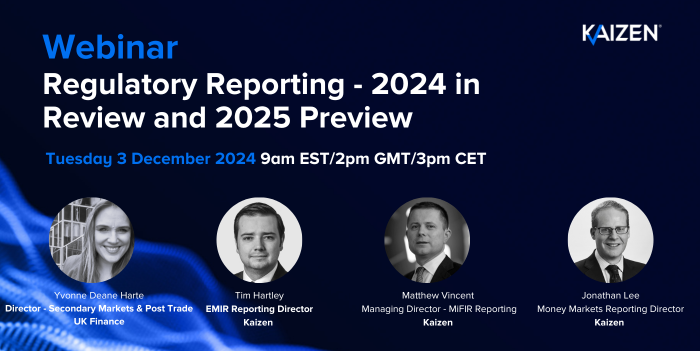
  • WATCH: Regulatory Reporting – 2024 in Review, 2025 Preview

    WATCH: Regulatory Reporting – 2024 in Review, 2025 Preview

    On MiFIR transaction reporting, there were significant changes announced by ESMA and a new discussion paper launched by the FCA, and new regimes are being introduced in the money markets space.

    Watch Kaizen’s regulatory experts as they reflect on 2024, and look ahead to what’s in store for regulatory reporting in 2025.

    The webinar was hosted by Yvonne Deane Harte, Director, Secondary Markets & Post-Trade at UK Finance and featured:

    Please note, we accept business emails only.

    For any queries relating to the upcoming regulatory changes or to speak to one of our subject matter experts, please contact us.

  • Kaizen and RegGenome Announce Strategic Partnership using AI to expand regulatory content on Single Rulebook

    Kaizen and RegGenome Announce Strategic Partnership using AI to expand regulatory content on Single Rulebook

    London, December 3, 2024 – Kaizen, a leading provider of regulatory compliance solutions for global financial institutions, announced today that it has entered into a strategic partnership with RegGenome, a UK based provider of global financial regulatory data, to use artificial intelligence (AI) to vastly expand the coverage and content of Kaizen’s Single Rulebook platform including new jurisdictions and regulatory domains.

    The collaboration between Kaizen and RegGenome will support the digitisation of regulation where both parties will work together to provide fast and efficient access to a vast array of global regulatory rules, jurisdictions and taxonomies on the Single Rulebook platform. By combining Single Rulebook’s front end user interface with RegGenome’s AI powered regulatory data and information structures, the firms will provide clients with a new standard of regulatory intelligence and change management.

    Many financial institutions operate across multiple locations and global regulatory jurisdictions. Today’s announcement means that firms will be able to navigate and respond quickly to the complex landscape of regulatory change and divergence more easily and efficiently.

    In early 2025, Single Rulebook clients will be able to access regulatory content covering all major global financial markets. This includes coverage of US federal regulators and agencies, European national law and global G20 members.

    In addition to core financial services regulations, Single Rulebook users will also be able to investigate emerging compliance requirements for cryptocurrency, cyber security and digital operational resilience.

    Mark Johnston, CEO, RegGenome commented: “We are delighted to announce our strategic partnership with Kaizen’s Single Rulebook. This collaboration will make RegGenome’s comprehensive structured regulatory data available through Single Rulebook’s innovative platform. By combining our extensive regulatory content with Single Rulebook’s advanced search and analytics capabilities, we’re enabling financial institutions to better navigate the complex regulatory landscape.”

    Chris Dingley, CEO, Single Rulebook said: “We’re excited to announce our partnership with RegGenome today. Working with RegGenome’s AI solution for regulatory data and information means that we will be able to expand the Single Rulebook platform and content rapidly for our clients, continuing and enhancing our efforts to support them with the burden of managing global regulation.”

    RegGenome processes global regulation using artificial intelligence (AI) to transform what is human-readable into machine-readable and machine-consumable data. It is part of the Regulatory Genome Project (RGP), a public-private initiative between the University of Cambridge, Judge Business School, and RegGenome. RGP aims to build and review a set of open-access regulatory information structures, known as the Cambridge Regulatory Genome (CRG), and make available a global repository of aggregated, structured regulatory data.  

    Single Rulebook is Kaizen’s digital solution for searching and navigating global regulation. The platform helps firms manage regulatory change with front end functionality such as rule maps, labels and annotations which can be pinned to regulatory rules and shared across global organisations.

    About RegGenome

    RegGenome is a regulatory data technology company and a leader in computational regulation, changing how the world produces and consumes regulatory information. We process the world’s regulation using AI to transform what is human-readable into machine-readable and machine-consumable data. 

    www.reg-genome.com

    For more information, please contact James Dunseath, Communications Director, on +44 (0) 7557 955795 or media@kaizenreporting.com

  • What’s on the horizon for Securities Financing Transaction (SFT) Reporting in 2025?

    What’s on the horizon for Securities Financing Transaction (SFT) Reporting in 2025?

    Approaching the final act of 2024, the world remains in a perilous place, economic growth is faltering, interest rates have been slow to ease but inflation also remains sticky and prone to energy price shocks. In this environment, money market and securities finance transaction (SFT) reporting moves closer to the top of the Treasury’s and Central Bank’s toolkit as they seek to establish the effectiveness and transmission of monetary policy together with any signs of external factors impacting the order and robustness of broader capital markets.

    New US regimes and SFTR Review

    2024 will draw to a close in the money markets and SFT reporting space with the introduction of daily US Non-Centrally Cleared Bilateral Repo Market reporting to the Office of Financial Research (OFR) for major securities/government bond brokers and dealers, on 2 December. OFR Phase 2 on 1 April 2025 will see reporting expanded to cover ‘Category 2’ major ‘Buyside’ Non-Centrally Cleared Bilateral Repo market participants.

    Elsewhere though, 2025 looks potentially like a year of delays. US securities lending reporting under SEC 10c-1a and administered by FINRA as Rule 6500 SLATE reporting is politically a very hot potato, facing a number of amendments and potential delays with the SEC postponing their approval of the FINRA rule until January, corresponding with Gary Gensler’s departure. Additionally, US trade associations are potentially launching other legal challenges. It might still go ahead on 2 January 2026 though!

    The SFTR Review also appears to be subject to further delay, with no sign of it appearing on the ESMA 2025 schedule of work.

    Where to focus for 2025

    However, while many eyes may be pointing at the shiny new regulations, in practical reality, it’s the seasoned, mature regulatory reporting regimes that compliance officers want to worry about.

    Regulators make allowances for new regulations, they let them bed in and teething troubles are tolerated – not so once a regime has been live for five years.    

    Unfortunately, almost five years in, data quality in the SFTR space continues to let it down. It has perhaps not helped that (new UK validation rules – live on 25 November 2024 aside – which are largely a replay of ESMA’s March 2023 rules), SFTR has been somewhat untouched for an extended period now. The last SFTR Q&A was published in June 2023.

    Of late, we’ve heard anecdotes of new NCAs entering into the fray with challenging questions and investigations following concerted pressure from ESMA and potential signs of a delegated reporting timebomb too. While the SFTR Review may be subject to further delay, regulators such as the UK FCA have been keen to draw our attention to SFTR.

    FCA Market Watch 81 – what does it mean for SFTR?

    Earlier this month, the FCA released Market Watch 81 which primarily focused on MiFID transaction reporting requirements however it made it clear that it would also be of interest to firms subject to UK EMIR and SFTR. 

    The newsletter contains a rich seam of statements that in our anecdotal experience apply equally to SFTR. To let Market Watch do the talking…

    “We continue to identify incomplete and inaccurate transaction reports,” with complaints about issues re-occurring post remediation, poor change management, data governance, control frameworks and oversight.

    Perhaps most poignant of all from an SFTR perspective was the statement:

    “Data quality issues can also emerge where change processes are outsourced to third parties, and there is inadequate oversight over the scope of deliverables. This can be worsened by the absence of transaction reporting subject matter expertise within the firm.”

    Furthermore: “We have identified firms who have excluded services and data provided by third parties from their control and reconciliation framework. This can create gaps in monitoring and prevent firms from identifying issues originating outside the firm.”

    The FCA also stated:

    “Limited compliance oversight over transaction reporting can hinder firms from improving their reporting processes through independent advice and challenge.”

    Of course, a layer of independent quality assurance through regulatory testing (such as our ReportShield Accuracy Testing) would ensure that regulatory reports are subject to a fully independent challenge.

    “Staff turnover and absences can also affect data quality. We have identified data quality issues including failure to report transactions where key staff dependencies exist, and there are not clear policies and procedures to manage reporting in their absence.”

    Again, outsourcing elements of your controls environment and oversight not only helps counteract key person dependencies but also mitigates against any inadequacies in policies, procedures and change management.  

    Don’t rest on your laurels

    Governments and regulators are currently on edge for understandable reasons. Excuses for incomplete or inaccurate reporting of the very regulations (SFTR, EMIR, CFTC etc) implemented in mitigation of the global financial crisis have been exhausted. The onus is now on firms to ensure complete, accurate and timely reporting or start to face the wrath of emboldened regulators across Europe, North America and globally. This is no time for resting on your laurels.  

    Our ReportShield solutions are designed to directly address the controls issued raised in Market Watch 81 – to request a demo or for a conversation with one of our regulatory experts, please get in touch.

  • Kaizen receives £42 million growth investment from Guidepost Growth Equity

    Kaizen receives £42 million growth investment from Guidepost Growth Equity

    London, November 6, 2024 – Kaizen, a leading provider of regulatory compliance solutions for global financial institutions, today announced the completion of a £42 million minority investment from Guidepost Growth Equity, a Boston-based growth equity firm partnering with entrepreneur-led technology companies. The investment will be used to accelerate product development, invest in go-to-market initiatives, expand in North America, and enhance its award-winning compliance technology. This represents Kaizen’s first external investment since its founding in 2013 by CEO Dario Crispini.

    Kaizen is the global leader in regulatory reporting quality assurance with its pioneering ReportShield platform, which enables its clients to fully test the accuracy and quality of regulatory reports at the trade level, identify 100% of errors at scale, and efficiently remediate with global regulatory coverage including MiFID, EMIR, SFTR, CFTC, and SEC, among others. 

    Kaizen has established itself as a trusted partner to the world’s largest and most sophisticated banks, asset managers, hedge funds and brokers to ensure accurate, complete, and timely reporting in an increasingly challenging regulatory environment, evidenced by strong revenue growth since inception.

    More recently, the Company has diversified its product suite to include solutions for managing and reporting shareholding disclosures, regulatory rules management, trade and communications surveillance and research management. Kaizen has also invested in London Reporting House and Cumulus9.

    Dario Crispini, Founder and CEO, Kaizen commented: “We are delighted to be partnering with Guidepost as we enter a new chapter in our evolution. Guidepost has a great track record in helping firms reach their full potential and their investment and partnership will enable us to build and enhance our existing technology, deliver new compliance solutions, and drive our expansion into North America. The solutions we offer at Kaizen are designed to help our clients adhere to their compliance obligations in an efficient and cost-effective manner and we look forward to delivering more solutions that do just that.”

    Gene Nogi, General Partner at Guidepost said: “Kaizen has transformed the transaction reporting and compliance market, helping the world’s largest financial institutions navigate and comply with an increasingly complex regulatory environment with heightened scrutiny from regulators. The Company embodies everything we look for in an entrepreneur-led, capital-efficient, rapidly growing, and highly differentiated technology business operating within a large, dynamic market. We are thrilled to partner with Dario, Ian and the entire team at Kaizen and look forward to working together on the next stage of the journey.”

    As part of the investment, Gene Nogi will join the Kaizen Board of Directors alongside two new independent directors to be named. Raymond James was the exclusive financial advisor on the investment and Norton Rose Fulbright acted as legal counsel to Kaizen. Liberty Corporate Finance, Alvarez and Marsal and Crosslake also advised Kaizen. Choate Hall & Stewart and Stevens & Bolton acted as legal counsel to Guidepost.

    About Guidepost Growth Equity

    Guidepost Growth Equity (“Guidepost”) is a leading core growth equity firm that partners with entrepreneur-led companies utilizing technology to transform industries within application and infrastructure software and tech-enabled and data services. Current and prior investments include ActiveViam (acquired by Nordic Capital), ClassWallet, Lucid (acquired by Cint Group AB), Mineral (acquired by Mitratech), OutSystems, Traction on Demand (acquired by Salesforce), and Tractive. The firm is headquartered in Boston, MA.

    Guidepost Growth Equity provides the flexible capital, operational assistance, and strategic guidance necessary to support the continued success of high-growth businesses and has over $1.9 billion of capital under management. For more information, please visit their website. 

    For more information, please contact James Dunseath, Communications Advisor, on +44 (0) 7557 955795 or media@kaizenreporting.com


  • Kaizen joins the Securities Finance Symposium

    Kaizen joins the Securities Finance Symposium

    Date: 12 November | Location: One Great George Street, Westminster, SWIP 3AA 

    Kaizen is returning to Securities Finance Symposium taking place in Westminster on 12 November.  The event is the repo’s industry leading technology event.

    Our SFTR Reporting Director, Jonathan Lee will join the first panel discussion of the day to discuss regulation. 

    You’ll also find the Kaizen team at our exhibit stand.  We hope you can join us at the conference. 

    Register


  • WATCH: Is your regulatory reporting valid but wrong?

    WATCH: Is your regulatory reporting valid but wrong?

    A large majority of the reports that Kaizen tests are ‘valid but wrong’. The valid but wrong scenario occurs when reports pass the validation rules by the regulator or intermediary entity (ARM, SDR or TR) but the data within the reports is inaccurate. 

    Watch our video above to find out more or contact us for a free healthcheck to find out how many of your reports are valid but wrong.


  • Commentary – managing the upcoming money markets reporting obligations

    Commentary – managing the upcoming money markets reporting obligations

    Kaizen’s Money Markets Reporting Director, Jonathan Lee shares his insights on the upcoming reporting obligations in the SFT and money markets reporting space in a commentary written for the Securities Finance Times and Asset Servicing Times.

    “We are entering a period of significant change in the money markets and securities financing regulatory reporting space. Extraterritoriality in the FINRA SLATE rules for US securities lending, the likelihood of growing requirements in Europe in the SFTR Review/Refit, further new but smaller requirements for uncleared bilateral repo reporting to the OFR in the US, and the potential for further global and European divergence, are all likely to feature over the next couple of years.”

    Read the full article on the Securities Financing Times Website. 

  • US OFR bilateral uncleared repo reporting – playing catch-up or saving the greatest till last?

    US OFR bilateral uncleared repo reporting – playing catch-up or saving the greatest till last?

    The market has been taken by surprise by the 2 December 2024 go live date for the new OFR Bilateral Uncleared Repo Reporting regime. Earlier this month, the OFR (Office of Financial Research) of the US Treasury adopted the non-centrally cleared bilateral repo (NCCBR) final rule.

    Largest segment of the US repo market comes under scrutiny

    In the headline of this blog, I say ‘the greatest’ because at $US2 trillion outstanding commitments per day, this is the largest of the four segments of the US repo market and by extension, the US SFT market overall as well. It is also the second biggest single SFT market in the world (after the EU bilateral uncleared repo market). Despite its size, this market remains rather opaque, something that the OFR is finally looking to address.  

    While the activities in the US cleared repo and triparty repo markets are already captured by US regulators, the securities lending market (where reporting commences in 2026) and non-centrally cleared bilateral repo (NCCBR) markets remain under-scrutinised. This became a particular concern following the spike in repo rates that occurred in September 2019 and also in relation to the sharp drop in US Treasury prices and further spike in repo rates in March 2020. US regulators continue to harbour major concerns about collateral risks given the prevalence of lower quality non-Fedwire eligible collateral. They are also concerned about the amount of cash borrowing the uncleared bilateral markets offer to highly leveraged entities such as hedge funds.        

    Background to the final rule

    The OFR is wasting no time in closing out this gap, albeit more than nine years after the seminal Financial Stability Board (FSB) paper ‘Standards and Processes for Global Securities Financing Data Collection and Aggregation‘, and four and a half years after SFTR go-live in Europe.

    We had a pilot reporting exercise from the OFR in June 2022, followed by the publication of proposed rulemaking for the collection of NCCBR data in January 2023 and a 60 day consultation ending in March 2023 – then radio-silence!  Then on 6 May 2024, the OFR published the final rule along with reporting instructions, technical guidance and a fact sheet on reporting. 

    Shock announcement 

    Taking the market by surprise, they have sprung a 2 December 2024 reporting go-live date upon us (150 days after the effective date of 5 July 2024) for ‘Category 1’ covered reporters. These include securities brokers, securities dealers, government securities brokers and government securities dealers with outstanding commitments to borrow cash and extend guarantees in NCCBR transactions with counterparties every business day during the prior quarter of $US10 billion. This captures approximately 40 firms.

    Category 2 reporters are required to comply 120 days later from 1 April 2025. Category 2 reporters comprise of any financial companies that are not securities or government securities brokers or dealers with over $US1 billion in assets or under management whose average daily commitments in NCCBR transactions are over $US10 billion in each of the business days in the prior calendar quarter. Category 2 will routinely capture relatively few firms but nevertheless, those potentially coming into scope will be expected to re-test themselves for eligibility each quarter.

    Reporting requirements 

    The very aggressive deadline aside, surveying the reporting itself, it looks eminently sensible.  It is essentially daily repo position reporting of all new transactions, existing transactions that remain open and any transactions opened and closed on the same business day.       

    What’s in scope?

    The scope will include bilateral uncleared repos under (but not limited to) Master Repurchase Agreements (MRA), Global Master Repurchase Agreements (GMRA) or transactions subject to the provisions of 11 U.S.C. 559. Following the consultation regarding the proposed rule, sell/buy-back transactions have also been brought into scope. However, transactions under Securities Lending Agreements (SLA), Master Securities Lending Agreements (MSLA) or Global Master Securities lending Agreements (GMSLA) not considered as repurchase agreements, are expressly out of scope, acknowledging that these will be captured imminently under the FINRA SLATE regime under the SEC 10c-1a regulation. Repos associated with the execution of commercial mortgage loans or the initial securitisation of a residential mortgage loan are also out of scope.    

    Reports comprise 32 fields

    Reporting comprises of 32 data fields by 11am on Trade Date +1 (T+1) Eastern time, following a trading day that runs from 6pm on T-1 to 6pm on T. Reporting shuns the needless complexity of ISO 20022 XML for more human-readable TXT or CSV, to be submitted to the OFR’s Data Collection Utility (DCU). The only lifecycle / action type required is the need to requirement to resubmit a day’s complete submission should OFR enquiries result in the identification of an error.

    Maybe all SFT reporting should be like this! The ability for regulators to survey the latest activities and current SFT position of firms on a daily basis without the need for a complex set of reportable actions, data tables and in excess of 100 fields seems admirable. The only notable limitation may be the lack of availability of collateral reuse data.      

    If you are concerned about your reporting obligations under the OFR’s Uncleared Bilateral Repo Reporting requirements, FINRA ‘SLATE’ SEC 10c-1 for securities lending, or other global money market reporting obligations generally, please get in touch.


  • Jonathan Lee on the challenges of SEC’s Rule 10c-1a and the OFR Final Rule

    Jonathan Lee on the challenges of SEC’s Rule 10c-1a and the OFR Final Rule

    At this year’s Securities Finance Symposium (SFT) held in Boston, Kaizen’s Money Markets Reporting Director Jonathan Lee took part in a panel discussing the challenges that firms face with the introduction of the SEC Rule10c-1a and the Office of Financial Research’s (OFR) final rule which was adopted on 6 May.

    “Firms have got a very short space of time to implement what’s going to be highly scrutinised reporting. This won’t just be in the US, but on a global basis. It’s very much front and centre of systemic risk,” said Jonathan. 

    Read the full article on the SFT’s website.


  • SEC Rule10c-1 and FINRA’s Securities Lending Transparency Engine (SLATE)

    SEC Rule10c-1 and FINRA’s Securities Lending Transparency Engine (SLATE)

    Securities Loan? Put it on the SLATE

    The Financial Industry Regulatory Authority (FINRA) published a proposed rule change to adopt the FINRA Rule 6500 Series (Securities Lending and Transparency Engine) ‘SLATE’ on 1 May 2024.

    US Securities Lending Reporting Takes Shape

    SLATE proposals take the SEC’s Final Rule 10c-1a of 13 October 2023 and start to map out what the securities lending transparency regime will look like in the USA once it goes live on 2 January 2026 (assuming no delay by the SEC). This in turn will lead to the publication of individual loan and aggregated securities lending data by FINRA from 2 April 2026. The FINRA rule is subject to a consultation, albeit scheduled to end on 28 May – a mere 21 days after its appearance in the Federal Register. At this stage, we have quite a detailed text outline but no schemas, validation rules or exacting field specifications.

    Requirements for Trade Reporting ++

    The industry has been somewhat surprised by the proposed rule. What first appeared ahead of the FINRA announcement to be simple trade reporting of approximately 12 data elements is shaping up to be a great deal more complex and expensive to implement and report under. This is end of day transaction and lifecycle reporting (on T) by the lender or their agent and subsequent significant loan transparency on T+1. 

    Elements of the scope remain TBC

    The exact scope, potential extra-territoriality and potential dual reporting (to FINRA and the OFR) remain somewhat uncertain. FINRA have identified 609 ‘Covered persons’ who will need to register and report to SLATE, broken down as 434 persons effecting a loan as lender without intermediary, 34 broker dealers borrowing excess margin securities, 4 broker dealer intermediaries, 31 non-broker intermediaries, 97 broker dealers acting as reporting agents and 9 clearing agencies acting as reporting agents. There is no further detail as to who they are or how they came to this estimate.

    Devil will be in the detail regarding reporting taxonomy

    The reporting requirements break down into around 15 public data fields, together with confidential fields relating to identifiers for parties to the loan, indications where securities are sourced from broker/dealer inventory and whether the loan is being used to close out a fail. Depending upon how you count them, we can see effectively up to 45 reportable fields.

    It is the conditional fields (referred to as modifiers and identifiers), full disclosure of all lifecycle events with sequencing, the need to report all modifications (changes and terminations) and the requirement to ingest FINRA generated unique trade identifiers (UTI) and reuse them for all subsequent lifecycle reporting that ramp up the complexity.

    Same day reporting

    Unfortunately for “covered person” reporters, FINRA requires not only the end of day snapshot of any modification but individual reports for each and every change to the terms of the transaction. All by 8pm ET on trade date (if ‘effected’ by 7:45pm ET).

    The modifiers and identifiers required are: Exclusive Arrangements (the lender has with a borrower or intermediary), Loan to Affiliate, Unsettled Loan, Terminated Loan and Rate or Fee Adjustment. To an SFTR veteran, these have the look and feel of counterparty fields in the case of the first two, an error action type (where the loan ultimately wasn’t good), a termination report and a modification of the rebate rate field or lending fee field. It may make the reporting more intuitive to frame these as optional fields (where applicable) and action types (new, modify, error or terminate) or similar, rather than “modifiers and identifiers.”

    Security Lending Data Published T+1

    The public data will be shared by FINRA during the morning of T+1 (excluding the loan amount) at both the individual loan level and in the form of daily loan statistics (e.g. aggregate loan activity and the distribution of loan rates). This data will incorporate both new loans and loan modifications. On T+20, loan amounts will also be shared. This data will be on the FINRA website free of charge for personal, non-commercial use only. For other uses, FINRA will require fees to obtain SLATE data.   

    Reporting requirements exceed remit and could jeopardize effective transparency

    The Financial Stability Board’s (FSB) 2015 proposals around securities financing data collection globally generally were to focus on periodic, settled, position level reporting. The primary objective here (and the substance behind the majority of the c.2000 consultation responses received by the SEC) was to provide greater retail level transparency around the securities lending market and how this market in turn facilitates short sellers in the US equity market. By insisting on pre-settlement trade level data, every modification, incorporating loans that never actually conclude and the modifiers and identifiers (rather than simply excluding biased data from the daily tape) runs the risk of blinding the public with science rather than in providing an invaluable level playing field of transparency with enhanced competition.

    If you are concerned about your reporting obligations under SEC 10c-1, the OFR’s Uncleared Bilateral Repo Reporting requirements or other global money market reporting obligations generally, please get in touch.

  • EMIR Refit implications for the SFTR Review

    EMIR Refit implications for the SFTR Review

    With the go live of EMIR Refit this week, ESMA’s attentions will surely turn next to what to do about SFTR. Next year, SFTR will be five years post-implementation and it will be time for the delayed SFTR Review to commence.

    Having studied the EMIR Refit, it’s apparent that quite a few of the changes were piloted by the SFTR introduction in 2020. Lessons learned by ESMA from the original EMIR regulation and implementation subsequently fed through to SFTR. And it seems likely that many of the developments rolled out in the EMIR Refit will find their way into the SFTR Review.

    Opposite directions

    As a bit of an EMIR outsider, it’s somewhat alarming the extent to which EU regulation and the industry dynamic are moving in opposite directions. The industry is focused on adopting standards, the Regulatory Oversight Committee’s (ROC) common data elements, common booking models, common domain models (CDM), simplification and far greater automation through machine reading and blockchain. CDMs focus on non-proprietary, non-licensed fundamental transaction, position and lifecycle data, an approach that is about achieving fully matched, perfectly replicable trade data with relatively few fields and no complications. CDMs should in theory dramatically reduce the number of manual touchpoints on any trade, significantly reducing operational costs.

    However EU regulators are looking for more data, extensive embellishment and enrichment, to not only achieve a truly forensic analysis of a firm’s balance sheet, processes and operations, but also to negate the need for them to hold any reference or static data at all. Indeed, thinking that 155 fields for SFTR was a lot, we now face up to 203 fields under EMIR Refit (a 65% increase on the original). There are ‘just’ 110 common data elements listed by the ROC…

    Which EMIR Refit elements are likely to be incorporated into the SFTR Review?

    • Bilateral variation margin reporting. Back in 2016 at the Paris hearings on SFTR technical standards, I suggested that there be a separate table to report bilateral variation margins for repo transactions, as ESMA insisted that Table 3, the Margin Table, was exclusively for CCP margins. This motion wasn’t carried and consequently, it is evident that SFTR bilateral variation margin reporting is currently flawed and frequently underreported. The approach required under SFTR v1 of providing trade level collateral updates with UTIs and bilateral variation margin collateral updates without UTIs does not appear to ever have been fully understood. Therefore, the EMIR Refit change that incorporates both CCP margins together with bilateral variation margining in the same margin table would be a welcome step forward, removing confusion and enhancing regulatory certainty.
    • Executing Agent field. The introduction of an executing agent field (as per EMIR Refit) would also significantly enhance the trade repository reconciliation process, particularly when reporting or facing funds as one of the counterparties. This should mitigate current misreporting, where the agent lender or broker fields are often misused to represent fund managers.
    • Intra-group trade identifier. Another party to the transaction field that may carry from EMIR is an Intra-group trade identifier. This omission was something highlighted in the recent ESMA Market Report on EU Securities Financing Transactions Markets 2024. While not strictly necessary (intra-group entities can be identified by their LEI), it would further reduce the burden on regulators to establish this relationship themselves. 
    • Waterfall guidance on UTI. EMIR Refit was written post-Brexit and consequently, they have taken account of the fact that many transactions in Europe today are single sided, being cross-jurisdictional. Therefore, there is a new waterfall providing guidance about responsibility to generate and share unique transaction identifiers (UTIs) when trading across borders. This measure should reduce late reporting (where there is uncertainty about UTI generation and sharing and consequently late reporting) and again provide clearer direction and certainty for reporting counterparties.   
    • Effective dates are another EMIR Refit feature that are likely to benefit SFTR.  At present the need to delay reports until agreed contractual modifications take effect certainly presents a timing challenge to complete and accurate reporting. The revive action type (allowing the reopening of matured or terminated/cancelled by mistake trades) may also be broadly welcomed, aiding in dealing with trades failing over their maturity date/end date for example.
    • Additional EMIR Refit changes that are likely to be mooted include event types complementing certain action types, package identifiers (useful for identifying products such as collateral swaps) and the requirement to report the nature and corporate sector of the other counterparty in addition to the reporting counterparty.

    There is no better way to prepare for SFTR 2 than to get your house in order for SFTR 1. For help addressing your SFTR data quality concerns, please get in touch.

  • Kaizen joins the Securities Finance Technology Symposium, Boston

    Kaizen joins the Securities Finance Technology Symposium, Boston

    Date: 07 May | Location: Longwood Venues, Boston

    Kaizen will once again join The Securities Finance Technology Symposium in Boston on 7 May.  

    Kaizen’s Money Markets Reporting Director, Jonathan Lee, will be speaking on the ‘The Rise in Regulatory Reporting’ panel at 09:30am.  

    Click the link below to view the full agenda and contact your relationship manager for free VIP tickets (limited amount available). 

    Register

  • ESMA Data Quality Report 2023: What does it say about SFTR?

    ESMA Data Quality Report 2023: What does it say about SFTR?

    ESMA published its 2023 Report on the Quality and Use of Data earlier this month. In this blog, we focus on the SFTR elements of the report and we also look at another ESMA report published the same week, the ESMA Market Report: EU Securities Financing Transactions Markets 2024.

    The week of 8 April 2024 was an embarrassment of riches in the world of SFTR with not one but two reports relating to securities financing transactions regulation reporting, each highlighting serious issues with reporting data quality. 

    SFTR ‘severe misreporting’ – fine?

    Not once, not twice, but on three consecutive occasions, ESMA has raised the botheration of “severe misreporting” through a failure to close out outstanding securities loans through either modification of the open term field to false and addition of a maturity date/end date or booking of an early termination. This overreporting significantly distorts the regulator’s view of the SFT market and its ability to monitor and tackle genuine systemically significant issues or clear cases of market manipulation and abuse.

    In the 2021 Data Quality Report, it was noted that the value of open SFTs was constantly increasing until November 2021 when an NCA took action against one counterparty that saw them book backloaded early terminations. The outstanding number of open SFT reports more than halved from c.7.5 million to <3 million by December 2021. This also resulted in a notable drop in the proportion of open SFTs made up by SLEBs from as much as c.85% down to c.65% between October 2020 and October 2021.

    In the 2022 Data Quality Report, there were up to three entities in a single jurisdiction reporting ‘implausibly high values in the field 2.56 ‘loan value’ reported for the securities lending transactions’. This issue, while not fully resolved by the end of 2022 nevertheless saw total SLEB loan value fall from c.€250 trillion !!! to c.€10 trillion.

    Three strikes and you’re out?

    No fines, public disclosures and an apparent lack of regulatory jeopardy and sadly lessons do not appear to be learnt. Perhaps lightning does strike three times! This year’s (2023) data quality report highlighted that one entity was still overreporting during the first half of 2023. Their SLEB loan value represented 55% of the total market value until ESMA contacted the relevant NCA and oversaw the resolution plan and corrective actions. This saw their SLEB loan value market share drop to a relatively immaterial amount (based on ESMA’s chart).

    Furthermore, ESMA noted that one counterparty was reporting repo principal amounts that accounted for c.15% of the overall market, reaching its peak in November 2022 at around €3 trillion. This entity was also populating the triparty agent field in error with the same LEI as the reporting counterparty. As remediation takes place, the market share of this reporting counterparty has dropped completely off the chart…

    ESMA Market Report – data quality observations

    In the meantime, the inaugural report on EU SFT markets (primarily focused on the repo market) was a welcome addition to ESMA’s market reports series.  

    However, it’s important to highlight that issues with outliers, stale reports, missing maturity dates and implausible collateral to loan ratios meant that ESMA had to exclude up to 36% of overall collateral market value from their analysis. Neither the scale of the data exclusion, nor the implications for data quality appear to have been fully acknowledged by this report.  

    The measure taken by ESMA to set thresholds for outliers based on “relevant monetary variable(s)” four standard deviations outside the median value indicate quite severe data quality issues. Setting the threshold so wide, I wonder how many values in the sample fell even two standard deviations outside the median. This measure resulted in a 4k reduction of the number of records in the sample, (0.6% of records) but a 19% or €2 trillion reduction in notional amount.

    The removal of stale reports, including mismatched but paired double-sided trades and records with an event date older than one year resulted in another 97k records (7% of records) being excluded, resulting in a cumulative 25% reduction in collateral market value. The need to exclude 97k records does not bode well either for the desirability of two-sided reporting, nor having overly stringent reconciliation requirements encompassing so many fields with such limited (or non-existent) tolerances. In fact if you were to exclude two-sided records from a single source (delegated reporting and a single vendor enrichment), then the negative effects would be even more evident.

    Finally, removal of term repos without maturity date and the exclusion of records with implausible collateral-to-loan ratios resulted in the loss of a further 5k records (1% of the total records) and a total of 36% reduction in overall collateral market value.

    When data quality issues appear to have such an adverse effect on data analysis, measures of stability, regulatory oversight and transparency, maybe it’s time to revisit the rulebook and terms of engagement with reporting counterparties?

    • Read our analysis of the MiFIR and EMIR angles of the 2023 Report on the Quality and Use of Data.
    • For an independent, forensic review of your firm’s reporting data quality, please get in touch.
  • Money market regulation – what’s in store for 2024/25?

    Money market regulation – what’s in store for 2024/25?

    In the world of transaction reporting, we’re always slave to events – economic crises, major fines, unexpected guidelines or Q&As. However, the path of wholesale regulatory development, new regulations and change tends to be slightly better signposted with official announcements, effective dates, regulations coming into force and reporting go-live dates. Relative to the world of derivatives, the regulatory landscape for money markets and SFTR looks significantly quieter in 2024.

    However, this may prove to be the calm before the storm. 2025 and 2026 are set to host two brand new reporting regimes in the USA and it’s highly likely that these will coincide with the onset of the SFTR Review and subsequent Refit.  

    SEC 10c-1a Securities Lending Reporting

    Coming back to 2024: The next known change is the US deadline for the Financial Industry Regulatory Authority (FINRA), the sole Registered National Securities Association (RNSA) to publish implementation rules for SEC 10c-1a Securities Lending reporting. According to the proscribed timeline, this must occur by 2 May 2024. The clock will also be ticking for reporting itself to commence on 2 January 2026. These rules will set out how US securities lenders or their agents will be required to report 12 data elements relating to those loans. We will discover just how many reportable fields those 12 data elements translate into (I would suggest that while not of SFTR proportions it’s likely to be rather more than 12). In instances where a covered securities loan consists of a broker or dealer borrowing fully paid or excess margin securities, only the broker or dealer (the borrower) is required to report and not the lender. The final deadline is 2 April 2026, when FINRA will be required to publish aggregated transaction activity and the distribution of loan rates for each security.  

    OFR’s Bilateral Uncleared Repo Reporting

    The timing is less certain on the next most imminent regulation – it’s now more than 12 months since a 60-day consultation was announced by the Office of Financial Research (OFR) department of the US Treasury on proposed data collection for the bilateral uncleared repo market. In spite of this, we still await the final rule which remains imminent. This regime was successfully piloted in 2022. The reporting requirements are more extensive than 10c-1 and are likely to be a major burden to plan, build, implement and control ahead of a 2025 or 2026 go-live. There are 33 proposed data elements including haircut, rate and optionality. Mooted by the OFR as “The last segment of the US SFT market lacking a transaction-level data source.” They expect approximately 40 reporting institutions, made up of brokers, dealers and other financial companies with large exposures ($10bn+) to the non-centrally cleared bilateral repo market to have to report daily to the OFR.       

    Expansion of Money Market Statistical Reporting (MMSR) in Europe

    Returning to Europe: On 1 July 2024, an additional 24 banks will add to the ranks of Money Market Statistical Reporting (MMSR) institutions, on top of the 45 existing reporters. This follows the first major extension of scope. Following LIBOR decommissioning and a less benign interest rate environment, the regulation has seen greater scrutiny from the European System of Central Banks members in recent months. The new reporters were expected to implement a soft go-live at the beginning of 2024 ahead of a more formal adoption in July. These reports, due 7am CET on T+1 pertain to the four money market segments of Unsecured, Secured, FX Swaps and OIS markets. As the sole mechanism for calculating the benchmark Euro Short Term Rate (€STR) and the principle means for the ECB to monitor the market transmission of monetary policy, it is very apparent that data quality is critical and effective controls, paramount.

    Closer scrutiny on SFTR in 2024

    Last, but certainly not least, ESMA’s SFTR review and subsequent Refit planning is not expected until 2025. Nevertheless, a number of National Competent Authorities (NCAs) appear to be paying closer attention to data quality and compliance in 2024 as SFTR takes its place as a more mature and topical regulation in the current geo-political environment.

    • If you have any concerns about existing or impending money market/securities financing regulation on either side of the Atlantic, please do not hesitate to get in touch with our team of regulatory experts at Kaizen.   
  • Regulatory Reporting – 2024

    Regulatory Reporting – 2024

    Watch our webinar replay to find out what you need to do to stay on top of 2024’s unprecedented regulatory change.

    • Proposed changes to MiFIR Transaction and Post-Trade Transparency Reporting
    • EMIR Refit go live in the EU and UK
    • APAC derivative reporting rewrites and global harmonisation of reporting rules
    • MMSR expansion and new rules on securities lending and uncleared bilateral repo in the US
    • Proposed changes to CFTC Part 43 and 45 reporting.

    Speakers

    Hosted by Kaizen’s Co-Founder and Managing Director Ian Rennie, the webinar features: 

    For any queries relating to the webinar or to speak to one of our subject matter experts, please contact us.

  • Kaizen’s CEO Dario Crispini speaks to FinTech Global

    Kaizen’s CEO Dario Crispini speaks to FinTech Global

    Following Kaizen’s inclusion in the 2024 RegTech100 listing, our CEO Dario Crispini spoke to FinTech Global about the key challenges facing the industry today, including staying connected in a post-Covid world and how the Kaizen Community is bringing compliance professionals together by combining technology and regulatory expertise with in-person networking opportunities.
     

    “We’re trying to have more touch points across our client base and use our position in the industry to bring clients together so they can share their war stories and their pain points… There is an appetite to get back together and to start chatting and networking with peers. We are facilitating that.”

    Read more

  • Kaizen selected as RegTech100 Company

    Kaizen selected as RegTech100 Company

    London, 6 December 2023 – Leading regulatory technology firm, Kaizen today announced that it has been selected for the RegTech 100 listing, an exclusive directory of the world’s leading RegTech companies, for the fourth time. The RegTech100 companies are chosen by a panel of analysts and industry experts as the world’s most innovative and disruptive businesses in the regulatory technology space that are seeking to help financial institutions manage the fast-paced changes brought on by ongoing regulatory updates and technological advances.

    Chosen from a longlist of over 1,400 companies worldwide, Kaizen was selected for its RegTech solutions which provide a network of services for the compliance and reporting community on one platform.

    Dario Crispini, CEO of Kaizen, said,

    “We are very proud to have been selected as a RegTech100 company for the fourth time and to be recognised for the range of solutions we now offer our clients. Our aim is to make working with regulation easy and cost effective and ensure clients stay on top of their compliance obligations through the introduction of new technologies and product innovation.”

    RegTech Analyst director of research Mariyan Dimitrov said, “With the tougher economic climate and the continued rise of AI, financial institutions are re-examining the compliance software’s true cost, namely whether a given RegTech solution truly will free up compliance staff for higher-level tasks and whether the software can scale, adapt, and get implemented efficiently. This year’s RegTech100 list highlights the leading companies in areas such as information security, compliance, risk management and fraud prevention working on the forefront of innovation and new AI implementations who have demonstrated a strong track record delivering regulatory and operational improvements in financial services.”

    Since last being listed as a RegTech 100 company, Kaizen has expanded its product offering. Our ReportShield™ suite of regulatory reporting assurance services, which includes Kaizen’s award-winning Accuracy Testing, is now complemented by solutions for monitoring and reporting of Shareholding Disclosures, Trade and Communications Surveillance, Research Management, and Single Rulebook, a digital platform for managing regulatory rules.

    (ends)

    • For more information, please contact James Dunseath, Communications Advisor, on +44 (0) 7557 955795 or media@kaizenreporting.com.
  • Jonathan Lee discusses SFTR validation rule changes at this year’s SFT Symposium

    Jonathan Lee discusses SFTR validation rule changes at this year’s SFT Symposium

    At this year’s Securities Finance Technology Symposium held in London, Kaizen’s Money Markets Reporting Director Jonathan Lee took part in a panel, discussing navigating the regulatory landscape, including Money Market Statistical Reporting, 10c-1 and the new SFTR validation rules.

    “The UK and EU have seen a small but growing level of divergence’ in the face of upcoming Securities Financing Transactions Regulation (SFTR) updates, which will potentially lead to ‘two speed’ changes to validation rules.” 

    Read more

  • Join us at Securities Finance Technology Symposium 2023

    Join us at Securities Finance Technology Symposium 2023

    We’re looking forward to returning to the Securities Finance Technology Symposium on 21 November in London.

    Jonathan Lee, our Money Markets Reporting Director, will share his insights on the first panel of the day, which focuses on how to navigate the regulatory horizon.

    Visit our booth to find out more about how we support firms achieve accurate, complete and timely SFTR reporting.  We’ll also be joined by industry repo experts London Reporting House.

    Please click the link below to find out more and to register.

    Register

  • Jonathan Lee talks to Securities Finance Times on the SEC’s Rule 10c-1

    Jonathan Lee talks to Securities Finance Times on the SEC’s Rule 10c-1

    The SEC has now adopted Rule 10c-1 relating to the reporting of securities lending trades. Kaizen’s Money Markets Reporting Director, Jonathan Lee shares his insights on the introduction of the new rule.

    “Jonathan Lee believes that the SEC has found a good initial balance in the regulatory design that it has put forward in its 10c-1a Final Rule. This was always going to be a fine line to tread, he notes, and there will be further opportunity to review and refine these initial provisions, in consultation with FINRA, when the Rule is live and when the market starts to see transaction data being published.”

    Read more

  • SEC adopts Rule 10c-1a on reporting securities lending trades

    SEC adopts Rule 10c-1a on reporting securities lending trades

    The countdown begins! Securities lending reporting in the United States is set to go live in 2025, after the US Securities and Exchange Commission (SEC) published the ‘Final Rule on Reporting of Securities Loans’ on Friday 13 October 2023. We’ll have more precise timing as soon as the adopting release is published in the Federal Register (not less than 30 days following the publication of the Final Rule). Securities lending reporting could be upon us as soon as January 2025.

    Our view on the Final Rule 

    Following more than 2,000 consultation responses to the proposed rule from every spectrum of investor and market participant, it seems the SEC has listened and allayed many concerns. It was always going to be a fine balance between satisfying the requirements to monitor, supervise and ensure an efficient, orderly market while providing much greater transparency and a more level playing field, while not appearing punitive towards market professionals or creating an operationally unworkable regime.       

    The final report appears to be less alarming and less onerous than the draft rule published back in November 2021.

    In particular, the proposal that securities lenders would be required to disclose details of securities “available to loan” and securities “on loan” to the registered national securities association (being FINRA – Financial Industry Regulatory Authority) which would be required to publish this information to the general public have both been removed. Also, the most sensitive aspects relating to transaction level loan amounts and individual loan and security identifying information will now be subject to a 20-day deferral period prior to publication.

    Finally, much to the relief of securities lending operations teams across the USA, the 15-minute reporting proposal has been shelved, replaced by “the end of the day on which the covered securities loan is effected.” End of day reporting will be required for new loans and loan modifications.

    Implementation and firms in scope

    FINRA is the organisation that will implement the rules regarding the format and manner to administer collection of information. They must propose rules within four months of the effective date of Rule 10c-1a (with the effective date set 60 days following the publication of the adopting release in the Federal Register).

    Scope of the reporting: 

    • Single-sided reporting from lenders only
    • Any person/entity who loans a security on behalf of itself or another ‘person’ 
    • Alternatively, reporting may be submitted by banks, clearing agencies, brokers, dealers, intermediaries (such as agent lenders) who act on behalf of beneficial owners.

    What must be reported?

    The Final Rule identifies 12 reportable data elements. We anticipate FINRA’s implementation may involve more than 12 fields but the data elements required to report are as follows:

    1. Legal name of the security issuer, and the LEI (Legal Entity Identifier) of the issuer, if the issuer has a non-lapsed LEI
    2. Ticker symbol, ISIN, CUSIP, or FIGI of the security, if assigned, or other identifier
    3. Date the loan was effected
    4. Time the loan was effected
    5. Name of the platform or venue for loans executed on a venue or platform
    6. Amount, such as size, volume, or both, of the reportable securities loaned
    7. Securities lending fee or rate, or any other fee or charges for loans not collateralised by cash
    8. Type of collateral used to secure the loan of securities
    9. Rebate rate or any other fee or charges for a loan collateralised by cash
    10. Percentage of collateral to value of loaned reportable securities required to secure such loan
    11. Termination date of the loan, if applicable
    12. Whether the borrower is a broker or dealer, a customer (if the person lending securities is a broker or dealer), a clearing agency, a bank, a custodian, or other person.
    • Read the press release on the new rule on the SEC’s website 
    • For background read Jonathan’s previous blog 
    • For a conversation with Jonathan on what this new rule means for your reporting, or for a discussion on your data quality concerns, contact us.
  • Winners of the Barclays RepoHack 2023!

    Winners of the Barclays RepoHack 2023!

    We are thrilled to announce that Kaizen and our colleagues at London Reporting House (LRH) have been crowned winners of the Barclays RepoHack 2023! Congratulations to Kaizen’s Samuel Jackson (pictured far left) and Joseph Awonusi (pictured far right), together with our LRH colleagues Aleksandr Mattal and Dr. Luke Johnson for their tremendous efforts.

    The hackathon, hosted by Barclays Bank, ICMA, ISLA, ISDA, and FINOS was held in London. Organisations including Barclays, JP Morgan, CapGemini, Transcend, TradeHeader, and Lab 49 came together to compete against one another to streamline the post-trade processing of repo trades by integrating the repo Common Domain Model (CDM).

    Participants were tasked with crafting a seamless trade execution process and interface, all while spotlighting post-trade innovations through CDM.

    The team’s winning strategy came down to both innovation and efficiency. Aleksandr, Luke, Samuel and Joseph devised a system, harnessing CDM objects to facilitate the smooth transfer of transaction data between post-trade systems and SFTR reports. By utilising CDM’s consistent and digital trade representation, the team were able to sidestep redundant data reconciliation, thus accelerating the transition from trade execution to in-depth data analysis.

    We are so proud of the efforts of our Hackathon team, what an achievement!

  • UK SFTR Validation Rules – a late twist from the FCA

    UK SFTR Validation Rules – a late twist from the FCA

    The UK FCA finally proposed its own changes to the SFTR validation rules on 1 August 2023, subject to a consultation period ending on 15 September 2023, before taking effect on 4 November 2024.

    This follows ESMA’s announcement in March 2023, due to come into effect in the EU on 11 September 2023. The proposals largely mirror ESMA’s changes with a few sensible twists – that will give small data quality benefits. In particular, the FCA is proposing using the EMIR Refit currency code validations (prohibiting special currency codes) and planning to add major post Libor benchmark interest rates such as €STR, SONIA and SOFR to the list of recognised floating rates and floating rebate rates. This last point is a big win and something that has likely frustrated regulators across Europe, with their inability to aggregate spurious ‘free text’ populated rates.

    ESMA’s mirroring changes are to the list of actions that will mandate reporting counterparty details (nature & sector) and entity responsible for the report. There are clarifications around the method used to provide collateral (conditionality only applying to securities lending), clearing, open term, collateralisation of net exposure, type of collateral component, the uncollateralised securities lending flag and collateral market value. These are in addition to clarifications on report tracking numbers, permitted types of collateral and associated fields for securities lending (cannot be commodities collateral) and UTI for collateral updates when collateralisation of net exposure is false.

    Finally, the UK cements its minor deviation from ESMA’s rules, with no reporting required for non-financial counterparties, through appropriate changes to the validation rules to reflect this.  

    The pressing issue is going to be the two speed validation rules changes, which will be running in parallel for the 15 months between September 2023 and November 2024. For any firm with both UK and EU SFTR reporting obligations, this is likely to prove significantly more onerous than the two and a half month wait that we saw last time…

    • Read the full update on the FCA’s website
    • For a conversation with Jonathan on the new validation rules, please contact us.
  • Kaizen wins at the Securities Finance Times Industry Excellence Awards 2023

    Kaizen wins at the Securities Finance Times Industry Excellence Awards 2023

    London, 7 July 2023 – Leading regulatory technology firm, Kaizen Reporting has won ‘Regulatory Solution of The Year’ at the Securities Finance Times Industry Excellence Awards 2023 for its ReportShield™ Accuracy Testing service.

    The Securities Finance Times Industry Excellence Awards were judged by a panel of industry experts, and are dedicated to supporting and recognising talented and dedicated firms, individuals and departments across the industry.

    Justin Lawson, Founder and Group Publisher, Black Knight Media Limited, commented:

    “With more entries than ever, this year’s Industry Excellence Awards were highly competitive. Kaizen Reporting’s Accuracy Testing positioned it as a deserving winner of the ‘Regulatory Solution of the Year’ category. Regulators expect the SFTR data they receive to be accurate and Kaizen’s Accuracy Testing service enables firms to deliver just that.”

    Dario Crispini, CEO of Kaizen Reporting commented:

    “We are honoured to have been selected as the winner of ‘Regulatory Solution of the Year’ at the Securities Finance Times Industry Excellence Awards 2023. The SFTR regime is now three years old and regulators expect the data reported by firms to be of the highest quality.  This is particularly important at times of market volatility as regulators rely on this data – and that of other reporting regimes – to detect systemic risk. We are proud to offer a service that helps firms improve their data quality and fulfil their regulatory obligations.”

    Kaizen’s Accuracy Testing, part of its ReportShield™ suite of regulatory reporting controls, is an automated managed service that tests the quality of trade and transaction reporting data reported to the regulator. What makes the service unique is its ability to test all data fields on all reports, giving clients full visibility of their reporting quality. The expertise of Kaizen’s subject matter experts is embedded in the service, which covers a wide range of regimes including MiFIR Trade and Transaction Reporting, EMIR, SFTR, CFTC and many more. This year Kaizen also added Sterling Money Market Daily (SMMD) reporting and Money Market Statistical Reporting (MMSR) to the list of regimes its testing covers.

    (ends)

    • For more information, please contact James Dunseath, Communications Advisor, on +44 (0) 7557 955795 or media@kaizenreporting.com
  • Kaizen and London Reporting House write for ISLA 30

    Kaizen and London Reporting House write for ISLA 30

    Kaizen and London Reporting House have written a joint article which has been featured in ISLA 30, a special publication by the Securities Finance Times, marking ISLA’s 30th Securities Finance & Collateral Management Conference.

    In the article we question whether regulation has been a help or hindrance to the securities lending and repo markets, and argue that regulatory requirements have in fact paved the way for incredible growth in these markets.

    Read the article in full

  • ESMA’s spotlight on data quality – Part 3: SFTR – a case of ‘valid but wrong’

    ESMA’s spotlight on data quality – Part 3: SFTR – a case of ‘valid but wrong’

    Identifying SFTR errors should be rather like shooting fish in a barrel. In spite of this, ESMA’s latest data quality report simply did not uncover the bodies.

    In this edition, there was no smoking gun, more of a smoking peashooter. In relation to SFTR, only one low-key material issue was uncovered in which three entities in a single jurisdiction had reported unfeasibly large securities loans.

    Our SFTR testing experience indicates that there is a sea of price unit errors, haircut issues, incorrect quality, incorrect price, incorrect type, under-reporting (collateral, re-use, cash reinvestment & funding sources) among a litany of other errors. On top of that, many aspects of SFTR remain only partially defined or undefined, such that the resultant data is of dubious value, full of uncertainty and contradiction.

    Data quality indicators dashboard

    ESMA stated that it had been transitioning to a new data quality indicators (DQIs) dashboard for both EMIR and SFTR, with the SFTR implementation to be completed during 2023. Together with a data-sharing framework, this is how ESMA is proactively monitoring and engaging with National Competent Authorities (NCAs) on data quality issues.

    In the existing case for EMIR, it includes 19 DQIs to detect and measure various types of misreporting, including under and over reporting, inconsistent reporting vis-à-vis the other counterparty, incomplete information in the key fields of the report, late reporting, abnormal values, and a lack of correct identifiers of the counterparties. This is computed by ESMA monthly, based on the entire EMIR dataset.

    The empirical evidence we have from our quality assurance testing services indicates that ESMA’s methods – with dependency on extraordinary values, the validation rules and TR reconciliation processes – may only scratch the surface of errors present in reported data.

    False comfort

    In ESMA’s EMIR data, there appears to be a lot of false comfort to be had from the reduction in the percentage of errors identified under these DQI methods from a high of 27.6% to a low of 7.8%. If we were to speculate that ESMA’s methods identify only 10% of true outstanding errors, then a decline from 27.6% to 7.8% equates to less than a 2% improvement in actual data quality.

    On SFTR specifically, ESMA identified implausibly high loan values (field 2.56) for securities lending trades, where loans from three entities in a single jurisdiction accounted for 77% of the total loan value in the market as a whole. On further investigation, it proved to be misreporting. This emphasises the importance of having SFTR reporting controls in place to identify ‘fat fingers’, spurious values and issues with units.

    Five fields responsible for most errors

    We repeatedly state that the validation rules, or indeed validations in conjunction with TR reconciliations are woefully inadequate measures for establishing high standards of data quality. We have also harboured doubts that the validation rules were always applied in their entirety, as we repeatedly see accepted messages we would expect to be ‘NACKed.’ However, ESMA has chosen to perform a “revalidation” process, largely to ensure that the TRs have applied the validation rules correctly. During this exercise, it identified issues with between 23 and 43 fields depending on which month’s run. However five fields were responsible for 95% of total failures:

    1. Collateral basket identifier (by far the biggest)
    2. Classification of a security
    3. Spread
    4. Floating rate reset frequency – multiplier, and
    5. Floating rate reference period.

    We have observed a number of issues with the population of the collateral basket identifier and ways in which this field can be ‘abused.’ In some cases, we’ve seen individual bond ISIN codes entered (that are clearly not collateral basket ISINs), proprietary (non-official) ISIN codes and frequent use of the collateral basket identifier (typically in relation to securities lending business) to avoid having to provide further collateral detail.

    With regards to classification of a security (CFI code), until very recently (and the publication of Q&A 15), it has been the only SFTR field with a golden source, namely the ANNA ASB database. In our experience, it is common to see the default character ‘X’ used in place of correct characters, CFI codes that bear no relation to the security in question and inconsistencies with the values published in the ANNA ASB database.

    The final two fields mentioned, floating rate reset frequency – multiplier and floating rate reference period – time period, in our experience, are both impacted by default values (particularly one) and inconsistent inputs that do not make economic or standard market practice sense.

    Fit for purpose?

    Sadly, the conceptual issue remains, the vast majority of incorrect reports pass the validation rules – the classic ‘valid but wrong’ problem. SFTR is crying out for greater regulatory certainty, precisely defined fields with limited acceptable parameters. The doctrine “counterparties should agree amongst themselves” simply does not work. A regime with a litany of errors and extraordinary operational burden, is simply not fit for purpose.

    • Read the Data Quality full report on ESMA’s website
    • Read our insights from our regulatory experts on the EMIR and MiFIR aspects of the report
    • For a free healthcheck of your SFTR reporting or a conversation with Jonathan or another regulatory expert, please contact us.
  • The clock ticks for SEC Rule 10c-1/OFR Sec Lending and Uncleared Bilateral Repo Reporting

    The clock ticks for SEC Rule 10c-1/OFR Sec Lending and Uncleared Bilateral Repo Reporting

    SEC Securities Lending Reporting and OFR Uncleared Bilateral Repo Reporting cannot come too soon. US regulators face renewed pressure from all sides.

    Not to put too fine a point on it, US regulators find themselves lagging their international peers when it comes to securities financing transactions (SFT) regulation. US SFT regulation stands accused of being too light touch, fragmented and incomplete. In an environment of heightened inflation, rapidly rising interest rates, deteriorating credit conditions and where solvency concerns abound, this is undoubtedly making US authorities rather uncomfortable and eager to close out the gaps as a matter of priority.

    The US has a key role to play in identifying global and domestic SFT market systemic risk and in forewarning and tackling market crises. In the recent past, SFTs have certainly played a role in market failures such as the Gamestop short squeeze, UK pension LDI solvency crisis, and the collapses of Silicon Valley Bank and Credit Suisse banks.

    Gaps in reporting mean US regulators cannot get a firm handle on market events and are letting down their international partners in identifying and quantifying global systemic issues.

    Following the last financial crisis, SEC and Federal Reserve Board representatives played a very active role in the early discussions held by the newly formed Financial Stability Board (FSB) between 2012-2015. This culminated in the publication of “Standards and processes for collecting and aggregating global data on SFTs”. Subsequently, with the exception of the Office of Financial Research Centrally Cleared Repo Data Collection (beginning late 2019) taken directly from the DTCC and tri-party repo data that the Fed has supervisory authority over, it all went rather quiet in the US.

    The two major gaps in US SFT reporting are the securities lending market and the uncleared, bilateral repo market – currently operating in almost complete darkness. Steps are underway by both the SEC and Office of Financial Research (US Federal Reserve Board) respectively to bridge the gaps in these two unreported segments. In market conversation, at this juncture, we anticipate little resistance from either the securities lending nor repo industries in pushing ahead with these new reporting regimes.

    SEC 10c-1 Securities Lending Reporting has already been subject to extended delays.

    Thus far, consultations have dragged on significantly longer than first anticipated, especially in relation to SEC 10c-1 Securities Lending Reporting, in which the final rules were initially expected at the beginning of 2022. The need to significantly extend the consultation period and subsequent rule making perhaps demonstrate both the overly ambitious reporting time lines (initially proposed to be within 15 minutes of a securities loan being agreed) and transparency publication objectives, together with the competing interests of Wall Street (agent lenders), institutional investors (beneficial owners) and retail investors (craving a level playing field).

    OFR uncleared bilateral repo reporting is certainly more fully formed, following a successful pilot reporting exercise conducted with nine dealers over three days in June 2022. The scope of uncleared bilateral repo reporting is also much narrower, focused only on the largest collateral givers (with daily outstanding loans of $10 billion+). Therefore, it is also quite likely that OFR bilateral repo reporting goes live over a similar timeline to the SEC Securities Lending Reporting, quite possibly during 2024.

    Both regulators and the man on the street are losing patience. Retail investors in particular have been highly vocal in demanding greater transparency and fairness in equity markets.

    Regarding uncleared bilateral repo reporting, the Federal Register stated that is was,“a critical blind spot in a market that plays a key role in financial stability.”

    Regarding the SEC consultation on securities lending reporting, it has solicited close to 2000 responses, the vast majority of which have come from angered, frustrated retail investors, annoyed at the slow pace of regulatory change, the inability to address market failure, and craving far greater stock lending transparency. Retail investors have come out overwhelming in support of SEC 10c-1 Securities Lending Reporting in its current form as a bare minimum.

    Here are some quotes from the consultation responses:

    “I support these rule changes, the truth needs to come out.”   

    “Please for the love of America. Please stop shorting/naked shorting only to benefit Hedge Funds and the loss of the retail investor. Only allow 100% of the float to be obtained. The technology is available Please invest in a program to be able to see illegal shorting and spoofing. Lastly please FINE more then they made off their illegal tactics. As a member in the US Air Force I do my job no matter what the cost and get paid peanuts. Please do yours make it a fair market.”

    With extensive experience in helping firms comply with securities financing and money market reporting regimes, Kaizen Reporting can assist in putting together controls and quality assurance around impending securities lending and bilateral uncleared repo reporting. Please get in touch to kick off a conversation to get ahead and comply with impending regulation.

  • Does your firm have an SMF for trade and transaction reporting?

    Does your firm have an SMF for trade and transaction reporting?

    The Senior Managers and Certification Regime (SM&CR) may be under review but that doesn’t mean it’s not still in place.

    The FCA and PRA recently published a joint discussion paper which asks for feedback on the operational aspects of the SM&CR.  At the same time HM Treasury also published a Call for Evidence seeking views on the legislative aspects of the regime.  This follows the announcement in December 2022 that there would be a review of SM&CR as part of the Edinburgh Reforms.  Responses to the discussion paper are due on 1 June.

    This could not come at a more crucial time for the industry with so much regulatory change afoot with expected divergence in MiFID II reporting, EMIR Refit upcoming, as well as various other rewrites concluding. 

    But in the meantime, we wanted to remind firms of their SM&CR responsibilities. Do firms have a Senior Management Function (SMF) in place for their trade and transaction reporting requirements, accuracy and approvals?  Who is your SMF16?

    SM&CR takes three key elements:

    • Senior Managers Regime – Understanding and mapping out of the SMF responsibilities and consequences of actions, personal accountability
    • Certification regime – Documenting, demonstrating, and certifying that SMFs are suitable and ‘fit & proper’ for the role, with annual assessments. “Have my SMFs been trained?”
    • Conduct Rules – Governance and documentation, procedures & policies that have been brought into line for SM&CR and controls in place for recording the implementations, steps and the decisions made by your firm to comply with the Conduct Rules across all staff within your organisation.

    Kaizen can help firms through the understanding of the accuracy of their regulatory reporting, so SMFs have a valued and independent view of their reporting.  We also provide governance and controls with our structured Control Framework services, designed by former regulators and our industry specialists experts, making sure internal GRC structures and procedures are acceptable.

    Only a few months ago, the FCA issued a Dear CEO letter to wholesale brokers reminding them of their regulatory obligations and to take proactive steps towards ensuring compliance, in particular highlighting that individuals in compliance risk personal liability when something goes wrong under the SM&CR.

    • If you’d like some help getting the right controls in place to ensure your firm meets the requirements of the SM&CR from regulatory reporting perspective, please get in touch.


  • Join us in Boston for the Securities Finance Technology Symposium 2023

    Join us in Boston for the Securities Finance Technology Symposium 2023

    We are delighted to be taking part in the industry-leading Securities Finance Technology Symposium 2023 on 2 May, which is coming to America for the first time. 

    The event will take place at the Longwood Venues State Room in Boston, providing panoramic views of the iconic Boston skyline.

    Our SFTR Reporting Director Jonathan Lee will be speaking on the ‘Regulatory Reporting: ReWrite, Reform, Refit’ panel, providing an update on recent regulatory implementations, new regulations and regulatory reviews, including the potential challenge presented by SEC 10c-1.

    When: Tuesday 2 May 2023
    Time: 7.30am -5pm
    Where: State Room, Longwood Venues, 33rd Floor, 60 State St, MA 02109, USA.


    Email for your free ticket

  • SFTR: Which jurisdiction is the issuer?

    SFTR: Which jurisdiction is the issuer?

    ESMA publishes Q&A 15

    SFTR reporting is saddled with a number of hidden mysteries. The lack of regulatory certainty frustrates reporting counterparties, regulators and quality assurance providers alike. Any field, especially a matchable/reconcilable field that has multiple permissible answers will forever be a quandary. 

    The publication of ESMA’s SFTR Q&A 15 finally answers one of the great mysteries of SFTR reporting! 

    When reporting the jurisdiction of the issuer of either a loaned security (field 2.53) or a collateral security (field 2.92), the question has remained unanswered until now – which jurisdiction should be used?

    Question 15 was published in a new version of the SFTR Q&As by ESMA on 31 March 2023. The question raised is:

    “Should the fields 2.53 and 2.92 ‘Jurisdiction of the issuer’ be populated with the country code of the registered office of the issuer or of the country where the head office is located?”

    The answer ESMA has given is:

    “These fields should be populated with the country of the registered office of the issuer (fields 2.54 and 2.93 ‘LEI of the issuer’), corresponding to the ‘Legal address’ in GLEIF data.”

    In practical terms, always use the jurisdiction of the registered office (equivalent to incorporation) of the ultimate parent, or, if not known, the jurisdiction of the subsidiary if the issuer does not feature in the GLEIF database.

    • To read the latest Q&A, please visit ESMA’s website
    • For help navigating through the maze of ESMA and FCA rules around SFTR reporting, or for a conversation with Jonathan Lee, please get in touch.
  • UPDATED: A tale of inflation, solvency & regulatory jeopardy

    UPDATED: A tale of inflation, solvency & regulatory jeopardy

    We first published this article in November 2022 but given current market events, we’re republishing it this week with some updated opening paragraphs. 

    There is a common perception in securities trading that getting the timing right when taking positions in the market is far more difficult than having the right idea to begin with. In hindsight, the below blog, written in November 2022, was a classic example of this. Regulatory concerns I raised five months ago in relation to rising interest rates, badly positioned market counterparties, bond market losses, capital adequacy, solvency issues and fears of contagion were well placed, but four months too early…

    In a similar manner to government preparations for a flu pandemic in 2020, following the 2008-2011 financial crisis, regulators were well prepared for a series of credit events. Unfortunately, the pre-cursor to the current situation is not a credit event but an interest rate event, for which preparations are far less appropriate, regulators simply find themselves looking in the wrong direction. Regulators will be quantifying counterparty exposures, collateral concentrations, leverage, levels of collateralisation and evidence of any further systemic risks. The principal tools for identifying these risks include SFTR, MMSR, SMMD and the likes of PRA Liquidity Reporting. If this data is poor, regulators will be active in their response. For a conversation about your data quality, please contact us.

    ***

    21 November 2022

    The deflation that followed rapid Chinese industrialisation has kept interest rates on a declining and ultimately stagnant path for decades since the 1990s.  In recent years, interest rate and government bond markets could have been politely described as being as dull as ditch water.

    However, as with all things in the market, the trend is your friend, until it isn’t…

    UK Treasury 2050, 0 5/8% Bond Price – theoretically one of the safest investments…

    Source: London Stock Exchange


    Supply chain and booming inflation

    Supply chain issues stemming from Covid, compounded by the emergence of China as a new superpower with massive domestic consumption and to a lesser extent Brexit, saw the price of the long dated UK Gilt (above) dip from around 100 (or par) into the 80s in February 2021. This c.20% fall in value accelerated as war broke out in Ukraine in February 2022 resulting in a dramatic jump in global inflation, with central banks increasing official interest rates in an attempt to ensure that this inflation is transitory. The downward trajectory in UK bond prices troughed with the fallout from the misguided September UK mini-budget on 8 October 2022 when the price hit 36.40 – a fall of 64% in the 2050 Gilt price from its high to low.

    Rates markets have become sexy again

    Higher interest rates, volatility, differing views on inflation expectations all of a sudden bring bond markets, money markets and securities financing markets back into sharp focus. While this may be to the delight of rates traders, it will have been highly unwelcome by the pensions industry as the value of many of their key ‘low risk’ assets are needed to service pensioners of the future evaporated. The moves were so dramatic, some pension funds’ solvency was called into question, resulting in intervention by the Bank of England to support the Gilt market in October.

    What does all this mean for regulatory reporting?

    Central banks and regulators will be on heightened alert to identify large interest rate exposures, the effective transmission of official central bank interest rates, solvency issues, credit default risk and the potential for contagion. Trade and transaction reporting regimes are among their principle means of performing this supervisory oversight and analysis. This will encompass everything from MiFID, SFTR, EMIR, MMSR, SMMD, CFTC, FinfraG, SESTA and many more besides. When faced with something of a crisis or an emergency situation, there is a risk that regulators need to react quickly with punitive measures if their investigative work is thwarted by reporting data quality issues.

    Enforcement has been notable in its absence for a number of years, just don’t be too surprised if this now goes the way of the bond market.         

    • If your money markets reporting (under SFTR, MMSR & SMMD), your bond market transaction reporting (under MiFIR) and your interest rate derivatives reporting (under EMIR, CFTC, MAS & HKMA) is not in perfect order or you are unaware of how good (or bad) it is, please get in touch.
  • Join us at the EUREX Derivatives Forum 2023 in Frankfurt

    Join us at the EUREX Derivatives Forum 2023 in Frankfurt

    Join the Kaizen and Single Rulebook teams in person at the EUREX Derivatives Forum Frankfurt 2023 on 22-23 March.  The event will take place at the Congress Center Messe Frankfurt and will also be available virtually with thought leadership insights, industry debates and keynote speeches, focusing on trading and clearing for derivatives and securities financing across asset classes.

    We will have an exhibition stand, so please come and say hello!

    To register, follow the link below and enter the following token: Kaizen-DFF

    Register here


  • WATCH: Kaizen client conference 2023 highlights

    WATCH: Kaizen client conference 2023 highlights

    Watch this video to see highlights of our Kaizen client conference ‘Regulatory Reporting – where are we now?’ at Banking Hall in the heart of the city of London. 

    More than 180 clients, staff and industry experts joined us for an afternoon of all things regulation and reporting. 

    We were delighted to host the FCA’s Markets Reporting Team Manager Tom Soden as the keynote speaker, as well as speakers from HSBC, DTCC, FIA, and our very own Advisory Board and subject matter experts. 

    Panel discussions included:

    • The current regulatory landscape
    • Data quality and the drive to improve it
    • Regulatory reporting in 2023 and beyond.

    A huge thank you to everyone who took part in or attended the event and we look forward to seeing you next year.  For suggestions for topics you’d like us to cover, please get in touch. 

  • ESMA’s new SFTR validation rules – still playing roulette with data accuracy

    ESMA’s new SFTR validation rules – still playing roulette with data accuracy

    The highly anticipated new ESMA SFTR validation rules (and corresponding minor XML schema changes) were finally published on 8 March, coming into effect on 11 September 2023, leaving nothing but a damp squib in their wake.

    Having been pre-warned by ESMA that no new guidelines or the delayed SFTR Review were imminent, nor likely this year, it was something of a disappointment to find so little advancement on the path to regulatory certainty. This is a missed opportunity to enrich the ‘Conditional validations, format and content’ and ‘Details to be reported’ columns to capture new post-Libor interest rates, precise definitions of collateral/security type, and provide clarity around jurisdictions, haircuts and other contentious fields. We will continue to roll the roulette wheel as to whether “valid” reports are right or indeed remain “valid but wrong.”

    The changes only affect the ‘General information’ and ‘Cpy_Transaction’ tabs. General information simply clarifies that correction “CORR” messages can only be used to repair loan data or loan and collateral data but not only collateral data. Any collateral changes, corrections or not, should be made using a collateral update “COLU.”

    The ‘Cpy_Transaction’ tab contains the bulk of the changes:

    • The additional sector classification field (1.6) has now been made consistent across all action types, conditionally required for errors, early terminations, collateral updates and valuation reports.  
    • Unique transaction identifiers (UTI) (Field 2.1) are now mandatory for repo, buy-sellback and securities lending collateral updates where collateralization of net exposure is false. This does close a loop-hole and ensures collateral can be more easily accounted for.
    • Type of collateral component (2.75) has had conditional validations clarified, around the need for it to be populated for corrections containing collateral information and position components. This removes the previous anomaly where it required for corrections and position components, even on uncollateralised securities loans. 
    • Collateral unit of measure (2.84) is no longer required under any circumstances for securities lending trades. This is slightly curious as it is still permissible (albeit highly unlikely) to have commodities collateral on a securities loan.
    • Haircut or margin (2.89) – still misnamed (margins are not acceptable), has a single somewhat confused additional condition that “The absolute value of this field should range between 0 and 100.” However, quite rightly it still allows negative as well as positive values and capping it at 100 only partially prevents the incorrect reporting of initial margins (as opposed to haircuts) as specified in the “Details to be reported.” The cap could have been set rather lower than 100 to make this condition truly effective.
    • Finally, the Level field (2.99) has been tweaked, no longer required for new or modified margin loans (only transaction level reporting is possible) and the position component action type (have you ever seen one?!) is only valid for transaction level reports.  

    That’s all folks! Hopefully the UK FCA will follow suit without delay, preventing two-speed SFTR re-occurring later this year and into 2024.

  • Dario Crispini speaks to Global Investor Group on LRH acquisition

    Dario Crispini speaks to Global Investor Group on LRH acquisition

    Kaizen’s CEO Dario Crispini spoke to the Global Investor Group on the recent investment in London Reporting House.

    “Our clients see us as a trusted third party so LRH is one of the initiatives that we have pursued, where we are trying to take the data and create something new that adds value to their businesses.

    “We have teamed up with LRH to create something new which I think is a real game-changer for the industry.”

    Read the article in full

    (You must be a subscriber to view the article in full).

  • Dario Crispini speaks to Securities Finance Times on LRH acquisition

    Dario Crispini speaks to Securities Finance Times on LRH acquisition

    Kaizen’s CEO Dario Crispini spoke to the Securities Finance Times on the recent investment in London Reporting House.

    “Our partnership with London Reporting House shows our commitment to expanding the services we can offer our clients.”

    Read more

  • Kaizen Reporting acquires majority stake holding in London Reporting House

    Kaizen Reporting acquires majority stake holding in London Reporting House

    Tuesday 7 March 2023 – Leading regulatory technology firm, Kaizen Reporting today announced that it has acquired a majority stake in London Reporting House, a new service that brings unrivalled insight into the repo market.

    London Reporting House’s platform anonymises, aggregates, enriches and analyses raw SFTR trade data from multiple sources to provide unprecedented views over, and depth into, the EU and UK repo markets. There are six key elements to London Reporting House’s offering which provide clients and market participants with analytics and metrics on GC repo curves and spreads, specials, collateral haircuts and prices, flows of new transactions and open interest.

    The new London Reporting House products and analytics tools will be available via the Kaizen Hub, a web based RegTech platform for accessing a range of compliance tools.

    Dario Crispini, CEO of Kaizen Reporting, commented: “Our partnership with London Reporting House shows our commitment to expanding the services we can offer our clients.  It also highlights our belief in the expertise and creativity that Danny and Richard [Danny Corrigan: CEO and Co-founder and Richard Comotto: Head of product and Co-founder at London Reporting House] bring to LRH and the products they are building at LRH.  The products they are creating provide invaluable information for trading and risk teams at a time when financial institutions are looking for enhanced transparency and data across all markets.”

    Danny Corrigan, CEO and Co-founder, London Reporting House, commented: “We are delighted to be a part of Kaizen and by joining forces we are able to enhance our offering and build out our platform which leverages Kaizen’s IT infrastructure and legal framework for onboarding. Bringing their expertise and technology together with ours, we are able to offer the repo market a unique service that creates a transparent and deep view of the UK and EU repo markets.”

    The terms of the acquisition were not disclosed.

    (ends)

    About London Reporting House

    London Reporting House was founded by a team of repo specialists who saw an opportunity to bring a new level of transparency to the repo markets. Having access to granular, detailed and timely data is invaluable for making superior investment decisions. London Reporting House’s repo analytics tools provide a deep and granular view of the market for front and back-office functions across the industry. Our products and analytics tools are available via the Kaizen Hub, a web based RegTech platform for accessing a range of compliance tools.

    www.londonreportinghouse.com

    • For more information, please contact James Dunseath, Communications Advisor, on +44 (0) 7557 955795 or media@kaizenreporting.com
  • How-to Guide: SFTR repo day-count conventions

    How-to Guide: SFTR repo day-count conventions

    Day-count conventions – a land of confusion

    Anecdotal evidence from regulatory testing, reported data, questions we’re asked and the helpdesk queries we receive indicate that confusion reigns when it comes to repo market day-count conventions. This is an issue both in terms of ensuring SFTR reports are accurate but also an issue as a matchable field reconcilable at the Trade Repository (TR).

    Market craves standards and best practice

    The problems arise primarily from two factors:

    1) A tendency to report the underlying collateral bond interest accrual day-count convention instead of the correct repo interest convention.

    2) The prevalence of a large number of irrelevant conventions (in the context of SFTs) on the ESMA/FCA validation rules list of options including many bond coupon conventions and derivative interest conventions too.

    Very tellingly, the latest proposals from the Office of Financial Research in the US state that they believe the ISO 20022 definitions to be too broad and that they were going to insist on everything being reported on the US market convention Actual/360 basis.

    Until now, there simply has not been a definitive guide to which day-count conventions to use in which markets.

    Only two repo day-count conventions in regular use

    In the vast majority of cases, we foresee only two of the listed day-count conventions being relevant and correct when reporting repo transactions. While not all market participants will necessarily follow the market convention associated with the particular market in question, nevertheless, they tend to abide by Actual/360 or Actual/365. In rarer cases, we see Actual/Actual (notably in Russia). We would also expect these to be repo market specific conventions and not derivatives related ISDA ones for example. Indeed, if the SFTR reported convention is not A004 or A005 and it is a major market, the reported convention is quite probably incorrect.

    Actual/360 covers Euro, USD, JPY (international) and CHF

    In the Euro, USD, CHF and international repo markets in Japan, Canada, Australia and New Zealand, the standard convention is Actual/360 , the actual number of days interest (the numerator), divided by an assumed 360 days in a year (the denominator). This is denoted under SFTR as A004.

    Actual/365 covers Euro, USD and JPY (domestic) 

    In the UK and Japanese, Canadian, Australian and New Zealand domestic markets the convention is Act/365 Fixed, the actual number of days interest divided by 365 days in a year, regardless of leap-years. This is denoted by A005.

    Japan, Australia, New Zealand and Canada conventions differ between international and domestic. Do not be surprised to see repo trading under the international (Actual/360) convention in the repo markets in any of these jurisdictions.

    There are some smaller markets such as Brazil (that uses a business day convention) and Burundi, Ethiopia and Rwanda that use an Actual/364 convention that would need to be reported using the free-text option. This option should only be used when reporting activities in smaller, non-standard markets. The ICMA provide some guidance on the reporting of unlisted conventions in recommendation 5.17 of its recommendations for reporting under SFTR. Using this as a context for the reporting of non-standard conventions should limit instances of TR reconciliation breaks on this field too.

    NB: When referencing domestic repo markets, this relates to trades between two onshore counterparties, potentially on a domestic platform or venue, settling in the domestic location, often using a domestic interest rate, e.g. Tibor in Japan. International repo trades are typically cross-border, off-exchange (although some is now exchange traded), cleared through an  International Central Securities Depository (iCSD) such as Euroclear and executed using an internationally recognised common rate standard.

    Day-count conventions and SFTR codes per jurisdiction

    Actual/365F (A005 SFTR)

    Actual/360 (A004 SFTR)

    Actual/Actual (A006)

    UK

    US

    Russia

    Japan (domestic)

    EUR


    Australia (domestic)

    Japan (international)


    Canada (domestic)

    China


    Israel

    Switzerland


    India

    Sweden


    New Zealand (domestic)

    Denmark


    Singapore

    Norway


    South Africa

    Australia (international)


    South Korea

    New Zealand (international)


    Taiwan

    Canada (international)


    Thailand

    Turkey


    Sri Lanka

    Mexico


    Kenya

    Argentina


    Kuwait

    Algeria


    Malawi

    Angola


    Malaysia

    Bahrain


    Mauritius

    Barbados


    Pakistan

    Botswana


    Poland

    Bulgaria


    Tanzania

    Chile


    Zambia

    CFAF


    Colombia


    Congo DRC


    Czechia


    Egypt


    Hungary


    Iceland


    Indonesia


    Morocco


    Oman


    Philippines


    Qatar


    Romania


    Saudi Arabia


    UAE


    Vietnam


    WAMU


    • If you have any concerns about the quality of your firm’s SFTR reporting or require training, please contact us to discuss your requirements.
    • Many thanks to Richard Comotto for his assistance in compiling this list. 
  • Help Kaizen win at the Hedgeweek European Awards 2023

    Help Kaizen win at the Hedgeweek European Awards 2023

    Help us win at the Hedgeweek European Awards 2023 where we have been shortlisted for two awards:

    Best Outsourced Solution

    Best Regulatory Reporting Solution

    The Hedgeweek European Awards 2023 recognise excellence among fund managers and service providers in Europe across a wide range of categories. Voting closes Monday 23 January 2023.

    All you need to do is follow the link below, fill in your details and select yes for question 9, and select Kaizen Reporting for questions 41 and 53.  And press submit! 

    A huge thank you in advance for your support. 

    Vote here


  • SFTR ‘ish’ USA

    SFTR ‘ish’ USA

    New daily reporting obligations for bilateral repo trades have been proposed in the US. Our regulatory subject matter expert Jonathan Lee looks at the background to the announcement and reviews what’s being proposed. 

    It’s been a long time coming…

    The G20 Financial Stability Board agreed a mandate to enact securities financing reporting at the end of 2015 as a direct result of the last financial crisis. There were significant concerns stemming from the crisis about the role played by ‘shadow banks’ (non-banks offering credit intermediation) and the repo, securities lending and margin lending markets. Given how opaque the US repo market remains, recent market episodes and rising rates have raised alarm within the US Treasury and have heightened the need to implement Dodd Frank Act responsibilities. Finally we’re starting to see signs of SFTR USA, albeit a rather piecemeal, fragmented affair in comparison with the European regulation. The US approach is also significantly more pragmatic and cost-focused.

    Since November 2019, the only SFT data collection taking place was a process where the Office of Financial Research (OFR) of the US Treasury department took details of centrally cleared funding transactions in the US repo market directly from the DTCC, together with tri-party repo activities facilitated by Bank of New York acting as tri-party agent. In March 2022, the SEC released a consultation to start to tackle reporting requirements for the US securities lending market (Regulation 10c-1) but further feedback on the results of that consultation remain imminent. This leaves a significant gap for reporting of the US uncleared bilateral repo market.  

    Reporting regime for US uncleared bilateral market proposed

    On 5 January 2023, the OFR published a 60-day consultation on implementing a reporting regime for the US uncleared bilateral repo market. Responses to this consultation are due on 6 March 2023 (OFR reserve the right to extend this). This follows a pilot data collection study conducted by the OFR over three days in June 2022, in which nine dealers volunteered to take part. This new proposal, in conjunction with the SEC proposals covering securities lending will start to bridge the significant regulatory gaps in the US SFT market reporting coverage. The OFR found that the gap represents 60% of total repo lending by primary dealers and 37% of total repo borrowing.

    Approximately 40 US repo counterparties in scope

    At present, the proposals will focus on a reporting requirement for US brokers, dealers and other financial counterparties whose extended guarantees in the uncleared repo market exceed $10 billion, with these approximately 40 market counterparties accounting for more than 90% of the market by volume. In addition, they propose to capture any other financial companies with over $10 billion in extended guarantees where non-cleared borrowing from non-broker, non-dealer lenders takes place to prevent any data gaps now or in the future.

    ISO 20022 – field definitions ‘too broad’

    The OFR is considering reporting in either its own data elements format or the existing definitions under the ISO 20022 format. However, its initial thought is that ISO 20022 field definitions are too broad for its purposes. For example, the OFR wants all rates to be quoted on an Act/360 day-count basis, not using the 14 permissible conventions in ISO 20022 schemas. Primary focus is on reporting by borrowers (collateral givers).

    Current proposals include:

    • Trade executed under (but not limited to) Master Repurchase Agreements (MRA) and Global Master Repurchase Agreements (GMRA)
    • To potentially exclude sell-buyback as well as any securities lending transactions
    • Collection of in-scope transactions settled internationally or denominated in currencies other than USD would be included to prevent regulatory avoidance and to provide greater insight into cross-border activities.

    OFR repo reporting looks set to establish LEI and UTI as truly global standards

    • To adopt Legal Entity Identifiers (LEIs) to identify market participants
    • To adopt Unique Transaction Identifiers (UTIs) for ease of systemic risk monitoring.

    Required fields currently limited to 33 (vs. 155 in Europe)


    33 Reportable fields are proposed

    File observation date

    Trade timestamp

    Floating rate

    Covered reporter LEI

    Start date

    Floating rate reset frequency

    Cash lender LEI

    End date

    Spread

    Cash lender name

    Minimum maturity date

    Securities identifier type

    Cash borrower name

    Cash lender internal identifier

    Security identifier

    Cash borrower LEI

    Cash borrower internal identifier

    Securities quantity

    Guarantee

    Start leg amount

    Securities value

    Netting set

    Close leg amount

    Securities value at inception

    Transaction ID

    Current cash amount

    Securities value currency

    Unique transaction ID

    Start leg currency

    Haircut

    Trading platform

    Rate

    Special instructions notes or comments


    The consultation in full, together with its supporting documents, can be accessed here.

    Responses to the consultation can be submitted online or by mail to: Office of the Chief Counsel, Office of Financial Research, 717 14th Street NW, Washington, DC 20220.

    • For a confidential discussion about the quality of your existing SFT and money market reporting obligations or impending US obligations, please get in touch.
  • In the news: Jonathan Lee at the Securities Finance Times Symposium

    In the news: Jonathan Lee at the Securities Finance Times Symposium

    Kaizen’s Senior Regulatory Reporting Speciailist Jonathan Lee spoke on the ‘Regulation’ panel at the Securities Finance Times Symposium held in London on 22 November. 

    Central banks and regulators are “on heightened alert” when it comes to interest exposures, solvency issues, contagion and credit default risk. Predicting that the next financial crisis will be based on an inability to deal with increasing interest rates.

    Read more

  • Join Kaizen at the Securities Finance Technology Winter Symposium 2022

    Join Kaizen at the Securities Finance Technology Winter Symposium 2022

    Join the Kaizen team in person at the Securities Finance Technology Winter Symposium in London on Tuesday 22 November.  The event will take place at the Leonardo Royal Hotel, St Paul’s, EC4V 5AJ.

    There will be a variety of panels on securities finance and our Senior Regulatory Reporting Specialist for SFTR, Jonathan Lee will be speaking on the ‘Regulation’ panel.


    Book here

  • Errors and omissions notifications: the regulatory reporting confession letter

    Errors and omissions notifications: the regulatory reporting confession letter

    Regulatory reporting is hard, and mistakes inevitably do happen. But knowing what action to take once you’ve discovered errors and omissions in your reported data is equally challenging. Sometimes issues are found via internal means, but they can also be discovered by regulators who then begin asking questions.  At Kaizen, we regularly help firms in this position, supporting them with their communication to the regulator and correcting and re-reporting the transactions via our Accuracy Testing.  Here, we share some of our insights on errors and omissions notifications and what to do once your firm finds regulatory gremlins lurking.

    1. Regulatory clarity – clarify your mis-reporting

    Before enthusiastic (or defensive) emails are sent to the regulator, you must clarify exactly how deep the problem goes.  What volume of trades have been missed or impacted, over what time period?  Coupled with this is the need to understand exactly what the mis-reporting actually was.  Vague explanations will inevitably lead to further questions from a puzzled regulator.

    At this stage of issue discovery, many firms choose to perform assurance and accuracy testing on their reporting population, to ensure that any other hidden powder kegs are uncovered well before further regulatory scrutiny prevails.  Independent assurance testing is the most efficient and complete way of undergoing such checks and can also help paint a good picture to the regulators when it comes to submitting an errors and omissions notification.

    Regulatory reporting is the counterparty’s responsibility. Firms must be able to understand and explain why the reporting was wrong or incomplete. Importantly, this is true for those making direct reporting submissions to a trade repository/ARM/SDR, and it is equally true for those utilising a form of ‘delegated reporting’.

    2. Preparing the Errors and Omissions notification

    If you’ve completed the above, now it’s time to own up to all the things you’ve got wrong. To do this, most regulators expect firms to fill in an errors and omissions notification.  The ideal point to draft the notification is not the same for all situations. Generally though, only once a firm has performed satisfactory checks and is confident with the known scope of the errors, can the notification be drafted. The UK FCA Errors and Omissions form* and the Central Bank of Ireland’s form* are good starting points to illustrate what details you should include, but each regulator will have its own variation on this theme and some even simply ask for a free format email.

    The notification should ideally confirm:

    • The full scope of the mis-reporting
    • Remediation steps undertaken
    • The cause of the issues
    • How these errors will be avoided in future.

    The regulator needs to see that you have control over these issues and over the reporting in general.  Failure to demonstrate strength in this area will undoubtedly prompt the regulator to probe for more information and place demands on how and when further data is provided, often citing how and when remedial actions are carried out.

    In our experience, it is exponentially better to provide all the information in advance. The motive here is to answer all the questions the regulator may have before they are asked.  Providing the bare minimum of detail, in an evasive or defensive manner, can backfire and lead to further scrutiny and the possibility of fines.  

    In all cases, you should be ready for follow up questions from the regulator.  The more thorough and prepared you have been with your scope investigation, the more comfortable you will be in answering such questions. In addition, it’s important to remember that the aim here is to close out as many questions as you can before there is a chance to ask them.  Therefore, the deeper the dive in reviewing existing reporting quality and completeness, the better prepared you will be and fewer questions will arise.

    3. Frequency and strength of notifications

    In our experience, fewer but stronger, notifications is the optimal strategy here.  As mentioned earlier, the aim of the notifications is to demonstrate the strength of your regulatory reporting, and control over the errors at hand.  Some firms have legal and compliance policies in place to notify their supervisor for each and every error uncovered on an ad-hoc reactive basis. However when it comes to the regulator, too frequent notifications risk demonstrating a lack of control over issues and procedures, and can lead to further regulatory scrutiny.  Some regulators may request regular updates for known issues or existing independent reviews, but usually only for many errors across large data arrays.

    Whatever frequency is explicitly committed to, you must ensure that any deadlines are adhered to, or give reasonable written notice with clear sensible justifications as to why a specific date is no longer feasible.

    4. Remediating errors and other useful actions

    Notifications should demonstrate an organisation’s remediation plans, taking into account factors such as technology build requirements, prioritisation alongside existing commitments, and it is always a shrewd move to add contingency for unforeseen delays.  Firms would also be wise to use this opportunity to:

    • Create or enhance deep, tailored and universal accuracy and completeness testing controls incorporating all fields and all reports submitted
    • Ensure supporting policies and procedures are up to date and fully cater to avoid a repeat of the identified issues
    • Check that reporting errors are escalated appropriately with clear and written action points for defined responsible stakeholders
    • Confirm access to the reported data from the regulator or trade repository/ARM/SDR which is regularly saved down for future endeavours
    • Engage in annual regulatory training to ensure that all impacted internal parties are up to date on reporting requirements.

    5.  Final thoughts

    Demonstrating the appropriate controls and strength of process regarding how you approach errors and omissions notifications, and the manner in which information is relayed to the regulator, is absolutely crucial to that working relationship, and will proactively influence the nature of any further regulatory scrutiny, fines or demands that follow. Having a well thought through errors and omissions notification policy will help ensure that communication with the regulator is open and effective.

    • If you find yourself in this position and would like a discussion with one of our regulatory specialists about this process, please get in touch.

    *Both forms will download rather than open in a webpage.

  • Join Kaizen at the bwf and ICMA Capital Markets Conference

    Join Kaizen at the bwf and ICMA Capital Markets Conference

    Join the Kaizen team in person at the annual bwf and ICMA Capital Markets Conference in Frankfurt on 13 October.  The event will take place at the Deutsche Nationalbibliothek – Frankfurt and will be combining the current regulatory discussion with an analysis of various aspects of the German and European securities market.

    Our senior regulatory reporting specialist, Jonathan Lee, will be speaking on why data quality matters to regulators and reporting firms alike.

    Book here

  • SFTR – The Terrible Twos or Yesterday’s News?

    SFTR – The Terrible Twos or Yesterday’s News?

    SFTR reporting is now two years old for banks and investment firms and after a challenging gestation period and turbulent infancy, it’s toddling along with growing maturity.

    Nobody involved is ever likely to forget the scale of the challenge to go-live in the epicentre of a global pandemic. Nor, the market fragmentation and change involved in implementing Brexit before SFTR had begun to find its feet. Just as we were looking ahead to a thorough regulatory review and ultimately SFTR Refit, war in Ukraine really placed a spanner in the works of the EU legislative process and has likely set us back a couple of years.

    Data quality issues

    Given the current state of the EU regulatory agenda, the onus has fallen upon the National Competent Authorities (NCAs) to be the principle guardians of reporting data quality. The EMIR & SFTR Data Quality Report 2021 perhaps set the tone in April this year, with glaring reporting misdemeanours highlighted (notably one major party reported a lot of open term business but failed to ever report a close!). Since then, it has become apparent that identifying data quality issues, under-reporting in particular, has been akin to shooting fish in a barrel for some of the NCAs.

    Reporting quality is improving, particularly among our clients, even if in some cases it has required something of a regulatory stick from the most proactive NCAs. Demand for back reporting (correcting historic errors and adding under-reported activities) and assistance with back reporting is growing fast.

    If any further prompts were necessary, here is a summary of the findings from 24 months of ReportShield™ Accuracy Testing for SFTR:

    Reference and static data challenges

    Many issues continue to present themselves, particularly in the realm of reference and static data and in particular in relation to fields that have no function within the trade lifecycle or settlement function. The decision to include fields that are not recorded in risk management systems or trade books and records has been highly questionable from the beginning. The concept that clients should agree the most appropriate field populations amongst themselves is also deeply flawed. There are also significant elements of uncertainty about how they should be populated (in some instances with multiple permissible answers). In particular, security/collateral type, credit quality, master agreements, jurisdiction of issuers, security maturity dates and CFI codes all present ongoing challenges.     

    Trade economics woes

    In terms of the economics, the picture is not entirely rosy either, much to regulators’ anguish as spurious data is compounded by aggregation in the public data and potentially globally shared SFT data too. Many of the issues relate to incorrect interpretation, application of the rules, poor reporting logic or under-reporting (notably of collateral and valuations). The good news here (and the beauty of independent Accuracy Testing) is that once identified, these issues can often be quashed for good with relatively simple reporting logic changes (rather than the relentless and ongoing battle with reference data). We continue to witness instances of missing direction of collateral, significantly overstated haircuts (where initial margins have been used in error), incorrect pricing (prices & rates) and incorrect rate indices among other issues. Some of these issues are compounded by late reporting or misleading report timing (given the lack of effective data under SFTR).

    How to cope with the early years?

    Like caring for small children, there is no shame in calling for help! Not marking your own homework and an independent assessment of your ‘child’s’ performance gives great perspective. If you’d like some help in dealing with those sleepless nights, please contact us.

    Jonathan is delivering an SFTR Core Training Course on 14-15 September.  For more details or to book your place please visit our training pages.

  • Kaizen wins at the Risk Technology Awards 2022

    Kaizen wins at the Risk Technology Awards 2022

    London, Thursday 4 August 2022 – Leading regulatory technology firm, Kaizen Reporting has won ‘Regulatory Reporting System of the Year’ at the Risk Technology Awards 2022 for its ReportShield™ Accuracy Testing service. This is the fourth time that Kaizen has won a Risk award for its regulatory reporting services. 

    The 2022 Risk Technology Awards were divided into 25 categories and received 120 entries, which were narrowed down to a shortlist of 80 firms. A panel of eight industry experts and Risk.net editorial staff reviewed the shortlisted entries. The judges individually scored and commented on the shortlisted entrants, before meeting to review the scores and, after discussions, made a final decision on the 24 winners.

    Antony Chambers, Publisher, Risk.net, commented:

    “This year’s Risk Technology Awards were as competitive as ever with both the number of firms entering and the quality of the services they provide the market. Kaizen Reporting stood out for its Accuracy Testing service which enables firms to submit high quality and accurate data to the regulators.”

    Dario Crispini, CEO of Kaizen, commented:

    “Global regulators are giving the financial services industry a clear and consistent message that they expect the trade and transaction data they receive to be of the highest quality. Kaizen’s Accuracy Testing service helps firms deliver just that and we are honoured that the service has been recognised as the ‘Regulatory Reporting System of the Year’ at the Risk Technology Awards for 2022.”    

    Kaizen’s Accuracy Testing is part of the company’s ReportShield™ suite of quality assurance services, which help financial firms meet their reporting obligations and effectively manage their regulatory risks. The service is tailored for global trade and transaction reporting regimes including MiFIR, EMIR, CFTC, SEC, SFTR, MAS, ASIC, HKMA, and FinfraG. Accuracy Testing is unique in being able to fully assess the quality of the data that firms report to the regulator.

    (ends)

    • For more information, please contact James Dunseath, Communications Advisor, on +44 (0) 7557 955795 or media@kaizenreporting.com
  • ESMA publishes SFTR Q&As 13 and 14

    ESMA publishes SFTR Q&As 13 and 14

    ESMA struggles to hit the spot in terms of tackling the most pressing issues with its latest Q&As but there is some benefit for reporting firms from Q&A 14, published alongside Q&A 13 on 19 July 2022.

    Q&A 14 clarifies the requirements around reporting collateral and validation updates on the last day of an SFT (including overnight and intraday transactions). The answer is that firms should not send either collateral or valuation updates for the last day of an SFT. In the case of intraday transactions, the day of conclusion (execution date) is the last day of the SFT. For overnight transactions, counterparties should report valuation and collateral updates for trade date (T).

    The second Q&A 13 applies to trade repositories, reiterating that they need to include SFTs in the trade state report up until their maturity date / end date unless they have been errored or early terminated. 

    • For a conversation with Jonathan about your SFTR reporting headaches or to find out how we can improve the accuracy of your SFTR reporting, please contact us. 
  • ESMA concedes – third-country issuer LEIs only where they exist

    ESMA concedes – third-country issuer LEIs only where they exist

    ESMA has published a third statement on the requirement to provide the Legal Entity Identifier (LEI) of the issuer of securities loaned or used as collateral, in instances in which the issuer is domiciled outside the European Economic Area (in a third country) for SFTR reports. They have decided that it is only mandatory to provide the issuer LEI for securities from third country issuers where it exists.  ESMA has requested that Trade Repositories (TRs) will not reject SFTR reports without a third country issuer LEI for securities lent, borrowed or provided as collateral in an SFT.

    Backtracking 

    This concession backtracks somewhat on the second statement published in April 2021 that indicated “No LEI, No trade” by October 2022. ESMA reflects that at present, around 14% of all open SFTs still do not have an issuer LEI.  The fundamental problem is that holders of collateral (in many cases a very fleeting relationship) or securities lenders and borrowers have very little leverage over securities issuers to compel them to obtain an issuer LEI when they are established in third countries outside Europe.  It is very different to the amount of leverage firms had over their counterparties to a transaction when this requirement for counterparty LEIs was mandated under MiFID II.

    ESMA to monitor situation 

    ESMA has taken the decision that instead of rolling forward the deadline for a third time, they will continue to monitor the situation and give six months’ notice prior to changing the validation rules to mandate issuer LEIs.  In the meantime, ESMA expects counterparties and other parties to a transaction (such as agent lenders and triparty agents) to encourage third country issuers to adhere to SFTR requirements and obtain an issuer LEI.  We anticipate that the UK FCA will provide very similar guidance shortly, having taken a more pragmatic view from the outset.     

    • For a conversation with Jonathan about your SFTR Reporting or a no-obligation review of the quality of your reporting, please contact us.
  • In the news: The end of regulatory reporting as we know it?

    In the news: The end of regulatory reporting as we know it?

    Is regulatory reporting still viewed as a burden? What are the lessons learned over the past ten years?

    These and other topics including common data models, the implementation of global standards, and buy vs build, were covered by an expert panel that included Kaizen’s Jonathan Lee at the recent International Securities Lending Association (ISLA) conference in Vienna.

    Jonathan was joined by representatives from Credit Suisse, S&P Global, ISDA and DTCC to discuss ‘Beyond Acks & Nacks: The End of Regulatory Reporting as We Know it?’.

    Read a summary of the discussion by the Securities Finance Times here.

  • Join Kaizen at the FIA Forum in Frankfurt

    Join Kaizen at the FIA Forum in Frankfurt

    Join the Kaizen team in person at the FIA Forum in Frankfurt on 12 July.  The event will take place at the Hilton Hotel – Frankfurt, City Centre and will be addressing key issues impacting listed and cleared derivatives market participants in the region. 

    Our regulatory reporting specialists will be speaking on various topics from the EU regulatory landscape to the need for improved data quality. We look forward to seeing you at the forum.

    Book here

  • In the news: Jonathan Lee on securities industry’s reporting requirements

    In the news: Jonathan Lee on securities industry’s reporting requirements

    Challenges faced by market participants include fragmentation, complexity, a lack of regulatory certainty and tight deadlines for data processing. Our Senior Regulatory Reporting Specialist, Jonathan Lee spoke to IFLR at the ISLA  conference in Vienna about the securities industry’s call for standardised, simplified reporting requirements.   

    “We need to think big, but I am conscious that the wheels in the regulatory space tends to move slowly and you need a bit of regulatory jeopardy or some crisis for it to move forward. The Financial Stability Board backing initiatives to put together a new roadmap for reporting globally gives it legs, but there’s a lot to be done and many of us won’t see the finished product during our careers.”

    Read the full article here.  (You must be a subscriber to view the article in full).


  • UK SFTR validation rule revisions will not crack the data quality conundrum

    UK SFTR validation rule revisions will not crack the data quality conundrum

    Monday 11 April saw revised Securities Financing Transactions Regulation (SFTR) validation rules come into force for UK SFTR.  Kaizen’s Senior Regulatory Reporting Specialist, Jonathan Lee, spoke to Securities Finance Times.


    “Be aware that the validation rules are the most basic conditions that need to be met to submit transaction and lifecycle event reports to a trade repository; they do not offer any further guarantees that reporting is complete or accurate.

    “The data quality concerns are amplified every time we test valid but wrong reports (that have passed the validation rules at the trade repository) but still contain incorrect data.”


    Read the full article


  • In the news: Jonathan Lee on the revised SFTR validation rules – 11 April

    In the news: Jonathan Lee on the revised SFTR validation rules – 11 April

    The revised UK SFTR validation rules went live today, 11 April 2022.  Kaizen’s Senior Regulatory Reporting Specialist, Jonathan Lee, spoke to Global Investor Group.

    “A large proportion of the issues that we identify with SFTR reports are areas in which the reports pass the validation rules, but the content of those fields is conclusively proven to be incorrect.

    “Even if it’s a sample of reports, they need to make sure they are credible, consistent, and not only meet the validation rules, but can be conclusively proven to be accurate,” he said.

    Read the full article 


     (You must be a subscriber to view the article in full).

  • ESMA’s Data Quality report (SFTR) – window dressing or reliable data?

    ESMA’s Data Quality report (SFTR) – window dressing or reliable data?

    ESMA’s EMIR and SFTR data quality (DQ) report 2021, published on Friday 1 April is the first to truly incorporate SFTR, after the very limited feedback provided in the 2020 report given the newness of the regime. We have covered the EMIR aspect of the report in a separate blog.

    It is important to give careful consideration to the DQ report as it reflects some of the National Competent Authorities’ (NCA) and ESMA’s areas of focus. However we would caution firms against using this as the principle measure of data quality. This is because the methods used are flawed and unlikely to reflect the much broader scope of analysis used by NCAs (who are after all, your regulators) in order to detect market abuse, systemic risk and ensure complete, accurate and timely reporting.  

    We continue to advocate the best, most pressing data quality consideration that ESMA should address is the need for regulatory certainty and tightly defined reporting field definitions where they do not exist today. On a more positive note, we have it explicitly in writing for the first time that,

    “Reporting counterparties are expected to have processes, systems and controls in place to ensure completeness, accuracy and timeliness of the reported information.”

    and

    “Counterparties are strongly encouraged to use the regulatory data in their own internal risk and compliance management processes.” 

    On a completely different note, one of the most interesting things to come out of the report centres on one reporting counterparty’s failure to report terminations of open SFTs, resulting in a significant exaggeration of the value of outstanding transactions across the market for most of 2021.  This is something firms should take note of and ensure that they are not putting themselves in the same position.

    The 2021 DQ report focus

    • ESMA launched the Data Quality Engagement Framework (DQEF) for SFTR in 2021 to coordinate efforts to supervise reporting counterparties and trade repositories (TRs) with the NCAs
    • The DQEF was tasked with focusing on the timeliness of reporting, rejections and pairing. We would caution that while some (but not all) timeliness issues may be identified, neither rejections nor pairing statistics will give a material measure of data quality issues
    • Even this round, not all NCAs were able to contribute to this analysis and in the meantime will focus on building systems and supervisory engagements
    • The 2021 SFTR DQ exercises were performed on weekly datasets taken in June and November 2021, focusing on timeliness of reporting, reports rejected under the validation rules and unsuccessfully paired reported records.

    ESMA’s conclusions

    1. Reported volumes fell by approximately 50% following Brexit
    2. Approximately 10% of SFTs are reported late (after T+1)
    3. Rejections have been low (around 2%)
    4. Duplicate reporting “does not pose major issues” although there is limited scope for identifying duplicates reported across two TRs, only intra-TR
    5. Reconciliation pairing rates “have been only around 60%”
    6. Reconciliation rates for loan and collateral data “have been low but increasing to around 40% and 30% respectively”
    7. TRs do not agree on the number of records they reconcile against each other, indicating possible inter-TR reconciliation issues
    8. ESMA believes that the use of ISO 20022 XML end-to-end reporting has brought quality and accessibility benefits and that it is already seeing positive trends in rejections and reconciliations
    9. ESMA was able to identify one counterparty failing to terminate their open SFTs (presumably a systemically significant counterparty given the size of the apparent bias), a factor that continued to inflate the volume outstanding until November 2021 when the NCA ensured it sent back-loaded early terminations.

    Kaizen conclusions

    1. The vast majority of reporting issues that Kaizen’s ReportShield™ Accuracy Testing identifies relate to reports that have passed the TR validation rules. Our testing tells us that there remains widespread issues with ‘valid but wrong’ reports. These are reports that pass validation but still contain incorrect data. Likewise, having an SFTR report accepted by the TR is setting the bar very low.  Sadly, the revised validation rules will do little to alleviate this, with limited true “validation” (many totally implausible values will still pass as valid) and a significant lack of effective rules on field conditionality too.
    2. To suggest that even a fully reconciled SFTR report is accurate is naïve in itself, given the prevalence of delegated reporting and data aggregators and enrichers in the reporting space.  Two wrongs may match each other but it does not make them right.
    3. In order to illustrate how ineffective reliance on pairing & matching is with regard to data quality, it is important to estimate the proportion of reports that are subject to the reconciliation, paired and successfully reconciled. The honest answer is that these figures are extraordinarily low.

      For example, the public data* tells us that at most during any period, on average, only c.20% of reports are two sided.  Of these, ESMA states that around 60% of them pair (12% of total reports). Of this 12% of paired reports, 40% of loan reports match (less than 5% of all reports) and around 30% of collateral reports match (less than 4% of reports).

      Continued and persistent focus on ineffective DQ measures that encapsulate less than 5% of reports seems a very inefficient mechanism for ensuring “the usability of the data for monitoring of financial stability risks.”

    4. If you wish to truly establish the data quality of your SFTR reporting, we recommend that reporting counterparties receive independent quality assurance through frequent, periodic regulatory testing.

    To reflect on the most poignant observation from this data quality report, a reporting firm’s internal controls should bear in mind that transactions remain live in the database until they reach their contractual maturity date, a modification adds a contractual maturity date or they are early terminated. Reporting open transactions and forgetting is likely to be met with the wrath of the NCA.    

    • For a conversation with Jonathan about your SFTR Reporting data quality or a no-obligation review of the quality of your reporting, please contact us.

    *For a consolidated view of the public data, visit ICMA’s website.

  • Join Kaizen at the ICMA AGM and Conference in Vienna

    Join Kaizen at the ICMA AGM and Conference in Vienna

    Join the Kaizen team in person at the ICMA AGM and Conference in Vienna on 8-10 June.  The event will take place at the Hilton Vienna Park and will also be available virtually with some of the most influential figures for global markets from governments, regulators, central banks and other key institutions.

    We will have an exhibition stand at the conference, so please come and say hello!

    Book here

  • Kaizen’s Jonathan Lee to speak at ISLA 2022 in Vienna

    Kaizen’s Jonathan Lee to speak at ISLA 2022 in Vienna

    Kaizen’s Senior Regulatory Reporting Specialist, Jonathan Lee, will speak at the ISLA 29th Annual Securities Finance & Collateral Management Conference taking place in Vienna from 6 – 8 June 2022.

    ‘Beyond Acks & Nacks: The End of Regulatory Reporting as We Know it?’ will take place on Wednesday 8 June at 10:00-11:00.

    Panelists:

    • Pierre Khemdoudi, S&P Global
    • Ian Sloyan Director, ISDA
    • Valentino (Val) Wotton Managing Director, DTCC


    Book here

  • Join Kaizen at the EUREX Derivatives Forum 2022 in Frankfurt

    Join Kaizen at the EUREX Derivatives Forum 2022 in Frankfurt

    Join the Kaizen team in person at the EUREX Derivatives Forum Frankfurt 2022 on 24-25 May.  The event will take place at the Congress Center Messe Frankfurt and will also be available virtually with thought leadership insights, industry debates and keynote speeches, focusing on trading and clearing for derivatives and securities financing across asset classes.

    We will have an exhibition stand, so please come and say hello!

    Book here


  • ESCB transactions to be reportable under UK SFTR

    ESCB transactions to be reportable under UK SFTR

    The FCA has announced that Temporary Transitional Power (TTP) will end at the close of business on 31 March 2022 and that UK established financial institutions and UK branches will be required to report transactions facing European System of Central Banks (ESCB) member banks from 1 April 2022.  This brings UK SFTR further into line with EU SFTR, where the Bank of England is treated as a third country central bank and transactions facing them are reportable. 

    The FCA reiterated, to avoid duplication and in contrast with EU SFTR, no SFTs will be reportable under UK MiFID Transaction Reporting from 1 April 2022. Therefore, SFTs facing the Bank of England will neither be reportable under SFTR nor MiFID.

    This announcement is further evidence that the FCA is keen on limiting the regulatory burden that follows divergence from EU rules.  These changes see greater harmonisation and equivalence with EU SFTR, following the adoption of identical schemas and validation rules from 11 April.

    However, the FCA have demonstrated their pragmatism with steps to reduce the regulatory burden of SFTR reporting where it adds little or no value from a regulatory perspective. Examples of this include the removal of SFTR reporting obligations for non-financial institutions and the removal of any MiFID Transaction Reporting requirements for SFTs.

    Read the full announcement on the FCA’s website.

    • For a conversation with Jonathan about your SFTR Reporting or a no-obligation review of the quality of your reporting, please contact us.
  • Join us at Trade & Transaction Reporting 2022

    Join us at Trade & Transaction Reporting 2022

    In person events are back!  Join Kaizen, ESMA, Dutch AFM, and trade bodies ICMA, ISLA and ISDA at the Trade & Transaction Reporting Conference 2022 on 22-23 March 2022 in London.

    The event includes regulatory updates for buy-side and sell-side firms to help comply with SFTR, MiFIR, EMIR and CSDR.

    Kaizen’s subject matter experts are speaking on the following panels:

    We will also have an exhibition stand, so come and say hello! 

    The event is being held at Leonardo Royal, Tower Bridge, London.

    We are delighted to share our discount code ‘FKM64249KRE’, so please use this when booking to save 30%.

    Book here

  • SFTR’s ongoing settlement fails saga

    SFTR’s ongoing settlement fails saga

    ESMA has published an amendment to Q&A no.2 on “Reporting of settlement fails” but unfortunately it leaves as many outstanding questions as answers. 

    An out of the blue requirement

    Securities Financing Transaction (SFT) markets, the repo market in particular, operate on the basis of perfect settlement. At most firms, there is no feedback loop between settlement systems and SFT risk management systems to enable firms to reliably capture the fact that a transaction closing leg is failing. Therefore, many firms have lacked the technical ability to disconnect their SFTR reporting from their risk management books and records, and report fails in accordance with the regulation. This seemed an out of the blue requirement when it first appeared in the ESMA SFTR Guidelines document in January 2020 and many firms still struggle or fail to meet this requirement as it stands today.

    Industry consternation

    As a result of the consternation expressed by the industry regarding this requirement, ESMA felt the need for reiteration in the first set of SFTR Q&A published in November 2020. This month, ESMA has quietly revised this Q&A further, giving additional guidance and clarifying expectations for SFT markets outside the repo market.

    So what does it say?

    The primary expectation is that if one or both parties to the transaction have failed to report an amended maturity date/end date to reflect the failing status of the transaction, then both parties will agree a new UTI and book a new transaction to reflect the risk that ESMA perceives to be outstanding. Unfortunately, ESMA neglects to mention what a party who has correctly reported an amendment to the original transaction should do, nor what start date/value date to use on this new hypothetical transaction.

    In addition, ESMA reiterates that reporting of settlement fails of the closing leg applies to all types of SFT. ESMA also states that this applies to CCP-cleared SFTs, providing any settlement fails are attributable to individual SFTs.      

    So all in all, this Q&A update is a missed opportunity from ESMA to truly clarify exactly what its expectations are of the industry, leaving many firms still struggling to adhere to this rather onerous requirement. 

    • Read the Q&A in full on ESMA’s website.
    • For a conversation about your SFTR data quality with Jonathan or one of our regulatory specialists, please contact us.
  • WATCH: What’s next for regulatory reporting?

    WATCH: What’s next for regulatory reporting?

    The webinar covers the following reporting regimes: 

    • MiFIR Transaction – Simon Appleton
    • MiFIR Post-Trade Transparency – Chris Machin
    • EMIR – Tim Hartley and Francesco Angelini
    • SFTR – Jonathan Lee 
    • CFTC and SEC – Alan McIntyre
    • MAS, ASIC and HKMA –  Tim Hartley and Francesco Angelini
    • Shareholding Disclosure – Angie Huff.
  • WATCH: Regulatory Reporting and RegTech in 2022

    WATCH: Regulatory Reporting and RegTech in 2022

    From the expectations of regulators to upcoming regime changes, Kaizen’s CEO Dario Crispini shares his views on Regulatory Reporting and RegTech in 2022 in our latest video interview.

    To discuss any of the topics raised in this inteview or for a conversation about the quality of your reporting, please contact us.

    (The videos below are individual snippets of each interview question, if you’d prefer to watch shorter clips). 

  • SEC Rule 10c-1 Securities Lending Market Reporting Proposals  – a blessing or a curse?

    SEC Rule 10c-1 Securities Lending Market Reporting Proposals – a blessing or a curse?

    New US Securities and Exchange Commission (SEC) proposals for a securities lending trade reporting regime have the potential to turn global securities financing transaction (SFT) reporting on its head.  The proposals introduce near real-time transparency to SFT markets, while significantly reducing the operational burden on market participants to report their trades.  On the flip side, get it wrong and we could see a mass exodus from the US securities lending market, a significant reduction in liquidity and higher financing costs affecting wholesale capital markets in the United States.  

    The SEC shows its hand

    It was likely to be only a matter of time under President Biden’s administration before US regulatory attention turned to SFT data collection under the 2015 Financial Stability Board (FSB) mandate.  To date, the only element of Standards and Processes for Global Securities Financing Data Collection and Aggregation (FSB 2015) implemented in the US was the Office of Financial Research requirement.  This was introduced in October 2019 for central clearing houses (DTCC in particular) to report details of centrally cleared repo transactions to the Federal Reserve Bank of New York on a business day+1 basis – a significant but small subset of the overall US SFT market.  Amidst much more comprehensive reporting requirements in Europe and Japan, the SEC has chosen now to show its hand.

    What’s being proposed?

    In summary, this proposal is in a moderately late stage of development and seems highly likely to come to fruition.  Plans are afoot for any lenders, oft represented by agent lenders or broker dealers to report basic details (12 fields) in relation to their securities lending transactions and any modifications to a Registered National Securities Association (RNSA) – almost certainly the Financial Industry Regulatory Authority (FINRA), within 15 minutes of execution. Lenders are also required to report details of the total amount of securities available to lend and the total amount of securities on loan by end of day each business day.

    More transformational are plans for RNSAs to publish details of securities loans, potentially on an intraday basis (ticker tape style).  In particular, proposals include publishing the legal name of the issuer of the securities to be borrowed, the ticker symbol of those securities, time and date of the loan, name of the platform or venue (if applicable), amount of securities loaned, rates, fees, charges and rebates for the loan (as applicable), type of collateral provided for the loan, percentage collateralisation of the value of the loaned securities, termination date of the loan (if applicable) and borrower type (e.g. broker, dealer, bank, customer, clearing agency, custodian).  In addition, aggregated information on securities on loan or available to loan would also be published on a timely basis, likely the following business day.

    Transformative

    The reporting obligation is intended to be far more timely (within 15 minutes of execution or a modification being made) but with far fewer fields (12 fields for a transaction report) than existing regimes such as SFTR in Europe.  If SEC rule 10c-1 reporting of securities lending transactions works (with flaws ironed out and without unintended consequences), then it is likely to prove revolutionary and could prove quite transformative of regulatory regimes across the globe.  It puts end investors, transparency and market efficiency first, is operationally (comparatively) light/low cost, while meeting both the micro surveillance as well as macro systemic aims of SFT reporting regimes.

    The pros of this proposal are:

    • The intention to eliminate pricing and security availability (for loan) information asymmetry between broker dealers, agent lenders, beneficial owners, borrowers and end investors in the securities lending market.  The primary focus is in providing market transparency and creating a level playing field, enabling all market participants to understand market conditions and ensure best execution
    • Single-sided reporting is proposed by lenders only (who are seen as closest to the data – reducing the regulatory burden)
    • The SEC have stated that the reporting would be a means to achieve in-depth monitoring of lending activity and surveillance of securities markets, enable the identification of the build-up of risk by market participants, provide colour on broker-dealer strategies to source securities for customer lending and cover for settlement fails.  Furthermore, the SEC expect to build a greater understanding of investor behaviour in the securities lending market and the broader securities market more generally
    • Reports require just 12 simple, precise fields to populate at the trade level.  Even fewer fields are required for end of day position and availability for loan reporting.

    Challenges:

    • Beneficial owners and securities lenders can be a shy bunch.  A sizeable proportion of beneficial owners are established or domiciled outside the US and subsequently may take fright at the level of transparency on offer and withdraw from the market entirely, lend in the UK, EU or a jurisdiction not subject to such transparency or simply execute equivalent, unpublished repo transactions instead
    • The domestic US securities lending market may in part or on a larger scale migrate to the repo market, where economically equivalent transactions can be executed.  A large proportion of these repo transactions, under current rules, would not be subject to any reporting requirements or transparency
    • 15 minute reporting, presumably proposed because the majority of TRACE securities trade reports to FINRA are required within 15 minutes, is likely to prove both challenging and optimistic in the comparatively manual and less automated securities lending market.

    Next steps

    This regulation is set to develop very quickly from here, with the SEC inviting comments and answers to the 97 questions posed in the consultation by 7 January 2022 (30 days after its publication).  They have stated that a decision will be made concerning the collection of information between 30 and 60 days after publication of the consultation.  This regulation looks set to be one, if not the biggest focus of SFT market attention in 2022, certainly in the US, if not throughout the world. It may well go ahead in close to its current form but we suspect that for the reporting requirement to be truly successful (and not result in damaging unintended consequences) then it will have to be extended to the repo market.

    • To read the SEC’s press release and the full proposal, please visit the SEC’s website.
    • For a conversation with Jonathan or one of our regulatory specialists about the above topics, please contact us.
  • FCA proposes ending transaction reporting of SFTs under UK MiFIR

    FCA proposes ending transaction reporting of SFTs under UK MiFIR

    The FCA recently published a quarterly consultation paper (No 34) in which they propose to completely exclude securities financing transactions (SFTs) from any MiFIR transaction reporting obligations under RTS 22. In particular, at present, while SFTs facing the Bank of England or a European System of Central Banks (ESCB) member as ‘Other counterparty’, are excluded from SFTR reporting, they are required to be transaction reported under UK MiFIR.  The proposal is for the requirement to report these transactions under UK MiFIR to cease, with effect from 31 March 2022.

    The industry will be very grateful for this very sensible change.  At present the requirement to provide MiFIR reports on central bank SFT transactions is very much a case of trying to push a round peg into a square hole. The MiFIR taxonomy is wholly inappropriate for reporting SFTs, with very little guidance available.  The resultant MiFIR reports appear sufficiently meaningless as to add no apparent value to regulators.  This proposed change comes alongside the FCA’s earlier removal of the obligation to report SFTs executed by non-financial counterparties. The additional move to eliminate all MiFIR SFT reporting demonstrates further pragmatism in keeping UK SFTR equivalent to the EU regime while listening to the industry’s operational concerns and taking a more pragmatic approach.

    Comments are to be sent to FCA by 17 January 2022.  

    • To read the consultation paper, please visit the FCA’s website.
    • For a conversation with Jonathan or one of our regulatory specialists about the above topics, please contact us.
  • Join us for ‘SFTR and Now’ at the Securities Finance Technology Symposium

    Join us for ‘SFTR and Now’ at the Securities Finance Technology Symposium

    We’re delighted to be taking part in this year’s Securities Finance Technology Symposium.

    Join Kaizen’s Jonathan Lee and SFTR industry experts from DTCC and ISLA for ‘SFTR and Now’, the event’s flagship panel discussion, which will look back at the successful rounds of implementation and upcoming changes to SFTR.

    When: Thursday 4 November 2021
    Time: 10-11am GMT

    The symposium is aimed at leading securities finance professionals and technological experts tackling the biggest challenges within the industry. The day-long event consists of high-quality panel discussions and presentations on other topics including CSDR, UMR, Collateral Optimisation, Liquidity and Digital Markets for securities finance.

    • Registration is free. Find out more and book here.
  • UK SFTR – Desynchronised Harmony

    UK SFTR – Desynchronised Harmony

    UK announces SFTR validation rule changes

    On 14 October 2021, the FCA published updated validation rules for SFTR in the UK. These amended rules are due to take effect on 11 April 2022*.

    In terms of the validation rules themselves, this move will bring them entirely into line with the new EU SFTR validation rules due to take effect from 31 January 2022. The current rules differ slightly in the treatment of price currency loan and collateral fields.

    We think this is the right approach – UK/EU rules should either be harmonised (as is the case here) or fully diverged (as part of a more aggressive regulatory arbitrage) but not somewhere in no-mans-land in the middle.

    The timing (April rather than January) arguably gives firms a little more time to implement the changes (something the industry has been very vocal about). The fact that these were announced in mid-October rather than the end of July (when ESMA made its announcement) negates this benefit somewhat, particularly for firms that only have a UK reporting obligation. The current two-speed timing (EU implementing in January and UK in April) also complicates things for dual reporting firms as it means two and a half months of validation rule divergence.

    The FCA is dangling a carrot as firms will have until 11 April 2022 to make the changes. We hope ESMA will take the bait and offer a matching extension to its original implementation date!

    *Please note this date was updated from 14 April.

    • If you have concerns about your firm’s SFTR data quality and regulatory compliance, working through the changes to the validation rules or undergoing trade repository migrations, we can help.  Please contact us for a conversation with Jonathan or one of our regulatory specialists to discuss your challenges.  
  • SFTR: Time for reflection or a fresh start for the buy-side?

    SFTR: Time for reflection or a fresh start for the buy-side?

    Time to reflect on the past year: the anniversary of the SFTR reporting go-live for pension funds, insurance & re-insurance companies, AIFs and UCITs falls today. Firms got over the line but how confident are Compliance teams that the firm is truly compliant? The trade repository (TR) public data has highlighted data quality issues and with it, potential systemic issues. Collateral reporting in particular appears to be a pain point but also something that may raise alarm at national competent authorities – with fears of under or over collateralisation. ICMA’s recent report provides a good summary of exactly what the TR data has revealed.  

    When will regulators act?

    Tackling the lack of visibility around the functioning of SFT markets, together with preventing the next financial crisis being caused by excess leverage or interconnectedness were the foundations on which SFTR was built. Without high quality data, this simply is not possible and regulators will be poised to take action against parties preventing this transparency through low quality reporting.

    Questions buy-side firms should be asking  

    Many buy-side firms opted to take advantage of delegated reporting offerings from their broker dealers. Delegated reporting maybe out of sight but are you receiving sufficiently detailed management information from broker dealers for it to be out of mind? How much visibility do you have around the completeness, timeliness and accuracy of your firm’s reporting? Are you able to see the trade repository acceptance status of your firm and your fund’s reports? Are you able to keep on top of the status of new reports and lifecycle events? Have you experienced any issues over the generation, transmission, receipt or onward reporting of collateral re-use or cash re-investment? While you may delegate the physical act of reporting, unfortunately, you cannot delegate the legal obligation to ensure that SFTR reporting is complete, accurate and timely.

    Have you noticed variation in the quality of the regulatory reporting services you receive? Are certain report submitting parties filling you with less confidence? Have you reviewed how consistent the reports are between different brokers? Are securities being classified in the same, correct way across different report submitters?

    Clarity on the rules

    Uncertainty has been the bane of all reporting parties under SFTR. While reporting counterparties like clear sets of rules, the current, rather immature state of the guidelines and Q&A mean that regulatory and compliance certainty is sadly lacking. The latest SFTR Q&A backs this up.

    What’s next?

    In our experience, sell-side firms are facing significant challenges in ensuring the quality of their own reporting, never mind their client’s reporting. That SFTR has been as successfully adopted as it has amid dramatically shifting landscapes has been quite remarkable. The pandemic (with no additional delays for the buy-side) has been compounded not only by Brexit (with obligations to report under two distinct jurisdictions and in some instances both regimes) and now the withdrawal of one of the trade repositories that perhaps initially had the keenest buy-side focus. This withdrawal has introduced scheduling and porting challenges together with a renewed focus on the quality of reporting. No better time than a migration to take a fresh look at whether everything is being reported, that validation and reconciliation queries are being addressed and that reports are not only valid (they pass TR validation rules) but are also correct.

    • As we enter year 2, please feel free to contact us to learn more about our SFTR quality assurance services and how we can assist in ensuring 100% compliance.   
  • SFTR Q&A 11: Reporting LEI changes following Corporate Actions

    SFTR Q&A 11: Reporting LEI changes following Corporate Actions

    SFTR reporting parties and those involved in the business of promoting SFTR data quality are forever grateful for all of the Q&A and guidance they receive given the complex and imprecise nature of what is still a relatively immature regulation.

    Uncertainty is after all the curse of operations and compliance managers when it comes to ensuring compliance with transaction reporting regimes. Certainty is very much the Holy Grail….

    Unfortunately, the latest Q&A is really such an edge case that it does very little to relieve that uncertainty. There remain many unanswered questions and uncertainty in how to populate many of the fields that are required for the majority of SFTR reports (such as which jurisdiction to use (incorporation or headquarters) and what type is the definitive answer to security/collateral type fields). We urge regulators not to sit on the fence but either to provide precise, exact answers or ultimately remove fields from the schema.

    Question 11 “LEI Changes due to Mergers & Acquisitions” was published on 21 September and answers a) Which data fields should be updated in case of corporate restructuring events affecting the LEI?  and b) To which entities the information on the LEI update should be broadcasted?

    In response to:

    1. ESMA stated that following receipt of a notification regarding a corporate restructuring, Trade Repositories (TRs) should identify all outstanding SFTs in which the LEI of the Reporting counterparty, Other counterparty, Entity responsible for the report, Report submitting entity, Beneficiary, Tri-party agent, Broker, Clearing member, Central Securities Depository (CSD) participant, Agent lender, CCP or LEI of the issuer have changed and replace the old identifier with the new LEI.
    2. For other corporate restructuring events e.g. partial acquisitions and spin-offs affecting only a subset of outstanding SFTs, the new entity should provide the TR with the UTIs of the SFTs impacted by that event. The TR should then inform all of the other relevant parties to the transaction of the change.
    • If you require help to navigate through the complexity of SFTR reporting or would like to explore the benefits of quality assurance through regulatory testing then please contact us.
  • And Then There Was One

    And Then There Was One

    The London Stock Exchange Group has announced that they are closing their SFTR trade repository (TR) with effect from 31 January 2022, the same day that new ESMA schemas and validation rules are due to be introduced.

    Dwindling number of vendors

    This development should perhaps not be any great surprise as SFTR services in general are gravitating towards a dwindling number of vendors. However, it may cause some concern at regulators, leaving a sole TR in the UK and effectively a duopoly in the EU too (with KDPW perhaps having most relevance only to the Polish market). UnaVista itself originally spawned from the UK FSA (now FCA) sale of their Transaction Reporting System (TRS) for securities transaction reporting, having subsequently expanded into the TR space. Could the FCA consider entering the fray again, to offer SFTR reporting parties an alternative and circumvent any monopolistic issues in future?

    More accurate reporting?

    A greater concentration of SFTR reports is not without benefit. Reconciliations become more centralised, with fewer if any inter-TR reconciliations necessary. It will also concentrate expertise and users in fewer places to work together to tackle reporting challenges and data quality. The FCA overseeing a single TR could also choose to be more pragmatic in addressing schema, validation rules and other reporting issues, to prioritise accurate, high quality reporting over the strict application of the rules governing a TR.

    Tone from the top

    In terms of what will benefit both the industry and regulators most, we continue to put the spotlight on measures to tackle data quality. In our opinion, this needs to come from the top, from regulators themselves. This includes a stronger partnership with industry in writing a far more comprehensive and watertight set of rules, standards and definitions to remove any room for ambiguity or controversy. This would be reinforced if reporting parties were encouraged to adopt regulatory testing and reconciliation to ensure continual improvement in the quality of their reporting.

    How Kaizen can help

    Firms who are required to migrate their activities from UnaVista to another TR, either in the EU or the UK may take this opportunity to go back to basics and thoroughly review their reporting scope and methodology, prior to onboarding at the new TR. Kaizen is uniquely placed to uncover all of the errors and questionable elements of your SFTR reporting to date, through our Accuracy Testing and Advanced Reconciliation services, enabling firms to start on a solid footing at the new TR.

    • For advice about moving TRs or a no-obligation conversation about how we can help you get your SFTR reporting into shape please contact us.


  • New SFTR Validation Rules – Same Old Challenges

    New SFTR Validation Rules – Same Old Challenges

    Looking back on the first year of SFTR, we’ve highlighted the ineffectiveness of the validations and the trade repository (TR) reconciliations as a means of ensuring data quality. Given the global nature of SFT markets and post-Brexit in particular, the vast majority of transactions are simply non-reconciled by the TRs. According to DTCC, just 24% of EU SFTR reports are eligible for the TR reconciliation (dropping to 14% in the UK).

    The recently released new schemas and validation rules (due to come into force on 31st January 2022) were a real opportunity to provide the clarity the industry craves and have a material impact on data quality. Unfortunately, the published changes are minor and will result in very limited improvement without significant further guidance / Q&As.

    Why is data quality so bad?

    When entering into data quality discussions, we are in effect doing the regulators’ bidding for them. The two greatest stumbling blocks we face are:

    1) A significant lack of clarity around the rules, particularly in relation to security & collateral classification fields where far more explicit definitions and specifications are required (or else they should be removed)

    2) The need for more explicit, official acknowledgement that no field is truly optional (or better still making all optional fields conditional). For example, why are CSD participant, branch of reporting/other counterparty, triparty agent, broker, beneficiary, agent lender, earliest call-back date, adjusted rate, price currency, market value, floating rate parameters, currency of collateral nominal amount and price currency not conditional? Clearly, the regulators’ intention was to extract this data if it were applicable to the transaction or event, so why do they not stamp their authority on this?   

    So, what are the changes?

    The changes themselves amount to more granular counterparty data being required across more action types and a number of clarifications around the loan and collateral data fields.

    The most sensible of these include:

    • UTIs becoming mandatory for margin loan collateral updates,
    • Clarification that issuer LEIs must not be branch LEIs,
    • Individually cash collateralised securities lending trades must either have fixed or floating rebate rates
    • The value date of collateral becoming optional for collateral updates and corrections
    • Commodities have been ruled out as securities lending collateral
    • Further clarification has been given that action types termination (ETRM) and position component (POSC) can only be reported once for a given UTI and pair of counterparties.

    Pain and expense for market participants

    One loophole being closed for repo is that previously the type of collateral component was effectively optional on new reports and consequently parties were reporting repo loans without any collateral detail whatsoever (even single piece of collateral repos where the collateral was known at point of execution). Repos are effectively driven by the underlying collateral. However, this same change to securities lending (loan driven) has caused some consternation where parties must either report the type of collateral or a collateral basket identifier for collateralised SL trades. The workaround is likely to be the routine reporting of not available (NTAV) collateral baskets in relation to SL transactions. This will cause pain and expense for market participants while adding no additional information to reports.

    A missed opportunity

    In conclusion, this is a significant opportunity missed. Data quality is poor and a continual focus on tweaking validation rules (and associated schema) will do very little to tackle this. Measures to mandate regulatory testing, quality assurance controls and reconciliation (as per MiFIR) would have a far greater impact on ensuring regulatory submissions are fit for the dual purposes of identifying macro systemic risk and market manipulation.  

    The new schemas and validation rules are available on ESMA’s website.

    • For a conversation with Jonathan about your SFTR Reporting or a no-obligation review of the quality of your reporting, please contact us.


  • SFTR One Year On

    SFTR One Year On

    Following on from our recent webinar ‘SFTR Reporting – the highs, the lows and the year ahead‘, Senior Consultant Richard Comotto and Kaizen’s Jonathan Lee look back at the first year of SFTR and ask what’s next for this most complex of reporting regimes.

    Impressive, ambitious delivery in the midst of a pandemic

    The initial SFTR delivery was a remarkable success story given the Covid pandemic, delivered as it was from employee’s bedrooms and breakfast tables. More prescriptive regulatory texts helped to an extent with many lessons learnt from EMIR and MiFID II, particularly regarding the creation and sharing of unique trade identifiers (UTIs). Following the pain of EMIR, all credit should really go to the industry for such a successful delivery in such difficult circumstances.

    Trade repository ACK rates were extraordinarily high

    The trade repository (TR) accepted rates were exceptionally high from day one, aided by the three-month delay to implementation and an extended user acceptance testing period. However, merely meeting the validation rules requirements has been the easy part of this delivery.

    SFTR public data has been poor but telling

    TRs published data has been poor, but has indicated lower volumes and notional traded than expected or anticipated. Methods used to compile the data have been opaque and together with published data vary significantly between TRs. The lack of useful market data as part of the TRs published data has also been a source of frustration.   

    On one hand, data indicates some under-reporting of collateral data and possibly loans too. On the other hand, signs of double counting of loans exist where both counterparties have a reporting obligation, especially when reporting to different TRs. Potentially, some firms trading SFTs have not reported any transactions at all, while others lack collateral updates, valuation updates, re-use updates, margin updates or modifications as required under the regulation.

    Many grey areas and regulatory requirements that lack clarity

    The lack of clarity in areas such as bilateral margin reporting, collateral re-use & cash reinvestment reporting, and the reporting of commodity financing transactions has led to an apparent lack of reports covering these areas. In spite of repeated industry presentations prior to go-live about the significance of bilateral margining for repo, it has proved something of an after-thought in the reporting taxonomy. Indeed, Jonathan stood up at the ESMA Paris hearing in November 2016 suggesting that bilateral margining had such significance, it warranted its own reporting table under SFTR – sadly, this fell on deaf ears. Under-reporting is often easy to spot, particularly in the wholesale lack of collateral updates relative to market convention in repo markets.

    Late publication of guidelines, the final report and Q&As, often incomplete, muddled, confusing and not without error, have further diminished data quality and completeness. There has been a tendency to answer one question, while posing others, leaving the industry rather perplexed. We hope that the schemas, validation rules, guidelines and Q&As will evolve and improve but this is likely to be a slow process.      

    The majority of reported activities are valid but wrong

    Kaizen’s quality assurance indicates that a large proportion of reporting counterparties benefit tremendously from regulatory testing. The majority of reports tested for the first time by Kaizen exhibit errors and questionable population, typically reported with valid (they pass trade repository validation rules) but wrong data. A survey poll of respondents during our recent webinar indicated that only 22% acknowledged the scale of the data quality issue (selecting 76%-100% of reports as valid but wrong). The actual figure is 93%.

    Reporting statistics on iceberg graph

    The TR reconciliation process is woefully ineffective as a data quality control

    The principle mechanism regulators put in place for promoting data quality under SFTR is the TR reconciliation. The concept is that if both firms submit reports directly from their books and records then trades and post trade lifecycle events should ultimately match and provide assurance that if both sides agree the data must be correct. This has proven to be a rather naive premise for two key reasons:

    1. The vast majority of SFTR reports are single-sided and not subject to the reconciliation. According to DTCC, these figures currently stand at 76% in the EU and 86% in the UK. When surveyed during our latest webinar, only 32% of webinar participants polled began to appreciate the ineffectiveness of the trade repository reconciliations (selecting the level of TR reconciliation at 0-25%).
    2. SFTR was so ambitious in its data reporting requirements that a large proportion of reporting counterparties don’t have enough reference data or static data to complete a report. Therefore, much of the data is sourced from third parties, not the reporting firm’s books and records and is of mediocre to poor quality.

    SFTR data infographic

    Firms are committing significant resources to addressing TR reconciliation breaks, but potentially at the expense of ensuring the accuracy and completeness of their own reporting. From a data quality standpoint it looks grossly ineffective. Unfortunately, the costs of SFTR to the industry thus far, appear to far outweigh the benefits to regulators.

    Regulatory testing is the key to unlocking SFTR data quality

    At Kaizen, we have repeatedly urged our clients to focus on the quality of their own SFTR reporting, empowering them to be in a position to stand up to their counterparties in the TR reconciliation space and to regulators where necessary.

    Regular, periodic, full universal quality assurance through regulatory testing enables firms to gain a tight grip on the reporting errors they are making. Armed with this information, they are able to prioritise fixes to maximise efficiency, keep regulators on-side and nip issues in the bud. Subsequent test runs ensure necessary remediatory progress is being made, new business deliveries do not break reporting accuracy and new Q&A, guidelines, schemas and validation rules are accounted for.

    • If you would like to explore how Kaizen Reporting can help your firm be truly SFTR compliant, please contact us.
  • WATCH: SFTR Reporting – the highs, the lows and the year ahead

    WATCH: SFTR Reporting – the highs, the lows and the year ahead

    Topics covered:

    • Looking back – what’s gone well and what hasn’t?
    • Data quality – how much reporting is valid but wrong? Will new schemas, validation rules and guidelines help address this?
    • Completeness/Reconciliation – are there notable gaps in collateral reporting? How much does a lack of executing agent affect buy-side reporting and reconciliation? Are the use of broker, agent lender and beneficiary fields an aid or a hindrance?
    • Collateral reuse and margin reporting – can these challenges be overcome?
    • How can firms can better meet their SFTR data quality challenges in the year ahead?
  • In the news: Jonathan Lee speaks to Risk.net

    In the news: Jonathan Lee speaks to Risk.net

    Kaizen’s Senior Regulatory Reporting Specialist Jonathan Lee spoke to Risk.net and explains the impact of Brexit in the SFTR space and the reasons for the fall in pairing and matching rates along with the increase in single-sided reporting.


    Read the article in full here.

  • In the news: Jonathan Lee speaks to Securities Finance Times

    In the news: Jonathan Lee speaks to Securities Finance Times

    Kaizen’s Senior Regulatory Reporting Specialist Jonathan Lee spoke to Securities Finance Times to explain how we are bringing novel solutions to help financial firms tackle trade and transaction reporting data quality and how Brexit creates double jeopardy for regulatory compliance.

    Read the article in full in this week’s edition.

  • Solving the EMIR Reporting data quality problem 

    Solving the EMIR Reporting data quality problem 

    SFTR insights provided by Jonathan Lee

    Data quality – the two words that are perhaps most likely to annoy ESMA and the NCAs when associated with EMIR reporting. We all know that EMIR reporting data quality has been poor for some time – in fact, since the regime was introduced.  Our testing results confirm this is the case.  So what did the first EMIR and SFTR Data Quality Report (DQR) released by ESMA last week, tell us?  Well to be honest, not a huge amount we didn’t already know.  But for a regime now seven years old, the statistics make for some grim reading for regulators and firms alike.

    What’s the background to the report?

    Since September 2014, the Data Quality Action Plan (DQAP) has been in place between the NCAs and ESMA to try to improve the quality of the data. Part of the plan requires NCAs to perform a quantitative assessment of the data reported by counterparties in their Member State.  This is known as the Data Quality Review (DQR) and has enabled the NCAs to compare specific data of their own supervised counterparties, with the data of other counterparties based in other E.U. Member States. ESMA produced an NCA peer review in 2019 into this process across six regulators with a mixed review of their assessment.  The FCA in particular came under criticism from ESMA as not being proactive enough.  It is worth noting that due to Brexit, a lack of data sharing between the FCA and ESMA/EU NCAs will change future peer reviews. 

    Pairing and matching rates

    Pairing and matching rates have been low since EMIR’s inception in 2014. But what is interesting is that ESMA didn’t even publish matching rates in the DQR.  Its most recent published figures had matching rates at 29% so we have to assume it has the data  – why not include it?  The DQR puts pairing rates at 53% which is slightly lower than the 59% it has previously quoted. Does that mean data quality is going down, not up? Regardless, pairing rates should be a lot higher given that counterparties still only have to agree three fields[1] to pair.

    So what does this suggest?

    Confusion and communication issues between counterparties still exist when trying to meet their ongoing T+1 reporting obligation. ESMA also emphasises this view and that this further boils down to firms not reporting at all (!), not reporting in a timely, complete and accurate manner, as well as disagreements about the Unique Trade Identifier (still!).  Some other key components from the report are mentioned below:

    • Based on early 2021 data, around 7% of daily submissions are being reported late by counterparties;
    • Up to 11 million of open derivatives did not receive daily valuation updates;
    • According to ESMA estimates, there tend to be between 3.2 and 3.7 million of open non-reported derivatives on a given reference date during 2020.

    What needs to happen for EMIR data quality to improve?

    1. More guidance to improve understanding of the obligations

    Greater clarity needs to be provided by the regulators specific to the data fields. The trade bodies put together Best Practice Guidance for firms on how to populate fields last year.  We applauded this at the time and would also welcome further initiatives from regulators, especially where confusion still exists between Regulatory Technical Standards/Implementing Technical Standards and the ESMA Q&A. One example where we see consistent confusion amongst firms is the use ‘Broker ID’ field.

    1. Better communication within firms

    Firms already have a packed working day in order to meet their existing obligations, but the fact that ESMA are drawing out issues over the UTI and not reporting at all provides concern. If there are ongoing issues, appropriate and documented escalation should be occurring within firms and where appropriate, if material issues are arising, escalation to your supervisory team at your NCA.

    What will happen if things don’t improve?

    Ultimately we could still see more fines being levied on firms for their EMIR reporting.  The main reason why firms get fined is due to ‘Management and Control’ related issues. This is especially prominent in any EMIR and MiFID fine we see. Kaizen can very much assist on this matter and identify why your reporting isn’t accurate, complete or provided in a timely manner. Once your reported data has been tested, we then provide you with several different data quality reports which can be used to present to your senior management/committees.

    What about SFTR?

    ESMA has been keen from the outset to bring SFTR governance, oversight and controls in line with EMIR reporting. To this end, SFTR is included in the 2020 DQR for the first time. At this stage, it is a rather token inclusion given the July 2020, October 2020 and January 2021 go-live dates for sell-side and market infrastructures, buy-side and non-financial counterparties respectively.

    The report plots the growth in open SFTRs, with the subsequent decline in January 2021 as the UK drops post-Brexit. ESMA also plots the lion’s share of open SFTs being securities lending & borrowing transactions (with repos coming a distant second) and where investment firms and credit institutions continue to report the majority of SFTs.

    In this first report, there is limited feedback on SFTR data quality given the lack of maturity of the regime. Comments and a chart are used to demonstrate the decline in rejection rates during the regime’s short life. At Kaizen, we would caution that trade repository rejection rates alone are a very poor measure of data quality. SFTR is a new, complex and challenging regulatory reporting regime in which our regulatory testing routinely flags a multitude of valid but wrong reports.   

    If your EMIR or SFTR reporting isn’t up to best practice or if you’re unsure of its quality, we can help. Please get in touch for a conversation with one of our regulatory specialists to discuss your reporting challenges.

    Our EMIR and SFTR reporting core training courses also cover all aspects of the reporting requirements to gain an excellent overall understanding of the scope, drivers, trading scenarios and key fields that make up an EMIR and SFTR report. Book your place now.


    [1] Reporting counterparty ID’, ‘ID of the other counterparty’, and ‘Trade ID’


  • ESMA plays catch-up on Issuer LEIs as the deadline passes

    ESMA plays catch-up on Issuer LEIs as the deadline passes

    Maintain the status quo

    ESMA has finally published a statement to clarify how SFTR reporting firms should treat the end of the initial deadline for populating issuer LEIs for third country issuers. They have extended the deadline and require all issuer LEIs to be reported where they exist but will continue to permit reports without issuer LEIs for third country issuers until 10 October 2022. They advise market participants that this is the latest date by which firms will be permitted to report without issuer LEIs, while also committing to updating their position on issuer LEIs in advance of 10 October 2022:

    “Considering the still unsatisfactory level of LEI coverage on a global scale…ESMA expects competent authorities to continue not prioritising their supervisory actions in relation to reporting of LEIs of third-country issuers.”

    This announcement indicates another slight divergence from the UK FCA, where the exemption has been extended until 13 April 2022 at the earliest. Again in practical terms, the UK and EU are now fully aligned; an issuer LEI is required where available in third countries but can be reported without where it does not yet exist.

    Kaizen is always on hand to assist firms in ensuring compliance with this complex and evolving regulation. Please get in touch to discuss any SFTR reporting challenges or to find out more about how our multi-award winning ReportShield™ quality assurance testing can get your reporting accurate and complete.

  • New SFTR Q&A: Question 9 – Portfolio Manager Reporting

    New SFTR Q&A: Question 9 – Portfolio Manager Reporting

    ESMA have updated the SFTR Q&As to add Question 9: “Reporting of SFTs where an external portfolio manager participates.” This does clarify the requirement but this isn’t necessarily the helpful guidance the industry was looking for.  This means that unfortunately the challenges for the funds industry will persist.

    In Part a) How should a portfolio manager be identified in an SFT report? The short answer is that they should not be identified unless formally performing a role as an agent lender or broker. Therefore, the trade repository reconciliation process remains very tricky where trades cannot readily be associated with a particular fund manager.

    In Part b) In order to report estimated collateral reuse or cash reinvestment where a fund executes SFTs with several counterparties, those counterparties have a responsibility to provide the report submitting entity with relevant details to enable them to report. This includes the obligation for the reporting counterparty or report submitting entity to either calculate estimated reuse themselves, or provide the relevant details to the party taking delegated responsibility for performing the calculation.

    Finally, Part c) Asks how variation margining on a net exposure basis should be reported when a financial counterparty or entity responsible for reporting uses multiple portfolio managers. In addition to this consideration for bilateral margining, they also raise the same issue in relation to triparty securities lending, also collateralised at the net exposure level. Again, the responsibility falls upon the reporting counterparty or report submitting entity to either perform relevant calculations themselves or provide necessary details to the party to whom it has been delegated to.     

    At Kaizen, we are committed to helping reporting counterparties improve the quality of their SFTR reporting and ensure compliance with the regulation. Where the guidelines and Q&A still lack clarity, we can assist reporting parties through our ReportShield Accuracy Testing and Advanced Reconciliations to ensure that these obligations are met.

    We eagerly await the ESMA response to the impending deadline for reporting third-country issuer LEIs, where the current exemption is due to end on 13 April 2021. 

  • WATCH: SFTR implications for the buy-side with Jonathan Lee

    WATCH: SFTR implications for the buy-side with Jonathan Lee

    At the Buyside Repo & Regulation Forum, Jonathan Lee talks to Luke Jeffs, Managing Editor of the Global Investor Group about the implications of SFTR.

    The video covers the following topical issues:

    1. How smoothly has the buyside go-live for SFTR gone?
    2. Is this a delegate and forget regulation for the funds industry?
    3. What impact has Brexit had on reporting?
    4. How important is it for a buyside reporting counterparty to have an effective controls environment?
    5. What are the key issues that have been noted in testing buyside SFTR reports?


  • In the news:  Jonathan Lee speaks to Global Investor Group on buy-side SFTR implementation

    In the news: Jonathan Lee speaks to Global Investor Group on buy-side SFTR implementation

    European fund managers still have a long way to go to streamline their reporting of securities financing transactions as current processes are “fragmented” across various counterparties and reporting venues.

    Kaizen’s Jonathan Lee, told the Buy-Side Repo & Regulation Forum, that the October 2020 implementation of the EU’s SFTR among fund managers had gone smoothly but there are still issues to be ironed out.

    Watch the interview in full or read the article on Global Investor Group’s website. 

  • The Kaizen Helpdesk one year on

    The Kaizen Helpdesk one year on

    A year ago, at the start of the pandemic, we launched the Kaizen Helpdesk to provide our clients with direct access to our team of regulatory specialists and test analysts. Our goal was to improve support and enable clients to raise any questions about their ReportShield™ testing and reconciliation results while many were working remotely from home. 

    What is the Kaizen Helpdesk?

    The Kaizen Helpdesk provides an instant way to communicate with our team of specialists either for technical queries relating to the regulation itself, or for data issues with your ReportShield Accuracy Testing and Reconciliation results. When submitting an enquiry, clients can highlight the exact service and regulation their question relates to, ensuring it reaches the correct recipients immediately. Clients can also attach documents, spreadsheets, emails and screenshots directly into the comment box for the Kaizen team to review.

    Any question can be submitted to the Helpdesk and it’s designed to encourage:

    • Efficiency – direct access to the entire team of Regulatory Specialists, Data Analysts and Relationship Managers, avoiding your message being lost in crowded inboxes or receiving an Out Of Office reply
    • Transparency – your request will be shared with your fellow colleagues with Helpdesk access
    • Auditability – requests are never archived and don’t disappear if the user leaves the organisation
    • Traceability – to prevent duplication of Q&A and provide evidence of decisions made
    • Tracking  – of changes to client’s business and data discovery profiles or Kaizen’s test parameters.

    How long will it take to process my enquiry?

    The Helpdesk is monitored by our team of regulatory specialists, relationship managers and support functions to ensure that queries are dealt with as quickly as possible. We aim to respond to clients and resolve enquiries within 24 hours.  If you need urgent assistance, please contact your Relationship Manager or support contact quoting your Kaizen Helpdesk reference and they’ll assist with escalating your enquiry.

    Future Plans

    We have received great feedback on the Kaizen Helpdesk over the past year and the number of clients using the service continues to grow.  As a result, we have been gathering feedback to design and launch a new, improved Helpdesk which is currently in testing. Watch this space for further announcements on the new Helpdesk service with additional functionality in due course.

    • As always, if you have any suggestions or feedback on how we can improve any of our services, including the Helpdesk, please contact us. And keep raising those questions…
    • If you’re not a client and would like more information about our ReportShield services and how you can access our Helpdesk, please also get in touch! 
  • Join us for SFTR Implications at the Buy-Side Repo and Regulatory Forum

    Join us for SFTR Implications at the Buy-Side Repo and Regulatory Forum

    Is SFTR a delegate and forget regulation for the funds industry?  Find out at the Buy-Side Repo and Regulatory Forum on 24 March when Kaizen’s Jonathan Lee will share his insights on the past six months since SFTR Reporting went live for the buy-side.

    In a fireside chat with Luke Jeffs, Managing Editor of Global Investor Group, Jonathan will cover how the introduction of SFTR has gone for the buy-side, the quality of reporting, the impact of Brexit, and the key issues for firms.

    • When: Wednesday 24 March
    • Time: 11.50am

    Entry is open to all market participants. 

    Find out more on the FOW website or register directly here.


  • Lies, LEIs and SFTR Reports

    Lies, LEIs and SFTR Reports

    Tuesday 13 April should be crunch time for the removal of the 12-month waiver for the need to report issuer Legal Entity Identifiers (LEIs) for collateral or loaned securities issued outside the EU. However sometimes regulator desires are incompatible with the reporting realities. According to the study conducted by the joint trade associations (ISLA, ICMA, Amafi and AFME) and forming part of a joint letter to ESMA and national competent authorities (NCAs), there are at least 37,207 outstanding ISINs that don’t have issuer LEIs, of which 36,505 were issued outside the EU. This is prevalent in two of the world’s biggest securities markets, the USA and Japan…

    Trade Associations request guidance

    The trade associations have requested guidance from ESMA and NCAs about how to proceed, as the prospect of “No LEI, No Trade” really isn’t viable given the scale of the issue. It also reflects the fact that by merely being a holder of a security without an LEI as opposed to facing a counterparty without an LEI  gives you very little leverage to coerce the issuer into getting one.

    The guidance requested by the trade associations focused on two options, either the use of a dummy LEI where none exists or maintain the status quo of leaving the LEI blank. We await feedback from ESMA and NCAs as to the preferred approach to take but would caution adopting any changes even at this late stage.

    What is the best approach?

    During trade association meetings trade repositories have shared that they have not yet been advised to prepare for any changes in the validation rules regarding either of the issuer LEI fields to date. In practical terms, this means that if you continue to report issuer LEIs only where they exist (you should have controls in place to ensure you always report them where they exist), then your reports will continue to be accepted into the trade repository, even where the LEI is blank.  Until we hear words to the contrary, this would seem the best approach with full disclosure in the spirit of the regulation and neither misreporting (such as dummy LEIs) or underreporting (omitting the securities completely).

    • We are here to help if you have concerns about the quality of your SFTR reporting, with training, accuracy testing and advanced reconciliations available to ensure that you are compliant and remain so, as the regulation evolves. Please contact us to speak to Jonathan or one of our SFTR specialists about your challenges and how we can help.

    • Jonathan is speaking on the issues above in “SFTR Implications” at the FOW Buy-Side Repo and Regulatory Forum at 11.50am GMT on 24 March. Registration is free for market participants. Find out more and register here. 
  • Video series: 2021 Regulatory Reporting Trends

    Video series: 2021 Regulatory Reporting Trends

  • WATCH: An Introduction to Kaizen Reporting

    WATCH: An Introduction to Kaizen Reporting

    Watch Kaizen’s CEO Dario Crispini explain what led him to set up Kaizen Reporting, what makes our quality assurance services unique, and how we are helping financial firms achieve accurate and complete reporting.

  • The (Trade) State We’re In: SFTR Q&A #2

    The (Trade) State We’re In: SFTR Q&A #2

    ESMA has updated its SFTR Q&As (28 January) to provide clarification on three areas:

    • (6) How to report past modifications,
    • (7) How to update a trade state report belonging to a SFT, and
    • (8) Reporting of SFTs by the FC on behalf of a SME-NFC pursuant to Article 4(3) SFTR.

    The clarifications provided in Q6 and 7, while not appearing to make any of the reporting simpler, should ensure that activity corrections and modifications provide an accurate picture of past trade lifecycle, while maintaining an accurate current trade state.

    Late Reporting Guidance – Question 6

    In Question 6, ESMA explains that whether you are reporting one or a number of events (e.g. modifications or corrections) with past event dates (prior to reporting date -1), then you should submit these reports with the correct historic events dates. Since these will not be captured in the current trade state report, you must also send a modification report of the latest version (its current state), with the date in which the report is made (i.e. the same date as in the reporting timestamp field).

    Integrity of the Trade State Report – Question 7

    ESMA’s response to question 7 clarifies the treatment of events in the creation of trade state reports.

    Part a), explains that only actions reported where event date is equal to or one business day less than reporting date should be included in the trade state. This should take into consideration non-working days in the jurisdiction of the reporting counterparty or entity responsible for the report.

    Part b), states that the trade state of an SFT relates only to outstanding transactions and that while changes to terminated or matured SFTs should be incorporated in the event log, they cannot be reopened. Trade repositories (TRs) should not update the latest state of an SFT if the event date of a report is prior to Reporting date -1.

    Parts c) & d) explain that while it is possible to report a termination late, using the action type – Termination (ETRM) and the relevant event date and termination in the past. The TRs should subsequently update the latest trade state report and remove these SFTs. The TRs should also remove these SFTs from their reconciliation 30 calendar days after a termination is reported.

    Mandatory Delegation for Small NFCs – Question 8

    Question 8 is focussed on full clarification of how financial counterparties (FCs) provide mandatory delegated reporting for small non-financial counterparties (NFCs).

    Part a) lays out the counterparty & reuse table fields and data that will need to be supplied by the NFC. It also reiterates the FCs responsibility to report the trades as soon as they are in receipt of the necessary information, even when late.

    Part b) explains the situation in which the NFC has allowed their LEI to lapse – in which case, the FC must submit reports as soon as it has been renewed by the NFC.

    Part c) reiterates that it is the responsibility of the NFC to keep its status as a small NFC up to date with the FC. Where this status is updated late, the FC should submit the missing reports (new trades, modifications & terminations) ASAP.

    Finally, Part d) explains that in the unusual situation in which the FC and NFC are reporting to different TRs and the status of the NFC changes such that they become eligible for mandatory delegated reporting by the FC, then the NFC should transfer its outstanding SFTs concluded with the FC to their TR. 

    • Kaizen provides Accuracy Testing on SFTR reports to provide assurance that your SFTR reporting is accurate and complete. For a conversation about your SFTR reporting challenges, please contact us.
    • To read the Q&A visit ESMA’s website.          
  • WATCH: SFTR Reporting trends in 2021 with Kaizen Reporting’s Jonathan Lee

    WATCH: SFTR Reporting trends in 2021 with Kaizen Reporting’s Jonathan Lee

    What developments can we expect when it comes to SFTR reporting this year?  What changes might we see as a result of Brexit?

    We caught up with Kaizen’s Senior Regulatory Reporting Specialist Jonathan Lee and asked him the following: 

    1. What can we expect from see from SFTR this year?
    2. What are the main issues that firms should currently be looking out for?
    3. What should firms already have in place now that the UK has left the EU? What likely changes might we see down the line?
    4. What will regulators be expecting now in terms of SFTR reporting?
    5. What are the main risks of poor regulatory reporting practice?
    • For a virtual discussion of your own with Jonathan or one of our regulatory reporting specialists, please contact us.
  • SFTR: Six months on – what have we learned?

    SFTR: Six months on – what have we learned?

    As we look back on six months of SFTR, it’s fair to say that as a regulatory reporting quality assurance firm, we are perhaps the harshest critics of regulatory regimes and reporting firms. We do however wrap our criticism in a velvet glove as opposed to the enforcement actions that may follow for firms that do not take heed.

    Brexit has taken over

    With Brexit also live, there is perhaps as much uncertainty now as there was in the run up to July go-live. Brexit has hijacked the agenda and brings about new fears and challenges such as some dual reporting requirements. We have already seen the first signs of divergence (with non-financial counterparty reporting live in the EU but not required in the UK), with more to follow if the UK fails to make a breakthrough on passporting. EU beneficiary countries taking business from London have yet to show their true colours in terms of their levels of surveillance, regulatory interpretation and enforcement, adding to the uncertainty.

    Regulatory concerns

    There was certainly a lot of virtual back-slapping following SFTR go-live with very high trade repository (TR) acceptance rates (particularly relative to more mature regimes) but regulator concerns remained. Reported volumes, while hard to judge during a global pandemic, have been trending below regulator expectations. Collateral reporting, its quality and in some cases, its apparent absence, appear something of a black mark.

    How could the UK improve the regime?

    Though our Kaizen Accuracy Testing we have been able to glean far greater insights into reporting logic than the validation rules ever could. We can see that firms are struggling to populate certain data fields. The haircut and margin fields are good examples of where we are seeing significant numbers of errors. The concerns that I expressed with the FSB and ESMA with regard to reference data quality have also been borne out of the reporting delivery. The need for fully specified reference data and genuine golden sources is more evident than ever. The UK could be minded to take out much of this reference data, significantly simplify reporting and dramatically improve data quality by independently sourcing much of the security data themselves. “If you ask 10 different reporting counterparties, you’ll get 8 or 9 different answers!”  

    Next steps:

    1. Don’t try to game the regulation and take advantage of the current poor state of the validation rules. Expect tighter regulation and enforcement as the newly involved EU national competent authorities find their feet and their teeth and the UK FCA looks to re-assert its authority.
    2. Ensure that controls are in place to provide certainty around completeness of reporting, with particular attention to full collateral lifecycles and collateral reuse.
    3. Finally don’t be afraid to reach out to get help! There is a lot to be said for not marking your own homework and employing expertise and regulatory testing to bring the true quality of your SFTR reporting into sharp focus.
    • If you would like help with your SFTR reporting post-Brexit or to speak to one of our specialists, please contact us.
  • Kaizen Reporting in the news 2020

    Kaizen Reporting in the news 2020

    17 December 2020: David Nowell spoke to Hugo Bromley at Practice Insight (IFLR) – Emir and Mifir – all effort no value

    2 December 2020: Dario Crispini spoke to Justin Pugsley at Global Risk Regulator – Regulators FCA ponders UK rules post-Brexit

    6 November 2020: David Nowell spoke to Wendy Lisney at Global investor group – Brexit data split raises systemic risk concerns – expert

    28 October 2020: David Nowell spoke to Hugo Bromley at Practice Insight (IFLR) – EU and UK diverge on Mifid II options as Brexit nears

    13 October 2020: David Nowell spoke to Hugo Bromley at Practice Insight (IFLR) – Brexit: firms brace for immediate enforcement

    5 October 2020: David Nowell spoke to Sam Wilkes at Risk.net – Escape from Emir? Not so fast, swaps users


    9 September 2020: David Nowell spoke to Hugo Bromley at Practice Insight (IFLR) – Data Reporting RTS 22

    18 August 2020: Jonathan Lee featured in the Securities Lending Times – SFTR Diaries

    23 June 2020: David Nowell spoke to Securities Lending Times – EMIR Refit may have regulators seeing double

    26 May 2020: Jonathan Lee spoke to Securities Lending Times – Beware of valid but wrong SFTR reports

    12 May 2020: Ian Rennie spoke to Alice Tchernookova at Practice Insight (IFLR) – SMCR: Covid-19 could impact firms’ compliance

    6 April 2020: David Nowell spoke to Peter McGill at Global Risk Regulator – More banks likely to face regulatory sanctions as UK toughens stance on reporting

    26 March 2020: David Nowell spoke to Alice Tchernookova at Practice Insight (IFLR) – Emir reporting: new guidelines are good but need wider takeup

    26 March 2020: Jonathan Lee spoke to Jimmie Franklin at International Financial Law Review – PRIMER: Securities Financing Transactions Regulation / SFTR

    25 March 2020: David Nowell spoke to Alice Tchernookova at Practice Insight (IFLR) – How today’s coronavirus crisis will shape tomorrow’s regulatory landscape

    25 March 2020: Jonathan Lee spoke to Sam Wilkes at Risk.net – SFTR confusion over Esma’s coronavirus delay

    17 March 2020: Securities Lending Times interviews SFTR Specialist Jonathan Lee.

    9 March 2020: Dario Crispini and Patrick Ludden spoke to Luke Jeffs at FOW – Kaizen hires expert amid increased regulatory scrutiny.

    9 March 2020: Dario Crispini and Patrick Ludden spoke to Justin Lawson at Securities Lending Times – Regulatory reporting specialist joins Kaizen.

    9 March 2020: Dario Crispini and Patrick Ludden spoke to Mondovisione – Patrick Ludden is the latest senior hire to join the Kaizen team.

    28 February 2020: David Nowell spoke to Jimmie Franklin at International Financial Law Review about the EMIR refit – PRIMER: Emir refit

    19 February 2020: David Nowell spoke to Hugo Bromley at Practice Insight (IFLR) – Industry concerned by Mifir dark trading proposal

    7 February 2020: Jonathan Lee spoke to Ben St. Clair at Risk.net – Non-EU hedge funds stage surprise escape from SFTR

    3 February 2020: David Nowell spoke to Hugo Bromley at Practice Insight (IFLR) – ‘No meaningful use’ for Mifid best ex reports

    16 January 2020: Jonathan Lee spoke to spoke to Alice Tchernookova at Practice Insight (IFLR) about the SFTR final guidelines released by ESMA – SFTR guidelines: too little too late.

    14 January 2020: Chris Machin spoke to Alice Tchernookova at Practice Insight (IFLR) about consolidated tape – EU financial regulation in 2020; what to expect (part III) 

    10 January 2020: Chris Machin spoke to Alice Tchernookova at Practice Insight (IFLR) about predictions on MiFID III – EU financial regulation in 2020: what to expect

    9 January 2020: Kaizen Reporting spoke to Chris Kentouris at Fin Ops – Regulatory Ops 2020: Handling Tower of Acronyms

    7 January 2020: David Nowell spoke to Rachel Wolcott at Thomson Reuters Regulatory Intelligence – Quality assurance, improved governance should top firms’ transaction reporting priorities in 2020

    2 January 2020: Dario Crispini spoke to Drew Nicol at Securities Lending Times – Kaizen Reporting adds to SFTR team

    1 January 2020: Dario Crispini spoke to Reg Tech 100 – Quality Assurance in Regulatory Reporting

    Click here to check our media coverage from 2019. 

    To speak to one of our regulatory experts, please contact Fiona Wilde, Head of Communications, on +44 (0) 203 912 3271 or media@kaizenreporting.com

  • ESMA releases SFTR data reporting Q&A

    ESMA releases SFTR data reporting Q&A

    ESMA published the first Questions and Answers on SFTR data reporting document on 5 November 2020. For those of you that have been paying attention, there is remarkably little news or need to make any further changes – everything here has been flagged to the trade associations well in advance

    The optimists among us will be disappointed that no concessions have been made to the challenging and cumbersome need to keep rolling the maturity date/end date on failing repo transactions.

    The key questions addressed in this Q&A include:

    1. Treatment of working days from a reporting perspective and differing calendars/ time zones between counterparties. The message is clear, use local times and calendars, with branches expected to report within the working day of the member state from which they operate.
    2. No change on treatment of fails. Temporary fails on the value date (start date) that do not result in modification or termination are not reportable. Transactions failing over their maturity date (end date) continue to need to be modified on contractual maturity date +1 – to roll the date forward one business day until they settle, regardless of SFT type. Failing closing legs of CCP cleared SFTs should only be reported (with modification) if the fail can be attributed to individual SFTs.
    3. Repo transactions subject to bilateral margining post trade should be reported as Collateralisation of net exposure TRUE throughout their life. These transactions should then be subject to both trade level collateral updates (with UTIs) and net exposure bilateral margin collateral updates without UTIs throughout their lives.
    4. Use of trading venue: When executed on a trading venue, the segment MIC code of the venue should be reported. If the particular SFT is admitted to trading on a venue but executed off venue then XOFF should be used. In all other cases, including executing through a Systematic Internaliser (SI), then XXXX should be used.
    5. In order to report zero collateral for margin lending, counterparties should use the European Financial Stability Facility ISIN code EU000A1G0EB6 to report zero collateral for margin loans.    
    • For help to ensure that your firm is compliant with SFTR data reporting or to talk to one of our regulatory experts, please contact us.


  • Brexit and SFTR – Your questions answered

    Brexit and SFTR – Your questions answered

    We’ve had a great response to our Brexit webinar on EMIR and MiFIR, but it’s left some of our clients asking “what about SFTR?” We asked our Senior Regulatory Reporting Specialist for SFTR, Jonathan Lee, about what firms need to know.

    This Q&A looks specifically at the SFTR reporting obligations (as distinct from any other disclosure requirements) and the period following the end of the transition period from 1 January 2021. 

    What are the reporting differences?

    The key difference between EU SFTR and UK SFTR is that under UK SFTR, non-financial counterparties (NFCs) established in the UK will not be required to report under SFTR, either directly (if large in size) or via mandatory delegated reporting (if small or medium-sized).

    As a further point of clarification, if a financial counterparty established in the UK has traded with an NFC, then they will only be required to provide a single transaction report with the FC as reporting counterparty. In the EU, transactions executed by NFCs will be required to be reported from 11 January 2021.

    Which regimes do I need to report under?

    • Financial counterparties established in the UK will need to report under UK SFTR.
    • Financial and non-financial (from 11 January 2021) counterparties established in the EU will need to report under EU SFTR.
    • UK established firms trading through EU branches will need to submit reports under both UK SFTR and EU SFTR.
    • EU established firms trading through UK branches will need to report under both EU SFTR and UK SFTR.
    • Third country established firms trading through UK branches will need to report under UK SFTR.
    • Third country established firms trading through EU branches will need to report under EU SFTR.

    Which trade repository should I register with?

    • Financial counterparties established in the UK will need to sign up to a UK SFTR trade repository (TR) if they have not already done so.
    • Financial counterparties established in the EU or any third country, trading through UK branches will also need to sign up to a UK SFTR TR.

    What about reconciliations?

    Reconciliations going forward will only take place between intra-jurisdiction (EU vs EU or UK vs UK). Simply, you will only be subject to trade reconciliations when both parties have an obligation to report under that jurisdiction (whether UK or EU). This applies to both pairing and matching of transactions and lifecycle events.

    Anything else for firms to consider? UTI creation, sharing, pairing and matching…

    At present, the unique trade identifier (UTI) creator is determined by either bilateral agreement with the counterparty or a mechanism determined by the ESMA defined waterfall. In essence, this will not change, the issue is that it will only continue to formally apply across a single jurisdiction. Therefore, if you currently have a bilateral agreement to receive UTIs from an EU counterparty, while you will be required to report under UK SFTR, then they will no longer be bound to provide it, nor will it be subject to pairing and matching and vice versa. There is no reason why you cannot continue to supply and receive UTIs in the same way as pre-Brexit, but you may meet reluctance from some counterparties and without dialogue with your counterparties, it should not be assumed, if crossing jurisdictions.

    Since these cross jurisdictions become single-sided transaction reports, some dealers have expressed a desire to simplify processes by unilaterally assigning UTIs to cross jurisdictional transactions, thereby no longer offering UTI sharing and pairing for these reports.


    • For a conversation with Jonathan or one of our regulatory experts about reporting under SFTR after Brexit, please contact us.
  • SFTR Reporting Challenges for Buy-Side firms

    SFTR Reporting Challenges for Buy-Side firms

    SFTR Reporting go-live in July seemed to go fairly smoothly (at least on the surface) but how will the buy-side fare now it’s their turn? Jonathan Lee outlines some of the challenges facing buy-side firms.

    Almost five long years since the SFTR regulation was published in November 2015, the reporting requirements finally go live for the buy-side* and UCITs today (Monday 12 October). In practice, the first reports are likely to wait until tomorrow given the lack of trading on a Sunday.

    Delegated reporting

    Buy-side SFTR reporting brings with it many new nuances and challenges, particularly given the greater dependence on delegated reporting and the management structure surrounding some funds. Where the reports become essentially single-sided reports with delegation, any perceived reporting quality benefits from pairing and matching disappear (although the results from our ReportShield™ Accuracy Testing leads us to believe these benefits are somewhat tenuous anyway). The lack of a reporting aggregator will present significant report sequencing challenges too, where one manager or delegated reporting broker dealer can inadvertently overwrite the reports of another. This is particularly relevant to collateral reuse and cash reinvestment reporting (Table 4) and repo market bilateral margin reporting too.

    Reporting counterparties are ultimately responsible

    Unfortunately for the buy-side, SFTR reporting is not something you can wash your hands of through delegation. The reporting counterparty (you, the fund) retains the legal obligation to submit complete, accurate and timely reports to a registered trade repository (TR). In addition, the lack of necessary data at the delegated reporting party, coupled with commercial confidentiality concerns around revealing positions, means you retain the obligation to provide collateral reuse and cash reinvestment details too. Together, this means that ensuring that the reporting firm has an effective controls environment is a key requirement for all financial counterparties in the securities financing transaction (SFT) markets.

    Controls are key

    At Kaizen Reporting, we are firm believers in not marking your own homework when it comes to quality checking your own reporting. We are working closely with our clients to ensure the right controls are in place to keep delegated reporting parties on their toes. Our ReportShield Accuracy Testing and Advanced Regulatory Reconciliation are outsourced, managed services that aid firms in doing this, providing fund managers, compliance and senior management with confidence that they are meeting their SFTR reporting requirements.  

    • Watch Jonathan speaking about these issues in this short interview.
    • If you are a buy-side firm and would like a conversation about the contents of this blog or the accuracy of your SFTR reporting, please contact us.

    *pension funds, insurance & re-insurance companies, alternative investment funds (hedge funds)

  • SFTR Reporting goes live for the buy-side

    SFTR Reporting goes live for the buy-side

    Our SFTR Reporting Specialist Jonathan Lee on the challenges buy-side firms are facing as the SFTR reporting obligation goes live for them today.  The interview covers the following questions:

    • SFTR reporting seemed to go smoothly for the first and second cohort of firms in July. Is it likely to be the same for the buy-side?
    • How is SFTR reporting different for buy-side firms than sell-side firms?
    • What’s your advice for buy-side firms planning to fully delegate their reporting?
    • Do you expect reporting quality to be better or worse?
    • Any advice for buy-side firms for the next few weeks?

    Jonathan’s also written a blog on the same topic: SFTR Challenges for Buy-Side Firms

    Read Jonathan’s blog


  • Seven tips for navigating collateral reporting under SFTR

    Seven tips for navigating collateral reporting under SFTR

    Our SFTR specialists Jonathan Lee and Tony Weedon, list their key recommendations for addressing the challenges of collateral reporting which is proving to be one of the most difficult aspects of SFTR. 

    1. Install data guardians. Ensure every data item is appropriately sourced and has an accountable owner.
    2. Make your vendors earn their keep! Devote significant effort to sourcing SFTR data internally or around installing effective governance around externally sourced vendor data. 
    3. Prioritise data sources i.e. ESMA demand official sources for data points such as CFI codes, so use official sources such as the numbering agencies and FIRDS rather than data vendors wherever possible.
    4. Be upfront, transparent and timely in all of your SFTR reporting including the collateral. Do not withhold know transaction details and ensure daily collateral updates of changes and pricing. Ensure executions are always reported on a trade date +1 basis.
    5. Collateral updates. If the pricing of collateral or the quantity of collateral has changed in relation to open and outstanding term transactions, then provide settlement date +1 collateral updates accordingly.
    6. Stay honest to the transactions: if the master agreement indicates that the transaction is collateralised at the trade level, then report accordingly. Do not allow net collateralisation reporting to absorb what should be trade level collateral reporting if this is not consistent with the contract.
    7. Follow ICMA’s ERCC best practice on bilateral margin reporting for repo until such time that ESMA have provided a Q&A or clear guidelines regarding any alternative approach. This process will involve maintaining two distinct sets of collateral and collateral updates (trade level and portfolio level) in relation to the repo book.
  • Kaizen joins FCA, AFM at the Trade and Transaction Reporting Conference

    Kaizen joins FCA, AFM at the Trade and Transaction Reporting Conference

    Please join us at this year’s Trade and Transaction Reporting virtual conference where our CEO Dario Crispini joins a stellar line up of speakers from regulators, trade bodies and industry participants across Europe. 

    Dario joins a panel with Ana Fernandez, the manager of the Markets Reporting Team from the UK’s FCA, and Wouter van Bronswijk from the Netherlands’ AFM, to discuss one of our favourite topics – strengths and weaknesses of data and reporting under MiFID II. 

    With plenty of other topics including an update from ESMA on SFTR reporting, and preparing for transaction reporting after Brexit, it’s a great opportunity to get up to speed on all things regulatory reporting for buy-side and sell-side firms, market infrastructures and third party providers.

    When: Wednesday 23 September
    Time: 8.15am-5.20pm

    For more details and to register visit the Trade and Transaction Reporting conference website.

  • Free Webinar: SFTR lands in the market – Thursday 30 July 2020

    Free Webinar: SFTR lands in the market – Thursday 30 July 2020

    Kaizen’s Jonathan Lee joins a panel of experts and the Chartered Institute for Securities and Investment (CISI) for a free webinar on SFTR.

    Webinar details:

    SFTR phase 1 is now live and EU-incorporated and located banks and investment firms and others, have begun regulatory reporting of repos and securities lending. The data published by the ESMA licenced trade repositories confirm the markets are huge: in the first week 1.4 million transactions were reported with a cash value of 14 trillion euros & positions of 8 trillion euros.The market is multi-layered, international & much is centrally cleared.

    Join the CISI’s webinar and hear what has happened so far, the issues that should be addressed now, how flexible the regulators will likely be, and what’s next.

    When: Thursday 30 July
    Time: 12.15 – 13:15pm

    Click here to register.

    The panel includes:

    • Richard Colvill, Managing Partner, Consolo
    • Richard Comotto, Consultant
    • Tim Hartley, Vice President, Duff & Phelps
    • John Kernan, CEO REGIS-TR UK
    • Jonathan Lee, Senior Regulatory Reporting Specialist, Kaizen Reporting

    Danny Corrigan CEO of London Reporting House will chair.

    Join us, the webinar is free and open to non-CISI members. Participation qualifies towards CPD.

  • The SFTR Collateral Conundrum

    The SFTR Collateral Conundrum

    SFTR go-live is being hailed by many as a great success. On the banking side, the reporting firm’s ability to submit SFTR reports to trade repositories and have those reports accepted is seen as a significant achievement.

    Pairing and matching rates low

    Unfortunately, if you dig a little deeper, the picture is somewhat less rosy. The initial anecdotal evidence from market infrastructures and dealers is that pairing rates (where the UTIs and counterparties are the same) are quite low. The matching rates (where the further reconcilable fields match the counterparty) on loans are very low (with breaks in most empirical values where ESMA gives very limited or zero tolerance), and in many cases, the pairing of collateral reports is non-existent. Indeed, the trade repositories are mandated to make some aggregated data public on a weekly basis* – these figures corroborate the lack of matching, particularly of collateral. The reported data is also neatly summarised by ICMA in its weekly report. These findings will come as no surprise to many as SFTR requires firms to populate 155 fields, across four reporting tables and 10 action types with many complex rules to adhere to.

    Collateral reporting challenges

    At Kaizen, we predicted collateral reporting was going to be a particular challenge, and wrote guidance on this very subject for industry participants in the latest Securities Lending Times SFTR Annual. Furthermore, our award-winning ReportShield™ Accuracy Testing is now available for SFTR reporting to give you the confidence to stand by the quality of your reporting in dealing with reconciliation queries and in front of your regulators.

    Contact us for a conversation about your collateral reporting or SFTR reporting more generally with one of our regulatory specialists. 

    *(Opens to external websites).See: DTCC, KDPW.

  • Well done to our SFTR Reporting Team!

    Well done to our SFTR Reporting Team!

    It’s been a big week for us and our clients with a new regulatory reporting regime – SFTR – going live.  As our Senior Regulatory Reporting Specialist for SFTR Jonathan Lee said earlier this week – while it’s an end for many project teams, for us here at Kaizen it’s only the beginning with the focus turning to the very reason we exist – improving the quality of the data reported to the regulator. 

    But first – we wanted to say a huge thank you to the core members of our SFTR Reporting team who’ve been working tirelessly for months to get our ReportShield™ quality assurance services ready to test our clients’ reported SFTR data for accuracy and timeliness.

    We asked them what they were most proud of about our SFTR assurance services.

    Tony Weedon – Regulatory Reporting Specialist

    “Having been with Kaizen for just over six months, I am most proud of the unique testing methodology that underpins our services and the fact that we have not shied away from the significant challenges that SFTR poses compared to other regimes.  In fact we have embraced that challenge to not only provide a unique service but be the best in market.  The 100% commitment of everyone to get it right, to give the client the best experience possible to the highest standard, makes me feel proud to be part of Kaizen.”

    Sam Jackson – Data Analyst

    “SFTR is a highly complex regulation, quite distinct from EMIR and MiFIR.  It’s been a great privilege to build testing for a new regime from the ground up.  I’m also extremely proud that, as part of our ReportShield™ Accuracy Testing, we include an additional value-add that shows the reporting fields clients should focus their attention on most, to improve their reporting accuracy.”

    Jiaqi Song – Data Analyst and Developer

    “Our services combine our regulatory specialists’ extensive expertise with advanced technology, enabling clients to identify potential issues in their reporting. Developing SFTR testing has been challenging because it’s a new regulation and many tests can’t be built in the same way as those traditional jurisdictions such as EMIR or MiFIR.  SFTR also requires additional reference data which does not exist in existing databases which has also been a challenge.”

    Jonathan Lee – Senior Regulatory Reporting Specialist

    “SFTR is not rocket science but the level of detail (with up to 155 fields across four reporting tables and 10 action types) is unprecedented.  Our ReportShield™ Accuracy Testing is uniquely comprehensive and powerful in helping firms achieve compliance with SFTR reporting obligations. I believe no other firm can offer a service so focused on reporting accuracy and quality.”

    For a conversation about your SFTR reporting accuracy with one of our regulatory specialists, please contact us.

  • SFTR Reporting goes live for investment firms

    SFTR Reporting goes live for investment firms

    It’s been eight years in the making but the Securities Financing Transaction Regulation (SFTR) reporting regime is now live for the first and second cohorts of firms required to report under this complex regime.  In this video, our SFTR Director Jonathan Lee, who has been has been at the forefront of advocacy and educational efforts for SFTR, covers the following questions: 

    • You’ve been heavily involved from the outset, how are you feeling now the reporting obligation is finally live? 
    • Do you feel that SFTR reporting will achieve what the regulation intends ie. transparency and fewer risks in securities financing markets?
    • What should firms be focusing on in the coming weeks?
    • What’s the quality of reporting expected to be like? 
    • SFTR goes live for the buy-side in October, what lessons can they learn from the sell-side?

    Find out more about our SFTR Reporting Assurance services or contact us for a conversation with one of our SFTR subject matter experts.

  • Less than a week to go until SFTR go-live, what should firms be doing?

    Less than a week to go until SFTR go-live, what should firms be doing?

    Four and a half years after the SFTR regulation was published, we are finally looking at the go-live for investment firms in just under one week’s time!

    I don’t doubt that many operations managers, project leads and regulatory reporting teams wish they were better prepared for 13 July. Final UAT testing is still going on, final system changes and enhancements are still being made but day one looks likely to be far from perfect.

    At this moment, it is important to take stock. Having an understanding of what doesn’t work, what is not going to be reported, what isn’t going to be reported correctly and what controls are not in place will be more fruitful than knowing what works.

    Controls are often the first thing that gets sacrificed in any rushed regulatory go-live. And go-live under lockdown after a less than generous three-month delay is likely to come at the detriment of controls more than ever.

    As we enter the final week, the importance of governance, control frameworks, action plans, management information and periodic regulatory testing cannot be overstated. Ensuring that it is not the same minds perpetuating mistakes that were made in the initial regulatory interpretation and build; that they have independence, is also key to the effectiveness of regulatory testing and controls. 

    At Kaizen, our multi-award winning ReportShield™ quality assurance services are designed to do just that. Our testing and controls have been tailored for SFTR to give you full visibility of the quality of your reporting – giving you confidence that you’re compliant with the reporting obligations.

    Contact us for a conversation about your SFTR reporting accuracy and completeness.


  • EMIR, MiFIR, SFTR Reporting Core Training – new course dates announced

    EMIR, MiFIR, SFTR Reporting Core Training – new course dates announced

    We’re pleased to announce new dates for our CPD-accredited EMIR, SFTR and MiFID/MiFIR Reporting Core Training Courses which we are delivering remotely. 

    Developed and delivered by our regulatory specialists David Nowell (EMIR and MiFIR) and Jonathan Lee (SFTR), these popular half-day courses are also at a significantly discounted price for a limited time only!

    Click on the links below for more details and to book your place.

    Training is an integral part of the systems and controls that firms need to have in place around reporting. Despite the coronavirus pandemic, regulators have made it clear that they are monitoring the quality of regulatory reports closely. 

    If you have any questions about our training courses or for enquiries about bespoke options, please email our Training Team. 

  • SFTR – the day that wasn’t

    SFTR – the day that wasn’t

    Today was going to be the day…

    For those of us involved in SFTR reporting, Easter was cancelled, last minute testing was to be cast aside and reporting was going into production. The initial report was expected to be small given that it was to cover securities financing transactions trading during the period Easter Saturday to Easter Monday but nevertheless we all waited anxiously in case of the inevitable teething problems that occur.

    Instead, the world was plunged into crisis and an unexpected delay has happened. It will be more than four and a half years from the publication of the regulation to go-live for the now combined first and second phases – Banks, CCPs and CSDs. Crisis or not, this is a great gift for an industry that was not entirely ready for this regulation to become a reality.

    Here are the top three things that banks should be doing to ensure that the additional three months are maximised:

    1. Test, test, test

    Like Covid-19, the key to reporting accuracy is testing, testing and more testing. Once satisfied that SIT and UAT testing are functioning correctly internally, with files passing the trade repository validation rules and ideally independently checked for completeness and accuracy, then it’s time to test with counterparties, market infrastructures, triparty agents, agent lenders and across the industry.

    2. Put the right controls in place

    Controls around reporting should never have been a Day 2 delivery but invariably were destined to be with an April go-live. This excuse has now gone. Therefore, SFTR reporting should have a full set of procedures, reporting policy and decisions made should be fully documented. A testing and reconciliation plan should be put in place internally, with appropriate management information in place to cover reporting completeness, timeliness, trade repository receipts and reconciliation breaks and the closure of those breaks.

    3. Don’t mark your own homework

    Implementing an independent quality assurance layer through periodic regulatory testing will ensure the regulation, technical standards, guidelines and updates have been implemented correctly and remain correctly interpreted as they and the business evolves. It will ensure that the firm is not marking their own homework and losing sight of the less obvious reporting issues they face. It will also reassure key stakeholders and national competent authorities that the regulatory obligations are taken seriously and managed most efficiently.     

    We are helping a number of firms prepare for SFTR reporting including pre go-live accuracy testing of reports as well as providing a full suite of post go-live assurance services to ensure the accuracy and completeness of your reporting.

    Contact us for a conversation with one of our regulatory experts.

    Join our Kaizen community of regulatory reporting professionals for blogs, events and insights from our regulatory subject matter experts.

  • SFTR latest developments: COVID-19 delays, backloading, MiFID II reporting of SFTs, and a new best practice guide…

    SFTR latest developments: COVID-19 delays, backloading, MiFID II reporting of SFTs, and a new best practice guide…

    In amongst the backdrop of this very human and truly global crisis, it has been refreshing to see how innovative and productive our sector of the financial services industry has remained. Efforts continue to ensure that banks and other securities financing transaction counterparties are able to comply with SFTR reporting requirements. Banks will be joined by market infrastructures in going live on 13 July, while the buy-side will follow on 12 October and non-financial counterparties from 11 January 2021.  

    Following the announcement from ESMA on 19 March regarding efforts to delay the first phase of SFTR reporting, there have been further announcements and clarifications to aid the industry during these difficult times. The particular challenge that ESMA has faced has been in how to enact appropriate changes and delays in a suitably technical way to avoid needing executive approval from the EU Parliament, Council and Commission.

    Backloading is no more

    Backloading has become a particular area of concern and confusion. But we can now say with confidence that backloading (the need to report transactions that were opened before go-live date and still open 180 days later) has been removed as a requirement across all phases of reporting.

    ESMA attempted to clarify this as best it could with an update to the initial public statement on 26 March which stated, “ESMA therefore expects competent authorities not to prioritise their supervisory actions towards counterparties, entities responsible for reporting and investment firms in respect of their reporting obligations pursuant to SFTR or MIFIR, regarding SFTs concluded between 13 April 2020 and 13 July 2020, and SFTs subject to backloading under SFTR, and to generally apply their risk-based approach in the exercise of supervisory powers in their day-to-day enforcement of applicable legislation in this area in a proportionate manner.”

    Much more telling have been the conversations that ESMA has had with trade associations such as ICMA and ISLA and in statements from certain national competent authorities (NCAs). The French regulator (AMF) has been most explicit in stating “Concerning the backloading obligations and following ESMA’s update, market participants are expected to focus exclusively on the reporting of SFTs concluded on or after 13 July 2020.” Other NCAs have also provided off the record feedback to the trade associations to the same effect.

    MiFID II reporting of SFTs with ESCB members is also put back until 13 July 2020

    The ESMA statement above also helps clarify that in line with the delay to SFTR reporting, the need to provide MiFID II RTS 22 Transaction Reports in relation to SFTs facing European System of Central Banks (ESCB) counterparties. These reports are also not required from banks, investment firms and credit institutions until 13 July 2020.

    ISLA issues SFTR Best Practice Guide  

    ISLA published its SFTR Best Practice Guide earlier this week to assist securities lending market participants with their SFTR reporting. The online guide explains how to apply the regulatory technical standards across the SFTR counterparty, loan & collateral and collateral re-use data tables and how to populate each respective field. While only available to ISLA members at present, this provides a good complement to the ICMA Guide to Reporting under SFTR which is freely available.

    We are helping a number of firms prepare for SFTR reporting including offering pre go-live accuracy testing of reports as well as a full suite of post go-live assurance services. Contact us for a conversation with one of our regulatory experts.


  • ESMA pragmatism allows three-month COVID-19 delay to SFTR implementation

    ESMA pragmatism allows three-month COVID-19 delay to SFTR implementation

    ESMA has stepped up in light of the current COVID-19/Coronavirus crisis.

    Following the joint appeal to ESMA and the European Commission by ICMA and ISLA on Monday 16 March, ESMA has today announced a three-month delay to SFTR implementation. They have created this technical delay in three steps:

    1. Requesting that National Competent Authorities do not prioritise supervisory actions until 13 July 2020
    2. ESMA not registering any Trade Repositories (TRs) ahead of 13 April 2020
    3. Stating that ESMA will also not be available to record details of Securities Financing Transactions (SFTs).

    These three actions ensure “counterparties, entities responsible for reporting and report submitting entities will be unable to report by the reporting start date.”

    “ESMA expects TRs to be registered sufficiently ahead of the next phase of the reporting regime, i.e. 13th July 2020 for credit institutions, investment firms, CCPs and CSDs and relevant third-country entities to start reporting as of this date.”

    The ESMA public statement has the full details.

    Kaizen is offering quality assurance testing as well as core training on the reporting obligations. Get in touch to find out more about how we can get you ready for reporting under SFTR.

  • WATCH: Ian Rennie on how Kaizen helps investment firms achieve complete and accurate regulatory reporting

    WATCH: Ian Rennie on how Kaizen helps investment firms achieve complete and accurate regulatory reporting

    In this video, Kaizen’s Managing Director Ian Rennie answers the below questions:

    • What are the main issues investment firms face when it comes to trade and transaction reporting?
    • How does Kaizen solve the problem of incorrect reporting?
    • What enables Kaizen to solve the problem in a way that others can’t?

    If you need help with your regulatory reporting data quality for MiFID II, EMIR, DFA, SFTR, HKMA or any other G20 reporting regime, please get in touch.

  • Watch: Jonathan Lee looks at the controls firms need for accurate SFTR reporting

    Watch: Jonathan Lee looks at the controls firms need for accurate SFTR reporting

    In this video, Jonathan Lee answers the below questions:

    • What controls do firms need to have in place for SFTR reporting?
    • What is the benefit of independent quality assurance over pre-matching and contract compare?
    • What should the top three areas of focus be for firms preparing for SFTR reporting?

    If you need help with your SFTR reporting, we offer quality assurance testing as well as core training on the regulation. Get in touch for more details.

  • Kaizen’s Jonathan Lee to speak at CSS 2020 Regulatory Compliance Forum

    Kaizen’s Jonathan Lee to speak at CSS 2020 Regulatory Compliance Forum

    Our Senior SFTR Reporting Specialist Jonathan Lee joins a line up of expert speakers including Dr Kay Swinburne at the CSS 2020 Regulatory Compliance Forum: Managing Regulatory Change in the Funds Industry.

    The one-day event on is free for financial institutions in the funds industry such as asset managers, custodians, fund managers and hedge funds and will explore topics of major concern for compliance professionals.

    Please register here to join a distinguished list of speakers and colleagues for insightful discussions, learning opportunities, networking and more.

    When: Thursday 5 March 2020
    Where: The Brewery, 52 Chiswell St, London EC1Y 4SD 

    To find out more about how we can help you get your SFTR reporting accurate, please contact us.

  • ESMA and the European Commission clarify treatment of Alternative Investment Funds (AIFs) under SFTR

    ESMA and the European Commission clarify treatment of Alternative Investment Funds (AIFs) under SFTR

    The European Commission and ESMA have both dispelled any concerns that non-EU AIFs were being brought into scope for SFTR reporting if their AIFMs were EU-based.

    A paragraph in the Final Report that accompanied the Level 3 Guidelines on SFTR reporting on 6 January, raised concerns as it appeared to bring non-EU AIFs into scope for SFTR reporting if their Alternative Investment Fund Manager (AIFM) was based in the EU. This statement, while apparently contradicting elements of SFTR Level 1 (the regulation itself), Level 2 (the regulatory and implementation technical standards (RTS & ITS)) and other elements of the guidelines, nevertheless raised fears that extra territoriality was sought by EU regulators.

    In response to trade association concerns, both ESMA and the Commission have responded in letters stating that non-EU AIFs will not come into scope for SFTR reporting regardless of where their AIFM is based.

    Furthermore, ESMA provides further clarification about the nature of the Final Report and how to distinguish it from the Guidelines themselves. The Final Report provides feedback on the consultation responses, a summary of proposals in the consultation paper and an assessment of the feedback. They hasten to add that while some of the feedback resulted in amendments to the guidelines, other elements were discarded. They further emphasise that reporting parties should focus on the Guidelines and not the Final Report as it is the Guidelines that contain all the clarifications and examples to enable reporters to be compliant with the Level 1 SFTR regulation.

    The Commission in its response, re-states that SFTR Article 2(1) limits the application of the regulation to “(a) a counterparty to an SFT that is established (i) in the Union, including all its branches irrespective of where they are located; (ii) in a third country, if the SFT is concluded in the course of the operations of a branch in the Union of that counterparty.” Therefore, an AIF not established in the Union is not subject to the obligations set out in Article 4(1) SFTR.    

    Now we can only hope for such definitive feedback from the Commission and ESMA in relation to settlement finality and the reporting of bilateral variation margins…to be continued!

    You can read the letters here.

    We are helping a number of investment firms prepare to report accurately for SFTR.  Please contact us for a complementary consultation with one of our regulatory experts. 

  • Kaizen Reporting in the news 2019

    Kaizen Reporting in the news 2019

    20 December 2019: Dario Crispini spoke to Drew Nicol at Securities Lending Times – UK’s FCA predicted to ramp-up non-compliance fines in 2020

    18 December 2019: Dario Crispini spoke to Luke Jeffs at FOW – FCA to “dramatically increase” scrutiny in 2020 – expert

    28 November 2019: David Nowell spoke to Alice Tchernookova at Practice Insight (IFLR) – MiFID II’s review path ahead.

    28 November 2019: David Nowell spoke to Hugo Bromley at Practice Insight (IFLR) – Away from equities: MiFID II, Priips struggle in fixed income, derivatives

    23 October 2019: Ian Rennie spoke to Alice Tchernookova at Practice Insight (IFLR) – FCA: Buyside ‘miles behind’ on SMCR journey.

    22 October 2019: Jonathan Lee spoke to Lynn Strongin Dodds at Best Execution – The long and winding road of SFTR.

    12 September 2019: David Nowell spoke to Thomas Helm at Practice Insight (IFLR) – Special report: Transparency makes markets safer but more complex.

    4 September 2019: David Nowell spoke to James Thursfield at FOW – German consultation positions FIRDS as potential golden source.

    25 July 2019: David Nowell spoke to Alice Tchernookova at Practice Insight (IFLR) – Industry bemoans ‘excessive’ rules.

    11 July 2019: David Nowell spoke to Alice Tchernookova at Practice insight (IFLR) – Emir refit: frustration hits the industry as new rules come in.

    11 July 2019: David Nowell spoke to Gill Wadsworth at Best Execution – The Long Goodbye.

    5 July 2019: David Nowell spoke to Rachel Wolcott at Thomson Reuters – ESMA says 40% of EMIR trade reports match; sceptical reporting specialists say rate likely much lower.

    1 July 2019: David Nowell spoke to Fraser Tennant at Financier Worldwide – Transaction reporting: the importance of getting it right.

    12 June 2019: Chris Machin spoke to Louisa Chender at FOW – Consolidated tape post-Brexit could create competition, costs.

    5 June 2019: David Nowell spoke to Justin Pugsley at Global Risk Regulator – Consequences of MiFID still unfolding ahead of pending review.

    30 May 2019: David Nowell spoke to Louisa Chender at FOW – Essential Mifid II tool not yet accurate.

    14 May 2019: David Nowell spoke to David Braid at Practice Insight – Goldman/UBS fines sharpen Mifid reporting compliance.

    7 May 2019: David Nowell spoke to Thomas Helm at Practice Insight – Buyside at risk of Emir reporting fines.

    5 May 2019: Dario Crispini spoke to Nickolas Pratt at Funds Europe – Asset servicing: Avoid a transaction reporting fine.

    28 March 2019: Dario Crispini spoke to Louisa Chender at FOW – Goldman Sachs fined £34.3 million for reporting failures.

    19 March 2019: David Nowell spoke to Hayley MCdowell at The Trade – UBS fined £27.6 million for MiFID reporting failures.

    19 March 2019: Ian Rennie spoke to Louisa Chender at FOW – UBS slapped with £27.6 million fine for reporting flaws.

    14 March 2019: David Nowell spoke to Thomas Helm at Practice Insight – Mifid II: UK firms start receiving FCA letters.

    8 February 2019: Jonathan Lee spoke to Rebekah Tunstead at Bob’s Guide – Banks pressurize trading venues for SFTR filing clarity.

    1 February 2019: Dario Crispini spoke to Rachel Wolcott at Thomson Reuters – Workload to prepare transaction reporting for Brexit is equivalent to MiFID II go live.

    29 January 2019: Jonathan Lee spoke to Sharon Kimathi at Practice Insight – SFTR: banks anxious about delegated reporting.

    14 January 2019: David Nowell contributed an article for Global Risk Regulatory – Issues remain one year on from MiFIR transaction reporting going live.

    11 January 2019: Jonathan Lee spoke to Olly Jackson at International Financial Law Review – SFTR: market sill needs critical data.

    3 January 2019: David Nowell spoke to Louisa Chender at FOW – Mifid II reporting issues linger one year on.

  • Video series: Dario Crispini on Kaizen’s key regulatory reporting services

    Video series: Dario Crispini on Kaizen’s key regulatory reporting services

    Kaizen Reporting’s CEO Dario Crispini talks about the regtech company’s multi-award winning regulatory reporting assurance services and the unique testing methodology behind them. 

    This is a four part introduction to Kaizen Reporting video series from CEO Dario Crispini.

    Watch the first video in the series – Why was Kaizen founded?

    Watch the third video in the series – Issues and risks of poor data quality in regulatory reporting.

    If you’re concerned about the data quality of your regulatory reporting, get in touch. 

    Huge thanks to the Wealth Mosaic whom we collaborated with on this project. 

  • Video series: Dario Crispini on why he set up Kaizen Reporting

    Video series: Dario Crispini on why he set up Kaizen Reporting

    Kaizen Reporting’s CEO Dario Crispini talks about the factors that led him to start the company, our services, and the benefits we bring to our clients, in the first video of a series introducing who we are and what we do.


    This is a four part introduction to Kaizen Reporting video series from CEO Dario Crispini.

    Watch the second video in the series – Kaizen’s key regulatory reporting services.

    Watch the third video in the series – Issues and risks of poor data quality in regulatory reporting.

    If you’re concerned about the data quality of your regulatory reporting, get in touch. 

    Huge thanks to the Wealth Mosaic whom we collaborated with on this project. 

  • SFTR validation rules and schemas from the ESMA cauldron…

    SFTR validation rules and schemas from the ESMA cauldron…

    Halloween saw some new ghoulish delights appear from the ESMA cauldron with the publication of SFTR validation rules (revised following the summer consultation) and XML schemas for reporting. ESMA has released four documents covering:

    1. SFTR report validation rules
    2. Counterparty and Trade Repository (TR) data exchange XML schema
    3. Intra-TR data exchange XML schema
    4. TR to authority data exchange XML schema.

    We have created a marked changes version of the latest validation rules to highlight the differences.

    Tighter but more logical 

    The validation rules have been tightened up to reflect instances in which fields that business logic dictates should be mandatory or conditional are no longer optional. For example, the loan field ‘security quality’ is now conditional rather than optional for new securities lending transactions. In other instances, fields that were not rationally mandatory (e.g. ‘maturity {date} of the security’ fields for both loan and collateral) are now conditional. The rules generally make more sense, particularly in relation to the two changes noted below.

    Full reporting – not delta reporting

    Modifications and corrections at both trade and position level now require all of the original counterparty table fields to be populated. In most cases, they also require the same fields to be populated in the loan and collateral table as in the original NEWT report in accordance with the same mandatory and conditional rules as the original report. This requirement for full reporting of modifications and corrections should be clarified in the level three guidelines when published by ESMA later this quarter.

    Bilateral Margining Simplified

    The ‘counterparty side’ is no longer required for collateral updates, making bilateral margin reporting simpler. Since stating whether the reporting party is a collateral giver or collateral taker is no longer a pre-requisite of providing a bilateral margining collateral update (COLU) or any other COLU report, it is much more straightforward to report instances of collateral flowing in both directions with the same other counterparty.

    The references to negative values of securities in the ‘counterparty side’ validation field notes on format and content have also been removed (in addition to this field being no longer required for COLU reports). Instead, the ‘collateral quantity or nominal amount’ is now permitted to be negative, enabling you to report collateral moves in either direction – as a margin giver or taker for example. You are also now permitted to use negative values in the ‘price per unit’ field. Again, we hope for further clarification when the reporting guidelines are released.

    The publication of schemas, the cementing of validation rules and a number of key clarifications (as highlighted) puts the industry in a much greater state of readiness for reporting – now only five months away.  Our advice?  Don’t now wait for final reporting guidelines (due later in Q4) but focus full steam ahead on implementation, testing and establishing your controls environment.  And if you’d like to discuss how we can ensure you are compliant with SFTR reporting rules, please don’t hesitate to contact us.

    The new validation rules and schemas are available on the SFTR section of our website.


  • The scariest regulatory reporting changes facing you this Halloween

    The scariest regulatory reporting changes facing you this Halloween

    It’s Halloween! And what better time to cover off some of the scariest regulatory reporting changes that you need to keep very very close to, following the full-moon…

    Quoting Macbeth’s three witches, “By the pricking of my thumbs, something wicked this way comes”, here are three key regulations affecting everyone in the coming months:

    In Thunder comes Brexit

    31 October was always going to be a horror Halloween show but the EU have prolonged the agony for another three months to 31 January. The good news is that most firms have prepared for the October exit but do keep an eye on any unknown regulatory changes in the coming months – or read our Brexit White Paper to help with your preparations.  

    In Lightning comes SMCR

    Ghosting quietly in, don’t forget if you’re an Core or Enhanced Firm, as categorised by the FCA, your CF Approved Persons change to SMFs under the Senior Managers and Certification Regime (SMCR) on 9 December. Encouraging a culture of taking responsibility for actions and demonstrating a clear understanding of where that responsibility lies, are the key messages. You can’t use a magic wand to sign-off on the accuracy of your regulatory reporting, a key task for your SMFs.

    In Rain comes SFTR

    As we speak on the day of the devil, SFTR is only 166 days away.  This is frighteningly close.  Are you prepared and testing in UAT for this new reporting regime coming into effect on 14 April 2020? Contacting our very own SFTR expert Jonathan Lee is much less scary than a letter from the regulator.

    When the hurly-burly’s done, when the battle’s lost and won, Kaizen is here to help with the most scary of regulatory reporting challenges. Please contact us if you’re worried about any of the above and we can turn your regulatory reporting obligations from a trick to a treat!

    Author: Chris Machinbeth

  • Join us at Infoline’s Trade and Transaction Reporting Conference in Stockholm

    Join us at Infoline’s Trade and Transaction Reporting Conference in Stockholm

    We are delighted to be able to offer 30% off tickets. Use code FKM63769KAIZEN.

    Register


    Calling all investment firms, securities firms, banks and trading venues impacted by the reporting and disclosure obligations of SFTR, MiFIR and EMIR! Please join us at this one day conference in Stockholm. Don’t miss our Senior Regulatory Reporting Specialist, Jonathan Lee, discussing SFTR Reporting best practice and how to prepare for the April 2020 go-live at 10:30am. Followed by Senior Regulatory Reporting Specialist, David Nowell, on a panel to discuss the ongoing challenges with MiFID II Transaction Reporting and EMIR Trade Reporting. 

  • Cappitech and Kaizen Reporting publish findings of SFTR implementation survey

    Cappitech and Kaizen Reporting publish findings of SFTR implementation survey

    FOR IMMEDIATE RELEASE

    17 September 2019, London and Tel Aviv: Cappitech and Kaizen Reporting today published the findings of the SFTR implementation survey conducted by Cappitech, a leading provider of regulatory reporting and intelligence solutions for the financial services industry, and analysed by Kaizen Reporting, global leaders in quality and accuracy for regulatory reporting, in which securities financing market participants were asked to help establish the industry’s state of readiness.

    While there is a greater state of readiness among the banks (due to go live in the first phase, April 2020) of reporting, the survey shows that 56% of banks are still only in the pre-implementation planning stages. The survey concluded that overall only 37% of the securities lending industry has started or completed SFTR implementation and expect to be ready in time when the regulation comes into force in phase one. 11.5% have not even begun to plan. While some allowance can be made for the fact that a number of respondents have later go-live dates, this is somewhat concerning.

    The current lack of readiness across the industry for this new and complex regulation is highlighted by the survey. Both Cappitech and Kaizen Reporting believe industry participants need to prioritise planning, implementation and testing of robust processes for SFTR, to ensure timely implementation.

    Jonathan Lee, Senior Regulatory Reporting Specialist (SFTR) at Kaizen Reporting said, “The findings from the SFTR survey make it clear that many companies are not as prepared as they should be at this stage. In order for firms to be ready by April 2020 there is a need to accelerate their plans and make sure that they allow enough time for testing and implementation.”

    Ronen Kertis, Founder and CEO of Cappitech comments, “Reporting firms who aren’t ready, especially those that haven’t started planning, will need to prioritise this in the coming months. Where possible, an extension of their existing technology may provide an easier and more seamless transition.”

    Reporting firms highlighted a number of additional concerns with SFTR including, most significantly, the issue of UTI matching; 54% of respondents felt they will need to implement UTI matching, with another 33% still considering it.

    40% of survey respondents are also still undecided regarding which trade repository (TR) they are intending to use, bringing additional readiness to test. While tier 1 firms often decide based on board seats and shareholdings, for the rest of the market pricing will be key and most TRs have not yet published detailed pricing data.

    Additional findings from the report include:

    Vendor Selection: This is an ongoing process, with 58% of respondents planning to implement extensions of their current reporting tools.  

    Delegated reporting: 51% of the banks surveyed are committed to providing delegated reporting. “Delegated reporting brings real challenges, not least of which is the need for clients to have control of and access to their reporting data to meet their regulatory requirements. Specific delegated reporting solutions  solve this challenge for banks when they offer delegated or assisted reporting to their clients,” says Mr. Kertis.

    UAT testing: The report also shows that despite its importance, UAT testing has not been fully embraced by the industry. Approximately 54% plan to test in the three months prior to go-live but Kaizen and Cappitech experience proves that many regulatory programme deliveries are delayed, leaving minimal time for testing. This has a knock on negative impact on data quality and regulatory compliance. For the 11% who are planning not to do any testing, and the 7% whose planning only incorporates testing one month before, these risks are greater with Mr. Lee stating, “We would caution that three months will not necessarily prove sufficient to launch such a large and complex reporting regime.”

    For a full copy of the report and to access further findings, please download it here.

    (ends)

    For media inquiries, please contact Fiona Wilde on media@kaizenreporting.com or +44 (0) 20 3912 3271.

  • 10 Lessons from industry responses to the ESMA Guidelines Consultation

    While not an exhaustive list, here are our key takeaways from reading the ESMA SFTR Guidelines consultation responses. The overall level of engagement in relation to the consultation was substantial, with 49 files published by ESMA following the consultation period.

    1. Reporting certainty

    A few fundamental questions are key to providing clarity to support a timely build for SFTR reporting. Banks and credit institutions (due to report from April 2020) need answers to some of the these questions well in advance of the self-imposed Q4 2019 deadline set by ESMA.

    In particular, question 25, whether to provide full reports or the delta of changes for modifications and corrections – respondents overwhelming voted for full reporting.

    2. Reportability of intraday market infrastructures executed SFTs

    Which intraday transactions executed on behalf of firms by CSDs and CCPs remain in-scope for reporting? While T2S Auto-collateralisation transactions are explicitly excluded from reporting, does this also cover UK Crest Auto-collateralised repos? Extracting and reporting this data presents unique challenges.

    3. Scope and third country considerations

    The approach to determining the ‘conclusion’ of a transaction by a branch is far reaching and strays from the EMIR definition. It appears to focus on the activities of individuals rather than risk held in the EU. The practical challenges of reporting SFT activities of non-EU entities where traders are supervised by EU branches are immense and likely to lead to significant confusion in relation to areas such as bilateral margining and reuse.

    Concerns were raised where SFTR does not require non-EU AIFs managed by EU AIFMs to be reported (unlike EMIR), while EU AIFs must be reported regardless of whether the AIFM is based in the EU (again unlike EMIR).

    4. Why are buy-sell backs still treated differently?

    ESMA have specified that documented buy-sell backs should be reported as buy-sell backs listing the master agreement, but it is still unclear why the reporting requirements differ from repo. The inability to apply a repo rate, forward breakeven yield or forward price on a buy-sell back is a particular issue.

    5. Is fails reporting really required?

    There has been some confusion about the reporting of settlement fails (general consensus was that perfect settlement would be assumed unless both parties chose to modify a transaction to reflect a default or extended fail).

    6. How to report bilateral variation margining

    Concerns continue to surround the reporting of bilateral variation margins for repo. Given these margin calls at the counterparty portfolio level are entirely separate from the trade level collateral, there should be a separate end of day collateral update report to reflect bilateral margining. They cannot, as ESMA examples suggest, be incorporated with trade level collateral updates.

    7. Failure to transmit Unique Trade Identifiers (UTI)

    The issue of what to do if a counterparty is responsible for providing the UTI fails to provide it in a timely manner for reporting, remains an open question. The real question is how the party subject to late notification of the UTI by their counterparty can be excused from their obligation to submit timely reports.

    8. Availability & consistency of reportable data

    There are many concerns about the availability of data for reporting. The FSB themselves highlighted in their May 2019 document Thematic Review on Implementation of the Legal Entity Identifier that on aggregate only 55% of all financial instruments in scope have an LEI code (representing 78% of outstanding amounts) and that only 11% of all firms that are issuing securities have so far obtained an LEI. Mandating usage of issuer LEIs when firms that use securities as collateral have no contractual relationship with the issuer of the securities, appears a step too far. Solutions are to make the field conditional or apply a standard dummy issuer LEI.

    Other concerns persist around missing official CFI codes, ISIN codes, differences in credit rating assessments between firms and the collateral type field.

    9. The removal of ESCB transactions from the calculation

    Trade associations reiterated that removing ESCB transactions from both sides of estimated re-use calculations will be both difficult and misleading. Nonetheless, this is understood to be an FSB requirement rather than ESMA specific.

    10. Uncertainly around in-scope commodities financing transactions

    A number of trade associations and other respondents commented on the significant uncertainty felt by the commodities trading industry around the SFTR reporting scope of any of their transactions. Concerns were raised that while commodities financing transactions share attributes with SFTs, they are not executed for financing purposes. Disagreement exists as to which transactions constitute repos and which buy-sell backs, in general they were deemed hard to define under existing SFT definitions. There are also concerns that certain commodity transactions, believed to best fit the repo definition use pledge arrangements and not title transfer. Some power and gas contracts may also be reportable under SFTR as well as REMIT. While exclusions are in place for EMIR, they are not in place for REMIT.

    Did you know Jonathan provides CPD-accredited, CISI-endorsed training on the SFTR reporting requirements? Book your place on one of our upcoming courses here or get in touch for bespoke, in-house training.   

  • Collaborative reporting expected to be in demand for SFTR

    Collaborative reporting expected to be in demand for SFTR

    There is likely to be a high demand for collaborative reporting –  and other forms of delegated reporting – under SFTR, according to the results of our recent webinar with UnaVista. In this blog, we cover the results of the three polling questions asked during the webinar and what they mean for the industry.

    Q: About which of these are you the most concerned with regards to cleared trade reporting?

    1. Timelines of data from the CCP (25%)
    2. Market data availability (20%)
    3. Matching tolerances on collateral valuations (32%)
    4. Accuracy of Margin Reporting (11%)
    5. Correct application of RTNs (11%)

    Cleared trades are by nature significantly more likely to be consistently booked and subsequently reported. The benefits of clearing in counterparty risk reduction and in providing a single data set for many of the reporting fields seems likely to outweigh a number of concerns about the availability of data from CCPs. Nevertheless, pricing anomalies (resulting in concerns by 32% of participants about matching tolerances on collateral valuations) are common among SFT market participants even across different lines of the same business and these differences are likely to promote standardisation, best practices and efficiencies going forward.

    Q: Do you use any form of delegated reporting for other regulatory reporting regimes?

    1. Yes, we use delegated reporting for other regimes (e.g. MiFIR or EMIR) (55%)
    2. No, we have never used delegated reporting (32%)
    3. We have only used assisted reporting (14%)

    Again, interesting to see that 69% of participants use (or claim to use) some form of delegation. It adds weight to the recommendation that these parties focus on the quality of reporting to ensure that they are compliant with the regulation and keeping their reporting counterparty under appropriate scrutiny regarding the service provided.

    Q: How comfortable are you offering optional delegated reporting for SFTR?

    1. Entirely comfortable; this is a mature service for other regimes that we will simply extend to SFTR (37%)
    2. Will reluctantly offer; due to commercial pressures from client dictate we must offer it (23%)
    3. Will offer but not full delegation (7%)
    4. Will not offer any delegated reporting (33%)

    The proportion of participants that stated they were “entirely comfortable” was surprising, particularly given the challenges associated with populating the re-use table for third parties. The “will offer but not full delegation,” option seems more likely where clients use facilities offered by the trade repositories to provide a mirror of the broker dealer’s report to enable ease of reporting but only 7% responded in this way. The 33% stating they will not offer any delegated reporting maybe a little misleading given the mixed nature of participants (both buy-side and sell-side) and the commercial pressures that are likely to fall as reporting deadlines approach.

    In practice, to offer some form of delegated reporting under SFTR is likely to prove a must-do commercially on the sell-side but few operations managers will take it on with much enthusiasm (or resource). We think both parties should be focussed on data quality. The client should ensure that they are meeting their legal obligations (over the completeness, accuracy and timeliness of their reporting – that they cannot delegate). The reporting party should ensure that reports are correct (for both parties) and they do not only meet the trade repository validation, pairing and matching requirements. Two wrongs after all do not make a right! 

    If you’d like support with your SFTR preparation, we can help. Led by our SFTR Reporting Specialist Jonathan Lee, our pre go-live services include programme design and implementation, development of an appropriate controls environment, pre go-live testing of your reporting data and training on the reporting requirements.  Please contact us to find out more or visit our SFTR reporting page for more details.

  • Sunny ESMA provides some SFTR relief

    Sunny ESMA provides some SFTR relief

    ESMA published a Consultation paper “Guidelines for reporting under Articles 4 and 12 SFTR,” together with the latest consolidated SFTR validation rules. The deadline for responses is 29 July 2019. ESMA plan to consider feedback during Q3 2019 and the final report is scheduled to be published in Q4 2019. This does not give a lot of time, particularly for the 1st phase of reporting counterparties (Banks), due to go-live in April 2020.

    Nevertheless, ESMA provided clarity on many issues and gave reason to be cheerful as many SFTs executed on behalf of financial institutions through powers of attorney during the course of daily clearing, custody and settlement activities at CCPs, CSDs and ICSDs were ruled out of scope. This has undoubtedly removed a major operational headache from the SFTR reporting requirements and will assist regulatory authorities in gaining a better understanding of the data (as they will be significantly less overwhelmed with noise).

    • In particular, Chapter 5 (General Principles), paragraphs 25-27 rule out any reporting of short term credit lines for custody or CCP clearing.
    • Paragraphs 36-41 rule out reporting of any transactions relating to “fails-curing” services offered by CSDs.
    • Paragraph 43 rules out the need to report any transactions associated with Target 2 Securities Auto-Collateralisation.

    The guidelines also clarify the exclusion of the need to report under SFTR in relation to: Retail client lending (except when it is against an irrevocable trust), private banking & Lombard loans, syndicated lending and other corporate lending for commercial purposes, intermediate give-ups and take-ups (in the execution & clearing chain) and transactions involving emission allowances.

    In further points of clarification:

    • Buy-sellbacks and Sell-buybacks should be reported as such with the appropriate master agreement detail where applicable (overruling the original SFTR regulation) (paragraph 61).
    • Margin Loan reporting only applies to Prime Brokerage business (paragraph 11).
    • Modifications that are agreed but have not taken place should not be reported until the actual modification takes place (paragraph 117).
    • Margin loans – where the value of an existing margin loan hits zero, the transaction should be modified (MODI action type) rather than terminated (ETRM action type) (paragraph 83).
    • Securities lending and borrowing transactions can only involve a single ISIN being transferred between a given pair of counterparties (paragraph 65).
    • Backloading: ESMA advises that they like the idea of reporting all open and term transactions executed prior to the date of application whether they meet the requirements for backloading or not. This approach is seen as operationally simpler for many reporting parties and provides authorities with greater information in relation to variation margining (paragraphs 167-170).
    • When trading with sub-funds, each sub-fund should be treated as a counterparty if they have their own LEI (paragraph 52)
    • For cleared SFTs, each SFT between the CCP, its clearing members and the clients of those clearing members should be treated as separate SFTs with different UTIs (paragraph 53).
    • In relation to Repos, collateralised loans in more than one currency constitute separate SFTs. This doesn’t preclude a single SFT having collateral denominated in multiple currencies though
    • Small & medium sized non-financial counterparties trading with a non EU third country entity must either trade with an entity that has been granted equivalence (in which case there is no reporting obligation under SFTR), else they will need to delegate or self-report the transaction/s (paragraph 93).
    • Execution by a branch was clarified to cover the following: a) for a client in accordance with a discretionary mandate given to it by the client; b) where the branch has supervisory responsibility for the person responsible for the investment decision concerned; c) where the branch has supervisory responsibility for the person responsible for execution of the transaction; d) where the transaction was executed on a trading venue or an organised trading platform located outside the Union using the branch’s membership of that trading venue or an organised trading platform (paragraph 102).
    • Counterparties should not report the LEI of the CSD in which they are either a direct or indirect participant (paragraph 122) in the CSD participant field.
    • ESMA acknowledged that updating valuations of securities on loan or used as collateral may not be possible where pricing becomes stale. This can affect suspended shares and some illiquid fixed income securities. In these instances, reporting parties should use contractually agreed values and only update them if new price information becomes available (paragraph 155).
    • ESMA advises counterparties should always use official sources for CFI codes. Those who felt that it would be sufficient to just populate the first 2 characters are likely to be disappointed as ESMA states that X should only be used when a character is not applicable (paragraph 163).
    • Non-bank entities are permitted to start reporting earlier than their date of application if they find it easier (paragraph 188).   

    The consultation also contains an extensive set of sample reports for many different scenarios, detailing how each of the 4 reporting tables should be populated. Once we’ve had the opportunity to review these samples and the latest trade repository validation rules, we will produce a follow-up blog.

  • ANNA alleviates the SFTR Issuer LEI Conundrum

    SFTR presents firms with many data challenges, including capturing the correct issuer LEI. There are ten unique instances in which reporting parties are required to provide an LEI and one of the most challenging of these is the LEI for an issuer of a security.     

    The Association of National Numbering Agencies (ANNA) and the Global Legal Entity Identifier Foundation (GLEIF) announced the go-live for their new initiative to start linking ISIN codes with LEIs on the 4th April 2019.

    The published ISIN to LEI mapping will be freely available on the GLEIF website and already contains mappings for in excess of 1 million ISINs. While details of the issuer LEI are already available on the FIRDS database for securities admitted to trade in the EEA, coverage is lacking outside this region. Given the global nature of collateral used in SFT transactions and the requirement to populate the issuer LEI for every piece of security collateral, this is a very welcome development to facilitate the reporting requirements.

    We hope in future that such an initiative extends further into other SFTR reference data elements such as the CFI codes, maturity of the security (where applicable), security type and high level security quality. Nevertheless this is a valuable contribution to successful reporting.

    Did you know Kaizen provides training on the SFTR reporting requirements? For further details, please see our SFTR Reporting Core Training page.


  • Lack of training results in transaction reporting breaches

    Lack of training results in transaction reporting breaches

    One of the most interesting statements from the FCA Final Notices following the recent fines for MiFID transaction reporting breaches concerned the general lack of expertise around transaction reporting in the industry. The firm impacted was clearly trying to do the right thing, but was hampered by “…a scarcity across the Firm and the industry of personnel with the expertise and systems knowledge required both to implement the enhanced controls and remediate the issues identified during the course of the project”¹ 

    It is difficult to understand why this lack of expertise should still afflict such an important area of compliance. Whilst it may not appear to be the most glamourous area of regulation, the FCA has shown a continued willingness to take action against firms for breaches. Many of the errors highlighted by the FCA appear to have been simple mistakes in the interpretation of the reporting requirements and might have been avoided through a more effective training programme. It should also be remembered that these fines relate to the old MiFID transaction reporting which is relatively simple compared to the greatly increased scope and complexity of the current MiFIR transaction reporting regime.

    Help is at hand

    At Kaizen, we believe effective training is an essential element in ensuring complete and accurate transaction reporting. We offer a half day CPD-accredited training course, endorsed by the Chartered Institute for Securities and Investment (CISI), which gives candidates a core understanding of the transaction reporting requirements and the fields that comprise a transaction report. The course can be taken at Kaizen HQ or at your own offices and is accompanied by an exam which enables you to demonstrate your understanding of the reporting requirements. Similar courses are available for EMIR trade reporting and SFTR. Visit our training page for further details and to book your place on one of our upcoming scheduled dates. 

    Are you a Transaction Reporting guru? Why not take part in #TransactionReportingTuesday over on LinkedIn.

    Every Tuesday, on the Kaizen LinkedIn we will be publishing a MiFIR Transaction Reporting question from our training exam. The answer will be posted a week later along with a new question. 


    ¹ FCA Final Notice to Goldman Sachs

  • SFTR Regulatory Technical Standards published in the Official Journal

    SFTR Regulatory Technical Standards published in the Official Journal

    Click to enlarge

    We now have legal certainty around the SFTR Article 4 reporting timelines as the ten delegated acts, implementing regulations and annexes have been published in today’s Official Journal of the European Union. Each respective delegated regulation is available here. These requirements appear to be unchanged from those published and adopted by the European Commission on 13th December 2018.

    Timelines

    The SFTR Regulatory Technical Standards (RTS) and Implementing Technical Standards (ITS) come into force 20 days after publication (11th April 2019). This provides the basis behind reporting obligations becoming live on the following dates:

    • Monday 13th April 2020 – Credit Institutions (Banks) & Investment Firms
    • Monday 13th July 2020 – CCPs & CSDs
    • Monday 12th October 2020 – Pension Funds, Insurance/Reinsurance Companies, AIFs & UCITs (Buy-side)
    • Monday 11th January 2021 – Non-Financial Institutions.

    It’s time to get ready…

    Now that we have legal certainty, firms should be fully engaged in SFTR planning, building, testing and controls initiatives in readiness for go-live. We can help to meet your training, scoping, pre-go live testing, vendor selection, controls agenda and post go-live quality assurance to ensure reporting accuracy for this most complex of reporting requirements.  Please contact us for a complementary consultation or find out more in our SFTR section of our website.

  • In the news: Jonathan Lee speaks to BobsGuide

    In the news: Jonathan Lee speaks to BobsGuide

    Our Securities Financing Transaction Regulation (SFTR) reporting specialist Jonathan Lee recently spoke with Rebekah Tunstead at Bobs Guide to highlight the pressure that tier one banks are putting on trading venues to provide a much more compliant SFTR confirmation file from the beginning. 

    “Pretty much everyone in the chain is looking for ways in which to cut costs and to some extent pass on the onus and responsibility to others. Even among the tier one banks, they are looking to trading venues that will provide more of the reportable field in the appropriate format such that they don’t need to collate and process that data themselves,”  Lee says.

    Read the full interview.

  • Santa’s SFTR gift extends to EMIR

    Santa’s SFTR gift extends to EMIR

    Santa delivered the long-awaited SFTR technical standards just in time for Christmas to delight SFTR specialists everywhere. But there also appeared to be something at the bottom of Santa’s sack for EMIR trade reporting specialists because the SFTR implementing technical standards also amended the EMIR trade reporting ITS. However, now we’ve taken the wrapping paper off this present, there doesn’t seem to be anything of value inside…

    No real change

    The reference to “Implementing Regulation (EU) No 1247/2012” seems curious as this is the old ITS that has already been amended by the shiny new Implementing Regulation (EU) 2017/105. Putting that aside, the changes appear meaningless. In a nutshell, the only taxonomy that can be used to classify an instrument is the CFI (as the ‘UPI’ alternative doesn’t exist and wouldn’t be a classification taxonomy if it did exist). This is not a real change as ESMA’s validation scheme already ensured only the CFI could be used – NB: the validation scheme is a really (under)handy mechanism to tweak the technical standards without having to bother with tiresome process.

    Annoyingly, Annex II of the SFTR ITS replaces Annex to the EMIR trade reporting ITS (Regulation (EU) 2017/105 rather than the stated (EU) 1247/2012). This is a tricky case of spot the difference – even the amusing typos in the formats of the ‘Collateral portfolio code’ and the ‘Trade ID’ have been persisted. The only changes I could find were on ‘Product classification type’ (only ‘C’ for CFI allowed), ‘Product classification’ (has to be a CFI) and the UPI is no longer referenced as a possible ‘Underlying identification type’ or ‘underlying identification’.

    SONIA

    At a micro detail level, I was disappointed that SONIA wasn’t allowed to join the floating rate index club, despite being set to become a key benchmark. The publication of the ‘new’ ITS annex might have been an ideal time to add it to the list of permitted codes for floating rate indices alongside other key benchmarks such as JIBAR and BUBOR. As a paranoid Briton, I like to think of it as a slight against UK standards, but maybe we were nebulous in just not asking for it. Still, it might be a good one for firms to remember if they ever get lectured by the regulators on the importance of putting “EONA” in their floating rate fields instead of “EONIA”.

    We will be providing EMIR trade reporting half-day training courses from early next year.  Please contact us to register your interest and for further details. 

  • SFTR: The final countdown

    SFTR: The final countdown

    UPDATED 18 December with additional links and further details on timelines for trade repository reconciliations for certain fields.

    Now that the ITS and RTS have been released, we have greater clarity on the nature of the European Commission standards for SFTR as well as the timelines. Our SFTR specialist Jonathan Lee highlights the key changes and the timeline for implementation. 

    On Thursday 13 December 2018, the European Commission (EC) adopted Regulatory Technical Standards (RTS) and Implementation Technical Standards (ITS) covering Article 4 ‘Transparency of SFTs’ reporting requirements under Securities Financing Transaction Reporting (SFTR). This critical step puts the wheels in motion for SFTR to become a live reporting obligation and sets an increasingly clear timeframe for the reporting to start from April 2020.

    Official links: EC RTS, RTS Annex 1, and EC ITS and ITS Annex 1 and RTS for Trade Repositories (TR), RTS for TR Annexes and RTS for Access to details of SFTs held in TRs.

    SFTR go-live timeline 

    The RTS and ITS have been subject to some minor revisions since the ESMA publication, therefore we can confirm that it will be subject to a three month scrutiny period by the European Parliament & Council (not the one- month period for an unchanged RTS, nor the six-month period for an RTS subject to significant, material change). Following this scrutiny, it will be published in the Official Journal of the European Union.

    The timeline from here is as follows in the graphic below, although experience tells us to leave approximately one month leeway around these dates:

    SFTR reporting timeline infographic
    Click image to enlarge

    Changes to the RTS

    While this announcement was much more about certainty of timing (after an extended delay), enabling European SFT counterparties to plan and budget for implementation, nonetheless there are some changes of note relative to the 31st March 2017 ESMA text. We can confirm that:

    1. It will be possible to include agent lenders on repo trades.
    2. There is a not-applicable option on termination optionality for repo and securities lending trades.
    3. There is more substantive guidance on the Unique Trade Identifier (UTI) creation waterfall (see Article 3, page 4 of the ITS).
    4. Timelines for Trade Repository reconciliations for certain fields have changed. The following fields in the Transaction Data table Loan section: Security quality, Maturity of the security, Jurisdiction of the issuer, LEI of the issuer and Security type  – have been brought forward to Day 1. They were previously Day 1 +24 months in the 2017 ESMA text. This will present a more pressing data quality challenge. As a small concession in Transaction Data Collateral section: Collateral unit of measure, Price currency, Price per unit and Collateral market value have been pushed back from Day 1 to Day 1 +24 months. This brings the importance of independent reference data testing to the fore. 
    5. Finally and perhaps most significantly, any bad blood between the EC and ESMA over the adoption of UTIs and branch LEIs appears to have ended. The EC has stated that that once standards are finalised and considered suitable for the purposes of reporting SFTs, the regulation will be amended accordingly. In the interim, ISO codes should be used to identify branches and bilaterally agreed UTIs should be used to identify SFTs.    

    We can help you put the right controls in place

    As we look forward to the festive season and find time to step away from all this talk of SFTR, we would encourage you to ensure that projects are now underway. Now is the time to start SFTR budgeting, hiring, planning, building and thinking about testing, controls and governance if your project has not already begun. 

    Need some help with your SFTR reporting implementation? Contact us for a consultation to find out how you can put the right controls in place to ensure accurate and effective reporting from day one. We are also rolling out an SFTR training course early in 2019 so again, please get in touch to register your interest or find out more.

  • Another year of significant growth, success and development for Kaizen

    Another year of significant growth, success and development for Kaizen

    FOR IMMEDIATE RELEASE

    17 December 2018, London: Leading regulatory reporting firm Kaizen Reporting, developer of the multi-award-winning assurance service, ReportShield™, has rounded off a successful year of exciting expansion, both of its specialist team and its services, consolidating its market-leading reputation. With several influential senior hires, the launch of a tailored, expert-led regulatory reporting training service and numerous prestigious award wins, Kaizen has continued to set itself apart at the forefront of the industry.

    Kaizen began the year with a significant partnership with challenger consultancy Elixirr to deliver a complete end-to-end regulatory reporting remediation service for financial institutions, a much-needed partnership for responding to increasing levels of complexity in market regulations.

    This was followed with the hiring of two senior staff: the former chair of the ICMA taskforce on SFTR, Jonathan Lee, and the former regulator and EMIR and MiFIR expert, David Nowell. The addition of two highly-respected regulatory veterans further consolidated Kaizen’s position as market leader, bringing clients even greater assurance services for EMIR, MIFID II transaction reporting, Dodd-Frank and SFTR.

    Kaizen continued to win awards, and in December ReportShield was named ‘Best New Regulatory Reporting Product’ by the FOW International Awards. It was also one of a select group of companies chosen to exhibit at the fourth annual FIA Innovators Pavilion in Chicago, launched to showcase forward-thinking solutions for the global derivatives market. In addition, Kaizen was listed in the RegTech 100, a global directory of companies providing the most innovative solutions in regulation.

    Earlier this month Kaizen announced an expansion of its MiFIR offering, adding APA trade reporting. At the same time Chris Machin, a MiFIR trade reporting specialist, joined Kaizen to head the development of its new service.

    Dario Crispini, CEO of Kaizen, commented: “Our successes in 2018 are down to the commitment and innovation of our fantastic team here at Kaizen. We have doubled our client base and increased the staff numbers supporting our clients by a third. We have made even greater strides towards solidifying our position as the leading regulatory assurance provider. It’s not only a testament to our hard work, but also to the value of the service we are delivering to our clients.”

    “Our successes in 2018 are down to the commitment and innovation of our fantastic team here at Kaizen”

    Ian Rennie, Managing Director of Kaizen, added: “What I think has particularly differentiated this year from previous years is the expertise we have brought on board in the form of Jonathan, David and Chris. We now not only offer an unrivalled service across more regimes but also the specialist expertise from well-known players in this space, bringing even more peace of mind to our clients.”

    Dario continued, “Looking ahead to 2019, we will see regulators increasingly focus on the quality of data being reported for MiFID II, EMIR, Dodd-Frank and other G20 regulations. For MiFID II in particular, the UK regulator, the FCA, is already writing to firms to warn them about improving their data quality. We will also see the extension of the SMCR regime which will put further pressure on senior individuals within financial institutions to ensure their reporting is accurate and complete. And now that the regulatory technical standards have been approved, preparation for SFTR reporting will also increasingly demand time and focus from financial institutions. Putting the right controls in place at an early stage will result in compliant and efficient reporting from go-live”

    ReportShield is a set of services that help financial firms meet their reporting control obligations and effectively manage their reporting risks.  The service includes Kaizen’s award-winning accuracy testing which is unique in its ability to test all reported data, providing firms with full visibility of the quality of their reporting.

    (ends)

    For media inquiries, please contact Fiona Wilde at communications@kaizenreporting.com or +44 (0) 20 3912 3271.

  • SFTR – the countdown to compliance begins

    SFTR – the countdown to compliance begins

    Commenting on the adoption of the Regulatory Technical Standards for SFTR, our Senior Regulatory Reporting Specialist, Jonathan Lee said,

    “The European Commission’s decision to adopt the Regulatory Technical Standards (RTS) and Implementation Technical Standards (ITS) for Securities Financing Transaction Reporting (SFTR) on 13th December 2018 presents the final piece in the puzzle of certainty around the Article 4 regulatory reporting obligation go-live. It also dictates the timeline to implementation. The European Parliament and Council of Ministers now have a three-month scrutiny period, followed by publication in the Official Journal of the European Union, a further 20 days will pass and the regulation comes into force. Once in force, Credit Institutions (Banks) and Investment Firms have 12 months to implement reporting, Central Counterparties (CCPs) and Central Securities Depositories (CSDs) have 15 months, Pension Funds, Insurance/Reinsurance Companies, AIFs and UCITs have 18 months and Non-Financial Counterparties have 21 months. On that basis, reporting will start in earnest in April (possibly May) 2020 for Banks with the others to follow in three month increments.     

    “At present, the actual content of the RTS and ITS have only been released to a select few (it is not yet public) but we understand that few changes have been made from the ESMA 31st March 2017 and EC July 2018 versions. Now is the time to start SFTR budgeting, hiring, planning, building and thinking about testing, controls and governance if your project has not already kicked off.”

    Need some help with your SFTR reporting implementation? Contact us for a consultation to find out how you can put the right controls in place to ensure accurate and effective reporting. 

  • Deep into the soul of regulatory reporting in 2018

    Deep into the soul of regulatory reporting in 2018

    We look back at the regulatory reporting year that was through the songs of Aretha Franklin (sorry Aretha).

    We saw yet another true legend sing her last note this year as the world stood United Together and said a fond farewell to the awe-inspiring Aretha Franklin. We apologise to any fan and most importantly to the great lady herself as we look back at the key regulatory reporting developments of 2018 through her songs and lyrics. I am afraid we have not learnt from our 2016 Bowie travesty….

    MiFIR transaction reporting go-live

    This time last year many of us were running through go-live lists rather than Santa lists and thinking, “I’m going to Drown in my own Tears“. However all that hard work did pay off and all involved deserve their very own Dr Feelgood feeling for their efforts. On the whole, firms got across the line despite the headwinds that presented themselves in the form of instrument data issues (FIRDs / DSB teething issues, understanding TOTV implications, identifying reportable indices), missing LEIs, rogue validation rules at ARMs and the regulator (to mention just a few).

    Though what January really signaled was the beginning of the journey and not the end. Firms’ efforts in the first months of the year were focused on reporting as much of their business as possible and dealing with the inevitable spike in validation breaks from the ARMs and competent authorities. Now the equally hard part of putting in controls to comply with RTS 22 Article 15, to check that what is reported is accurate and complete, before the regulator does, is the new priority.

    ESMA has been very busy

    We always say that regulatory reporting is the gift that keeps on giving, but ESMA can be a little like your eccentric Aunt Vera in delivering something you didn’t ask for and didn’t really want. Well, Vera has certainly been busy this year.  We had new iterations of the EMIR Q&A from ESMA on 12 July and 26 July. And since MiFIR reporting went live on 3 January, we had updates to the Q&A on 25 May and 26 September and some tweaks to the validation schemes as well.

    To be fair to ESMA, we haven’t had the avalanche of information overload we experienced in 2017 and the Q&A mechanism is an essential tool to help bed-down the new reporting regimes so we are Willing to Forgive. Whilst change can often be painful, you can always rely on Kaizen to ensure our ReportShield™ testing reflects the very latest gift from ESMA to keep you One Step Ahead.

    The FCA and SMCR

    When it comes to the Senior Managers and Certification Regime (SMCR) regime it is plain for all to see that the FCA is expecting firms to demonstrate some Respect. In the coming year, the regime will be extended to the core SMCR firms under which an individual within a firm will be ultimately responsible for ensuring that a firm complies with the conduct rules and expectations. Being able to evidence their firm’s reporting is accurate and complete will be a key demand from those who hold this responsibility.

    SFTR

    Having published its Final Report: Technical Standards under SFTR and certain amendments to EMIR back in March 2017, ESMA and the market anticipated that by December 2018 this would be a live reporting regime for investment firms and credit institutions (banks). All that was needed was European Commission endorsement and the legislative steps that follow….

    The European Commission had a Think and after 15 long months eventually piped up I Knew You Were Waiting in late July 2018, albeit with a long list of proposed amendments; largely semantics. Unfortunately, the Commission also decided that A Change is Gonna Come in reference to the rights that ESMA claimed to govern UTI and branch LEI standards endorsement. They left it with ESMA, Call Me.

    ESMA responded to the proposed amendments in September 2018, but unfortunately, it was not with Amazing Grace but rather a dismissive ‘Non,’ rejecting all the changes. The ball is now firmly in the European Commission’s court and as for the bickering, we’re sure It Hurts like Hell but to date, they have not yet found a Bridge Over Troubled Water and endorsed a final RTS for European Parliamentary and Council scrutiny. May the market sing Oh Happy Day when ESMA and the EC stand United Together and we get some certainty over the timing of SFTR go-live.

    Trade reporting and Jumpin’ Jack Flash

    So quite like Jumpin’ Jack Flash, trade reporting for MiFIR started on 3 January 2018 like a cross-fire hurricane with levels of uncertainty and clarity over different aspects of the regulation and the whole market frowned at the crumbs of a crust of bread at the quality of data.

    Firms howled at the morning driving rain with the barrage of Q&A updates throughout the year but as mentioned previously, this has certainly helped bring clarity to many grey areas within the regulation.  DVC, LEI and SI regime delays helped investment firms that felt drowned, washed up and left for dead by the various regulatory demands placed on them.

    What does 2019 hold for us?  The derivatives systematic internaliser regime. Could we start to see a penalty or sanction regime set out by ESMA and the NCAs which could leave investment firms crowned with a spike right through my head?  Questions still do remain though as to whether transparency and a level playing field has really been achieved…

    A view from across the Atlantic

    The CFTC has also been busy in 2018. Two White Papers published suggest that in these Ever Changing Times it is necessary to refresh the Dodd Frank(Iin) Act.

    The first paper, ‘Swaps Regulation Version 2.0’ sets out new proposals to change reporting to a T+1 model and bring in more detail to collateral data requirements. The second paper, which had us singing Border Song, sees The Weight of regulatory burden somewhat lifted for non-US entities where risk is sufficiently monitored by their home regulations.

    No official new rules or timeline has been given yet but we hope the CFTC will Get It Right when legislation is published. We’ll work with our clients to Jump To It and make the necessary preparations when the time comes.

    Brexit – I say a little prayer

    As we approach the end of the year the shadow of Brexit looms large for everyone.  We will share our thoughts on the impact on reporting early in the New Year but in the meantime, season’s greetings from all of us at Kaizen and we wish you a restful break with your family and friends. We thank you for your continued support and we look forward to helping you feel Rock Steady about your reporting quality in the New Year and beyond.

    If nothing else, we hope you have enjoyed listening to some fantastic and enduring classics…you can listen to our Spotify playlist here.

    With thanks to Kaizen Reporting’s industry leading reporting experts for their contributions. Dario Crispini, David Nowell, James Mooney, Jonathan Lee and Chris Machin.

  • SFTR RTS endorsement is still wait and see

    SFTR RTS endorsement is still wait and see

    Wednesday’s Trade & Transaction Reporting Northern Europe conference delivered updates from the European Commission (EC) and ESMA on the state of play for SFTR. It was a useful refresher course but did not deliver anything more tangible on reporting go-live timescales.

    European Commission Policy Officer Gerd Heinen said the delay in the EC’s adoption of the SFTR Regulatory Technical Standards (RTS) is the result of relatively minor technical legal concerns. He said they were highly motivated to endorse the RTS before year end but the EC did not agree with ESMA’s assertion that it was sufficient for them to endorse common standards for UTIs and branch LEIs for these fields to come into force, rather than amending the RTS itself. Once the RTS is endorsed by the EC, there is a three-month period for the European Parliament and the Council to adopt, followed by publication into the Official Journal. A further 20 days later, the RTS will come into force, consistent with a late Q1 2020 reporting go live for banks and investment firms. Market infrastructures (including CCPs), funds and large non-financial counterparties will follow at subsequent three-month intervals.

    ESMA Senior Policy Officer Nikolay Arnaudov reiterated that there were seven technical standards under SFTR (*). He highlighted that this was an EU transparency regime aimed at enhancing financial stability and contributing to the global securities financing transactions data collection exercise. He revisited the EMIR foundations of the report and the four data tables as building blocks (counterparty, loans & collateral, margin, and re-use). However, he would not be drawn any further on go-live dates beyond saying that the RTS amendments by the EC and the subsequent rejection of those amendments by ESMA, were in line with standard procedures.

    We continue to believe that an RTS (likely to be little different in substance from the March 2017 ESMA RTS) will be endorsed by the EC during November or December 2018. This would mean the reporting requirement goes live for banks and investment firms during the latter stages of Q1 2020, with an outside chance that it falls into April 2020.

    (*) The seven technical standards are:

    • RTS and ITS on SFT reporting
    • RTS and ITS on registration and extension of registration of trade repositories
    • RTS on data collection
    • RTS on data availability and access levels
    • ITS on exchange of data between authorities
  • Join us in Stockholm for the Trade and Transaction Reporting Conference

    Join us in Stockholm for the Trade and Transaction Reporting Conference

    We are very pleased to be taking part in the Infoline Trade and Transaction Reporting Northern Europe Conference on 17 October in Stockholm. The conference is aimed at investment and securities firms, banks and trading venues impacted by the reporting and disclosure obligations of EMIR, MiFID II,and SFTR.   

    On the agenda are our very own Senior Regulatory Reporting Specialists David Nowell and Jonathan Lee who will give practical insight on EMIR and MiFIR reporting data quality (David) and taking the pain away from SFTR transaction reporting implementation (Jonathan).

    We’d be delighted to see you there and would love to pass on a 30% saving on your conference pass (please quote FKM63655KR). 

    Event details:

    For more information, please don’t hesitate to contact us.

  • SFTR: ESMA dismissive of proposed amendments from European Commission

    SFTR: ESMA dismissive of proposed amendments from European Commission

    ESMA have now published their opinion on proposed amendments to SFTR technical standards. This mirrors the letter that they published, sent to the commission on 4 September.

    ESMA dismiss outright the proposed changes made by the European Commission, citing the importance of the original text and the limitations of the Commission’s proposed alternatives. ESMA are adamant that they must continue to include LEIs, ISINs and UTIs in order to be consistent with EMIR and international developments in global standards (Branch LEIs and UTIs). They also state the desire to “Future Proof” SFTR.

    It is fair comment to suggest that some of the EC proposals did water down some of the ESMA proposed data standards for SFTR and that ESMA have made a number of valid points. If ESMA had decided to carry through these proposals then it was likely to introduce some confusion over the timely adoption of UTIs (without which trade repository pairing and matching would have become an even greater challenge). It was also likely to slow the international adoption of branch LEIs. 

    All in all, this would appear to be much ado about nothing. The changes (or lack of changes) from the original “Final RTS” published by ESMA on 31st March 2017 will not have any material impact on the SFTR delivery. It is just unfortunate that the pragmatic steps that the EC proposed to incorporate the option of including agent lenders on repo trades and in providing a not-applicable option for termination optionality on repo and securities lending trades will also be omitted.

    In practical terms, there is likely to be a few additional weeks of delay to the publication of the SFTR RTS into the official journal of the European Union as negotiations between ESMA and the EC continue. The EC could potentially overrule ESMA on some of these matters. This delay is likely to push out the go-live for SFTR reporting further into Q1 2020, starting with the banks & investment firms.

    For a consultation on your SFTR reporting preparation, please contact us.

  • Five things we learned at the Regis-TR SFTR workshop

    Five things we learned at the Regis-TR SFTR workshop

    We were delighted to attend the Regis-TR SFTR workshop in Frankfurt yesterday.  Here’s a quick summary of the key insights we picked up: 

    1. Data sourcing was perhaps seen as the greatest challenge, with c.40% of reportable fields not readily available from risk management and trading systems
    2. It is a significant logistical challenge to obtain data from so many sources (siloed businesses acting independently, tri-party agents, agent lenders, CSDs, legal and reference data hubs etc)
    3. Realisation that reporting hard-to-obtain data from such a large and disparate range of sources is an inherently risky business necessitating a rigorous controls environment (something Kaizen can help with) 
    4. Education is key, recent MiFID II experience and industry discussions indicate that many eligible reporting parties are thought to be blissfully unaware of their obligations under SFTR
    5. Pairing and matching obligations at trade repositories mean that firms need to become better at communicating with their counterparties to reap the benefits of a greater level of standardisation and operational efficiency while becoming ever more regulatory compliant.

    For a consultation on your SFTR reporting preparation, please contact us.  

    SFTR: Challenges of implementation

  • In the news: Jonathan Lee speaks to Inside Data Management

    In the news: Jonathan Lee speaks to Inside Data Management

    Our SFTR reporting specialist Jonathan Lee recently spoke with Amelia Axelsen at Waters Technology about the challenges of SFTR implementation.

    “Implementing the necessary controls around accuracy and completeness is going to be arduous,” he says.

    Read the full article: Illuminated data – SFTR may reach too far

    Read Jonathan’s blog on the challenges of SFTR implementation. 

    Contact us for an initial conversation about getting ready for SFTR reporting. 

  • SFTR: Challenges of implementation

    SFTR: Challenges of implementation

    In Part 2 of our introduction to SFTR, Jonathan Lee looks ahead at the implementation of the regulation and some of the data quality challenges firms need to be thinking about now.

    STOP PRESS! The European Commission broke with protocol in publishing a letter sent to ESMA on 2 August (generally they do not publish in August), stating that they planned to endorse with amendments, the draft Regulatory Technical Standards (RTS) and Implementing Technical Standards (ITS). This gives ESMA a further six weeks to submit revised drafts that reflect these changes.

    The changes whilst minor, are extensive. There are a large number of changes in semantics, providing further clarity through simpler language. The material changes relate to concerns that LEIs for branches and standards around UTIs may not be ready in time for go-live. Furthermore, they have incorporated industry feedback that agent lenders may be used on repo trades and that there needs to be a not-applicable option for termination optionality on repo and securities lending trades.

    These amendments and the six weeks for ESMA to respond will introduce some additional delay to SFTR Article 4 reporting go-live. Nevertheless, we anticipate that the RTS will be published in the official journal of the European Union at the end of 2018 or early 2019 and that reporting will go-live for banks & investment firms in Q1 2020 with market infrastructures, fund managers and non-financial counterparties to follow at three month subsequent intervals.

    A herculean task

    Under SFTR, participants in the European securities financing markets will be required to provide daily reporting to a trade repository (TR) of not only every new trade, amendment, correction, error and cancelation but also the majority of lifecycle events, collateral valuations and legal entity wide collateral re-use statistics. This herculean reporting task will hand a legal obligation to all but the smallest non-financial counterparties to report between 61-128 fields (product dependent) across four reporting tables. Furthermore, reporting parties will be tasked with ensuring that between 36-48 of these fields can be matched between reporting parties (intra and inter trade repository) for ESMA to be able to interpret the data and the ESCB Datastore to be able to create the Europe wide data aggregations. We envisage that handling trade repository reconciliation queries on SFTR is set to become a significant and complex operational task post go-live.

    Bringing together securities financing markets

    Securities financing markets are currently more fragmented and disparate than many other markets currently subject to significant regulatory reporting regimes. There is generally less precedent, less market convention and less infrastructure in place than for many other markets. The regulation seeks implicitly to set about changing this. To put forward the repo market as an example, there are still many instances in which the functioning of the market is very settlements driven, there are many manual processes and any pre-settlement matching is limited in scope or subscription. SFTR will encourage many OTC telephone or messaging based trades to move onto venues. This would certainly help overcome many booking discrepancies, contractual and lifecycle handling differences between counterparties. It will also help in the creation of a common dataset to in turn be reported to the TRs.

    Data sourcing will be painful

    SFTR requires that reporting firms not only provide the common reporting standards (ISINs for collateral, LEIs for counterparties and collateral issuers, MIC codes for venues, CFI codes for collateral classification and unique trade identifiers (UTIs)) – with mandatory use of UTIs and branch LEIs potentially to be introduced later – but also much additional classification and derivation too. Many of the required fields are largely unfamiliar within this industry and will present data sourcing difficulties. Indeed, in many cases, firms will need to look beyond risk management, trading and settlement systems in order to source the data. Siloed securities financing businesses will also need to look beyond their own businesses to capture data across entire legal entities in order to meet requirements such as re-use reporting.

    Less risk, greater transparency

    ESMA and the European regulators have made it very clear that they require SFTR reports to be a true reflection of a firm’s books and records. They have provided very little sympathy for proposed pragmatic reporting solutions that ensure higher degrees of trade repository matching rates if this deviates from original trade bookings or fails to reflect fundamental business practice or booking discrepancies that the securities financing industry is experiencing. The regulators expect firms to be able to prove that they are continuing to evolve and improve both their booking and reporting practices to create an environment of less risk, greater efficiency and the greater transparency that comes from strengthening regulatory reporting compliance. The reporting deadline itself may prove something of a ‘Big Bang’ but ensuring that the controls and quality assurance framework continue to make evolutionary and iterative progress is not.

    Data quality assurance should be part of SFTR plan

    At Kaizen Reporting, we support trade association industry initiatives that encourage securities financing businesses to shape up in advance of SFTR go-live.  We also support bilateral reconciliations to better understand firms’ and industry reporting issues and the creation of industry-wide best practice documents to encourage enhanced booking practices and behaviours. In addition, we would urge reporting parties to embark on the incorporation of trade level and reference data quality assurance within their project plans. Firms should look to perform both internal and external reconciliations to ensure reporting data is complete, accurate and uncorrupted by systems. Furthermore, applying Kaizen’s ReportShield™ to your post go-live plans will help tremendously in ensuring Senior Managers are kept abreast of reporting quality and reassuring the regulatory authorities of the firm’s level of diligence. Contact us for an initial conversation about getting ready for SFTR reporting. 

    Read Part 1: SFTR – if you can’t beat em, join em which focuses on the background and context of SFTR.

  • SFTR: If you can’t beat ’em, join ’em…

    SFTR: If you can’t beat ’em, join ’em…

    In the first of a two-part blog, our newly appointed SFTR reporting expert Jonathan Lee looks at the background and context of the Securities Financing and Transactions Regulation. 

    The author of this blog is about to take an “If you can’t beat ‘em, join ‘em” approach in following our European regulators into their summer recess. The European Commission publication freeze will shortly kick in and the probable timeline for publication of the final Regulatory Technical Standards (RTS) for Securities Financing Transaction Reporting will be held back until September this year at the earliest. This in turn will result in SFTR Article 4 Reporting delayed until Q1 2020 for banks and investment firms, with market infrastructures, fund managers and large non-financial counterparties to follow at subsequent three month intervals.

    Waiting a little longer…

    Many of us working closely on the new Securities Financing Transaction Reporting European regulatory regime have been on tenterhooks ever since the publication of ESMA’s Final Report on Technical Standards under SFTR in March 2017. Indeed, the initial guidance was that the European Commission would decide whether to endorse the technical standards within three months of that date and for reporting for banks and investment firms to follow approximately 15 months later (September/October 2018). We have now slipped approximately 15 months from this original target date. Nevertheless, as September approaches, we are likely to finally have some report timing finality.  

    Securities financing influence is high 

    The premise for SFTR reporting has always been a little different from the mainstream reporting regimes exemplified by MiFIR, EMIR, Dodd Frank and so forth. Securities Financing markets are less widely understood and often seen as a market utility or service offering rather than a mainstream ‘risk’ market. Nevertheless, of the four markets covered by SFTR (Repo, Buy-sellback, Securities Lending and Margin Lending); EUR 7.25 trillion contracts were recorded as outstanding within the scope of the highly respected ICMA ERCC Semi-Annual European Repo market survey (for Repo markets alone) in December 2017. The ability of securities financing markets to influence leverage, liquidity and overall global systemic market function is high.

    Financial crisis

    SFTR Regulation (November 2015) stems from the financial crisis. Repo and other securities financing markets were seen at the centre of aspects of the crisis, perhaps most notably in the collapse of Lehman Brothers (September 2008). Concerns over shadow banking, the lack of transparency, build-up of leverage, interconnectedness and pro-cyclicality inspired much debate and discussion among G20 members from 2011. This culminated in FSB reports on Shadow Banking in October 2011 and further FSB reports specific to Securities Lending and Repo from April 2012 onwards. SFTR itself sets out to enact the FSB 2015 report “Standards and Processes for Global Securities Financing Data Collection and Aggregation.”

    The greatest challenge of SFTR is the extent to which European regulators seek to ‘gold plate’ the global guidelines. The Financial Stability Board (FSB) stipulates the need for retrospective, periodic, single sided, settled position level reporting that can readily be aggregated regionally and globally. The European regulation sets out the need for very granular, daily, two-sided, trade and lifecycle event level reporting. Invariably, this is going to be very challenging to implement, manage and control by reporting parties and perhaps equally tricky for regulators to interpret, comprehend and aggregate.

    Implementation of SFTR and data quality implications will be covered in a second blog from Jonathan early next week.

  • In the news: Jonathan Lee speaks to the International Financial Law Review

    In the news: Jonathan Lee speaks to the International Financial Law Review

    Our SFTR reporting specialist Jonathan Lee spoke to reporter Sharon Kimathi at the International Financial Law Review (IFLR) about the challenges firms are facing with the implementation of SFTR.

    Here’s an extract from the article:

    Securities lending desks and trade repositories feel that the new regulation’s 153 data fields are cumbersome, with significant potential for errors and duplication. The UTI requirement is a particular headache.

    “There are a large number of fields to complete, not only in terms of the initial transaction but also covering lifecycle events that take place during the course of the transaction,” says Jonathan. 

    Read the full article. 

  • Media release: Kaizen hires industry expert to consolidate SFTR offering

    Media release: Kaizen hires industry expert to consolidate SFTR offering

    We’re delighted to announce that Jonathan Lee is to head up our recently-formed SFTR-related operation. The former Fixed Income Regulatory Reporting Manager at JP Morgan Chase is a leading voice on regulation and specifically on SFTR. Lee was previously head of the International Capital Markets Association (ICMA)’s SFTR taskforce and has spearheaded industry responses and discussions related to the challenges it brings. With more than 10 years of regulatory reporting experience and 9 years as an Interest Rate Strategist at Barclays Capital under his belt, he will be tasked with working with Kaizen’s clients to ensure we offer the same high level of service for SFTR as we do for regulations such as MiFID II and EMIR.

    SFTR is a new reporting obligation aimed to bring transparency to the securities financing industry and shadow banking sector.  Kaizen’s existing client base of tier 1 and 2 banks, fund managers and brokers increasingly consider SFTR a top priority.  Lee joins Kaizen in the middle of an exciting period of expansion for us and the new SFTR section further bolsters its team of regulatory reporting experts and data scientists.  

    Holding an MSc in International Securities, Investment and Banking from the ICMA centre, Reading University, Jonathan’s role of Chair of ICMA’s European Repo & Collateral Council (ERCC) taskforce on SFTR has meant working closely with industry participants, ESMA, ECB and FSB on implementation, giving him a truly unique perspective on the intricacies of the regulation and making him an invaluable asset to financial institutions. Endorsement of the final draft Regulatory Technical Standards by the European Commission is expected imminently and the estimated go-live of SFTR transaction reporting is expected up to 15 months after that.

    Dario Crispini, CEO of Kaizen, commented: “We are delighted to bring someone of Jonathan’s calibre on board.  We want to ensure that our clients are prepared well in advance for SFTR transaction reporting go-live.  Jonathan will work with our clients on their SFTR preparedness and internally with our data scientists to develop testing and reconciliations so that our clients have the same confidence and assurance for SFTR as they currently enjoy with MiFID II, EMIR and other G20 regulations. I am incredibly pleased to welcome him to the team.”

    Ian Rennie, Managing Director, added: “SFTR is the next big challenge in the reporting space and anything that is of primary concern to our clients is of course of equal concern to us. I’m excited to have enlisted Jonathan, whom I see as the best person for the job. He clearly has extensive and specialised knowledge of SFTR as well as wide-ranging influence and experience in the industry.”

    Jonathan Lee said: “Kaizen is growing rapidly and is working with a wide range of clients for whom SFTR is becoming increasingly important. I’m looking forward to joining such a knowledgeable team, and I am very much looking forward to working with our clients.”

    For an initial consultation with Jonathan on preparing for SFTR reporting, please contact him directly on jonathan.lee@kaizenreporting.com

    Editorial contacts

    Fiona Wilde
    Email: media@kaizenreporting.com
    Tel: +44 (0) 20 3912 3271