Tag: Money Markets

Discover Kaizen Reporting’s resources on money markets. Learn more about global regulatory reporting from our team of specialists, covering FCA, ESMA and SEC.

  • ESMA Call for Evidence: Interim Report Signals Direction of Travel for Transaction Reporting Reform

    ESMA Call for Evidence: Interim Report Signals Direction of Travel for Transaction Reporting Reform

    • ESMA signals major changes ahead for EU transaction reporting rules
    • Scenario 1a is the leading near-term option for reform
    • Change will depend on EU legislative updates

    ESMA has set a course towards a more streamlined and efficient trade and transaction reporting regime across European markets with the publication today of its Interim Report on the Call for Evidence on a comprehensive approach for the simplification of financial transaction reporting.

    It has now been ten months since the Call for Evidence (CfE) was launched and five months since ESMA’s Data Day. The interim report summarises feedback from 108 written responses to the CfE, alongside separate insights gathered from 14 meetings involving 25 stakeholders.

    This is not the end of the consultation process nor even the beginning of the end. Rather, it marks the end of the beginning. There is now clear acknowledgement that the current framework is not where the industry or regulators want it to be and that significant change is inevitable. However, that change will neither be quick nor straightforward.

    Cost-benefit analysis

    Much of the report consolidates existing themes; a restatement of the current challenges, a reframing of the objectives and detailed analysis of stakeholder views on the options originally presented in June 2025.

    Given the need for a thorough cost-benefit analysis (CBA), the report does not yet contain policy recommendations. As a next step, ESMA will continue to engage with market participants, including through an open hearing on 28 May before moving towards final recommendations expected by the middle of the year.

    An independent entity is currently conducting an extensive CBA involving 30 participants across four sectors; buy-side firms, sell-side firms, market infrastructure providers and non-financial corporates. In parallel, ESMA is assessing the impact on the public sector through input from National Competent Authorities (NCAs) and other stakeholders. The results of both CBAs will feed into the Final Report, expected in July 2026.

    Key developments

    Despite its interim nature, several clear markers provide greater certainty regarding the direction of travel, if not the final destination:

    • Of the four scenarios originally presented, Scenario 1b (event-based delineation) and Scenario 2b (expanded “report once”) have been ruled out due to limited support.
    • Scenario 1a is emerging as a viable near-term option; offering limited structural change, lower implementation costs and shorter timelines. It may also serve as a phased pathway towards Scenario 2a, which is increasingly viewed as the longer-term target.

    By way of reminder:

    • Scenario 1a – delineation by instrument: separation of ETDs and OTC derivatives across EMIR and MiFIR, alongside revisions to dual-sided reporting
    • Scenario 2a – “report once”: a unified MiFIR framework incorporating EMIR and SFTR within a single reporting template.

    Stakeholders consistently emphasised the need to reduce the burden associated with dual-sided reporting under both EMIR and SFTR while preserving the principle of maintaining the full scope of information.

    Focus on Scenario 1a “sub-variants”:

    Looking ahead to the Final Report, ESMA is expected to select one of the following of Scenario 1a:

    • Option 1ai (with schema changes):
      Retains the CfE approach with targeted schema modifications to preserve supervisory capabilities (e.g. market abuse monitoring and systemic risk oversight). Includes expansion of mandatory delegated reporting and removal of reconciliation processes linked to dual-sided reporting.
    • Option 1aii (without schema changes, no delineation):
      Focuses on reducing costs associated with dual-sided reporting through expanded delegated reporting, without introducing ETD/OTC delineation.
    • Option 1aiii (without schema changes, with delineation):
      Introduces partial separation between ETDs and OTC derivatives (e.g. excluding EU ETDs from EMIR), while maintaining current MiFIR scope. Also includes expanded delegated reporting and associated reconciliation processes.

    Direction of travel

    Across all variants, there is a consistent trajectory:

    • Expansion of delegated reporting obligations
    • Removal of reconciliation requirements linked to dual-sided reporting
    • Continued emphasis on data quality through mechanisms ensuring alignment between counterparties.

    Importantly, these sub-variants are not alternatives to Scenario 2a, but potential intermediate steps designed to deliver earlier relief while preserving a path towards a more comprehensive “report once” framework.

    While the longer-term end-state of Scenario 2a remains even less precisely defined, ESMA has been clear that intermediate steps will not be reversed as the framework evolves.

    Critical dependency: Level 1 change

    A key takeaway from the report is ESMA’s explicit acknowledgement that meaningful reform will require Level 1 legislative change, “provided that the relevant changes to the Level 1 framework are made to enable ESMA to progress this simplification exercise”.

    This means that while the Final Report will set out policy recommendations, implementation will depend on action by the European Commission, Parliament, and Council. As such, timelines are for now uncertain and will be measured in years. 

    Final thoughts

    We have deliberately avoided speculation at this stage as the Final Report is on the horizon and this is when ESMA will provide more concrete proposals. We need to bear in mind that these will be policy recommendations not legal change. We are also deliberately avoiding specific analysis vis-a-vis the FCA’s agenda in the UK although it is clear that both regulatory bodies have a very similar objective in mind.

    A key difference in the EU is that political will and space in the legislative timetable is also required, whereas the FCA can, for the most part, act without recourse to Parliament.  

    Momentum is building but this will play out over years not months.

    • Read the report in full on ESMA’s website
    • For a conversation with Matthew or one of our regulatory specialists to discuss your regulatory change challenges, please get in touch.
  • WATCH: The Regulatory Reporting Landscape in 2026

    WATCH: The Regulatory Reporting Landscape in 2026

    Why watch?

    As regulatory reporting enters a new phase in 2026, firms are navigating potential changes to reporting data alongside increased regulatory scrutiny. The session provides regulatory reporting and compliance professionals with the insights needed to align their 2026/27 reporting with regulatory expectations.

    ● Audit-ready insights: Understand the areas regulators are likely to target this year.

    ● Multi-jurisdictional updates: A one-stop briefing on MiFIR Transaction Reporting, EMIR, ASIC, MAS, HKMA and North American developments.

    ● Money Markets in focus: How to prepare for heightened transparency in short-term liquidity reporting.

    ● Expert Q&A: Get direct answers to your most pressing reporting challenges directly from Kaizen’s subject matter experts.

    Speakers:

  • ESMA’s 2024 Data Quality Report: Increased Focus on SFTR Data Quality

    ESMA’s 2024 Data Quality Report: Increased Focus on SFTR Data Quality

    ESMA’s Report on Quality and Use of Data for 2024 (published 30 April 2025), delivers a clear message: “ESMA expects that reporting entities increase the quality of their reported data significantly” and “the quality of the SFTR data still has large margins of improvements.”

    A particularly encouraging development is the “enhanced cooperation with BaFin,” where ESMA and BaFin established “an enhanced periodic engagement” with BaFin stepping up their approach and increasing targeted efforts. This marks positive progress in what had previously appeared to be somewhat polarised regulatory scrutiny across the EU.

    SFTR Data Quality Indicators Now Fully Implemented

    ESMA finalised its Data Quality Indicators (DQI) approach for SFTR in 2024, following their successful introduction for EMIR in 2022. Prior reports highlighted concerns, most notably the overstatement of open term securities loans values during 2021-2023, but there was relatively little structured analysis before the DQIs. ESMA notes that “a TR issue due to which inflated market values were observed has been resolved with the pending correction of historical data being monitored,” likely referring to reporters’ failure to send terminations or add maturity/end dates to open term securities loans.

    Key SFTR Data Quality Indicators Revealed

    Missing Valuations (DQI 5a)

    This metric shows significant improvement, falling from 26.3% in March 2023 to 8.5% by December 2024, though still above ESMA’s 5% threshold. The “dramatic” improvement was due to “amelioration of reporting by a few of the major reporting entities.”

    Outdated Valuations (DQI 5b)

    Of all DQIs, this remains “the worst among depicted DQIs,” despite falling from 41.4% in March 2023 to 26% by December 2024. ESMA emphasises: “Having updated information in times of adverse market movements and crises is crucial for authorities” and it is “imperative for counterparties to swiftly follow on the identified issues with outdated valuation.”

    Trade Reporting Discrepancies (DQI 1a)

    This indicator shows an average of 35% mismatch in outstanding SFTs between counterparty pairs – far above the 5% threshold and higher than EMIR’s 20.5%. This is remarkable considering that many SFTR reports are single-sided, and many dual-sided reports are generated by a single party with pre-matching and third-party data enrichment.

    Position-Level Discrepancies (DQI 1b)

    This indicator measures differences in position-level reporting between counterparties. While ESMA highlights this metric, position-level reporting is relatively uncommon in SFTR, making its prominence in the report somewhat curious.

    Entity Responsible for Reporting (DQI 9a)

    This field identifies who is responsible for reporting (UCIT managers for funds, AIFMs for AIFs, etc.). Though important for attributing data quality errors to the correct entity, this metric showed modest issues at 1.9% by end of 2024.

    Regulatory Expectations Rising

    ESMA’s commitment to data quality is clear: “ESMA always encourages the amelioration of reporting even in cases where the error rate is below the DQEFs which govern actions taken to tackle data quality.”

    Our Perspective

    At Kaizen, we welcome the increased focus on SFTR data quality five years after implementation. The publication of the Data Quality Engagement Framework and DQIs provide important steps toward greater regulatory certainty.

    However, we are cautious about equating matched reports with high-quality data. We would also challenge the focus on securities lending data elements and the relative absence of repo data given its greater systemic risk significance.

    Is your SFTR reporting in good shape? Can you evidence this? Kaizen provides comprehensive quality assurance for accurate, complete and timely SFTR reporting.  We also provide Daily Controls for SFTR delegated reporting arrangements.

    Contact us to request a demo or for a conversation with Jonathan or one of our regulatory experts.

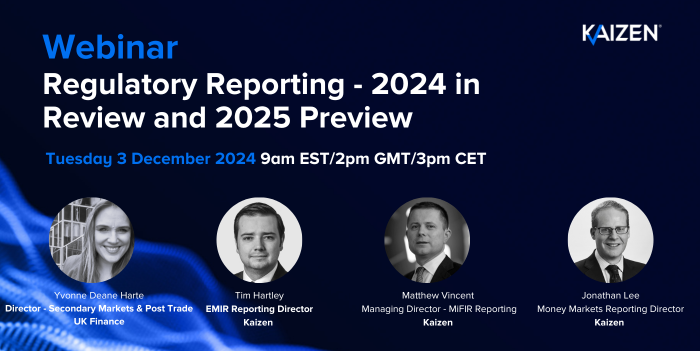
  • WATCH: Regulatory Reporting – 2024 in Review, 2025 Preview

    WATCH: Regulatory Reporting – 2024 in Review, 2025 Preview

    On MiFIR transaction reporting, there were significant changes announced by ESMA and a new discussion paper launched by the FCA, and new regimes are being introduced in the money markets space.

    Watch Kaizen’s regulatory experts as they reflect on 2024, and look ahead to what’s in store for regulatory reporting in 2025.

    The webinar was hosted by Yvonne Deane Harte, Director, Secondary Markets & Post-Trade at UK Finance and featured:

    Please note, we accept business emails only.

    For any queries relating to the upcoming regulatory changes or to speak to one of our subject matter experts, please contact us.

  • What’s on the horizon for Securities Financing Transaction (SFT) Reporting in 2025?

    What’s on the horizon for Securities Financing Transaction (SFT) Reporting in 2025?

    Approaching the final act of 2024, the world remains in a perilous place, economic growth is faltering, interest rates have been slow to ease but inflation also remains sticky and prone to energy price shocks. In this environment, money market and securities finance transaction (SFT) reporting moves closer to the top of the Treasury’s and Central Bank’s toolkit as they seek to establish the effectiveness and transmission of monetary policy together with any signs of external factors impacting the order and robustness of broader capital markets.

    New US regimes and SFTR Review

    2024 will draw to a close in the money markets and SFT reporting space with the introduction of daily US Non-Centrally Cleared Bilateral Repo Market reporting to the Office of Financial Research (OFR) for major securities/government bond brokers and dealers, on 2 December. OFR Phase 2 on 1 April 2025 will see reporting expanded to cover ‘Category 2’ major ‘Buyside’ Non-Centrally Cleared Bilateral Repo market participants.

    Elsewhere though, 2025 looks potentially like a year of delays. US securities lending reporting under SEC 10c-1a and administered by FINRA as Rule 6500 SLATE reporting is politically a very hot potato, facing a number of amendments and potential delays with the SEC postponing their approval of the FINRA rule until January, corresponding with Gary Gensler’s departure. Additionally, US trade associations are potentially launching other legal challenges. It might still go ahead on 2 January 2026 though!

    The SFTR Review also appears to be subject to further delay, with no sign of it appearing on the ESMA 2025 schedule of work.

    Where to focus for 2025

    However, while many eyes may be pointing at the shiny new regulations, in practical reality, it’s the seasoned, mature regulatory reporting regimes that compliance officers want to worry about.

    Regulators make allowances for new regulations, they let them bed in and teething troubles are tolerated – not so once a regime has been live for five years.    

    Unfortunately, almost five years in, data quality in the SFTR space continues to let it down. It has perhaps not helped that (new UK validation rules – live on 25 November 2024 aside – which are largely a replay of ESMA’s March 2023 rules), SFTR has been somewhat untouched for an extended period now. The last SFTR Q&A was published in June 2023.

    Of late, we’ve heard anecdotes of new NCAs entering into the fray with challenging questions and investigations following concerted pressure from ESMA and potential signs of a delegated reporting timebomb too. While the SFTR Review may be subject to further delay, regulators such as the UK FCA have been keen to draw our attention to SFTR.

    FCA Market Watch 81 – what does it mean for SFTR?

    Earlier this month, the FCA released Market Watch 81 which primarily focused on MiFID transaction reporting requirements however it made it clear that it would also be of interest to firms subject to UK EMIR and SFTR. 

    The newsletter contains a rich seam of statements that in our anecdotal experience apply equally to SFTR. To let Market Watch do the talking…

    “We continue to identify incomplete and inaccurate transaction reports,” with complaints about issues re-occurring post remediation, poor change management, data governance, control frameworks and oversight.

    Perhaps most poignant of all from an SFTR perspective was the statement:

    “Data quality issues can also emerge where change processes are outsourced to third parties, and there is inadequate oversight over the scope of deliverables. This can be worsened by the absence of transaction reporting subject matter expertise within the firm.”

    Furthermore: “We have identified firms who have excluded services and data provided by third parties from their control and reconciliation framework. This can create gaps in monitoring and prevent firms from identifying issues originating outside the firm.”

    The FCA also stated:

    “Limited compliance oversight over transaction reporting can hinder firms from improving their reporting processes through independent advice and challenge.”

    Of course, a layer of independent quality assurance through regulatory testing (such as our ReportShield Accuracy Testing) would ensure that regulatory reports are subject to a fully independent challenge.

    “Staff turnover and absences can also affect data quality. We have identified data quality issues including failure to report transactions where key staff dependencies exist, and there are not clear policies and procedures to manage reporting in their absence.”

    Again, outsourcing elements of your controls environment and oversight not only helps counteract key person dependencies but also mitigates against any inadequacies in policies, procedures and change management.  

    Don’t rest on your laurels

    Governments and regulators are currently on edge for understandable reasons. Excuses for incomplete or inaccurate reporting of the very regulations (SFTR, EMIR, CFTC etc) implemented in mitigation of the global financial crisis have been exhausted. The onus is now on firms to ensure complete, accurate and timely reporting or start to face the wrath of emboldened regulators across Europe, North America and globally. This is no time for resting on your laurels.  

    Our ReportShield solutions are designed to directly address the controls issued raised in Market Watch 81 – to request a demo or for a conversation with one of our regulatory experts, please get in touch.

  • WATCH: Is your regulatory reporting valid but wrong?

    WATCH: Is your regulatory reporting valid but wrong?

    A large majority of the reports that Kaizen tests are ‘valid but wrong’. The valid but wrong scenario occurs when reports pass the validation rules by the regulator or intermediary entity (ARM, SDR or TR) but the data within the reports is inaccurate. 

    Watch our video above to find out more or contact us for a free healthcheck to find out how many of your reports are valid but wrong.


  • Commentary – managing the upcoming money markets reporting obligations

    Commentary – managing the upcoming money markets reporting obligations

    Kaizen’s Money Markets Reporting Director, Jonathan Lee shares his insights on the upcoming reporting obligations in the SFT and money markets reporting space in a commentary written for the Securities Finance Times and Asset Servicing Times.

    “We are entering a period of significant change in the money markets and securities financing regulatory reporting space. Extraterritoriality in the FINRA SLATE rules for US securities lending, the likelihood of growing requirements in Europe in the SFTR Review/Refit, further new but smaller requirements for uncleared bilateral repo reporting to the OFR in the US, and the potential for further global and European divergence, are all likely to feature over the next couple of years.”

    Read the full article on the Securities Financing Times Website. 

  • Money Market Statistical Reporting (MMSR) regime expansion goes live

    Money Market Statistical Reporting (MMSR) regime expansion goes live

    As of July 1, 2024, the European Central Bank (ECB) has implemented revised guidelines for Money Markets Statistical Reporting (MMSR). Twenty-four new firms, including some of the world’s largest and global systemically important banks (G-SIBs), are joining the 46 that are already navigating MMSR, bringing the total to 70 entities. Post-Brexit, these institutions have become key players in the EU money markets, making their inclusion essential.

    Why MMSR matters

    MMSR is crucial in providing data on daily money market transactions. This isn’t just about ticking regulatory boxes – this is about giving the ECB the insights it needs to steer the Eurozone economy through monetary policy. Secured and unsecured transactions, foreign exchange swaps, overnight index swaps (OIS) – the ECB relies on this granular data to make decisions that impact us all.

    What are the consequence of getting it wrong?

    The ECB expects accuracy, promptness, and transparency. If firms don’t comply, the consequences can be severe – hefty fines can be imposed (as much as 10% of a bank’s total annual turnover) and there can be reputational damage too. Inaccurate reporting can ripple out, leading to flawed policy decisions that affect the entire economy. The ECB’s data quality checks ensure that firms maintain high standards, but the responsibility ultimately lies with the reporting firms.

    What errors do we find?

    At Kaizen, our testing of the accuracy of MMSR data has uncovered common issues such as incorrect rates, misinterpretation between collateral nominal and transaction nominal, inaccurate haircuts, misreported execution times, and variations in FX forward points and OIS rates. These errors can stem from manual mistakes, system glitches, or misinterpretations of the guidelines. Identifying and correcting these issues is essential for maintaining the integrity of MMSR data.

    Are you ready?

    The inclusion of 24 new firms into the MMSR fold is a significant development. The enhanced dataset arising from the additional firms’ reporting will offer a richer, more diverse view of the market but also ramps up the pressure on firms to deliver good quality reports. For new reporting agents, this means upgrading systems, implementing new validation processes, and ensuring staff are up to speed.

    At Kaizen, our ReportShield™ quality assurance services are designed to help you navigate these changes. Combining the deep expertise of our regulatory experts with advanced technology, our solutions provide robust controls, continuous independent testing, and validation of submitted data. We leave no stone unturned, meticulously testing every data field on every report.

    Final thoughts

    Today marks a new era in MMSR reporting. The revised guidelines present challenges and opportunities for firms.  The expanded scope necessitates a renewed focus on data quality and firms’ control frameworks to ensure they are meeting the new requirements.

    Additional insights 

  • US OFR bilateral uncleared repo reporting – playing catch-up or saving the greatest till last?

    US OFR bilateral uncleared repo reporting – playing catch-up or saving the greatest till last?

    The market has been taken by surprise by the 2 December 2024 go live date for the new OFR Bilateral Uncleared Repo Reporting regime. Earlier this month, the OFR (Office of Financial Research) of the US Treasury adopted the non-centrally cleared bilateral repo (NCCBR) final rule.

    Largest segment of the US repo market comes under scrutiny

    In the headline of this blog, I say ‘the greatest’ because at $US2 trillion outstanding commitments per day, this is the largest of the four segments of the US repo market and by extension, the US SFT market overall as well. It is also the second biggest single SFT market in the world (after the EU bilateral uncleared repo market). Despite its size, this market remains rather opaque, something that the OFR is finally looking to address.  

    While the activities in the US cleared repo and triparty repo markets are already captured by US regulators, the securities lending market (where reporting commences in 2026) and non-centrally cleared bilateral repo (NCCBR) markets remain under-scrutinised. This became a particular concern following the spike in repo rates that occurred in September 2019 and also in relation to the sharp drop in US Treasury prices and further spike in repo rates in March 2020. US regulators continue to harbour major concerns about collateral risks given the prevalence of lower quality non-Fedwire eligible collateral. They are also concerned about the amount of cash borrowing the uncleared bilateral markets offer to highly leveraged entities such as hedge funds.        

    Background to the final rule

    The OFR is wasting no time in closing out this gap, albeit more than nine years after the seminal Financial Stability Board (FSB) paper ‘Standards and Processes for Global Securities Financing Data Collection and Aggregation‘, and four and a half years after SFTR go-live in Europe.

    We had a pilot reporting exercise from the OFR in June 2022, followed by the publication of proposed rulemaking for the collection of NCCBR data in January 2023 and a 60 day consultation ending in March 2023 – then radio-silence!  Then on 6 May 2024, the OFR published the final rule along with reporting instructions, technical guidance and a fact sheet on reporting. 

    Shock announcement 

    Taking the market by surprise, they have sprung a 2 December 2024 reporting go-live date upon us (150 days after the effective date of 5 July 2024) for ‘Category 1’ covered reporters. These include securities brokers, securities dealers, government securities brokers and government securities dealers with outstanding commitments to borrow cash and extend guarantees in NCCBR transactions with counterparties every business day during the prior quarter of $US10 billion. This captures approximately 40 firms.

    Category 2 reporters are required to comply 120 days later from 1 April 2025. Category 2 reporters comprise of any financial companies that are not securities or government securities brokers or dealers with over $US1 billion in assets or under management whose average daily commitments in NCCBR transactions are over $US10 billion in each of the business days in the prior calendar quarter. Category 2 will routinely capture relatively few firms but nevertheless, those potentially coming into scope will be expected to re-test themselves for eligibility each quarter.

    Reporting requirements 

    The very aggressive deadline aside, surveying the reporting itself, it looks eminently sensible.  It is essentially daily repo position reporting of all new transactions, existing transactions that remain open and any transactions opened and closed on the same business day.       

    What’s in scope?

    The scope will include bilateral uncleared repos under (but not limited to) Master Repurchase Agreements (MRA), Global Master Repurchase Agreements (GMRA) or transactions subject to the provisions of 11 U.S.C. 559. Following the consultation regarding the proposed rule, sell/buy-back transactions have also been brought into scope. However, transactions under Securities Lending Agreements (SLA), Master Securities Lending Agreements (MSLA) or Global Master Securities lending Agreements (GMSLA) not considered as repurchase agreements, are expressly out of scope, acknowledging that these will be captured imminently under the FINRA SLATE regime under the SEC 10c-1a regulation. Repos associated with the execution of commercial mortgage loans or the initial securitisation of a residential mortgage loan are also out of scope.    

    Reports comprise 32 fields

    Reporting comprises of 32 data fields by 11am on Trade Date +1 (T+1) Eastern time, following a trading day that runs from 6pm on T-1 to 6pm on T. Reporting shuns the needless complexity of ISO 20022 XML for more human-readable TXT or CSV, to be submitted to the OFR’s Data Collection Utility (DCU). The only lifecycle / action type required is the need to requirement to resubmit a day’s complete submission should OFR enquiries result in the identification of an error.

    Maybe all SFT reporting should be like this! The ability for regulators to survey the latest activities and current SFT position of firms on a daily basis without the need for a complex set of reportable actions, data tables and in excess of 100 fields seems admirable. The only notable limitation may be the lack of availability of collateral reuse data.      

    If you are concerned about your reporting obligations under the OFR’s Uncleared Bilateral Repo Reporting requirements, FINRA ‘SLATE’ SEC 10c-1 for securities lending, or other global money market reporting obligations generally, please get in touch.


  • Jonathan Lee on the challenges of SEC’s Rule 10c-1a and the OFR Final Rule

    Jonathan Lee on the challenges of SEC’s Rule 10c-1a and the OFR Final Rule

    At this year’s Securities Finance Symposium (SFT) held in Boston, Kaizen’s Money Markets Reporting Director Jonathan Lee took part in a panel discussing the challenges that firms face with the introduction of the SEC Rule10c-1a and the Office of Financial Research’s (OFR) final rule which was adopted on 6 May.

    “Firms have got a very short space of time to implement what’s going to be highly scrutinised reporting. This won’t just be in the US, but on a global basis. It’s very much front and centre of systemic risk,” said Jonathan. 

    Read the full article on the SFT’s website.


  • SEC Rule10c-1 and FINRA’s Securities Lending Transparency Engine (SLATE)

    SEC Rule10c-1 and FINRA’s Securities Lending Transparency Engine (SLATE)

    Securities Loan? Put it on the SLATE

    The Financial Industry Regulatory Authority (FINRA) published a proposed rule change to adopt the FINRA Rule 6500 Series (Securities Lending and Transparency Engine) ‘SLATE’ on 1 May 2024.

    US Securities Lending Reporting Takes Shape

    SLATE proposals take the SEC’s Final Rule 10c-1a of 13 October 2023 and start to map out what the securities lending transparency regime will look like in the USA once it goes live on 2 January 2026 (assuming no delay by the SEC). This in turn will lead to the publication of individual loan and aggregated securities lending data by FINRA from 2 April 2026. The FINRA rule is subject to a consultation, albeit scheduled to end on 28 May – a mere 21 days after its appearance in the Federal Register. At this stage, we have quite a detailed text outline but no schemas, validation rules or exacting field specifications.

    Requirements for Trade Reporting ++

    The industry has been somewhat surprised by the proposed rule. What first appeared ahead of the FINRA announcement to be simple trade reporting of approximately 12 data elements is shaping up to be a great deal more complex and expensive to implement and report under. This is end of day transaction and lifecycle reporting (on T) by the lender or their agent and subsequent significant loan transparency on T+1. 

    Elements of the scope remain TBC

    The exact scope, potential extra-territoriality and potential dual reporting (to FINRA and the OFR) remain somewhat uncertain. FINRA have identified 609 ‘Covered persons’ who will need to register and report to SLATE, broken down as 434 persons effecting a loan as lender without intermediary, 34 broker dealers borrowing excess margin securities, 4 broker dealer intermediaries, 31 non-broker intermediaries, 97 broker dealers acting as reporting agents and 9 clearing agencies acting as reporting agents. There is no further detail as to who they are or how they came to this estimate.

    Devil will be in the detail regarding reporting taxonomy

    The reporting requirements break down into around 15 public data fields, together with confidential fields relating to identifiers for parties to the loan, indications where securities are sourced from broker/dealer inventory and whether the loan is being used to close out a fail. Depending upon how you count them, we can see effectively up to 45 reportable fields.

    It is the conditional fields (referred to as modifiers and identifiers), full disclosure of all lifecycle events with sequencing, the need to report all modifications (changes and terminations) and the requirement to ingest FINRA generated unique trade identifiers (UTI) and reuse them for all subsequent lifecycle reporting that ramp up the complexity.

    Same day reporting

    Unfortunately for “covered person” reporters, FINRA requires not only the end of day snapshot of any modification but individual reports for each and every change to the terms of the transaction. All by 8pm ET on trade date (if ‘effected’ by 7:45pm ET).

    The modifiers and identifiers required are: Exclusive Arrangements (the lender has with a borrower or intermediary), Loan to Affiliate, Unsettled Loan, Terminated Loan and Rate or Fee Adjustment. To an SFTR veteran, these have the look and feel of counterparty fields in the case of the first two, an error action type (where the loan ultimately wasn’t good), a termination report and a modification of the rebate rate field or lending fee field. It may make the reporting more intuitive to frame these as optional fields (where applicable) and action types (new, modify, error or terminate) or similar, rather than “modifiers and identifiers.”

    Security Lending Data Published T+1

    The public data will be shared by FINRA during the morning of T+1 (excluding the loan amount) at both the individual loan level and in the form of daily loan statistics (e.g. aggregate loan activity and the distribution of loan rates). This data will incorporate both new loans and loan modifications. On T+20, loan amounts will also be shared. This data will be on the FINRA website free of charge for personal, non-commercial use only. For other uses, FINRA will require fees to obtain SLATE data.   

    Reporting requirements exceed remit and could jeopardize effective transparency

    The Financial Stability Board’s (FSB) 2015 proposals around securities financing data collection globally generally were to focus on periodic, settled, position level reporting. The primary objective here (and the substance behind the majority of the c.2000 consultation responses received by the SEC) was to provide greater retail level transparency around the securities lending market and how this market in turn facilitates short sellers in the US equity market. By insisting on pre-settlement trade level data, every modification, incorporating loans that never actually conclude and the modifiers and identifiers (rather than simply excluding biased data from the daily tape) runs the risk of blinding the public with science rather than in providing an invaluable level playing field of transparency with enhanced competition.

    If you are concerned about your reporting obligations under SEC 10c-1, the OFR’s Uncleared Bilateral Repo Reporting requirements or other global money market reporting obligations generally, please get in touch.

  • EMIR Refit implications for the SFTR Review

    EMIR Refit implications for the SFTR Review

    With the go live of EMIR Refit this week, ESMA’s attentions will surely turn next to what to do about SFTR. Next year, SFTR will be five years post-implementation and it will be time for the delayed SFTR Review to commence.

    Having studied the EMIR Refit, it’s apparent that quite a few of the changes were piloted by the SFTR introduction in 2020. Lessons learned by ESMA from the original EMIR regulation and implementation subsequently fed through to SFTR. And it seems likely that many of the developments rolled out in the EMIR Refit will find their way into the SFTR Review.

    Opposite directions

    As a bit of an EMIR outsider, it’s somewhat alarming the extent to which EU regulation and the industry dynamic are moving in opposite directions. The industry is focused on adopting standards, the Regulatory Oversight Committee’s (ROC) common data elements, common booking models, common domain models (CDM), simplification and far greater automation through machine reading and blockchain. CDMs focus on non-proprietary, non-licensed fundamental transaction, position and lifecycle data, an approach that is about achieving fully matched, perfectly replicable trade data with relatively few fields and no complications. CDMs should in theory dramatically reduce the number of manual touchpoints on any trade, significantly reducing operational costs.

    However EU regulators are looking for more data, extensive embellishment and enrichment, to not only achieve a truly forensic analysis of a firm’s balance sheet, processes and operations, but also to negate the need for them to hold any reference or static data at all. Indeed, thinking that 155 fields for SFTR was a lot, we now face up to 203 fields under EMIR Refit (a 65% increase on the original). There are ‘just’ 110 common data elements listed by the ROC…

    Which EMIR Refit elements are likely to be incorporated into the SFTR Review?

    • Bilateral variation margin reporting. Back in 2016 at the Paris hearings on SFTR technical standards, I suggested that there be a separate table to report bilateral variation margins for repo transactions, as ESMA insisted that Table 3, the Margin Table, was exclusively for CCP margins. This motion wasn’t carried and consequently, it is evident that SFTR bilateral variation margin reporting is currently flawed and frequently underreported. The approach required under SFTR v1 of providing trade level collateral updates with UTIs and bilateral variation margin collateral updates without UTIs does not appear to ever have been fully understood. Therefore, the EMIR Refit change that incorporates both CCP margins together with bilateral variation margining in the same margin table would be a welcome step forward, removing confusion and enhancing regulatory certainty.
    • Executing Agent field. The introduction of an executing agent field (as per EMIR Refit) would also significantly enhance the trade repository reconciliation process, particularly when reporting or facing funds as one of the counterparties. This should mitigate current misreporting, where the agent lender or broker fields are often misused to represent fund managers.
    • Intra-group trade identifier. Another party to the transaction field that may carry from EMIR is an Intra-group trade identifier. This omission was something highlighted in the recent ESMA Market Report on EU Securities Financing Transactions Markets 2024. While not strictly necessary (intra-group entities can be identified by their LEI), it would further reduce the burden on regulators to establish this relationship themselves. 
    • Waterfall guidance on UTI. EMIR Refit was written post-Brexit and consequently, they have taken account of the fact that many transactions in Europe today are single sided, being cross-jurisdictional. Therefore, there is a new waterfall providing guidance about responsibility to generate and share unique transaction identifiers (UTIs) when trading across borders. This measure should reduce late reporting (where there is uncertainty about UTI generation and sharing and consequently late reporting) and again provide clearer direction and certainty for reporting counterparties.   
    • Effective dates are another EMIR Refit feature that are likely to benefit SFTR.  At present the need to delay reports until agreed contractual modifications take effect certainly presents a timing challenge to complete and accurate reporting. The revive action type (allowing the reopening of matured or terminated/cancelled by mistake trades) may also be broadly welcomed, aiding in dealing with trades failing over their maturity date/end date for example.
    • Additional EMIR Refit changes that are likely to be mooted include event types complementing certain action types, package identifiers (useful for identifying products such as collateral swaps) and the requirement to report the nature and corporate sector of the other counterparty in addition to the reporting counterparty.

    There is no better way to prepare for SFTR 2 than to get your house in order for SFTR 1. For help addressing your SFTR data quality concerns, please get in touch.

  • Money market regulation – what’s in store for 2024/25?

    Money market regulation – what’s in store for 2024/25?

    In the world of transaction reporting, we’re always slave to events – economic crises, major fines, unexpected guidelines or Q&As. However, the path of wholesale regulatory development, new regulations and change tends to be slightly better signposted with official announcements, effective dates, regulations coming into force and reporting go-live dates. Relative to the world of derivatives, the regulatory landscape for money markets and SFTR looks significantly quieter in 2024.

    However, this may prove to be the calm before the storm. 2025 and 2026 are set to host two brand new reporting regimes in the USA and it’s highly likely that these will coincide with the onset of the SFTR Review and subsequent Refit.  

    SEC 10c-1a Securities Lending Reporting

    Coming back to 2024: The next known change is the US deadline for the Financial Industry Regulatory Authority (FINRA), the sole Registered National Securities Association (RNSA) to publish implementation rules for SEC 10c-1a Securities Lending reporting. According to the proscribed timeline, this must occur by 2 May 2024. The clock will also be ticking for reporting itself to commence on 2 January 2026. These rules will set out how US securities lenders or their agents will be required to report 12 data elements relating to those loans. We will discover just how many reportable fields those 12 data elements translate into (I would suggest that while not of SFTR proportions it’s likely to be rather more than 12). In instances where a covered securities loan consists of a broker or dealer borrowing fully paid or excess margin securities, only the broker or dealer (the borrower) is required to report and not the lender. The final deadline is 2 April 2026, when FINRA will be required to publish aggregated transaction activity and the distribution of loan rates for each security.  

    OFR’s Bilateral Uncleared Repo Reporting

    The timing is less certain on the next most imminent regulation – it’s now more than 12 months since a 60-day consultation was announced by the Office of Financial Research (OFR) department of the US Treasury on proposed data collection for the bilateral uncleared repo market. In spite of this, we still await the final rule which remains imminent. This regime was successfully piloted in 2022. The reporting requirements are more extensive than 10c-1 and are likely to be a major burden to plan, build, implement and control ahead of a 2025 or 2026 go-live. There are 33 proposed data elements including haircut, rate and optionality. Mooted by the OFR as “The last segment of the US SFT market lacking a transaction-level data source.” They expect approximately 40 reporting institutions, made up of brokers, dealers and other financial companies with large exposures ($10bn+) to the non-centrally cleared bilateral repo market to have to report daily to the OFR.       

    Expansion of Money Market Statistical Reporting (MMSR) in Europe

    Returning to Europe: On 1 July 2024, an additional 24 banks will add to the ranks of Money Market Statistical Reporting (MMSR) institutions, on top of the 45 existing reporters. This follows the first major extension of scope. Following LIBOR decommissioning and a less benign interest rate environment, the regulation has seen greater scrutiny from the European System of Central Banks members in recent months. The new reporters were expected to implement a soft go-live at the beginning of 2024 ahead of a more formal adoption in July. These reports, due 7am CET on T+1 pertain to the four money market segments of Unsecured, Secured, FX Swaps and OIS markets. As the sole mechanism for calculating the benchmark Euro Short Term Rate (€STR) and the principle means for the ECB to monitor the market transmission of monetary policy, it is very apparent that data quality is critical and effective controls, paramount.

    Closer scrutiny on SFTR in 2024

    Last, but certainly not least, ESMA’s SFTR review and subsequent Refit planning is not expected until 2025. Nevertheless, a number of National Competent Authorities (NCAs) appear to be paying closer attention to data quality and compliance in 2024 as SFTR takes its place as a more mature and topical regulation in the current geo-political environment.

    • If you have any concerns about existing or impending money market/securities financing regulation on either side of the Atlantic, please do not hesitate to get in touch with our team of regulatory experts at Kaizen.   
  • Regulatory Reporting – 2024

    Regulatory Reporting – 2024

    Watch our webinar replay to find out what you need to do to stay on top of 2024’s unprecedented regulatory change.

    • Proposed changes to MiFIR Transaction and Post-Trade Transparency Reporting
    • EMIR Refit go live in the EU and UK
    • APAC derivative reporting rewrites and global harmonisation of reporting rules
    • MMSR expansion and new rules on securities lending and uncleared bilateral repo in the US
    • Proposed changes to CFTC Part 43 and 45 reporting.

    Speakers

    Hosted by Kaizen’s Co-Founder and Managing Director Ian Rennie, the webinar features: 

    For any queries relating to the webinar or to speak to one of our subject matter experts, please contact us.

  • Kaizen’s CEO Dario Crispini speaks to FinTech Global

    Kaizen’s CEO Dario Crispini speaks to FinTech Global

    Following Kaizen’s inclusion in the 2024 RegTech100 listing, our CEO Dario Crispini spoke to FinTech Global about the key challenges facing the industry today, including staying connected in a post-Covid world and how the Kaizen Community is bringing compliance professionals together by combining technology and regulatory expertise with in-person networking opportunities.
     

    “We’re trying to have more touch points across our client base and use our position in the industry to bring clients together so they can share their war stories and their pain points… There is an appetite to get back together and to start chatting and networking with peers. We are facilitating that.”

    Read more

  • Kaizen selected as RegTech100 Company

    Kaizen selected as RegTech100 Company

    London, 6 December 2023 – Leading regulatory technology firm, Kaizen today announced that it has been selected for the RegTech 100 listing, an exclusive directory of the world’s leading RegTech companies, for the fourth time. The RegTech100 companies are chosen by a panel of analysts and industry experts as the world’s most innovative and disruptive businesses in the regulatory technology space that are seeking to help financial institutions manage the fast-paced changes brought on by ongoing regulatory updates and technological advances.

    Chosen from a longlist of over 1,400 companies worldwide, Kaizen was selected for its RegTech solutions which provide a network of services for the compliance and reporting community on one platform.

    Dario Crispini, CEO of Kaizen, said,

    “We are very proud to have been selected as a RegTech100 company for the fourth time and to be recognised for the range of solutions we now offer our clients. Our aim is to make working with regulation easy and cost effective and ensure clients stay on top of their compliance obligations through the introduction of new technologies and product innovation.”

    RegTech Analyst director of research Mariyan Dimitrov said, “With the tougher economic climate and the continued rise of AI, financial institutions are re-examining the compliance software’s true cost, namely whether a given RegTech solution truly will free up compliance staff for higher-level tasks and whether the software can scale, adapt, and get implemented efficiently. This year’s RegTech100 list highlights the leading companies in areas such as information security, compliance, risk management and fraud prevention working on the forefront of innovation and new AI implementations who have demonstrated a strong track record delivering regulatory and operational improvements in financial services.”

    Since last being listed as a RegTech 100 company, Kaizen has expanded its product offering. Our ReportShield™ suite of regulatory reporting assurance services, which includes Kaizen’s award-winning Accuracy Testing, is now complemented by solutions for monitoring and reporting of Shareholding Disclosures, Trade and Communications Surveillance, Research Management, and Single Rulebook, a digital platform for managing regulatory rules.

    (ends)

    • For more information, please contact James Dunseath, Communications Advisor, on +44 (0) 7557 955795 or media@kaizenreporting.com.
  • WATCH: Why Money Market Statistical Reporting Matters

    WATCH: Why Money Market Statistical Reporting Matters

    Webinar summary

    • Why MMSR reporting is important to regulators
    • What the reporting requirements are and common errors
    • The consequences of getting your reporting wrong
    • Are you one of the 24 firms now in scope for MMSR?
    • How to put the right controls in place.

    Speakers

    • Ian Rennie, Managing Director, Kaizen
    • Jonathan Lee, Money Markets Reporting Director, Kaizen
    • Faizal Shaikh, Money Markets Reporting Director, Kaizen
    • Danny Corrigan, London Reporting House


    • For any queries relating to the webinar or to speak to one of our subject matter experts, please contact us.


  • Unveiling key changes in ECB’s MMSR – a closer look

    Unveiling key changes in ECB’s MMSR – a closer look

    The European Central Bank (ECB) recently released revised guidelines for Money Markets Statistical Reporting (MMSR), bringing some key changes to the reporting framework. This comes hot on the heels of an earlier announcement by the ECB that it was expanding the scope of the regime, including 24 new firms that now required to report from next year.

    What do the revised guidelines say?

    • To improve efficiency and reduce reporting burden, transactions below EUR 500,000 nominal amount will not be reported across all money market segments and sectors, to maintain focus on significant transactions.                             
    • Only ‘reverse stock loans’ or ‘reverse securities loans’ economically equivalent to a repurchase agreement, are reportable, focusing on cash-driven transactions with securities loaned. Other SLEBs are out of scope.
    • To simplify and streamline Novations Reporting, ‘RELATED PROPRIETARY TRANSACTION IDENTIFICATION’ and ‘NOVATION STATUS’ fields will only need to be reported in the first rollover after novation, unless another novation occurs.
    • Reporting of UTI in all four segments is strongly advocated however still not enforced; for FX Swaps, the far leg’s UTI needs to be reported if they differ for accurate identification of these transactions.
    • ‘REFERENCE RATE INDICES ISIN CODES’ list truncated; EONIA and LIBOR indices ISINs have been removed. These revisions align with the wider adoption of the €STR benchmark interest rate and the ongoing decommissioning of EURIBOR and LIBOR indices.

    Impact on reporting firms

    Existing reporting firms must adjust their reporting logic to align with the revised guidelines, while the 24 new firms in scope will need to comply with MMSR regulations from July 1 2024, or can adopt early with prior notification to ECB. Adherence to these guidelines is vital for correct and accurate data submission, enabling the daily calculation of the €STR benchmark rate.

    Focus on controls and data quality

    The ECB emphasises the importance of controls and data quality. These guidelines aim to enhance the understanding of money markets, facilitate timely surveillance, improve information on monetary policy transmission, and provide reliable and transparent data to market participants. They guide reporting agents towards accurate reporting and increased market transparency. 

    The revised guidelines represent a significant step in the quest for data accuracy and transparency in money markets. Together with the expanded number of reporting firms, streamlined requirements, and a strong focus on controls and data quality, the ECB aims to bolster market surveillance and strengthen monetary policy transmission. Reporting firms, both existing and new, play a crucial role in this journey towards data excellence, ensuring the integrity of the money markets and providing valuable insights for market participants and policymakers alike.

    • Read the revised guidelines on the ECB’s website
    • For a discussion with Faizal or one of our regulatory experts about your MMSR reporting requirements, please contact us.
  • ECB expands Money Markets Statistical Reporting

    ECB expands Money Markets Statistical Reporting

    The European Central Bank (ECB) has announced a significant expansion of its Money Markets Statistical Reporting (MMSR) regime. From 1 July 2024, 24 new institutions will join the ranks of reporting agents for the MMSR dataset. The list includes some prominent financial institutions and another set of top tier institutions in Europe. This expansion promises to enrich the dataset’s diversity and depth.

    The MMSR dataset is a vital repository of transaction-by-transaction data that provides insights into various segments of the Euro money market. This includes secured and unsecured markets, foreign exchange swaps, and overnight index swaps. Perhaps most importantly the euro short-term rate (€STR) is created off the back of the MMSR data.

    At its core, the MMSR dataset serves as a window into the intricacies of the Euro money market. By collecting granular transaction data, the ECB gains a holistic understanding of market dynamics. This wealth of information, in turn, informs the ECB’s monetary policy decisions, enabling them to navigate market complexities effectively.

    Impact on €STR benchmark rate

    The data provided by the new reporting agents will be incorporated into the calculation of the euro short-term rate (€STR). As such, the expanded reporting population will have a direct influence on this crucial benchmark, which serves as a reference rate for various financial transactions.

    The ECB’s decision to add 24 new reporting agents to the Money Markets Statistical Reporting dataset underscores its commitment to maintaining accurate and comprehensive insights into the Euro money market. This expansion aligns with the ECB’s and other global regulators’ efforts to enhance transparency and make well-informed monetary policy decisions based on robust data.

    • View the list of the new reporting agents on the ECB’s website
    • If you would like to discuss any concerns or issues you have with your MMSR reporting please contact us.
  • A Guide: The Importance of Money Market Statistical Reporting (MMSR)

    A Guide: The Importance of Money Market Statistical Reporting (MMSR)

    What is MMSR?

    The Money Market Statistical Reporting (MMSR) regime is the European Central Bank’s (ECB) official and only source of data on daily money market transactions. Accurate reporting of this statistical information is crucial for decision-making at the ECB. This data provides a view of not just collateralised but also the unsecured, FX swaps & overnight index swaps (OIS) elements of the money markets.

    Why is it important?

    The ECB has been particularly keen on monitoring and regulating this aspect of the market, as it directly impacts economic activity across Europe. The regulator relies on MMSR reports to make informed decisions on monetary policy, financial stability, financial regulations and more importantly, the daily Euro benchmark computation of €STR (European Short-Term Rate).

    One of its measurements so far has been the withdrawal of the ECB’s quantitative easing. As the ECB scaled down its bond-buying programme, market participants watched the impact of the decision by tracking the money markets performance.

    What are the consequences of getting it wrong?

    The ECB requires financial institutions to report their data promptly, accurately, and transparently. Additionally, the legislation states the requirement that all statistical data reported is:

    “…tested frequently and adequate data quality checks are implemented by the reporting.”

    If a discrepancy is found, the ECB can impose fines on the institution responsible, ultimately holding them accountable for their actions.

    “ECB and the NCBs carry out frequent data quality checks on submitted reports to assess and question the quality and consistency of the data; Appropriate internal testing procedures and health checks of trading and reporting systems; Early detection of failures and gaps in reporting flows.” Reporting Instructions for the Electronic Transmission of Money Market Statistical Reporting (MMSR), version 3.5. (20 December 2021)

    The repercussions of inaccurate reporting are severe for firms and also have broader long-lasting effects on trust and stability within the financial markets. These issues range from simple errors in reporting to more complicated instances of data misrepresentation.

    Common errors

    Any small discrepancy in reported values can have a ripple effect that can cause significant damage to the economy and the financial industry.

    When testing our clients’ data we see a number of common errors occurring:

    • Enormously high or irrelevant haircuts and spreads
    • Erroneous rates, cash and nominal fields misinterpretation
    • Misreporting on collateral indicators and collateralisation values.

    These errors can lead to a distortion of the true state of the market and paints a completely different picture, undermining the existence of such data-driven and effective benchmark reporting in first place.

    How Kaizen can help

    Financial institutions should regularly test their data to ascertain the production of accurate results. Kaizen’s ReportShield™ quality assurance services have been developed by former regulators and industry specialists to provide firms with robust controls including continuous independent testing and validation of submitted data. Our testing is unique because we test every single data field on every report, so firms can be confident that they’re receiving a comprehensive assessment of their reporting quality.  

    One of our mantras is ‘don’t mark your own homework’ when it comes to your regulatory reporting data. Using an independent specialist provider gives far greater rigour than what can be achieved internally.

    Our services include:

    Final remarks

    Failure to report accurate statistical data creates risk of regulatory fines and reputational damage for the firm involved jeopardising the stability of financial markets. It’s crucial for firms to prioritise the importance of achieving maximum accuracy in their MMSR reporting, both to ensure that the economic environment remains stable and robust in the long run and to avoid serious consequences for the firm. Investment in assurance activities will provide significant cost savings as well as reducing regulatory risks.

    • Do you have the right controls in place for your MMSR reporting? Are you 100% certain on the data quality and accuracy of your reporting?
    • For a discussion with Faizal or one of our regulatory experts about any of the topics above, please contact us.


  • Does your firm have an SMF for trade and transaction reporting?

    Does your firm have an SMF for trade and transaction reporting?

    The Senior Managers and Certification Regime (SM&CR) may be under review but that doesn’t mean it’s not still in place.

    The FCA and PRA recently published a joint discussion paper which asks for feedback on the operational aspects of the SM&CR.  At the same time HM Treasury also published a Call for Evidence seeking views on the legislative aspects of the regime.  This follows the announcement in December 2022 that there would be a review of SM&CR as part of the Edinburgh Reforms.  Responses to the discussion paper are due on 1 June.

    This could not come at a more crucial time for the industry with so much regulatory change afoot with expected divergence in MiFID II reporting, EMIR Refit upcoming, as well as various other rewrites concluding. 

    But in the meantime, we wanted to remind firms of their SM&CR responsibilities. Do firms have a Senior Management Function (SMF) in place for their trade and transaction reporting requirements, accuracy and approvals?  Who is your SMF16?

    SM&CR takes three key elements:

    • Senior Managers Regime – Understanding and mapping out of the SMF responsibilities and consequences of actions, personal accountability
    • Certification regime – Documenting, demonstrating, and certifying that SMFs are suitable and ‘fit & proper’ for the role, with annual assessments. “Have my SMFs been trained?”
    • Conduct Rules – Governance and documentation, procedures & policies that have been brought into line for SM&CR and controls in place for recording the implementations, steps and the decisions made by your firm to comply with the Conduct Rules across all staff within your organisation.

    Kaizen can help firms through the understanding of the accuracy of their regulatory reporting, so SMFs have a valued and independent view of their reporting.  We also provide governance and controls with our structured Control Framework services, designed by former regulators and our industry specialists experts, making sure internal GRC structures and procedures are acceptable.

    Only a few months ago, the FCA issued a Dear CEO letter to wholesale brokers reminding them of their regulatory obligations and to take proactive steps towards ensuring compliance, in particular highlighting that individuals in compliance risk personal liability when something goes wrong under the SM&CR.

    • If you’d like some help getting the right controls in place to ensure your firm meets the requirements of the SM&CR from regulatory reporting perspective, please get in touch.


  • UK gilt market crisis leads regulators to dig deeper

    UK gilt market crisis leads regulators to dig deeper

    Bank of England working paper underlines the importance of getting regulatory reporting right

    The Bank of England’s recently released working paper ‘An anatomy of the 2022 gilt market crisis’ reminds us why regulatory reporting is so crucial to the healthy operation of the financial markets.

    The paper, published in March, is a subject for further debate rather than a policy document. Nevertheless, the production of a 95-page document has clearly been prompted by a very keen interest.

    A quick recap – what happened last year?

    The Bank of England intervened on three separate occasions during September and October 2022 in order to maintain financial stability and prevent pension funds collapsing, following the Kwarteng/Truss ministerial statement, ‘The Growth Plan’ of 23 September 2022.

    The paper’s author identified such extreme concentration in the liability driven investment (LDI) pension insurance industry that just 3 firms were accountable for 70% of UK gilts they were forced to sell to primary dealers in the eye of the storm.

    Rapidly rising interest rates and inflation expectations at this time played havoc with the balance of assets and liabilities at these funds, particularly as real yields plummeted to new extreme negative levels.

    The demands of future pensioners necessitate real, rather than nominal returns, i.e. pension funds need to be able to lock in a certain level of future spending power for their members, irrespective of the future path of inflation. When you discount future liabilities with ever more negative real yields, those liabilities grow alarmingly.

    The LDI pension insurance industry faced the double whammy of significant bond market losses being compounded by margin calls on repo, inflation swap and OIS swap positions, meaning that they had to sell yet more gilts in order to cover these margin calls. Subsequently, the gilt market entered into something of a downward spiral, that it took BoE intervention to bring to a close. 

    What does this mean for regulatory reporting?

    On the first page of this working paper, the author places a quote prominently at the top of the page:

    “It was not quite a Lehman moment. But it got close.”

    (ref: Sep 2022, senior London-based banker).

    One of the outcomes of the last financial crisis was the additional regulatory reporting obligations that were placed on firms to ensure that both prudential and conduct regulators had sufficient transparency of derivative markets, securities financing markets and greater transparency of securities markets.

    This was achieved through the regulatory reporting regimes introduced post-crisis – EMIR, SFTR/MMSR/SMMD (financing & money markets) and a significant broadening of the MiFID transaction reporting requirements via MiFID II.

    These obligations allow regulators to quantify and respond effectively to the macro-systemic risks around solvency, market stability and concentration risks.  The Bank of England has been able to use this data; MiFIR RTS 22 transaction reporting (UK government bond, inflation linked and conventional ‘gilt’ markets), EMIR reporting (inflation & OIS swaps, UK gilt futures) and Sterling Money Market Daily (SMMD) reporting (UK gilt repo market) to produce this.

    Clearly, if the bank’s efforts were thwarted by low quality data stemming from firms’ transaction reports, the firms’ CEO and compliance officers would be the first to hear about it in no uncertain terms! Any reporting errors could lead to costly audits or investigations and potentially substantial fines and reputational damage. Firms need to ensure they have robust controls and procedures in place, including how accurately they report under these regimes.

    • Read the full working paper on the Bank of England’s website
    • If you have concerns about the quality of your transaction reporting under any of the regimes referenced in this blog or for a conversation with Jonathan Lee. Please contact us. 


  • UPDATED: A tale of inflation, solvency & regulatory jeopardy

    UPDATED: A tale of inflation, solvency & regulatory jeopardy

    We first published this article in November 2022 but given current market events, we’re republishing it this week with some updated opening paragraphs. 

    There is a common perception in securities trading that getting the timing right when taking positions in the market is far more difficult than having the right idea to begin with. In hindsight, the below blog, written in November 2022, was a classic example of this. Regulatory concerns I raised five months ago in relation to rising interest rates, badly positioned market counterparties, bond market losses, capital adequacy, solvency issues and fears of contagion were well placed, but four months too early…

    In a similar manner to government preparations for a flu pandemic in 2020, following the 2008-2011 financial crisis, regulators were well prepared for a series of credit events. Unfortunately, the pre-cursor to the current situation is not a credit event but an interest rate event, for which preparations are far less appropriate, regulators simply find themselves looking in the wrong direction. Regulators will be quantifying counterparty exposures, collateral concentrations, leverage, levels of collateralisation and evidence of any further systemic risks. The principal tools for identifying these risks include SFTR, MMSR, SMMD and the likes of PRA Liquidity Reporting. If this data is poor, regulators will be active in their response. For a conversation about your data quality, please contact us.

    ***

    21 November 2022

    The deflation that followed rapid Chinese industrialisation has kept interest rates on a declining and ultimately stagnant path for decades since the 1990s.  In recent years, interest rate and government bond markets could have been politely described as being as dull as ditch water.

    However, as with all things in the market, the trend is your friend, until it isn’t…

    UK Treasury 2050, 0 5/8% Bond Price – theoretically one of the safest investments…

    Source: London Stock Exchange


    Supply chain and booming inflation

    Supply chain issues stemming from Covid, compounded by the emergence of China as a new superpower with massive domestic consumption and to a lesser extent Brexit, saw the price of the long dated UK Gilt (above) dip from around 100 (or par) into the 80s in February 2021. This c.20% fall in value accelerated as war broke out in Ukraine in February 2022 resulting in a dramatic jump in global inflation, with central banks increasing official interest rates in an attempt to ensure that this inflation is transitory. The downward trajectory in UK bond prices troughed with the fallout from the misguided September UK mini-budget on 8 October 2022 when the price hit 36.40 – a fall of 64% in the 2050 Gilt price from its high to low.

    Rates markets have become sexy again

    Higher interest rates, volatility, differing views on inflation expectations all of a sudden bring bond markets, money markets and securities financing markets back into sharp focus. While this may be to the delight of rates traders, it will have been highly unwelcome by the pensions industry as the value of many of their key ‘low risk’ assets are needed to service pensioners of the future evaporated. The moves were so dramatic, some pension funds’ solvency was called into question, resulting in intervention by the Bank of England to support the Gilt market in October.

    What does all this mean for regulatory reporting?

    Central banks and regulators will be on heightened alert to identify large interest rate exposures, the effective transmission of official central bank interest rates, solvency issues, credit default risk and the potential for contagion. Trade and transaction reporting regimes are among their principle means of performing this supervisory oversight and analysis. This will encompass everything from MiFID, SFTR, EMIR, MMSR, SMMD, CFTC, FinfraG, SESTA and many more besides. When faced with something of a crisis or an emergency situation, there is a risk that regulators need to react quickly with punitive measures if their investigative work is thwarted by reporting data quality issues.

    Enforcement has been notable in its absence for a number of years, just don’t be too surprised if this now goes the way of the bond market.         

    • If your money markets reporting (under SFTR, MMSR & SMMD), your bond market transaction reporting (under MiFIR) and your interest rate derivatives reporting (under EMIR, CFTC, MAS & HKMA) is not in perfect order or you are unaware of how good (or bad) it is, please get in touch.
  • WATCH: Kaizen client conference 2023 highlights

    WATCH: Kaizen client conference 2023 highlights

    Watch this video to see highlights of our Kaizen client conference ‘Regulatory Reporting – where are we now?’ at Banking Hall in the heart of the city of London. 

    More than 180 clients, staff and industry experts joined us for an afternoon of all things regulation and reporting. 

    We were delighted to host the FCA’s Markets Reporting Team Manager Tom Soden as the keynote speaker, as well as speakers from HSBC, DTCC, FIA, and our very own Advisory Board and subject matter experts. 

    Panel discussions included:

    • The current regulatory landscape
    • Data quality and the drive to improve it
    • Regulatory reporting in 2023 and beyond.

    A huge thank you to everyone who took part in or attended the event and we look forward to seeing you next year.  For suggestions for topics you’d like us to cover, please get in touch. 

  • Help Kaizen win at the Hedgeweek European Awards 2023

    Help Kaizen win at the Hedgeweek European Awards 2023

    Help us win at the Hedgeweek European Awards 2023 where we have been shortlisted for two awards:

    Best Outsourced Solution

    Best Regulatory Reporting Solution

    The Hedgeweek European Awards 2023 recognise excellence among fund managers and service providers in Europe across a wide range of categories. Voting closes Monday 23 January 2023.

    All you need to do is follow the link below, fill in your details and select yes for question 9, and select Kaizen Reporting for questions 41 and 53.  And press submit! 

    A huge thank you in advance for your support. 

    Vote here


  • Join us at the ISDA AGM in Madrid

    Join us at the ISDA AGM in Madrid

    Join Kaizen at the ISDA 36th AGM on 10-12 May 2022 in Madrid.  Targeted at derivatives professionals, this year’s event will feature high-level keynote speakers with panels on critical topics such as benchmarks, sustainable finance and crypto derivatives.

    We will have an exhibition stand, so come and say hello!

    The event is being held at the Hotel Riu Plaza España.


  • LIBOR decommissioning brings SONIA and SMMD reporting to the fore

    LIBOR decommissioning brings SONIA and SMMD reporting to the fore

    The death knell for GBP LIBOR began to sound back in March this year with the FCA’s announcement that most of the LIBOR tenors will cease to operate by 31 December 2021. LIBOR’s legacy dating back to 1980s was deeply tarnished and irreparably damaged by the LIBOR scandal of the 2000s.

    SONIA and Sterling Money Market Daily reporting

    GBP LIBOR is being replaced by the Sterling Overnight Index Average (SONIA). SONIA is a new regulatory report-driven unsecured benchmark rate for Sterling Money Markets. Sterling Money Market Daily (SMMD) reporting is the dataset used by the Bank of England (BoE) in order to calculate the daily publication of SONIA benchmark interest rates. This reporting also plays a vital role in the BoE’s monetary and financial policy decision making. SMMD reporting aids the BoE in monitoring the economic impact of monetary policy, setting interest rates, market financing and money market surveillance. It provides much needed transparency on short-term wholesale borrowing and lending activities within the Sterling area.

    Accurate reporting is expected by regulators 

    LIBOR reporting became a painful episode for a number of UK financial institutions, with firms and traders finding themselves in the courts.  As a consequence the controls around SMMD reporting are stringent and the penalties for getting it wrong are dissuasive.  The mandatory control requirements for SMMD reporting institutions are framed by the Bank of England Money Markets Code and the FCA’s Senior Managers and Certification Regime (SMCR).

    What are the reporting requirements?

    • Periodic and comprehensive testing of the reporting firm’s data, including reference data
    • Early detection of failures and gaps in reporting flows
    • Controls to ensure both secured and unsecured borrowing and lending activities are captured
    • Governance arrangements to ensure compliance with industry standards and market best practice with a minimum of annual attestation by both a senior compliance officer and a relevant business area representative.

    “Each reporting institution’s internal controls for SMMD Reporting should include comprehensive testing of automated processes and documented change control processes, procedures to detect failure to capture a segment of eligible transactions and failure to exclude non-eligible transactions.”

     – Bank of England, SMMD Reporting Instructions Version 4.6, December 2020

    The global view

    The UK is not alone in phasing out the LIBOR benchmark.  The Euro area is also resorting to new regulatory report-driven overnight unsecured benchmark interest rates.  The Euro Short-Term rate (€STR) has been published since October 2019, driven by transactions reported under the Money Markets Statistical Reporting (MMSR) regulation.  €STR will be officially adopted on 3 January 2022 as the replacement of Euro money markets benchmark superseding the Euro Overnight Index Average (EONIA) and the Euro Interbank Offered Rate (EURIBOR).  Indeed, across the globe new alternative interest rates are replacing LIBOR such as the Office of Financial Research report based Secured Overnight Financing Rate (SOFR) in the US, and the Tokyo Overnight Average Rate (TONA) in Japan.

    The right controls

    What controls does your firm have in place for SMMD and MMSR reporting?  Are you satisfied that your firm meets the requirements listed above? Kaizen can provide quality assurance through regulatory testing of these regimes though our multi-award winning ReportShield™ services, giving you confidence that you are meeting your regulatory obligations. 

    • For a conversation with Faizal or one of our regulatory specialists about putting the right controls in place for SMMD or MMSR reporting, please contact us.