Tag: MiFID II transaction reporting

  • ESMA Call for Evidence: Interim Report Signals Direction of Travel for Transaction Reporting Reform

    ESMA Call for Evidence: Interim Report Signals Direction of Travel for Transaction Reporting Reform

    • ESMA signals major changes ahead for EU transaction reporting rules
    • Scenario 1a is the leading near-term option for reform
    • Change will depend on EU legislative updates

    ESMA has set a course towards a more streamlined and efficient trade and transaction reporting regime across European markets with the publication today of its Interim Report on the Call for Evidence on a comprehensive approach for the simplification of financial transaction reporting.

    It has now been ten months since the Call for Evidence (CfE) was launched and five months since ESMA’s Data Day. The interim report summarises feedback from 108 written responses to the CfE, alongside separate insights gathered from 14 meetings involving 25 stakeholders.

    This is not the end of the consultation process nor even the beginning of the end. Rather, it marks the end of the beginning. There is now clear acknowledgement that the current framework is not where the industry or regulators want it to be and that significant change is inevitable. However, that change will neither be quick nor straightforward.

    Cost-benefit analysis

    Much of the report consolidates existing themes; a restatement of the current challenges, a reframing of the objectives and detailed analysis of stakeholder views on the options originally presented in June 2025.

    Given the need for a thorough cost-benefit analysis (CBA), the report does not yet contain policy recommendations. As a next step, ESMA will continue to engage with market participants, including through an open hearing on 28 May before moving towards final recommendations expected by the middle of the year.

    An independent entity is currently conducting an extensive CBA involving 30 participants across four sectors; buy-side firms, sell-side firms, market infrastructure providers and non-financial corporates. In parallel, ESMA is assessing the impact on the public sector through input from National Competent Authorities (NCAs) and other stakeholders. The results of both CBAs will feed into the Final Report, expected in July 2026.

    Key developments

    Despite its interim nature, several clear markers provide greater certainty regarding the direction of travel, if not the final destination:

    • Of the four scenarios originally presented, Scenario 1b (event-based delineation) and Scenario 2b (expanded “report once”) have been ruled out due to limited support.
    • Scenario 1a is emerging as a viable near-term option; offering limited structural change, lower implementation costs and shorter timelines. It may also serve as a phased pathway towards Scenario 2a, which is increasingly viewed as the longer-term target.

    By way of reminder:

    • Scenario 1a – delineation by instrument: separation of ETDs and OTC derivatives across EMIR and MiFIR, alongside revisions to dual-sided reporting
    • Scenario 2a – “report once”: a unified MiFIR framework incorporating EMIR and SFTR within a single reporting template.

    Stakeholders consistently emphasised the need to reduce the burden associated with dual-sided reporting under both EMIR and SFTR while preserving the principle of maintaining the full scope of information.

    Focus on Scenario 1a “sub-variants”:

    Looking ahead to the Final Report, ESMA is expected to select one of the following of Scenario 1a:

    • Option 1ai (with schema changes):
      Retains the CfE approach with targeted schema modifications to preserve supervisory capabilities (e.g. market abuse monitoring and systemic risk oversight). Includes expansion of mandatory delegated reporting and removal of reconciliation processes linked to dual-sided reporting.
    • Option 1aii (without schema changes, no delineation):
      Focuses on reducing costs associated with dual-sided reporting through expanded delegated reporting, without introducing ETD/OTC delineation.
    • Option 1aiii (without schema changes, with delineation):
      Introduces partial separation between ETDs and OTC derivatives (e.g. excluding EU ETDs from EMIR), while maintaining current MiFIR scope. Also includes expanded delegated reporting and associated reconciliation processes.

    Direction of travel

    Across all variants, there is a consistent trajectory:

    • Expansion of delegated reporting obligations
    • Removal of reconciliation requirements linked to dual-sided reporting
    • Continued emphasis on data quality through mechanisms ensuring alignment between counterparties.

    Importantly, these sub-variants are not alternatives to Scenario 2a, but potential intermediate steps designed to deliver earlier relief while preserving a path towards a more comprehensive “report once” framework.

    While the longer-term end-state of Scenario 2a remains even less precisely defined, ESMA has been clear that intermediate steps will not be reversed as the framework evolves.

    Critical dependency: Level 1 change

    A key takeaway from the report is ESMA’s explicit acknowledgement that meaningful reform will require Level 1 legislative change, “provided that the relevant changes to the Level 1 framework are made to enable ESMA to progress this simplification exercise”.

    This means that while the Final Report will set out policy recommendations, implementation will depend on action by the European Commission, Parliament, and Council. As such, timelines are for now uncertain and will be measured in years. 

    Final thoughts

    We have deliberately avoided speculation at this stage as the Final Report is on the horizon and this is when ESMA will provide more concrete proposals. We need to bear in mind that these will be policy recommendations not legal change. We are also deliberately avoiding specific analysis vis-a-vis the FCA’s agenda in the UK although it is clear that both regulatory bodies have a very similar objective in mind.

    A key difference in the EU is that political will and space in the legislative timetable is also required, whereas the FCA can, for the most part, act without recourse to Parliament.  

    Momentum is building but this will play out over years not months.

    • Read the report in full on ESMA’s website
    • For a conversation with Matthew or one of our regulatory specialists to discuss your regulatory change challenges, please get in touch.
  • EU regulators haven’t paused on reporting quality

    EU regulators haven’t paused on reporting quality

    As we’ve been discussing for almost 12 months now, the EU regulatory reporting change agenda has, for the first time in several years, largely paused while the European Securities and Markets Authority (ESMA) considers the feedback received from its Call for Evidence (June 2025) on simplifying financial reporting. Until that process concludes, the legislative schedule for MiFID II transaction reporting and related frameworks has stalled.

    Some reporting firms may have drawn the wrong conclusion from this pause by thinking that if ESMA has slowed down, regulators across Europe might focus their attention elsewhere and ease their demands for high-quality reporting data. Recent publications from two mainland European regulators suggest otherwise.

    AMF and CSSF both signal continued focus on reporting data quality

    The Autorité des marchés financiers (AMF) in France and the Commission de Surveillance du Secteur Financier (CSSF) in Luxembourg have each released detailed papers outlining how they monitor MiFID II transaction reporting, the common reporting issues they continue to find and what they expect from supervised firms.

    The timing is notable and reinforces that national competent authorities (NCAs) are not standing down while the legislative picture clears. 

    CSSF: systematic testing and quarterly remediation feedback

    The CSSF’s January 2026 press release outlines its ongoing transaction reporting quality testing. As of 1 January 2026, 105 Luxembourg firms are in scope, submitting nearly 24 million reports in 2025. The CSSF applies standardised tests aligned with NCAs and ESMA, alongside its own quarterly analytical summaries (running since 2022), which highlight data inconsistencies firms are expected to investigate and fix.

    Key focus areas include instrument price anomalies, branch field errors affecting NCA routing, inconsistent INTC account MIC usage, cross-checks with Suspicious Transaction and Order Reports (STORs), and reconciliation with Luxembourg Stock Exchange order book data. The CSSF also emphasises that transaction data is increasingly used beyond market abuse monitoring, including for single volume cap calculations, raising the importance of accuracy across all fields.

    AMF: reporting controls named as a 2026 supervisory priority

    France’s AMF has explicitly identified data-quality frameworks and reporting controls as a 2026 supervisory priority. While regulators often highlight data quality issues, it is less common to see formal focus on the underlying processes that produce the data. This suggests that AMF scrutiny may extend beyond outputs to firms’ internal controls.

    Meanwhile some firms with dual reporting obligations in both the UK and EU may have been distracted by the reporting “revolution” (simplification rather than deregulation) currently being contemplated by the UK’s Financial Conduct Authority.

    What this means for reporting firms

    The message from continental Europe is clear: while the legislative process may be sitting in the sidings, regulators are still actively using, monitoring and challenging firms on the quality of their reported data.

    • Regulatory reporting data quality remains a supervisory priority. Regulators continue to emphasise the accuracy, completeness and reliability across MiFID II transaction reporting submissions.
    • Transaction reports are actively monitored.  Validation checks and analytical reviews are running on submitted data on a recurring basis, not just when something has gone wrong.
    • Supervisors conduct systematic data-quality testing, analysing key reporting fields such as instrument identifiers, prices, client identifiers and trading-venue information to detect anomalies.
    • Firms receive regulatory feedback on potential issues. The CSSF distributes quarterly analytical summaries highlighting potential reporting errors that firms are expected to investigate and remediate.
    • Regulators cross-check datasets. Transaction reports are compared with other supervisory data sources such as STORs and trading-venue data to identify inconsistencies.
    • Proactive remediation is expected. Firms are expected to identify and correct reporting issues themselves rather than waiting for regulators to highlight them.
    • Regulatory reporting controls are under scrutiny. The AMF has specifically identified data-quality frameworks and reporting controls as an area of supervisory focus for market intermediaries.
    • High-quality reporting underpins market supervision. Accurate data is essential for market abuse detection, trading-volume monitoring and broader market oversight.
    • The current MiFIR reporting framework remains in force. Despite reform being paused, firms must continue to comply fully with existing reporting obligations without interruption.

    The window to act

    It’s clear that even though the regulatory reform agenda has slowed temporarily, supervisory expectations around reporting quality have not.

    For firms subject to transaction reporting, the time allowed by the pause in the change agenda should be used wisely: this is a practical opportunity to ensure that assurance and controls, monitoring and remediation processes are working as intended.

    The rules, they are going to be “a-changin”, and it’s always easier to navigate change from solid ground than from shifting sand. 

    For a conversation about your transaction reporting data quality or a demo of our assurance platform, please get in touch.

  • Key themes from our webinar: The Regulatory Reporting Landscape in 2026

    Key themes from our webinar: The Regulatory Reporting Landscape in 2026

    Regulatory reporting is entering a new phase as the era of large-scale refits and rewrites across G20 regimes comes to an end but the pressure on firms has not let up.

    In our recent webinar, The Regulatory Reporting Landscape in 2026, our regulatory specialists explored what this shift means in practice and where firms should be focusing their attention now.

    Below are some of the key themes discussed during the session.

    From regulatory change to regulatory scrutiny

    Following several years of extensive refits and rewrites across G20 reporting regimes, regulators are now entering a period of reassessment. While proposals for change are on the table including the Financial Conduct Authority’s (FCA) MiFID transaction reporting consultation and ESMA’s Call for Evidence on reporting simplification, firms are operating in a landscape where scrutiny is increasing.

    Across jurisdictions, regulators are placing increased emphasis on the quality, consistency and usability of reported data. But firms should be aware that ‘simplification does not mean deregulation’. Regulatory data remains key to market abuse detection, financial stability monitoring and risk-based supervision and has an increasing number of other uses, making the quality of reported data even more important. Regulators are actively using today’s data to assess risk and exposure, so firms cannot take their eyes off the ball.

    Diverging timelines but shared direction of travel

    One of the central themes of the webinar discussion was the differing pace of change between the UK and the EU.

    In the EU, the European Markets and Markets Authority (ESMA) is currently in a period of reflection following its Call for Evidence on transaction reporting, with no immediate changes to reporting expected in the short term. By contrast, the UK’s FCA is already moving forward with proposals to simplify MiFID transaction reporting, including descoping certain instruments, removing reporting fields and revisiting existing guidelines.

    Despite these different timelines, the underlying direction of travel is the same: simpler frameworks, fewer data points and reduced costs of reporting, but higher expectations around data quality and controls.

    Data quality is the focus for all regulators and firms

    Live polling during the webinar revealed that improving reporting accuracy is the top priority for firms heading into 2026, ahead of preparing for future regulatory change or investing in new reporting platforms.

    Common reporting errors highlighted in the webinar included:

    • Inconsistent counterparty data

    • Collateral and valuation reporting

    • Reference data quality

    • Repeated or overlapping data fields that do not reconcile cleanly.

    These issues can occur even in mature reporting environments and often only come to light through deeper data quality analysis.

    EMIR and other G20 regimes – expanded requirements

    Although EMIR and other OTC derivative reporting regimes are no longer in rewrite mode, the webinar highlighted that 2026 will still bring operational challenges. There are expanded reconciliation requirements for EMIR, evolving guidance and increased supervisory focus. This means that firms cannot afford to treat these regimes as ‘business as usual’.

    Regulators in North America and APAC are also shifting attention towards data governance, control frameworks, UTI and UPI usage, and delegated reporting oversight.  A recent report from ASIC that reviewed the CFD sector, shows how reporting quality is increasingly being used as a proxy for governance.

    What does this mean for firms? 

    A consistent message throughout the webinar was the importance of knowing your current state. Firms that have a clear understanding of their reporting processes, data lineage and controls will be far better placed to respond to both supervisory scrutiny and future regulatory change.

    Rather than waiting for what comes next, firms should use this period to stabilise business-as-usual reporting, remediate known data issues and strengthen governance foundations.

    Watch the on-demand webinar to hear the full discussion, including regulator-focused insights, live polling results, and audience Q&A with our regulatory reporting specialists.

  • WATCH: Introducing Kaizen’s Regulation Dashboard

    WATCH: Introducing Kaizen’s Regulation Dashboard

    Kaizen’s Regulation Dashboard is new feature of our ReportShield™ solution – providing clients with a complete, single view of their regulatory reporting quality, making it easier to understand where the top errors are, what to prioritise and how data is improving over time.

    What the Regulation Dashboard delivers:

    1. A clear dashboard summary of reporting completeness and accuracy:
      Demonstrating the overall health of regulatory reporting data, without the need to analyse detailed testing outputs.
    2. Top reporting errors at a glance:
      Highlighting the most significant issues instantly and automatically allows firms to prioritise remediation efforts.
    3. Status tracking across reporting data:
      Tracking shows which issues are new, which have been resolved, and which are recurring or trending – all in one dashboard.

    The Regulation Dashboard helps firms:

    • Reduce time spent analysing results
    • Improve confidence in regulatory reporting submissions, and
    • Support better, faster decision-making across compliance, data and ops teams

    Contact us for a demo or a conversation with one of our regulatory experts. 

  • WATCH: The Regulatory Reporting Landscape in 2026

    WATCH: The Regulatory Reporting Landscape in 2026

    Why watch?

    As regulatory reporting enters a new phase in 2026, firms are navigating potential changes to reporting data alongside increased regulatory scrutiny. The session provides regulatory reporting and compliance professionals with the insights needed to align their 2026/27 reporting with regulatory expectations.

    ● Audit-ready insights: Understand the areas regulators are likely to target this year.

    ● Multi-jurisdictional updates: A one-stop briefing on MiFIR Transaction Reporting, EMIR, ASIC, MAS, HKMA and North American developments.

    ● Money Markets in focus: How to prepare for heightened transparency in short-term liquidity reporting.

    ● Expert Q&A: Get direct answers to your most pressing reporting challenges directly from Kaizen’s subject matter experts.

    Speakers:

  • FCA Transaction Reporting Update: Proposed Key Changes in CP25/32

    FCA Transaction Reporting Update: Proposed Key Changes in CP25/32

    The Financial Conduct Authority’s (FCA’s) Discussion Paper and more recent Consultation Paper on Improving the UK Transaction Reporting Regime signal more than a revision of the reporting rules. They point to a much broader shift in the FCA’s view of data: both what it collects and how it uses it.

    As the FCA consults on its proposals to reduce cost and complexity, it is clear about its objectives:

    “We want to clarify and streamline transaction reporting requirements so firms can improve the quality of data they submit. We expect the proportion of complete, accurate and timely transaction reports to increase as a result.”

    This statement reflects the core message emerging from both DP24/2 and CP25/32. On one level, the reforms aim to modernise the UK transaction reporting regime, remove redundant requirements and align it more closely with the FCA’s statutory objectives. But beneath this sits a second theme: regulators are increasingly relying on regulatory data for surveillance, risk assessment and policy decisions, and that increasing reliance inevitably brings greater scrutiny.

    From supporting a statutory objective to a strategic data asset

    A decade ago, transaction reporting was seen as helping the FCA identify potential instances of market abuse and to combat financial crime. Today, the FCA describes a much broader remit. Transaction reports have evolved into a strategic regulatory data asset which underpins multiple functions – supervision, enforcement, market monitoring and policy design.

    Across the two papers, the FCA sets out an expanding set of uses:

    1. Market abuse – firstly, detecting, investigating and preventing market abuse remains the regulatory reporting’s central purpose, and the FCA is clear that incomplete or inconsistent data undermines its ability to act quickly and confidently.
    2. Financial crime –  the FCA also links transaction reporting to preventing and disrupting financial crime, reflecting the growing convergence between market oversight, conduct supervision and financial crime monitoring – where transaction-level reporting provides traceability and evidence.
    3. Functioning of markets – beyond misconduct, reporting data also supports the FCA’s understanding of how markets function in practice: assessing liquidity, tracking trading behaviour, identifying disruptions and monitoring resilience.
    4. Direct supervision – increasingly, it is also used to supervise firms more directly. For example identifying risk signals, weaknesses in controls and compliance issues. Reporting quality is no longer an operational footnote; it influences supervisory priorities and drives engagement.
    5. Evaluation of rules – the FCA emphasises that its decisions must be grounded in data and an evidence-based understanding of markets. Transaction reports help all regulators, including the Bank of England and Prudential Regulation Authority, assess how rules influence behaviour and where emerging risks are building. The data is used not only to implement policy, but also to evaluate whether rules are working as intended, and whether reforms are needed.
    6. Measuring market stress – the FCA also explicitly references the use of transaction reporting during periods of stress, where timeliness and completeness become critical in assessing liquidity and volatility pressures, concentration risks and disorderly market conditions.
    7. Data sharing – reporting is increasingly part of cross-authority coordination. Transaction data is shared with other bodies, such as the Bank of England, to support risk monitoring in sovereign debt and bond markets.  This underlines that reporting quality is not simply an FCA issue, but also feeds into wider financial stability intelligence.

    CP25/32: a material reduction in what firms must report

    Against this backdrop of a growing reliance on data, the consultation paper proposes a reduction in requirements. The headline changes include:

    • reducing the number of transaction reporting fields from 65 to 52, removing 13 fields from the current dataset; albeit with five fields that are effectively already removed using a reduction in their supervisory priority
    • removing the reporting obligation for around six million EU-only instruments, i.e. instruments only traded on EU venues
    • removing FX derivatives from scope
    • shortening the default back-reporting period from five years to three; and
    • providing clearer guidance on complex areas such as swaps to improve reporting consistency between firms
    • removing the obligation to report a limited set of corporate actions. 

    Taken together, these proposed changes represent a move toward a more targeted and proportionate dataset aligned with what the FCA genuinely needs, and specifically designed to reduce unnecessary complexity.

    Reduced burden should increase data quality

    A theme running through CP25/32 is that simpler reporting should enable better reporting. The FCA’s logic is straightforward: if requirements are clearer and more proportionate, firms will spend less time wrestling with complexity and remediation and more time ensuring that the remaining fields are complete, accurate and timely.

    The FCA is explicit that it expects quality improvements, and it reinforces that expectation in several ways:

    1. Streamlining and clarity should reduce misinterpretation and inconsistency, lowering the rate of rejected or inaccurate reports.
    2. Removing low-value fields and obligations refocuses resources on the data the FCA actually relies on.
    3. Reduced scope lowers operational complexity, removing failure points in mapping, controls and remediation.
    4. Stronger baseline reporting should reduce the frequency of ad hoc follow-up data requests, improving efficiency for both firms and the regulator.
    5. Finally, the FCA makes clear it will measure improvement through observable indicators such as acceptance rates, error alert ratios and corrective reporting ratios, alongside supervisory trends. This is a clear signal that quality will be monitored and improvement expected. 

    Improving competitiveness is not deregulation

    These reforms will likely require implementation by early 2028 and may not be the “white heat” of technological change UK Prime Minister Harold Wilson envisaged in the 1960s.  But they do reflect the same modernisation theme: regulation must adapt, be simpler and be more proportionate to today’s environment.

    This is where the FCA’s international competitiveness and growth objective matters. Not as a licence to weaken standards, but as a mandate to make regulation more effective and less burdensome while remaining anchored in allowing the regulator to achieve its consumer protection and market integrity objectives.  Done well, reform becomes a strategy: simpler rules, better supervision, less friction and a regulatory regime that protects trust in UK markets while promoting investment and innovation. 

    What happens next?

    The consultation closes on 20 February and impacted firms should respond either individually or collectively via a trade association. Kaizen is working with several trade associations to support their members in understanding the proposed changes and their impact. A policy statement will follow from the FCA with the expected changes, work will commence on revised reporting guidelines, and firms will have until early 2028 to implement the required changes.    

    The direction of travel is clear. The FCA is moving towards a streamlined reporting framework designed to support an expanding set of uses. But firms must be aware that with increased reliance on data comes increased scrutiny. Firms should read CP25/32 as simplification, not deregulation. It is a proposed reduction in burden coupled with a sharper focus on quality. With this comes a stronger expectation that firms deliver data that regulators and other agencies can rely on.

    There are undoubtedly benefits for industry. But the regulator’s new agenda includes strong data quality expectations – and firms should not lose sight of them.

    For a conversation with Matthew or one of our regulatory experts about the FCA’s proposals or for a free health check of your MiFIR transaction reporting data quality, please get in touch. 

  • INTC or not INTC? FCA expectations for aggregate client accounts under MiFIR Transaction Reporting

    INTC or not INTC? FCA expectations for aggregate client accounts under MiFIR Transaction Reporting

    One MiFIR transaction reporting convention that continues to trip firms up is the aggregate client account: INTC. In this blog, we take a deep dive into how INTC is supposed to work and why regulators keep coming back to it.

    INTC isn’t obscure. It’s everywhere:

    • 108 references in ESMA reporting examples
    • a clear legal basis in RTS 22
    • detailed direction in the ESMA Guidelines
    • repeated warnings in FCA Market Watch 62 and 70, and 
    • extensive coverage again in the FCA’s discussion and consultation papers.

    So why does it still go wrong so often?

    The legal foundation for INTC: RTS 22

    RTS 22, Article 11 is clear about the objective of INTC: to enable effective market monitoring, transaction reports must include exact information on any change in position of the investment firm or its client at the time the transaction took place. Firms must therefore report related fields consistently, and report different legs of a transaction such that their reports, collectively, provide a clear overall picture that accurately reflects changes in position.

    INTC is one of the conventions that allows firms to meet this objective, but only when used exactly as intended. ESMA fills in the “how” in the Guidelines.

    What INTC actually is (and isn’t) under MiFIR

    The ESMA guidelines define INTC clearly: the aggregate client account (INTC) is a reporting convention used to provide a link between the market side and client side of transactions.

    It therefore:

    • is not “real”
    • does not represent ownership
    • does not indicate internal position-taking
    • must never introduce a net position.

    When a firm aggregates multiple client orders and executes them in the market, INTC provides the bridge that allows a regulator to connect the market execution and the allocations to the underlying clients.

    That bridge must be temporary. Any movement through INTC must net to zero within the same business day.

    When INTC may be used in transaction reporting

    When reporting with INTC, there must always be:

    • a market-side transaction(s) into or out of INTC, and
    • corresponding client-side transactions out of or into INTC

    The ESMA guidelines are unambiguous: INTC should only be used in the circumstances set out in the guidelines. It shouldn’t be used for:

    • an order for one client executed in a single execution, or
    • an order for one client executed in multiple executions.

    And where there is a transfer into INTC, there must be a corresponding transfer out within the same business day, so the aggregate client account is flat.

    FCA Market Watch: repeated warnings

    The FCA has been flagging misuse for years. In Market Watch 62, the FCA highlighted firms:

    • using INTC for single-client orders, and
    • reporting flows that did not net off on the same business day.

    In Market Watch 70, three years later, the same issues remained:

    • one client, multiple fills reported via INTC
    • INTC used to signal an internal trading account, and
    • missing the market-side or client-side leg altogether.

    The underlying message is consistent: INTC is not a convenience field. It is a controlled linking convention.

    The scale of the problem: FCA policy papers

    The recent FCA discussion and consultation papers add numbers to what had previously been more of a supervisory narrative.

    The regulator’s analysis shows

    • one in five firms had INTC imbalances
    • seven per cent of all INTC reports contributed directly to those imbalances.

    Across the most recent full year of FCA analysis (2023):

    • 342 million reports used INTC
    • 447 firms used INTC.

    The FCA considered whether to introduce more precise linkage mechanisms between market and client side. The direction of travel in the consultation is to rule that out because implementation costs would outweigh benefits and increasing complexity could worsen data quality.

    In other words: the regulator is not planning to redesign INTC for firms but it does expect firms to use it properly.

    Why the FCA cares so much about INTC

    INTC errors are not cosmetic. When INTC does not net to zero – or is used incorrectly – the consequences are material:

    • regulators see phantom positions
    • ownership appears to pass through firms incorrectly
    • market abuse surveillance becomes distorted
    • aggregation logic breaks down.

    In short: market reconstruction fails.

    What firms should be doing now

    For MiFIR firms, the message is clear. The regulator has acknowledged that structural change may not be beneficial which means it will expect higher accuracy within the existing framework.

    1. Re-validate your INTC logic:
    • is INTC used only for genuine aggregation across multiple clients?
    • does it net to zero by instrument, per day?
    • do your reporting scenarios adhere to the guidelines?

    2. Expect supervisory scrutiny:

    • the FCA is clearly focusing on INTC
    • guidance will be reviewed, but the existing expectations already apply
    • less complexity in the regime means the regulator will expect greater precision, not less.

    Four simple letters – ‘INTC’ – have an outsized impact. Getting it right is one of the simplest ways to materially improve transaction reporting quality – and one of the easiest ways to stand out for the wrong reasons if you don’t. 

    While you are driving home for Christmas or taking your chance on the trains, worrying that you’ll be getting a FCA letter about INTC, please get in touch. Our award-winning ReportShield quality assurance highlights any issues you may have with INTC and once you know you have a problem, you can put it right before the FCA gets in touch.

  • Key changes proposed by FCA on MiFIR Transaction Reporting

    Key changes proposed by FCA on MiFIR Transaction Reporting

    The FCA’s CP 25/32 has landed and at nearly 200 pages, its full impact will take some time to digest. We were all expecting proposals to tune the obligation to suit the UK market, as well as steps to improve data quality and a reduction in the reporting burden on firms. And that is what it has delivered.

    But I think it is fair to say that the consultation proposes a more sweeping modernisation of the UK’s transaction reporting framework than was expected. A full read confirms that the proposed reform marks the most significant overhaul since transaction reporting was introduced.

    Here is a short summary and we’ll be taking a deeper dive over the coming weeks to fully grasp the finer details:

    1. Fewer reporting fields, leaner data requirements

    One of the headline changes is the reduction of transaction reporting data fields from 65 down to 52. This streamlining is designed to remove low-value data while maintaining the information needed to detect market abuse. The FCA is also proposing a reduction of instrument reference data fields from 48 to 37, alongside the removal of the obligation for systematic internalisers (SIs) to submit instrument reference data.

    2. Smaller instrument universe

    Another major shift is the removal of circa six million financial instruments – those only tradeable on EU venues – from the UK’s reporting scope. This re-scoping is expected to significantly shrink the volume of daily reports while aligning the UK regime more closely with the structure of domestic markets.

    3. FX derivatives out, shorter back-reporting period

    The consultation also proposes to eliminate FX derivatives from transaction reporting entirely, removing a category that currently generates high reporting volumes but low regulatory value. In addition, the FCA plans to shorten the back-reporting window from five years to three years, reducing the long-tail workload of historical corrections.

    4. Smarter reporting through conditional single-sided logic

    The true impact of the above proposal is unclear at this stage but the expansion of conditional single-sided reporting will be welcomed by some. It is not as extensive as the much loved portfolio manager’s exemption but it should have a beneficial impact on some firms.

    We are looking forward to participating in the debate with our clients and trade associations over the coming months. Please look out for a more detailed summary shortly!  

    For a conversation with Matthew or one of our regulatory experts about the FCA’s proposals, please get in touch.

  • FCA’s Market Watch 82: Key actions for firms on remediation

    FCA’s Market Watch 82: Key actions for firms on remediation

    Following on from Market Watch 81 where the FCA assessed the root causes of transaction reporting quality issues, Market Watch 82 focuses on the process firms are expected to engage with once errors are identified.

    All reporting firms should have robust procedures in place to identify, address and disclose regulatory reporting issues. Many will be actively engaged in the process. The findings detailed within Market Watch 82 stem from the FCA’s recent observations supervising the UK MiFID transaction reporting regime and focus on observed inefficiencies within the processes firms have in place.

    The Market Watch is in two halves – the first looks at remediation processes, and the second reviews remediation notifications. 

    We’ve distilled the newsletter into key actionable items that all firms must/might/should consider now if they haven’t already. 

    Remediation process

    • Document and agree a prioritisation methodology against which all “issues” are assessed
    • Remediate accordingly to the agreed prioritisation (the FCA makes it clear that under-reporting takes priority over misreporting a field where the supervisory priority has been downgraded)
    • Remediate the root cause first, then back report
    • Accurately identify all impacted records
    • Due care and diligence ensures repetition, missed records and unnecessary deadline extension requests are avoided
    • Determine and action a remediation plan to fix all impacted records within a realistic timeline
    • Ringfence resources to remediation – remediation is never done well “off the side of the desk”. A focused effort by regulatory subject matter experts will likely get the job done more efficiently than relying on individuals with other priorities
    • Make regulatory reporting and data migration a key sign off for all change projects be it new business, infrastructure or regulatory reporting driven change
    • Regular data quality testing will confirm that issues are no longer occurring once fixed and it is equally important to make sure that new issues aren’t introduced or worse, previous ones reoccur.

    Remediation notifications

    • Clearly state whether the issue is misreporting, under-reporting, or late reporting. Make sure you describe it in plain language, avoid internal jargon and keep it to the point 
    • Align your root cause analysis with the common causes from Market Watch 81. If citing human error, you should assess whether better processes, controls, or oversight could have prevented it
    • If exact impact details aren’t available, submit the notification without delay. Make this clear and provide estimated figures if needed. Indicate when the full assessment will be completed and specify whether volumes are exact or approximate
    • Give details about the planned remediation – if this is work in progress then detail the activity required to determine back-reporting timelines rather than give no details. Even the best teachers can’t mark blanks  
    • Clearly link the issue to its specific root cause, focusing on the actual weakness in systems or controls. Avoid generic statements about overall improvements. If including a third party, assess whether better vendor controls or oversight could have prevented the problem.

    As we were all reminded during the football over the weekend, a draw after two halves leads to penalties, and the FCA reminds us that “some firms must improve their operational frameworks”. A look back to the Final Notice issued by the FCA earlier this year reminds us that the firm in question was chastised for not only for accuracy errors but also for delayed regulatory notification and weaknesses in controls. 

    Our ReportShield services are used by hundreds of firms to address the issues raised by the FCA in Market Watch 81 and 82. For help with your remediation programme, a review of your controls or a comprehensive assessment of your data quality using our market-leading tools, please get in touch. 

  • ESMA’s Data Quality Report 2024: MiFiR transaction reporting remains a key focus

    ESMA’s Data Quality Report 2024: MiFiR transaction reporting remains a key focus

    ESMA’s fifth report on data quality (published 30th April) – like last year’s – seemed light on a first read for MiFIR. But a second read alongside another ESMA document, the “Data Quality Engagement Framework (DQEF) for MiFIR’ published a week after the report, reminds us that MiFIR transaction reports and their data quality remain a key focus for ESMA and EU National Competent Authorities (NCAs).

    The purpose of MiFIR transaction reporting

    In the data quality report (DQR) ESMA reinforces, should we have forgotten, that data supports the day-to-day activities of financial regulators and remains essential for them to achieve their primary mandates of financial stability, orderly markets and market integrity.

    “Reduce the reporting obligations on firms”

    The DQR provides a number of use cases, introduces the DQEF and gives a significant mention to the role of transaction reports in the transparency and volume cap calculations that will reduce the reporting obligations on firms.  In case you missed it – “reduce the reporting obligations on firms”. The proof of concept (PoC) to prove the role of reports in these calculations determined that data quality is good but the DQEF being introduced is designed to address the critical data quality issues that became apparent during the exercise. 

    Improved tooling for increased scrutiny

    Furthermore, the DQR mentions that ESMA and NCAs now have improved tooling for monitoring markets. This includes details on the ESMA Data Platform (EDP) where regulators can share reported data and access predefined analytics to support them in their work.  As we highlighted last year – firms contributing reports to these calculations that are lacking data quality can expect their NCA to give them an opportunity to discuss the issues found.

    Delving into the details

    At a macro level, reported data under MiFIR is used to monitor overall trends and key market-level developments.  NCAs use the data in national financial stability reporting and sectoral updates whilst some have established systems to monitor trading venue activity or to rank firms based on their risk profiles.

    For the detection of market abuse, NCAs have developed a variety of automated alerting tools to highlight behaviours that could threaten market integrity for follow up by surveillance staff.  Data from different regimes is combined to identify cases of potential market abuse. 

    New tests to enhance data quality

    The PoC to test the potential for using MiFIR data for transparency and volume cap calculations achieved > 95% accuracy and hence will replace the existing systems (FITRS and DVCAP) and reduce the reporting burden for firms.  The discrepancies found will be addressed via the newly established DQEF based on ESMA’s existing transaction data validation rules and the TREM (Transaction Reporting Exchange Mechanism) DQEF tests, with new completeness, accuracy and consistency tests introduced to enhance data quality.

    The aim is to launch the DQEF in the first half of 2025 to allow NCAs and firms to address the quality issues found – ahead of the go live of the new transparency and volume cap system.   

    Conclusion

    We are often asked, ‘do regulators actually use the data?’ and the DQR provides clear evidence that they do. ESMA’s reuse of MiFIR transaction data for transparency and volume cap calculations demonstrates its commitment to reducing duplicative reporting – something the industry has long requested. However, increased data usage means increased scrutiny. Firms submitting poor quality data can expect to be contacted, remediation expected, warnings given and potential enforcement action.

    Firms often approach us for quality assessments after the regulator has challenged their data. This puts them in damage control mode.  The better approach is proactive quality assurance that identifies problems before regulators do. Please don’t hesitate to reach out to us at Kaizen to see how we can help.

  • Kaizen wins Best Solution for Sell-Side Regulatory Compliance

    Kaizen wins Best Solution for Sell-Side Regulatory Compliance

    London, Wednesday 21 May – Kaizen, a leading provider of regulatory compliance solutions for global financial institutions, has won ‘Best Solution for Sell-Side Regulatory Compliance’ at the A-Team RegTech Insight Awards Europe 2025 for its ReportShield™ Accuracy Testing service.  

    Kaizen’s ReportShield™ Accuracy Testing is an automated, managed solution that tests the quality of trade and transaction data reported to the regulator. What makes the solution unique is the deep testing of all reportable trades down to field level, providing financial firms with full visibility of their reporting quality.  Accuracy Testing covers all global trade and transaction reporting regimes.

    Clients access their results including detailed management information via the Kaizen Hub, Kaizen’s easy-to-use platform, which also provides actionable insights into reporting quality. They can also assess their ongoing performance with historical trends and compare the quality of their reporting with similar firms, thanks to Kaizen’s large client base.  

    Jean-Marie Mamodesen, Head of European Sales at Kaizen, said: “A big thank you to the editorial and advisory board members who selected Kaizen as the Best Solution for Sell-Side Regulatory Compliance at this year’s RegTech Insight Awards Europe 2025. This award is testament to our commitment to helping financial institutions navigate complex regulatory challenges. As sell-side firms in Europe continue to grapple with the complex changes introduced by EMIR Refit and prepare for the upcoming MiFIR Review, our ReportShield Accuracy testing provides the confidence and clarity they need. By providing detailed insights that go beyond basic validation, we empower our clients to turn reporting from a burden to a business advantage.”

    Angela Wilbraham, CEO of A-Team Group commented: “Congratulations to Kaizen for winning Best Solution for Sell-Side Regulatory Compliance at the fifth annual RegTech Insight Awards Europe 2025. The awards recognise both established providers and innovative newcomers providing RegTech solutions that have successfully improved firms’ ability to effectively respond to evolving and ever more complex regulatory requirements across the global financial services industry.”

    At last year’s RegTech Insight Awards Europe, Kaizen’s Single Rulebook platform won ‘Best Solution for Regulatory Change Management’.

    (ends)

    For more information, please contact James Dunseath, Communications Director, on +44 (0) 7557 955795 or media@kaizenreporting.com

  • Kaizen wins Most Innovative Regulatory Reporting Solution

    Kaizen wins Most Innovative Regulatory Reporting Solution

    London, 30 April 2025 – Kaizen, a leading provider of regulatory compliance solutions for global financial institutions, has won ‘Most Innovative Regulatory Reporting Solution’ at the A-Team Innovation Awards 2025 for its ReportShield™ Accuracy Testing product.  

    Kaizen’s ReportShield™ Accuracy Testing is an automated, managed solution that tests the quality of trade and transaction data reported to the regulator. What makes the solution unique is the deep testing of all reportable trades down to field level, providing financial firms with full visibility of their reporting quality.  Accuracy Testing covers all global trade and transaction reporting regimes. Clients access their results including detailed management via the Kaizen Hub, Kaizen’s easy to use web-based platform which also provides actionable insights into reporting quality. Clients can assess their ongoing performance with historical trends and compare the quality of their reporting with similar firms, thanks to Kaizen’s large client base.  

    The A-Team Innovation Awards, now in their 5th year, celebrate innovative projects and teams across the vendor and practitioner communities that make use of new and emerging technologies to deliver high-value solutions for financial institutions in capital markets, with a specific focus on data management, trading technology, ESG and RegTech solutions. 

    Angela Wilbraham, CEO, A-Team Group, said: “Congratulations to Kaizen for winning the Most Innovative Regulatory Reporting Solution at the A-Team Innovation Awards 2025. These awards celebrate providers of leading RegTech solutions, services and consultancy and are uniquely designed to recognise both start-up and established providers who are creatively finding solutions to help with regulatory challenges and span a wide range of regulatory requirements. Our congratulations to Kaizen for their achievement in winning this award in a highly competitive contest.” 

    Rory McLaren, Chief Product Officer at Kaizen, commented: “I would like to thank the judging panel who selected Kaizen as the Most Innovative Regulatory Reporting Solution at the A-Team Innovation Awards 2025.    

    “With significant regulatory changes on the horizon across global markets such as the MiFIR Review, firms face increasing complexity in their reporting obligations. Kaizen has consistently led the way with innovative solutions, evidenced by their award-winning ReportShield™ Accuracy Testing. This product exemplifies our commitment to innovation by offering the most comprehensive quality assurance available. To continue supporting clients effectively, Kaizen must persist in its inventive approach, leveraging cutting-edge technology and deep regulatory expertise. This will ensure firms not only meet current requirements but are also prepared for upcoming regulatory shifts, ultimately reducing compliance risk and operational burden.”  

    (ends) 

    For more information, please contact James Dunseath, Communications Advisor, at communications@kaizenreporting.com  

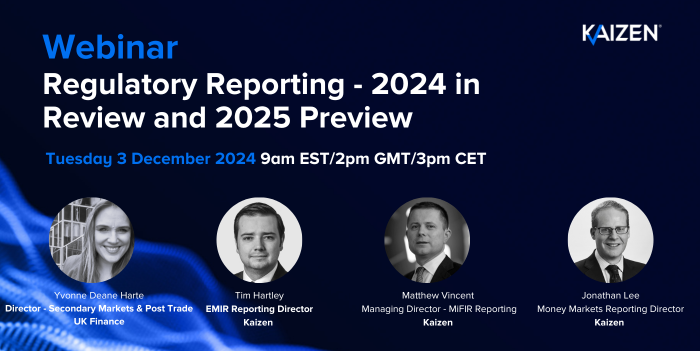
  • WATCH: Regulatory Reporting – 2024 in Review, 2025 Preview

    WATCH: Regulatory Reporting – 2024 in Review, 2025 Preview

    On MiFIR transaction reporting, there were significant changes announced by ESMA and a new discussion paper launched by the FCA, and new regimes are being introduced in the money markets space.

    Watch Kaizen’s regulatory experts as they reflect on 2024, and look ahead to what’s in store for regulatory reporting in 2025.

    The webinar was hosted by Yvonne Deane Harte, Director, Secondary Markets & Post-Trade at UK Finance and featured:

    Please note, we accept business emails only.

    For any queries relating to the upcoming regulatory changes or to speak to one of our subject matter experts, please contact us.

  • Kaizen receives £42 million growth investment from Guidepost Growth Equity

    Kaizen receives £42 million growth investment from Guidepost Growth Equity

    London, November 6, 2024 – Kaizen, a leading provider of regulatory compliance solutions for global financial institutions, today announced the completion of a £42 million minority investment from Guidepost Growth Equity, a Boston-based growth equity firm partnering with entrepreneur-led technology companies. The investment will be used to accelerate product development, invest in go-to-market initiatives, expand in North America, and enhance its award-winning compliance technology. This represents Kaizen’s first external investment since its founding in 2013 by CEO Dario Crispini.

    Kaizen is the global leader in regulatory reporting quality assurance with its pioneering ReportShield platform, which enables its clients to fully test the accuracy and quality of regulatory reports at the trade level, identify 100% of errors at scale, and efficiently remediate with global regulatory coverage including MiFID, EMIR, SFTR, CFTC, and SEC, among others. 

    Kaizen has established itself as a trusted partner to the world’s largest and most sophisticated banks, asset managers, hedge funds and brokers to ensure accurate, complete, and timely reporting in an increasingly challenging regulatory environment, evidenced by strong revenue growth since inception.

    More recently, the Company has diversified its product suite to include solutions for managing and reporting shareholding disclosures, regulatory rules management, trade and communications surveillance and research management. Kaizen has also invested in London Reporting House and Cumulus9.

    Dario Crispini, Founder and CEO, Kaizen commented: “We are delighted to be partnering with Guidepost as we enter a new chapter in our evolution. Guidepost has a great track record in helping firms reach their full potential and their investment and partnership will enable us to build and enhance our existing technology, deliver new compliance solutions, and drive our expansion into North America. The solutions we offer at Kaizen are designed to help our clients adhere to their compliance obligations in an efficient and cost-effective manner and we look forward to delivering more solutions that do just that.”

    Gene Nogi, General Partner at Guidepost said: “Kaizen has transformed the transaction reporting and compliance market, helping the world’s largest financial institutions navigate and comply with an increasingly complex regulatory environment with heightened scrutiny from regulators. The Company embodies everything we look for in an entrepreneur-led, capital-efficient, rapidly growing, and highly differentiated technology business operating within a large, dynamic market. We are thrilled to partner with Dario, Ian and the entire team at Kaizen and look forward to working together on the next stage of the journey.”

    As part of the investment, Gene Nogi will join the Kaizen Board of Directors alongside two new independent directors to be named. Raymond James was the exclusive financial advisor on the investment and Norton Rose Fulbright acted as legal counsel to Kaizen. Liberty Corporate Finance, Alvarez and Marsal and Crosslake also advised Kaizen. Choate Hall & Stewart and Stevens & Bolton acted as legal counsel to Guidepost.

    About Guidepost Growth Equity

    Guidepost Growth Equity (“Guidepost”) is a leading core growth equity firm that partners with entrepreneur-led companies utilizing technology to transform industries within application and infrastructure software and tech-enabled and data services. Current and prior investments include ActiveViam (acquired by Nordic Capital), ClassWallet, Lucid (acquired by Cint Group AB), Mineral (acquired by Mitratech), OutSystems, Traction on Demand (acquired by Salesforce), and Tractive. The firm is headquartered in Boston, MA.

    Guidepost Growth Equity provides the flexible capital, operational assistance, and strategic guidance necessary to support the continued success of high-growth businesses and has over $1.9 billion of capital under management. For more information, please visit their website. 

    For more information, please contact James Dunseath, Communications Advisor, on +44 (0) 7557 955795 or media@kaizenreporting.com


  • Watch our ‘Regulatory Reporting 2024’ conference highlights

    Watch our ‘Regulatory Reporting 2024’ conference highlights

    Watch the highlights of our annual regulatory reporting conference where we welcomed more than 200 clients, the FCA, trade organisations and industry specialists to Banking Hall, London for an afternoon of engaging talks, panels and audience discussions.

    Tom Soden, Markets Reporting Manager, FCA delivered the keynote speech on MiFIR Transaction Reporting data quality. 

    Panellists included Carmel Deenmamode, Market Conduct & Post Trade Policy Manager at the FCA, as well as representatives from the ISDA, FIA, Regis-TR, BMO,  HSBC, Deutsche Bank, ABRDN and our very own industry experts.  The panel discussions covered a wide range of issues facing the industry today including MiFIR, EMIR Refit go live, and upcoming ASIC and MAS ReWrites.

    A huge thank you to our speakers, clients and everyone who attended for making it such a fantastic afternoon! 

    • If you would like to learn more about how Kaizen can help you with your regulatory reporting, please get in touch.
  • MiFID II 2nd anniversary – ready for the terrible twos?

    MiFID II 2nd anniversary – ready for the terrible twos?

    It’s two years since the introduction of MiFIR transaction reporting. What will regulators be expecting at this stage?

    Quite simply, complete and accurate transaction reporting. Whilst the MiFIR transaction reporting regime is very complex, I think regulators’ patience is starting to wear thin. The UK FCA has twice signalled in Market Watch that it is seeing unacceptable errors in transaction reports and firms have to heed that message. All the NCAs have a job to do – MiFIR Article 24 obliges the competent authorities to monitor the activities of investment firms and if the quality of data submitted by firms prevents them from meeting this obligation, then the authorities will take action.

    What action have we seen from the FCA so far?

    Just because we haven’t seen any formal enforcement cases for MiFIR transaction reporting does not mean that the FCA is happy with the quality of the data it has received. Far from it – judging by its remarks last year in Market Watch 59 and 62. It is entirely possible that the FCA is working on cases already – there is often quite a long lead time in such cases.

    What we have seen from the FCA is plenty of letters warning firms that they have discovered issues with their data. This demonstrates that the FCA is investigating the quality of reports and that firms will get found out if they haven’t got sufficient controls over their reporting processes. Often firms believe that because the FCA hasn’t contacted them, their reporting must be ok. This could prove to be a very risky assumption. The FCA has limited resources to monitor the 3,000-plus firms that have a transaction reporting requirement. However, the sophistication of their monitoring systems is increasing and they will be able to work their way through the number of firms that report. It is very important to note that when the FCA does find issues, it usually requires firms to back date all the impacted reports since go-live. The longer it takes issues to be discovered, the more complex and expensive this back-reporting exercise becomes.

    How can firms be sure they’re reporting accurately?

    Again, there is a very simple answer to this – they need to implement the controls detailed in Article 15 of the regulatory technical standards. In particular, they need to perform quality assurance testing of their submitted transactions and they need to do regular reconciliations from the data in their source systems to the reports received by the FCA.

    Unfortunately, I think there are many firms that are afraid of what they will find once they start implementing the correct controls. Too often, transaction reporting is filed in the ‘too difficult drawer’. Many firms fear their transaction reporting has become an Augean Stables and they don’t want to discover how difficult a task they have on their hands. If this is the situation you are in, perhaps it’s time for a new year’s resolution –  call in Kaizen to perform the quality assurance checks and reconciliations from front office systems to data reported to the FCA. We can also help design a quality assurance control framework and train your staff on reporting. So what are you waiting for? 

    Happy Anniversary MiFID II.

  • Video series: Dario Crispini on Kaizen’s key regulatory reporting services

    Video series: Dario Crispini on Kaizen’s key regulatory reporting services

    Kaizen Reporting’s CEO Dario Crispini talks about the regtech company’s multi-award winning regulatory reporting assurance services and the unique testing methodology behind them. 

    This is a four part introduction to Kaizen Reporting video series from CEO Dario Crispini.

    Watch the first video in the series – Why was Kaizen founded?

    Watch the third video in the series – Issues and risks of poor data quality in regulatory reporting.

    If you’re concerned about the data quality of your regulatory reporting, get in touch. 

    Huge thanks to the Wealth Mosaic whom we collaborated with on this project. 

  • No market abuse sanctions by FCA in 2018

    No market abuse sanctions by FCA in 2018

    ESMA has published its peer review on how national competent authorities handle suspicious transactions and orders reports (STORs) under the Market Abuse Regulation. It is fully compliant in four of the ESMA metrics and broadly compliant in the other two.  So congratulations FCA – pretty much top of the league in this review.

    However, what is interesting is that despite this near-perfect report card, the FCA has not imposed any measures and sanctions on firms.  Surely the true measurement has to be the number of successful market abuse cases the regulator has brought? The ESMA report has a handy table showing the number of measures and sanctions imposed for market abuse infringements and the UK figures for 2018 show no sanctions.

    Without wanting to appear like the Christmas Grinch, in our view this is a very disappointing figure. Bearing in mind that 2018 marked the introduction of a dramatically more complex transaction reporting regime which offers regulators a far richer data set to monitor market abuse more effectively, this failure to sanction would indicate to us that something isn’t right.

    Whilst many firms are making great efforts to report STORs and to submit transaction reports, the FCA can only do its job effectively if those transaction reports are complete and accurate. If you are not completely confident that your transaction reports meet this requirement, talk to us about our ReportShield™ data quality, reconciliation and training services.

    What do you think about this peer review from ESMA? Join in the conversation over on our LinkedIn.

  • Video series: Dario Crispini on why he set up Kaizen Reporting

    Video series: Dario Crispini on why he set up Kaizen Reporting

    Kaizen Reporting’s CEO Dario Crispini talks about the factors that led him to start the company, our services, and the benefits we bring to our clients, in the first video of a series introducing who we are and what we do.


    This is a four part introduction to Kaizen Reporting video series from CEO Dario Crispini.

    Watch the second video in the series – Kaizen’s key regulatory reporting services.

    Watch the third video in the series – Issues and risks of poor data quality in regulatory reporting.

    If you’re concerned about the data quality of your regulatory reporting, get in touch. 

    Huge thanks to the Wealth Mosaic whom we collaborated with on this project. 

  • The scariest regulatory reporting changes facing you this Halloween

    The scariest regulatory reporting changes facing you this Halloween

    It’s Halloween! And what better time to cover off some of the scariest regulatory reporting changes that you need to keep very very close to, following the full-moon…

    Quoting Macbeth’s three witches, “By the pricking of my thumbs, something wicked this way comes”, here are three key regulations affecting everyone in the coming months:

    In Thunder comes Brexit

    31 October was always going to be a horror Halloween show but the EU have prolonged the agony for another three months to 31 January. The good news is that most firms have prepared for the October exit but do keep an eye on any unknown regulatory changes in the coming months – or read our Brexit White Paper to help with your preparations.  

    In Lightning comes SMCR

    Ghosting quietly in, don’t forget if you’re an Core or Enhanced Firm, as categorised by the FCA, your CF Approved Persons change to SMFs under the Senior Managers and Certification Regime (SMCR) on 9 December. Encouraging a culture of taking responsibility for actions and demonstrating a clear understanding of where that responsibility lies, are the key messages. You can’t use a magic wand to sign-off on the accuracy of your regulatory reporting, a key task for your SMFs.

    In Rain comes SFTR

    As we speak on the day of the devil, SFTR is only 166 days away.  This is frighteningly close.  Are you prepared and testing in UAT for this new reporting regime coming into effect on 14 April 2020? Contacting our very own SFTR expert Jonathan Lee is much less scary than a letter from the regulator.

    When the hurly-burly’s done, when the battle’s lost and won, Kaizen is here to help with the most scary of regulatory reporting challenges. Please contact us if you’re worried about any of the above and we can turn your regulatory reporting obligations from a trick to a treat!

    Author: Chris Machinbeth

  • Join us at Infoline’s Trade and Transaction Reporting Conference in Stockholm

    Join us at Infoline’s Trade and Transaction Reporting Conference in Stockholm

    We are delighted to be able to offer 30% off tickets. Use code FKM63769KAIZEN.

    Register


    Calling all investment firms, securities firms, banks and trading venues impacted by the reporting and disclosure obligations of SFTR, MiFIR and EMIR! Please join us at this one day conference in Stockholm. Don’t miss our Senior Regulatory Reporting Specialist, Jonathan Lee, discussing SFTR Reporting best practice and how to prepare for the April 2020 go-live at 10:30am. Followed by Senior Regulatory Reporting Specialist, David Nowell, on a panel to discuss the ongoing challenges with MiFID II Transaction Reporting and EMIR Trade Reporting. 

  • ESMA clarifies FX forwards transaction reporting in new MiFIR Q&A

    ESMA clarifies FX forwards transaction reporting in new MiFIR Q&A

    ESMA has provided a very useful example of how to report FX forwards in its latest Q&A on MiFIR data reporting. In particular, we would urge firms to take note on the practice of populating the ‘quantity’ and ‘price’ fields:

    • The ‘quantity’ (and ‘quantity currency’) should reflect the amount of the FX forwards in the base currency
    • The ‘price’ (and ‘price currency) should show the forward rate expressed as a price of base currency in the quoted The monetary value XML tag should be used (if reporting to an ARM in flat file, ‘price type’ is monetary value.

    The only additional changes appear to be in the table of national identifier formats. This details a change in the format of Portuguese passports issued after April 2018 and corrections to the Romanian National Identification Number and national passport formats.

    Whilst the new MiFIR Q&A signals only relatively minor changes, it clearly demonstrates the need for firms to remain on top of regulatory developments. Our regulatory reporting training courses help firms stay abreast of the reporting requirements and help identify any interpretational errors. For further details, please see our training courses.

     
  • In the news: David Nowell speaks to Practice Insight on regulatory change

    In the news: David Nowell speaks to Practice Insight on regulatory change

    Senior Regulatory Reporting Specialist David Nowell spoke to Alice Tchernookova from International Financial Law Review’s publication Practice Insight about the future of regulation now that MiFID II has bedded down within the industry. 

    “We have almost reached a stage where we must ask ourselves whether being fully compliant is actually possible,” said David Nowell.

    Read the full article. 

  • MiFIR versus EMIR – which is the most important reporting regime?

    MiFIR versus EMIR – which is the most important reporting regime?

    There are many similarities between the MiFIR transaction reporting and EMIR trade reporting requirements. Both are T+1 reporting regimes and there is a large overlap in the instrument set that they cover. However, there are distinct regulatory drivers behind each regime: MiFIR transaction reporting is primarily used to detect market abuse whilst EMIR trade reporting is used primarily to monitor for systemic risk.

    There is no doubt that combating market abuse is a very important regulatory service; everybody benefits from clean markets. Complete and accurate transaction reports are vital to help the regulators perform this task effectively. However, systemic risk is even more important as it represents the risk of collapse of the entire financial system -there is no point monitoring for market abuse if the financial system has collapsed around you.

    It is very interesting therefore to compare the number of errors and omissions forms for MiFIR breaches against the number of equivalent forms for EMIR trade reporting breaches. Statistics from the UK Financial Conduct Authority (FCA) obtained through a Freedom of Information Act request show that it received notifications from 384 firms MiFIR transaction reporting breaches since go-live compared to a paltry 75 for EMIR trade reporting in the period since Q2 2018 when the EMIR breach form became available. So, it is tempting to believe that firms recognise the relative importance of EMIR trade reporting and are making greater efforts to ensure the accuracy of data they report. Sadly, this is not the case. At Kaizen, we perform data quality checks on firms’ transaction reports and trade reports. For EMIR we initially find that a much lower number of EMIR trade reports are accurate than compared with the MiFIR reports we test. This reflects the complexity of the reporting regime, but we find firms’ reporting quality rapidly improves once we have highlighted and explained the errors to them.

    So this presents an apparent anomaly. The evidence suggests the quality of EMIR trade reports is at a lower level than the quality of MiFIR transaction reports, yet over five times as many firms have notified the FCA of MiFIR transaction reporting errors than they have for EMIR trade reporting. It is not difficult to understand why this is the case; the FCA is constantly reminding the industry on the need to notify them of MiFIR transaction reporting breaches, and to correct those errors, but it appears to be comparatively silent on the need to notify them of EMIR reporting breaches. What is more difficult to understand is why the FCA appears to be less active in meeting its G20 commitments in ensuring the same level of high quality in EMIR trade reporting data.

    If you’re concerned about the quality of your MiFIR transaction reporting data or EMIR trade reporting data or would simply like confirmation that it is accurate and complete, please get in touch for a complementary consultation with one of our regulatory experts.

  • FCA publish Market Watch 59

    FCA publish Market Watch 59

    Market Watch 59 is ‘almost totally dominated by Transaction Reporting Observations’ and marks yet another strongly worded message from the Financial Conduct Authority on the importance of complete and accurate transaction reporting and how it is critical to the FCA’s work to ensure that markets function well.

    As ever, the FCA stress the importance of adequate systems and controls over transaction reporting and highlights how these requirements are clearly defined in Article 15 of RTS22. In particular, the FCA stresses the importance of reconciliation of front office trading records against data samples from the NCA. It also notes that some market participants don’t appear to be aware of the FCA’s facility to provide this data and the need for regular and thorough reconciliation.

    Valid but incorrect reports

    One of the more important messages from the FCA’s Market Watch is that:

    “Firms should not assume that a report was accurate because it was accepted by the Market Data Processor, as business validation rules are not intended to identify all errors and omissions”

    As we already know at Kaizen, there are too many ‘valid but incorrect’ transaction reports. In amongst the errors highlighted by the FCA are a number of old favourites, including the transposing of the buyer and sell:

    • Incorrect time (especially after the transition to British Summer Time!!!)
    • Price not reported in the major currency
    • Venue populated with the operating MIC where a segment level MIC is available
    • Misreporting the buyer as the seller and vice versa (oh come on!)
    • Re-use of identifiers for multiple clients
    • Incorrect client type code
    • Inconsistency between trading capacity and buyer/seller IDs

    Instrument Reference Data

    There is slightly conciliatory tone on the rejections where the instrument ID, or underlying instrument ID, is not present on FIRDS. Whilst the FCA is still keen to point out this is sometimes the firms’ fault, using the wrong Venue code for example, quite often it results from incorrect reference data submitted by the trading venues. The FCA is clearly sending a message to the trading venues and systematic internaliser that greater control is required over their RTS23 reference data submissions.

    Errors and omissions notifications forms

     The FCA’s observations end on a particularly worrying note for many firms. It reminds firms that where errors or omissions are identified in transaction reports, participants must submit a corrected report to the NCA. Alas, the FCA has noted that some firms are submitting an errors and omissions form, but not subsequently correcting the errors or correcting errors without submitting an errors and omissions form. The FCA does not appear to be happy about this!

    How Kaizen can help

    This is exactly what we here at Kaizen exist to do.  We have a proven track record in helping firms tackle their trade and transaction reporting issues and risks head on – and helping them to avoid censure whether it is for RTS23, MiFIR, EMIR, Dodd-Frank or another G20 regulation. Please contact us for a discussion with one of our regulatory experts to find out more.

  • Lack of training results in transaction reporting breaches

    Lack of training results in transaction reporting breaches

    One of the most interesting statements from the FCA Final Notices following the recent fines for MiFID transaction reporting breaches concerned the general lack of expertise around transaction reporting in the industry. The firm impacted was clearly trying to do the right thing, but was hampered by “…a scarcity across the Firm and the industry of personnel with the expertise and systems knowledge required both to implement the enhanced controls and remediate the issues identified during the course of the project”¹ 

    It is difficult to understand why this lack of expertise should still afflict such an important area of compliance. Whilst it may not appear to be the most glamourous area of regulation, the FCA has shown a continued willingness to take action against firms for breaches. Many of the errors highlighted by the FCA appear to have been simple mistakes in the interpretation of the reporting requirements and might have been avoided through a more effective training programme. It should also be remembered that these fines relate to the old MiFID transaction reporting which is relatively simple compared to the greatly increased scope and complexity of the current MiFIR transaction reporting regime.

    Help is at hand

    At Kaizen, we believe effective training is an essential element in ensuring complete and accurate transaction reporting. We offer a half day CPD-accredited training course, endorsed by the Chartered Institute for Securities and Investment (CISI), which gives candidates a core understanding of the transaction reporting requirements and the fields that comprise a transaction report. The course can be taken at Kaizen HQ or at your own offices and is accompanied by an exam which enables you to demonstrate your understanding of the reporting requirements. Similar courses are available for EMIR trade reporting and SFTR. Visit our training page for further details and to book your place on one of our upcoming scheduled dates. 

    Are you a Transaction Reporting guru? Why not take part in #TransactionReportingTuesday over on LinkedIn.

    Every Tuesday, on the Kaizen LinkedIn we will be publishing a MiFIR Transaction Reporting question from our training exam. The answer will be posted a week later along with a new question. 


    ¹ FCA Final Notice to Goldman Sachs

  • FCA MiFID reporting fine – could it have been you?

    FCA MiFID reporting fine – could it have been you?

    Many firms were wondering when the first fine for MiFIR transaction reporting breaches would be levied by the FCA, so it might have come as a surprise to see a fine for a breach under the previous MiFID transaction reporting regime. We have seen strong signals from the FCA that it is disappointed with quality of some of the transaction reports it receives and it has been tireless in explaining that complete and accurate transaction reports are essential to monitor for market abuse effectively.

    Tough line

    Despite these warnings, some might have been thinking that the FCA was too occupied with Brexit to take enforcement action for transaction reporting breaches. The latest fine, at £27.6m after a 30% early settlement discount, is over twice as large as the previous fine for MiFID transaction reporting and should leave firms in no doubt that the FCA will continue to take a hard line with reporting breaches of both the MiFID and EMIR variety.  Many may be left considering what they should be doing to make sure they’re not the next subject of enforcement action.

    What failings did the FCA identify?

    Purely in terms of numbers, between 5 November 2007 and 24 May 2017, the firm:

    1. Failed to report 3,658,423 transactions;
    2. Inaccurately reported 83,074,015 transactions, and
    3. Erroneously reported 49,152,274 transactions.

    These look like very large numbers, but they have to be taken in context: In the period in question approximately 1.8 billion transactions were reported. This implies that the FCA didn’t raise any issues for approximately 1.665 billion transaction reports, or 92.5% of the submitted reports. It would be interesting to know how many senior managers are confident their firm is reporting more than 92.5% of its transactions correctly. Of course, they should be aiming for 100% complete and accurate reporting, but it is possible that many senior managers don’t actually know their accuracy rate.

    Systems and controls

    Of course, it isn’t just a numbers game. The accompanying Final Notice highlights a lack of sufficient systems and controls. In particular, the FCA stated there was a breach of Principle P3 by:

    1. Failing to have adequate systems and controls to ensure that reference or ‘static’ data used for various mandatory fields in the transaction reports submitted to the authority were complete and accurate;
    2. Failing to have in place adequate change management controls to manage changes affecting transaction reporting processes and systems, and
    3. Failing to undertake appropriate testing to ensure the completeness and accuracy of transaction reports.

    It is particularly interesting to note the criticisms in the Final Notice of the control framework calling out that it “did not adequately test and reconcile the completeness and accuracy of all transaction reporting data from its front office systems to the ARM reporting to the Authority.”

    Lessons to be learned

    The obvious lesson is that the FCA is actively enforcing transaction reporting. If your firm does not have adequate systems and controls in place or doesn’t even know how good (or bad) its reporting is; you could be at risk.

    Interestingly, in reference to the weakness of the reconciliation and testing controls, the notice called out the “periodic, sample based” nature of them. The limitations of sample testing and the false confidence that it provides has been one of the root causes of many a fine. At Kaizen, we provide quality assurance testing on all transaction reports and our reconciliation service tests all trades in the front office systems, determines whether they should be reported, and only then reconciles against the reports submitted to the regulator. We can also advise on the control framework, test all reference data (including ISINs, counterparty LEIs and for natural persons) and provide training on the regulatory requirements.

    Firms need to react

    When issues are identified by the FCA the clock is ticking. Firms should take any issue identified by the FCA as a trigger to not only investigate the issue raised but to look across all of its reporting to make sure it is correct. Flushing out issues quickly is critical in maintaining the confidence of the FCA. The industry is littered with examples of firms that have completed reviews and improved procedures only to have issues found many months and sometimes years later.

    Senior Managers liable

    The Senior Managers and Certification Regime (SMCR) has increased the reporting risks by making senior managers personally liable for transaction reporting controls.  The SMCR is soon to extend to all core firms at the end of the year.  Firms and their senior managers need to examine the systems and controls they have over transaction reporting and ask themselves whether they truly understand whether they are meeting the FCA requirements or whether they could be potentially next in line for enforcement action.

    If you have any doubts whether your reporting and controls are up to the required standard, we can help.  We have a proven track record in helping firms tackle their transaction reporting issues and risks head on – and helping them to avoid censure.Our ReportShield™ quality assurance service provides everything you need for reporting assurance including a bespoke control framework, quality assurance testing, reference data testing, reconciliation and training.  

    Please contact us for a discussion with one of our regulatory experts to find out more.

  • Valid but wrong: FCA warns on MiFIR transaction reporting data quality

    Valid but wrong: FCA warns on MiFIR transaction reporting data quality

    Senior Managers will not need a crystal ball to predict what will happen when the first MiFID II enforcement case is completed…

    In a speech on 7 February, the FCA’s Head of Market Policy, Stephen Hanks, warned about the unsatisfactory quality of some transaction reporting and the potential future consequences. The FCA stated that it was “particularly disappointed” to see fundamental errors in transaction reports that would have been incorrect under the previous MiFID reporting regime, let alone the far more complex MiFIR reporting regime.

    To demonstrate this type of error, the FCA noted that it was seeing zero in the price field in many reports. This is a classic example of what we call the “valid but wrong” problem. A zero price will pass the ESMA validation, but that doesn’t make it correct – we would only expect a zero price to be seen in exceptional cases, such as certain swap contracts where the spread is zero.

    The FCA also warned that just because there has been no enforcement action so far under MiFiD II, it doesn’t mean that it is happy with how firms have met the MiFID II requirements. Of course, formal sanctions are not the only tool at the FCA’s disposal and many firms have discovered how problematic remediating transaction reporting failures can be when issues are discovered. At Kaizen, we recommend four key areas that firms need to focus on to avoid the worst of the FCA’s wrath:

    1. Accuracy Testing
      • Quality assurance testing of all reportable data to identify incorrect transactions, using independent sources of data where possible
    2. Reconciliation
      • Reconcile all trades in your books and records with data received by the regulator
      • Note that the RTS 22, Article 15 reconciliation requirement includes “checking the timeliness of the report, the accuracy and completeness of the individual data fields and their compliance with the standards and formats specified in Table 2 of Annex 1”
    3. Reference data testing
      • Testing of counterparty and instrument static data for accuracy and completeness
    4. Control Framework
      • A risk and accountability framework tailored to your business
      • Process documentation, steering groups, training and remediation process.

    There is no need to have a crystal ball to understand what will happen when the first fine is issued under MiFID II. Senior management teams (which now include the SM&CR Manager responsible for transaction reporting) in organisations large and small will know exactly how well placed their organisation is in terms of judging the data quality of their reports. The call will go out to Compliance, Operations, Business and IT teams to run an immediate and urgent review of controls and data quality. This takes up valuable management and SME time and firms often don’t end up with the full picture. This is the typical response of firms who have not put in place effective controls and emphasises the need to be proactive and get these controls operational.

    At Kaizen Reporting, we have a team of specialist regulatory experts and data analysts delivering excellence on each of these four transaction reporting assurance requirements. Contact us to find out more about how we can give you peace of mind in the quality of your regulatory reporting and keep you on the right side of the regulator.

  • Alpha FMC and Kaizen to provide transaction reporting compliance assurance service

    Alpha FMC and Kaizen to provide transaction reporting compliance assurance service

    Combined proposition will assess governance and control frameworks and identify any gaps in MiFID II transaction reporting obligations.


    FOR IMMEDIATE RELEASE

    5 February 2019, London: Alpha FMC the global leader in asset and wealth management consultancy, has teamed up with multi-award-winning Kaizen Reporting, the specialist regulatory reporting firm. The collaboration will comprise a “health check” for specialist wealth managers and smaller asset managers by providing independent transaction reporting assessments. 

    The new proposition will see Kaizen’s proprietary testing technology combine with Alpha’s wide-ranging global asset and wealth management expertise to provide independent and expert assurance to wealth and asset managers that their transaction reporting arrangements meet the standards required by MiFID II.

    The combined proposition will check the accuracy of all of an institution’s reported data, assess the effectiveness of firms’ governance and control frameworks, and identify any gaps they might have in meeting the regulator’s transaction reporting obligations.

    “The proposition is an ideal solution for asset and wealth managers with lower trading volumes who require peace of mind that they are reporting accurately and correctly.” 

    The key benefits of the proposition include:

    • Full visibility of the quality of data reported to the regulator, including accuracy testing of all instruments, scenarios and data fields
    • Review of existing transaction reporting governance and oversight framework
    • Independent assessment and recommendations for regulatory compliance
    • Fast execution and outcomes

    The proposition comprises a discovery phase, using a detailed questionnaire to cover transaction reporting compliance and the process involved. This is followed by an evaluation phase involving a thorough assessment of the regulatory reporting control and governance framework.

    Reporting quality will be checked by Kaizen’s accuracy testing service which assesses all data fields on all reported transactions to provide a complete picture of reporting integrity. Recommendations will then made on whether transaction reporting controls are robust and whether the required level of testing is in place.

    Andrew Glessing, Head of Regulation, Compliance and Risk at Alpha FMC said:

    “We are delighted to work alongside Kaizen, who are the standard-setters when it comes to reporting assurance. With MiFID II requirements now a year old, this is the perfect time for specialist wealth and asset managers to take stock of their reporting quality and processes. We think this proposition fills a gap in the market by providing firms with market leading assurance tools and expert advice on their transaction reporting arrangements.”

    Dario Crispini, CEO of Kaizen, said:

    “This is an important milestone in Kaizen’s timeline. By joining forces with Alpha, we are able to offer the wealth and asset management sector a vital snapshot of the quality of its transaction reporting through an all-important health check. I am delighted we are working together.”

    “The proposition is an ideal solution for asset and wealth managers with lower trading volumes who require peace of mind that they are reporting accurately and correctly.  We recommend health checks take place periodically for ongoing visibility of reporting quality or in some circumstances, more regular testing may be required

    (ends)

    For media inquiries, please contact Fiona Wilde on media@kaizenreporting.com or +44 (0) 20 3912 3271.

  • ESMA updates Q&A on MiFIR and EMIR reporting

    ESMA seemingly delivered a double whammy on 4 February with the publication of Q&As for both MiFIR and EMIR data reporting. However, there’s nothing to get too excited about, although firms do need to understand the ‘clarification’ and adjust their reporting accordingly.

    Impact on MiFIR data reporting

    Bit of a damp squib. There is only one question that relates to transaction reporting (TVTIC on complex trades); the others all relate to RTS 23/MAR reference data reporting. The clarifications can be summarised as follows (italics indicate direct quote from the Q&A):

    How should the TVTIC (field 3 of RTS 22) be populated in transaction reports of a complex trade?

    Bit of a change here. Previously, firms were required to put the same TVTIC on each leg of the reported trades (if they were traded on a trading venue). New instruction is to use the TVTIC provided by trading venue for each leg of the complex trade (where the trading venue uses multiple TVTICs)

    How should Field 15 (Maturity date) of Table 3 of the Annex to RTS 23 and related MAR RTS and ITS be populated in case of trading in bonds after their originally intended maturity date?

    “For bonds that were not paid out on the originally intended maturity date (and therefore have not expired, because, for example, they defaulted), the maturity date should be set to 9999- 12-31 …until they are finally paid out, in which case the maturity date should be updated with the actual date of redemption”.

    How should field 15 (maturity date) and field 24 (expiry date) of Table 3 of the Annex to RTS 23 and related MAR RTS and ITS be populated, if these dates are non-trading dates, e.g. a weekend or a bank holiday?

    “The maturity date/expiry date defined by the issuer or the prospectus of the financial instrument should be used. No adjustment should be made to the next or previous working day for the purpose of instrument reference data reporting.”

    When should an instrument be terminated in FIRDS?

    “When field 12 (termination date) of Table 3 of the Annex to RTS 23 and related MAR RTS and ITS is initially left empty, the reporting entity is expected to fill it in when the instrument is going to be terminated. This also includes the cases when the given instrument has matured/expired, i.e. where fields 15 (maturity date) or 24 (expiry date) are applicable to the given instrument and are populated in the report.

    The termination date should be earlier than or equal to the maturity/expiry date in the cases where the maturity/expiry date is populated.”

    (RTS 23)What action should be taken by the operator of the trading venue or the systematic internaliser in the cases where the LEI of the issuer cannot be obtained?

    Tell the issuer that they should get an LEI (!!!).


    Impact on EMIR Data Reporting

    There are only three clarifications in the EMIR data reporting Q&A – the first two are amendments to previous trade reporting questions whilst the third is a brand new question:

    Q34 – Reporting of contracts with no maturity date (e.g. CFDs);

    ESMA simply reminds firms that they can also report new trades for instruments with no maturity date with an ‘Action Type’ of ‘P’ (“position component”) if it is to be included in a position level report on the same day. This is in line with previous comments from ESMA.

    Q38 – Trades terminated before the reporting deadline

    All trades must be reported even if they are terminated before the reporting deadline and ESMA is simply clarifying that these reports could also be made with an Action Type of ‘P’ if the trade is to be included in a position level report, on the same day.

    Q50 – Reporting of Confirmation Means

    ESMA states:

    The value ‘N’ (not confirmed) should be used either when:

    • The derivative has to be confirmed by the counterparties but has not been confirmed yet;
    • The derivative does not have to be confirmed by the counterparties because it has been traded on a trading venue and once traded all the terms of the contracts are known and agreed by the parties.

     In other cases, the counterparties should report the ‘E’ or ‘Y’ value for this field depending on the confirmation means used (electronic or non-electronic).

    I think this is the one element in the new Q&As that may surprise some firms as it clearly states that trades on a trading venue should have a value of ‘N’.

    So, not a lot really going on with the new Q&As. It is tempting to think that little news is good news. Personally, I don’t subscribe to this point of view; I think there is still plenty of grey in there that would benefit from further clarification, which is natural given the fundamental changes brought in by MiFIR. I also think there are a few elements in the Guidelines that, with hindsight, could have been better – (equity swaps is my favourite bugbear today).

    If you have a burning MiFIR or EMIR reporting question keeping you awake at night, why not contact us at Kaizen.

  • MiFIR transaction reporting –  a happy 1st birthday?

    MiFIR transaction reporting – a happy 1st birthday?

    January 3, 2019 marks the first anniversary of MiFIR transaction reporting and what a joy it has proved to be!  The changes introduced last year were truly transformational with new asset classes being brought into scope, new reference data standards to contend with and a massive increase in the number of the fields to be reported. Many operations and compliance staff will still have unhappy memories of last year’s struggle to implement the changes over the festive period to be ready for go-live. Despite the magnitude of the task, most participants will look back in relief that it wasn’t quite the fiasco many had feared. However, even one year on, there are a number of outstanding issues to keep us all awake at night…

    Reference data

    Perhaps the most difficult part of transaction reporting is knowing exactly what instruments are reportable. Many have assumed this is simple as ESMA’s Financial Instruments Reference Data System (FIRDS) contains all the reportable instruments. Unfortunately, this is not quite true! For a start, FIRDS does not provide details of index constituents or the underlyings to third country derivatives and depository receipts – the onus is on firms to work this out for themselves. Perhaps more importantly, the quality of FIRDS, whilst much improved since go-live, is still not good enough. We still have the FCA’s warning in MarketWatch 54: “Please note that ESMA states that it cannot take responsibility for this information being complete, accurate or up to date”. This is frustrating for firms because if they send a report with an instrument identifier that is not contained in this database within seven days of receipt of the report, it will be rejected and sent back to the reporting firm. This is almost a catch-22 situation for firms as it is now a breach to over-report or to under-report, but they still face the possibility of having their reports rejected even if they are correct because of the FIRDS limitations. Whilst the regulators demand “complete and accurate” transaction reports from firms they cannot ensure the quality of the essential reference data firms need to meet this obligation.

    Legal Entity Identifiers (LEIs)

    Many firms were concerned that they couldn’t get LEIs for all their counterparties they traded with ahead of go-live. This was particularly concerning as ESMA’s validation specified that “the initial registration date of the LEI shall be equal to or before the trading date” so firms couldn’t implement a fix if they had made a reportable trade against a counterparty without an LEI. However, an early Christmas present from the regulators postponed this validation until 3 July 2018 and firms have been largely successful in persuading these entities to get LEIs or in getting LEIs on their behalf so that they can continue to trade with them.

    Transaction Reporting Guidelines

    Most participants are grateful for ESMA’s extensive transaction reporting guidelines  and there is no doubt that they helped firms’ preparations enormously (compare and contrast with the EMIR Q&A!). However, nobody can say that they are an easy read or that they cover every trading scenario. This is only to be expected as MiFIR is a very complex reporting regime and regulators cannot envisage all possible trading scenarios across all member states. A number of firms have been frustrated by their local NCA’s inability to respond to every question, but this is a feature of harmonised regulation – it naturally prevents NCAs from offering definitive advice or interpretations outside the ESMA texts. This could present additional risks for firms making their interpretations from the available text.

    Complete and accurate reporting

    This is the simple demand from the regulators, but it is far from simple for firms to meet it. With the scale of the changes, nobody could justifiably expect implementation to be perfect. The industry was grateful for reassuring words from the FCA ahead of go-live that they could continue to work with the regulator to fully meet the requirements, provided that they could demonstrate that they had prepared well for implementation. However, there are now signs that the FCA might be less accommodating.

    In its mid-year industry forums, the FCA fired a warning shot that firms could expect a less tolerant attitude. They’d had six months to ensure their systems and controls were adequate to ensure complete and accurate reporting. We also see a danger in firms assuming that a reduced number rejected reports is an indication that their reporting is up to standard. Unfortunately, the validations only capture the tip of the iceberg of incorrect reports – there are a large number of valid but wrong reports submitted by firms.

    Data quality – round 2

    Basic validation can only capture basic errors and firms should be aware that all the NCAs are now starting to employ more intelligent ‘business rules’ to uncover reports that have passed validation, but are still incorrect. There is a temptation for firms to believe that it is “job done” for MiFIR transaction reporting now a year has passed by, but it is increasingly important that firms test the accuracy of their reports to the regulators and we are increasingly seeing evidence of this as the FCA has begun sending letters to firms pointing out errors.

    Regulators will also want to see evidence of reconciliation of their transaction reports. Firms need to be aware that this isn’t simply checking that their competent authority has received all the reports they have sent.  The requirement is clear; firms must ensure the details of the reportable trades they have made match exactly with those in the reports they have sent to the competent authority and that reports have been made for all the reportable trades.

    But…help is at hand

    Ensuring reports are complete and accurate is an extremely difficult task, not least because the rules and guidelines have become so extensive and so complex. Unfortunately, “difficulty” is not an adequate excuse for firms failing to meet the regulators’ demands and firms need to remember that the FCA has a strong track record of using sanctions, including fines, to encourage firms to submit complete and accurate transaction reports.

    At Kaizen, we provide quality assurance testing of all reportable data to identify incorrect transactions. We can also reconcile all trades in your books and records with data received by the regulator, identifying under and over reporting with matching on specific fields. Additionally, we deliver training on the reporting requirements and provide a control framework tailored to your business. Find out more about our ReportShield™ assurance service or contact us to find out how we can give you peace of mind in your regulatory reporting quality.

  • FCA data extract will now include transaction submission date

    Great news! The FCA has announced that from 15 December its data extract schema will include the transaction submission date.

    At Kaizen, we consider this to be very good news as it will now be possible to identify the latest version of the trade report. Instead of simply reconciling the accuracy and completeness against data from the ARMs, we will now be able to reconcile the data against the records held by the FCA. This makes it far easier for firms to be fully compliant with the obligations detailed in RTS 22 Article 15(3):

    “Investment firms shall have arrangements in place to ensure that their transaction reports are complete and accurate. Those arrangements shall include testing of their reporting process and regular reconciliation of their front-office trading records against data samples provided to them by their competent authorities to that effect.”   

    We look forward to substantially increasing our use of FCA-provided data samples for testing and reconciliation, providing confidence to firms that they are meeting their MiFIR transaction reporting obligations.

    For more information visit the FCA website.

  • Book now! Kaizen launches regulatory reporting training service led by industry expert David Nowell

    Book now! Kaizen launches regulatory reporting training service led by industry expert David Nowell

    FOR IMMEDIATE RELEASE

    23  October 2018, London: Leading regulatory technology firm Kaizen Reporting today announced that it is launching a training service led by the company’s new Senior Regulatory Reporting Specialist, David Nowell. The training will initially focus on MiFIR transaction reporting before expanding to include EMIR trade reporting and the upcoming Securities Financing Transaction Regulation (SFTR).

    A former regulator, Nowell has 30 years’ financial services experience. Having previously worked as a transaction reporting technical specialist at the UK FSA, as head of transaction reporting for a tier-1 investment firm and head of compliance for an Approved Reporting Mechanism and Trade Repository, David has a thorough understanding of both the importance and the challenges in meeting the regulatory reporting requirements. He also has extensive experience of client training on both MiFIR transaction reporting and EMIR trade reporting.

    Dario Crispini, CEO of Kaizen, commented: “David is widely seen as a leading authority in the industry. The FCA frequently warns about the risk to institutions of inadequately trained regulatory reporting teams and in many of its warning notices cites a lack of training as a factor in its decision to censure a firm for incorrect reporting.  Expanding our services to include training makes sense for us, and we are looking forward to helping our clients improve their knowledge in this space.”

    David Nowell, Senior Regulatory Reporting Specialist at Kaizen, commented: “Training is an integral part of the systems and controls that firms need in place to be reporting accurately. It’s impossible to get your regulatory reporting correct unless you understand the legislation from the Level 1 text down to the regulatory technical standards, guidelines, Q&A and validations. Our new courses are designed to help get our clients up to speed quickly, allowing them to understand what needs to be done to report correctly as soon as possible.”

    David adds, “Ensuring your staff are properly trained on the reporting regulations can save costs in the long run as it will increase a firm’s chances of avoiding regulatory sanctions for incomplete or inaccurate reports and the additional expense of costly back reporting exercises.”

    The training service includes four-hour classroom-style workshops as well as in-house sessions for financial institutions. 

    (Ends) 

    For more information please visit our training page or for inquiries about the service please email training@kaizenreporting.com

    For media inquiries, please contact Fiona Wilde at media@kaizenreporting.com or +44 (0) 20 3912 3271.