Tag: MAS/HKMA/ASIC

Discover all of Kaizen Reporting’s MAS resources. Learn more about global regulatory reporting from our team of specialists, covering FCA, ESMA and SEC.

  • ASIC and MAS shift to data scrutiny: what it means for regulatory reporting

    ASIC and MAS shift to data scrutiny: what it means for regulatory reporting

    Through recent discussions in Sydney and Singapore and ongoing work with firms in the region, I’ve seen a clear shift in APAC regulatory reporting: from implementation to data scrutiny and supervision.

    It’s clear that attention has moved beyond how firms implemented the 2024 rewrites, and onto the quality of the data being reported. ASIC’s recent review of the contracts for difference (CFD) sector reinforces this position. 

    Where discussions previously centred on readiness and interpretation, they are now focused on identifying data issues, understanding inconsistencies, and addressing the root causes of poor data quality. 

    This follows a familiar pattern. In the UK and EU under EMIR Refit, regulators have moved from implementation to identifying outliers, challenging firms and ultimately enforcing remediation and fines. ASIC is already well into this process, with MAS moving in the same direction. 

    Gaps in data quality are increasingly visible

    As supervision increases, weaknesses in reported data are becoming more apparent. 

    UPI is emerging as a key issue. The current framework allows for inconsistencies between the UPI and other reported fields, with limited validation to catch errors. In some cases, this creates structurally correct but fundamentally inconsistent reporting (what we call the ‘valid but wrong‘ scenario), with the added risk of distorting how trades are interpreted from a risk perspective.

    At the same time, longstanding challenges remain. Collateral and valuation reporting, despite being calculated daily by firms, are still not consistently reflected in regulatory submissions. This creates a disconnect between internal systems and reported data, making it difficult for regulators to assess true exposure.

    Complexity is increasing but clarity isn’t

    Firms are navigating growing complexity across reporting regimes, but without a corresponding increase in regulatory clarity. A consistent theme from firms was the lack of detailed, scenario-based guidance. In its absence, interpretation varies and over time, those inconsistencies become the outliers regulators focus on.

    At the same time, global firms are managing ongoing regulatory change. ESMA’s simplification agenda across MiFIR, EMIR and SFTR is being closely watched, but simplification does not reduce the cost of compliance. Each change introduces implementation effort, resource constraints, and trade-offs with other priorities.

    Beyond the headline regimes, firms are also contending with requirements across KRX, JFSA, HKMA and others, all of which demand the same level of control and oversight, often with less guidance available. This is something we are seeing consistently across firms we work with in the region.

    What this means for firms

    The key question from regulators now is can your data be trusted? 

    Firms that continue to treat data quality as a technical or operational issue will struggle to keep pace with this shift. Across our work with firms in APAC, those that are ahead are treating data quality as a control framework, supported by independent testing, and clear ownership.

    As supervision increases, so does the cost of getting it wrong. As we all know, remediation programmes are expensive, time-consuming, and highly visible.

    Ensuring data quality upfront is no longer just about compliance. It’s about reducing risk, controlling costs, and maintaining confidence in reported data.

    Kaizen supports firms globally with independent regulatory reporting quality assurance, helping them identify gaps in controls, strengthen governance and evidence reporting quality before issues surface with regulators. Contact us for a conversation about how we can help you.

  • Key themes from our webinar: The Regulatory Reporting Landscape in 2026

    Key themes from our webinar: The Regulatory Reporting Landscape in 2026

    Regulatory reporting is entering a new phase as the era of large-scale refits and rewrites across G20 regimes comes to an end but the pressure on firms has not let up.

    In our recent webinar, The Regulatory Reporting Landscape in 2026, our regulatory specialists explored what this shift means in practice and where firms should be focusing their attention now.

    Below are some of the key themes discussed during the session.

    From regulatory change to regulatory scrutiny

    Following several years of extensive refits and rewrites across G20 reporting regimes, regulators are now entering a period of reassessment. While proposals for change are on the table including the Financial Conduct Authority’s (FCA) MiFID transaction reporting consultation and ESMA’s Call for Evidence on reporting simplification, firms are operating in a landscape where scrutiny is increasing.

    Across jurisdictions, regulators are placing increased emphasis on the quality, consistency and usability of reported data. But firms should be aware that ‘simplification does not mean deregulation’. Regulatory data remains key to market abuse detection, financial stability monitoring and risk-based supervision and has an increasing number of other uses, making the quality of reported data even more important. Regulators are actively using today’s data to assess risk and exposure, so firms cannot take their eyes off the ball.

    Diverging timelines but shared direction of travel

    One of the central themes of the webinar discussion was the differing pace of change between the UK and the EU.

    In the EU, the European Markets and Markets Authority (ESMA) is currently in a period of reflection following its Call for Evidence on transaction reporting, with no immediate changes to reporting expected in the short term. By contrast, the UK’s FCA is already moving forward with proposals to simplify MiFID transaction reporting, including descoping certain instruments, removing reporting fields and revisiting existing guidelines.

    Despite these different timelines, the underlying direction of travel is the same: simpler frameworks, fewer data points and reduced costs of reporting, but higher expectations around data quality and controls.

    Data quality is the focus for all regulators and firms

    Live polling during the webinar revealed that improving reporting accuracy is the top priority for firms heading into 2026, ahead of preparing for future regulatory change or investing in new reporting platforms.

    Common reporting errors highlighted in the webinar included:

    • Inconsistent counterparty data

    • Collateral and valuation reporting

    • Reference data quality

    • Repeated or overlapping data fields that do not reconcile cleanly.

    These issues can occur even in mature reporting environments and often only come to light through deeper data quality analysis.

    EMIR and other G20 regimes – expanded requirements

    Although EMIR and other OTC derivative reporting regimes are no longer in rewrite mode, the webinar highlighted that 2026 will still bring operational challenges. There are expanded reconciliation requirements for EMIR, evolving guidance and increased supervisory focus. This means that firms cannot afford to treat these regimes as ‘business as usual’.

    Regulators in North America and APAC are also shifting attention towards data governance, control frameworks, UTI and UPI usage, and delegated reporting oversight.  A recent report from ASIC that reviewed the CFD sector, shows how reporting quality is increasingly being used as a proxy for governance.

    What does this mean for firms? 

    A consistent message throughout the webinar was the importance of knowing your current state. Firms that have a clear understanding of their reporting processes, data lineage and controls will be far better placed to respond to both supervisory scrutiny and future regulatory change.

    Rather than waiting for what comes next, firms should use this period to stabilise business-as-usual reporting, remediate known data issues and strengthen governance foundations.

    Watch the on-demand webinar to hear the full discussion, including regulator-focused insights, live polling results, and audience Q&A with our regulatory reporting specialists.

  • WATCH: The Regulatory Reporting Landscape in 2026

    WATCH: The Regulatory Reporting Landscape in 2026

    Why watch?

    As regulatory reporting enters a new phase in 2026, firms are navigating potential changes to reporting data alongside increased regulatory scrutiny. The session provides regulatory reporting and compliance professionals with the insights needed to align their 2026/27 reporting with regulatory expectations.

    ● Audit-ready insights: Understand the areas regulators are likely to target this year.

    ● Multi-jurisdictional updates: A one-stop briefing on MiFIR Transaction Reporting, EMIR, ASIC, MAS, HKMA and North American developments.

    ● Money Markets in focus: How to prepare for heightened transparency in short-term liquidity reporting.

    ● Expert Q&A: Get direct answers to your most pressing reporting challenges directly from Kaizen’s subject matter experts.

    Speakers:

  • ASIC’s CFD review sends a clear warning on regulatory reporting quality

    ASIC’s CFD review sends a clear warning on regulatory reporting quality

    Regulatory reporting lessons from ASIC’s CFD report

    ASIC’s review of the contracts for difference (CFD) sector makes one thing very clear: transaction reporting data is now a frontline supervisory and enforcement tool.

    Risky business: Driving change in CFD issuers’ distribution practices (Report 828) focuses on CFDs in Australia but it contains crucial insights for the global derivatives market: regulators are reviewing reported data to assess conduct, governance and control frameworks, not just compliance with the reporting rules.

    70 million errors: what ASIC’s findings tell us

    The report details ASIC’s findings of a sector-wide review of CFD issuers’ distribution practices and compliance measures conducted between October 2024 and December 2025. Among the compliance issues identified, substandard OTC derivatives transaction reporting stood out, with over 70 million erroneous reports. While the review focused on CFDs, the reporting deficiencies identified can affect all derivative products.

    ASIC categorised the failures into two categories:

    1. Poor data quality and missing reportable information
    • Missing Data: Unwind payments, under-reported derivatives and collateral info
    • Inaccurate data: Incorrect Action and Event type combinations, erroneous timestamps, prices, valuations and collateral
    • Abnormal values: Notional amounts exceeding hundreds of millions of dollars

    These are all errors that we here at Kaizen find in our quality assurance testing.  At scale they undermine the regulators’ ability to understanding market activity and identify emerging risks within the market.

    1. Inadequate oversight and governance
    • Minimal or no oversight of delegated reporting arrangements: No systematic way of knowing when third parties faced system issues or anomalies that may cause misreporting
    • Data scrutiny: No processes in place to review data quality before and after submission to trade repository

    The positive outlier

    Amid the widespread failures, one reporting entity stood out by consistently reporting high-quality data with no identifiable errors. This was achieved through regular collaboration with peers, close adherence to oversight guidance for delegated reporting arrangements, and systematic reconciliations between trade repository and source systems.

    ASIC’s spotlight on these practices signals that reporting entities can achieve exemplary reporting quality by implementing effective controls and governance for both in-house and delegated reporting arrangements, including:

    • Data quality checks: Detect abnormalities such as unusually large notionals, valuations, and inaccurate or missing collateral data
    • Trade and position reconciliations: Identify discrepancies between source systems and trade repository records, including over or under-reporting
    • Exceptions monitoring and resolution: Tracking, prioritising and resolving issues identified through data quality checks and reconciliations

    These practices reflect an organisational culture where data quality is prioritised, controls are embedded, and issues are identified and resolved proactively, pointing to a mature governance framework.

    The wider implications

    The October 2024 ASIC rules rewrite represented a fundamental change in how transaction data supports regulatory oversight. Control over data quality and reconciliations aren’t extraordinary measures; they’re baseline practices for entities that take reporting seriously.

    The message from ASIC’s report extends far beyond CFDs and Australian markets. As regulators globally gain experience with years of accumulated reporting data, they will be using that data for conduct reviews, enforcement actions, and assessments of firms’ control environments. The report’s title says it all: treating reporting quality as an afterthought is risky business. The question isn’t whether your regulator will scrutinise your reported data – it’s when.

    How Kaizen can help

    ASIC’s findings highlight a clear expectation that firms must be able to demonstrate effective assurance, controls and oversight over their regulatory reporting, including delegated arrangements.

    Kaizen supports firms globally with independent regulatory reporting quality assurance, helping them identify gaps in controls, strengthen governance and evidence reporting quality before issues surface with regulators. Contact us for a conversation about how we can help you.

  • HKMA Rewrite: A Major Transformation Complete

    HKMA Rewrite: A Major Transformation Complete

    This week marks the completion of nearly three years of G20 regulatory reporting updates, starting with the CFTC Rewrite, followed by the EMIR Refit (EU and UK), JFSA, ASIC and MAS Rewrites, culminating in the most significant change yet: the HKMA Rewrite.

    Why is it the most significant? Despite it having a fairly low profile compared to the other updates, the HKMA Rewrite goes well beyond the incremental changes we’ve seen with previous G20 refits/rewrites. The Hong Kong regulator has undertaken a comprehensive restructuring of its derivatives reporting framework, bringing it into line with other G20 jurisdictions.

    What’s changed?

    The rewrite delivers some genuinely welcome improvements.  

    • Fewer reportable fields. HKMA has streamlined the reporting burden significantly, reducing reportable fields from more than 300 down to 183 for trade reporting and just 34 for margin and collateral. This should make life considerably easier for operations teams managing daily submissions.
    • Technical alignment. HKMA has moved from one of the most challenging message specifications to ISO20022 XML format. Firms that have already invested in this infrastructure for other G20 jurisdictions can leverage their existing systems rather than building from scratch. This alignment should help reduce both implementation costs and ongoing operational complexity.
    • Requirements: New margin and collateral reporting requirements provide regulators with better visibility into the collateralisation aspects of systemic risk, while the adoption of Unique Product Identifiers (UPI) and making the Unique Transaction Identifiers (UTI) the primary trade ID, improves pairing and matching processes across the different G20 regimes.

    What makes it different?

    HKMA has retained some jurisdiction-specific requirements that set it apart. Unlike EMIR, they still require both legs of FX swaps to be reported (linked via ‘Swap Link ID’), and they’ve maintained broader CDS field requirements compared to JFSA and MAS.

    On the positive side, there’s no need to navigate the clearing obligation and threshold determinations that were introduced in the EMIR Refit.

    Worth the effort 

    While any major regulatory overhaul brings implementation challenges, this transformation represents a strategic win for the industry. The alignment with global standards means firms can build on existing regulatory reporting infrastructure rather than starting from scratch. The streamlined field requirements should reduce ongoing errors and operational friction, while positioning Hong Kong’s derivatives market infrastructure for continued growth.

    For firms already reporting across multiple G20 jurisdictions, this harmonisation effort should ultimately simplify rather than complicate things, making the huge implementation effort worthwhile.

    For a conversation with one of our subject matter experts of a free health check of your HKMA reporting please get in touch. 

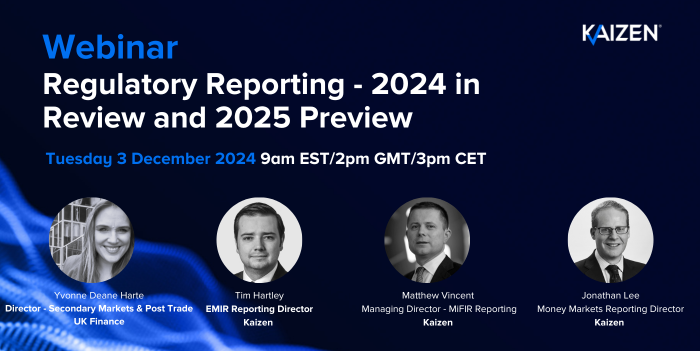
  • WATCH: Regulatory Reporting – 2024 in Review, 2025 Preview

    WATCH: Regulatory Reporting – 2024 in Review, 2025 Preview

    On MiFIR transaction reporting, there were significant changes announced by ESMA and a new discussion paper launched by the FCA, and new regimes are being introduced in the money markets space.

    Watch Kaizen’s regulatory experts as they reflect on 2024, and look ahead to what’s in store for regulatory reporting in 2025.

    The webinar was hosted by Yvonne Deane Harte, Director, Secondary Markets & Post-Trade at UK Finance and featured:

    Please note, we accept business emails only.

    For any queries relating to the upcoming regulatory changes or to speak to one of our subject matter experts, please contact us.

  • ASIC and MAS Rewrites go live – what’s changed?

    ASIC and MAS Rewrites go live – what’s changed?

    From today, firms with ASIC and MAS reporting obligations are operating under a new landscape.

    Just like the recent EMIR Refit and CFTC ReWrite before that, both rewrites introduce many changes to align with global harmonisation of G20 derivatives reporting. Congratulations to all industry participants involved in the implementation, which is no mean feat so soon after last month’s UK EMIR Refit go live.

    Let’s recap: what are some of the main changes to both regimes?

    • Mandatory usage of ISO 20022 XML format – the cessation of CSV and FPML formats means firms have had to either build internally or procure the ability to send and receive messages in ISO 20022 XML format from a third party.
    •  A significantly increased data set, due to the addition of new fields – firms have had to interpret these new fields by analysing technical specs and guideline documents to ensure that they are sourcing the right values and where not available, create customised logic to synthetically manufacture the correct values.
    • Adoption of the Unique Product Identifier  – firms have had to incorporate the correct UPI data against reportable transactions for subsequent reporting.

    ACKs and NACKs

    Ideally, the completion of all of this work culminates into reports being successfully accepted by the respective Trade Repository (TR), commonly referred to as an ‘ACK’ message. A high ‘ACK’ rate indicates that the report messages submitted by the reporting firm, successfully conforms to the required standards and schemas and also meets the business validation requirements that prevents non-sensible data (for example, omitting option type details when the derivative is an option).

    Achieving a high ‘ACK’ rate or conversely, low ‘NACKs’ (rejections) is definitely a positive first step towards a successful go-live.

    Is your reporting valid but wrong?

    Unfortunately, the work doesn’t end there because the risk of ‘valid but wrong’ reporting can still exist on a report messages that have been ‘ACK’ed’. The valid but wrong scenario occurs when reports pass the validation rules, but the data within the reports is inaccurate. Validations are often syntax rules that require firms to report their data in the right format. For example, if the value reported in a counterparty field does not contain a valid LEI ie a 20 digit alphanumeric that exists in the GLEIF database. ​

    To stay on the right side of the regulators in Australia and Singapore, firms would be remiss to ignore the need to have adequate controls in place to ensure that submitted reports are an accurate, complete and timely representation of reportable derivatives. Kaizen’s ReportShield solutions provide a completely independent assessment of the quality of your reporting by testing all data fields on all reports, with results available on our easy to use dashboard. 

    To gain confidence in the quality of your reported data (and avoid the valid but wrong scenario), please get in touch for a free healthcheck of your reported ASIC or MAS data.

  • Watch our ‘Regulatory Reporting 2024’ conference highlights

    Watch our ‘Regulatory Reporting 2024’ conference highlights

    Watch the highlights of our annual regulatory reporting conference where we welcomed more than 200 clients, the FCA, trade organisations and industry specialists to Banking Hall, London for an afternoon of engaging talks, panels and audience discussions.

    Tom Soden, Markets Reporting Manager, FCA delivered the keynote speech on MiFIR Transaction Reporting data quality. 

    Panellists included Carmel Deenmamode, Market Conduct & Post Trade Policy Manager at the FCA, as well as representatives from the ISDA, FIA, Regis-TR, BMO,  HSBC, Deutsche Bank, ABRDN and our very own industry experts.  The panel discussions covered a wide range of issues facing the industry today including MiFIR, EMIR Refit go live, and upcoming ASIC and MAS ReWrites.

    A huge thank you to our speakers, clients and everyone who attended for making it such a fantastic afternoon! 

    • If you would like to learn more about how Kaizen can help you with your regulatory reporting, please get in touch.
  • Kaizen and LPA partner to provide transaction reporting assurance solutions

    Kaizen and LPA partner to provide transaction reporting assurance solutions

    London, Frankfurt am Main – 26 June 2024 – Leading regulatory technology firm, Kaizen and Lucht Probst Associates (LPA), the German capital market technology and advisory firm, have partnered to offer a range of compliance solutions to international clients.

    The new partnership will allow Kaizen and LPA to work with clients offering them independent transaction reporting assessments and regulatory reconciliations solutions.

    Kaizen’s ReportShield™ Accuracy Testing is an automated, managed solution that tests the quality of trade and transaction data reported to the regulator. What makes it unique is the comprehensive deep testing of all records, which provides financial firms with full visibility of their reporting quality. In addition to Accuracy Testing, Kaizen offers an Advanced Regulatory Reconciliation solution that provides an independent assessment of the completeness of a firm’s regulatory reporting to identify under and over-reporting.

    LPA offers a broad range of consulting services for banks, asset managers, and exchanges, with a strong focus on capital markets. Our expertise extends to the implementation of regulatory requirements in transaction reporting. Beyond the initial setup of transaction reporting regimes, we place a significant emphasis on data analysis, optimizing data quality, and enhancing the efficiency of reporting processes.

    Jean-Marie Mamodesen, Managing Director – Head of European Sales at Kaizen, commented: “LPA has a strong reputation in Germany and we are delighted to be working with them. By bringing the skillset and expertise of the two companies together we are able to provide solutions that ensure that the data which firms are reporting to the regulators is of the highest quality.”

    Hans Joachim Lefeld, Senior Partner – Head of Transaction Reporting from LPA said: “We are delighted to be working with Kaizen, who offer an array of market leading compliance solutions. By joining forces with Kaizen we extend our eco system and will be able to better serve our clients and help them navigate the complexity of the global regulatory reporting landscape.”

    (ends)

    About LPA

    Founded in 1999 by Stefan Lucht and Roland Probst, LPA was one of the first financial services providers to focus on technology solutions and consulting that optimize processes and guarantees regulatory compliance. LPA’s success is based on sound capital market expertise combined with ongoing technical innovations. Following the integration of Modelity, EffCom and AAAccell, the rapidly growing software and consulting company employs around 400 people at twelve international locations.

    www.l-p-a.com

    For more information, please contact James Dunseath, Communications Advisor, on +44 (0) 7557 955795 or media@kaizenreporting.com

  • Kaizen partners with Suite2Go to offer regulatory reporting quality assurance solutions in APAC

    Kaizen partners with Suite2Go to offer regulatory reporting quality assurance solutions in APAC

    London, Sydney, 5 June 2024 – Leading regulatory technology firm, Kaizen and Suite2Go, the Australian financial software consultancy have partnered to offer Kaizen’s ReportShield™ quality assurance solutions in APAC, as part of its continued expansion in the region.

    Kaizen’s ReportShield™ Accuracy Testing is already used by 18 firms in Australia, including some of the largest banks and asset managers. This means that 50% of ASIC’s systemically important banks use our assurance solutions.

    Accuracy Testing tests the quality of trade and transaction data reported to the regulator. What makes it unique is the comprehensive deep testing of all records, which provides financial firms with full visibility of their reporting quality. The solution is available via the Kaizen Hub, Kaizen’s easy to use web-based platform. It is the only assurance solution that is tailored to all global derivative reporting regimes including ASIC, MAS, HKMA, MiFIR transaction and post-trade reporting, EMIR, and SFTR.

    In addition to Accuracy Testing, Kaizen offers an Advanced Regulatory Reconciliation solution, which is an end-to-end solution that provides an independent assessment of the completeness of a firm’s regulatory reporting to identify incorrect interpretation or application of the regulations, enabling all under and over-reporting to be detected. The solution also identifies mismatches across all the reported data fields (e.g.  price, quantity, product difference etc).

    Dario Crispini, CEO of Kaizen, said, “This new partnership with Suite2Go is an important step in our plans to bring our ReportShield solutions to the wider APAC region. With the constant evolution in the global regulatory landscape, including the upcoming ASIC, MAS and HKMA ReWrites, firms face the challenge of being able to report their trade and transaction data in an accurate, complete and timely manner. Kaizen’s ReportShield™ solutions help firms deliver the quality of data that the regulators have come to expect, and by partnering with Suite2Go we look forward to supporting organisations in the APAC region.”

    Andrew King, Principal at Suite2Go, commented, “We are delighted to have the opportunity to work with Kaizen in the Asia Pacific region. The solutions they offer will be invaluable to the many firms that have reporting obligations in APAC and we look forward to helping develop their presence in the market.”

    (ends)

    For more information, please contact James Dunseath, Communications Advisor, on +44 (0) 7557 955795 or media@kaizenreporting.com

    About Suite2Go

    Based in Sydney, Australia, Suite2Go is a financial software consultancy team of experienced professionals with deep working knowledge of the financial services industry and how to best solve for workflow challenges through technology solutions. 

    We were founded in 2017 with a team of 8, comprising principals and consultants with an average of 20+ years experience who have expertise across; capital markets, data management, regulatory and risk reporting, superannuation, asset, and wealth management, including front and back office, asset servicing and payments. We look to assist world class fintech organisations to achieving success in their chosen target market by bringing solutions to the financial services industry to overcome challenges and address problems while saving cost and time for both buyers and sellers.

    Press Contact: Leanne Bradley, Co-CEO leanne@suite2go.com

  • Three top tips for implementing regulatory reporting rewrites

    Three top tips for implementing regulatory reporting rewrites

    Implementing regulatory change projects is never a straightforward journey and although the list of tasks may seem never ending, it can sometimes benefit a firm to pause and assess how their implementation is going. A key area of focus can be how the current project integrates new information. We have seen numerous examples of this in the past few months. In March, ASIC scoped in seven additional data elements from CP361. In May, MAS finalised its OTC derivatives reporting regulations which contained differences from its original consultation and more recently published its FAQ and Guidelines.  

    If this process is left unchecked, this can often derail project delivery and risk regulatory breach. 

    Here are our top three tips to thrive in this environment.

    1. Monitor ongoing changes

    Although regulators have provided the core requirements on rewrites, firms still need to remain attentive to any late changes. This can be achieved by connecting with industry working groups, trade associations and signing up for notifications at respective NCA websites. However, attending the meetings and analysing all of the variable outcomes from industry discussions can be time consuming. Committing adequate resources to this task will enable a firm to gather and evaluate new information prior to translating them into new requirements where necessary.

    1. A consistent approach

    Whenever new requirements do surface, firms are forced to decide whether to include or exclude for go live. Choosing to delay means firms go live with a reporting process that contravenes the rules. Conversely, adding new requirements midway can also jeopardise the final delivery. When any decision could lead to potentially undesirable outcomes, it’s the criteria rather than the decision that increases in importance. There can be many ways of doing this, ie. trading volumes, field materiality, IT effort, source system dependencies or anything else a firm feels appropriate. Whatever that may be, applying this framework consistently will help with prioritising work in line with a firm’s risk appetite within the context of regulatory reporting.

    1. Spotlight the issues

    Design a project status dashboard that provides transparency on how new requirements impact project deliverables. When issues do arise, make them stand out within the project status summaries so that project stakeholders automatically give their attention to the most pressing issues. This allows them to quickly identify situations that may require intervention or escalation to senior management. The key here is that the issues are effectively disseminated to the people that are empowered to make key decisions in relation to resourcing or even approving a risk accepted strategy.

    The bottom line is that firms have a clear go live date and there is always new information that needs to be evaluated. Firms that have a strategy to evaluate changes consistently will allow new issues to quickly come to light and remedied in time for go live. This can only increase their chances of success in achieving regulatory compliance at go live.  

    To find out more about how we can help you prepare for the upcoming UK EMIR Refit, MAS or ASIC ReWrites, please get in touch.

  • MAS updates FAQ ahead of October ReWrite of transaction reporting rules

    MAS updates FAQ ahead of October ReWrite of transaction reporting rules

    The Singapore financial regulator, MAS, has published a revision to its FAQ on Reporting of Derivatives Contracts. The latest revision contains some timely guidance aimed to provide clarity around certain aspects of the MAS reporting ReWrite which will be implemented on 21 October this year alongside ASIC’s similar ReWrite of the Australian reporting rules.

    The new questions can be identified by the tag “[With effect from 21 Oct 2024]” and include guidance on:

    • Reporting CFDs at position level
    • Whether previously reported trades need updating with a UTI that meets the latest standards
    • Reporting collateralisation category when the counterparty has a sub-agreement that differs with the main credit support annex
    • When reporting firms should populate the FX swap link ID and package identifier fields
    • When updating previously reported trades does the reporting firm need to report information that was not previously captured or reported.

    While the latest guidance is timely and will hopefully provide firms with additional clarity around certain aspects of the MAS ReWrite, the industry is still awaiting final rules from MAS.

    Many firms are actively working towards the 21 October deadline implementation based on the message specifications published by the trade repositories. Publishing the final rules would provide much needed clarity for all the firms involved. We hope the publication of these final MAS rules follow soon after this FAQ.

    • The revised FAQ can be found on MAS’ website
    • For a free health check of your MAS reporting ahead of the ReWrite, please contact us. 


  • Regulatory Reporting – 2024

    Regulatory Reporting – 2024

    Watch our webinar replay to find out what you need to do to stay on top of 2024’s unprecedented regulatory change.

    • Proposed changes to MiFIR Transaction and Post-Trade Transparency Reporting
    • EMIR Refit go live in the EU and UK
    • APAC derivative reporting rewrites and global harmonisation of reporting rules
    • MMSR expansion and new rules on securities lending and uncleared bilateral repo in the US
    • Proposed changes to CFTC Part 43 and 45 reporting.

    Speakers

    Hosted by Kaizen’s Co-Founder and Managing Director Ian Rennie, the webinar features: 

    For any queries relating to the webinar or to speak to one of our subject matter experts, please contact us.

  • Kaizen’s CEO Dario Crispini speaks to FinTech Global

    Kaizen’s CEO Dario Crispini speaks to FinTech Global

    Following Kaizen’s inclusion in the 2024 RegTech100 listing, our CEO Dario Crispini spoke to FinTech Global about the key challenges facing the industry today, including staying connected in a post-Covid world and how the Kaizen Community is bringing compliance professionals together by combining technology and regulatory expertise with in-person networking opportunities.
     

    “We’re trying to have more touch points across our client base and use our position in the industry to bring clients together so they can share their war stories and their pain points… There is an appetite to get back together and to start chatting and networking with peers. We are facilitating that.”

    Read more

  • APAC Derivative Reporting ReWrites: An Overview

    APAC Derivative Reporting ReWrites: An Overview

    The year ahead promises to be a busy one for firms caught under OTC derivatives reporting regimes in APAC. Here’s a quick overview of some key dates and some of the more substantive changes that are being introduced by regulators in Japan, Australia, Singapore and Hong Kong.

      JFSA (Japan) ASIC (Australia) MAS (Singapore) HKMA (Hong Kong)
    Timeline / Go-live date 1 April 2024 21 October 2024 21 October 2024 Q3 2025
    NEW ISO 20022 XML format ✓ ✓ ✓ Expected to align
    Unique Product Identifier Field (UPI) Only required from 7 April 2025 ✓ ✓ Expected to align
    Valuation Reporting Fields NEW In Situ In Situ Expected to align
    Margin Reporting Fields NEW Increases substantially NEW Expected to align
    NEW Action Type(s) & Event Type(s) ✓ ✓ ✓ Expected to align
    NEW Repeatable Date and Payment schedules ✓ ✓ ✓ Expected to align


    The impact of some of these changes are significant and very nearly on par as when dealing with a brand new reporting regime. So why now? How will this impact firms and what else do firms need to consider beyond what’s obvious?

    Global harmonisation

    When OTC derivatives transaction reporting was first introduced, each region established their own form of reporting structure and format. Although there was a common purpose to monitor systemic risk in financial markets, each region did so in an independent fashion. This was particularly evident when one looked at each regime’s reporting template.

    Admittedly, designing an all-encompassing report template can be highly complex. Not a simple task, given the variety of data points that may or may not be relevant given the type of derivative and differing underlying asset(s) it can reference.

    The overhaul(s) that are taking place aims to reform existing reporting regimes towards global harmonisation to crucially, lead to higher quality data for regulators to monitor and act upon. The ReWrites do this by incorporating many of the Critical Data Elements from the Technical Guidance on the Harmonisation of Critical Data Elements issued by the Regulatory Oversight Committee (ROC).

    A global cause but unitary implementation

    Say the words ‘global harmonisation’ uttered in the context of regulatory reporting and one would be hard pressed to receive objections of any kind from market participants. Everyone is onboard with this collective goal but at the risk of stating the obvious, accomplishing it remains a unitary effort.

    Each affected entity must make their own individual evaluations to ensure that they are able to meet the revised reporting obligations within its respective regime.

    The table shown above is by no means exhaustive but aims to highlight the multi-faceted nature of these changes. Firms will be busy allocating resources to:

    • Create or procure the right technological capabilities to process data in ISO 20022 XML format
    • Identify their ‘UPI’ strategy and implement its corresponding solution which sounds fairly straightforward but firms should not underestimate the magnitude of this task. For more on this see our UPI Explained blog
    • Conduct in-depth business analysis to understand and map internal system workflows to its respective ‘Action Type’ and ‘Event Type’ combination(s)
    • Establish the gap between the requirements of new data fields against internal systems to ultimately build reporting capabilities that adheres to the ReWrite.

    In addition to all of the above, firms need to navigate any potential last minute changes as we have seen thus far with the latest follow-on consultation that was released by ASIC in November. Not an easy task given that many firms are likely to be in their development phase with the majority of specification requirements already finalised.

    Last but not least!

    Whilst firms should rightly devote high focus towards the new build(s) for the ReWrites, they would be remiss to think that their work ends there.

    Firms will have to review and recalibrate existing control frameworks to ensure that they remain fit for purpose. Although the harmonisation in standards should in theory help to simplify the whole reporting process, firms will now be reporting on a larger expanded set of data elements with some of these data elements themselves potentially being derived from complex processes (think UPI).

    After all, this is hardly a new concept and market participants have had time to encounter the various nuts and bolts that go towards securing a robust regulatory reporting framework. It’s crucial that firms do not approach control frameworks as an afterthought and to have the necessary controls in place to ensure that their reported data is accurate and complete.

    • For a conversation with one of our regulatory specialists on the upcoming ReWrites outlined above, please get in touch. 
  • Kaizen selected as RegTech100 Company

    Kaizen selected as RegTech100 Company

    London, 6 December 2023 – Leading regulatory technology firm, Kaizen today announced that it has been selected for the RegTech 100 listing, an exclusive directory of the world’s leading RegTech companies, for the fourth time. The RegTech100 companies are chosen by a panel of analysts and industry experts as the world’s most innovative and disruptive businesses in the regulatory technology space that are seeking to help financial institutions manage the fast-paced changes brought on by ongoing regulatory updates and technological advances.

    Chosen from a longlist of over 1,400 companies worldwide, Kaizen was selected for its RegTech solutions which provide a network of services for the compliance and reporting community on one platform.

    Dario Crispini, CEO of Kaizen, said,

    “We are very proud to have been selected as a RegTech100 company for the fourth time and to be recognised for the range of solutions we now offer our clients. Our aim is to make working with regulation easy and cost effective and ensure clients stay on top of their compliance obligations through the introduction of new technologies and product innovation.”

    RegTech Analyst director of research Mariyan Dimitrov said, “With the tougher economic climate and the continued rise of AI, financial institutions are re-examining the compliance software’s true cost, namely whether a given RegTech solution truly will free up compliance staff for higher-level tasks and whether the software can scale, adapt, and get implemented efficiently. This year’s RegTech100 list highlights the leading companies in areas such as information security, compliance, risk management and fraud prevention working on the forefront of innovation and new AI implementations who have demonstrated a strong track record delivering regulatory and operational improvements in financial services.”

    Since last being listed as a RegTech 100 company, Kaizen has expanded its product offering. Our ReportShield™ suite of regulatory reporting assurance services, which includes Kaizen’s award-winning Accuracy Testing, is now complemented by solutions for monitoring and reporting of Shareholding Disclosures, Trade and Communications Surveillance, Research Management, and Single Rulebook, a digital platform for managing regulatory rules.

    (ends)

    • For more information, please contact James Dunseath, Communications Advisor, on +44 (0) 7557 955795 or media@kaizenreporting.com.
  • ASIC publishes Consultation CP361a

    ASIC publishes Consultation CP361a

    The consultation paper (CP361a) released by ASIC earlier this month can be seen as a very positive outcome of effective dialogue between regulators and market participants.

    The new data elements that have been put forward are reflective of the feedback provided by market participants and include a clear summary of the need for those new data elements.

    Here’s a summary of the content within CP361a that would no doubt require some attention:

    Seven new data elements:

    • 1a Secondary transaction identifier
    • 7a Counterparty 2 name
    • 59a Lower or only barrier price
    • 59b Upper barrier price
    • 58a Lower or only barrier price notation
    • 58b Upper barrier price notation
    • 105 New Derivative Trade Repository.

    On 24 existing fields:

    • ASIC has provided further clarification on how to report on 17 fields. Some notable clarifications to point out:
      • Alignment with CDE to restrict negative notional amounts to commodity derivatives only
      • Call and Put Amounts are not required for digital options
      • Data elements related to other payments is expected for partial and full terminations
    • Changes to seven fields that are fairly cosmetic in nature (for example, Field 13 ‘Execution agent of the Counterparty 1’ to ‘Execution agent of Counterparty 1’) or updating references from ‘Identifier’ to ‘Indicator’ for Field 86 ‘Identifier of the floating rate—Leg 2’

    Clarifications on any regulatory reporting is always welcome given the complexities. But given the timing, any late changes would undoubtedly put more pressure on existing project workstreams. Firms will have to impact assess the latest changes and work out how best to minimise any negative impacts late changes can bring to any project.

    The consultation closes on 15 December 2023 and a quick turnaround of the publishing of the ‘final’ changes is likely to be on a firm’s Christmas wish list!

    • Read the consultation paper on ASIC’s website
    • For a conversation with one of our regulatory specialists about preparing for the ASIC ReWrite, please get in touch. 
  • January 2024 – UPI and CFTC ReWrite Phase 2

    January 2024 – UPI and CFTC ReWrite Phase 2

    The bad news

    January 2024 kickstarts a truly tumultuous year for transaction reporting. January 29 more precisely sees the implementation of the CFTC ReWrite Phase 2 which means the adoption of UPI (Unique Product Identifier). After many years in the making the UPI might be having its debutants ball in the USA but that really just gets the ReWrite/Refit party circuit started.

    At the time of writing, the calendar for 2024 also entails implementation go-lives for:

    Jurisdiction  Regulator Status Description Date
    Japan JFSA Confirmed ReWrite 1 April 2024
    EU ESMA Confirmed EMIR Refit 29 April 2024
    UK FCA Confirmed EMIR Refit  30 September 2024
    Australia ASIC Confirmed ReWrite 21 October 2024
    Singapore MAS Expected ReWrite “October 2024”
    Canada CSA Expected ReWrite Q1 2025
    Hong Kong HKMA Expected ReWrite  Q3 2025


    The (somewhat) good news

    Back in 2015 I wrote an article describing transaction reporting as “the gift that keeps giving”. With eight major implementations planned for next year that’s as true today as it was back then. The 2024/5 reporting ReWrites’ schedule is without a shadow of a doubt the toughest we’ve seen since the inception of OTC derivative transaction reporting. But it’s not all bad news. Challenging as this will be there is some good news. The purpose driving all these implementations is harmonisation and they, for the most part, share a lot in common including the adoption of:

    • UPI to provide a consistent product taxonomy for reporting derivative products
    • CDE (Critical Data Elements) to globally agree the fields, the values and the definitions
    • ISO 20022 XML messaging standards for submitting to trade repositories
    • Global UTI standards to enforce common transaction identifiers across the various reporting regimes.

    Therefore the difficulties of managing multiple implementations across various reporting regulations is somewhat offset by the fact the reporting requirements are becoming more standardised and many of the data elements are converging on common globally agreed definitions. Reporting solutions, data dictionaries, analysis and reporting flows in theory become a bit simpler to manage. In theory at least.

    What does UPI mean for reporting?

    Anyone hoping that reporting with UPIs means simply replacing the current product identifier taxonomies with a new shiny UPI and sitting down with a nice cup of tea is going to be sorely disappointed.

    Reporting firms need to map all their current product attributes and then use these attributes to source a UPI from ANNA-DSB for each product. They’ll need to do this for all the product types they currently trade and any open positions previously reported to a trade repository (TR) or swap data repository (SDR).

    Some firms may opt to integrate the UPI data in their reporting solution only. Whereas others may integrate it further upstream in their trading, confirmation and associated systems as well. Either way, care will need to be taken to ensure the correct products are mapped to the correct UPIs. Unlike the current simple taxonomies such as FX Forward, the UPI is comparatively opaque and as such it won’t be easy for a human to see if the wrong UPI is on the trade without first looking up the reference data behind that UPI.

    Finally, firms will need to take a lot of care to ensure the other fields being reported on any given transaction are consistent with the UPI’s product characteristics. For example, if your UPI relates to a GBP/USD FX Forward then you need to ensure Notional Currency Leg 1&2 also contain GBP & USD.

    What does 29 January 2024 look like for CFTC & UPI?

    CFTC Rewrite Phase 2 contains two items of good news:

    1. The CFTC descoped UPI for commodity asset class. So UPI is being implemented for credit, equity, FX and interest rates but not commodity
    2. The CFTC also descoped ISO 20022 messaging because they wanted to wait until UPI is also ready for commodities.

    Some may argue it’s only postponing the pain as the above postponements will result in a Phase 3, likely in 2025, but for the time being given the evident confusion around UPI, this is probably best for most firms reporting to the CFTC.

    Once firms have designed and implemented a functioning UPI process, they will have the joy/pain of ensuring that UPI info is accurately incorporated into regulatory reporting processes given that:

    1. UPI will be required on all* Part 43/PPD submissions to the SDR
    2. UPI will be required on all* Part 45 trade submissions to the SDR
    3. UPI will be required on all Part 45 valuation submissions to the SDR.

    *Terminations and Erroring out (Action Types TERM & EROR) will not require UPI for either Part 43 PPD or Part 45 trade submissions. This is to accommodate removing previous submissions that may have been reported prior to UPI being applicable.

    Looking at the message specifications for one leading SDR, a handful of previously submittable fields have been deprecated. For example, Underlier ID is no longer required as this information is now embedded within the UPI.

    A new paradigm

    More interestingly there are fields which will be reported to the CFTC based on data that is derived from the UPI but are not submitted by the reporting firm, such as UPI Status, UPI Instrument Type and UPI Delivery Type. This is essentially a new paradigm for transaction reporting where a range of fields will be sourced from an external data provider (ANNA-DSB) and reported to the regulators despite not being submitted into the SDR by the reporting firm.

    This will also impact firms’ control frameworks as they need to ensure that the various product attributes within their systems are aligned to the correct UPI which they’ll submit to the SDR. They’ll also need to consider reconciling fields the SDR derived from the UPI to their source systems despite not having actually submitted these fields.

    Conclusion

    The CFTC may be the first off the mark with UPI in January next year but there are several other implementations coming, not least for both the EU & UK versions of EMIR. With only four months to go there is a worrying amount of confusion around UPI. Hopefully the UAT process will help to iron out the kinks and figure out the edge cases. Whether UPI achieves the regulatory aims of standardisation and interoperability, time will tell. Meantime 2024 is looking like a doozy for many reporting firms, ourselves at Kaizen included.

    • To understand the fundamentals of UPI, read Alan’s recent guide, UPI Explained
    • Still scratching your head over UPI?  For a conversation with Alan or one of our regulatory specialists, please get in touch. 
  • UPI – Unique Product Identifier Explained

    UPI – Unique Product Identifier Explained

    The Unique Product Identifier (UPI) is the long-awaited new taxonomy for better describing OTC derivative products and the various characteristics of how each derivative is structured.

    At its simplest level the UPI replaces the current simplistic OTC derivative taxonomy values such as “FX Forward” or ISDA’s “ForeignExchange:Forward” with an identifier mapped to far more granular attributes in a centralised database.

    That database is run by ANNA-DSB and much like ISIN codes, will mean that various parties can be sure they are talking about the same OTC derivative because they can look up that UPI in the database and all see the same attributes.

    ROCking out with ANNA

    Alphabetti spaghetti time for the acronyms.

    The ROC gave the mandate to ANNA to establish and run the DSB for UPI.

    Clear?

    No?

    Ok. The Regulatory Oversight Committee (a supranational group of financial market regulators and authorities that amongst other duties oversees the LEI framework) is leading the global rollout of UPI. As well as helping to establish the UPI protocols and taxonomy, the ROC has mandated the Association of National Numbering Agencies (ANNA) with establishing and operating a facility for obtaining and maintaining UPIs. This facility is called the Derivatives Service Bureau (DSB) and is essentially a paid-for service where users can obtain an existing UPI if one already exists or have a new UPI generated if it doesn’t. Think of it as a big centralised Excel spreadsheet that debits your credit card every time you glance in its direction.

    Taxonomies? Attributes? What?

    This stuff is admittedly hard to visualise so let’s break it down with examples.

    Let’s take good old Credit Default Swaps (CDS). Because had they not crashed the world’s economy in 2008 we wouldn’t be here today discussing UPI as part of the remedy for that misadventure.

    A firm has a CDS in its systems with various product attributes that describe things like what the underlying asset the CDS is based on and it wants to obtain the UPI for that CDS.

    The firm submits a query to ANNA-DSB with various inputs describing the CDS.

    The UPI query inputs for a CDS on a corporate bond are shown below:
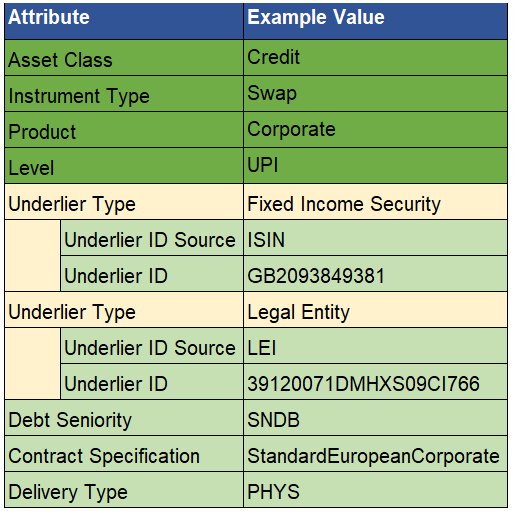
                                         

    ANNA-DSB searches the UPI database to see if a UPI already exists for a CDS matching these various inputs. If no UPI exists, the DSB will assign a new UPI and create a new record in the database for subsequent users to see.

    The DSB then responds to the query with the resulting UPI (highlighted) and additional characteristics as shown below.
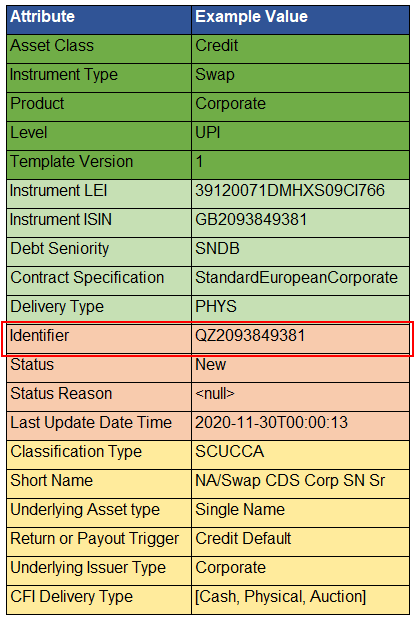
                                         

    Now whenever the firm communicates with another firm, regulator or party they can all use DSB data to know that UPI QZ2093849381 refers to a Credit Default Swap on a European corporate bond with ISIN GB2093849381, with CFI code SCUCCA and issued by LEI 39120071DMHXS09CI766.

    So similarly to the LEI where the database maintained by GLEIF means that firms can use an LEI code to ensure that they are talking about the exact same legal entity, the rationale behind UPI is that a central database of products provides clarity that firms are talking about the exact same OTC derivative product.

    FX Example

    The UPI query inputs and outputs vary based on the asset class and product type.

    If we consider Foreign Exchange then, if a firm has an FX Option in its systems and it wants to obtain the UPI for that FX Option.

    The firm submits the below query to ANNA-DSB with various inputs describing the various characteristics of the FX Option.
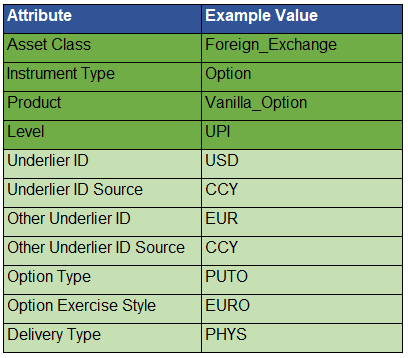
                                           

    DSB then responds to the query with the resulting UPI (highlighted) and additional characteristics as shown below.
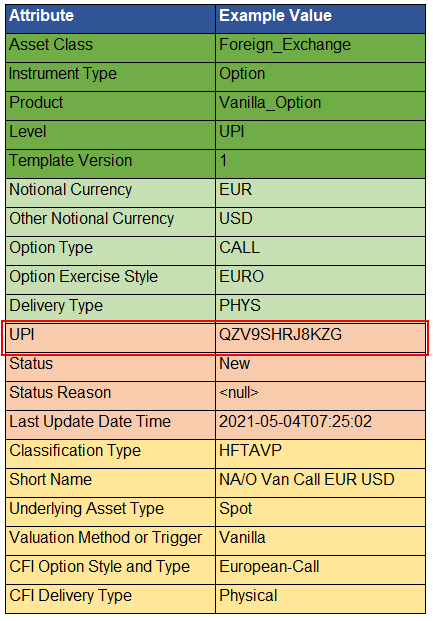
                                           

    Now all parties can use DSB data to know that UPI QZV9SHRJ8KZG refers to an FX Option on a EUR vs USD, with CFI code HFTAVP, that’s a European-style physically settled call option.

    Interest Rates Example

    Next if we look at interest rates, if a firm has a cross-currency fixed-float swap and it wants to obtain the UPI for that swap.

    The firm submits the below query to ANNA-DSB describing the rates swap.
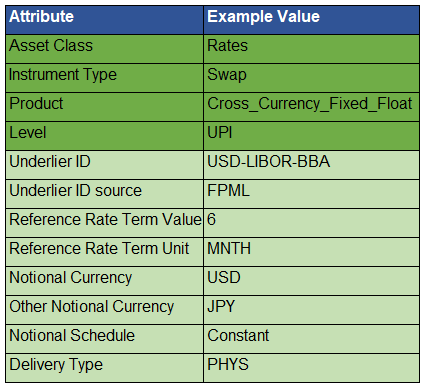
                                           

    DSB then responds to the query with the resulting UPI (highlighted) and additional characteristics as shown below.
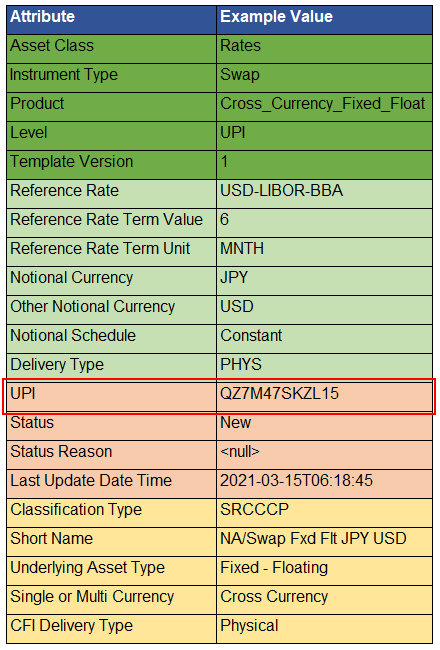
                                             

    Now all parties can use DSB data to know that UPI QZ7M47SKZL15 refers to an cross-currency fixed-float swap on USD vs JPY, with CFI code SRCCCP that’s physically settled.

    So UPI is like an ISIN then?

    UPI essentially sits between a CFI code and an ISIN in terms of how granular or specific it gets.

    The CFI code describes the basic attributes but does not get as far as underlying assets, currencies etc.

    Taking the CFI from the previous rates example, we see that SRCCCP is the CFI code for a physically settled, cross-currency, fixed-floating, rates swap.

    Diagram below generated using ISDA’s CFI Code Generator:

                     

    The UPI takes it to the next level of granularity by telling us this rates swap is also based on USD vs JPY, uses the USD-LIBOR-BBA floating rate and has a six-month period for that reference rate. So the UPI is far more specific than the CFI which just outlines the broad characteristics.

    ISIN would take it even further in terms of granularity because ISIN also tends to reference the trading venue where it traded and any venue specific characteristics such as the currency it’s traded/priced in.

    Why not just use ISIN?

    Two main reasons…

    1. The more forgiving reason is that since ISINs are often specific to the trading venues this means that using ISINs makes it more difficult to aggregate products with the same characteristics that are traded on different venues. Given the whole OTC derivative reporting framework is geared towards systemic risk, the regulators want the ability to aggregate transactions at product level, rather than venue level, when examining counterparty exposure. So UPI being venue agnostic is beneficial for this surveillance.
    2. The less forgiving answer is that outside of EMIR (EU & UK versions) no other regulators use ISINs for OTC derivatives. EU and UK reporting is therefore the outlier and much like the reporting of Exchange Traded Derivatives (ETDs) that underpins it, the use of ISINs for OTC was widely considered crazy but nonetheless made it into the rulebooks.

    So whilst ESMA and the FCA pushed ahead with ISINs for OTC derivatives the remainder of the regulators globally have patiently waited for UPI to be ready as a global solution much like the LEI.

    UPI Pay to Play

    Unlike LEIs (where the legal entity obtaining an LEI has to pay an annual fee for that LEI but the database and data is essentially free to all), ANNA-DSB will charge users for creating UPIs and accessing the UPI data in general. This is a little more controversial as UPI’s adoption across many of the OTC derivative reporting regimes amongst other use-cases means that many firms will have no alternative other to register with ANNA-DSB and pay for the privilege.

    Time will tell whether other cottage industries and resources pop up around UPI data in much the same way as you see a plethora of LEI websites and utilities whenever you search for an LEI these days. I personally hope so because ANNA-DSB needs remuneration for creating and maintaining the UPI services, that much is reasonable. But everyone having to repeatedly pay to access the same data seems a lot less reasonable in the long run.

    Similarly to the LEI rollout, we’d expect an explosion of new UPIs at the start (when the CFTC goes live with UPI in January) and another explosion when EMIR Refit follows in April next year. But that growth in new UPI population will theoretically tail off and eventually slow right down where only exotic edge-case UPIs are requested, or UPIs on newly created credit or equity underlying instruments.

    Conclusion – The Big Short rerun

    The UPI is a good concept in general and, after what seems like a very long time in the making, it is finally becoming a reality. It should help to improve clarity and consistency across the industry and for regulatory reporting in general. However we see a great deal of confusion around what UPI really means and with six months to go until the CFTC UPI go live, this is concerning. 

    If the UPI allows various regulators to aggregate similar derivative contracts together to better assess the systemic risk then that can only be a good thing. I’ll happily watch the excellent The Big Short film again but I don’t need to relive the crisis itself. There is clearly a great deal of work ahead to get UPI up and running and fully integrated across many firms and many systems.

    Tables (apart from ISDA’s) sourced from ANNA-DSB.

    • Still scratching your head over UPI?  For a conversation with Alan or one of our regulatory specialists, please get in touch. 
    • Is your firm prepared for EMIR Refit? To find out more about our EMIR Refit Toolkit, please contact us.
  • Kaizen speaks to DerivSource on the upcoming APAC ReWrites

    Kaizen speaks to DerivSource on the upcoming APAC ReWrites

    Kaizen’s Alan McIntyre and Tim Hartley spoke to DerivSource on the challenges firms face in complying with the upcoming APAC rewrites of the OTC derivatives reporting rules, scheduled to go live in 2024.

    “The different regulators will have different interpretations that firms will have to be aware of.”  – Alan McIntyre

    “In many ways it is a good excuse to re-evaluate what they have. There will be more than one way to do it but the real challenge with overlapping regulations is to ensure that best practice is being applied across the regions.” – Tim Hartley

    For help preparing for the upcoming APAC rewrites, please contact us. 

    Read the article in full


  • Singapore FX growth highlights importance of complete and accurate MAS derivatives reporting

    Singapore FX growth highlights importance of complete and accurate MAS derivatives reporting

    Singapore – Top three FX centres in the world

    The latest Triennial Central Bank Survey of FX and OTC derivatives markets published by the Bank for International Settlements (BIS) makes for very interesting reading. In the survey, the BIS confirms that Singapore has retained its position as the third largest FX centre in the world behind the U.K and the U.S. Moreover, in the report the BIS confirms that Singapore’s share of global FX volumes rose to 9.5% in early 2022, up from 7.7% since the last BIS survey in 2019, which includes FX Swaps, Options and Forwards which are all reportable under the MAS derivatives reporting regime.

    Why is it important to firms?

    With Singapore in the top three FX centres in the world, it brings opportunities (commercial and technological), and of course risks. It also brings increased scrutiny from regulators and central banks as they have their own mandates for monitoring systemic risk, and that means that the quality of the reporting data will be more important than ever. This, as we know is part of a significant ongoing effort from the industry ever since reporting went live.

    Reacting to the survey, MAS welcomed the growth and collaboration with the industry in Singapore in the FX space. As we know with any commercial or regulatory change there will be additional scrutiny of regulatory reporting, and this will be no different as we approach the 2024 rewrites including MAS, ASIC, EMIR (both EU and UK) and beyond. Firms should take more than just a note of these statements and factor the importance in planning and implementation for reporting rewrite go-lives.

    So, what can firms do to keep up-to-date with regulatory obligations?

    With the BIS survey and the MAS press release both highlighting the growing volume of the FX market in Singapore, there is a resulting effect on FX regulatory reporting requirements and as a result, more firms are impacted. It is important that firms continually test  their reporting data now and beyond the 2024 go-lives as regulators continue to use this information to monitor for systemic risks.

    With data quality being a continual discussion point in the regulatory community, the opportunity also exists to not only test reporting data, but enhance a firm’s framework, which includes policies, procedures and improving knowledge through training which are all elements of a firm’s controls.  

    So, as an industry, the concentration of FX flows in the region brings opportunities, but with such a huge volume of FX activity it’s clear that accurate and complete data is paramount for both firms and regulators. Firms need high quality controls to function properly and to enable accurate reporting. Regulators need accurate data reporting to supervise the markets and any excessive risks that are building up.

    • For a free healthcheck of the quality of your MAS reporting, or a conversation with Francesco about the topics above, please get in touch.


  • Dario Crispini talks to Risk on how to tackle regulatory reporting data quality

    Dario Crispini talks to Risk on how to tackle regulatory reporting data quality

    Following Kaizen’s win at the Asia Risk Awards 2022 for  ‘Governance, Risk and Compliance Solution of the Year’, CEO Dario Crispini talks about the challenges financial firms face navigating a complex regulatory landscape with constantly changing reporting obligations.

    “One of the biggest challenges for firms is what we call the ‘valid but wrong problem’, which occurs when firms have sent their reports to a trade repository to be ‘validated’ before they are sent on to the regulator.  Many firms mistakenly believe that if their reports have passed the validation rules, it means they are accurate.”

    Read the article in full

  • Kaizen wins at Asia Risk Technology Awards for second year in a row

    Kaizen wins at Asia Risk Technology Awards for second year in a row

    London, 27 September 2022 – Leading regulatory technology firm, Kaizen Reporting has won ‘Governance, Risk and Compliance Solution of the Year’ at the Asia Risk Technology Awards 2022 for its ReportShield™ Accuracy Testing service.

    This is the second consecutive year that Kaizen has won the award, and the fifth award it has been given by Risk. Last month, it received the trophy for the Regulatory Reporting System of the Year at the Risk Markets Technology Awards 2022. 

    The Asia Risk Technology Awards recognise firms that are doing the most to help the industry meet its various challenges in innovative and forward-looking ways. The awards, now in their 17th year, received over 180 entries.  

    Kaizen’s Accuracy Testing is part of the company’s ReportShield™ suite of services, which help financial firms meet their reporting obligations and effectively manage their regulatory risk. The service is tailored for global reporting regimes including MAS, HKMA, ASIC, MiFID II, EMIR, CFTC, SFTR and FinfraG.  Accuracy Testing is unique in being able to fully assess the quality of the data that firms report to the regulator, giving firms full visibility of their reporting quality.

    Chris Davis, Senior Markets Reporter and Asia Editor for Risk, commented:

    “For the second consecutive year the examples that Kaizen Reporting provided in their entry demonstrated quality, creativity and strength of submission that put them ahead of all other entries in this space.  Its Accuracy Testing service and the enhancements it has made positioned it as the clear winner in the ‘Governance, Risk and Compliance Solution of the Year’ category. Congratulations on your repeat success.”

    Dario Crispini, CEO of Kaizen, commented:

    “It’s a great honour to have won ‘Governance, Risk and Compliance Solution of the Year’ at the Asia Risk Technology Awards for the second year in a row. With the current global instability, it is as important as ever that the regulators are able to monitor the markets properly and in order to do this they rely heavily on the quality of the data they receive. Kaizen’s Accuracy Testing service helps our clients to be fully compliant with their reporting obligations and as a result, this helps the regulators with their monitoring for fraud and financial stability.”

    (ends)

    • For more information, please contact James Dunseath, Communications Advisor, on +44 (0) 7557 955795 or media@kaizenreporting.com
  • Errors and omissions notifications: the regulatory reporting confession letter

    Errors and omissions notifications: the regulatory reporting confession letter

    Regulatory reporting is hard, and mistakes inevitably do happen. But knowing what action to take once you’ve discovered errors and omissions in your reported data is equally challenging. Sometimes issues are found via internal means, but they can also be discovered by regulators who then begin asking questions.  At Kaizen, we regularly help firms in this position, supporting them with their communication to the regulator and correcting and re-reporting the transactions via our Accuracy Testing.  Here, we share some of our insights on errors and omissions notifications and what to do once your firm finds regulatory gremlins lurking.

    1. Regulatory clarity – clarify your mis-reporting

    Before enthusiastic (or defensive) emails are sent to the regulator, you must clarify exactly how deep the problem goes.  What volume of trades have been missed or impacted, over what time period?  Coupled with this is the need to understand exactly what the mis-reporting actually was.  Vague explanations will inevitably lead to further questions from a puzzled regulator.

    At this stage of issue discovery, many firms choose to perform assurance and accuracy testing on their reporting population, to ensure that any other hidden powder kegs are uncovered well before further regulatory scrutiny prevails.  Independent assurance testing is the most efficient and complete way of undergoing such checks and can also help paint a good picture to the regulators when it comes to submitting an errors and omissions notification.

    Regulatory reporting is the counterparty’s responsibility. Firms must be able to understand and explain why the reporting was wrong or incomplete. Importantly, this is true for those making direct reporting submissions to a trade repository/ARM/SDR, and it is equally true for those utilising a form of ‘delegated reporting’.

    2. Preparing the Errors and Omissions notification

    If you’ve completed the above, now it’s time to own up to all the things you’ve got wrong. To do this, most regulators expect firms to fill in an errors and omissions notification.  The ideal point to draft the notification is not the same for all situations. Generally though, only once a firm has performed satisfactory checks and is confident with the known scope of the errors, can the notification be drafted. The UK FCA Errors and Omissions form* and the Central Bank of Ireland’s form* are good starting points to illustrate what details you should include, but each regulator will have its own variation on this theme and some even simply ask for a free format email.

    The notification should ideally confirm:

    • The full scope of the mis-reporting
    • Remediation steps undertaken
    • The cause of the issues
    • How these errors will be avoided in future.

    The regulator needs to see that you have control over these issues and over the reporting in general.  Failure to demonstrate strength in this area will undoubtedly prompt the regulator to probe for more information and place demands on how and when further data is provided, often citing how and when remedial actions are carried out.

    In our experience, it is exponentially better to provide all the information in advance. The motive here is to answer all the questions the regulator may have before they are asked.  Providing the bare minimum of detail, in an evasive or defensive manner, can backfire and lead to further scrutiny and the possibility of fines.  

    In all cases, you should be ready for follow up questions from the regulator.  The more thorough and prepared you have been with your scope investigation, the more comfortable you will be in answering such questions. In addition, it’s important to remember that the aim here is to close out as many questions as you can before there is a chance to ask them.  Therefore, the deeper the dive in reviewing existing reporting quality and completeness, the better prepared you will be and fewer questions will arise.

    3. Frequency and strength of notifications

    In our experience, fewer but stronger, notifications is the optimal strategy here.  As mentioned earlier, the aim of the notifications is to demonstrate the strength of your regulatory reporting, and control over the errors at hand.  Some firms have legal and compliance policies in place to notify their supervisor for each and every error uncovered on an ad-hoc reactive basis. However when it comes to the regulator, too frequent notifications risk demonstrating a lack of control over issues and procedures, and can lead to further regulatory scrutiny.  Some regulators may request regular updates for known issues or existing independent reviews, but usually only for many errors across large data arrays.

    Whatever frequency is explicitly committed to, you must ensure that any deadlines are adhered to, or give reasonable written notice with clear sensible justifications as to why a specific date is no longer feasible.

    4. Remediating errors and other useful actions

    Notifications should demonstrate an organisation’s remediation plans, taking into account factors such as technology build requirements, prioritisation alongside existing commitments, and it is always a shrewd move to add contingency for unforeseen delays.  Firms would also be wise to use this opportunity to:

    • Create or enhance deep, tailored and universal accuracy and completeness testing controls incorporating all fields and all reports submitted
    • Ensure supporting policies and procedures are up to date and fully cater to avoid a repeat of the identified issues
    • Check that reporting errors are escalated appropriately with clear and written action points for defined responsible stakeholders
    • Confirm access to the reported data from the regulator or trade repository/ARM/SDR which is regularly saved down for future endeavours
    • Engage in annual regulatory training to ensure that all impacted internal parties are up to date on reporting requirements.

    5.  Final thoughts

    Demonstrating the appropriate controls and strength of process regarding how you approach errors and omissions notifications, and the manner in which information is relayed to the regulator, is absolutely crucial to that working relationship, and will proactively influence the nature of any further regulatory scrutiny, fines or demands that follow. Having a well thought through errors and omissions notification policy will help ensure that communication with the regulator is open and effective.

    • If you find yourself in this position and would like a discussion with one of our regulatory specialists about this process, please get in touch.

    *Both forms will download rather than open in a webpage.

  • Kaizen wins at the Risk Technology Awards 2022

    Kaizen wins at the Risk Technology Awards 2022

    London, Thursday 4 August 2022 – Leading regulatory technology firm, Kaizen Reporting has won ‘Regulatory Reporting System of the Year’ at the Risk Technology Awards 2022 for its ReportShield™ Accuracy Testing service. This is the fourth time that Kaizen has won a Risk award for its regulatory reporting services. 

    The 2022 Risk Technology Awards were divided into 25 categories and received 120 entries, which were narrowed down to a shortlist of 80 firms. A panel of eight industry experts and Risk.net editorial staff reviewed the shortlisted entries. The judges individually scored and commented on the shortlisted entrants, before meeting to review the scores and, after discussions, made a final decision on the 24 winners.

    Antony Chambers, Publisher, Risk.net, commented:

    “This year’s Risk Technology Awards were as competitive as ever with both the number of firms entering and the quality of the services they provide the market. Kaizen Reporting stood out for its Accuracy Testing service which enables firms to submit high quality and accurate data to the regulators.”

    Dario Crispini, CEO of Kaizen, commented:

    “Global regulators are giving the financial services industry a clear and consistent message that they expect the trade and transaction data they receive to be of the highest quality. Kaizen’s Accuracy Testing service helps firms deliver just that and we are honoured that the service has been recognised as the ‘Regulatory Reporting System of the Year’ at the Risk Technology Awards for 2022.”    

    Kaizen’s Accuracy Testing is part of the company’s ReportShield™ suite of quality assurance services, which help financial firms meet their reporting obligations and effectively manage their regulatory risks. The service is tailored for global trade and transaction reporting regimes including MiFIR, EMIR, CFTC, SEC, SFTR, MAS, ASIC, HKMA, and FinfraG. Accuracy Testing is unique in being able to fully assess the quality of the data that firms report to the regulator.

    (ends)

    • For more information, please contact James Dunseath, Communications Advisor, on +44 (0) 7557 955795 or media@kaizenreporting.com
  • Kaizen wins at the WatersTechnology Asia Awards 2022 for second year in a row

    Kaizen wins at the WatersTechnology Asia Awards 2022 for second year in a row

    London, 30 June 2022 – Leading regulatory technology firm, Kaizen Reporting has won ‘Best Regulatory Reporting Initiative’ at the WatersTechnology Asia Awards 2022 for its ReportShield™ Accuracy Testing service. This is the second consecutive year that Kaizen has won the award.  

    The panel of editorial and industry experts who judged the WatersTechnology Asia Awards were looking for firms that have grown and improved over the year.  They considered not only the performance of the company but the impact it has had on the market and market development.

    Kaizen’s Accuracy Testing is part of the company’s ReportShield™ suite of quality assurance services, which help financial firms meet their reporting obligations and effectively manage their regulatory risks. The service is tailored for global trade and transaction reporting regimes including MAS, ASIC, HKMA, MiFIR, EMIR, CFTC, SFTR and FinfraG. Accuracy Testing is unique in being able to fully assess the quality of the data that firms report to the regulator.

    Wei-Shen Wong, Asia Editor of WatersTechnology, commented:

    “As firms face constant regulatory change, it is increasingly essential to ensure they submit accurate data to the regulators. The judges were most impressed with Kaizen’s continued innovation in helping firms achieve high data quality and accuracy.”

    Dario Crispini, CEO of Kaizen, commented: “A huge thank you to the team at WatersTechnology Asia for Kaizen’s second consecutive award for Best Regulatory Reporting Initiative. Regulatory reporting is only getting more complex and we are delighted that our ReportShield Accuracy Testing is helping more clients transform the quality of their reporting in Asia and across the globe. We see this as testament to the hard work of all our team at Kaizen and recognition of the unique service we provide.”

    (ends)

    • For more information, please contact James Dunseath, Communications Advisor, on +44 (0) 7557 955795 or media@kaizenreporting.com
  • Are the APAC regulators planning a 2024 April Fools?

    Are the APAC regulators planning a 2024 April Fools?

    I’m not sure if Aprils Fools and spending the first day of April each year playing practical jokes on each other is a western concept or whether it’s more universal and embraced by our Asian friends and colleagues.

    Even if it’s more universally adopted I struggle to picture serious national regulators engaging in Aprils Fools pranks. It’s hard to picture the UK’s FCA releasing a statement on the morning of 1 April saying they are about to repeal MiFID II and then adding in the afternoon, ‘Gotcha, April Fools!’.

    I’m pontificating about this because 1 April 2024 is starting to look pretty interesting for the APAC transaction reporting regimes. As it stands here at Kaizen Reporting we’re tracking several reporting timelines starting to coalesce around this date.

    • In Japan the JFSA have a consultation on their proposed changes due in July 2022. Implementation of these changes which will include harmonising to CDE (critical data elements), UPI (unique product identifier) and UTI (unique transaction identifier) – all being widely adopted by other global regulators – is expected to be implemented on 1 April 2024


    • Down under in Australia, ASIC have taken a slightly different approach with a small batch of changes due on 1 October 2023. These will then be followed by the main event (harmonisation to CDE, UPI, UTI etc) being implemented on 1 April 2024


    • The HKMA in Hong Kong also has a consultation on CDE & UPI due second half of 2022. Implementation of these changes along with adopting of collateral and margin reporting is currently slated for “no sooner than 1 April 2024”


    • Over in Singapore MAS is keeping us guessing as it is reviewing the responses received from their recent consultation on harmonisation including CDE, UPI and UTI. At the time of writing they haven’t published firm dates but a 2024 go-live is looking very likely.

    And as if that wasn’t plenty to keep the regulatory transaction reporting community busy that’s just the APAC side of things.


    • In Europe the European Commission has finally approved the EMIR Refit RTS which assuming the EU parliament sticks with its allocated three months to pass the Refit into law then points towards a late Q1 to early Q2 2024 go live


    • Over in Canada the CSA authorities released a consultation on 8 June that also sees the Canadians wanting to get in on the CDE, UPI, UTI harmonisation party and they too are proposing – you guessed it – a 2024 implementation.


    And finally closer to home for me, the UK Treasury and FCA are pointing towards a summer policy statement that should clarify the implementation timeline for the UK version of the EMIR Refit. Here at Chez Kaizen we’re tracking late 2024 for the UK Refit but I guess it’s not too late for the FCA to go for April Fools Day 2024!

    • Kaizen can help firms prepare for the regulatory changes mentioned above. For a conversation with Alan or one of our regulatory specialists, please contact us.
  • ASIC Rewrite Consultation #2: Seeing Double?

    ASIC Rewrite Consultation #2: Seeing Double?

    The Australian Securities and Investments Commission (ASIC) has published their second consultation on updates to their Derivative Transaction Reporting rules, building on their first consultation (CP 334) and addressing issues that they had previously deferred. As expected, ASIC continues to explore the correct blend of data elements sourced from the CPMI-IOSCO Critical Data Elements (CDE), foreign jurisdictions, and of their own making to determine the final reporting requirements.

    Unexpectedly, ASIC is now proposing to implement these changes through two separate rewrites, taking effect in October 2023 and April 2024 respectively. Here we’ll be discussing Phase 1, the “draft remade ASIC rules” and Phase 2, known as the “draft amended ASIC rules”, as well as the continued focus on data quality by ASIC.

    Phase 1

    The first phase introduces format and validation requirements for existing fields at the regulatory level for the first time for ASIC reporting, as well as redefining and renaming many fields.

    ASIC stresses that their intent is not to require substantive changes to reporting practices beyond the UTI and LEI during Phase 1, as reflected in the proposed format requirements, but widespread changes to field names and definitions may make current practices incorrect even if the Trade Repository (TR) continues to accept such reports.

    Moreover, even if changes that reporting entities make to their workflows are limited in scope and scale, the shift to ISO 20022 XML for Phase 2 means these changes will not last beyond the six months that Phase 1 will be in effect. As Phase 2 also requires the updating of outdated reports to comply with the new rules, including those made during Phase 1, there will also be no long term effect on the coherence of data at the TR.

    Beyond specification changes, Phase 1 cleans up the rules, removing outdated provisions and consolidating exemptions, and fully implements the UTI and the LEI. LEI implementation is as expected, with the significant clarification that non-LEI identifiers are not required to be updated for existing transaction reports that contain non-LEI identifiers.

    Responding to feedback in the first consultation, the UTI generation waterfall now prioritises bilateral agreements, allowing reporting entities to bypass challenges in reconciling strict hierarchies between different jurisdictions. Unlike other regulators, ASIC has also included a safe harbour provision where the non-UTI generating party does not receive a UTI in time for reporting.

    Phase 2

    The proposed second phase of the rewrite implements many of the changes originally proposed in CP 334, implementing various CDE, UPI, and ISO 20022 XML for reporting. ASIC also proposes the re-reporting of existing transactions with a minimum remaining maturity, in line with MAS and ESMA proposals.

    The CDE are largely implemented as originally proposed although ASIC has removed and edited a number of data elements. One area of concern is the number of changes ASIC proposes to make to CDE field definitions, which may limit a reporting party’s ability to easily standardise their reporting. Even where these are clarifications or improvements, they still introduce an additional analysis requirement that the CDE were designed to resolve.

    ASIC intends to require the UPI to be reported but also proposes to include a number of data elements to account for product data which cannot be included when generating a UPI and may complicate standardisation of ISO 20022 XML for reporting these products. ISO 20022 is not discussed at length during this consultation, but ASIC does intend to require ISO 20022 XML for Phase 2 reporting and we expect to see more detail in the third consultation.

    Surveillance and Data Quality

    In the first consultation ASIC discussed ‘alternative reporting’ under the current rules, where some non-Australian entities can fulfil their ASIC reporting obligations by complying with their domestic reporting requirements. ASIC intended for these foreign trade reports to be additionally designated as ASIC-applicable and for the TR to provide ASIC with access to these reports, but this has never happened, and ASIC has never had access to this data.

    Understandably, ASIC are considering removing the alternative reporting provision altogether from the rules and applying the standard reporting requirement, as well as other options to enforce ASIC’s access to the relevant trade data. ASIC has not concluded this discussion, but all options lead to much more scrutiny of this data in future, so affected parties should ensure that they are prepared to fulfil their obligations under the final rules.

    ASIC also proposes to remove the delegated reporting safe harbour provision in Phase 1, following objections during the first consultation, citing low data quality, and will hold entities who delegate strictly responsible for the quality of reporting. Entities who delegate their reporting will need to ensure they can adequately assure the quality of reporting on their behalf, especially in the face of ASIC’s stated dissatisfaction with current data quality.

    Summary

    Throughout the consultation, it’s striking how frequently ASIC includes analytics from existing reporting data to justify its reasoning, discussing reporting practices across many fields and at times, cutting through aggregated data to the reporting behaviour of just a few entities. Alongside plans for greater scrutiny of alternative and delegated reporting, it’s evident that ASIC is already taking a closer look at derivatives data.

    With re-reporting on the horizon, two rewrites, and a third consultation still to come, ASIC clearly sees room for improvement on all sides of the reporting equation and is prepared to put in the effort and focus to get it right. On their part, reporting entities will need to make sure they have the resources and knowledge to match.

    • For a conversation with John or one of our regulatory specialists about the topics mentioned above, please contact us.
  • WATCH: What’s next for regulatory reporting?

    WATCH: What’s next for regulatory reporting?

    The webinar covers the following reporting regimes: 

    • MiFIR Transaction – Simon Appleton
    • MiFIR Post-Trade Transparency – Chris Machin
    • EMIR – Tim Hartley and Francesco Angelini
    • SFTR – Jonathan Lee 
    • CFTC and SEC – Alan McIntyre
    • MAS, ASIC and HKMA –  Tim Hartley and Francesco Angelini
    • Shareholding Disclosure – Angie Huff.
  • WATCH: Regulatory Reporting and RegTech in 2022

    WATCH: Regulatory Reporting and RegTech in 2022

    From the expectations of regulators to upcoming regime changes, Kaizen’s CEO Dario Crispini shares his views on Regulatory Reporting and RegTech in 2022 in our latest video interview.

    To discuss any of the topics raised in this inteview or for a conversation about the quality of your reporting, please contact us.

    (The videos below are individual snippets of each interview question, if you’d prefer to watch shorter clips). 

  • Trade Reporting vs Transaction Reporting

    Trade Reporting vs Transaction Reporting

    Regulatory trade and transaction reporting is a strange beast.  I think most people fall into it by accident rather than choosing it (including myself), but people still get confused with the terminology and understandably so, as it does get complex.  Inconsistent wording across regulations doesn’t help, as they interchange between using the term ‘trade’ and the term ‘transaction’ and if you are lucky, a bit of ‘position’, even when it is the same regulator writing the rules. If you are sitting comfortably then I’ll begin (to confuse you)…

    MiFIR trade reporting

    Let’s start with MiFIR trade reporting (RTS 1 and 2). This is real-time trade transparency reporting, made public at the point of execution via an Approved Publication Arrangement (APA). Simple enough but MiFIR also has transaction reporting (RTS 22).  This is T+1 reporting of all transactions, either directly to the regulator or via an Approved Reporting Mechanism (ARM), to allow the European regulators to monitor market abuse.  Similar by name but very different in nature…

    Not to forget MiFIR also has its Commodities Derivatives Reporting (RTS 21) but that’s at position level.  Hold on…

    EMIR trade reporting

    EMIR has trade reporting where you report your derivative transactions to a Trade Repository (TR). That is of course unless you take up the option under EMIR to report some of your trades at position level instead! Keep up!

    Even though EMIR is more similar to SFTR transaction reporting than MiFIR trade reporting, both EMIR and SFTR mandate reporting to a Trade Repository and not a Transaction Repository. Yep, I’m lost…

    The good news is that the sensible people in the Asia Pacific region have tried to keep it consistent and retain the model of transaction reporting. HKMA, MAS & ASIC all use transaction reporting terminology.  Phew…

    Dodd-Frank Act price reporting

    The US Dodd-Frank Act (DFA) Part 43 price reporting, similar to MiFIR trade reporting, reports through a Swap Data Repository (SDR) that accepts data relating to (you guessed it) swap transactions, not a standalone publication tool like an APA.  Part 45 transaction reporting or swap reporting, also uses trade reporting terminology throughout.  Full circle, for CFTC commodities position reporting, all the terms trade, transaction and position are used.  HELP!!

    • Clear as mud?  Our team of ex-regulators and regulatory reporting specialists love talking about this stuff and can guide you though any reporting challenge. For a conversation about your trades, I mean transactions, across any of the global reporting regimes, please contact us.
  • Acclaim: Relentless Focus on Quality at Kaizen Reporting

    Acclaim: Relentless Focus on Quality at Kaizen Reporting

    Following Kaizen’s win at the WealthTechAsia Awards 2021, our Managing Director, Ian Rennie spoke to Tom Burroughes of Acclaim Magazine.

    What sets you apart from your peers this year and why?

    Kaizen Reporting is a specialist regulatory reporting firm with a goal of transforming the quality of regulatory reporting data the world over. Our quality assurance testing is unique in checking every reportable record, giving firms a complete picture of the quality of their reporting.

    As we expand our RegTech solutions to serve the wider compliance community, we have also broadened our scope of services to meet the needs of the wealth management industry in Asia. We have launched our Shareholding Disclosure Service, which automates shareholding disclosure monitoring and reporting. In addition, we have launched Single Rulebook, which gives firms the ability to search, share and manage regulatory rules on one digital platform.

    What do you hope will be the result of receiving this accolade?

    It’s never been a better time for wealth management firms to get the right systems and controls in place as regulatory reporting will only get more challenging in the coming years in Asia and across the globe. Regulators are increasingly broadening the scope of firms that have to report under various trade and transaction reporting regimes and wealth managers are no exception.

    Read the full interview here.


    • For more information, please contact James Dunseath, Communications Advisor, on +44 (0) 7557 955795 or media@kaizenreporting.com


  • The End of the Beginning for MAS Reporting

    The End of the Beginning for MAS Reporting

    The final phase of MAS reporting has finally come to pass, and all firm types in scope for MAS reporting are now required to report trades in all asset classes. Hopefully this shouldn’t be news for any affected firms, but there’s no time to sit back and relax, with MAS finally having joined the range of derivatives regulators looking to rewrite their rules.

    MAS proposal: CDEs, UPIs, UTIs

    The first consultation on enhancements to the MAS OTC derivatives reporting regulations is now closed, with proposals to introduce the global UTI, and many of the CDEs, in line with global harmonisation efforts, as well as introducing collateral and margin reporting, to come into effect in Q2 2023. MAS currently plans to implement the Unique Product Identifier (UPI) separately later on, despite the expected go-live of the UPI reference data system in July 2022, and so they’ve retained a wide range of product data elements that may quickly become redundant, sure to be a source of frustration if left unchanged in the final rules. We look forward to seeing what feedback firms have given and how MAS takes it on board.

    Re-Reporting: a fresh start

    Outside the content of trade reports, MAS has proposed the use of ISO 20022 XML for reporting, and has offered a variety of approaches to a global UTI generation waterfall to resolve the challenges of differences in cross-jurisdictional reporting deadlines. MAS has also proposed to require reporting counterparties to re-report all open trades above a minimum remaining maturity once the proposed reporting standards come into force, which is sure to be a pain for entities which have only just started reporting under the current rules to begin with.

    Despite the pain that digging up new data on old trades is sure to cause, at Kaizen we know from experience looking at mixed RTS 1 and 2 EMIR reports that trying to squeeze trade reports from an old specification into a new structure following the rules update would result in messy, incoherent trade state data, so it makes perfect sense that MAS is mirroring ESMA in pushing to wipe the slate clean once they complete their rules rewrite.

    Renewed focus on data quality

    Mandating updates to old reports is a sure-fire indication that MAS is getting serious about data quality and reporting firms will want to ensure that they’ve captured any existing issues while they develop their new reporting framework, not to mention checking over their old reporting before they update open trades for the new requirements.


    • Is your MAS Reporting accurate and complete? Can you evidence this? We can help. Contact us for a complementary consultation with one of our regulatory experts and find out how you can stay on the right side of the Singapore regulator.
  • Kaizen Reporting wins at the WealthTechAsia Awards 2021

    Kaizen Reporting wins at the WealthTechAsia Awards 2021

    London, 30 September 2021 – Leading regulatory technology firm, Kaizen Reporting has won the ‘’Regulatory Reporting’ award at the WealthTechAsia Awards 2021 for its ReportShield Accuracy Testing service.

    The WealthTechAsia Awards were judged by an independent panel of industry experts who focused on the client experience as well as the services provided by the winners. The judges awarded firms who had clearly demonstrated both innovation and excellence over the last year.    

    Kaizen’s Accuracy Testing is part of the company’s ReportShield™ suite of services, which help financial firms meet their reporting obligations and effectively manage their regulatory risk. The service was originally developed for MiFID and has subsequently been built out to test a range of G20 reporting obligations including for ASIC, MAS, HKMA. Kaizen’s Accuracy Testing is unique in being able to fully assess the quality of the data that firms report to the regulator.

    Stephen Harris, ClearView Financial Media’s CEO commented “These awards recognise the very best operators in the Asia wealth management industry. Kaizen Reporting stood out as the clear winner in the Regulatory Reporting category for its Accuracy Testing service. By identifying all reporting errors firms can ensure that they remediate incorrect reports and alert the regulator to any issues before sanctions are imposed.”

    Ian Rennie, Managing Director of Kaizen, commented: “We are honoured to have been selected as the winner of the ‘Regulatory Reporting’ category in this year’s WealthTechAsia Awards. It’s vital that regulators can rely on the accuracy of the trade and transaction data they receive in order to be able to spot financial fraud and systemic risk. Our expansion in the region and the services we offer will give both financial firms and the regulators peace of mind and confidence in the quality of the data that is being submitted.”

    Earlier this week Kaizen was also recognised at the Asia Risk Technology Awards 2021, winning ‘Governance, Risk and Compliance Solution of the Year’.

    In addition to Kaizen’s ReportShield services Kaizen also offers a Shareholding Disclosure Service and following the acquisition of Single Rulebook provides a solution that lets firms search, share and manage the multitude of complex regulatory rules on a single digital platform.

    (ends)

    • For more information, please contact James Dunseath, Communications Advisor, on +44 (0) 7557 955795 or media@kaizenreporting.com
  • Kaizen Reporting wins at the Asia Risk Technology Awards 2021

    Kaizen Reporting wins at the Asia Risk Technology Awards 2021

    London, 29 September 2021 – Leading regulatory technology firm, Kaizen Reporting has won ‘Governance, Risk and Compliance Solution of the Year’ at the Asia Risk Technology Awards 2021 for its ReportShield Accuracy Testing service.

    The Asia Risk Technology Awards recognise firms that are doing the most to help the industry meet its various challenges in innovative and forward-looking ways. The awards, now in their 16th year received over 180 entries.   

    Kaizen’s Accuracy Testing is part of the company’s ReportShield™ suite of services, which help financial firms meet their reporting obligations and effectively manage their regulatory risk. The service is tailored for global reporting regimes including MAS, HKMA, ASIC, MiFID II, EMIR, Dodd-Frank, SFTR and FinfraG. Kaizen’s Accuracy Testing is unique in being able to fully assess the quality of the data that firms report to the regulator.

    Blake Evans-Pritchard, bureau chief for Asia Risk, commented: “Providing a high standard in management and implementation of risk and regulatory technology has never been more important. The examples that Kaizen provided in their entry displayed innovation, creativity and use cases that put it ahead of all other entries in this space. The panel of industry judges were unanimous that Kaizen was the standout entry.”

    Dario Crispini, CEO of Kaizen, commented: “It’s a great honour to have won ‘Governance, Risk and Compliance Solution of the Year’ at this year’s Asia Risk Technology Awards. Regulators in Asia expect the highest quality and accuracy in data they receive, in order to spot both financial fraud and systemic risk in the markets. At Kaizen we provide the services and solutions which enable clients to be fully compliant with their reporting obligations.”

    As part of Kaizen’s continued expansion, it has introduced two new services over the past year. Firstly its Shareholding Disclosure Service which provides an automated shareholding monitoring and reporting solution to financial institutions who are exposed to disclosure requirements. In addition, Kaizen has acquired Single Rulebook and in doing so now provides a solution that lets firms search, share and manage the multitude of complex regulatory rules on a single digital platform.

    (ends)

    • For more information, please contact James Dunseath, Communications Advisor, on +44 (0) 7557 955795 or media@kaizenreporting.com
  • October 2021 – The End of Part 1 for MAS

    October 2021 – The End of Part 1 for MAS

    On 1 October 2021 the Monetary Authority of Singapore (MAS) implements the final phase of the reporting of OTC derivatives that it began in 2014. The Singapore regulator has extended the reach of its reporting obligations incrementally based on asset class, the type and size of the firm, and whether the OTC contracts were booked or traded in Singapore.

    The upcoming October milestone sees the reporting of FX, equity and commodity contracts which began for the banks years earlier (2015 for FX and 2018 for EQ & CO) extended to other firm types. Essentially the buy-side is now obligated to report these three asset classes and this completes the rollout of the reporting rules as legislated in the Securities And Futures (Reporting Of Derivatives Contracts) 2013 Act.

    Proceed with caution

    The 2021 deadline was delayed a year due to the Covid-19 pandemic and marks the end of the line for the original reporting requirements after a series of consultations with the industry and a determinedly collaborative approach with MAS peers including ESMA and ASIC. However if the recent 5 July 2021 consultation is any indicator, the Singapore regulator is far from ready to rest on its laurels.

    Slicing and dicing

    Some regulators rolled out their reporting obligations incrementally based on factors like report type. For example ESMA staggered collateral and valuation reporting to commence six months after the transaction reporting began. In Singapore MAS has taken a far more granular approach and staggered the start dates based on four different criteria:

    • Asset class: credit, interest rate, FX, equity & commodity
    • Firm type:
      • banks and merchant banks licensed in Singapore
      • finance company licensed in Singapore
      • subsidiary of a bank incorporated in Singapore
      • insurers licensed in Singapore
      • holders of a capital markets services (CMS) licence
      • significant derivatives holders
    • Activity type: whether the OTC was ‘booked’ or ‘traded’ in Singapore
    • The groups of fields to be reported:
      • Main transaction and counterparty details
      • Additional transaction details
      • Trader and booking location details.

    Additionally the insurers, bank subsidiaries and holders of CMS licenses are subject to a threshold and need to trade over S$5 billion annual aggregate gross notional amount of specified derivatives.

    Stepping stones

    • April 2014 saw reporting begin for credit & interest rate contracts booked in Singapore, with banks and merchant banks licensed in Singapore being the first firm types obligated to report.Credit and interest rate reporting was quickly extended to other firms including bank subsidiaries, insurers, finance companies in July 2014, and significant holders of derivatives in October 2014.
    • May 2015 saw the banks and merchant banks begin reporting FX derivatives booked in Singapore
    • November 2015 was a busy month as the reporting obligation for the banks was expanded to include FX, credit and interest rates traded in Singapore
    • October 2018 saw the banks being asked to start reporting equity and commodity contracts booked or traded in Singapore
    • October 2020 was originally scheduled to extend the reporting of FX, equity and commodities begin for the other firms types (bank subsidiaries, insurers, finance companies etc.) but this was delayed a year due to the impact of the global pandemic
    • October 2021 therefore sees the completion of the journey with all Singapore firm types reporting all five asset classes, all fields and all trading/booking activities.

    Further over the horizon

    Seven and a half years of reporting implementations isn’t the end of the story by any means. Like many of its G20 counterparts, MAS has been closely following developments elsewhere and heavily engaged with harmonisation efforts such as CDE. And like its peers at the CFTC, ASIC, HKMA, ESMA and the JFSA, the Singapore regulator will be implementing its own rewrite of the reporting rules. As mentioned earlier in this piece the consultation processes are underway in Singapore and we will share our observations as this process evolves.

    Is your MAS Reporting accurate and complete? Can you evidence this? If you are a buy-side firm preparing to report for the first time, we can help.  Contact us for a complementary consultation with one of our regulatory experts and find out how you can stay on the right side of the Singapore regulator.

  • UPI Implementation: The Approaches of Regulators

    UPI Implementation: The Approaches of Regulators

    Throughout 2020 and 2021, regulators across G20 jurisdictions have undertaken revisions to their derivatives reporting rules, with an eye to greater standardisation across jurisdictions and the implementation of lessons learned. Regulators’ experiences with derivative trade data is behind the drive to improve the quality of data available for systemic risk assessment.

    While many consultations, reports, and publications have been devoted to the CPMI-IOSCO Critical Data Elements (CDE), and understandably so, given the fine-tuning required to ensure they fit every regulator’s needs, the harmonised Unique Product Identifier (UPI) is also central to ensuring that derivative products are fully identified in an efficient manner.

    Unique Product Identifier (UPI) Reference Data System

    The UPI identifies derivative products at a level of detail less specific than the OTC ISIN but more specific than the CFI Code. Once the UPI system is live, trade data reports across jurisdictions will all link to a single reference data library for product data, simplifying the work of regulators in accurately determining the details of traded derivative products. The Derivatives Service Bureau (DSB), which maintains the OTC ISIN library, is responsible for the development and implementation of the UPI reference data system, which is expected to be widely available for use from July 2022.

    The ROC recently hosted presentations by the DSB on the current status of UPI development to promote awareness among market participants globally. APAC and North American regulators were in attendance to set out how they anticipate UPI implementation to fare once participants are able to register and access the UPI system.

    There were a number of core takeaways, as well as a range of comments on how the UPI timeline will intersect with planned and ongoing regulatory changes.

    Key Takeaways

    • Regulatory staff encouraged market participants to engage with the DSB on gaining access to the UPI system as early as possible to ensure that they can fully link it into their reporting workflow in time for compliance.
    • There is confidence in the DSB’s implementation timeline and regulatory staff were comfortable setting out their own actions in anticipation of a July 2022 go-live date.
    • UPI implementation for derivatives reporting obligations is expected to take place for the first jurisdictions in Q3-Q4 2022.

    At present, outside the EU and UK, the requirement to connect to an external system to generate and obtain product identifiers is an unfamiliar step in the derivatives reporting process. Participants globally should start work early to ensure that they are ready once UPI obligations start rolling in.

    • For a summary of different global regulators’ approach to UPI implementation, please click on the tabs below.
  • Kaizen Reporting wins ‘Best Regulatory Reporting Initiative’ at the WatersTechnology Asia Awards 2021

    Kaizen Reporting wins ‘Best Regulatory Reporting Initiative’ at the WatersTechnology Asia Awards 2021

    London, 18 June 2021 – Leading regulatory technology firm, Kaizen Reporting has won ‘Best Regulatory Reporting Initiative’ at the WatersTechnology Asia Awards 2021 for its ReportShield Accuracy Testing service.

    The WatersTechnology Asia Awards recognise excellence in the deployment and management of financial information and technology within Asia’s capital markets community. The awards were judged by WatersTechnology’s four senior editors, including Anthony Malakian, editor-in-chief, and Victor Anderson, global content director. 

    Kaizen’s Accuracy Testing is part of the company’s ReportShield™ suite of services, which help financial firms meet their reporting obligations and effectively manage their regulatory risk. The service is tailored for global reporting regimes including MAS, ASIC, MiFID II, EMIR, Dodd-Frank, SFTR and FinfraG. Kaizen’s Accuracy Testing is unique in being able to fully assess the quality of the data that firms report to the regulator.

    “Providing a high standard in management and deployment of financial data and technology has never been more important,” said Victor Anderson, global content director of WatersTechnology. “Kaizen Reporting stood out as the clear winner in the Best Regulatory Reporting Initiative category for its Accuracy Testing service, designed to help firms report their data accurately, and in doing so, fulfil their global regulatory reporting responsibilities.”

    Dario Crispini, CEO of Kaizen, commented: “We are honoured to have won ‘Best Regulatory Reporting Initiative’ at this year’s WatersTechnology Asia Awards. Asia-based regulators expect the highest quality in the data they receive and at Kaizen we continue to provide our clients with the services and solutions that enable them to manage the complexities of today’s global regulations. As we continue to expand in the region we look forward to helping the industry with the quality and accuracy of the trade and transaction data it provides to the regulators.”

    Over the past year Kaizen has expanded its suite of services outside of reporting assurance. In Q3, Kaizen launched its Shareholding Disclosure Service which provides an automated shareholding monitoring and reporting solution to financial institutions who are exposed to disclosure requirements. In Q4, Kaizen acquired Single Rulebook and in doing so now provides a solution that lets firms search, share and manage the multitude of complex regulatory rules on a single digital platform.

    (ends)

    • For more information, please contact James Dunseath, Communications Advisor, on +44 (0) 7557 955795 or media@kaizenreporting.com
  • Your ASIC reporting risk just increased

    Your ASIC reporting risk just increased

    The Australian Securities and Investment Commission (ASIC) has issued its first penalty notice for alleged breaches of the derivative reporting rules, which require counterparties to report derivative transaction and position information to derivative trade repositories. 

    The notice was issued to Australian bank Westpac together with a fine for AU$127, 250 (about £75,000) for incorrect transaction reporting. The bank failed to ‘report information about 112,556 reportable transactions,’ between October 2013 to 30 April 2015.

    The example demonstrates the importance of having testing and controls in place to identify data quality issues quickly, as we outlined on our recent webinar.

    Flaw in system caused reporting failure

    ASIC said a flaw in Westpac’s reporting system caused the failure, which the bank was made aware of in July 2014, however it wasn’t aware that the flaw was causing the transactions not to be reported. 

    Westpac decided not to further investigate the flaw and put off the investigation to a later date as it thought only a small number of transactions would be affected. 

    The bank only discovered that it was a ‘material number’ of transactions in March 2015.  It reported the unreported transactions to DTCC in January 2016, but they were reported ‘with the counterparty buyer/seller information inadvertently reversed’.

    Firms must have testing in place to identify issues

    This example demonstrates once again how important it is for financial firms to understand their transaction reporting obligations and – just as crucially – to have testing in place to identify issues quickly. 

    Not only that, but when seeking to address an issue through replays, appropriate testing is needed to ensure that the replays do not introduce new errors as is the case here.  Firms would do well to note the two main ‘banana skins’ that have contributed to the notice, notably Westpac’s failure to:

    • Have testing in place to identify at an early stage any reporting quality issues (both accuracy and completeness testing), and
    • Implement assurance on the replays they were submitting.

    These failures left them exposed to regulatory censure which means not only a fine but also reputational damage, both of which could easily have been avoided with the right controls in place.

    Reporting risk levels have increased

    As a first penalty notice under the derivatives reporting regime, the scale of the fine and the quantum per erroneous trade report should be noted as this sets the level of reporting risk that firms are facing from a fining perspective: around AU$1 per incorrect or missing report. 

    If you consider that reporting volumes are significantly higher for most firms, reporting risk levels just increased.

    No matter what the regulation, Kaizen can help protect you from regulatory fines and penalties.  Please contact us for a chat about your regulatory reporting challenges.