Tag: data quality

  • Kaizen RegTalk 2026

    Kaizen RegTalk 2026

    Kaizen RegTalk 2026, our flagship conference for the regulatory reporting community, returns on Tuesday 2 June at Drapers’ Hall, London.

    We are pleased to welcome back Tom Soden from the Financial Conduct Authority (FCA) as our keynote speaker, alongside specialists from across the industry, including firms, trade associations and Kaizen’s regulatory experts.

    The regulatory landscape is entering a new period of transition, with significant changes proposed across UK and EU regimes.  As these changes develop, firms will face increased scrutiny on the accuracy and quality of their reported data.

    This year’s event will bring the industry together to share practical insights, examine what the changes mean for firms, and explore what comes next.

    Join us to:

    • Hear directly from the FCA
    • Gain practical insight into UK and EU regulatory developments
    • Prepare for upcoming changes to UK MiFIR Transaction Reporting
    • Explore how firms are strengthening reporting quality and controls
    • Connect with peers across the regulatory reporting community
    • Experience the next evolution of the Kaizen Hub platform, including enhancements available now and a preview of what’s to come.

    View the Kaizen Regtalk 2025 highlights in the video at the top of the page.

    Places are limited to clients and invited guests but if you would like to attend, please email your interest to communications@kaizenreporting.com and we will do our best to accommodate you.

  • WATCH: Introducing Kaizen’s Regulation Dashboard

    WATCH: Introducing Kaizen’s Regulation Dashboard

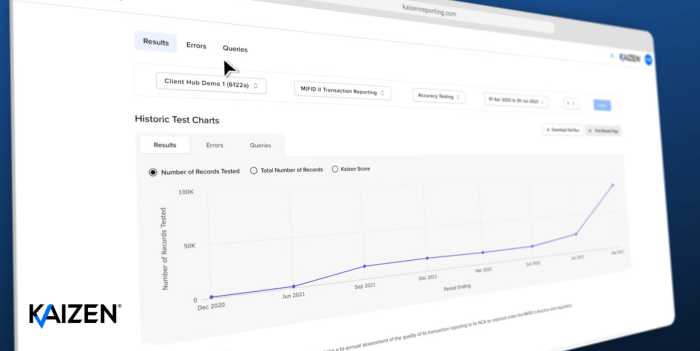
    Kaizen’s Regulation Dashboard is new feature of our ReportShield™ solution – providing clients with a complete, single view of their regulatory reporting quality, making it easier to understand where the top errors are, what to prioritise and how data is improving over time.

    What the Regulation Dashboard delivers:

    1. A clear dashboard summary of reporting completeness and accuracy:
      Demonstrating the overall health of regulatory reporting data, without the need to analyse detailed testing outputs.
    2. Top reporting errors at a glance:
      Highlighting the most significant issues instantly and automatically allows firms to prioritise remediation efforts.
    3. Status tracking across reporting data:
      Tracking shows which issues are new, which have been resolved, and which are recurring or trending – all in one dashboard.

    The Regulation Dashboard helps firms:

    • Reduce time spent analysing results
    • Improve confidence in regulatory reporting submissions, and
    • Support better, faster decision-making across compliance, data and ops teams

    Contact us for a demo or a conversation with one of our regulatory experts. 

  • EMIR Refit: Five Key Takeaways from Kaizen RegTalk

    EMIR Refit: Five Key Takeaways from Kaizen RegTalk

    EMIR Refit is one of the most significant pieces of regulatory change in financial services in recent years. At our recent Kaizen RegTalk conference, we hosted a panel discussion: “EMIR Refit – One Year On” bringing together speakers from the Financial Conduct Authority (FCA), Bank of England, HSBC as well as Kaizen’s subject matter expert Tim Hartley, to share their experiences of the implementation. The panel was hosted by John Graham from the Futures Industry Association (FIA). 

    To set the scene, the EMIR panel commenced with a live audience poll asking how firms felt about their EMIR Refit experience one year on. The results painted an interesting picture: 

    • 47% said it went “about as expected,” 
    • 20% found it “smoother than expected.” 
    • 20% are “still working through issues,” and 
    • 13% found it “more challenging than expected.” 

    These results confirm the broad industry view that firms made good progress in ensuring compliance at go live, and were able to submit successfully, but that momentum has slowed down as firms focus on their ‘day two’ book of work. 

    Here are five key takeaways from our panel discussion:

    1. Learning from the challenges of EU go-live 

    Firms with dual reporting obligations in the UK and EU had the advantage of going live first with EU EMIR Refit and then five months later with UK EMIR Refit. The staggered go-live dates meant that firms had the chance to see what worked and what didn’t in the EU regime, providing them with the opportunity to rectify errors and improve processes in time for UK implementation. 

    The majority of UK firms reported successfully on day one with high acceptance rates and minimal disruptions, which is reflected above in the total 67% of firms who highlighted a positive experience of go-live (i.e. “about as expected” and “smoother than expected”).

    2. Now is the time to focus on data quality

    While the initial focus was on acceptance rates, the panel participants made it clear that getting technically connected and having reports accepted was only the beginning. Many firms are meeting the validation rules, and trade repository rejection rates are thankfully low. However, firms can be compliant with the validation rules BUT still have inaccuracies in their data – the focus for firms now must be to identify and locate issues and remediate them.   

    Many firms are now spending significant time and resources on fixing errors that are still ongoing, and the industry is grappling with the much more difficult task of ongoing data quality management. 

    Key issues that firms continue to face include: 

    • Matching Problems: while pairing rates are getting better, reconciliation breaks still create significant work. Different interpretations between counterparties on certain fields are causing ongoing headaches. 
    • Counterparty Data Issues: this is especially problematic when firms use delegated reporting, where maintaining oversight while relying on third parties creates practical challenges with reporting for the same legal entity. 
    • More Changes Coming: additional reconciliation fields will be rolled out in phases, indicating that firms need to stay prepared. 

    3. Resilience during periods of increased volatility 

    One area discussed by the panel participants was how well systems are coping under pressure for example, during the recent ‘Liberation Day’ market stress and volatility, reporting volumes jumped from 30 million to 76 million reports per day – more than double average volumes. But firms’ systems and teams across the industry managed the increased reporting volumes smoothly.

    4. ‘Regulatory decay’ 

    The panel highlighted something that is often underestimated: the ongoing effort required to continue to align with regulatory requirements after implementation and go-live. Budget pressures and limited team resources means firms need to prioritise which problems to fix first. 

    A major concern raised was “regulatory decay” – losing knowledge as team members move onto new projects. Firms realise they need strong processes in place to maintain standards and grow the expertise they’ve built in-house. 

    5. Regulators ARE using the data

    Regulators from the Bank of England and FCA gave insights into how they are actually using EMIR data, which reinforces why it’s so important to get reported data correct: 

    • Policy Decisions: the data goes directly to the Financial Policy Committee and Monetary Policy Committee 
    • Watching Markets: real-time monitoring of risks and market concentration 
    • Crisis Response: quick analysis when firms fail (like Silicon Valley Bank) — results in minutes, not days 
    • Stress Testing: using detailed derivatives data for policy planning 
    • Market Abuse: every FCA investigation in the past decade has started with data from transaction reports. 

    Looking Ahead 

    Panel participants made it clear that the key lesson from the EMIR Refit implementation is that it wasn’t a one-time project. Meeting the regulatory obligation is an ongoing process that requires constant attention to data quality and systems management, especially given how important this data is to regulators and what it’s being used for. 

    Concerned about the quality of your EMIR Reporting data? More than 200 firms from tier 1 banks to small fund managers rely on Kaizen’s quality assurance to meet – and exceed – their regulatory obligations. Contact us to request a demo or for a conversation with one of our regulatory experts. 

  • ESMA’s SFTR Data Quality Indicators: Progress with Limitations

    ESMA’s SFTR Data Quality Indicators: Progress with Limitations

    The New Framework 

    ESMA finalised its 23 SFTR Data Quality Indicators (DQIs) during 2024 and published them last month together with a “Framework for provision of data and follow-up on SFTR data quality issues“. The framework laid out how results of the DQIs are identified and expressed at the EU level, discussed at the Repositories Task Force (RTF) and shared with National Competent Authorities (NCAs) at the entity level.

    NCAs are now expected to follow up with the entities and provide feedback to ESMA. ESMA then reviews the feedback and performs a rerun to confirm the issue has been resolved, this is then shared with the RTF with any follow-ups deemed necessary. Given how variable and sporadic SFTR supervision has been across Europe, these are very positive developments. 

    Understanding the 23 DQIs: Not All Created Equal 

    Ask an ESMA official and all 155 SFTR reporting fields were created equal, however, I suspect that there is a very different view on the ground in the regulatory reporting oversight offices of the 30 NCAs and two European Supervisory Authorities (ESAs). Under SFTR, predominantly but not exclusively a systemic risk monitoring regulation, trade economics are king.  

    In summary, while the DQIs will provide the less sophisticated NCAs with a means of challenge their regulated entities in at least a minimal way, for others unfortunately at this stage, they may be little more than a distraction in performing their valuable work in keeping their domestic economies from harm. ie. time spent reviewing ESMA findings and coordinating responses may actually be better placed analysing genuinely systemic issues in that jurisdiction. 

    Two-Sided Reconciliation Tests (8 DQIs): Eight of the 22 DQIs rely on a fundamental assumption: that SFTR reports are genuinely two-sided. This means both parties have reporting obligations, are in the same jurisdiction, haven’t delegated their reporting, and their data comes from independent sources rather than shared systems. In theory, this creates a true representation of each firm’s books and records. However the reality is very different. These DQIs are flawed because so few reports are genuinely, independently two-sided. Most data ultimately comes from a single source – whether through shared systems, data vendors, or reporting delegation. In our experience, time and time again, two wrongs really do make a wrong when you’re trying to reconcile reports that originated from the same place.

    Reporting Discipline Issues (10 DQIs): A further 10 of the DQIs cover essentially SFTR reporting discipline issues rather than material economics. These include the number of rejected reports (NACKs), late reporting, missing variation margin reports on CCP cleared trades, client codes used in place of LEIs, missing issuer LEIs, incorrect reporting counterparty classification x 3, duplicate reports and not updated event dates. 

    The One with Potential: DQI 11A Anomalies 

    There is just one SFTR DQI that appears to have the potential to be truly powerful. Unfortunately like many things SFTR, it is rather loosely defined. DQI 11A Anomalies uses statistical approaches to identify abnormal/anomalous values in listed fields but encouragingly, in ratios between relevant fields too. This DQI spans 20 SFTR fields covering repo, securities lending and margin lending across loan values, collateral values, market values, lending fees, haircuts, CCP margins, collateral reuse and cash reinvestment (for securities lending). Arguably this should really be broken down into hundreds of sub and specific DQIs per type of SFT and nature of the test, such that there is a thorough understanding of the parameters and expectations. It would also enable firms to implement these indicators in their own controls frameworks. Unfortunately there are no further details or definition, such that both NCAs and reporting counterparties are left to guess the precise nature of the tests. 

    The Bigger Picture Problems 

    Aside from the limited instances of true independent two-sided reporting and an over-emphasis on reporting discipline, many of the tests also focus on the number of reports or instances, not their economic value. Also considering that in terms of market size and risk exposure, in excess of 75% of the SFT market in the EU is repo and the closely related buy-sellback market, it is something of a concern that the lion’s share of DQIs are focused on the securities lending. As primarily macro-systemic regulation, this is disappointing. 

    Looking Forward 

    It’s easy to pick holes in the new SFTR DQIs but for the forgotten stepchild of EMIR, they are certainly a move in the right direction. While at this stage it appears to be something of an opportunity squandered, firms should be painfully aware that they are on notice to up their game in terms of SFTR data quality. Those NCAs that have kept quiet and have been lurking in the shadows are highly likely to let their presence be felt once they start receiving DQI queries from ESMA that require their attention. 

    Kaizen’s quality assurance testing includes checking for all issues included in ESMA’s DQIs and many more. For a conversation with Jonathan or one of our regulatory experts about your SFTR data quality, please get in touch.

  • WATCH: Highlights of Kaizen RegTalk 2025

    WATCH: Highlights of Kaizen RegTalk 2025

    We’re thrilled to share the highlights of Kaizen RegTalk, our annual event for our client community, which took place on Tuesday 10 June at Merchant Taylor’s Hall, London. 

    More than 200 clients, partners and industry specialists joined us for an afternoon of networking, insights and best practices on regulatory reporting, with speakers from the FCA, Bank of England, ISDA, Regis-TR, FIA and many client firms. 

    Tom Soden, Manager, Markets Reporting Team at the FCA gave the keynote address.

    Key topics for the afternoon included the MiFIR Review, EMIR Refit lessons learned, delegated reporting best practices, and the growing role of AI.

    Once again, a huge thank you to all our speakers and panellists, and of course to our valued community of clients who make events like this possible.

  • ESMA’s Data Quality Report 2024: MiFiR transaction reporting remains a key focus

    ESMA’s Data Quality Report 2024: MiFiR transaction reporting remains a key focus

    ESMA’s fifth report on data quality (published 30th April) – like last year’s – seemed light on a first read for MiFIR. But a second read alongside another ESMA document, the “Data Quality Engagement Framework (DQEF) for MiFIR’ published a week after the report, reminds us that MiFIR transaction reports and their data quality remain a key focus for ESMA and EU National Competent Authorities (NCAs).

    The purpose of MiFIR transaction reporting

    In the data quality report (DQR) ESMA reinforces, should we have forgotten, that data supports the day-to-day activities of financial regulators and remains essential for them to achieve their primary mandates of financial stability, orderly markets and market integrity.

    “Reduce the reporting obligations on firms”

    The DQR provides a number of use cases, introduces the DQEF and gives a significant mention to the role of transaction reports in the transparency and volume cap calculations that will reduce the reporting obligations on firms.  In case you missed it – “reduce the reporting obligations on firms”. The proof of concept (PoC) to prove the role of reports in these calculations determined that data quality is good but the DQEF being introduced is designed to address the critical data quality issues that became apparent during the exercise. 

    Improved tooling for increased scrutiny

    Furthermore, the DQR mentions that ESMA and NCAs now have improved tooling for monitoring markets. This includes details on the ESMA Data Platform (EDP) where regulators can share reported data and access predefined analytics to support them in their work.  As we highlighted last year – firms contributing reports to these calculations that are lacking data quality can expect their NCA to give them an opportunity to discuss the issues found.

    Delving into the details

    At a macro level, reported data under MiFIR is used to monitor overall trends and key market-level developments.  NCAs use the data in national financial stability reporting and sectoral updates whilst some have established systems to monitor trading venue activity or to rank firms based on their risk profiles.

    For the detection of market abuse, NCAs have developed a variety of automated alerting tools to highlight behaviours that could threaten market integrity for follow up by surveillance staff.  Data from different regimes is combined to identify cases of potential market abuse. 

    New tests to enhance data quality

    The PoC to test the potential for using MiFIR data for transparency and volume cap calculations achieved > 95% accuracy and hence will replace the existing systems (FITRS and DVCAP) and reduce the reporting burden for firms.  The discrepancies found will be addressed via the newly established DQEF based on ESMA’s existing transaction data validation rules and the TREM (Transaction Reporting Exchange Mechanism) DQEF tests, with new completeness, accuracy and consistency tests introduced to enhance data quality.

    The aim is to launch the DQEF in the first half of 2025 to allow NCAs and firms to address the quality issues found – ahead of the go live of the new transparency and volume cap system.   

    Conclusion

    We are often asked, ‘do regulators actually use the data?’ and the DQR provides clear evidence that they do. ESMA’s reuse of MiFIR transaction data for transparency and volume cap calculations demonstrates its commitment to reducing duplicative reporting – something the industry has long requested. However, increased data usage means increased scrutiny. Firms submitting poor quality data can expect to be contacted, remediation expected, warnings given and potential enforcement action.

    Firms often approach us for quality assessments after the regulator has challenged their data. This puts them in damage control mode.  The better approach is proactive quality assurance that identifies problems before regulators do. Please don’t hesitate to reach out to us at Kaizen to see how we can help.

  • WATCH: Introducing Kaizen Insights

    WATCH: Introducing Kaizen Insights

    Kaizen Insights is an exciting new feature of our ReportShield Accuracy Testing. Clients can now navigate from Accuracy Testing results on the Hub to view explanatory texts for incident codes written by our subject matter experts and links to the regulations in Single Rulebook.  Kaizen Insights provides clients with greater transparency of the tests themselves, as well as directing to the section of the regulation where the test is derived.

    Gain immediate access to:

    • Expert interpretations of error codes from our subject matter specialists
    • Clear regulatory definitions and source references
    • Industry best practices to resolve compliance issues
    • Direct links to the relevant regulations within Single Rulebook

    Contact us for a demo or a conversation with one of our regulatory experts. 

  • ESMA’s 2024 Data Quality Report: EMIR Refit under the Microscope

    ESMA’s 2024 Data Quality Report: EMIR Refit under the Microscope

    ESMA released the fifth iteration of its Report on Quality and Use of Data (DQR) late last month, which highlights the use of reported data across multiple regimes, critiques submission quality, and references some of the enforcement actions carried out in 2024. This analysis focuses on the DQR’s EMIR data quality findings and their implications for firms. We have also published our SFTR analysis of the report.

    Focus on EMIR Refit

    Last year’s DQR placed a heavy emphasis on the potential for the EMIR Refit reporting changes to improve data quality. 12 months later, ESMA provides a mixed assessment:

    • ‘Positive assessment of go live’ in April 2024
    • Concerns regarding preparedness of Trade Repositories and reporting entities
    • Ongoing ‘need for further engagement for corrective actions’.

    EMIR Reporting was described by ESMA in last year’s DQR webinar as being ‘much more complicated’ under EMIR Refit. From Kaizen’s view of post-Refit reporting, many firms still have significant work to do to uncover hidden reporting issues and apply successful remediation procedures. This report may still be too early to provide a true reflection of data quality under the EMIR Refit regime.

    Limited Data Quality Indicators (DQIs)

    The EMIR metrics provided in the report give a limited and somewhat lacklustre view on where EMIR data quality currently rests.  Of the seven DQI metrics displayed:

    • Six show a mild improvement in data quality metrics (such as the Number of Outstanding Trades in Chart 3)
    • One indicates declining quality – percentage of missing valuations (Chart 7).

    A more comprehensive analysis of all the EMIR DQIs would be extremely useful for the industry and help us to gain a more accurate evaluation of data quality. ESMA’s Data Quality Dashboard for EMIR Refit document details (approximately) an additional 18 DQIs (c.25 in total) that are being actively monitored and discussed between supervisory authorities. The DQIs are a key tool within their regulatory arsenal and it is disappointing only a small number appear in the public report.

    Key DQI findings

    Rejection rates

    ESMA highlights the rejection rate of derivatives, which sits at approximately 1-2.5% across EU submitters. The rejection rate is described as ‘critical for authorities’ to ensure data is complete and accurate. ESMA’s expectation is for a ‘close to zero’ rejection rate.

    For me, the late report statistic is far more important, as firms are required to report trades in a timely and accurate fashion. Late submissions by some counterparties can lead to the view of unpaired submissions that distort the visibility of derivative exposure. Firms are required to report by end of day T+1, and are not in breach of any regulatory requirements if they resubmit a rejected derivative within that timeframe. In the absence of any material increases in this statistic, I question the value of emphasising it.

    Legacy format upgrades

    The DQR states that ‘36 million’ submissions needed upgrading to the new EMIR Refit format within 180 days from April 2024. At the end of February 2025, 2% of those submissions had not been converted. Firms with a UK EMIR reporting obligation should take note of the focus on updating old submissions and enforcing the strict schemas under EMIR. ESMA states firms should ensure ‘swift upgrading’ of any old format derivatives.

    Maturity date issues

    Abnormal or blank maturity dates continue to cause confusion (as shown in Chart 6), despite a small reduction to approximately 10% of submissions. Due to products such as CFDs, the maturity date fields have not been mandatory under EMIR Reporting’s validation rules, long prior to EMIR Refit. Regulators fully expect these ‘optional’ fields to be populated where applicable to the derivative. It is worth repeating:

    Optional fields do not mean the entity has a choice as to whether they are populated or not.

    Abnormal or blank maturity dates is a relatively high figure at 10% and ESMA explicitly expects a ‘lower percentage going forward’. Firms must ensure that this data point, and all further ‘optional’ fields are fully reviewed and are being reported for all submissions in a timely and consistent manner.

    Missing valuations

    Chart 7 shows that missing valuations are increasing (currently at 12.36%), even though daily valuations are required for a large majority of EMIR reporters and have been since August 2014. 

    Entity Responsible for Reporting (ERR)

    The DQR also places emphasis on a new field from EMIR Refit, the Entity Responsible for Reporting (ERR). This OTC field is described as a ‘crucial addition under EMIR Refit’ and ESMA appears dissatisfied with the volume of misreporting of this field (as shown in Chart 6).

    Trade Repositories’ (TRs) challenges

    ESMA gives mention to the reporting difficulties of TRs as well as entities, including issues such as:

    • Difficulty with reporting portability
    • LEI updates from M&A activity
    • Inter-TR reconciliation delays
    • Challenges providing complete reports to the NCAs.

    In my opinion, this highlights the complexity of EMIR Refit for firms and TRs alike, notably given the vast range of reportable products and lifecycle events, under a complicated reporting regime.

    The simplification paradox

    ESMA makes efforts to explain its desire to simplify reports and reduce the regulatory burden for firms. Very few firms will agree that this objective has been achieved in practice or in the spirit of the regulation. While many aspects of reporting have received welcome clarification, additional reporting requirements have been introduced and made the overall regulatory regime much more complex.

    What does this mean for firms?

    Based on the DQR findings, firms should focus on:

    1. Ensuring proper population (where applicable) of maturity data fields
    2. Valuation reporting – review processes to stop the increasing trend of missing valuations
    3. ERR field accuracy – verify the correct implementation of this ‘crucial’ addition
    4. Legacy migrations – complete any remaining pre-Refit format submission upgrades
    5. Rejection rates vs late reporting – while ESMA focuses on rejection rates, firms should also prioritise timeliness.

    Assessment

    Overall, I welcome the DQR’s attention to data quality critique and its motivation to help firms achieve regulatory compliance through complete, accurate and timely reporting. The justification of how data is used is particularly valuable, as this large operational burden is often questioned by firms.

    Going forward, the DQR would benefit from further transparency and metrics across the full suite of DQIs. This would help firms understand how their reporting is being reviewed by supervisory authorities and allow them to focus their limited remediation resources on improving the most material parts of EMIR Reporting.

    Better guidance and clarity would also ensure firms are better equipped to ensure reporting is complete and accurate at point of submission, negating the need for costly remedial action for firms and regulators alike.

    Concerned about the quality of your EMIR Reporting data? More than 200 firms from tier 1 banks to small fund managers rely on Kaizen’s quality assurance to meet – and exceed – their regulatory obligations. Contact us to request a demo or for a conversation with one of our regulatory experts. 

  • ESMA’s 2024 Data Quality Report: Increased Focus on SFTR Data Quality

    ESMA’s 2024 Data Quality Report: Increased Focus on SFTR Data Quality

    ESMA’s Report on Quality and Use of Data for 2024 (published 30 April 2025), delivers a clear message: “ESMA expects that reporting entities increase the quality of their reported data significantly” and “the quality of the SFTR data still has large margins of improvements.”

    A particularly encouraging development is the “enhanced cooperation with BaFin,” where ESMA and BaFin established “an enhanced periodic engagement” with BaFin stepping up their approach and increasing targeted efforts. This marks positive progress in what had previously appeared to be somewhat polarised regulatory scrutiny across the EU.

    SFTR Data Quality Indicators Now Fully Implemented

    ESMA finalised its Data Quality Indicators (DQI) approach for SFTR in 2024, following their successful introduction for EMIR in 2022. Prior reports highlighted concerns, most notably the overstatement of open term securities loans values during 2021-2023, but there was relatively little structured analysis before the DQIs. ESMA notes that “a TR issue due to which inflated market values were observed has been resolved with the pending correction of historical data being monitored,” likely referring to reporters’ failure to send terminations or add maturity/end dates to open term securities loans.

    Key SFTR Data Quality Indicators Revealed

    Missing Valuations (DQI 5a)

    This metric shows significant improvement, falling from 26.3% in March 2023 to 8.5% by December 2024, though still above ESMA’s 5% threshold. The “dramatic” improvement was due to “amelioration of reporting by a few of the major reporting entities.”

    Outdated Valuations (DQI 5b)

    Of all DQIs, this remains “the worst among depicted DQIs,” despite falling from 41.4% in March 2023 to 26% by December 2024. ESMA emphasises: “Having updated information in times of adverse market movements and crises is crucial for authorities” and it is “imperative for counterparties to swiftly follow on the identified issues with outdated valuation.”

    Trade Reporting Discrepancies (DQI 1a)

    This indicator shows an average of 35% mismatch in outstanding SFTs between counterparty pairs – far above the 5% threshold and higher than EMIR’s 20.5%. This is remarkable considering that many SFTR reports are single-sided, and many dual-sided reports are generated by a single party with pre-matching and third-party data enrichment.

    Position-Level Discrepancies (DQI 1b)

    This indicator measures differences in position-level reporting between counterparties. While ESMA highlights this metric, position-level reporting is relatively uncommon in SFTR, making its prominence in the report somewhat curious.

    Entity Responsible for Reporting (DQI 9a)

    This field identifies who is responsible for reporting (UCIT managers for funds, AIFMs for AIFs, etc.). Though important for attributing data quality errors to the correct entity, this metric showed modest issues at 1.9% by end of 2024.

    Regulatory Expectations Rising

    ESMA’s commitment to data quality is clear: “ESMA always encourages the amelioration of reporting even in cases where the error rate is below the DQEFs which govern actions taken to tackle data quality.”

    Our Perspective

    At Kaizen, we welcome the increased focus on SFTR data quality five years after implementation. The publication of the Data Quality Engagement Framework and DQIs provide important steps toward greater regulatory certainty.

    However, we are cautious about equating matched reports with high-quality data. We would also challenge the focus on securities lending data elements and the relative absence of repo data given its greater systemic risk significance.

    Is your SFTR reporting in good shape? Can you evidence this? Kaizen provides comprehensive quality assurance for accurate, complete and timely SFTR reporting.  We also provide Daily Controls for SFTR delegated reporting arrangements.

    Contact us to request a demo or for a conversation with Jonathan or one of our regulatory experts.

  • Video series: Dario Crispini on issues and risks of poor data quality in regulatory reporting

    Video series: Dario Crispini on issues and risks of poor data quality in regulatory reporting

    In this video, Dario Crispini covers the following data quality in Regulatory Reporting topics:

    • What are the main regulatory reporting issues that firms should currently be looking out for?
    • What should firms have in place and what preparations should they be making for new regulations?
    • What is the status of firms’ regulatory reporting capabilities?
    • What are the main risks of a poor regulatory reporting practice?

    This is a four part introduction to Kaizen Reporting video series from CEO Dario Crispini.

    Watch the first video in the series – Why was Kaizen founded?

    Watch the second video in the series – Kaizen’s key regulatory reporting services.

    If you’re concerned about the data quality of your regulatory reporting, get in touch. 

    Huge thanks to the Wealth Mosaic whom we collaborated with on this project. 

  • FIRDS: Are trading venues contributing to poor quality transaction reporting?

    FIRDS: Are trading venues contributing to poor quality transaction reporting?

    Perhaps the biggest irony about MiFIR transaction reporting is that reports submitted by investment firms need to be complete and accurate, but ESMA states it cannot provide any guarantee that one of the key tools firms need to do this, the ESMA FIRDS reference database, is “complete, accurate or up-to-date”. This is particularly harsh on firms as they can report with the correct ISIN to identify the financial instrument, but if that ISIN (or underlying ISIN) is not on the FIRDS database within seven calendar days, then the report will be rejected by the competent authority. The onus is then on the firm to investigate whether they should re-submit the report.

    This is unfair on firms as most of them are trying to do the right thing by only reporting transactions in instruments that are reportable, but they are frustrated with limitations of ESMA’s FIRDS database. It would be easy to blame ESMA for this, but I believe that also is unfair. The quality of FIRDS can only ever be as good as the information submitted to it and it is the EEA trading venues that are obliged to submit this data through the requirements detailed in RTS 23. The quality of FIRDS data has improved dramatically since go-live, as you would expect over the course of two years, and many trading venues may be reporting perfectly. However, other trading venues are not, and deficiencies in this reference data was highlighted in Germany’s Ministry of Finance’s position paper on MiFID and MiFIR.

    Germany’s Ministry of Finance concludes that “ further analysis is needed on the question of how to ensure the provision of accurate, reliable and timely reference data. The analysis should also explore ways to make FIRDS the golden source for reference data.” Well I’m sure we all know the obvious answer to this one – there is nothing quite like a sanction, perhaps in the form of a fine and public censure, to ensure data quality is taken more seriously. We have seen sanctions used for firms’ poor transaction reporting and how this can focus attention, so maybe trading venues need to be wary of the possibility of sanctions if they don’t improve the quality of their reference data. If you are a trading venue that has doubts about the quality of its reference data, now might be a good time to look at quality assurance solutions.

    The quality of FIRDS data also impacts the thorny issue of the ESMA opinion paper on OTC derivatives traded on a trading venue. In this paper, ESMA expands the reportable instrument set to include “OTC derivatives sharing the same reference data details as the derivatives traded on a trading venue”. This paper has caused much consternation in the industry. Whilst some firms have paid as much attention to the opinion paper as a London cyclist does to a red light, many other firms are desperately trying to do the right thing in trying to match the reference data attributes of their OTC derivatives against the attributes of derivatives on the FIRDS database to see if they are reportable. The quality of the FIRDS data, and the flexibility of FIRDS itself, often makes this a frustrating and imprecise task. This appears particularly true for FX and interest rate derivatives and prompts the question (also asked by Germany’s Ministry of Finance) of whether the concept of ‘traded on a trading venue’ should be applied to OTC derivatives. Anybody who thinks it should, needs to try assessing whether some OTC FX swaps are reportable or not. They would probably find that they first need to match attributes against the ANNA Derivatives Service Bureau to find potential ISINs and then compare the attributes associated with these ISINs against FIRDS to see if the instruments are reportable (not forgetting to check if the underlying forwards have reportable ISINs). They may well struggle with the flexibility of FIRDS in this task and may possibly be perplexed by the quality of much of the data – for example, the lack of consistency between the financial instrument long name and the attributes, particularly the expiry date. 

    Whilst the MiFIR definition of reportable instruments appears easy on paper (MiFIR Article 26(2)), there is plenty of devil in the detail and many firms struggle to fully understand them. These firms are unlikely to understand the implications of the ESMA ToTV opinion paper and it does appear to be too complex a requirement for the associated regulatory benefit. The current data quality and flexibility of FIRDS does not seem fully adequate to support this requirement. More importantly, it appears that the quality of FIRDS reference data may be causing issues with the overall quality of transaction reporting. Whilst many trading venues are on top of the task of their RTS 23 reporting, it appears that some trading venues need to up their game to avoid regulatory attention.

    If you’re worried about the quality of your reported data, this is why we here at Kaizen exist. Our accuracy testing and reference data testing services check all data fields in every trade or transaction report submitted to the regulator so you have a full picture of the quality of your reporting.  Contact us for a discussion on how we can help. Join in the conversation over on our LinkedIn.

  • Video: David Nowell on what is happening with EMIR Trade Reporting

    Video: David Nowell on what is happening with EMIR Trade Reporting

    In this video, David Nowell answers the below questions:

    • Why is EMIR important?
    • Following recent comments from ESMA about the FCA and other NCAs, what changes are we likely to see?
    • What do the changes mean for financial firms?
    • What are the key changes from the recent EMIR re-fit?

    If you need help with your EMIR Trade Reporting data quality, get in touch.

  • One year to go:  RTS 2 non-equities reporting to reduce to five minutes

    One year to go: RTS 2 non-equities reporting to reduce to five minutes

    The countdown has now started! From this month it is now less than a year to go until investment firms’ RTS 2 non-equities post-trade transparency reporting needs to reduce from 15 minutes to five minutes. This new implementation comes in three years after the original MiFID II go-live.

    RTS 2, Article 7 states: “…for the first three years of application of Regulation No 600/2014, within 15 minutes after the execution of the relevant transaction; thereafter, within 5 minutes after the execution of the relevant transaction.”

    Whereas RTS 1 transparency has been relatively straightforward due to the electronic nature of equities trading (hence the one minute limit), the non-automated nature of voice trading, as an example, still causes problems for firms in terms of meeting the current close-to-real-time 15-minute deadline imposed by the regulation. It is commonly recognised that firms still struggle to meet publication after 15 minutes, whether that’s changing a trader’s habit, automating trading or even introducing FIX messaging protocol which  – believe it or not  – still isn’t used by all firms. So the reduction to five minutes may really impact firms and may alert the national competent authorities to focus more on these transparency deadlines.

    MiFID II’s transparency objective meant that it was bringing the non-equities trading world into the 21st century and electronifying the practice, creating a level playing field and enabling investors to make an informed decision with the knowledge of how the price was formed.

    With under a year to go, firms need to incorporate this change into their book of work technologically, procedurally and in some cases, culturally. At Kaizen, we provide accuracy testing on MiFID II post-trade transparency reporting (PTT) data to check that you are meeting these close-to-real-time requirements and that your data is correct. This includes checking whether you are reporting within the required timescales and alerting firms where they consistently do not meet the deadline after execution. 

    Contact us if you’d like some help in ensuring your PTT reporting is accurate as this will help with your preparation for the change to reporting within five minutes. 


  • Video series: Dario Crispini on Kaizen’s key regulatory reporting services

    Video series: Dario Crispini on Kaizen’s key regulatory reporting services

    Kaizen Reporting’s CEO Dario Crispini talks about the regtech company’s multi-award winning regulatory reporting assurance services and the unique testing methodology behind them. 

    This is a four part introduction to Kaizen Reporting video series from CEO Dario Crispini.

    Watch the first video in the series – Why was Kaizen founded?

    Watch the third video in the series – Issues and risks of poor data quality in regulatory reporting.

    If you’re concerned about the data quality of your regulatory reporting, get in touch. 

    Huge thanks to the Wealth Mosaic whom we collaborated with on this project. 

  • Video series: Dario Crispini on why he set up Kaizen Reporting

    Video series: Dario Crispini on why he set up Kaizen Reporting

    Kaizen Reporting’s CEO Dario Crispini talks about the factors that led him to start the company, our services, and the benefits we bring to our clients, in the first video of a series introducing who we are and what we do.


    This is a four part introduction to Kaizen Reporting video series from CEO Dario Crispini.

    Watch the second video in the series – Kaizen’s key regulatory reporting services.

    Watch the third video in the series – Issues and risks of poor data quality in regulatory reporting.

    If you’re concerned about the data quality of your regulatory reporting, get in touch. 

    Huge thanks to the Wealth Mosaic whom we collaborated with on this project. 

  • Join us at Infoline’s Trade and Transaction Reporting Conference in Stockholm

    Join us at Infoline’s Trade and Transaction Reporting Conference in Stockholm

    We are delighted to be able to offer 30% off tickets. Use code FKM63769KAIZEN.

    Register


    Calling all investment firms, securities firms, banks and trading venues impacted by the reporting and disclosure obligations of SFTR, MiFIR and EMIR! Please join us at this one day conference in Stockholm. Don’t miss our Senior Regulatory Reporting Specialist, Jonathan Lee, discussing SFTR Reporting best practice and how to prepare for the April 2020 go-live at 10:30am. Followed by Senior Regulatory Reporting Specialist, David Nowell, on a panel to discuss the ongoing challenges with MiFID II Transaction Reporting and EMIR Trade Reporting. 

  • ESMA clarifies FX forwards transaction reporting in new MiFIR Q&A

    ESMA clarifies FX forwards transaction reporting in new MiFIR Q&A

    ESMA has provided a very useful example of how to report FX forwards in its latest Q&A on MiFIR data reporting. In particular, we would urge firms to take note on the practice of populating the ‘quantity’ and ‘price’ fields:

    • The ‘quantity’ (and ‘quantity currency’) should reflect the amount of the FX forwards in the base currency
    • The ‘price’ (and ‘price currency) should show the forward rate expressed as a price of base currency in the quoted The monetary value XML tag should be used (if reporting to an ARM in flat file, ‘price type’ is monetary value.

    The only additional changes appear to be in the table of national identifier formats. This details a change in the format of Portuguese passports issued after April 2018 and corrections to the Romanian National Identification Number and national passport formats.

    Whilst the new MiFIR Q&A signals only relatively minor changes, it clearly demonstrates the need for firms to remain on top of regulatory developments. Our regulatory reporting training courses help firms stay abreast of the reporting requirements and help identify any interpretational errors. For further details, please see our training courses.

     
  • Cappitech and Kaizen Reporting publish findings of SFTR implementation survey

    Cappitech and Kaizen Reporting publish findings of SFTR implementation survey

    FOR IMMEDIATE RELEASE

    17 September 2019, London and Tel Aviv: Cappitech and Kaizen Reporting today published the findings of the SFTR implementation survey conducted by Cappitech, a leading provider of regulatory reporting and intelligence solutions for the financial services industry, and analysed by Kaizen Reporting, global leaders in quality and accuracy for regulatory reporting, in which securities financing market participants were asked to help establish the industry’s state of readiness.

    While there is a greater state of readiness among the banks (due to go live in the first phase, April 2020) of reporting, the survey shows that 56% of banks are still only in the pre-implementation planning stages. The survey concluded that overall only 37% of the securities lending industry has started or completed SFTR implementation and expect to be ready in time when the regulation comes into force in phase one. 11.5% have not even begun to plan. While some allowance can be made for the fact that a number of respondents have later go-live dates, this is somewhat concerning.

    The current lack of readiness across the industry for this new and complex regulation is highlighted by the survey. Both Cappitech and Kaizen Reporting believe industry participants need to prioritise planning, implementation and testing of robust processes for SFTR, to ensure timely implementation.

    Jonathan Lee, Senior Regulatory Reporting Specialist (SFTR) at Kaizen Reporting said, “The findings from the SFTR survey make it clear that many companies are not as prepared as they should be at this stage. In order for firms to be ready by April 2020 there is a need to accelerate their plans and make sure that they allow enough time for testing and implementation.”

    Ronen Kertis, Founder and CEO of Cappitech comments, “Reporting firms who aren’t ready, especially those that haven’t started planning, will need to prioritise this in the coming months. Where possible, an extension of their existing technology may provide an easier and more seamless transition.”

    Reporting firms highlighted a number of additional concerns with SFTR including, most significantly, the issue of UTI matching; 54% of respondents felt they will need to implement UTI matching, with another 33% still considering it.

    40% of survey respondents are also still undecided regarding which trade repository (TR) they are intending to use, bringing additional readiness to test. While tier 1 firms often decide based on board seats and shareholdings, for the rest of the market pricing will be key and most TRs have not yet published detailed pricing data.

    Additional findings from the report include:

    Vendor Selection: This is an ongoing process, with 58% of respondents planning to implement extensions of their current reporting tools.  

    Delegated reporting: 51% of the banks surveyed are committed to providing delegated reporting. “Delegated reporting brings real challenges, not least of which is the need for clients to have control of and access to their reporting data to meet their regulatory requirements. Specific delegated reporting solutions  solve this challenge for banks when they offer delegated or assisted reporting to their clients,” says Mr. Kertis.

    UAT testing: The report also shows that despite its importance, UAT testing has not been fully embraced by the industry. Approximately 54% plan to test in the three months prior to go-live but Kaizen and Cappitech experience proves that many regulatory programme deliveries are delayed, leaving minimal time for testing. This has a knock on negative impact on data quality and regulatory compliance. For the 11% who are planning not to do any testing, and the 7% whose planning only incorporates testing one month before, these risks are greater with Mr. Lee stating, “We would caution that three months will not necessarily prove sufficient to launch such a large and complex reporting regime.”

    For a full copy of the report and to access further findings, please download it here.

    (ends)

    For media inquiries, please contact Fiona Wilde on media@kaizenreporting.com or +44 (0) 20 3912 3271.

  • In the news: David Nowell speaks to Practice Insight

    In the news: David Nowell speaks to Practice Insight

    Our Senior Regulatory Reporting Specialist David Nowell recently spoke to Thomas Helm at Practice Insight for a special report on the accumulative impact of post-crisis reforms. In the report Thomas Helm joins the dots of transparency initiatives to reveal the bigger picture. David commented on data quality for the 124 data fields of EMIR trade reporting and the kind of errors we regularly see here at Kaizen. 

    “David Nowell says he frequently comes across errors, such as notional amounts in the “quintillions” in the Emir space, and that these errors can distort the public data aggregations. When compiling the public data aggregations we’d artificially disregard notionals above a certain level because they were obviously false, he says.

    Read the full report.         

  • 10 Lessons from industry responses to the ESMA Guidelines Consultation

    While not an exhaustive list, here are our key takeaways from reading the ESMA SFTR Guidelines consultation responses. The overall level of engagement in relation to the consultation was substantial, with 49 files published by ESMA following the consultation period.

    1. Reporting certainty

    A few fundamental questions are key to providing clarity to support a timely build for SFTR reporting. Banks and credit institutions (due to report from April 2020) need answers to some of the these questions well in advance of the self-imposed Q4 2019 deadline set by ESMA.

    In particular, question 25, whether to provide full reports or the delta of changes for modifications and corrections – respondents overwhelming voted for full reporting.

    2. Reportability of intraday market infrastructures executed SFTs

    Which intraday transactions executed on behalf of firms by CSDs and CCPs remain in-scope for reporting? While T2S Auto-collateralisation transactions are explicitly excluded from reporting, does this also cover UK Crest Auto-collateralised repos? Extracting and reporting this data presents unique challenges.

    3. Scope and third country considerations

    The approach to determining the ‘conclusion’ of a transaction by a branch is far reaching and strays from the EMIR definition. It appears to focus on the activities of individuals rather than risk held in the EU. The practical challenges of reporting SFT activities of non-EU entities where traders are supervised by EU branches are immense and likely to lead to significant confusion in relation to areas such as bilateral margining and reuse.

    Concerns were raised where SFTR does not require non-EU AIFs managed by EU AIFMs to be reported (unlike EMIR), while EU AIFs must be reported regardless of whether the AIFM is based in the EU (again unlike EMIR).

    4. Why are buy-sell backs still treated differently?

    ESMA have specified that documented buy-sell backs should be reported as buy-sell backs listing the master agreement, but it is still unclear why the reporting requirements differ from repo. The inability to apply a repo rate, forward breakeven yield or forward price on a buy-sell back is a particular issue.

    5. Is fails reporting really required?

    There has been some confusion about the reporting of settlement fails (general consensus was that perfect settlement would be assumed unless both parties chose to modify a transaction to reflect a default or extended fail).

    6. How to report bilateral variation margining

    Concerns continue to surround the reporting of bilateral variation margins for repo. Given these margin calls at the counterparty portfolio level are entirely separate from the trade level collateral, there should be a separate end of day collateral update report to reflect bilateral margining. They cannot, as ESMA examples suggest, be incorporated with trade level collateral updates.

    7. Failure to transmit Unique Trade Identifiers (UTI)

    The issue of what to do if a counterparty is responsible for providing the UTI fails to provide it in a timely manner for reporting, remains an open question. The real question is how the party subject to late notification of the UTI by their counterparty can be excused from their obligation to submit timely reports.

    8. Availability & consistency of reportable data

    There are many concerns about the availability of data for reporting. The FSB themselves highlighted in their May 2019 document Thematic Review on Implementation of the Legal Entity Identifier that on aggregate only 55% of all financial instruments in scope have an LEI code (representing 78% of outstanding amounts) and that only 11% of all firms that are issuing securities have so far obtained an LEI. Mandating usage of issuer LEIs when firms that use securities as collateral have no contractual relationship with the issuer of the securities, appears a step too far. Solutions are to make the field conditional or apply a standard dummy issuer LEI.

    Other concerns persist around missing official CFI codes, ISIN codes, differences in credit rating assessments between firms and the collateral type field.

    9. The removal of ESCB transactions from the calculation

    Trade associations reiterated that removing ESCB transactions from both sides of estimated re-use calculations will be both difficult and misleading. Nonetheless, this is understood to be an FSB requirement rather than ESMA specific.

    10. Uncertainly around in-scope commodities financing transactions

    A number of trade associations and other respondents commented on the significant uncertainty felt by the commodities trading industry around the SFTR reporting scope of any of their transactions. Concerns were raised that while commodities financing transactions share attributes with SFTs, they are not executed for financing purposes. Disagreement exists as to which transactions constitute repos and which buy-sell backs, in general they were deemed hard to define under existing SFT definitions. There are also concerns that certain commodity transactions, believed to best fit the repo definition use pledge arrangements and not title transfer. Some power and gas contracts may also be reportable under SFTR as well as REMIT. While exclusions are in place for EMIR, they are not in place for REMIT.

    Did you know Jonathan provides CPD-accredited, CISI-endorsed training on the SFTR reporting requirements? Book your place on one of our upcoming courses here or get in touch for bespoke, in-house training.   

  • In the news: David Nowell speaks to Practice Insight on regulatory change

    In the news: David Nowell speaks to Practice Insight on regulatory change

    Senior Regulatory Reporting Specialist David Nowell spoke to Alice Tchernookova from International Financial Law Review’s publication Practice Insight about the future of regulation now that MiFID II has bedded down within the industry. 

    “We have almost reached a stage where we must ask ourselves whether being fully compliant is actually possible,” said David Nowell.

    Read the full article. 

  • ESMA fines trade repository for data delivery breaches

    ESMA has announced it has fined a trade repository for failing to provide regulators direct and immediate access to details of derivative contracts. The failures relate to trade terminations and valuations and collateral updates for the period from the start of EMIR trade reporting go live in February 2016 through to October of the same year. According to the public notice, ESMA remained unaware of the error until it was informed by the Dutch national competent authority (NCA) in July 2016.

    The fine should be a reminder to all industry participants that ESMA takes EMIR trade reporting very seriously. ESMA and the NCAs also have a ‘Data Quality Action Plan’ to address quality issues in EMIR trade reports submitted by firms.

    If you are in any doubt whether your reports meet the standards required by the regulators, please get in contact with us to discuss your EMIR data quality. The FCA has already issued a £34.5m fine for EMIR reporting breaches – we can help you put the right controls in place to make sure that you are not at risk too.

  • MiFIR versus EMIR – which is the most important reporting regime?

    MiFIR versus EMIR – which is the most important reporting regime?

    There are many similarities between the MiFIR transaction reporting and EMIR trade reporting requirements. Both are T+1 reporting regimes and there is a large overlap in the instrument set that they cover. However, there are distinct regulatory drivers behind each regime: MiFIR transaction reporting is primarily used to detect market abuse whilst EMIR trade reporting is used primarily to monitor for systemic risk.

    There is no doubt that combating market abuse is a very important regulatory service; everybody benefits from clean markets. Complete and accurate transaction reports are vital to help the regulators perform this task effectively. However, systemic risk is even more important as it represents the risk of collapse of the entire financial system -there is no point monitoring for market abuse if the financial system has collapsed around you.

    It is very interesting therefore to compare the number of errors and omissions forms for MiFIR breaches against the number of equivalent forms for EMIR trade reporting breaches. Statistics from the UK Financial Conduct Authority (FCA) obtained through a Freedom of Information Act request show that it received notifications from 384 firms MiFIR transaction reporting breaches since go-live compared to a paltry 75 for EMIR trade reporting in the period since Q2 2018 when the EMIR breach form became available. So, it is tempting to believe that firms recognise the relative importance of EMIR trade reporting and are making greater efforts to ensure the accuracy of data they report. Sadly, this is not the case. At Kaizen, we perform data quality checks on firms’ transaction reports and trade reports. For EMIR we initially find that a much lower number of EMIR trade reports are accurate than compared with the MiFIR reports we test. This reflects the complexity of the reporting regime, but we find firms’ reporting quality rapidly improves once we have highlighted and explained the errors to them.

    So this presents an apparent anomaly. The evidence suggests the quality of EMIR trade reports is at a lower level than the quality of MiFIR transaction reports, yet over five times as many firms have notified the FCA of MiFIR transaction reporting errors than they have for EMIR trade reporting. It is not difficult to understand why this is the case; the FCA is constantly reminding the industry on the need to notify them of MiFIR transaction reporting breaches, and to correct those errors, but it appears to be comparatively silent on the need to notify them of EMIR reporting breaches. What is more difficult to understand is why the FCA appears to be less active in meeting its G20 commitments in ensuring the same level of high quality in EMIR trade reporting data.

    If you’re concerned about the quality of your MiFIR transaction reporting data or EMIR trade reporting data or would simply like confirmation that it is accurate and complete, please get in touch for a complementary consultation with one of our regulatory experts.

  • Sunny ESMA provides some SFTR relief

    Sunny ESMA provides some SFTR relief

    ESMA published a Consultation paper “Guidelines for reporting under Articles 4 and 12 SFTR,” together with the latest consolidated SFTR validation rules. The deadline for responses is 29 July 2019. ESMA plan to consider feedback during Q3 2019 and the final report is scheduled to be published in Q4 2019. This does not give a lot of time, particularly for the 1st phase of reporting counterparties (Banks), due to go-live in April 2020.

    Nevertheless, ESMA provided clarity on many issues and gave reason to be cheerful as many SFTs executed on behalf of financial institutions through powers of attorney during the course of daily clearing, custody and settlement activities at CCPs, CSDs and ICSDs were ruled out of scope. This has undoubtedly removed a major operational headache from the SFTR reporting requirements and will assist regulatory authorities in gaining a better understanding of the data (as they will be significantly less overwhelmed with noise).

    • In particular, Chapter 5 (General Principles), paragraphs 25-27 rule out any reporting of short term credit lines for custody or CCP clearing.
    • Paragraphs 36-41 rule out reporting of any transactions relating to “fails-curing” services offered by CSDs.
    • Paragraph 43 rules out the need to report any transactions associated with Target 2 Securities Auto-Collateralisation.

    The guidelines also clarify the exclusion of the need to report under SFTR in relation to: Retail client lending (except when it is against an irrevocable trust), private banking & Lombard loans, syndicated lending and other corporate lending for commercial purposes, intermediate give-ups and take-ups (in the execution & clearing chain) and transactions involving emission allowances.

    In further points of clarification:

    • Buy-sellbacks and Sell-buybacks should be reported as such with the appropriate master agreement detail where applicable (overruling the original SFTR regulation) (paragraph 61).
    • Margin Loan reporting only applies to Prime Brokerage business (paragraph 11).
    • Modifications that are agreed but have not taken place should not be reported until the actual modification takes place (paragraph 117).
    • Margin loans – where the value of an existing margin loan hits zero, the transaction should be modified (MODI action type) rather than terminated (ETRM action type) (paragraph 83).
    • Securities lending and borrowing transactions can only involve a single ISIN being transferred between a given pair of counterparties (paragraph 65).
    • Backloading: ESMA advises that they like the idea of reporting all open and term transactions executed prior to the date of application whether they meet the requirements for backloading or not. This approach is seen as operationally simpler for many reporting parties and provides authorities with greater information in relation to variation margining (paragraphs 167-170).
    • When trading with sub-funds, each sub-fund should be treated as a counterparty if they have their own LEI (paragraph 52)
    • For cleared SFTs, each SFT between the CCP, its clearing members and the clients of those clearing members should be treated as separate SFTs with different UTIs (paragraph 53).
    • In relation to Repos, collateralised loans in more than one currency constitute separate SFTs. This doesn’t preclude a single SFT having collateral denominated in multiple currencies though
    • Small & medium sized non-financial counterparties trading with a non EU third country entity must either trade with an entity that has been granted equivalence (in which case there is no reporting obligation under SFTR), else they will need to delegate or self-report the transaction/s (paragraph 93).
    • Execution by a branch was clarified to cover the following: a) for a client in accordance with a discretionary mandate given to it by the client; b) where the branch has supervisory responsibility for the person responsible for the investment decision concerned; c) where the branch has supervisory responsibility for the person responsible for execution of the transaction; d) where the transaction was executed on a trading venue or an organised trading platform located outside the Union using the branch’s membership of that trading venue or an organised trading platform (paragraph 102).
    • Counterparties should not report the LEI of the CSD in which they are either a direct or indirect participant (paragraph 122) in the CSD participant field.
    • ESMA acknowledged that updating valuations of securities on loan or used as collateral may not be possible where pricing becomes stale. This can affect suspended shares and some illiquid fixed income securities. In these instances, reporting parties should use contractually agreed values and only update them if new price information becomes available (paragraph 155).
    • ESMA advises counterparties should always use official sources for CFI codes. Those who felt that it would be sufficient to just populate the first 2 characters are likely to be disappointed as ESMA states that X should only be used when a character is not applicable (paragraph 163).
    • Non-bank entities are permitted to start reporting earlier than their date of application if they find it easier (paragraph 188).   

    The consultation also contains an extensive set of sample reports for many different scenarios, detailing how each of the 4 reporting tables should be populated. Once we’ve had the opportunity to review these samples and the latest trade repository validation rules, we will produce a follow-up blog.

  • FCA publish Market Watch 59

    FCA publish Market Watch 59

    Market Watch 59 is ‘almost totally dominated by Transaction Reporting Observations’ and marks yet another strongly worded message from the Financial Conduct Authority on the importance of complete and accurate transaction reporting and how it is critical to the FCA’s work to ensure that markets function well.

    As ever, the FCA stress the importance of adequate systems and controls over transaction reporting and highlights how these requirements are clearly defined in Article 15 of RTS22. In particular, the FCA stresses the importance of reconciliation of front office trading records against data samples from the NCA. It also notes that some market participants don’t appear to be aware of the FCA’s facility to provide this data and the need for regular and thorough reconciliation.

    Valid but incorrect reports

    One of the more important messages from the FCA’s Market Watch is that:

    “Firms should not assume that a report was accurate because it was accepted by the Market Data Processor, as business validation rules are not intended to identify all errors and omissions”

    As we already know at Kaizen, there are too many ‘valid but incorrect’ transaction reports. In amongst the errors highlighted by the FCA are a number of old favourites, including the transposing of the buyer and sell:

    • Incorrect time (especially after the transition to British Summer Time!!!)
    • Price not reported in the major currency
    • Venue populated with the operating MIC where a segment level MIC is available
    • Misreporting the buyer as the seller and vice versa (oh come on!)
    • Re-use of identifiers for multiple clients
    • Incorrect client type code
    • Inconsistency between trading capacity and buyer/seller IDs

    Instrument Reference Data

    There is slightly conciliatory tone on the rejections where the instrument ID, or underlying instrument ID, is not present on FIRDS. Whilst the FCA is still keen to point out this is sometimes the firms’ fault, using the wrong Venue code for example, quite often it results from incorrect reference data submitted by the trading venues. The FCA is clearly sending a message to the trading venues and systematic internaliser that greater control is required over their RTS23 reference data submissions.

    Errors and omissions notifications forms

     The FCA’s observations end on a particularly worrying note for many firms. It reminds firms that where errors or omissions are identified in transaction reports, participants must submit a corrected report to the NCA. Alas, the FCA has noted that some firms are submitting an errors and omissions form, but not subsequently correcting the errors or correcting errors without submitting an errors and omissions form. The FCA does not appear to be happy about this!

    How Kaizen can help

    This is exactly what we here at Kaizen exist to do.  We have a proven track record in helping firms tackle their trade and transaction reporting issues and risks head on – and helping them to avoid censure whether it is for RTS23, MiFIR, EMIR, Dodd-Frank or another G20 regulation. Please contact us for a discussion with one of our regulatory experts to find out more.

  • Kaizen wins ‘Best Reporting Platform or Service’ at Sell-Side Technology Awards

    Kaizen wins ‘Best Reporting Platform or Service’ at Sell-Side Technology Awards

    FOR IMMEDIATE RELEASE

    15 April 2019, London: Leading regulatory reporting firm Kaizen Reporting (Kaizen), developer of the multi-award-winning assurance service, ReportShield™, has won ‘Best Reporting Platform or Service for the Sell-Side’ at the Sell-Side Technology Awards. Hosted and run by WatersTechnology, the awards were set up in order to recognise market-leading technologies and third-party vendors that enable sell-side firms to operate more efficiently and transparently.

    “It’s a real honour to be named as the winner of ‘Best Reporting Platform or Service’, which further shows Kaizen’s commitment to offering our customers the best solutions to their reporting needs.”

    The methodology which applied to nominated companies focused on how they address the sector’s most pressing needs and manage the various risks financial firms frequently face, through innovation and effective collaboration. The winners of the awards were narrowed down from an extremely broad field; entry was open to all technology providers, brokers and sell-side institutions, illustrating the level of quality required to stand out.

    Dario Crispini, CEO of Kaizen, commented:

    “It’s a real honour to be named as the winner of ‘Best Reporting Platform or Service’, which further shows Kaizen’s commitment to offering our customers the best solutions to their reporting needs. The latest transaction reporting fine imposed by the FCA highlights the extent of the challenges firms face in trying to achieve high-quality reporting and the increased risks and costs of reporting failures for both the firms and their senior managers. Our solutions uniquely address these challenges and having that recognised through the Sell–Side Technology Awards is testament to the great work the team at Kaizen is doing”.

    Kaizen’s ReportShield™ is a set of services that help financial firms meet their reporting control obligations and effectively manage their reporting risks.  The service includes Kaizen’s award-winning accuracy testing, which utilises our multi-dimensional testing methodology to fully assess the quality of the data firms report to the regulator.

    (ends)

    For media inquiries, please contact Fiona Wilde on media@kaizenreporting.com or +44 (0) 20 3912 3271.

  • Lack of training results in transaction reporting breaches

    Lack of training results in transaction reporting breaches

    One of the most interesting statements from the FCA Final Notices following the recent fines for MiFID transaction reporting breaches concerned the general lack of expertise around transaction reporting in the industry. The firm impacted was clearly trying to do the right thing, but was hampered by “…a scarcity across the Firm and the industry of personnel with the expertise and systems knowledge required both to implement the enhanced controls and remediate the issues identified during the course of the project”¹ 

    It is difficult to understand why this lack of expertise should still afflict such an important area of compliance. Whilst it may not appear to be the most glamourous area of regulation, the FCA has shown a continued willingness to take action against firms for breaches. Many of the errors highlighted by the FCA appear to have been simple mistakes in the interpretation of the reporting requirements and might have been avoided through a more effective training programme. It should also be remembered that these fines relate to the old MiFID transaction reporting which is relatively simple compared to the greatly increased scope and complexity of the current MiFIR transaction reporting regime.

    Help is at hand

    At Kaizen, we believe effective training is an essential element in ensuring complete and accurate transaction reporting. We offer a half day CPD-accredited training course, endorsed by the Chartered Institute for Securities and Investment (CISI), which gives candidates a core understanding of the transaction reporting requirements and the fields that comprise a transaction report. The course can be taken at Kaizen HQ or at your own offices and is accompanied by an exam which enables you to demonstrate your understanding of the reporting requirements. Similar courses are available for EMIR trade reporting and SFTR. Visit our training page for further details and to book your place on one of our upcoming scheduled dates. 

    Are you a Transaction Reporting guru? Why not take part in #TransactionReportingTuesday over on LinkedIn.

    Every Tuesday, on the Kaizen LinkedIn we will be publishing a MiFIR Transaction Reporting question from our training exam. The answer will be posted a week later along with a new question. 


    ¹ FCA Final Notice to Goldman Sachs

  • Second fine for transaction reporting breaches in two weeks is a record £34.3m

    Second fine for transaction reporting breaches in two weeks is a record £34.3m

    The FCA has issued a record fine of £34.3m for incorrect transaction reporting, hot on the heels of a fine two weeks ago for similar breaches. 

    According to the FCA, the firm in question failed to provide accurate and timely reporting relating to 220.2 million transaction reports between November 2007 and March 2017.

    If any firm doubts the FCA’s resolve in its pursuit of complete and accurate transaction reporting, they need to take note of these fines and the accompanying warning from Mark Steward, the FCA’s Director of Enforcement:

    ‘The failings in this case demonstrate a failure over an extended period to manage and test controls that are vitally important to the integrity of our markets. These were serious and prolonged failures. We expect all firms will take this opportunity to ensure they can fully detail their activity and are regularly checking their systems so any problems are detected and remedied promptly, unlike in this case.’

    The two recent fines are almost double the amount of the previous 12 fines for MiFID reporting combined.

    What went wrong?

    The FCA’s Final Notice tells a very familiar tale of what happens when a complex organisation, acting in good faith, attempts to deliver upon these very complex regulatory obligations; a significant, material, and widespread set of issues left undetected for many years.

    The key message is that these errors result from inadequate systems and controls over transaction reporting. In particular, the FCA found issues with:

    1. Change management
    2. Accuracy and completeness controls – again signalling issues with an approach that only tests data samples
    3. Reference Data – identification of counterparties

    The FCA is evidently tired of sounding like a broken record as these three control issues continually result in transaction reporting failings. The message should be familiar to firms and their SMCR managers responsible for reporting.  It’s not a secret that if firms don’t test the accuracy of their reporting, don’t test their reference data and change management processes, and don’t have adequate reconciliation from front office systems to the reports received by the FCA, then they cannot have confidence their reporting is correct.

    Lessons for MiFIR transaction reporting

    It is important to note that both fines are for failures under the previous MiFID transaction reporting regime. It is possible that this now marks the end of sanctions for the MiFID reporting regime and that the FCA’s focus will turn to the MiFIR reporting regime which is considerably more complex than the MiFID reporting regime. The FCA has already warned about the unsatisfactory quality of some transaction reporting under the new regime and the potential future consequences. There are many more things that can go wrong under the new regime and it is essential that firms are confident that they have adequate controls over their transaction reporting. Firms need to take note that the reference period for this fine’s transaction reporting breaches started on 5 November 2007 – the very first day of the MiFID transaction reporting; no grace period. 

    Get peace of mind in your reporting quality

    Our blog about the fine two weeks ago asks ‘could it have been you?’ and if you have any doubt, it is important to act now.  These two fines should be a wake up call for senior managers to get their reporting controls up to standard – and fast. This is exactly what we here at Kaizen exist to do.  We have a proven track record in helping firms tackle their trade and transaction reporting issues and risks head on – and helping them to avoid censure whether it is for MiFIR, EMIR, Dodd-Frank or another G20 regulation.

    Our ReportShield™ quality assurance service marries our regulatory expertise with data science, and uniquely tests every single record at source avoiding the pitfalls of testing only a sample of data.  The service includes everything you need for reporting assurance including a bespoke control framework, quality assurance testing, reference data testing, advanced reconciliation and training. Please contact us for a discussion with one of our regulatory experts to find out how we can give you peace of mind in your reporting quality. 

  • Kaizen’s reaction to the £27.6 million fine issued by the FCA for incorrect reporting

    Kaizen’s reaction to the £27.6 million fine issued by the FCA for incorrect reporting

    Our Senior Regulatory Reporting Specialist, David Nowell, commented on the £27.6 million fine issued by the FCA today for breaches under the MiFID reporting regime:

    “Many may be surprised that the FCA should levy such a large fine for breaches under the previous MiFID reporting regime. However, it is a clear sign of the FCA’s tenacity and determination to strive for complete and accurate transaction reporting. It is also a message that could strike fear in the hearts of many senior managers as the new MiFIR transaction regime is far more complex than the previous MiFID regime. The requirement for adequate systems and controls over transaction reporting are clearly set out in Article 15 of RTS. Having a strong governance framework, regular reconciliations, quality assurance testing, and reference data testing are key elements in meeting these requirements. The FCA has been clear and consistent in its demands for complete and accurate transaction reporting; this latest fine is a strong and timely reinforcement of this message.”

    For accurate and complete reporting please contact us.
    For media inquiries, please contact Fiona Wilde on media@kaizenreporting.com or +44 (0) 20 3912 3271.


  • In the news: Jonathan Lee speaks to BobsGuide

    In the news: Jonathan Lee speaks to BobsGuide

    Our Securities Financing Transaction Regulation (SFTR) reporting specialist Jonathan Lee recently spoke with Rebekah Tunstead at Bobs Guide to highlight the pressure that tier one banks are putting on trading venues to provide a much more compliant SFTR confirmation file from the beginning. 

    “Pretty much everyone in the chain is looking for ways in which to cut costs and to some extent pass on the onus and responsibility to others. Even among the tier one banks, they are looking to trading venues that will provide more of the reportable field in the appropriate format such that they don’t need to collate and process that data themselves,”  Lee says.

    Read the full interview.

  • Alpha FMC and Kaizen to provide transaction reporting compliance assurance service

    Alpha FMC and Kaizen to provide transaction reporting compliance assurance service

    Combined proposition will assess governance and control frameworks and identify any gaps in MiFID II transaction reporting obligations.


    FOR IMMEDIATE RELEASE

    5 February 2019, London: Alpha FMC the global leader in asset and wealth management consultancy, has teamed up with multi-award-winning Kaizen Reporting, the specialist regulatory reporting firm. The collaboration will comprise a “health check” for specialist wealth managers and smaller asset managers by providing independent transaction reporting assessments. 

    The new proposition will see Kaizen’s proprietary testing technology combine with Alpha’s wide-ranging global asset and wealth management expertise to provide independent and expert assurance to wealth and asset managers that their transaction reporting arrangements meet the standards required by MiFID II.

    The combined proposition will check the accuracy of all of an institution’s reported data, assess the effectiveness of firms’ governance and control frameworks, and identify any gaps they might have in meeting the regulator’s transaction reporting obligations.

    “The proposition is an ideal solution for asset and wealth managers with lower trading volumes who require peace of mind that they are reporting accurately and correctly.” 

    The key benefits of the proposition include:

    • Full visibility of the quality of data reported to the regulator, including accuracy testing of all instruments, scenarios and data fields
    • Review of existing transaction reporting governance and oversight framework
    • Independent assessment and recommendations for regulatory compliance
    • Fast execution and outcomes

    The proposition comprises a discovery phase, using a detailed questionnaire to cover transaction reporting compliance and the process involved. This is followed by an evaluation phase involving a thorough assessment of the regulatory reporting control and governance framework.

    Reporting quality will be checked by Kaizen’s accuracy testing service which assesses all data fields on all reported transactions to provide a complete picture of reporting integrity. Recommendations will then made on whether transaction reporting controls are robust and whether the required level of testing is in place.

    Andrew Glessing, Head of Regulation, Compliance and Risk at Alpha FMC said:

    “We are delighted to work alongside Kaizen, who are the standard-setters when it comes to reporting assurance. With MiFID II requirements now a year old, this is the perfect time for specialist wealth and asset managers to take stock of their reporting quality and processes. We think this proposition fills a gap in the market by providing firms with market leading assurance tools and expert advice on their transaction reporting arrangements.”

    Dario Crispini, CEO of Kaizen, said:

    “This is an important milestone in Kaizen’s timeline. By joining forces with Alpha, we are able to offer the wealth and asset management sector a vital snapshot of the quality of its transaction reporting through an all-important health check. I am delighted we are working together.”

    “The proposition is an ideal solution for asset and wealth managers with lower trading volumes who require peace of mind that they are reporting accurately and correctly.  We recommend health checks take place periodically for ongoing visibility of reporting quality or in some circumstances, more regular testing may be required

    (ends)

    For media inquiries, please contact Fiona Wilde on media@kaizenreporting.com or +44 (0) 20 3912 3271.

  • ESMA updates Q&A on MiFIR and EMIR reporting

    ESMA seemingly delivered a double whammy on 4 February with the publication of Q&As for both MiFIR and EMIR data reporting. However, there’s nothing to get too excited about, although firms do need to understand the ‘clarification’ and adjust their reporting accordingly.

    Impact on MiFIR data reporting

    Bit of a damp squib. There is only one question that relates to transaction reporting (TVTIC on complex trades); the others all relate to RTS 23/MAR reference data reporting. The clarifications can be summarised as follows (italics indicate direct quote from the Q&A):

    How should the TVTIC (field 3 of RTS 22) be populated in transaction reports of a complex trade?

    Bit of a change here. Previously, firms were required to put the same TVTIC on each leg of the reported trades (if they were traded on a trading venue). New instruction is to use the TVTIC provided by trading venue for each leg of the complex trade (where the trading venue uses multiple TVTICs)

    How should Field 15 (Maturity date) of Table 3 of the Annex to RTS 23 and related MAR RTS and ITS be populated in case of trading in bonds after their originally intended maturity date?

    “For bonds that were not paid out on the originally intended maturity date (and therefore have not expired, because, for example, they defaulted), the maturity date should be set to 9999- 12-31 …until they are finally paid out, in which case the maturity date should be updated with the actual date of redemption”.

    How should field 15 (maturity date) and field 24 (expiry date) of Table 3 of the Annex to RTS 23 and related MAR RTS and ITS be populated, if these dates are non-trading dates, e.g. a weekend or a bank holiday?

    “The maturity date/expiry date defined by the issuer or the prospectus of the financial instrument should be used. No adjustment should be made to the next or previous working day for the purpose of instrument reference data reporting.”

    When should an instrument be terminated in FIRDS?

    “When field 12 (termination date) of Table 3 of the Annex to RTS 23 and related MAR RTS and ITS is initially left empty, the reporting entity is expected to fill it in when the instrument is going to be terminated. This also includes the cases when the given instrument has matured/expired, i.e. where fields 15 (maturity date) or 24 (expiry date) are applicable to the given instrument and are populated in the report.

    The termination date should be earlier than or equal to the maturity/expiry date in the cases where the maturity/expiry date is populated.”

    (RTS 23)What action should be taken by the operator of the trading venue or the systematic internaliser in the cases where the LEI of the issuer cannot be obtained?

    Tell the issuer that they should get an LEI (!!!).


    Impact on EMIR Data Reporting

    There are only three clarifications in the EMIR data reporting Q&A – the first two are amendments to previous trade reporting questions whilst the third is a brand new question:

    Q34 – Reporting of contracts with no maturity date (e.g. CFDs);

    ESMA simply reminds firms that they can also report new trades for instruments with no maturity date with an ‘Action Type’ of ‘P’ (“position component”) if it is to be included in a position level report on the same day. This is in line with previous comments from ESMA.

    Q38 – Trades terminated before the reporting deadline

    All trades must be reported even if they are terminated before the reporting deadline and ESMA is simply clarifying that these reports could also be made with an Action Type of ‘P’ if the trade is to be included in a position level report, on the same day.

    Q50 – Reporting of Confirmation Means

    ESMA states:

    The value ‘N’ (not confirmed) should be used either when:

    • The derivative has to be confirmed by the counterparties but has not been confirmed yet;
    • The derivative does not have to be confirmed by the counterparties because it has been traded on a trading venue and once traded all the terms of the contracts are known and agreed by the parties.

     In other cases, the counterparties should report the ‘E’ or ‘Y’ value for this field depending on the confirmation means used (electronic or non-electronic).

    I think this is the one element in the new Q&As that may surprise some firms as it clearly states that trades on a trading venue should have a value of ‘N’.

    So, not a lot really going on with the new Q&As. It is tempting to think that little news is good news. Personally, I don’t subscribe to this point of view; I think there is still plenty of grey in there that would benefit from further clarification, which is natural given the fundamental changes brought in by MiFIR. I also think there are a few elements in the Guidelines that, with hindsight, could have been better – (equity swaps is my favourite bugbear today).

    If you have a burning MiFIR or EMIR reporting question keeping you awake at night, why not contact us at Kaizen.

  • MiFIR transaction reporting –  a happy 1st birthday?

    MiFIR transaction reporting – a happy 1st birthday?

    January 3, 2019 marks the first anniversary of MiFIR transaction reporting and what a joy it has proved to be!  The changes introduced last year were truly transformational with new asset classes being brought into scope, new reference data standards to contend with and a massive increase in the number of the fields to be reported. Many operations and compliance staff will still have unhappy memories of last year’s struggle to implement the changes over the festive period to be ready for go-live. Despite the magnitude of the task, most participants will look back in relief that it wasn’t quite the fiasco many had feared. However, even one year on, there are a number of outstanding issues to keep us all awake at night…

    Reference data

    Perhaps the most difficult part of transaction reporting is knowing exactly what instruments are reportable. Many have assumed this is simple as ESMA’s Financial Instruments Reference Data System (FIRDS) contains all the reportable instruments. Unfortunately, this is not quite true! For a start, FIRDS does not provide details of index constituents or the underlyings to third country derivatives and depository receipts – the onus is on firms to work this out for themselves. Perhaps more importantly, the quality of FIRDS, whilst much improved since go-live, is still not good enough. We still have the FCA’s warning in MarketWatch 54: “Please note that ESMA states that it cannot take responsibility for this information being complete, accurate or up to date”. This is frustrating for firms because if they send a report with an instrument identifier that is not contained in this database within seven days of receipt of the report, it will be rejected and sent back to the reporting firm. This is almost a catch-22 situation for firms as it is now a breach to over-report or to under-report, but they still face the possibility of having their reports rejected even if they are correct because of the FIRDS limitations. Whilst the regulators demand “complete and accurate” transaction reports from firms they cannot ensure the quality of the essential reference data firms need to meet this obligation.

    Legal Entity Identifiers (LEIs)

    Many firms were concerned that they couldn’t get LEIs for all their counterparties they traded with ahead of go-live. This was particularly concerning as ESMA’s validation specified that “the initial registration date of the LEI shall be equal to or before the trading date” so firms couldn’t implement a fix if they had made a reportable trade against a counterparty without an LEI. However, an early Christmas present from the regulators postponed this validation until 3 July 2018 and firms have been largely successful in persuading these entities to get LEIs or in getting LEIs on their behalf so that they can continue to trade with them.

    Transaction Reporting Guidelines

    Most participants are grateful for ESMA’s extensive transaction reporting guidelines  and there is no doubt that they helped firms’ preparations enormously (compare and contrast with the EMIR Q&A!). However, nobody can say that they are an easy read or that they cover every trading scenario. This is only to be expected as MiFIR is a very complex reporting regime and regulators cannot envisage all possible trading scenarios across all member states. A number of firms have been frustrated by their local NCA’s inability to respond to every question, but this is a feature of harmonised regulation – it naturally prevents NCAs from offering definitive advice or interpretations outside the ESMA texts. This could present additional risks for firms making their interpretations from the available text.

    Complete and accurate reporting

    This is the simple demand from the regulators, but it is far from simple for firms to meet it. With the scale of the changes, nobody could justifiably expect implementation to be perfect. The industry was grateful for reassuring words from the FCA ahead of go-live that they could continue to work with the regulator to fully meet the requirements, provided that they could demonstrate that they had prepared well for implementation. However, there are now signs that the FCA might be less accommodating.

    In its mid-year industry forums, the FCA fired a warning shot that firms could expect a less tolerant attitude. They’d had six months to ensure their systems and controls were adequate to ensure complete and accurate reporting. We also see a danger in firms assuming that a reduced number rejected reports is an indication that their reporting is up to standard. Unfortunately, the validations only capture the tip of the iceberg of incorrect reports – there are a large number of valid but wrong reports submitted by firms.

    Data quality – round 2

    Basic validation can only capture basic errors and firms should be aware that all the NCAs are now starting to employ more intelligent ‘business rules’ to uncover reports that have passed validation, but are still incorrect. There is a temptation for firms to believe that it is “job done” for MiFIR transaction reporting now a year has passed by, but it is increasingly important that firms test the accuracy of their reports to the regulators and we are increasingly seeing evidence of this as the FCA has begun sending letters to firms pointing out errors.

    Regulators will also want to see evidence of reconciliation of their transaction reports. Firms need to be aware that this isn’t simply checking that their competent authority has received all the reports they have sent.  The requirement is clear; firms must ensure the details of the reportable trades they have made match exactly with those in the reports they have sent to the competent authority and that reports have been made for all the reportable trades.

    But…help is at hand

    Ensuring reports are complete and accurate is an extremely difficult task, not least because the rules and guidelines have become so extensive and so complex. Unfortunately, “difficulty” is not an adequate excuse for firms failing to meet the regulators’ demands and firms need to remember that the FCA has a strong track record of using sanctions, including fines, to encourage firms to submit complete and accurate transaction reports.

    At Kaizen, we provide quality assurance testing of all reportable data to identify incorrect transactions. We can also reconcile all trades in your books and records with data received by the regulator, identifying under and over reporting with matching on specific fields. Additionally, we deliver training on the reporting requirements and provide a control framework tailored to your business. Find out more about our ReportShield™ assurance service or contact us to find out how we can give you peace of mind in your regulatory reporting quality.

  • MiFIR offering from Kaizen to include APA trade reporting

    MiFIR offering from Kaizen to include APA trade reporting

    FOR IMMEDIATE RELEASE

    3 December 2018, London: Kaizen Reporting, the specialist regulatory reporting firm, has announced it is extending its award-winning assurance service, ReportShield™, to cover MiFIR trade reporting*.

    Kaizen has hired Chris Machin, who was instrumental in the development of the MiFIR real-time reporting solution TRADEcho, to help develop its new testing service. With a background in global banking (including at UBS and Credit Suisse), operations and client services, Machin brings significant subject-matter expertise on major regulatory regimes including MiFIR, CSDR, SFTR, MAR, EMIR and Dodd-Frank. He was most recently Head of Client Support at Simplitium, where he partnered with the London Stock Exchange to help build the APA TRADEcho.

    Ian Rennie, Managing Director of Kaizen, said: “With both the buy- and sell-side financial firms now turning their attention to the quality of the data published in the real-time reports through APAs, trade reporting is an important focus for our clients and exactly where Kaizen’s strengths of quality, accuracy and transparency will pay dividends.”

    He added: “We are delighted to have Chris leading the development of our testing service for MiFIR trade reporting. Chris previously played a prominent role in the planning, development and go-live at one of the main APAs. His expertise will enable us to quickly meet the increasing demand from clients and regulators for accurate and complete MiFIR trade reports.”

    Machin’s move to Kaizen adds to the company’s growing list of regulatory experts. Earlier this year the regulatory technology firm hired former regulator and EMIR and MiFIR expert David Nowell, and the former head of the ICMA Taskforce on SFTR, Jonathan Lee.  Already providing peace of mind to clients with its market-leading assurance services for EMIR, MIFID II transaction reporting, Dodd Frank and SFTR, the new MiFID II trade reporting testing service will provide additional confidence to clients that they are meeting their reporting obligations.

    Chris Machin commented: “Kaizen are pioneers in their approach to regulatory reporting assurance and I’m delighted to be joining such a forward-thinking company dedicated to giving clients peace of mind in their reporting data quality.  Trade reporting is a key part of MiFID II’s aims to improve price transparency in the financial markets and I am confident that clients will quickly benefit from the new service.”

    Kaizen’s ReportShield assurance service is a set of four controls that test for the accuracy and completeness of regulatory reports, something mandated under MiFIR.  Kaizen’s testing services are unique in their comprehensiveness, delivering full visibility of reporting quality.

    *Under MiFID II, investment firms are required to both trade and transaction report. Trade reporting improves the near to real-time trade transparency information published to potential investors. Financial details of trades are reported to an Approved Publication Arrangement (APA) for dissemination to the market. In transaction reporting trade details must be reported in T+1 to an Approved Reporting Mechanism (ARM) which validates the data before sending the reports to regulators. 

    (ends)

    For media inquiries, please contact Fiona Wilde at communications@kaizenreporting.com or +44 (0) 20 3912 3271.

  • Stockholm conference: New regulatory insights on EMIR and MiFIR reporting

    Stockholm conference: New regulatory insights on EMIR and MiFIR reporting

    It was great to be a part of last week’s Trade and Transaction Reporting Northern Europe Conference in Stockholm and in particular, hear insights from the European Commission and the Dutch and Finnish National Competent Authorities (NCAs) on EMIR and MiFIR, as well as the latest on SFTR reporting timelines. 

    European Commission’s Fitness Check

    Gerd Heinen, Policy Officer at the European Commission, spoke about the Commission’s ‘Fitness Check’ on supervisory reporting. The objective of the Commission’s project is to “identify areas where the cost and burden of supervisory reporting can be reduced without compromising the objectives of financial stability, market integrity, and consumer protection”. I’m sure both the reporting firms and the recipient regulatory bodies would agree this is a worthy and valuable project. However, the two sides certainly didn’t agree in their responses to the Commission’s public consultation, particularly on whether the reporting requirements were fit for purpose.

    The Commission published a summary report following its consultation, which contains some fascinating statistics and cost estimates. My particular favourite is that only four per cent of respondents thought that all the existing supervisory reporting requirements were relevant for maintaining financial stability and upholding market integrity and investor protection. I also enjoyed the Commission’s observation that “out of 391 responses received, 258 came from industry stakeholders (all of which were in the same sector and from the same member state), who provided very similar responses to sections 1 and 3”.

    The Commission expects to publish its conclusions of its Fitness Check in the first half of 2019 and ‘if necessary’ follow publication with recommendations to streamline and simplify supervisory reporting.

    MiFIR data quality issues in Europe

    I equally enjoyed a joint presentation from the Dutch and Finnish National Competent Authorities (NCAs) on their observations on MiFIR transaction reporting implementation. From a Brexit perspective, it was interesting to note that just over 50% of all transaction reports received by the Dutch NCA were from UK firms routed via the UK’s FCA. The corresponding figure for the Finnish NCA was even higher at roughly 80%.

    When it came to reporting quality issues, the Dutch and Finnish regulators presented the following areas of concern:

    • Gaps in reporting
    • Rejected transactions not corrected
    • Use of CONCAT instead of higher priority identifier
    • Incorrect national identifier format
    • Wrong trading venue identifier (On market vs XOFF) – Operator MIC instead of Segment MIC
    • LEI codes
    • Timestamp granularity
    • Default trading times
    • Trading place identifier
    • Price
    • Reporting of transaction chains
    • Non-flat ‘INTC’ end of day.

    There are some similarities here with the UK FCA findings presented in their summer forum. However, it is noticeable that this work extends beyond the relatively simple ESMA defined validations and firms need to be aware that the NCAs are now extending their quality assessment to ‘business validations’ such as ‘flat INTC accounts’ as well.

    At Kaizen, we believe you need to be a few steps ahead of the NCA in discovering errors in your transaction reports.  Even if reports pass through the ARM and NCA validation checks, it doesn’t mean that the data contained within them is correct. Our accuracy testing service carries out over 1000 tests on every transaction report to detect errors and give full transparency of the quality of your reporting so you don’t fall foul of the regulator. 

    For more information on Kaizen’s accuracy testing and how we can help solve your MiFIR (and EMIR) reporting challenges, please contact us.

  • In the news: David Nowell on the FCA’s ‘first warning’ to industry on transaction reporting improvement

    In the news: David Nowell on the FCA’s ‘first warning’ to industry on transaction reporting improvement

    Kaizen’s senior regulatory reporting specialist David Nowell spoke with Thomson Reuters Accelus about the recent forums where the FCA’s markets reporting team set out the common mistakes that firms had made on reports and urged them to focus on accuracy and completeness. 

    David’s recent blog covered the mistakes in detail, and when speaking to Thomson Reuters he said, “The temptation with MiFID II transaction reporting is to get across the line. With EMIR some firms took the fire and forget approach to reporting. With MiFIR, the recent transaction reporting forums should have woken up firms to the fact that improving their reporting is an ongoing job.” 

    If firms fail to correct the mistakes, eventually there will be fines. 

    David said, “Firms should be in no doubt of what needs to be done to achieve complete and accurate reporting. A firm may get away with a private warning, but it will be asked to back report and engage in remediation. Even then, the firm might not find everything that’s wrong with its reporting and will incur the cost of re-reporting again.”

    Read the full article: First warning: UK FCA sets out expectations for MiFID II transaction reporting improvement (a subscription-only site). 

    • Kaizen’s award-winning ReportShield™ quality assurance service checks transaction reporting data for accuracy, completeness and timeliness. What sets ReportShield™ apart is that it tests every single data field so you get a complete picture of what’s wrong and right with your reporting. 
    • ReportShield™ includes accuracy testing, advanced reconciliation, reference data testing and a control framework – everything you need to be compliant with your regulatory reporting obligations. 
  • In the news: Dario Crispini on transaction reporting data quality with Thomson Reuters

    In the news: Dario Crispini on transaction reporting data quality with Thomson Reuters

    Now MiFID II go-live has taken place, the FCA’s focus is starting to turn to the quality of the transaction reporting data being received by its Market Data Processor (MDP).

    Kaizen’s CEO Dario Crispini spoke with Rachel Wolcott at Thomson Reuters Accelus about the enhanced new tools the FCA has in place for monitoring transaction reporting data quality under MiFID II.

    “Fixing data quality problems early will help firms manage regulatory risk as well as the overall cost of reporting, perhaps even bringing it down,” Dario told Thompson Reuters. 

    “The sooner they (firms) do the data quality assessments they’ll be in a better place to get fixes done without having to reallocate resources to new IT projects. When we look at EMIR and Dodd-Frank Act reporting there’s still issues known about for a long time but there’s just not enough resources to put in those fixes,” he said.

    The FCA’s Market Data Processor (MDP) has far superior analytical tools and exception alerts which will make the FCA’s surveillance more proactive and timely.

    Read the full article: UK regulator to check MiFID II reporting data quality shortly, despite systems glitches (a subscription-only site).

    Trade repositories need constant supervisory hand holding to manage data quality-ESMA

    Dario also spoke to Thomson Reuters about the challenges trade repositories in Europe are facing when it comes to managing data quality issues.

    Read the full article Trade repositories need constant supervisory hand holding to manage data quality-ESMA (subscription-only site).