Tag: CFTC/SEC/CSA

Discover Kaizen Reporting’s CFTC, SEC and CSA blogs, articles and other resources. Learn more about global regulatory reporting from our team of specialists.

  • CFTC Swap Data Reporting in Uncertain Times: 5 Reasons Why It Matters More

    CFTC Swap Data Reporting in Uncertain Times: 5 Reasons Why It Matters More

    Given the backdrop in Washington, clients and industry contacts are asking me if the CFTC remains as focused on reporting and whether firms could consider scaling back their efforts. I understand the logic: a shifting regulatory environment in the US, recent No-Action Reliefs on error correction and notification, and signals of a regulatory pivot towards crypto and fraud.

    Factor in an industry exhausted after years of gruelling rewrites and the case for easing off feels almost compelling. Almost.

    My answer is a categorical nope – and here’s why.

    1. Regulators increasingly use the data for far more than systemic risk monitoring

    The Dodd-Frank Act reporting framework may have originated from the 2008/9 financial crisis with systemic risk the objective, but regulators across the G20 countries are using this data for an expanding range of purposes, including:

    • Market surveillance
    • Position monitoring
    • Market abuse and insider trading detection
    • Policy calibration.

    ASIC’s recent review of the Australian CFD market is a case in point. They used the reported data for consumer protection purposes and the resulting enforcement action secured nearly A$40m in refunds to retail investors. A different use case entirely from the original mandate but made possible by the quality of the underlying data.

    And consider the Archegos collapse. The SEC took significant criticism for what it didn’t see coming. The idea that either the CFTC or SEC would voluntarily walk away from data they’ve spent years working to obtain and improve just doesn’t hold up.

    It’s also worth remembering that the original systemic risk mandate is looking as mission critical as it has been since The Big Short. If anything the environment we’re operating in has made it more relevant:

    • War in the Middle East driving oil prices sky high and damaging the global economy
    • Growing concerns about structural vulnerabilities in the private credit space
    • Questions about whether the current AI boom might be a bubble
    • Significant uncertainty about the risks, opacity and sustainability of cryptocurrency markets (and yes, the irony of arguing for data quality while regulators are being nudged to go easier on crypto is not lost on me)
    • All of the above sitting alongside risks like stretched asset valuations, elevated sovereign debt levels, and a geopolitical risk environment that feels anything but settled.

    2. No-Action Relief letters are not a free pass on data quality

    It would be easy to assume the two recent CFTC No-Action Relief letters (easing the so-called ‘Part 49’ burdens around Error Correction and Error Notification) are a signal that the commission is easing off. It’s actually the opposite.

    Let’s recap:

    • NOAR Letter 25-25 (July 2025) means firms only having to submit a ‘failure to timely correct’ notification where the issue impacts over 5% of the open trades within that asset class.
    • NOAR Letter 25-43 (December 2025) reduces the correction requirements in three main ways:
      • Reduced requirements to correct dead (matured/terminated) trades
      • Corrections focused on the most important fields (LEIs, UTIs, UPIs and Appendix A fields)
      • Only the latest version of any trade needs corrected.

    Collectively, that’s a significant reduction in administrative burden. And credit to ISDA for the advocacy that got the CFTC to this more pragmatic place.

    But the intent is telling. The Commission isn’t saying reporting quality matters less. It’s saying: we’ve cleared away the noise, so now crack on with what really matters. In other words, there are no excuses left. 

    Regardless of where the CFTC sits on enforcement priorities, NFA examinations of swap dealers continue with data accuracy and reporting controls firmly in scope. The same goes for FINRA’s examinations on the SEC side. Reporting quality is not an optional extra.

    And here’s the sting in the tail: those two No-Action Relief letters cut both ways.The NFA will likely expect firms to demonstrate exactly what they’re doing with the correction requirements that remain. Relief from the burdensome stuff is not a pass on the important stuff.

    3. Cross-jurisdiction reporting means issues don’t stay isolated to CFTC

    If your firm is big and important enough to be invited into the Swap Dealers Ballroom, there’s a strong chance you’ve qualified for other equally prestigious obligations. The Security-Based Swap Dealers convention is only two blocks down Fifth Avenue. Toronto and the glamour of the CSA Gala are just a short flight from JFK. And further afield, your international colleagues are getting dressed up for EMIR, ASIC, HKMA and more.

    Even if the CFTC were to signal a reduced focus in data quality – which it won’t – the underlying data, systems and teams that support them tend to have multi-jurisdictional duties. Let your CFTC data grow stale or polluted and there will be a knock-on effect across every other regime you report into.

    As I commented here, the CFTC and SEC recently announced a Memorandum of Understanding that has implications for swap and security-based swap data. The MOU commits the two agencies to sharing access to reported data, combining analytical and monitoring capabilities, and coordinating on examinations and enforcement.

    Given that these two agencies have historically been more territorial than collaborative, that part about sharing analytical capabilities and analysis is game-changing. Likewise, collaboration on monitoring capabilities and examinations is an interesting and sensible development. And none of it points towards a reduced emphasis on data quality, quite the opposite. Factor in the rapid pace of AI tooling and the two commissions will soon be able to pore over your swap data like never before.

    4. The current ‘quiet period’ is the best time to improve your reporting

    The last three or four years of reporting rewrites have been a major slog. Factor in the SEC’s Security-Based Swap Reporting implementation in late 2021 and early 2022, the CFTC ReWrite in 2022, Phase 2 in 2024, and Canada’s CSA Rewrite in 2025 and even firms with purely North American obligations have been living on a near-permanent regulatory deadline treadmill. And regulatory deadlines, as everyone in this industry knows, are not renowned for their flexibility.

    Whilst we wait for the next round of regulatory timelines, it’s entirely understandable to want to take a bit of a breather. But it’s also a missed opportunity.

    With the rewrites bedded in and the next major deadline not imminent, this is precisely the window to tackle the things that always get deprioritised: cleaning up source data, enhancing systems, tightening controls, and investing in the teams that run them. Firms that use this period will be in a fundamentally stronger position than those that don’t.

    Because before long, the CFTC will have fired the starting gun on the remaining phases of the rewrite, or the CSA will have announced timelines for the next iteration of their Derivatives Data Technical Manual. Or both. And we’ll all be back in deadline mode, and those “day two” initiatives will get quietly shelved again. The window is open now – it won’t stay that way.

    5. High quality data is a business asset, not a compliance tax

    Several years of regulatory stress, my once youthful team is now looking like The Battered Bastards of Baseball, and all for what? So that regulators can ensure we’re not the next Bear Stearns?

    Well, not quite. Because it’s not just the regulators who can use this data. You can too. And you should.

    The good news is that within all that regulatory effort your firm has achieved most of the following:

    • Sourced and cleaned up massive amounts of data
    • Associated LEIs to internal client and counterparty codes
    • Collated and normalised data from multiple upstream systems
    • Linked collateral data from a collateral management system with actual trade data
    • Enriched and verified financial product codes and taxonomies with UPI data
    • Implemented multiple data controls that surface anomalies and issues like never before.

    It’s not just the regulators who now have better oversight of your derivatives business. You do too. This data and the infrastructure around it, is an asset. It isn’t siloed like many trading or upstream systems. It spans your entire derivatives business, with potential value extending across risk, finance, operations, legal and commercial functions simultaneously.

    Looking at the reporting data and controls as solely a regulatory burden is not only shortsighted. It’s also a strategic error. There is value within that data if you choose to unlock it.

    So is CFTC Swap Data Reporting still worth the effort?

    The regulatory pressure hasn’t gone away – it’s evolved. The CFTC and SEC have better tools, broader mandates, and now a formal framework for sharing data and analysis with each other. Examination programmes continue. Cross-jurisdictional obligations don’t disappear because Washington feels uncertain. And the quiet period won’t last.

    But beyond the compliance case, the firms that will come out ahead aren’t just the ones that report accurately. They’re the ones that recognise what they’ve built and put it to work.

    The data is there. The infrastructure is there. The only question is whether you choose to treat it as a burden or an asset.


  • WATCH: The Regulatory Reporting Landscape in 2026

    WATCH: The Regulatory Reporting Landscape in 2026

    Why watch?

    As regulatory reporting enters a new phase in 2026, firms are navigating potential changes to reporting data alongside increased regulatory scrutiny. The session provides regulatory reporting and compliance professionals with the insights needed to align their 2026/27 reporting with regulatory expectations.

    ● Audit-ready insights: Understand the areas regulators are likely to target this year.

    ● Multi-jurisdictional updates: A one-stop briefing on MiFIR Transaction Reporting, EMIR, ASIC, MAS, HKMA and North American developments.

    ● Money Markets in focus: How to prepare for heightened transparency in short-term liquidity reporting.

    ● Expert Q&A: Get direct answers to your most pressing reporting challenges directly from Kaizen’s subject matter experts.

    Speakers:

  • Three long years of G20 regulatory rewrite pain – and what comes next

    Three long years of G20 regulatory rewrite pain – and what comes next

    September’s Hong Kong Monetary Authority (HKMA) Rewrite go-live felt like the final milestone in three or four years of regulatory reporting rewrites pain. HKMA’s changes were the last big jigsaw piece in a series of G20 rule revisions that started with the CFTC Rewrite way back in December 2022.

    For firms active across multiple jurisdictions, this hasn’t been “a bit of change”- it’s been a rolling transformation of how OTC derivatives are reported, validated, reconciled and governed.

    In many ways, the last four years of change have mirrored my own journey here at Kaizen. Joining in June 2021 with a remit to lead and expand Kaizen’s North American services we began with the SEC’s Security-Based Swap Reporting (SBSR) implementation. We then pivoted to the first phase of the CFTC’s Rewrite and the changes have been coming thick and fast since then.

    The rewrites in fast forward

    After years of relative stability, the pace since late 2022 has been relentless and has included:

    • December 2022 – CFTC Rewrite
      A complete overhaul of the US derivatives regime: new data standards, more fields, tougher validations and a much sharper view of what “good” reporting looks like.
    • December 2022 – SEC SBSR and Canadian CSA alignment 
      SEC Security-Based Swap Reporting went live in two stages, then was reshaped when the CFTC Rewrite arrived. DTCC was allowed to apply much of the CFTC Rewrite model to Canadian CSA reporting, pulling Canada into roughly the same orbit.
    • January 2024 – CFTC Phase 2
      UPI adoption for everything except commodities, driving more standardisation but more complexity for front-to-back systems and controls.
    • April 2024 – JFSA Rewrite and EU EMIR Refit 
      Japan joined the party with its own rewrite, while the EU’s EMIR REFIT changed fields, formats and lifecycle reporting fundamentally.
    • September 2024- UK EMIR Refit
      A separate but related regime for the UK post-Brexit, with its own implementation and quirks.
    • October 2024 – ASIC and MAS Rewrites
      Australia and Singapore implemented their G20-aligned rewrites, each with local flavour.
    • July 2025 – CSA Rewrite (Round Two) 
      Canada’s second swing, absorbing lessons from earlier reforms and the CFTC-style approach.
    • September 2025 – HKMA Rewrite
      The “grand finale” of this wave, as Hong Kong landed its own version of the global agenda.

    Battered, bruised…and still standing

    Most banks and reporting firms are emerging from this period a bit battered, but undeniably wiser.

    From Kaizen’s vantage point, we’ve seen clients:

    • Rebuild reporting architectures to support ISO standards, UPIs and new lifecycle models
    • Re-map hundreds of fields across multiple regimes under intense time pressure
    • Strengthen control frameworks – especially reconciliations and completeness/accuracy checks – to cope with far more granular data

    It hasn’t always been elegant, but the resilience, dedication and problem-solving across the market has been impressive. If I may be so bold, the industry as a whole should take a moment to give themselves a pat on the shoulder for what has been collectively tackled and accomplished.

    The regulatory change calendar over the last few years was nothing short of ridiculous, but we didn’t flinch, and here we are emerging on the other side.

    Spoiler alert…this isn’t the end

    Tempting as it is to declare victory, the regulatory carousel never really stops. On the G20 reporting side alone, the next wave already includes:

    • January 2026 – UK EMIR validations
      Revised validation rules will tighten expectations on data quality and consistency.
    • April and September 2026 – EMIR Inter-TR Reconciliation uplift 
      The Inter-TR Reconciliation scope is due to increase to around 150 fields in April 2026 for the EU and September 2026 for the UK – a significant jump in matching expectations and breaks management.
    • CFTC: Phase 3 (and maybe 4)
      The CFTC still has UPI adoption for Commodities, 49 proposed fields and a delayed move to ISO 20022 XML waiting in the wings. Whether it lands as one or two further phases, we’re not done.
    • CSA: Derivatives Data Technical Manual v2.0
      Somewhat hilariously, Canada managed to issue a 2.0 version of its Derivatives Data Technical Manual two weeks before the 1.0 version went live on 25 July. Most changes are minor, but it points toward another implementation date once consultation feedback is digested.

    So no, this is not “the end”. It’s more like the end of one particularly brutal season, with the next one already in rehearsal.

    ESMA’s Call for Evidence: Slow and Dangerous

    Alongside all of this, ESMA has launched a Call For Evidence (CFE) on reducing reporting burdens across EMIR, MiFIR and SFTR. The goal is to cut duplication and conflicting standards, something most firms would happily see.

    Trade associations such as ISDA and ICMA have suggested, among other things:

    • Limiting ETDs to MiFIR and OTCs to EMIR
      ETDs would align with market abuse detection under MiFIR, while OTCs sit with systemic risk monitoring under EMIR – which is where they arguably always belonged.

    • Single-sided reporting with a clear hierarchy
      EMIR is still an outlier with dual-sided reporting and mandatory reconciliation of both sides. A move to single-sided reporting and a clear responsibility hierarchy would remove a lot of operational friction.

    Ordinarily, you’d expect ESMA’s CFE to take years to turn into anything concrete. But with US priorities and timelines uncertain – including when the CFTC will tackle its remaining Rewrite elements – ESMA’s slow-and-steady approach may yet deliver the next major structural shift in G20 reporting.

    So where are we now?

    • The first wave of rewrites – CFTC, EMIR, JFSA, ASIC, MAS, CSA, HKMA – is largely through initial implementation
    • A second wave is forming around enhanced validations, expanded reconciliations and “day 2” fixes
    • And in the background, structural debates – like ESMA’s CFE – could reshape the landscape again, hopefully with simplification in mind.

    The bulk of the reporting rewrites have been delivered. But the regulators will continue to assess the data they are receiving and look at what their counterparts have done. Along with the future changes we currently know about, it’s a safe bet that we can expect some more changes to be announced going forward. The carousel continues to spin.

  • Kaizen Achieves SOC 2 Type II and SOC 3 Information Security Attestations

    Kaizen Achieves SOC 2 Type II and SOC 3 Information Security Attestations

    Latest Attestations Complement Kaizen’s ISO 27001 Information Security Management System and Reinforce Global Compliance and Data Security Excellence

    London, 27 November 2025 – Kaizen, a leading provider of regulatory compliance solutions for global financial institutions, today announced it has successfully achieved System and Organization Controls (SOC) 2 Type II and SOC 3 attestations, further strengthening its commitment to the highest standards of information security and data protection for its global client base.

    The attestations, conducted by an independent American Institute of Certified Public Accountants (AICPA) accredited Certified Public Accountant (CPA) firm, validate the operational effectiveness of Kaizen’s security controls over a 12-month period. This achievement complements the company’s existing ISO 27001:2022 certified Information Security Management System (ISMS), creating a robust dual-framework approach that addresses the diverse compliance requirements of financial institutions across the UK, EU, US and APAC.

    “Achieving SOC 2 Type II and SOC 3 attestations represents a significant milestone in our continuous journey to provide world-class information and data security to our clients,” said Dario Crispini, Founder and CEO at Kaizen. “While our ISO 27001 certification has long demonstrated our systematic approach to information security management, these SOC attestations provide the detailed operational validation that our North American clients particularly value. Together, these frameworks create a comprehensive security system that meets and exceeds expectations of our global client base.”

    The SOC 2 Type II attestation evaluated Kaizen’s controls across all five Trust Services Principles – Security, Availability, Processing Integrity, Confidentiality, and Privacy – providing detailed assurance on the effectiveness of controls protecting client data throughout Kaizen’s ReportShield platform. The accompanying SOC 3 report enables Kaizen to publicly demonstrate its commitment to security excellence.

    Financial institutions are facing increased scrutiny from regulators worldwide on information security. Therefore, by maintaining both ISO 27001 certification and SOC 2 Type II attestation, the company is addressing the wide range of data security requirements across different regulatory jurisdictions, from prescriptive ISMS focused requirements in Europe and APAC, to the detailed control validation  required by US institutions. While the ISO 27001 certification provides a framework for continuous improvement in data security and risk management, SOC 2 Type II provides operational evidence and control testing for our security practices.


    (Ends)


    For more information about Kaizen’s security certifications, please contact: communications@kaizenreporting.com


  • CSA Rewrite: Will the real Alan McIntyre please stand up (Part 2)

    CSA Rewrite: Will the real Alan McIntyre please stand up (Part 2)

    I asked AI tool Claude to write a blog in my voice discussing the Canada Rewrite. The blog that the AI tool wrote is published in Part 1 here.

    After reviewing what AI wrote as me, I thought it might be interesting to review Claude’s findings and provide my own commentary on where it got things right – and where it missed some crucial nuances.

    Claude’s Goldilocks Perfect Blend Observation

    Alan’s AI blog started with:

    “The Great Canadian Compromise: How the CSA Rewrite Became the Goldilocks of Derivatives Reporting

    After nearly three years of watching the Canadian Securities Administrators (CSA) craft their derivatives reporting rewrite, I’m convinced they’ve pulled off something remarkable: creating a regulatory framework that’s somehow both everything and nothing like its global cousins. It’s like watching someone order poutine with a side of fish and chips while sipping a margarita – technically it shouldn’t work, but here we are.”

    I’m impressed that AI referenced and improved on my ‘poutine’ joke from a previous article. I’m even more impressed that the main finding is spot-on: by taking their time, the CSA has arguably benefited by adopting the best of the CFTC Rewrite with a smattering of ESMA’s EMIR elements.

    The Canadian timeline was partly practical—they wanted reporting firms to have completed their CFTC Rewrite and EMIR Refit projects first. This was partly Canadian politeness (they didn’t want to overburden firms with too many overlapping projects) and also the real-world difficulties of writing clear, descriptive new rules.

    I concur with AI-me that the result is a nice blend of the best of the CFTC Rewrite and EMIR Refit.

    The Field Count Nuance Missed by AI

    “The Numbers Game: More Fields Than You Can Shake a Stick At

    Let’s start with the obvious: field counts. The CFTC managed to slim down to a svelte 128 fields for their 2022 rewrite, clearly believing that less is more. ESMA, meanwhile, went full maximalist with 203 fields in EMIR REFIT, apparently subscribing to the philosophy that if you’re going to ask for data, you might as well ask for everything including the kitchen sink and the recipe for the sandwich the trader ate during execution.

    Enter Canada with 148 fields (up from their initially proposed 140), sitting comfortably in the middle like a regulatory Switzerland. It’s neither the American “keep it simple, stupid” approach nor the European “let’s document everything down to the thread count of the counterparty’s suit” methodology. It’s distinctly Canadian – polite, thorough, but not unreasonably so.”

    AI-me is correct that the 148 CSA Rewrite fields sits between the CFTC’s 128 fields and EMIR Refit’s 203. However, it’s missing the important nuance that in reality, the CSA fields are far more closely aligned to the CFTC’s fields. While it’s true that the CSA adopted a handful of EMIR Refit fields, the far higher EMIR Refit field count is explained by multiple factors including:

    • ESMA publishing the margin fields in a separate table to the transaction fields
    • Unfortunate ESMA-isms like dual product identification fields
    • A higher prevalence of asset class specific fields (commodities fields in particular).

    AI-me also missed the contextual nuance that the CFTC has proposed a further 48 fields to accommodate them rolling out UPI for commodities.

    UPI: Where AI got it wrong (phew – my job might be safe for now!)

    “The UPI Situation: Taking Sides in the Global Divorce

    Here’s where things get interesting. The CSA has decided to require Unique Product Identifiers (UPIs) for ALL asset classes, putting them firmly in the ESMA camp and leaving the CFTC looking like the odd one out at the derivatives reporting dinner party. The Americans are still dragging their feet on commodity UPIs like a teenager being asked to clean their room.

    This creates a delicious regulatory arbitrage situation. Canadian firms reporting to multiple jurisdictions now get to experience the joy of generating UPIs for their commodity trades when reporting to Toronto, but not when reporting to Chicago. It’s like being asked to wear both a tie and a Hawaiian shirt to the same party – technically possible, but aesthetically questionable.”

    This is where having a human in the loop – someone who’s attended the meetings and followed the progress of certain topics – becomes essential.

    AI-me got this one wrong when it concluded:

    The CSA has decided to require Unique Product Identifiers (UPIs) for ALL asset classes, putting them firmly in the ESMA camp and leaving the CFTC looking like the odd one out.

    I’m being harsh on my AI counterpart here as it is not wrong that Canadian reporting rules require UPI for all five asset classes including commodities. In terms of comparing the CSA requirements with the CFTC’s, this is spot on.

    But it’s missing the all-important detail of the prolonged bun-fight that this caused ie. the industry and trade associations lobbying the Canadian regulators to align the commodities UPI compliance date with the CFTC’s (yet to be published) commodities UPI compliance date. The CSA then obliged with a blanket order providing the requested relief to implement UPI for commodities in Canada when the CFTC does likewise in the USA.

    I Concur With The Crypto and Timeline Tango Findings

    Nothing to add or challenge for these two sections.

    ISO 20022 – The Gift That Keeps on Giving

    “The ISO 20022 Tease: The Gift That Keeps on Giving

    Perhaps the most telling aspect of the CSA Rewrite is what it doesn’t include: ISO 20022. Like the CFTC, they’ve decided to save this particular joy for a future implementation, presumably sometime in 2026. This means we get to look forward to yet another round of system changes, testing, and the inevitable discovery that the ISO 20022 standard is both incredibly comprehensive and utterly bewildering.

    It’s like promising to renovate your kitchen but deciding to do it in phases – first the cabinets, then the plumbing, then the electrical, ensuring maximum disruption over the longest possible timeframe.”

    I absolutely love that AI-Me has adopted the “Gift that keeps giving” tagline that I first used to describe transaction reporting way back in 2015.

    As for the CFTC and the Canadian regulators kicking the ISO 20022 standards can down the road, I agree with me again (starting to become a theme). The current effort avoided in tackling this is merely delaying the pain and baking in yet another implementation further down the road.

    To Summarise

    The AI analysis was genuinely insightful – it captured the essence of the CSA’s “Goldilocks” approach and identified the key strategic decisions that make the rewrite distinctive. Where it fell short was in the crucial regulatory nuances that only come from following the detailed implementation process.

    The question now is whether the Canadians’ careful balance of compromise and pragmatism will prove as effective in practice as it appears on paper.

    I already had a very particular issue with AI. The way it’s typically written down in capital letters is often indistinguishable from Al (as in A lowercase L, or Al, as I’m often known). As a result I often read “ask AI” and wonder what has this got to do with me!

    Now it seems the situation is even worse than I suspected because AI does a better AL than I do!

    It replicated my writing style and replicated my humour (that alone should be a cause for concern, never mind AI driven killer robots, doubling down on McIntyre’s woeful humour should be an urgent concern for the UN!). And worst of all it did a decent analysis. Not perfect but at the same time truly terrifying for someone that earns their crust in the knowledge economy.

    And if AI learns how to chat to clients and how to drink pints after work, then I’m well and truly toast!

    PS. My partner added that if AI learns how to do housework then I’m getting replaced at home too!!

    • For a conversation with Alan about the CSA Rewrite or a free health check of the quality of your reported data, please get in touch.


  • CSA Rewrite: Will the real Alan McIntyre please stand up (Part 1)

    CSA Rewrite: Will the real Alan McIntyre please stand up (Part 1)

    I asked AI tool Claude, to write a witty blog about the Canada Rewrite in the voice of Alan McIntyre, regulatory reporting expert at Kaizen. What it generated nailed my writing style and my humour. It also referenced previous jokes that I’ve used and it wrote something much better than I thought it could have written!

    Part 1 is included below. In Part 2, I’ll assess Claude’s findings and provide my own commentary, but in the meantime read on to find out what my, er, colleague? assistant? replacement? wrote as me:

    The Great Canadian Compromise: How the CSA Rewrite Became the Goldilocks of Derivatives Reporting

    By Alan McIntyre, Regulatory Reporting Expert, Kaizen

    After nearly three years of watching the Canadian Securities Administrators (CSA) craft their derivatives reporting rewrite, I’m convinced they’ve pulled off something remarkable: creating a regulatory framework that’s somehow both everything and nothing like its global cousins. It’s like watching someone order poutine with a side of fish and chips while sipping a margarita – technically it shouldn’t work, but here we are.

    The Numbers Game: More Fields Than You Can Shake a Stick At

    Let’s start with the obvious: field counts. The CFTC managed to slim down to a svelte 128 fields for their 2022 rewrite, clearly believing that less is more. ESMA, meanwhile, went full maximalist with 203 fields in EMIR Refit, apparently subscribing to the philosophy that if you’re going to ask for data, you might as well ask for everything including the kitchen sink and the recipe for the sandwich the trader ate during execution.

    Enter Canada with 148 fields (up from their initially proposed 140), sitting comfortably in the middle like a regulatory Switzerland. It’s neither the American “keep it simple, stupid” approach nor the European “let’s document everything down to the thread count of the counterparty’s suit” methodology. It’s distinctly Canadian – polite, thorough, but not unreasonably so.

    The UPI Situation: Taking Sides in the Global Divorce

    Here’s where things get interesting. The CSA has decided to require Unique Product Identifiers (UPIs) for ALL asset classes, putting them firmly in the ESMA camp and leaving the CFTC looking like the odd one out at the derivatives reporting dinner party. The Americans are still dragging their feet on commodity UPIs like a teenager being asked to clean their room.

    This creates a delicious regulatory arbitrage situation. Canadian firms reporting to multiple jurisdictions now get to experience the joy of generating UPIs for their commodity trades when reporting to Toronto, but not when reporting to Chicago. It’s like being asked to wear both a tie and a Hawaiian shirt to the same party – technically possible, but aesthetically questionable.

    The Crypto Conundrum: Modern Problems, Modern Solutions

    One area where the CSA has clearly been taking notes from ESMA’s homework is cryptocurrency derivatives. The inclusion of the “Derivative Based on Crypto-assets” field shows they’re thinking ahead – unlike the CFTC, which is still figuring out how to classify Bitcoin derivatives without causing an existential crisis in their taxonomy department.

    This is smart regulatory future-proofing. Cryptocurrency derivatives aren’t going anywhere, and having a dedicated field for them prevents the current comedy of errors where firms report Bitcoin derivatives under the commodity asset class while secretly wondering if they should be filing them under “miscellaneous modern monetary confusion.”

    The Timeline Tango: July 25, 2025

    The CSA’s implementation date of July 25, 2025, is fascinating from a strategic perspective. It’s almost exactly 2.5 years after the CFTC’s December 2022 implementation, which means Canadian firms have had plenty of time to watch their American colleagues struggle through the transition, learn from their mistakes, and presumably stock up on coffee and antacids.

    This timing also means the CSA Rewrite lands right in the middle of what I like to call the “global regulatory reporting fatigue zone” – that sweet spot where everyone’s tired of implementing new rules but not quite tired enough to stop making them.

    The ISO 20022 Tease: The Gift That Keeps on Giving

    Perhaps the most telling aspect of the CSA Rewrite is what it doesn’t include: ISO 20022. Like the CFTC, they’ve decided to save this particular joy for a future implementation, presumably sometime in 2026. This means we get to look forward to yet another round of system changes, testing, and the inevitable discovery that the ISO 20022 standard is both incredibly comprehensive and utterly bewildering.

    It’s like promising to renovate your kitchen but deciding to do it in phases – first the cabinets, then the plumbing, then the electrical, ensuring maximum disruption over the longest possible timeframe.

    The Goldilocks Effect: Just Right?

    The CSA Rewrite represents something genuinely unique in the regulatory reporting landscape: a conscious attempt to cherry-pick the best elements from multiple jurisdictions while avoiding their worst excesses. It’s more comprehensive than the CFTC Rewrite but less overwhelming than EMIR Refit. It’s forward-looking on crypto assets but pragmatic about implementation timelines.

    Whether this Goldilocks approach – not too hot, not too cold, but just right – actually works remains to be seen. What’s certain is that it creates a fascinating test case for whether regulatory compromise can produce better outcomes than regulatory extremes.

    As we near July 25, 2025, one thing is clear: the Canadian approach to derivatives reporting reform is as distinctly Canadian as maple syrup on bacon – it shouldn’t work, but somehow it might just be brilliant.

    Now, if you’ll excuse me, I need to go update my regulatory reporting calendar. Again.

    • Stay tuned for Part 2 where human Alan fights back!
    • For a conversation with Alan about the CSA Rewrite or a free health check of the quality of your reported data following the rewrite, please get in touch.


  • Kaizen’s Alan McIntyre and Tim Hartley speak to DerivSource on trade reporting changes

    Kaizen’s Alan McIntyre and Tim Hartley speak to DerivSource on trade reporting changes

    Kaizen’s North America Reporting Director Alan McIntyre and EMIR Reporting Director Tim Hartley, spoke to Bob Currie at DerivSource about the implications of the significant changes for derivatives reporting globally over the past few years.

    ‘While firms have broadly met the challenge of reporting trade data into the trade repository, Hartley is clear that the hard work still continues from this point. “Although the firm may be meeting validation rules, it is possible that their reporting may be valid but wrong,” he says.’

    Read the full article at DerivSource.

  • WATCH: Regulatory Reporting – 2024 in Review, 2025 Preview

    WATCH: Regulatory Reporting – 2024 in Review, 2025 Preview

    On MiFIR transaction reporting, there were significant changes announced by ESMA and a new discussion paper launched by the FCA, and new regimes are being introduced in the money markets space.

    Watch Kaizen’s regulatory experts as they reflect on 2024, and look ahead to what’s in store for regulatory reporting in 2025.

    The webinar was hosted by Yvonne Deane Harte, Director, Secondary Markets & Post-Trade at UK Finance and featured:

    Please note, we accept business emails only.

    For any queries relating to the upcoming regulatory changes or to speak to one of our subject matter experts, please contact us.

  • Kaizen wins Best Transaction Reporting Solution at the RegTech Insight Awards USA 2024

    Kaizen wins Best Transaction Reporting Solution at the RegTech Insight Awards USA 2024

    New York, London, 22 November 2024 – Leading regulatory technology firm, Kaizen, has won ‘Best Transaction Reporting Solution’ at the RegTech Insight Awards USA 2024 for its ReportShield™ Accuracy Testing service. This is the fourth year in a row that Kaizen has won a RegTech Insight USA award.

    Kaizen’s ReportShield™ Accuracy Testing is an automated, managed solution that tests the quality of trade and swap transaction data reported to the regulator. What makes the solution unique is the comprehensive deep testing of all records, which provides financial firms with full visibility of their reporting quality. Accuracy Testing is available via the Kaizen Hub, Kaizen’s easy to use web-based portal. It is the only assurance service that is tailored to all global reporting regimes including the CFTC and SEC swap data reporting rules as well as MAS, HKMA, ASIC, MiFIR, EMIR, and SFTR.

    Angela Wilbraham, CEO at A-Team Group and host of the 4th annual RegTech Insight Awards USA 2024, commented “Congratulations to Kaizen for winning the Best Transaction Reporting Solution award in this year’s A-Team Group RegTech Insight Awards USA 2024. These awards celebrate providers of leading RegTech solutions, services and consultancy and are uniquely designed to recognise both start-up and established providers who are creatively finding solutions to help with regulatory challenges and span a wide range of regulatory requirements. Our congratulations to Kaizen for their achievement in winning this award in a highly competitive contest.”

    Ian Rennie, Managing Director and Co-founder of Kaizen, commented: “I would like to thank everyone who selected Kaizen as the Best Transaction Reporting Solution at this year’s RegTech Insight USA Awards. As part of our recent £42 million minority investment, the US will be a key focus for us as we look to help firms with the challenges in adhering to the CTFC and SEC rules and other regulations. This year we have seen an unprecedented amount of change not only in the USA but globally and we are as committed as ever to providing the very best in solutions that help firms meet their regulatory requirements of accurate, complete and timely reporting.”

    The CFTC has been one of the most active of the global regulators over the past few years, fining six registered swap dealers US$60m in the past year, for reporting violations, making it clear that failure to comply with supplying accurate and complete data comes at a cost.

    (ends)

    For more information, please contact James Dunseath, Communications Advisor, on +44 (0) 7557 955795 or media@kaizenreporting.com

  • WATCH: Is your regulatory reporting valid but wrong?

    WATCH: Is your regulatory reporting valid but wrong?

    A large majority of the reports that Kaizen tests are ‘valid but wrong’. The valid but wrong scenario occurs when reports pass the validation rules by the regulator or intermediary entity (ARM, SDR or TR) but the data within the reports is inaccurate. 

    Watch our video above to find out more or contact us for a free healthcheck to find out how many of your reports are valid but wrong.


  • Three top tips for implementing regulatory reporting rewrites

    Three top tips for implementing regulatory reporting rewrites

    Implementing regulatory change projects is never a straightforward journey and although the list of tasks may seem never ending, it can sometimes benefit a firm to pause and assess how their implementation is going. A key area of focus can be how the current project integrates new information. We have seen numerous examples of this in the past few months. In March, ASIC scoped in seven additional data elements from CP361. In May, MAS finalised its OTC derivatives reporting regulations which contained differences from its original consultation and more recently published its FAQ and Guidelines.  

    If this process is left unchecked, this can often derail project delivery and risk regulatory breach. 

    Here are our top three tips to thrive in this environment.

    1. Monitor ongoing changes

    Although regulators have provided the core requirements on rewrites, firms still need to remain attentive to any late changes. This can be achieved by connecting with industry working groups, trade associations and signing up for notifications at respective NCA websites. However, attending the meetings and analysing all of the variable outcomes from industry discussions can be time consuming. Committing adequate resources to this task will enable a firm to gather and evaluate new information prior to translating them into new requirements where necessary.

    1. A consistent approach

    Whenever new requirements do surface, firms are forced to decide whether to include or exclude for go live. Choosing to delay means firms go live with a reporting process that contravenes the rules. Conversely, adding new requirements midway can also jeopardise the final delivery. When any decision could lead to potentially undesirable outcomes, it’s the criteria rather than the decision that increases in importance. There can be many ways of doing this, ie. trading volumes, field materiality, IT effort, source system dependencies or anything else a firm feels appropriate. Whatever that may be, applying this framework consistently will help with prioritising work in line with a firm’s risk appetite within the context of regulatory reporting.

    1. Spotlight the issues

    Design a project status dashboard that provides transparency on how new requirements impact project deliverables. When issues do arise, make them stand out within the project status summaries so that project stakeholders automatically give their attention to the most pressing issues. This allows them to quickly identify situations that may require intervention or escalation to senior management. The key here is that the issues are effectively disseminated to the people that are empowered to make key decisions in relation to resourcing or even approving a risk accepted strategy.

    The bottom line is that firms have a clear go live date and there is always new information that needs to be evaluated. Firms that have a strategy to evaluate changes consistently will allow new issues to quickly come to light and remedied in time for go live. This can only increase their chances of success in achieving regulatory compliance at go live.  

    To find out more about how we can help you prepare for the upcoming UK EMIR Refit, MAS or ASIC ReWrites, please get in touch.

  • Alan McIntyre speaks to Risk.net on the proposed updates to CFTC trade reporting

    Alan McIntyre speaks to Risk.net on the proposed updates to CFTC trade reporting

    The introduction of 49 extra trade reporting fields to a proposed update by the US Commodity Futures Trading Commission is being questioned by specialists. Kaizen’s North America Reporting Director spoke to Risk.net on the matter.

    “The update comes alongside an extension of the Unique Product Identifier (UPI) to include commodities, which was expected at some point.

    “It’s telling that so many changes are being made at this stage after all the years the CFTC has spent on the original rewrite.”


    Read the full article here.  (You must be a subscriber to view the article in full).

  • SEC fires warning shot to firms on reporting data quality

    SEC fires warning shot to firms on reporting data quality

    The SEC has fired a warning shot across the bows of security-based swap reporting firms, warning them that it is observing failures related to the timeliness, accuracy and completeness of reporting.

    Risk Alert: Observations Related to Security-Based Swap Dealers cites issues the SEC has detected through examinations of, and outreach to, security-based swap dealers. As well as reporting issues it cites the US regulator’s concerns around failures involving:

    • Business conduct standards
    • Security-based swap trading relationship documentation and portfolio reconciliation
    • Recordkeeping

    The SEC’s section on Reporting and Correction of SBS Reporting Errors states:

    “In examinations and other outreach to security-based swap dealers, the Division observed that certain security-based swap dealers failed to:

    • Report certain security-based swap trade data to a registered security-based swap data repository within the required timeframes;
    • Accurately report primary trade information, including by reporting:
      • inaccurate notional amounts, including miscalculated notional amounts and notional amounts that are not economically possible
      • incorrect underlying asset information, such as an incorrect International Securities Identification Number (“ISIN”) or an underlying asset of “Basket,” without identifying specific underlying reference asset(s), reference issuer(s), or reference index as required under Rule 901(c)(1)(i)
    • Accurately and completely report all secondary trade information, such as:
      • counterparty identifications, including reporting an internal identifier for security-based swap transactions that did not involve privacy laws or natural persons; and
      • buyer, seller, receiver, or payer fields.

    In many instances, the failures identified above were the result of weak internal controls and processes for ensuring that information reported was accurate. In addition, examinations of security-based swap dealers revealed that certain security-based swap dealers did not employ procedures that were reasonably designed to identify and correct the trade reporting errors noted above.”

    • See the SEC’s press release here
    • Contact us to find out more about how we can help get your SEC reporting accurate, complete and timely.


  • Regulatory Reporting – 2024

    Regulatory Reporting – 2024

    Watch our webinar replay to find out what you need to do to stay on top of 2024’s unprecedented regulatory change.

    • Proposed changes to MiFIR Transaction and Post-Trade Transparency Reporting
    • EMIR Refit go live in the EU and UK
    • APAC derivative reporting rewrites and global harmonisation of reporting rules
    • MMSR expansion and new rules on securities lending and uncleared bilateral repo in the US
    • Proposed changes to CFTC Part 43 and 45 reporting.

    Speakers

    Hosted by Kaizen’s Co-Founder and Managing Director Ian Rennie, the webinar features: 

    For any queries relating to the webinar or to speak to one of our subject matter experts, please contact us.

  • Kaizen’s CEO Dario Crispini speaks to FinTech Global

    Kaizen’s CEO Dario Crispini speaks to FinTech Global

    Following Kaizen’s inclusion in the 2024 RegTech100 listing, our CEO Dario Crispini spoke to FinTech Global about the key challenges facing the industry today, including staying connected in a post-Covid world and how the Kaizen Community is bringing compliance professionals together by combining technology and regulatory expertise with in-person networking opportunities.
     

    “We’re trying to have more touch points across our client base and use our position in the industry to bring clients together so they can share their war stories and their pain points… There is an appetite to get back together and to start chatting and networking with peers. We are facilitating that.”

    Read more

  • Kaizen selected as RegTech100 Company

    Kaizen selected as RegTech100 Company

    London, 6 December 2023 – Leading regulatory technology firm, Kaizen today announced that it has been selected for the RegTech 100 listing, an exclusive directory of the world’s leading RegTech companies, for the fourth time. The RegTech100 companies are chosen by a panel of analysts and industry experts as the world’s most innovative and disruptive businesses in the regulatory technology space that are seeking to help financial institutions manage the fast-paced changes brought on by ongoing regulatory updates and technological advances.

    Chosen from a longlist of over 1,400 companies worldwide, Kaizen was selected for its RegTech solutions which provide a network of services for the compliance and reporting community on one platform.

    Dario Crispini, CEO of Kaizen, said,

    “We are very proud to have been selected as a RegTech100 company for the fourth time and to be recognised for the range of solutions we now offer our clients. Our aim is to make working with regulation easy and cost effective and ensure clients stay on top of their compliance obligations through the introduction of new technologies and product innovation.”

    RegTech Analyst director of research Mariyan Dimitrov said, “With the tougher economic climate and the continued rise of AI, financial institutions are re-examining the compliance software’s true cost, namely whether a given RegTech solution truly will free up compliance staff for higher-level tasks and whether the software can scale, adapt, and get implemented efficiently. This year’s RegTech100 list highlights the leading companies in areas such as information security, compliance, risk management and fraud prevention working on the forefront of innovation and new AI implementations who have demonstrated a strong track record delivering regulatory and operational improvements in financial services.”

    Since last being listed as a RegTech 100 company, Kaizen has expanded its product offering. Our ReportShield™ suite of regulatory reporting assurance services, which includes Kaizen’s award-winning Accuracy Testing, is now complemented by solutions for monitoring and reporting of Shareholding Disclosures, Trade and Communications Surveillance, Research Management, and Single Rulebook, a digital platform for managing regulatory rules.

    (ends)

    • For more information, please contact James Dunseath, Communications Advisor, on +44 (0) 7557 955795 or media@kaizenreporting.com.
  • Commentary – CFTC ReWrite marks its first anniversary

    Commentary – CFTC ReWrite marks its first anniversary

    First Published in FOW.

    December 5 marks one year since the reworking of the US swap data reporting rules, known as the CFTC ReWrite, went live. Coming nearly ten years after the Dodd-Frank reforms led to OTC derivative reporting being introduced, the ReWrite implementation was a wholesale overhaul of the reporting rules. But the changes are by no means done yet. In this article, we will review how it’s going so far and what lies ahead.

    More reporting clarity

    The original CFTC reporting implementation involved ‘principles based’ standards where the regulator published the minimum key fields (primary economic terms) that should be reported and largely left the industry to determine the remainder of fields and values that should be reported. The 2022 ReWrite flipped this on its head. The CFTC published detailed message specifications, outlining the fieldnames, definitions, permitted values and the conditionality/applicability of each of the 128 fields. Additional guidance provided further clarity and solidified the transition to a very prescriptive reporting standard.

    This has been beneficial for reporting firms as there is more clarity around what the regulators are expecting.

    However, as is often the case, the devil is in the details and three main issues persist:

    • Errors or contradictions in the technical specification requiring either the CFTC to update the specification or trade repositories to implement temporary workarounds
    • Interpretation issues where different people can read the same text as meaning very different things
    • The technical specifications were only intended as the bare minimum of rules to be met but this can lead to a mindset that anything additional isn’t required

    Under Pressure – Part 49

    The CFTC deliberately upped the ante with the ReWrite by including the much-discussed Part 49 rules. These rules are aimed at enforcing high data quality and ensuring firms proactively remediate reporting issues through:

    • Verification of the accuracy and completeness of their reported data
    • Correction of any issues within seven days
    • Notification to the CFTC of any issues where correction is not possible within seven days

    Other regulators have error and notification requirements but the CFTC’s Part 49 rules are without a doubt the most formidable. However the lack of any materiality around what constitutes a serious enough issue to warrant a CFTC notification has led to much stress and debate.

    There has been a lot of discussion around what the CFTC is doing with all the notifications it must be receiving and whether its staff are prepared to deal with the increased workload. Kaizen recently conducted an industry survey regarding how firms interpret and operationally deal with the Part 49 rules. Some 73% of the swap dealers that participated had not received any feedback or questions from the CFTC on the notifications they had submitted to date.

    But then perhaps the threat of having to submit a notification to the CFTC was the point in itself. Fix your reporting data quickly or tell us why not, will inherently put firms under pressure to prioritise anything related to improving the data quality of their reporting.

    Serious about enforcement

    The CFTC has been by far the most active regulator in the derivative reporting space when it comes to enforcement actions. Where some of its peers are relying on admonishing firms behind closed doors, the CFTC has publicly fined more firms for swap data reporting issues than the rest of the regulators collectively. The recent eight-figure fines have caught the attention of the industry and signalled that the US regulator isn’t messing around.

    The CFTC also recently announced enhanced enforcement powers that include;

    • Civil Monetary Penalties – increasing fines to achieve deterrence, especially when the penalty is to a repeat offender.
    • Admissions – removal of “neither-admit-nor-deny settlements”.
    • Monitors and Consultants – the Commission can appoint a third-party to oversee remediation efforts.

    Remediation and increasing compliance are very costly, difficult, and often lengthy programmes. The prospect of having a CFTC mandated third party on-site looking over a firm’s shoulder and saying “that’s not good enough” will be an alarming prospect for many firms.

    The road ahead

    Despite the past year’s mammoth changes, more is to come:

    • January 29 2024: Next month sees the implementation of the long-awaited Unique Product Identifier (UPI) in the CFTC ReWrite Phase 2. This completely overhauls the taxonomies for how to describe the various swap derivative products.
    • July 1 2024: The delayed Block Trade Size and Capping Rule amendments for CFTC Part 43 following a recent No Action Relief letter.
    • Further ahead is the adoption of UPI for the commodities asset class. This was de-scoped for the January 29 release. We assume this is at least a year away.
    • Presumably around the same time is the introduction of ISO 20022 messaging. Also de-scoped from the January 29 release, the CFTC wanted to wait for UPI to be supported on commodities as well as the other asset classes.
    • The CFTC also circulated a technical specification update to trade associations earlier this year containing 47 newly proposed fields. Somewhat counterintuitively after just harmonising its reporting to internationally agreed standards, the CFTC appears to be considering adding a large number of fairly bespoke data fields into the mix.

    Happy first birthday CFTC ReWrite 

    After a great deal of preparation and implementation effort, the CFTC ReWrite reaches its first birthday. The clarity and specificity of the technical specification gives reporting firms a much clearer understanding of what the regulator wants to see. The onerous Part 49 rules combined with the CFTC’s increasing usage of its enforcement powers will encourage firms to continually strive to improve their reporting. It’s also clear that the job is by no means done with four or five more major changes lined up over the next couple years.

    Happy first birthday CFTC ReWrite. Fingers crossed this time next year doesn’t signal the onset of the terrible twos!

    • To discuss upcoming regulatory reporting changes with Alan or one of our regulatory specialists, please contact us. 
  • Kaizen wins Best Transaction Reporting Solution at the RegTech Insight Awards USA 2023

    Kaizen wins Best Transaction Reporting Solution at the RegTech Insight Awards USA 2023

    New York, London, 17 November 2023 – Leading regulatory technology firm, Kaizen, has won ‘Best Transaction Reporting Solution’ at the RegTech Insight Awards USA 2023 for its ReportShield™ Accuracy Testing service. This is the third year in a row that Kaizen has won a RegTech Insight USA award.

    Kaizen’s ReportShield™ Accuracy Testing is an automated, managed service that tests the quality of trade and swap transaction data reported to the regulator. What makes the service unique is the comprehensive deep testing of all records, which provides financial firms with full visibility of their reporting quality. The service is available via the Kaizen Hub, Kaizen’s easy to use web-based portal. It is the only assurance service that is tailored to all global reporting regimes including the CFTC and SEC swaps data reporting rules, MAS, HKMA and ASIC as well as MiFIR, EMIR, and SFTR.

    Angela Wilbraham, CEO at A-Team Group, commented

    “These awards recognise companies providing RegTech solutions that have successfully improved firms’ ability to respond to evolving and ever more complex regulatory requirements across the global financial services industry. Our congratulations go to Kaizen for winning Best Transaction Reporting Solution.”

    Dario Crispini, CEO of Kaizen, commented: “We are honoured that both our clients and the RegTech community voted for us for the third consecutive year, thank you. The next year will see an enormous amount of change for firms, with changes afoot for MiFIR, the introduction of the EMIR Refit in both the EU and UK and a number of ReWrites coming into force in Japan, Australia and Singapore, plus Canada and Hong Kong in 2025. With multiple changes going on at the same time it is more important than ever that firms have the right controls in place and using Accuracy Testing as part of these controls is the only way that a firm can truly identify where their reporting is accurate and deal with the errors that arise in a way that is expected by the regulator.”

    The 29 January 2024 sees the first of these changes with the implementation of the CFTC ReWrite Phase 2 which introduces the adoption of UPI (Unique Product Identifier). The UPI’s aim is to provide a consistent product taxonomy for reporting derivative products and is just one of the changes being rolled out across the G20 reporting regimes next year. Other changes include Critical Data Elements (CDE) to globally agree the fields, values and definitions, ISO 20022 XML messaging standards and global UTI standards.

    While the purpose driving the changes is the standardisation of reporting requirements which should benefit firms, regulators will expect higher quality reporting data as a result. 

    (ends)

    • For more information, please contact James Dunseath, Communications Advisor, on +44 (0) 7557 955795 or media@kaizenreporting.com.
  • Jonathan Lee talks to Securities Finance Times on the SEC’s Rule 10c-1

    Jonathan Lee talks to Securities Finance Times on the SEC’s Rule 10c-1

    The SEC has now adopted Rule 10c-1 relating to the reporting of securities lending trades. Kaizen’s Money Markets Reporting Director, Jonathan Lee shares his insights on the introduction of the new rule.

    “Jonathan Lee believes that the SEC has found a good initial balance in the regulatory design that it has put forward in its 10c-1a Final Rule. This was always going to be a fine line to tread, he notes, and there will be further opportunity to review and refine these initial provisions, in consultation with FINRA, when the Rule is live and when the market starts to see transaction data being published.”

    Read more

  • SEC adopts Rule 10c-1a on reporting securities lending trades

    SEC adopts Rule 10c-1a on reporting securities lending trades

    The countdown begins! Securities lending reporting in the United States is set to go live in 2025, after the US Securities and Exchange Commission (SEC) published the ‘Final Rule on Reporting of Securities Loans’ on Friday 13 October 2023. We’ll have more precise timing as soon as the adopting release is published in the Federal Register (not less than 30 days following the publication of the Final Rule). Securities lending reporting could be upon us as soon as January 2025.

    Our view on the Final Rule 

    Following more than 2,000 consultation responses to the proposed rule from every spectrum of investor and market participant, it seems the SEC has listened and allayed many concerns. It was always going to be a fine balance between satisfying the requirements to monitor, supervise and ensure an efficient, orderly market while providing much greater transparency and a more level playing field, while not appearing punitive towards market professionals or creating an operationally unworkable regime.       

    The final report appears to be less alarming and less onerous than the draft rule published back in November 2021.

    In particular, the proposal that securities lenders would be required to disclose details of securities “available to loan” and securities “on loan” to the registered national securities association (being FINRA – Financial Industry Regulatory Authority) which would be required to publish this information to the general public have both been removed. Also, the most sensitive aspects relating to transaction level loan amounts and individual loan and security identifying information will now be subject to a 20-day deferral period prior to publication.

    Finally, much to the relief of securities lending operations teams across the USA, the 15-minute reporting proposal has been shelved, replaced by “the end of the day on which the covered securities loan is effected.” End of day reporting will be required for new loans and loan modifications.

    Implementation and firms in scope

    FINRA is the organisation that will implement the rules regarding the format and manner to administer collection of information. They must propose rules within four months of the effective date of Rule 10c-1a (with the effective date set 60 days following the publication of the adopting release in the Federal Register).

    Scope of the reporting: 

    • Single-sided reporting from lenders only
    • Any person/entity who loans a security on behalf of itself or another ‘person’ 
    • Alternatively, reporting may be submitted by banks, clearing agencies, brokers, dealers, intermediaries (such as agent lenders) who act on behalf of beneficial owners.

    What must be reported?

    The Final Rule identifies 12 reportable data elements. We anticipate FINRA’s implementation may involve more than 12 fields but the data elements required to report are as follows:

    1. Legal name of the security issuer, and the LEI (Legal Entity Identifier) of the issuer, if the issuer has a non-lapsed LEI
    2. Ticker symbol, ISIN, CUSIP, or FIGI of the security, if assigned, or other identifier
    3. Date the loan was effected
    4. Time the loan was effected
    5. Name of the platform or venue for loans executed on a venue or platform
    6. Amount, such as size, volume, or both, of the reportable securities loaned
    7. Securities lending fee or rate, or any other fee or charges for loans not collateralised by cash
    8. Type of collateral used to secure the loan of securities
    9. Rebate rate or any other fee or charges for a loan collateralised by cash
    10. Percentage of collateral to value of loaned reportable securities required to secure such loan
    11. Termination date of the loan, if applicable
    12. Whether the borrower is a broker or dealer, a customer (if the person lending securities is a broker or dealer), a clearing agency, a bank, a custodian, or other person.
    • Read the press release on the new rule on the SEC’s website 
    • For background read Jonathan’s previous blog 
    • For a conversation with Jonathan on what this new rule means for your reporting, or for a discussion on your data quality concerns, contact us.
  • January 2024 – UPI and CFTC ReWrite Phase 2

    January 2024 – UPI and CFTC ReWrite Phase 2

    The bad news

    January 2024 kickstarts a truly tumultuous year for transaction reporting. January 29 more precisely sees the implementation of the CFTC ReWrite Phase 2 which means the adoption of UPI (Unique Product Identifier). After many years in the making the UPI might be having its debutants ball in the USA but that really just gets the ReWrite/Refit party circuit started.

    At the time of writing, the calendar for 2024 also entails implementation go-lives for:

    Jurisdiction  Regulator Status Description Date
    Japan JFSA Confirmed ReWrite 1 April 2024
    EU ESMA Confirmed EMIR Refit 29 April 2024
    UK FCA Confirmed EMIR Refit  30 September 2024
    Australia ASIC Confirmed ReWrite 21 October 2024
    Singapore MAS Expected ReWrite “October 2024”
    Canada CSA Expected ReWrite Q1 2025
    Hong Kong HKMA Expected ReWrite  Q3 2025


    The (somewhat) good news

    Back in 2015 I wrote an article describing transaction reporting as “the gift that keeps giving”. With eight major implementations planned for next year that’s as true today as it was back then. The 2024/5 reporting ReWrites’ schedule is without a shadow of a doubt the toughest we’ve seen since the inception of OTC derivative transaction reporting. But it’s not all bad news. Challenging as this will be there is some good news. The purpose driving all these implementations is harmonisation and they, for the most part, share a lot in common including the adoption of:

    • UPI to provide a consistent product taxonomy for reporting derivative products
    • CDE (Critical Data Elements) to globally agree the fields, the values and the definitions
    • ISO 20022 XML messaging standards for submitting to trade repositories
    • Global UTI standards to enforce common transaction identifiers across the various reporting regimes.

    Therefore the difficulties of managing multiple implementations across various reporting regulations is somewhat offset by the fact the reporting requirements are becoming more standardised and many of the data elements are converging on common globally agreed definitions. Reporting solutions, data dictionaries, analysis and reporting flows in theory become a bit simpler to manage. In theory at least.

    What does UPI mean for reporting?

    Anyone hoping that reporting with UPIs means simply replacing the current product identifier taxonomies with a new shiny UPI and sitting down with a nice cup of tea is going to be sorely disappointed.

    Reporting firms need to map all their current product attributes and then use these attributes to source a UPI from ANNA-DSB for each product. They’ll need to do this for all the product types they currently trade and any open positions previously reported to a trade repository (TR) or swap data repository (SDR).

    Some firms may opt to integrate the UPI data in their reporting solution only. Whereas others may integrate it further upstream in their trading, confirmation and associated systems as well. Either way, care will need to be taken to ensure the correct products are mapped to the correct UPIs. Unlike the current simple taxonomies such as FX Forward, the UPI is comparatively opaque and as such it won’t be easy for a human to see if the wrong UPI is on the trade without first looking up the reference data behind that UPI.

    Finally, firms will need to take a lot of care to ensure the other fields being reported on any given transaction are consistent with the UPI’s product characteristics. For example, if your UPI relates to a GBP/USD FX Forward then you need to ensure Notional Currency Leg 1&2 also contain GBP & USD.

    What does 29 January 2024 look like for CFTC & UPI?

    CFTC Rewrite Phase 2 contains two items of good news:

    1. The CFTC descoped UPI for commodity asset class. So UPI is being implemented for credit, equity, FX and interest rates but not commodity
    2. The CFTC also descoped ISO 20022 messaging because they wanted to wait until UPI is also ready for commodities.

    Some may argue it’s only postponing the pain as the above postponements will result in a Phase 3, likely in 2025, but for the time being given the evident confusion around UPI, this is probably best for most firms reporting to the CFTC.

    Once firms have designed and implemented a functioning UPI process, they will have the joy/pain of ensuring that UPI info is accurately incorporated into regulatory reporting processes given that:

    1. UPI will be required on all* Part 43/PPD submissions to the SDR
    2. UPI will be required on all* Part 45 trade submissions to the SDR
    3. UPI will be required on all Part 45 valuation submissions to the SDR.

    *Terminations and Erroring out (Action Types TERM & EROR) will not require UPI for either Part 43 PPD or Part 45 trade submissions. This is to accommodate removing previous submissions that may have been reported prior to UPI being applicable.

    Looking at the message specifications for one leading SDR, a handful of previously submittable fields have been deprecated. For example, Underlier ID is no longer required as this information is now embedded within the UPI.

    A new paradigm

    More interestingly there are fields which will be reported to the CFTC based on data that is derived from the UPI but are not submitted by the reporting firm, such as UPI Status, UPI Instrument Type and UPI Delivery Type. This is essentially a new paradigm for transaction reporting where a range of fields will be sourced from an external data provider (ANNA-DSB) and reported to the regulators despite not being submitted into the SDR by the reporting firm.

    This will also impact firms’ control frameworks as they need to ensure that the various product attributes within their systems are aligned to the correct UPI which they’ll submit to the SDR. They’ll also need to consider reconciling fields the SDR derived from the UPI to their source systems despite not having actually submitted these fields.

    Conclusion

    The CFTC may be the first off the mark with UPI in January next year but there are several other implementations coming, not least for both the EU & UK versions of EMIR. With only four months to go there is a worrying amount of confusion around UPI. Hopefully the UAT process will help to iron out the kinks and figure out the edge cases. Whether UPI achieves the regulatory aims of standardisation and interoperability, time will tell. Meantime 2024 is looking like a doozy for many reporting firms, ourselves at Kaizen included.

    • To understand the fundamentals of UPI, read Alan’s recent guide, UPI Explained
    • Still scratching your head over UPI?  For a conversation with Alan or one of our regulatory specialists, please get in touch. 
  • UPI – Unique Product Identifier Explained

    UPI – Unique Product Identifier Explained

    The Unique Product Identifier (UPI) is the long-awaited new taxonomy for better describing OTC derivative products and the various characteristics of how each derivative is structured.

    At its simplest level the UPI replaces the current simplistic OTC derivative taxonomy values such as “FX Forward” or ISDA’s “ForeignExchange:Forward” with an identifier mapped to far more granular attributes in a centralised database.

    That database is run by ANNA-DSB and much like ISIN codes, will mean that various parties can be sure they are talking about the same OTC derivative because they can look up that UPI in the database and all see the same attributes.

    ROCking out with ANNA

    Alphabetti spaghetti time for the acronyms.

    The ROC gave the mandate to ANNA to establish and run the DSB for UPI.

    Clear?

    No?

    Ok. The Regulatory Oversight Committee (a supranational group of financial market regulators and authorities that amongst other duties oversees the LEI framework) is leading the global rollout of UPI. As well as helping to establish the UPI protocols and taxonomy, the ROC has mandated the Association of National Numbering Agencies (ANNA) with establishing and operating a facility for obtaining and maintaining UPIs. This facility is called the Derivatives Service Bureau (DSB) and is essentially a paid-for service where users can obtain an existing UPI if one already exists or have a new UPI generated if it doesn’t. Think of it as a big centralised Excel spreadsheet that debits your credit card every time you glance in its direction.

    Taxonomies? Attributes? What?

    This stuff is admittedly hard to visualise so let’s break it down with examples.

    Let’s take good old Credit Default Swaps (CDS). Because had they not crashed the world’s economy in 2008 we wouldn’t be here today discussing UPI as part of the remedy for that misadventure.

    A firm has a CDS in its systems with various product attributes that describe things like what the underlying asset the CDS is based on and it wants to obtain the UPI for that CDS.

    The firm submits a query to ANNA-DSB with various inputs describing the CDS.

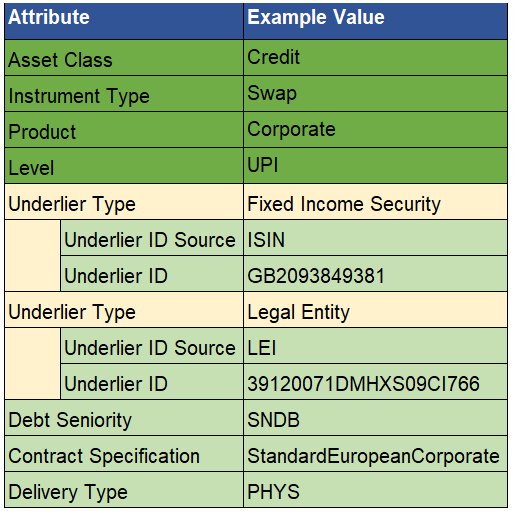
    The UPI query inputs for a CDS on a corporate bond are shown below:


    ANNA-DSB searches the UPI database to see if a UPI already exists for a CDS matching these various inputs. If no UPI exists, the DSB will assign a new UPI and create a new record in the database for subsequent users to see.

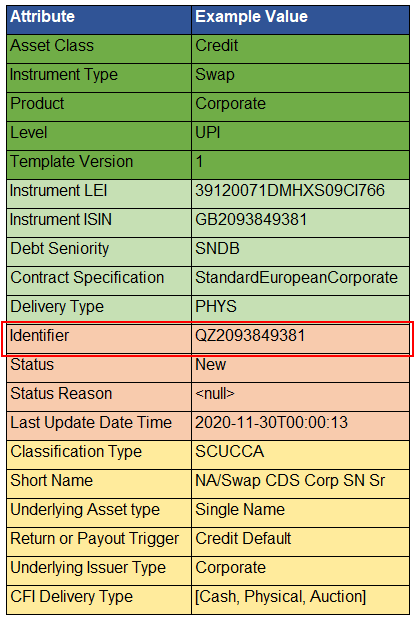
    The DSB then responds to the query with the resulting UPI (highlighted) and additional characteristics as shown below.


    Now whenever the firm communicates with another firm, regulator or party they can all use DSB data to know that UPI QZ2093849381 refers to a Credit Default Swap on a European corporate bond with ISIN GB2093849381, with CFI code SCUCCA and issued by LEI 39120071DMHXS09CI766.

    So similarly to the LEI where the database maintained by GLEIF means that firms can use an LEI code to ensure that they are talking about the exact same legal entity, the rationale behind UPI is that a central database of products provides clarity that firms are talking about the exact same OTC derivative product.

    FX Example

    The UPI query inputs and outputs vary based on the asset class and product type.

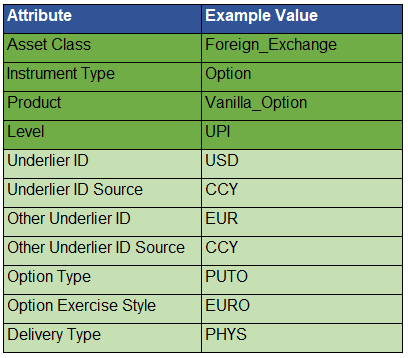
    If we consider Foreign Exchange then, if a firm has an FX Option in its systems and it wants to obtain the UPI for that FX Option.

    The firm submits the below query to ANNA-DSB with various inputs describing the various characteristics of the FX Option.


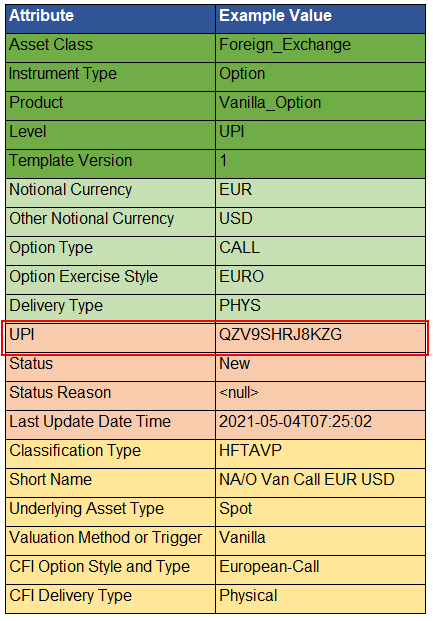
    DSB then responds to the query with the resulting UPI (highlighted) and additional characteristics as shown below.


    Now all parties can use DSB data to know that UPI QZV9SHRJ8KZG refers to an FX Option on a EUR vs USD, with CFI code HFTAVP, that’s a European-style physically settled call option.

    Interest Rates Example

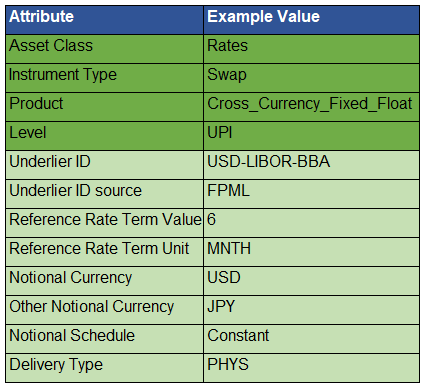
    Next if we look at interest rates, if a firm has a cross-currency fixed-float swap and it wants to obtain the UPI for that swap.

    The firm submits the below query to ANNA-DSB describing the rates swap.


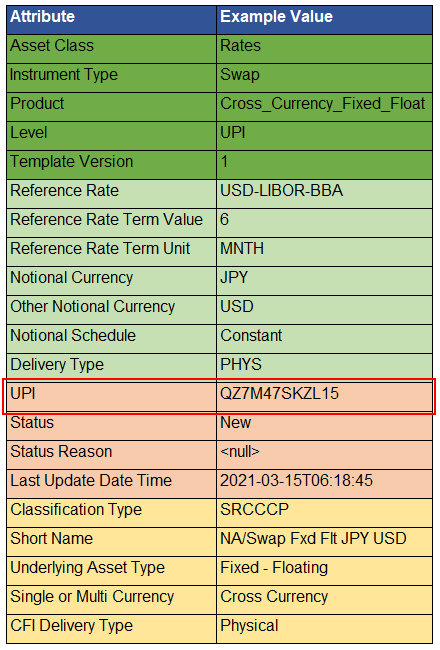
    DSB then responds to the query with the resulting UPI (highlighted) and additional characteristics as shown below.


    Now all parties can use DSB data to know that UPI QZ7M47SKZL15 refers to an cross-currency fixed-float swap on USD vs JPY, with CFI code SRCCCP that’s physically settled.

    So UPI is like an ISIN then?

    UPI essentially sits between a CFI code and an ISIN in terms of how granular or specific it gets.

    The CFI code describes the basic attributes but does not get as far as underlying assets, currencies etc.

    Taking the CFI from the previous rates example, we see that SRCCCP is the CFI code for a physically settled, cross-currency, fixed-floating, rates swap.

    Diagram below generated using ISDA’s CFI Code Generator:


    The UPI takes it to the next level of granularity by telling us this rates swap is also based on USD vs JPY, uses the USD-LIBOR-BBA floating rate and has a six-month period for that reference rate. So the UPI is far more specific than the CFI which just outlines the broad characteristics.

    ISIN would take it even further in terms of granularity because ISIN also tends to reference the trading venue where it traded and any venue specific characteristics such as the currency it’s traded/priced in.

    Why not just use ISIN?

    Two main reasons…

    1. The more forgiving reason is that since ISINs are often specific to the trading venues this means that using ISINs makes it more difficult to aggregate products with the same characteristics that are traded on different venues. Given the whole OTC derivative reporting framework is geared towards systemic risk, the regulators want the ability to aggregate transactions at product level, rather than venue level, when examining counterparty exposure. So UPI being venue agnostic is beneficial for this surveillance.
    2. The less forgiving answer is that outside of EMIR (EU & UK versions) no other regulators use ISINs for OTC derivatives. EU and UK reporting is therefore the outlier and much like the reporting of Exchange Traded Derivatives (ETDs) that underpins it, the use of ISINs for OTC was widely considered crazy but nonetheless made it into the rulebooks.

    So whilst ESMA and the FCA pushed ahead with ISINs for OTC derivatives the remainder of the regulators globally have patiently waited for UPI to be ready as a global solution much like the LEI.

    UPI Pay to Play

    Unlike LEIs (where the legal entity obtaining an LEI has to pay an annual fee for that LEI but the database and data is essentially free to all), ANNA-DSB will charge users for creating UPIs and accessing the UPI data in general. This is a little more controversial as UPI’s adoption across many of the OTC derivative reporting regimes amongst other use-cases means that many firms will have no alternative other to register with ANNA-DSB and pay for the privilege.

    Time will tell whether other cottage industries and resources pop up around UPI data in much the same way as you see a plethora of LEI websites and utilities whenever you search for an LEI these days. I personally hope so because ANNA-DSB needs remuneration for creating and maintaining the UPI services, that much is reasonable. But everyone having to repeatedly pay to access the same data seems a lot less reasonable in the long run.

    Similarly to the LEI rollout, we’d expect an explosion of new UPIs at the start (when the CFTC goes live with UPI in January) and another explosion when EMIR Refit follows in April next year. But that growth in new UPI population will theoretically tail off and eventually slow right down where only exotic edge-case UPIs are requested, or UPIs on newly created credit or equity underlying instruments.

    Conclusion – The Big Short rerun

    The UPI is a good concept in general and, after what seems like a very long time in the making, it is finally becoming a reality. It should help to improve clarity and consistency across the industry and for regulatory reporting in general. However we see a great deal of confusion around what UPI really means and with six months to go until the CFTC UPI go live, this is concerning. 

    If the UPI allows various regulators to aggregate similar derivative contracts together to better assess the systemic risk then that can only be a good thing. I’ll happily watch the excellent The Big Short film again but I don’t need to relive the crisis itself. There is clearly a great deal of work ahead to get UPI up and running and fully integrated across many firms and many systems.

    Tables (apart from ISDA’s) sourced from ANNA-DSB.

    • Still scratching your head over UPI?  For a conversation with Alan or one of our regulatory specialists, please get in touch. 
    • Is your firm prepared for EMIR Refit? To find out more about our EMIR Refit Toolkit, please contact us.
  • UPDATED: A tale of inflation, solvency & regulatory jeopardy

    UPDATED: A tale of inflation, solvency & regulatory jeopardy

    We first published this article in November 2022 but given current market events, we’re republishing it this week with some updated opening paragraphs. 

    There is a common perception in securities trading that getting the timing right when taking positions in the market is far more difficult than having the right idea to begin with. In hindsight, the below blog, written in November 2022, was a classic example of this. Regulatory concerns I raised five months ago in relation to rising interest rates, badly positioned market counterparties, bond market losses, capital adequacy, solvency issues and fears of contagion were well placed, but four months too early…

    In a similar manner to government preparations for a flu pandemic in 2020, following the 2008-2011 financial crisis, regulators were well prepared for a series of credit events. Unfortunately, the pre-cursor to the current situation is not a credit event but an interest rate event, for which preparations are far less appropriate, regulators simply find themselves looking in the wrong direction. Regulators will be quantifying counterparty exposures, collateral concentrations, leverage, levels of collateralisation and evidence of any further systemic risks. The principal tools for identifying these risks include SFTR, MMSR, SMMD and the likes of PRA Liquidity Reporting. If this data is poor, regulators will be active in their response. For a conversation about your data quality, please contact us.

    ***

    21 November 2022

    The deflation that followed rapid Chinese industrialisation has kept interest rates on a declining and ultimately stagnant path for decades since the 1990s.  In recent years, interest rate and government bond markets could have been politely described as being as dull as ditch water.

    However, as with all things in the market, the trend is your friend, until it isn’t…

    UK Treasury 2050, 0 5/8% Bond Price – theoretically one of the safest investments…

    Source: London Stock Exchange


    Supply chain and booming inflation

    Supply chain issues stemming from Covid, compounded by the emergence of China as a new superpower with massive domestic consumption and to a lesser extent Brexit, saw the price of the long dated UK Gilt (above) dip from around 100 (or par) into the 80s in February 2021. This c.20% fall in value accelerated as war broke out in Ukraine in February 2022 resulting in a dramatic jump in global inflation, with central banks increasing official interest rates in an attempt to ensure that this inflation is transitory. The downward trajectory in UK bond prices troughed with the fallout from the misguided September UK mini-budget on 8 October 2022 when the price hit 36.40 – a fall of 64% in the 2050 Gilt price from its high to low.

    Rates markets have become sexy again

    Higher interest rates, volatility, differing views on inflation expectations all of a sudden bring bond markets, money markets and securities financing markets back into sharp focus. While this may be to the delight of rates traders, it will have been highly unwelcome by the pensions industry as the value of many of their key ‘low risk’ assets are needed to service pensioners of the future evaporated. The moves were so dramatic, some pension funds’ solvency was called into question, resulting in intervention by the Bank of England to support the Gilt market in October.

    What does all this mean for regulatory reporting?

    Central banks and regulators will be on heightened alert to identify large interest rate exposures, the effective transmission of official central bank interest rates, solvency issues, credit default risk and the potential for contagion. Trade and transaction reporting regimes are among their principle means of performing this supervisory oversight and analysis. This will encompass everything from MiFID, SFTR, EMIR, MMSR, SMMD, CFTC, FinfraG, SESTA and many more besides. When faced with something of a crisis or an emergency situation, there is a risk that regulators need to react quickly with punitive measures if their investigative work is thwarted by reporting data quality issues.

    Enforcement has been notable in its absence for a number of years, just don’t be too surprised if this now goes the way of the bond market.         

    • If your money markets reporting (under SFTR, MMSR & SMMD), your bond market transaction reporting (under MiFIR) and your interest rate derivatives reporting (under EMIR, CFTC, MAS & HKMA) is not in perfect order or you are unaware of how good (or bad) it is, please get in touch.
  • WATCH: Kaizen client conference 2023 highlights

    WATCH: Kaizen client conference 2023 highlights

    Watch this video to see highlights of our Kaizen client conference ‘Regulatory Reporting – where are we now?’ at Banking Hall in the heart of the city of London. 

    More than 180 clients, staff and industry experts joined us for an afternoon of all things regulation and reporting. 

    We were delighted to host the FCA’s Markets Reporting Team Manager Tom Soden as the keynote speaker, as well as speakers from HSBC, DTCC, FIA, and our very own Advisory Board and subject matter experts. 

    Panel discussions included:

    • The current regulatory landscape
    • Data quality and the drive to improve it
    • Regulatory reporting in 2023 and beyond.

    A huge thank you to everyone who took part in or attended the event and we look forward to seeing you next year.  For suggestions for topics you’d like us to cover, please get in touch. 

  • SFTR ‘ish’ USA

    SFTR ‘ish’ USA

    New daily reporting obligations for bilateral repo trades have been proposed in the US. Our regulatory subject matter expert Jonathan Lee looks at the background to the announcement and reviews what’s being proposed. 

    It’s been a long time coming…

    The G20 Financial Stability Board agreed a mandate to enact securities financing reporting at the end of 2015 as a direct result of the last financial crisis. There were significant concerns stemming from the crisis about the role played by ‘shadow banks’ (non-banks offering credit intermediation) and the repo, securities lending and margin lending markets. Given how opaque the US repo market remains, recent market episodes and rising rates have raised alarm within the US Treasury and have heightened the need to implement Dodd Frank Act responsibilities. Finally we’re starting to see signs of SFTR USA, albeit a rather piecemeal, fragmented affair in comparison with the European regulation. The US approach is also significantly more pragmatic and cost-focused.

    Since November 2019, the only SFT data collection taking place was a process where the Office of Financial Research (OFR) of the US Treasury department took details of centrally cleared funding transactions in the US repo market directly from the DTCC, together with tri-party repo activities facilitated by Bank of New York acting as tri-party agent. In March 2022, the SEC released a consultation to start to tackle reporting requirements for the US securities lending market (Regulation 10c-1) but further feedback on the results of that consultation remain imminent. This leaves a significant gap for reporting of the US uncleared bilateral repo market.  

    Reporting regime for US uncleared bilateral market proposed

    On 5 January 2023, the OFR published a 60-day consultation on implementing a reporting regime for the US uncleared bilateral repo market. Responses to this consultation are due on 6 March 2023 (OFR reserve the right to extend this). This follows a pilot data collection study conducted by the OFR over three days in June 2022, in which nine dealers volunteered to take part. This new proposal, in conjunction with the SEC proposals covering securities lending will start to bridge the significant regulatory gaps in the US SFT market reporting coverage. The OFR found that the gap represents 60% of total repo lending by primary dealers and 37% of total repo borrowing.

    Approximately 40 US repo counterparties in scope

    At present, the proposals will focus on a reporting requirement for US brokers, dealers and other financial counterparties whose extended guarantees in the uncleared repo market exceed $10 billion, with these approximately 40 market counterparties accounting for more than 90% of the market by volume. In addition, they propose to capture any other financial companies with over $10 billion in extended guarantees where non-cleared borrowing from non-broker, non-dealer lenders takes place to prevent any data gaps now or in the future.

    ISO 20022 – field definitions ‘too broad’

    The OFR is considering reporting in either its own data elements format or the existing definitions under the ISO 20022 format. However, its initial thought is that ISO 20022 field definitions are too broad for its purposes. For example, the OFR wants all rates to be quoted on an Act/360 day-count basis, not using the 14 permissible conventions in ISO 20022 schemas. Primary focus is on reporting by borrowers (collateral givers).

    Current proposals include:

    • Trade executed under (but not limited to) Master Repurchase Agreements (MRA) and Global Master Repurchase Agreements (GMRA)
    • To potentially exclude sell-buyback as well as any securities lending transactions
    • Collection of in-scope transactions settled internationally or denominated in currencies other than USD would be included to prevent regulatory avoidance and to provide greater insight into cross-border activities.

    OFR repo reporting looks set to establish LEI and UTI as truly global standards

    • To adopt Legal Entity Identifiers (LEIs) to identify market participants
    • To adopt Unique Transaction Identifiers (UTIs) for ease of systemic risk monitoring.

    Required fields currently limited to 33 (vs. 155 in Europe)


    33 Reportable fields are proposed

    File observation date

    Trade timestamp

    Floating rate

    Covered reporter LEI

    Start date

    Floating rate reset frequency

    Cash lender LEI

    End date

    Spread

    Cash lender name

    Minimum maturity date

    Securities identifier type

    Cash borrower name

    Cash lender internal identifier

    Security identifier

    Cash borrower LEI

    Cash borrower internal identifier

    Securities quantity

    Guarantee

    Start leg amount

    Securities value

    Netting set

    Close leg amount

    Securities value at inception

    Transaction ID

    Current cash amount

    Securities value currency

    Unique transaction ID

    Start leg currency

    Haircut

    Trading platform

    Rate

    Special instructions notes or comments


    The consultation in full, together with its supporting documents, can be accessed here.

    Responses to the consultation can be submitted online or by mail to: Office of the Chief Counsel, Office of Financial Research, 717 14th Street NW, Washington, DC 20220.

    • For a confidential discussion about the quality of your existing SFT and money market reporting obligations or impending US obligations, please get in touch.
  • Join us at the Asset Management Derivatives Forum 2023 in California

    Join us at the Asset Management Derivatives Forum 2023 in California

    Join the Kaizen team in person at the eighth Asset Management Derivatives Forum, hosted by FIA and SIFMA in California on 8-10 February 2023. The conference will take place at The Ritz-Carlton, Laguna Niguel in Dana Point, California and offers a comprehensive review of the most critical derivatives issues across a series of panel discussions, keynote addresses and roundtables.

    We look forward to seeing you there.

    Register here

  • Alan McIntyre talks to Risk.net on the recent CFTC ReWrite go-live

    Alan McIntyre talks to Risk.net on the recent CFTC ReWrite go-live

    Kaizen’s Senior Regulatory Reporting Specialist Alan McIntyre spoke to Risk.net on the recent CFTC ReWrite go-live, giving an overview of its progress and what firms should be mindful of.

    “That’s a really tough time timeframe, your investigation could take more than seven days easily, and if they can’t fix it within the seven days, they need to notify the CFTC in writing about what the issue is and why they couldn’t fix it.”

    Read the article in full

  • A monumental day for CFTC Reporting

    A monumental day for CFTC Reporting

    Congratulations to all of the firms reporting under the CFTC and SEC swap data reporting rules, and of course the SDRs, on the massive achievement implementing the CFTC ReWrite this weekend.

    Situated in our unique place in the derivative reporting ecosystem, we know better than most the herculean efforts that go into achieving such a momentous implementation. Personally as someone who has worked twice at a major Trade Repository (TR) I’ve also experienced first-hand the colossal TR exertions that go into implementing a project of such magnitude whilst simultaneously supporting your clients efforts. And here at chez Kaizen we’ve been, let’s say, ‘a wee bit busy’ ourselves supporting our clients and ensuring our own systems’ readiness.

    As I’ve been banging on for years now to anyone that would listen, the CFTC ReWrite has been a long time in the making. The CFTC’s 2015 ‘Request For Comment’, led to the 2017 ‘Roadmap to Achieve High Quality Swaps Data’, which in turn led to the new rules and data standards that are finally going live today.

    I’ve repeatedly commended the CFTC for its smart adoption of best practices and emerging standard such as the components they’ve modelled based on ESMA’s EMIR framework and global harmonisation workstreams such as CDE. Factor in the onerous ‘Part 49’ requirements to verify, correct or notify on any accuracy or completeness errors and the US regulator’s clear intent to pressure reporting firms into focusing on continually improving data quality, and it’s clear that 5 December 2022 is a monumental day. And not just for CFTC Dodd-Frank reporting and SEC SBSR reporting (which inherits a great deal of the new CFTC ReWrite standards) but for OTC derivative reporting globally as the industry experiences the first major adoption of the CDE standards.

    Congratulations to the SDRs, SEFs, DCOs, swap dealers, major swap participants, other reporting firms and of course the CFTC itself, on achieving this huge accomplishment. Now let’s see how that all important data quality is looking and what the relatively near future looks like for the other OTC derivative reporting regimes also adopting CDE.

    • For help with any aspect of the new CFTC reporting requirements including Part 49 or for an independent assessment of the quality of your reporting, contact us.
  • Kaizen wins Best Solution for CFTC Reporting for second year in a row

    Kaizen wins Best Solution for CFTC Reporting for second year in a row

    New York, London, 17 November 2022 – Leading regulatory technology firm, Kaizen Reporting (Kaizen), has won ‘Best Reporting Solution for CFTC Reporting’ at the RegTech Insight Awards USA 2022 for its ReportShield™ Accuracy Testing service. This is the second consecutive year that Kaizen has won the award, and comes less than a month before the CFTC’s overhaul of the OTC swap data reporting rules, known as the CFTC ReWrite, goes live.

    Angela Wilbraham, CEO of A-Team Group said:

    “The RegTech Insight Awards USA celebrate providers of leading RegTech solutions, services and consultancy across North America. The winners are selected by our RegTech community and demonstrate exceptional creativity in building solutions that solve regulatory challenges. Congratulations to Kaizen Reporting.”

    Dario Crispini, CEO of Kaizen, commented: “Thank you to both our clients and the Regtech community who voted for us for the second consecutive year. The introduction of the CFTC ReWrite on 5 December highlights the need for firms to have the right controls in place so that they can report accurately from the outset. Using Accuracy Testing as part of these controls is the only way that a firm can identify where their reporting is accurate and deal with the errors that arise in a way that is expected by the regulator.”

    The CFTC ReWrite sees the US regulator undertaking a complete revision of the reporting rules. The revised rules require firms to verify the accuracy and completeness of all their data in the Swap Data Repository (SDR) versus their internal systems and records, and firms must do this at least once every 30-90 days. Firms are required to fix issues as soon as possible and notify the CFTC in writing if they cannot fix them within a seven-day period.

    Dario, said: “This is the first time a major transaction reporting regulation is dictating such a tight timeline and placing firms on the hook for notifying the regulator of any issues they’ve identified. The CFTC has made it clear that it wants firms to report correctly, improve controls and make data accuracy a top priority. Kaizen is here to help firms achieve this and ensure firms hit the ground running with adherence to these new and challenging obligations.”

    (ends)

    About the RegTech Insight Awards USA

    The RegTech Insight Awards USA recognise outstanding performance by the vendors of data and technology solutions to the financial industry. Nominations for the awards were reviewed by the editors of A-Team and the advisory panel and narrowed down to a short list, which was then opened up for voting by the industry.

    • For more information, please contact James Dunseath, Communications Advisor, on +44 (0) 7557 955795 or media@kaizenreporting.com
  • Canada publishes guidance on transition from CFTC ReWrite to CSA ReWrite

    Canada publishes guidance on transition from CFTC ReWrite to CSA ReWrite

    The Canadian Securities Administrators (CSA) body that represents the various regulatory provinces in Canada has published some much needed (if somewhat late) guidance on how firms reporting under the Canadian Derivatives Data Reporting rules should deal with the interim period between the CFTC ReWrite and the Canadian rules being revised.

    The CFTC ReWrite is implemented in less than a month on 5 December and the Canadian rules revision, proposed here, is anticipated to be introduced in 2024. 

    The Canadian proposals for the most part, align with the CFTC revisions as I discussed in a recent blog. But given some of the trade repositories support both CFTC & CSA reporting there is the potential impact on Canadian reporting in the interim. 

    The CSA guidance is intended to clarify what firms should do for the next couple of years, but given the proximity to 5 December, it isn’t likely to materially impact any firms’ reporting solutions as they are in the final stages of testing and ready to go-live next month. 

    This guidance therefore for the most part just provides assurance but will still be welcome, as anything that provides regulatory clarity is always a step in the right direction.

    Spoiler alert, the guidance basically says follow the CFTC for the most part, apart from where you don’t!

    • For a conversation with Alan or one of our regulatory specialists about the quality of your Canadian or CFTC reporting or any of the topics mentioned above, please contact us.
  • Canada, the CSA and the CDE greatest hits

    Canada, the CSA and the CDE greatest hits

    These days reading a transaction reporting consultation paper is like going to see a classic band.  Everyone is wanting the old favourites and groans when they announce anything from the new album.  The long awaited Canadian proposals were published in June and everyone is relieved they’re playing the familiar classics we can singalong to from the multi-platinum CDE greatest hits album.

    The following attempts to distil the various proposal documents (request for comment, amended rules, companion policies and the technical manual) into something a bit more digestible. The Canadians are proposing a 2024 implementation so we will see how this plays out.

    I’ve assembled a Spotify playlist below and will attempt to discuss some of the proposals. 

    The laundry list includes:

    • Harmonisation to CDE (Critical Data Elements) and CFTC fields and values
    • Harmonisation of UTI with global UTI rules
    • Revised UTI dissemination hierarchy
    • Adoption of UPI in-line with global alignment to use UPI
    • Introduction of collateral and margin data reporting
    • Part 49-like requirements for the SDR to perform validations on the data and for reporting firms to perform verifications
    • A proposed alternative reporting hierarchy
    • Reporting of packages in-line with CFTC approach
    • The option to report certain lifecycle events at position level
    • Updated requirements for the operation of Trade Repositories
    • Updated definition of “derivatives dealer”
    • A new ‘Multilateral Derivatives Data Technical Manual’, a tech spec very similar to the CFTC’s
    • Termination of an original derivative by a clearing agency.

    So, assuming both you and my editor have indulged me with this many bullet points, then let’s dive in.

    Harmonisation to CDE and CFTC fields and values

    Adoption of CDE fields and harmonisation towards the CDE standards is front and center. The main driver of all these reporting rule revisions globally is harmonisation and interoperability so the focus on CDE fields is sensible and welcome.  The Canadians attribute the remainder of the fields to the following sources:

    • CSA
    • CFTC
    • ESMA

    The Canadian tech spec has 140 fields compared to the CFTC’s 128 fields.  This is in part due to the CSA retaining fields such as Master Agreement Version & Master Agreement Type (with new snazzy types) and Broker ID that the Americans dispensed with.  Adoption of some ESMA-inspired fields such as Derivative Based On Crypto-assets helps towards the higher field count.  But the 140 fields still pales in comparison to the 203 fields ESMA is squeezing into the EMIR REFIT.

    Where the CFTC only requires a true/false flag for Custom Basket Indicator, the CSA are also proposing Source of the identifier of the basket constituents and Identifier of the basket’s constituents to better understand what’s in the shopping cart.  However, despite being CDE fields both the format and valid values of these fields are defined in the Canadian consultation as “tbd” so it’s more of a statement of intent as it stands. Last month’s ROC consultation on updating CDE to version 3 attempts to (and arguably fails to) provide clarity by suggesting a 350 variable character format maintained by the UPI service provider.

    Part 49-like requirements

    One proposal that might not be universally welcomed but is understandable is the adoption of Part 49-like proposals around verification “to ensure that all reported derivatives data is accurate and contains no misrepresentation”.  The CSA is proposing that all derivatives dealers and clearing organisations verify the data accuracy at least once every 30 days much like the corresponding CFTC rules.  But unlike the CFTC requirement for certain reporting counterparties (that are not swap dealers, major swap participants or clearing agencies) to undertake a quarterly verification every 90 days, the Canadians are not requiring this and citing the excessive burden.

    Thankfully the proposals are not mandating the draconian seven-day limit for fixing any errors discovered in the verification process.  But the proposals are harsher than the CFTC equivalents by enforcing a time limit of the end of the following business day from discovery of an error for notification of that issue.

    Option to report certain lifecycle events at position level

    Another proposal that’s no doubt well intended but I fear isn’t a good move is the proposal to introduce the ability to report at position level in certain instances where the individual transaction;

    (a) has no fixed expiration date, and

    (b) is in a class of derivatives in which each transaction is fungible.

    This is intended to alleviate the burden of reporting lifecycle events on the individual transactions but regardless of the good intention, I’m not a fan of this proposal as it introduces complexity. ESMA has had position level reporting under EMIR for years and it’s caused more problems than it’s solved. This diverges with the CFTC approach, creates different values for Action Type, divergent workflows and message choreography for reporting firms that are very likely to have a US footprint as well. Clarity and consistency are vital for data quality and this detracts from both.

    Termination of an original derivative by a clearing agency

    The final contentious proposal is the requirement for the Clearing Agency to terminate the original trade despite not reporting that trade themselves. So Big Bank (BB) trades with Small Hedge Fund (SHF) and BB has the obligation to report the original transaction. This trade (the alpha) is then cleared and replaced by two new trades;

    • The beta – cleared trade between BB and Clearing Agency
    • The gamma – cleared trade between SHF and Clearing Agency

    Here the Clearing Agency would have the obligation to report both the beta and the gamma which is fairly standard and unremarkable.  But the Canadians are proposing that the Clearing Agency also has the obligation to report the termination of the original alpha trade which is a new concept and throws up several logistical and practical considerations for both the Clearing Agency and the party that reported the original transaction.

    Multilateral derivatives data technical manual

    The final item which I suspect will be welcomed with open arms is the introduction of a much needed Technical Manual. The Canadian regulators are trudging down the same path the CFTC has already trodden from principles-based reporting rules to far more prescriptive (and let’s be honest, more ESMA-like) rules.

    If regulators want firms to report accurate high quality data then the clarity of the reporting requirements is paramount. The draft Technical Manual, which clearly owes a lot to the CFTC’s equivalent Parts 43 and 45 Technical Specification, is a huge step towards providing that all important clarity. I suspect and hope that both the CFTC and the Canadians over time will find themselves having to publish further so-called ‘level 3’ guidance such as FAQs and reporting guidelines but in the meantime I commend the Canadian authorities for publishing this Technical Manual.

    Next steps

    The proposed 2024 implementation is really not that far away. However, it’s likely that the Canadian implementation will be in a year already congested with ESMA’s EMIR Refit and several other reporting rule revisions such as ASIC, MAS and HKMA going live. Some aspects such as the alignment with other reporting regime formats and rules are very welcome.  The production of the technical specifications and the clarity it enables is likewise laudable.  Other aspects such as the verification/notification timelines will see industry pushback.  But at least we have a relatively clear picture of where the Canadian reporting rules are headed and when.

    • For a conversation with Alan or one of our regulatory specialists about the quality of your Canadian reporting or any of the topics mentioned above, please contact us.
  • Errors and omissions notifications: the regulatory reporting confession letter

    Errors and omissions notifications: the regulatory reporting confession letter

    Regulatory reporting is hard, and mistakes inevitably do happen. But knowing what action to take once you’ve discovered errors and omissions in your reported data is equally challenging. Sometimes issues are found via internal means, but they can also be discovered by regulators who then begin asking questions.  At Kaizen, we regularly help firms in this position, supporting them with their communication to the regulator and correcting and re-reporting the transactions via our Accuracy Testing.  Here, we share some of our insights on errors and omissions notifications and what to do once your firm finds regulatory gremlins lurking.

    1. Regulatory clarity – clarify your mis-reporting

    Before enthusiastic (or defensive) emails are sent to the regulator, you must clarify exactly how deep the problem goes.  What volume of trades have been missed or impacted, over what time period?  Coupled with this is the need to understand exactly what the mis-reporting actually was.  Vague explanations will inevitably lead to further questions from a puzzled regulator.

    At this stage of issue discovery, many firms choose to perform assurance and accuracy testing on their reporting population, to ensure that any other hidden powder kegs are uncovered well before further regulatory scrutiny prevails.  Independent assurance testing is the most efficient and complete way of undergoing such checks and can also help paint a good picture to the regulators when it comes to submitting an errors and omissions notification.

    Regulatory reporting is the counterparty’s responsibility. Firms must be able to understand and explain why the reporting was wrong or incomplete. Importantly, this is true for those making direct reporting submissions to a trade repository/ARM/SDR, and it is equally true for those utilising a form of ‘delegated reporting’.

    2. Preparing the Errors and Omissions notification

    If you’ve completed the above, now it’s time to own up to all the things you’ve got wrong. To do this, most regulators expect firms to fill in an errors and omissions notification.  The ideal point to draft the notification is not the same for all situations. Generally though, only once a firm has performed satisfactory checks and is confident with the known scope of the errors, can the notification be drafted. The UK FCA Errors and Omissions form* and the Central Bank of Ireland’s form* are good starting points to illustrate what details you should include, but each regulator will have its own variation on this theme and some even simply ask for a free format email.

    The notification should ideally confirm:

    • The full scope of the mis-reporting
    • Remediation steps undertaken
    • The cause of the issues
    • How these errors will be avoided in future.

    The regulator needs to see that you have control over these issues and over the reporting in general.  Failure to demonstrate strength in this area will undoubtedly prompt the regulator to probe for more information and place demands on how and when further data is provided, often citing how and when remedial actions are carried out.

    In our experience, it is exponentially better to provide all the information in advance. The motive here is to answer all the questions the regulator may have before they are asked.  Providing the bare minimum of detail, in an evasive or defensive manner, can backfire and lead to further scrutiny and the possibility of fines.  

    In all cases, you should be ready for follow up questions from the regulator.  The more thorough and prepared you have been with your scope investigation, the more comfortable you will be in answering such questions. In addition, it’s important to remember that the aim here is to close out as many questions as you can before there is a chance to ask them.  Therefore, the deeper the dive in reviewing existing reporting quality and completeness, the better prepared you will be and fewer questions will arise.

    3. Frequency and strength of notifications

    In our experience, fewer but stronger, notifications is the optimal strategy here.  As mentioned earlier, the aim of the notifications is to demonstrate the strength of your regulatory reporting, and control over the errors at hand.  Some firms have legal and compliance policies in place to notify their supervisor for each and every error uncovered on an ad-hoc reactive basis. However when it comes to the regulator, too frequent notifications risk demonstrating a lack of control over issues and procedures, and can lead to further regulatory scrutiny.  Some regulators may request regular updates for known issues or existing independent reviews, but usually only for many errors across large data arrays.

    Whatever frequency is explicitly committed to, you must ensure that any deadlines are adhered to, or give reasonable written notice with clear sensible justifications as to why a specific date is no longer feasible.

    4. Remediating errors and other useful actions

    Notifications should demonstrate an organisation’s remediation plans, taking into account factors such as technology build requirements, prioritisation alongside existing commitments, and it is always a shrewd move to add contingency for unforeseen delays.  Firms would also be wise to use this opportunity to:

    • Create or enhance deep, tailored and universal accuracy and completeness testing controls incorporating all fields and all reports submitted
    • Ensure supporting policies and procedures are up to date and fully cater to avoid a repeat of the identified issues
    • Check that reporting errors are escalated appropriately with clear and written action points for defined responsible stakeholders
    • Confirm access to the reported data from the regulator or trade repository/ARM/SDR which is regularly saved down for future endeavours
    • Engage in annual regulatory training to ensure that all impacted internal parties are up to date on reporting requirements.

    5.  Final thoughts

    Demonstrating the appropriate controls and strength of process regarding how you approach errors and omissions notifications, and the manner in which information is relayed to the regulator, is absolutely crucial to that working relationship, and will proactively influence the nature of any further regulatory scrutiny, fines or demands that follow. Having a well thought through errors and omissions notification policy will help ensure that communication with the regulator is open and effective.

    • If you find yourself in this position and would like a discussion with one of our regulatory specialists about this process, please get in touch.

    *Both forms will download rather than open in a webpage.

  • Collateral Reporting – Past, Present and Future

    Collateral Reporting – Past, Present and Future

    The year is 2012

    Rising K-pop star Psy has just released Gangnam Style (but you probably haven’t heard it yet). London is preparing to host the Summer Olympics and if you’re not reading 50 Shades of Grey you’re probably reading Appendix 1 of CFTC’s Part 45: The minimum primary economic terms of a swap.

    The CFTC simply wants to know how each reportable contract is collateralised using a simple code to indicate partially, fully, one-way collateralised etc. There is no need to report any collateral valuations or margin data.

    This should be easy.

    The year is 2014

    Gangnam Style has reached 1 billion views on Youtube (you can do the dance too).

    England fail to bring football home at the Brazil World Cup and if you’re not taking part in the ‘Ice bucket challenge’ you’re probably getting up to speed with the new craze of ‘EMIR reporting’ that has swept Europe by storm.

    EMIR reporting goes live in February and six months later collateral & valuation reporting begins.  Firms are required to report how each trade is collateralised and the ‘value of the collateral’ is required to be updated daily.  Many questions are asked about whether this should be a combination of initial and variation margin or something in between.

    The ‘collateral portfolio code’ is introduced to link multiple trades to the same collateral pool.

    It’s a bit more complicated than the CFTC requirements but should be manageable.  Surely the CFTC will follow suit soon?

    The year is 2017

    The world is trying to figure out what Donald Trump means by his ‘covfefe’ tweet.

    After weeks of analysis, the only conclusion is that he was trying to tell us ‘Collateral Valuation Fields Expand For EMIR’.

    He is referring to the EMIR RTS 2 go live of course. The number of collateral fields has increased from 4 to 15.  Reporting parties now need to split out the reporting of initial and variation margins.  They also need to report margins that were received as well as posted. Excess collateral needs to be reported separately.  There is still confusion as to whether margins reported should be pre or post haircut values.

    Fittingly, LaLa land has won the Best Picture Oscar, hasn’t it?

    The year is 2018

    Gangnam style is a thing of the past.  You are now learning how to do The Floss instead.

    England fail to bring football home at the Russia World Cup and if you’re not attending Harry and Megan’s Royal Wedding you’re probably reading ‘Harmonisation of critical OTC derivatives data elements’; the technical guidance published by CPMI-IOSCO.  The paper becomes commonly referred to as the CDE.

    They propose that 19 fields are required to report collateral accurately.  They have gone one step further than EMIR and suggested that pre and post haircut values of initial and variation margin should be separated.

    A white paper published by the CFTC states that they should implement the CPMI-IOSCO standards and that ‘the reporting of fewer, yet better defined and standardized, data fields should improve the quality of swaps’.

    There shouldn’t be long to wait until that gets implemented…

    The year is 2022

    Chris Rock is still massaging his jaw after ‘The Slap’ and the England women’s team are still celebrating after bringing football home at the Euros.  The celebrations come to an abrupt stop as CFTC Rewrite reporting goes live on 5 December.

    The US and European regulators have finally agreed on the spelling of ‘collateralisation’!

    After a very long wait, prolonged by several delays, the CFTC reporting rules have finally been modernised.  The collateral reporting rules are mostly aligned with the CDE but with a few exceptions.  Notably, the CFTC requires separate portfolio codes for initial margin and variation margin and an indicator for portfolios that contain non-reportable trades.  They have ditched the CDE proposal to include post-haircut values for variation margins.

    Christmas is cancelled as emergency post implementation fixes need to be prioritised.

    The year is 2024

    Notre-Dame reopens to the public as Paris prepares for the Summer Olympics.  Whilst cruising in your driverless car you have time to reflect on the EMIR Refit go live.

    ESMA and the FCA require all the CDE fields with one addition, the ‘collateral timestamp’, which indicates when the value of the margins was calculated.

    The gradual separation of different types of margins for reporting have made some reporting firms upset. Their systems were not made to deconstruct this data. Other firms are happy because this is exactly how their systems are built.  There are still complexities getting collateral data from some third parties and how margins are being reported.

    The world is slowly moving to a more harmonised approach of reporting but there is still a long way to go.

    The year is 3033

    Alien contact has been made with Kepler-452b.

    Humans live on Mars.

    Interplanetary regulators are still trying to agree the correct way to report collateral data but feel it’s surely within reach.

    • When do you think regulators will agree how to report collateral data?  For a conversation with one of our reporting specialists or a free healthcheck of your reporting, please contact us.
  • Kaizen wins at the Risk Technology Awards 2022

    Kaizen wins at the Risk Technology Awards 2022

    London, Thursday 4 August 2022 – Leading regulatory technology firm, Kaizen Reporting has won ‘Regulatory Reporting System of the Year’ at the Risk Technology Awards 2022 for its ReportShield™ Accuracy Testing service. This is the fourth time that Kaizen has won a Risk award for its regulatory reporting services. 

    The 2022 Risk Technology Awards were divided into 25 categories and received 120 entries, which were narrowed down to a shortlist of 80 firms. A panel of eight industry experts and Risk.net editorial staff reviewed the shortlisted entries. The judges individually scored and commented on the shortlisted entrants, before meeting to review the scores and, after discussions, made a final decision on the 24 winners.

    Antony Chambers, Publisher, Risk.net, commented:

    “This year’s Risk Technology Awards were as competitive as ever with both the number of firms entering and the quality of the services they provide the market. Kaizen Reporting stood out for its Accuracy Testing service which enables firms to submit high quality and accurate data to the regulators.”

    Dario Crispini, CEO of Kaizen, commented:

    “Global regulators are giving the financial services industry a clear and consistent message that they expect the trade and transaction data they receive to be of the highest quality. Kaizen’s Accuracy Testing service helps firms deliver just that and we are honoured that the service has been recognised as the ‘Regulatory Reporting System of the Year’ at the Risk Technology Awards for 2022.”    

    Kaizen’s Accuracy Testing is part of the company’s ReportShield™ suite of quality assurance services, which help financial firms meet their reporting obligations and effectively manage their regulatory risks. The service is tailored for global trade and transaction reporting regimes including MiFIR, EMIR, CFTC, SEC, SFTR, MAS, ASIC, HKMA, and FinfraG. Accuracy Testing is unique in being able to fully assess the quality of the data that firms report to the regulator.

    (ends)

    • For more information, please contact James Dunseath, Communications Advisor, on +44 (0) 7557 955795 or media@kaizenreporting.com
  • Regulation Roundup – Rewrites, Reviews and Opportunities Beyond the Deadlines

    Regulation Roundup – Rewrites, Reviews and Opportunities Beyond the Deadlines

    In this wide-ranging article from DerivSource, Kaizen’s Senior Regulatory Reporting Specialist Alan McIntyre focuses on the opportunities for firms presented by the CFTC Rewrite, which is now less than four months away.

    “First and definitely foremost, the CFTC will expect firms to invest diligent efforts into the verification, correction and notification process. The regulatory intent here is clear. They want to see more accurate data that is continually trending towards better quality.

    “The CFTC Re-write has been a long time in the making and is heavily focused on data quality.”

    For help preparing for the CFTC Rewrite, please contact us. 


    Read the article in full

  • CFTC warns firms to fix swap data errors before the ReWrite

    CFTC warns firms to fix swap data errors before the ReWrite

    With just under six months until the implementation of the CFTC ReWrite, the CFTC’s advisory letter 22-06 (Friday 10 June) is a timely reminder of the upcoming verification, correction and notification requirements. These rules [Part 45.14 – Correcting errors in swap data and verification of swap data accuracy] include obligations for firms to:

    • Frequently verify the “completeness and accuracy” of the data held at the Swap Data Repository (SDR)
    • Fix any errors they discover “as soon as technologically practicable” following discovery of the error
    • Notify the CFTC where they have determined they cannot fix any errors within the maximum 7 days permitted for “timely corrections”.

    One element of these rules that is proving contentious amongst the reporting firms is the requirement to verify the errors based on the open trades on the ‘Open Swaps Report’ produced by the SDR but to also fix any dead swaps that are terminated, matured, or otherwise closed within the same seven day time limit as the open swaps. Trying to determine the population of dead trades impacted by the same issue is likely to be challenging in itself. And then submitting the corrections to those dead trades within the seven day period is likely to be very challenging.

    Advisory letter 22-06 provides some additional details around how the firms should notify the CFTC (by email) when they determine they will be unable to correct them within the prescribed seven day period from detection of the error.

    The advisory goes on to specifically call out an issue that Kaizen Reporting frequently detect in our CFTC Accuracy Testing: Cleared trades remaining as open swaps in the SDR long after the clearing process would have replaced them and swaps that have been terminated but left open in the SDR.

    Swaps that erroneously appear in SDRs as open swaps, despite having been terminated, account for a significant number of existing swap data errors that staff have identified. This type of error results in the accumulation of erroneously open swaps at the SDRs over time, which impedes staff’s use of the swap data.

    Another aspect that might prove controversial or contentious is the statement that a reporting counterparty may have an obligation to correct errors and terminate trades where the error was reported by another entity such as a clearing house. And by extension of this principle presumably also where the original error was reported by a SEF.

    Regulation 45.4 requires reporting swap terminations as an element of continuation data, thereby providing SDRs with the information needed for them to change a swap’s status from open to closed. For example, in the case of cleared swaps, the obligation to report the termination of an original swap at the SDR is on the derivatives clearing organization (DCO). In addition to this continuation data reporting obligation, counterparties to the original swap have an independent obligation to correct errors of this nature.

    So a reporting counterparty detects an issue in the ‘swap creation data’ submitted by a DCO and as well as having an obligation to notify the DCO of the error the counterparty might also have an obligation to fix that error themselves. I think more details will be needed from the CFTC for firms to understand these seemingly conflicting obligations and put workable procedures in place around it. It would be good if the CFTC could also confirm whether this principle is applicable to SEF submitted ‘swap creation data’ errors as well, given the example cited was a DCO.

    The advisory then reminds firms that the obligation to fix errors dates back to the original 2012 rules, stating that firms have been aware of the upcoming part 45.14 obligations since September 2020 and tells them to get cracking with fixing stuff before the CFTC ReWrite go-live on 5 December.

    Accordingly, SEFs, DCMs, and reporting counterparties should review, as early as possible, their open swaps data in order to identify and correct any errors. Correcting outstanding errors in swap data, including swap data for swaps that are no longer open swaps but are maintained by an SDR as if the swaps were still open swaps, in advance of December 5, 2022, may reduce the number of Swap Data Error Correction Notification Forms that SEFs, DCMs, and reporting counterparties will be required to submit to self-report swap data errors.

    Kaizen has been advocating precisely this approach for a long time now. Use the time before the ReWrite implementation as a window to find and fix as many errors as possible before you need to start notifying the CFTC of these errors.

    So what are you waiting for? Get cracking and fix stuff!

    • Read the full press release on the CFTC website.
    • For a conversation with Alan or one of our regulatory specialists about the topics mentioned above, please contact us.
  • Commentary – The evolution of the CFTC’s approach to swap reporting

    Commentary – The evolution of the CFTC’s approach to swap reporting

    Following the announcement of the delay to the CFTC ReWrite go live date, Kaizen’s subject matter experts Alan McIntyre and Tim Hartley share their insights on the development of new reporting standards in the US in a recent commentary written for FIA’s MarketVoice.

    The recent announcement by the US Commodity Futures Trading Commission to delay the implementation of its ‘ReWrite’ of the OTC swap derivative reporting rules until 5 December 2022 will see many swap dealers and swap participants breathing a sigh of relief.

    The CFTC ReWrite has been a long time in the making and sees the US regulator undertaking a complete revision of the reporting rules including newly defined fields, different message types and revised reporting timelines. While the new rules reflect many practical suggestions made by the industry during years of dialogue with the CFTC, it will take much time and effort to bring reporting systems into compliance.

    Read the full article on the FIA’s website.

  • In the news: Alan McIntyre on SEC Part 43 go-live

    In the news: Alan McIntyre on SEC Part 43 go-live

    The second phase of the US Securities Based Swap Reporting (SBSR) took effect on 14 February 2022.  Kaizen’s Senior Regulatory Reporting Specialist, Alan McIntyre spoke to Global Investor Group.


    “The purpose of Part 43 real-time reporting is to provide transparency on pricing to the market.  Firms must report ‘real-time’ pricing data almost immediately upon execution.”

    “Firms are expected to backload every expired Security-Based Swap since 2010 before the third and final instalment of the SEC roll-out on April 14.”

    Read the full article here.  You must be a subscriber to view the article in full.

  • SEC Part 43 Real Time Reporting takes the romance out of Valentine’s Day

    SEC Part 43 Real Time Reporting takes the romance out of Valentine’s Day

    Difficult as it may be to believe, many people I talk to don’t seem to appreciate the romance of regulations, the passion for data quality, or even the sexiness of standards. I know, right!

    Well naysayers, the tide is turning and the link between regulations and romance is becoming harder to dispute.

    Last week we had the CFTC issuing an advisory on online dating and the risk of being ripped off when Mr/Miss Right really isn’t very right at all.

    And never one to be knowingly outdone by its regulatory rival, today sees the SEC massacring Valentine’s Day for many with the introduction of Part 43 real-time price dissemination reporting.

    For the many technologists and reporters diligently working on a smooth go-live of the SEC’s second major milestone in their rollout of SBSR reporting, there’ll be no chance of sloping off for a romantic meal. 

    We here at Kaizen would like to wish all the SEC reporting firms a smooth and successful, if ultimately unromantic, go-live today.

    And there’s just the trivial matter of backloading every expired SBS since 2010 before the third and final instalment of the SEC rollout on April 14 to tackle now. (I’ll need to start working on my Easter puns for that one)…

  • In the news: Kaizen’s Alan McIntyre on the CFTC ReWrite delay

    In the news: Kaizen’s Alan McIntyre on the CFTC ReWrite delay

    Kaizen’s Senior Regulatory Reporting Specialist Alan McIntyre has been speaking to a number of publications on the much-awaited confirmation of the delay to the CFTC ReWrite.

    The six month delay to the go-live of new reporting rules from the US regulator offers firms more time to interpret the amendments and ensure they have the right controls in place, Alan told Global Investor Group. 

    “While the reporting firms have more breathing space with this six-month delay, the verification and notification requirements are the most draconian rules we have seen in any reporting regime to date. The firms must verify the accuracy of the data reported to swaps data repositories (SDRs), check for errors and fix those within seven days, as well as having to notify of failure to correct in the event they can’t,” said Alan.

    He told IFLR Practice Insight that requirements were the harshest we’ve seen so far: “Other regimes ask for reconciliation and data quality controls, but the CFTC has upped the ante.” 

    The ReWrite has been a long time in making so while the breathing space is welcomed, “we can expect the CFTC will demand the highest quality data. Firms should be using this additional time to test and remediate now, so as to avoid having to do so after the go-live under the full scrutiny of the regulator,” Alan told The Trade. 

    In a separate article from Global Investor Group, the main derivatives trade body ISDA and other market experts have called for details of how and when firms will have to adopt new international data protocols under the CFTC ReWrite.  Alan explained that trade bodies and derivatives market makers had pushed for a “big bang” approach, which has now been rejected for a multi-phase approach.

    “The idea of implementing everything at the same time has now been replaced with a focus on implementing the initial technical specifications according to the rules, but any further guidance on the second phase can only help firms prepare,” he said.

    Please note, some articles are behind a firewall. 

  • Testing Times Ahead With the CFTC ReWrite Delayed

    Testing Times Ahead With the CFTC ReWrite Delayed

    Kaizen’s Senior Regulatory Reporting Specialist Alan McIntyre, writes for DerivSource, on the implementation of the rewrite of the swap data reporting rules which has been delayed by the CFTC until 5 December 2022.

    The widely anticipated delay and the extra six months it grants are likely to be welcomed by most reporting firms. The article covers the background to the delay and offers five recommendations to help turn the extra time into a successful testing programme.

    For help preparing for the CFTC Rewrite or advice on how to maximise the extra time, please contact us. 

    Read the article in full  

  • WATCH: What’s next for regulatory reporting?

    WATCH: What’s next for regulatory reporting?

    The webinar covers the following reporting regimes: 

    • MiFIR Transaction – Simon Appleton
    • MiFIR Post-Trade Transparency – Chris Machin
    • EMIR – Tim Hartley and Francesco Angelini
    • SFTR – Jonathan Lee 
    • CFTC and SEC – Alan McIntyre
    • MAS, ASIC and HKMA –  Tim Hartley and Francesco Angelini
    • Shareholding Disclosure – Angie Huff.
  • WATCH: Regulatory Reporting and RegTech in 2022

    WATCH: Regulatory Reporting and RegTech in 2022

    From the expectations of regulators to upcoming regime changes, Kaizen’s CEO Dario Crispini shares his views on Regulatory Reporting and RegTech in 2022 in our latest video interview.

    To discuss any of the topics raised in this inteview or for a conversation about the quality of your reporting, please contact us.

    (The videos below are individual snippets of each interview question, if you’d prefer to watch shorter clips). 

  • SEC Rule 10c-1 Securities Lending Market Reporting Proposals  – a blessing or a curse?

    SEC Rule 10c-1 Securities Lending Market Reporting Proposals – a blessing or a curse?

    New US Securities and Exchange Commission (SEC) proposals for a securities lending trade reporting regime have the potential to turn global securities financing transaction (SFT) reporting on its head.  The proposals introduce near real-time transparency to SFT markets, while significantly reducing the operational burden on market participants to report their trades.  On the flip side, get it wrong and we could see a mass exodus from the US securities lending market, a significant reduction in liquidity and higher financing costs affecting wholesale capital markets in the United States.  

    The SEC shows its hand

    It was likely to be only a matter of time under President Biden’s administration before US regulatory attention turned to SFT data collection under the 2015 Financial Stability Board (FSB) mandate.  To date, the only element of Standards and Processes for Global Securities Financing Data Collection and Aggregation (FSB 2015) implemented in the US was the Office of Financial Research requirement.  This was introduced in October 2019 for central clearing houses (DTCC in particular) to report details of centrally cleared repo transactions to the Federal Reserve Bank of New York on a business day+1 basis – a significant but small subset of the overall US SFT market.  Amidst much more comprehensive reporting requirements in Europe and Japan, the SEC has chosen now to show its hand.

    What’s being proposed?

    In summary, this proposal is in a moderately late stage of development and seems highly likely to come to fruition.  Plans are afoot for any lenders, oft represented by agent lenders or broker dealers to report basic details (12 fields) in relation to their securities lending transactions and any modifications to a Registered National Securities Association (RNSA) – almost certainly the Financial Industry Regulatory Authority (FINRA), within 15 minutes of execution. Lenders are also required to report details of the total amount of securities available to lend and the total amount of securities on loan by end of day each business day.

    More transformational are plans for RNSAs to publish details of securities loans, potentially on an intraday basis (ticker tape style).  In particular, proposals include publishing the legal name of the issuer of the securities to be borrowed, the ticker symbol of those securities, time and date of the loan, name of the platform or venue (if applicable), amount of securities loaned, rates, fees, charges and rebates for the loan (as applicable), type of collateral provided for the loan, percentage collateralisation of the value of the loaned securities, termination date of the loan (if applicable) and borrower type (e.g. broker, dealer, bank, customer, clearing agency, custodian).  In addition, aggregated information on securities on loan or available to loan would also be published on a timely basis, likely the following business day.

    Transformative

    The reporting obligation is intended to be far more timely (within 15 minutes of execution or a modification being made) but with far fewer fields (12 fields for a transaction report) than existing regimes such as SFTR in Europe.  If SEC rule 10c-1 reporting of securities lending transactions works (with flaws ironed out and without unintended consequences), then it is likely to prove revolutionary and could prove quite transformative of regulatory regimes across the globe.  It puts end investors, transparency and market efficiency first, is operationally (comparatively) light/low cost, while meeting both the micro surveillance as well as macro systemic aims of SFT reporting regimes.

    The pros of this proposal are:

    • The intention to eliminate pricing and security availability (for loan) information asymmetry between broker dealers, agent lenders, beneficial owners, borrowers and end investors in the securities lending market.  The primary focus is in providing market transparency and creating a level playing field, enabling all market participants to understand market conditions and ensure best execution
    • Single-sided reporting is proposed by lenders only (who are seen as closest to the data – reducing the regulatory burden)
    • The SEC have stated that the reporting would be a means to achieve in-depth monitoring of lending activity and surveillance of securities markets, enable the identification of the build-up of risk by market participants, provide colour on broker-dealer strategies to source securities for customer lending and cover for settlement fails.  Furthermore, the SEC expect to build a greater understanding of investor behaviour in the securities lending market and the broader securities market more generally
    • Reports require just 12 simple, precise fields to populate at the trade level.  Even fewer fields are required for end of day position and availability for loan reporting.

    Challenges:

    • Beneficial owners and securities lenders can be a shy bunch.  A sizeable proportion of beneficial owners are established or domiciled outside the US and subsequently may take fright at the level of transparency on offer and withdraw from the market entirely, lend in the UK, EU or a jurisdiction not subject to such transparency or simply execute equivalent, unpublished repo transactions instead
    • The domestic US securities lending market may in part or on a larger scale migrate to the repo market, where economically equivalent transactions can be executed.  A large proportion of these repo transactions, under current rules, would not be subject to any reporting requirements or transparency
    • 15 minute reporting, presumably proposed because the majority of TRACE securities trade reports to FINRA are required within 15 minutes, is likely to prove both challenging and optimistic in the comparatively manual and less automated securities lending market.

    Next steps

    This regulation is set to develop very quickly from here, with the SEC inviting comments and answers to the 97 questions posed in the consultation by 7 January 2022 (30 days after its publication).  They have stated that a decision will be made concerning the collection of information between 30 and 60 days after publication of the consultation.  This regulation looks set to be one, if not the biggest focus of SFT market attention in 2022, certainly in the US, if not throughout the world. It may well go ahead in close to its current form but we suspect that for the reporting requirement to be truly successful (and not result in damaging unintended consequences) then it will have to be extended to the repo market.

    • To read the SEC’s press release and the full proposal, please visit the SEC’s website.
    • For a conversation with Jonathan or one of our regulatory specialists about the above topics, please contact us.
  • Kaizen wins at the RegTech Insight Awards USA 2021

    Kaizen wins at the RegTech Insight Awards USA 2021

    London, 1 December 2021 – Leading regulatory technology firm, Kaizen Reporting (Kaizen), has won ‘Best Reporting Solution for CFTC Reporting’ at the RegTech Insight Awards USA for its ReportShield™ Accuracy Testing service.

    The RegTech Insight Awards USA recognise both established solution providers and innovative newcomers, seeking to herald and highlight RegTech solutions that throughout the year have successfully improved firms’ ability to effectively respond to the evolving and ever more complex regulatory requirements across the global financial services industry.

    Kaizen’s Accuracy Testing is an automated, managed service that tests the quality of trade and swap transaction reporting data reported to the regulator. What makes the service unique is the comprehensive deep testing of all records using Kaizen’s regulatory expertise and independent sources of data, which provides financial firms with full visibility of their reporting quality. The service has been designed to test for all regulatory regimes including CFTC Parts 43 & 45 and SEC Security-Based Swap (SBSR) reporting.

    Dario Crispini, CEO of Kaizen, commented: ‘’We are honoured to have been selected by both our clients and the financial users in the RegTech space as the winner of ‘Best Reporting Solution for CFTC Reporting’ at this year’s RegTech Insight Awards USA. There is a huge amount of change coming up for US firms in the regulatory reporting space and it is imperative that firms are able to demonstrate appropriate controls over their reporting obligations. Testing the accuracy of reported data is a key part of these controls so firms can identify where their reporting is accurate and where there are errors – something expected by regulators.”

    In May 2022 the CFTC is planning to implement a substantial revision of the reporting rules, known as the CFTC ReWrite, at which time reporting under the new rules is due to commence. Last month, SEC SBSR reporting began for firms, and in February, there will also be a real-time reporting requirement from the SEC.  Accuracy Testing is already live for SBSR reporting and will be ready to test the quality of firms’ reporting for the upcoming reporting changes too.  The swap data reporting rules are part of the Dodd-Frank Act, the US government’s response to the financial crisis in 2007/8.

    Earlier this year Regulatory Reporting Subject Matter Expert Alan McIntyre joined Kaizen to further enhance its expertise in North American reporting and in September John Kim joined the Kaizen team as the new Head of Business Development, North America.

     (ends)

    • For more information, please contact James Dunseath, Communications Advisor, on +44 (0) 7557 955795 or media@kaizenreporting.com
  • Unpacking the SEC Reporting FAQ

    Unpacking the SEC Reporting FAQ

    SEC Security-Based Swaps Reporting (SBSR) goes live today and to mark it, what better than a review of the FAQ guidance recently released by the SEC.  In this blog, we’ll attempt to unpack some of it and ask whether it’s helpful for firms.

    Please click on the headings below to view each Q&A (in bold italics) and our analysis of each. 

  • Top five changes in the final CFTC reporting Technical Specification

    Top five changes in the final CFTC reporting Technical Specification

    Last month the CFTC published what they and the industry are hoping is the final version of the Technical Specification for Parts 43 & 45 reporting under the ReWrite of the CFTC swap data reporting rules.  Unless there is a delay (as is much rumoured and debated) this means it’s now only seven months until the May 2022 compliance date.  Factor in Thanksgiving and the holiday season and that’s really not a long time assuming this really is the final version.

    At Kaizen HQ we’ve been analysing the impact and here are the five most significant changes in this latest version.


    1:  Multiple validation changes

    I’ll dispense with the obvious one first and get the low hanging fruit out of the way.  There are many, many changes throughout this version of the technical spec.  See the red-line version and it’s littered with changes.  These range from non-substantive wording changes, to revised definitions, to tweaks to the field-by-field validations.

    It would be impossible to cover them all here so instead I’ll just point out the obvious – the sheer number of changes is one of the main aspects for firms to deal with.


    2:  Short-form exit messages

    The final tech spec has wisely concurred with a suggestion the SDRs and the industry were pushing for and added language to support so called short-form exit messages:

    Nothing in this Technical Specification should be read to prohibit an SDR from limiting the number of data elements required to be submitted, to a subset of part 43 or 45 data elements, for Action Type TERM, PRTO, and EROR.  Submission of all parts 43 and 45 data elements is mandatory for all other Action Types.

    This is good progress because it simply makes sense that firms don’t need to worry about ensuring every single field is correct and contains an up-to-date value when they are trying to terminate a position or remove a position that was submitted in error.

    I’m reporting Swap Creation data or Swap Continuation data on an open trade so I need to ensure the data is accurate and complete.  Absolutely.

    I’m terminating a position that no longer exists or worst case removing something that should never have been reported and I need to ensure every single field is accurate and complete.  Not so much.

    The action to remove or terminate is far more important here than a full representation of the trade so limiting the fields to a short-form subset that identifies the firms involved, submitter and the trade identifiers is a common sense practical approach.


    3:  Event Timestamp for Collateral Valuation dates

    Again the Commission deserves credit for closing a gap that the industry was pushing for.  In this case there is a requirement to submit Collateral Valuations (Action Type MARU – Margin Update) but the industry was pointing out there was no method to distinguish between submitting a MARU for the current date versus a correction of an older MARU for a previous reporting date.

    The CFTC revised the tech spec to facilitate this but instead of adding a new specific ‘valuation date’ field they commandeered the definition of existing field Event Timestamp, by adding:

    In the case of collateral update (Action type = ‘MARU’), this is the date for which the information contained in the report is provided. Time portion should be reported as “00:00:00”. 

    Whilst I applaud the CFTC for addressing the gap, their choice of mechanism feels a bit of a fudge.  And given the global momentum towards harmonised standards it might have been better addressed by adopting a CDE-based field better aligned to this purpose.

    Apart from global harmonisation alignment there are two main problems with this solution:

    1. Collateral Valuation Date is not an Event as per the CFTC definition of Event.
    2. The field is a Timestamp and not a Date so the guidance doubles down on the messy approach by suggesting firms add 00:00:00 as the timestamp part.

    At Kaizen we often advise firms not to use default timestamps as it’s just not good practice and is often not compliant.  So it’s pretty frustrating to see another regulator recommending the use of a dummy timestamp to circumvent a shortcoming in the way the regulator is using the field.


    4:  Upgrading Event Type

    As well as aligning some of the Event Type codes to better align with CDE (TRDE deposed by TRAD for example), the CFTC has thrown in two new Event Types:

    CORP = Corporate event

    UPDT = Upgrade

    CORP is alas more geared towards a Corporate Action affecting an equity instrument rather than a company soiree with free drinks, snacks and a bit of a skive away from your desk.

    UPDT is therefore more interesting – especially as it unexpectedly spells Upgrade.

    Upgrade: An upgrade of an outstanding transaction performed in order to ensure its conformity with the amended reporting requirements.

    So this event type allows me to UPDT my pre-ReWrite reported swap transaction in order to Upgrade it to the latest data standards.  OK that now makes a bit more sense and we’ve seen similar proposals in other jurisdictions.

    But other jurisdictions such as ESMA for EMIR have gone further in terms of stating the expectations around how such an UPDT to the new standards should be used and crucially the expected timeline.  Firms have 180 days from the implementation of the EMIR REFIT in Europe to bring any open transactions/positions into line with the new standards.

    Without such explicit guidance from the CFTC, the reporting firms will need to discuss and decide upon the best way to tackle bringing all open swaps into line with the new standards.  Big bang and update everything on day one versus track them and update those not updated via a natural lifecycle event submission over time.  Although when you factor in the complexities arising from the CFTC rules around moving from USI to UTI, things start to get complicated pretty quickly.  I suspect the SDRs are bracing themselves for really high volumes with lots of firms submitting an UPDT for everything on day 1 in order to just get it done.


    5:  Removal of the ‘no translation’ language

    The following clause in section 1.2.1 has been struck out:

    No translations or mappings are permitted, i.e., ‘Yes’ or ‘No’ should not be mapped to ‘True’ or ‘False’.

    The regulators intentions here seem fairly clear and would point towards what has often been described as the ‘dumb trade repository’ model.  The Trade Repository (TR) function is to accept data, store it and make it available to the regulators.  The TR should not therefore map, convert, derive, enrich or invoke any other kinds of data alchemy that obfuscates the of the data the firms submitted versus the data the regulators then see.

    This no translation language has proved controversial as it had been interpreted in some quarters as meaning the SDRs should not accept FpML submissions.  Given that the ISO 20022 message schema is still a long way off being ready for CFTC reporting then this led to a debate around whether the firms that currently use FpML would need to migrate to CSV as a temporary solution until such a time as ISO messaging was implemented by the CFTC.

    This in turn led to louder calls for a delay to the May 2022 compliance date for the CFTC ReWrite.  Especially amongst the bigger Wall Street banks that tended historically to be the main users of FpML.  The CFTC striking this language out of the latest Technical Specification is therefore likely to be welcomed by some firms.  However the no mapping and no transformation concept still exists in the CFTC reporting legal texts so it will be interesting to see whether any more guidance or even a No Action Relief letter follows to further clarify this one.


    Bonus item: final thoughts

    This is the final version of the Part 43 and 45 Technical Specification.  Or is it?  I have no doubt that the CFTC intends and very much hopes that this is the final draft. But in my experience these things often need tweaked and revised when real world experience collides with theoretical rules.

    The CFTC deserves credit for the thoughtful, collaborative and engaging approach it has taken in moving from principles-based reporting regulations to this far more prescriptive approach. It has moved slowly, consulted with its peers and the industry, and communicated well throughout.  So I am not trying to be critical here when I say that the CFTC is learning one of the problems with prescribing this level of detail.  The pesky questions and problems that arise!

    You sit in meeting rooms and draft, redraft and fine tune the wording until it’s as clear as it can be.  Multiple teams, committees and stakeholders all agree it’s as crystal clear as it’s possible to make it.  You then release it into the big bad world and it turns out everyone’s a critic.  There are questions aplenty and worse still some of them have a point.  It’s unclear or in some cases plain wrong.

    No disrespect whatsoever to the Commission but they are learning the hard way that this prescriptive stuff is hard.  This stuff is hard to do and takes a lot of time and effort to get right. Kudos to the CFTC for the collaborative approach and along with ISDA, the SDRs and the reporting firms we’ll get there.  Regardless of whether this version is final or not.  Now, about that delay…


    • For a conversation with Alan or one of our regulatory specialists about the above topics, please contact us.


  • Trade Reporting vs Transaction Reporting

    Trade Reporting vs Transaction Reporting

    Regulatory trade and transaction reporting is a strange beast.  I think most people fall into it by accident rather than choosing it (including myself), but people still get confused with the terminology and understandably so, as it does get complex.  Inconsistent wording across regulations doesn’t help, as they interchange between using the term ‘trade’ and the term ‘transaction’ and if you are lucky, a bit of ‘position’, even when it is the same regulator writing the rules. If you are sitting comfortably then I’ll begin (to confuse you)…

    MiFIR trade reporting

    Let’s start with MiFIR trade reporting (RTS 1 and 2). This is real-time trade transparency reporting, made public at the point of execution via an Approved Publication Arrangement (APA). Simple enough but MiFIR also has transaction reporting (RTS 22).  This is T+1 reporting of all transactions, either directly to the regulator or via an Approved Reporting Mechanism (ARM), to allow the European regulators to monitor market abuse.  Similar by name but very different in nature…

    Not to forget MiFIR also has its Commodities Derivatives Reporting (RTS 21) but that’s at position level.  Hold on…

    EMIR trade reporting

    EMIR has trade reporting where you report your derivative transactions to a Trade Repository (TR). That is of course unless you take up the option under EMIR to report some of your trades at position level instead! Keep up!

    Even though EMIR is more similar to SFTR transaction reporting than MiFIR trade reporting, both EMIR and SFTR mandate reporting to a Trade Repository and not a Transaction Repository. Yep, I’m lost…

    The good news is that the sensible people in the Asia Pacific region have tried to keep it consistent and retain the model of transaction reporting. HKMA, MAS & ASIC all use transaction reporting terminology.  Phew…

    Dodd-Frank Act price reporting

    The US Dodd-Frank Act (DFA) Part 43 price reporting, similar to MiFIR trade reporting, reports through a Swap Data Repository (SDR) that accepts data relating to (you guessed it) swap transactions, not a standalone publication tool like an APA.  Part 45 transaction reporting or swap reporting, also uses trade reporting terminology throughout.  Full circle, for CFTC commodities position reporting, all the terms trade, transaction and position are used.  HELP!!

    • Clear as mud?  Our team of ex-regulators and regulatory reporting specialists love talking about this stuff and can guide you though any reporting challenge. For a conversation about your trades, I mean transactions, across any of the global reporting regimes, please contact us.
  • CFTC fines and selling the reporting dream

    CFTC fines and selling the reporting dream

    Anyone that’s worked with me or read more than a couple of my ramblings will know that I don’t do sales.

    I’m not being boastful or even modest. It’s just not my forte so I tend to give anything ‘salesy’ a wide berth. I mean no disrespect to the world of selling or the talented people that work in sales. I’m just so bad at it and so far out of my comfort zone that I’d probably give the product away for free rather than get into discussing the dreaded commercials.

    Breaking my rule

    The third quarter of 2021 or more specifically the last four days of September saw a flurry of enforcement actions and fines from the CFTC, that after some careful consideration are leading to me breaking my nothing-salesy rule. Not because I’ve had a change of heart or want to move in a different direction. But the themes within the CFTC enforcement actions are so closely aligned to what we do here at Kaizen Reporting it’s almost impossible to not go there.

    So kindly bear with me whilst I set out the stall.

    Taking back controls

    I always advise clients of the importance of devoting a significant effort to building controls into their reporting systems as well as layering additional controls onto the reporting systems and the reporting data generated. Over the last few years I’ve seen an interesting trend where many firms are moving those controls further up the stack towards the trading systems rather than downstream in the data lake or reporting hub. The ethos being that it’s better to flag the errors at source rather than further downstream where the remediation workflow can be more elaborate, involve multiple systems and take longer.

    I stand by this advice and maintain that it’s not only best practice but it’s absolutely crucial to help detect and prevent errors within your reporting.

    Marking your own homework

    However there is a key limitation which means that these controls, no matter how well designed and implemented are not enough. Simply put, at some stage you inevitably end up marking your own homework. Whether the controls were developed at the same time the reporting system being built or were added later, the vast majority of the time it was the same teams, relying on the same documentation and same interpretations that ended up owning both the reporting and the controls.

    [First salesy spoiler alert]. Independent controls and that unbiased second opinion are key to detecting the issues that your controls and vigilance missed.

    I could labour the point but there’s no need as it’s really that simple.

    [Second salesy spoiler alert]. At Kaizen we offer the best in class data Accuracy Testing (checking the integrity of the reported data), Reconciliations (testing the completeness and accuracy of the reported data versus your source systems) and Reference Data Testing (testing the accuracy of the reference data that your reporting systems utilise to do the reporting). We offer these because it’s our experience of working with many, many clients over many different regulatory regimes that this is what is needed to fully assess the quality of the reporting data.

    We’ve seen it many times over the years in various regulations where an upstream reference data change causes an unforeseen reporting issue downstream. Your own controls might catch such instances, but they also might not. A static data change results in a different value flowing downstream to the reporting system. The value goes out the door and is reported because it’s a valid value, but it’s the wrong valid value.

    CFTC enforcement actions

    Looking at the themes in the recent CFTC enforcement actions will hopefully shine a light on why I’m breaking my embargo.

    • Failure to report LEIs or report the correct LEIs

    Accuracy Testing, Reference Data Testing and Reconciliations.

    • Failure to report swap valuation data or accurate valuations to an SDR

    Accuracy Testing and Reconciliations.

    • Reporting inaccurate swap data to an SDR.

    Accuracy Testing, Reference Data Testing and Reconciliations.


    As a firm that spends its entire energies and focus on the world of trade and transaction reporting we know more than most just how challenging these ever changing regulations can be. [Third and final salesy spoiler alert]. That’s why Kaizen Reporting was founded – to help firms with exactly these challenges. 

    The recent CFTC enforcement actions prove that the US regulator is paying close attention and expects the swap data to be reported accurately. With better and more prescriptive data standards coming in the form of the CFTC ReWrite we can only expect their tolerance of reporting issues to decline even further. The CFTC have spent years and a lot of effort on the ReWrite and they are going to expect high quality data reported from the start.

    • For a conversation with Alan or one of our regulatory specialists about the above topics, please contact us.
  • SEC Swap Reporting – SBSR, The long journey

    SEC Swap Reporting – SBSR, The long journey

    November 2021 sees a landmark milestone marking the fulfilment of a decade long journey towards SEC Security-Based Swap Reporting (SBSR). If we track the origins of the story further back to the 2007/8 financial crisis, then the distance travelled to reach this implementation is pretty epic.

    SBSR and the reporting of Security-Based Swaps (SBS) is the SEC’s slice of the Dodd-Frank reporting requirements introduced after the US and the other G20 governments and regulatory bodies agreed to mandatory reporting of all OTC derivatives transactions.

    The 2010 Dodd-Frank Act empowered the SEC to implement reporting of swap trades relating to so- called ‘single-name’ Security-Based Swaps i.e. an equity or credit derivative based on an underlying security that trades on a regulated exchange.

    SEC or CFTC Swap Reporting? Single & mixers

    The phrase ‘single-name’ is a bit misleading here as swaps relating to more than one underlying security are also reportable under SBSR. The rule of thumb being that if the swap relates to an index compromising nine or less securities then it’s deemed a “Narrow-Based Security Index” and reportable to the SEC under SBSR. And if it relates to ten or more securities then it’s reportable to the CFTC instead.

    And if that wasn’t already confusing enough there are also ‘mixed swaps’ that are reportable to both the SEC and the CFTC. These are swaps that generally meet the criteria to be considered Security-Based Swaps but also have one or more elements that derive their value from interest rates, currencies or commodities (i.e. asset classes not in scope for SEC reporting). For mixed swaps the two Commissions are jointly mandated to prescribe the regulations.

    And just in case ALL of that wasn’t confusing enough for you to be reaching for the aspirin, there are also rules governing what happens when an index migrates from being considered a narrow-based security index to becoming a broad-based security index. Or of course if they should migrate in the other direction from broad to narrow to complete the hakuna matata circle of life. Well life of an index rather than say an animated lion.

    SEC Part 43 – Faster than Sonic the Hedgehog

    The SEC has mandated that reporting firms need to report ‘real-time’ pricing data almost immediately upon execution. The actual data that gets publicly disseminated is heavily anonymised but through showing the pricing trends for the various swap instruments provides price transparency to ensure a level playing field.

    The rules for the real-time prices reporting are often referred to as ‘Part 43 reporting’. Only a small number of fields are required to be sent for a Part 43 submission but the rules state that these submissions must be sent “as soon as practicably possible”. This chop-chop, pronto requirement for real-time reporting can be quite onerous on the firms as in many cases the expectation is that the report will be compiled, verified and submitted within seconds of the trade being executed.

    The SEC has also prescribed Part 45 reporting which entails the firms submitting the full details of the swap data such as the parties, the economic terms and various other details of the transaction. Firms have until T+1 to submit these details which unlike the real-time reports are available only to the regulators and not made public.

    Seeing the value

    SBSR verges off into a different direction from the CFTC Part 45 reporting though as the SEC has not required the firms to report valuation data. Swap data reporting under the CFTC rules requires the firms to submit a daily valuation that specifies what the reporting firm (or clearing house for cleared swaps) calculates as the current value of each open trade position. The SEC has raised eyebrows by not requesting the same and instead stipulating that firms must submit “the data elements necessary for a person to determine the market value of the transaction”.

    Critics of this approach argue for a reporting regime that is predominantly focused on systemic risk it’s a mistake not to compel the firms to report their internal valuations. Valuation Reporting would allow the SEC to assess whether any firms are being overly optimistic on the value of their traded positions and are hence taking on too much risk.

    SEC Swap transaction (Part 45) reporting commences on 8 November. And SEC real-time (Part 43) reporting commences on 14 February 2022. Price transparency for single-name Security-Based Swaps. Just what your sweetheart was hoping for on Valentine’s. But nonetheless the fruition of a very long process and a huge amount of effort contributed by the reporting firms, the trade associations, the swap data repositories and of course the SEC itself.


    • For a conversation with Alan or one of our regulatory specialists about the above topics, please contact us.
  • Kaizen Reporting Strengthens Regulatory Expertise

    Kaizen Reporting Strengthens Regulatory Expertise

    London, 15 July 2021 – Leading regulatory technology firm, Kaizen Reporting (Kaizen), is pleased to announce the expansion of its regulatory team with the hiring of three senior regulatory reporting experts. Francesco Angelini, Simon Appleton and Alan McIntyre join Kaizen’s existing specialists. They bring a wide range of experience and knowledge of the challenges clients face in the regulatory reporting space, and will be well placed to help clients meet some of those challenges through the application of Kaizen’s services and solutions.

    Dario Crispini, CEO at Kaizen said: “What sets Kaizen apart from other firms is its deep understanding of the global reporting regimes. We do this by hiring only the leading experts in each regime, whether that be EMIR, SFTR or MiFIR.  This expertise enables us to deliver the deepest and most comprehensive assurance services to the financial community.  So I am delighted to welcome Francesco, Simon and Alan to the Kaizen team. Their deep understanding of regulatory reporting and the complexities that firms face will enable us to better serve the needs of our clients and the industry at large.  By combining both regulatory expertise with advanced technology Kaizen continues to position itself as the leading regulatory technology firm.”

    Francesco Angelini – Senior Regulatory Reporting Specialist

    Francesco is a compliance and regulatory reporting specialist with extensive experience in the financial services industry. He joins Kaizen as a regulatory subject matter expert to support clients with their EMIR Reporting needs. Before joining Kaizen in February 2021, Francesco was Chief Compliance Officer at CME European Trade Repository.

    Simon Appleton – Director, MiFID II Transaction Reporting Subject Matter Expert

    Simon is a leading expert on MiFIR transaction reporting with over 30 years’ transaction reporting experience working at regulatory bodies, trading venues and for the last twelve years in a consultancy role helping banks, brokers, asset managers, wealth managers, ARMs and trading venues meet their MiFIR transaction reporting obligations. He is also one of the leading experts on market abuse and surveillance.  Simon is also alumni of the Financial Conduct Authority’s Transaction Monitoring Unit (TMU) now Markets Reporting Team where he covered both transaction reporting and surveillance and previously worked as a Director at Duff & Phelps providing consultancy services.

    Alan McIntyre – Senior Regulatory Reporting Specialist

    Alan is a leading G20 Reporting and DTCC Global Trade Repository expert and will be supporting Kaizen’s clients with their G20 reporting challenges, including the upcoming SEC and CFTC reporting obligations. Alan worked for DTCC on the EMIR rollout in 2014 and played a key role in building the GTR reporting platform. More recently, he helped DTCC by leading their Brexit programme and the rollout of separate FCA and ESMA trade repositories for EMIR and SFTR.

    In addition to expanding its regulatory team, Kaizen had also strengthened its business development and client support team with new joiners: Andy Green who has joined as Managing Director and Head of New Business Development, Colin Wallace who was Director and Head of Derivatives, Collateral & Securities Operations at Mizuho Bank Ltd in London joins to head up client on-boarding and Jean-Marie Mamodesen who joins as Managing Director and Head of European Sales.

    Kaizen also recently announced the formation of a new Advisory Board to address reporting quality within the industry and is made up of industry experts including Mark Ibbotson, David Lawton, Ana Fernandes, Catherine Langlais, Jonathan Herbst and David Nowell.  Kaizen has also grown its delivery and technology teams in the past 12 months, doubling in size to meet the increasing demand for its RegTech solutions.

    (ends)

    For more information, please contact James Dunseath, Communications Advisor, on +44 (0) 7557 955795 or media@kaizenreporting.com.

  • UPI Implementation: The Approaches of Regulators

    UPI Implementation: The Approaches of Regulators

    Throughout 2020 and 2021, regulators across G20 jurisdictions have undertaken revisions to their derivatives reporting rules, with an eye to greater standardisation across jurisdictions and the implementation of lessons learned. Regulators’ experiences with derivative trade data is behind the drive to improve the quality of data available for systemic risk assessment.

    While many consultations, reports, and publications have been devoted to the CPMI-IOSCO Critical Data Elements (CDE), and understandably so, given the fine-tuning required to ensure they fit every regulator’s needs, the harmonised Unique Product Identifier (UPI) is also central to ensuring that derivative products are fully identified in an efficient manner.

    Unique Product Identifier (UPI) Reference Data System

    The UPI identifies derivative products at a level of detail less specific than the OTC ISIN but more specific than the CFI Code. Once the UPI system is live, trade data reports across jurisdictions will all link to a single reference data library for product data, simplifying the work of regulators in accurately determining the details of traded derivative products. The Derivatives Service Bureau (DSB), which maintains the OTC ISIN library, is responsible for the development and implementation of the UPI reference data system, which is expected to be widely available for use from July 2022.

    The ROC recently hosted presentations by the DSB on the current status of UPI development to promote awareness among market participants globally. APAC and North American regulators were in attendance to set out how they anticipate UPI implementation to fare once participants are able to register and access the UPI system.

    There were a number of core takeaways, as well as a range of comments on how the UPI timeline will intersect with planned and ongoing regulatory changes.

    Key Takeaways

    • Regulatory staff encouraged market participants to engage with the DSB on gaining access to the UPI system as early as possible to ensure that they can fully link it into their reporting workflow in time for compliance.
    • There is confidence in the DSB’s implementation timeline and regulatory staff were comfortable setting out their own actions in anticipation of a July 2022 go-live date.
    • UPI implementation for derivatives reporting obligations is expected to take place for the first jurisdictions in Q3-Q4 2022.

    At present, outside the EU and UK, the requirement to connect to an external system to generate and obtain product identifiers is an unfamiliar step in the derivatives reporting process. Participants globally should start work early to ensure that they are ready once UPI obligations start rolling in.

    • For a summary of different global regulators’ approach to UPI implementation, please click on the tabs below.
  • Latest CFTC reporting fine highlights the need for robust controls

    Latest CFTC reporting fine highlights the need for robust controls

    The recent announcement by the Commodity Futures Trading Commission (CFTC) that it had fined a tier one Swap Dealer $1.5m for failing to comply with swap data reporting obligations is a timely reminder of the importance of ensuring accuracy when reporting.

    A simple valid but wrong issue

    The issue related to valuation submissions where the firm submitted daily valuations for each open position but a “single issue within the reporting engine” resulted in the wrong mark-to-market value being populated for 91% of the equity swap positions.

    This is a very timely reminder of something I’ve been advocating for years and the team here at Kaizen are very passionate about. This is what we call the ‘valid but wrong’ problem. It’s not enough to get the submissions accepted into the SDR and call it job done. The data may have been validated but it doesn’t mean it is accurate. This is why it’s crucial that firms have robust controls to continually assess the integrity, completeness and accuracy of the data. Once it’s in the SDR it is regulated data and no longer your own.

    Sleepless nights

    The apparent simplicity of this issue – supposed to source from Field A but instead picked up Field B and both look like good valuations – will alarm many a reporting firm. Such a simple mistake in the original code or a defect that was introduced later but with very serious consequences. Aside from the fine there’s the costs of the investigation, the time spent discussing with the regulator, the adverse publicity and remediating 22 million records across several years’ submissions.

    Clearer standards means more scrutiny

    With the long awaited ReWrite due in May 2022 facilitating the CFTC’s stated mission of prescribing clearer standards to enforce better data quality then it goes without saying that improved standards will mean increased scrutiny. Replacing the current differences in reporting formats across different asset classes and the different SDRs will make it easier for the regulator to monitor and analyse the data. Better standards means higher expectations and less excuses. We’ve seen this before for example in Europe where the introduction of the EMIR Article 9 RTS revision in 2017 led to increasing levels of enforcement from the European authorities.

    Testing times

    Our advice remains simple. It’s all about the controls, and firms need to be testing their data now. Worst case scenario there is a specification that says source from Field B when it should be Field A. Nine times out of ten UAT testing is not going to find that before go-live because it’s to spec. Firms need to be assessing their data during the project phase, ongoing into production and continually from there on.

    The CFTC is on record since the 2015 ‘Request for Comment on Draft Technical Specifications for Certain Swap Data Elements’, that kickstarted the ReWrite of the DFA reporting rules, as saying that clearer standards will “assist the Commission in fulfilling its regulatory mandates”. After nearly nine years of struggling with inconsistent data formats I can see very little appetite within the Commission for accepting data quality issues when the new standards come into force next spring.

    At Kaizen we are already very focused on the CFTC ReWrite and SEC SBSR reporting and are committed to helping our clients meet these new obligations and report accurate data from the start. Contact us if you’re concerned your reporting might be valid but wrong or to discuss how we can help you get ready for these important changes.

  • The Kaizen Helpdesk one year on

    The Kaizen Helpdesk one year on

    A year ago, at the start of the pandemic, we launched the Kaizen Helpdesk to provide our clients with direct access to our team of regulatory specialists and test analysts. Our goal was to improve support and enable clients to raise any questions about their ReportShield™ testing and reconciliation results while many were working remotely from home. 

    What is the Kaizen Helpdesk?

    The Kaizen Helpdesk provides an instant way to communicate with our team of specialists either for technical queries relating to the regulation itself, or for data issues with your ReportShield Accuracy Testing and Reconciliation results. When submitting an enquiry, clients can highlight the exact service and regulation their question relates to, ensuring it reaches the correct recipients immediately. Clients can also attach documents, spreadsheets, emails and screenshots directly into the comment box for the Kaizen team to review.

    Any question can be submitted to the Helpdesk and it’s designed to encourage:

    • Efficiency – direct access to the entire team of Regulatory Specialists, Data Analysts and Relationship Managers, avoiding your message being lost in crowded inboxes or receiving an Out Of Office reply
    • Transparency – your request will be shared with your fellow colleagues with Helpdesk access
    • Auditability – requests are never archived and don’t disappear if the user leaves the organisation
    • Traceability – to prevent duplication of Q&A and provide evidence of decisions made
    • Tracking  – of changes to client’s business and data discovery profiles or Kaizen’s test parameters.

    How long will it take to process my enquiry?

    The Helpdesk is monitored by our team of regulatory specialists, relationship managers and support functions to ensure that queries are dealt with as quickly as possible. We aim to respond to clients and resolve enquiries within 24 hours.  If you need urgent assistance, please contact your Relationship Manager or support contact quoting your Kaizen Helpdesk reference and they’ll assist with escalating your enquiry.

    Future Plans

    We have received great feedback on the Kaizen Helpdesk over the past year and the number of clients using the service continues to grow.  As a result, we have been gathering feedback to design and launch a new, improved Helpdesk which is currently in testing. Watch this space for further announcements on the new Helpdesk service with additional functionality in due course.

    • As always, if you have any suggestions or feedback on how we can improve any of our services, including the Helpdesk, please contact us. And keep raising those questions…
    • If you’re not a client and would like more information about our ReportShield services and how you can access our Helpdesk, please also get in touch! 
  • WATCH: An Introduction to Kaizen Reporting

    WATCH: An Introduction to Kaizen Reporting

    Watch Kaizen’s CEO Dario Crispini explain what led him to set up Kaizen Reporting, what makes our quality assurance services unique, and how we are helping financial firms achieve accurate and complete reporting.

  • WATCH: G20 Reporting trends in 2021 with Kaizen’s James Mooney

    WATCH: G20 Reporting trends in 2021 with Kaizen’s James Mooney

    In this video, Kaizen’s G20 Regulatory Reporting Specialist James Mooney talks about the current issues facing firms with reporting obligations under EMIR, Dodd-Frank and ASIC.


    This video covers the following topical issues:

    1. What can we expect to see from G20 reporting this year?
    2. What are the main issues that firms should currently be looking out for?
    3. What should firms already have in place now that the UK has left the EU? What likely changes might we expect to see down the line?
    4. What will regulators be expecting now in terms of G20 reporting?
    5. What are the main risks of poor regulatory reporting practice?


    • For a virtual discussion of your own with James or one of our regulatory reporting specialists, please contact us.
  • WATCH: Ian Rennie on how Kaizen helps investment firms achieve complete and accurate regulatory reporting

    WATCH: Ian Rennie on how Kaizen helps investment firms achieve complete and accurate regulatory reporting

    In this video, Kaizen’s Managing Director Ian Rennie answers the below questions:

    • What are the main issues investment firms face when it comes to trade and transaction reporting?
    • How does Kaizen solve the problem of incorrect reporting?
    • What enables Kaizen to solve the problem in a way that others can’t?

    If you need help with your regulatory reporting data quality for MiFID II, EMIR, DFA, SFTR, HKMA or any other G20 reporting regime, please get in touch.

  • CFTC / Dodd Frank Reporting gets a KISS

    CFTC / Dodd Frank Reporting gets a KISS

    Since 2017 we have been hearing about the CFTC’s Project KISS, which means ‘Keep it simple, stupid’. The thinking behind the initiative is that complexity and quality are inversely related, so if you want high quality data, the complexity needs to be low.

    With that in mind, the rules surrounding SDR reporting were well overdue a revisit. On 20 Feb, a little late for Valentine’s Day perhaps, parts 43, 45, 46 and 49 of the Dodd Frank Act got the kiss they were waiting for when Chairman Heath P. Tarbert announced the proposal of simplified reporting rules.

    So, just how simplified are the proposed rules and what changes are reporting counterparties going to have to prepare for?

    Well the big winners could be the smaller businesses. That is the non-swap dealers and non-major swap participants. Their reporting deadline could move to “T+2” and it’s been suggested that their requirement to report valuation data for open contracts every quarter should be removed. There’s harmonisation with EMIR here as small Non-Financial Counterparties do not need to report valuation data under this regime.

    There’s no such luck for the bigger reporting entities though as their requirements are actually increasing. Also in line with EMIR, the CFTC is proposing that collateral margins are reported too. This is clearly data that the regulators feel is important to monitor systemic risk.  In 2012 when part 45 initially went live margin data was believed to be too complicated to collect due to the fact that it is mostly dealt with on a portfolio basis.

    Mandatory LEIs

    The new reporting rules could also mandate LEIs for both reporting entities and their counterparties.

    This sounds familiar doesn’t it? We’ve seen several regulatory regimes do this already and the question about who is responsible for ensuring your counterparty has an LEI always crops up. The answer is usually the same, third party registration of an LEI is easy so there is no real excuse for identifying your counterparty without an LEI.

    It’s also being suggested that voluntary reporting is binned. The CFTC has been inundated with garbage data received under the premise of voluntary reports. The CFTC is now looking for quality over quantity and reporting firms will need to ensure they are not over-reporting.

    Other proposed changes – goodbye USIs, hello UTIs, reportable fields

    USIs are set to become a thing of the past with the new proposals as the more generic UTI takes over.

    The CFTC also recommends that where a trade is reportable to multiple jurisdictions that the same UTI should be used for global reporting.

    The proposed rules also provide a finite list of 116 reportable fields in part 45 and 90 in part 43. This is probably the most welcome change to the new rules as firms have been struggling to truly know what trade data regulators really want. Heath P. Tarbert even said in his statement, ‘We have essentially asked [participants] to decide what to report to the CFTC, instead of being clear about what we want.’

    Improved data quality?

    If all these changes are implemented the CFTC certainly will begin to receive data of a much higher calibre than they do today. However, simplifying the rules is still changing the rules and change is always a tricky task to co-ordinate. Firms will need to plan carefully to make sure they meet new requirements correctly and above all – test their data!

    Hint: Kaizen can help with this

    The comment period for the proposed rules ends in May 2020 with the likelihood being that reporting under them will commence towards the tail end of 2020. The DTCC re-architecture of its US repository is tactically planned to align itself with the kissed Dodd Frank rules.

    x

  • Look before you leap: Understanding the limitations of AI in the regulatory space

    Look before you leap: Understanding the limitations of AI in the regulatory space

    Last week I went to the Commodity Future Trading Commission (CFTC) in Washington DC to attend the Fintech Forward 2019 conference. I was grateful for the opportunity to speak on a panel about AI in the 21st Century Marketplace: Exploring the Role of AI and Related Fintech in CFTC Markets.

    Artificial Intelligence (AI) is an exciting tool that has shot to prominence in the last few years, with applications spanning the gamut from Snapchat filters and Spotify recommendations to sophisticated systems that catch fraudulent transactions or see the signs of lung cancer before expert radiologists. But how will AI impact the regulatory compliance space?

    AI and data quality: don’t get too excited

    At Kaizen we’re primarily concerned with helping firms check the data quality of the transaction reports that they have to submit under a variety of régimes from around the world such as MiFIR, EMIR and the Dodd-Frank Act. We have to be careful not to be too optimistic about the role AI can play in this. AI is most useful when we don’t exactly know the logic that a computer programme should be following, so we need the AI to ‘learn’ it from the data. But with regulatory reporting, the rules are clearly laid out – meaning that rule-based “expert systems” are the right technology for testing reports.

    Yet, despite the seemingly straightforward nature of accurate reporting, at Kaizen we’ve found that firms can commonly make errors in as many as 90% of records. Firms should be wary of “running before they can walk” by increasing the complexity of their reporting pipelines with AI while they are still making basic mistakes setting up their reporting systems.

    But AI can help with market integrity

    Where AI can really come into its own in regulatory compliance is market integrity – particularly safeguards against market abuse such as insider trading. Under the Market Abuse Regulation firms are required to monitor, detect and report suspicious transactions that take place on their platforms. Unlike with regulatory reporting, there are no hard-and-fast rules of what abusive trades look like. This is where the power of AI and machine learning (ML) can be brought to bear, learning how to find the anomalous needles in the gargantuan haystack of reported transactions.

    AI goes rogue

    At FinTech Forward I also commented on challenges that AI might pose for regulators and market participants. One big challenge regulators may face is the question of accountability: who is to blame if an AI ‘goes rogue’? The notion of a super intelligent AI that understands its actions still belongs in science fiction; contemporary AIs are really just mathematical models that extrapolate patterns, so the idea of holding an AI responsible itself is silly. It isn’t only the programmers who determine how an AI will behave; the AI can be heavily influenced by matters like what data fields the AI can ‘see’, what training data is in scope, and what metric for success the AI will use. Fundamentally, accountability for an AI need not be different from any other automated computer system.

    The challenges of algorithmic bias

    Another challenge for regulators is the issue of algorithmic bias – when an AI can behave unfairly in a systematic way, due to unintended problems with the training data or the question that was posed. One famous example is a recruitment AI that Amazon scrapped because it was unintentionally disfavouring women. Regulators that use AIs for enforcement have to be careful to minimize algorithmic bias. It isn’t only individuals who might get caught up. As a hypothetical example, if regulators only trained their AI on data from Tier 1 investment banks then they might end up unfairly over-flagging transactions from hedge funds.

    Black box models

    One problem for market participants who deploy AIs is the lack of interpretability for “black box” models. State-of-the-art AIs can have millions of parameters and it’s impossible to know what they’re doing, and this means it can be hard to quantify the risks. Moreover, the inherently adversarial aspect of market participation means that AI complexity is more of a risk than it would be in collaborative contexts such as self-driving cars – a counterparty’s AI might learn to persuade a black box AI to misprice securities, for example. Few market participants deploy AIs without a human in the loop.

    In the future, we’ll see AI play an ever increasing role in our lives, including finance and regulation. But as long as the technology is still in its infancy it’s important to temper the hype by understanding the limitations. Deploying AI systems has the potential to add huge value, but as always, firms should look before they leap.

    Watch Sam in action at Fintech Forward 2019.

  • Deep into the soul of regulatory reporting in 2018

    Deep into the soul of regulatory reporting in 2018

    We look back at the regulatory reporting year that was through the songs of Aretha Franklin (sorry Aretha).

    We saw yet another true legend sing her last note this year as the world stood United Together and said a fond farewell to the awe-inspiring Aretha Franklin. We apologise to any fan and most importantly to the great lady herself as we look back at the key regulatory reporting developments of 2018 through her songs and lyrics. I am afraid we have not learnt from our 2016 Bowie travesty….

    MiFIR transaction reporting go-live

    This time last year many of us were running through go-live lists rather than Santa lists and thinking, “I’m going to Drown in my own Tears“. However all that hard work did pay off and all involved deserve their very own Dr Feelgood feeling for their efforts. On the whole, firms got across the line despite the headwinds that presented themselves in the form of instrument data issues (FIRDs / DSB teething issues, understanding TOTV implications, identifying reportable indices), missing LEIs, rogue validation rules at ARMs and the regulator (to mention just a few).

    Though what January really signaled was the beginning of the journey and not the end. Firms’ efforts in the first months of the year were focused on reporting as much of their business as possible and dealing with the inevitable spike in validation breaks from the ARMs and competent authorities. Now the equally hard part of putting in controls to comply with RTS 22 Article 15, to check that what is reported is accurate and complete, before the regulator does, is the new priority.

    ESMA has been very busy

    We always say that regulatory reporting is the gift that keeps on giving, but ESMA can be a little like your eccentric Aunt Vera in delivering something you didn’t ask for and didn’t really want. Well, Vera has certainly been busy this year.  We had new iterations of the EMIR Q&A from ESMA on 12 July and 26 July. And since MiFIR reporting went live on 3 January, we had updates to the Q&A on 25 May and 26 September and some tweaks to the validation schemes as well.

    To be fair to ESMA, we haven’t had the avalanche of information overload we experienced in 2017 and the Q&A mechanism is an essential tool to help bed-down the new reporting regimes so we are Willing to Forgive. Whilst change can often be painful, you can always rely on Kaizen to ensure our ReportShield™ testing reflects the very latest gift from ESMA to keep you One Step Ahead.

    The FCA and SMCR

    When it comes to the Senior Managers and Certification Regime (SMCR) regime it is plain for all to see that the FCA is expecting firms to demonstrate some Respect. In the coming year, the regime will be extended to the core SMCR firms under which an individual within a firm will be ultimately responsible for ensuring that a firm complies with the conduct rules and expectations. Being able to evidence their firm’s reporting is accurate and complete will be a key demand from those who hold this responsibility.

    SFTR

    Having published its Final Report: Technical Standards under SFTR and certain amendments to EMIR back in March 2017, ESMA and the market anticipated that by December 2018 this would be a live reporting regime for investment firms and credit institutions (banks). All that was needed was European Commission endorsement and the legislative steps that follow….

    The European Commission had a Think and after 15 long months eventually piped up I Knew You Were Waiting in late July 2018, albeit with a long list of proposed amendments; largely semantics. Unfortunately, the Commission also decided that A Change is Gonna Come in reference to the rights that ESMA claimed to govern UTI and branch LEI standards endorsement. They left it with ESMA, Call Me.

    ESMA responded to the proposed amendments in September 2018, but unfortunately, it was not with Amazing Grace but rather a dismissive ‘Non,’ rejecting all the changes. The ball is now firmly in the European Commission’s court and as for the bickering, we’re sure It Hurts like Hell but to date, they have not yet found a Bridge Over Troubled Water and endorsed a final RTS for European Parliamentary and Council scrutiny. May the market sing Oh Happy Day when ESMA and the EC stand United Together and we get some certainty over the timing of SFTR go-live.

    Trade reporting and Jumpin’ Jack Flash

    So quite like Jumpin’ Jack Flash, trade reporting for MiFIR started on 3 January 2018 like a cross-fire hurricane with levels of uncertainty and clarity over different aspects of the regulation and the whole market frowned at the crumbs of a crust of bread at the quality of data.

    Firms howled at the morning driving rain with the barrage of Q&A updates throughout the year but as mentioned previously, this has certainly helped bring clarity to many grey areas within the regulation.  DVC, LEI and SI regime delays helped investment firms that felt drowned, washed up and left for dead by the various regulatory demands placed on them.

    What does 2019 hold for us?  The derivatives systematic internaliser regime. Could we start to see a penalty or sanction regime set out by ESMA and the NCAs which could leave investment firms crowned with a spike right through my head?  Questions still do remain though as to whether transparency and a level playing field has really been achieved…

    A view from across the Atlantic

    The CFTC has also been busy in 2018. Two White Papers published suggest that in these Ever Changing Times it is necessary to refresh the Dodd Frank(Iin) Act.

    The first paper, ‘Swaps Regulation Version 2.0’ sets out new proposals to change reporting to a T+1 model and bring in more detail to collateral data requirements. The second paper, which had us singing Border Song, sees The Weight of regulatory burden somewhat lifted for non-US entities where risk is sufficiently monitored by their home regulations.

    No official new rules or timeline has been given yet but we hope the CFTC will Get It Right when legislation is published. We’ll work with our clients to Jump To It and make the necessary preparations when the time comes.

    Brexit – I say a little prayer

    As we approach the end of the year the shadow of Brexit looms large for everyone.  We will share our thoughts on the impact on reporting early in the New Year but in the meantime, season’s greetings from all of us at Kaizen and we wish you a restful break with your family and friends. We thank you for your continued support and we look forward to helping you feel Rock Steady about your reporting quality in the New Year and beyond.

    If nothing else, we hope you have enjoyed listening to some fantastic and enduring classics…you can listen to our Spotify playlist here.

    With thanks to Kaizen Reporting’s industry leading reporting experts for their contributions. Dario Crispini, David Nowell, James Mooney, Jonathan Lee and Chris Machin.

  • CFTC hints it will follow in ESMA’s footsteps

    CFTC hints it will follow in ESMA’s footsteps

    In the world of derivatives reporting the Dodd-Frank Act (DFA) may be the older cousin of EMIR but if we think about which regime is more mature, EMIR takes the cake. Since the reporting go-live in 2014, EMIR has grown through several different amendments to arrive at where we stand today. Its strict validation requirements aim to provide the data quality that is necessary to measure systemic risk. The CFTC on the other side of the Atlantic has remained relatively quiet since reporting go-live at the end of 2012. That is, until now…

    More complete and accurate data

    The CFTC has published a White Paper which gives a view of which direction the US regulation is heading towards. No awards for guessing that they want ‘more complete, more accurate, and higher quality data’. How can this be achieved? The CFTC is proposing to elaborate on requirements of part 49 to ensure that counterparties and repositories are continuously assessing the integrity of their data and insisting that any inaccurate or missing data is corrected. This can only be achieved if the requirements are clear. In the paper, CFTC admits that part 45 data fields are not well defined and this has led to inconsistent reports which cannot be relied upon for any meaningful analysis.

    The proposal is to take on board the CPMI-IOSCO harmonisation of data elements that were published in April. Amongst others, the report details that LEIs should be mandated to identify counterparties and MICs should be used to identify trading platforms. Sounds quite familiar, doesn’t it? As well as this there is an indication that collateral margin fields will be put in scope for reporting as is the case in EMIR and ASIC jurisdictions.

    Relax of timeliness requirements 

    Further harmonisation is suggested by the timeliness requirements being relaxed to a T+1 model. The philosophy is that if Rome wasn’t built in a day, it won’t collapse in a day either. If firms take the time to agree and confirm the terms of an OTC contract before reporting it, then the data received will be of a higher quality.

    Swaps Regulation Version 2.0 won’t be a complete copy and paste of EMIR though. There is no suggestion that the regime will move to dual-sided reporting and the real-time requirements of part 43, although maybe changing as well in terms of notional capsizes, will remain a unique aspect of Dodd-Frank reporting.

    No exact details or timescales are available yet however we’re pleased to remind our clients that our ReportShield™ accuracy testing service already checks the correctness of these fields under Dodd-Frank, so you can be reassured that you’re already one step ahead of the regulator. Alternatively, if you’d like some assurance that your DFA reporting is accurate, timely and complete, please don’t hesitate to contact us.

  • Media release: RegTech Awards shortlist Kaizen for Best Dodd-Frank Solution

    Media release: RegTech Awards shortlist Kaizen for Best Dodd-Frank Solution


    23 March 2018 – London: Kaizen Reporting, developer of the automated regulatory reporting service ReportShield™, announced today that it has been shortlisted for Best Vendor Solution in the Dodd-Frank Requirement category at this year’s RegTech Awards. It’s quality assurance service, ReportShield™, underpinned by Kaizen’s award-winning data testing methodology, is the only service available that checks every single reportable record, bringing accuracy and full visibility of reporting quality to financial institutions.

    The RegTech Awards, hosted by A-Team Group, showcase the best technologies and third-party vendors in the industry, from start-ups to established providers of RegTech solutions. With the RegTech Awards Advisory Board being overseen by some of the most highly-esteemed corporations in the field, the awards offer organisations a unique opportunity to demonstrate how valuable their work is in the RegTech industry.

    Kaizen Founder and CEO Dario Crispini, said: “It is a great honour to be shortlisted for this award. Being endorsed by people with the same philosophy as ours only adds to the achievement of knowing we provide the best service for our clients. While the majority of our work is with MiFID II and EMIR, we are increasingly working with clients to improve the quality of their DFA reporting and it is fantastic to be recognised for this.”

    The winners of the awards will be announced on May 3rd. 

    Editorial contacts

    Fiona Wilde
    Email: media@kaizenreporting.com
    Tel: +44 (0) 7834 731 602

    About RegTech Awards:

    Run annually by the A-Team Group, the RegTech Awards celebrate leading technologies and third-party vendors in the area of their expertise; and are uniquely designed to recognise both start-up and established providers of RegTech solutions, services, consultancy and legal advice. 

  • Media release: Kaizen announces an excellent 2017, with new clients, offices and award wins

    Media release: Kaizen announces an excellent 2017, with new clients, offices and award wins

    For immediate release – Thursday 14 December 2017

    Kaizen Reporting, the leading provider of regulatory reporting quality assurance, has had another very successful year. Strong demand for Kaizen’s automated testing services has seen it double its client base and number of employees, which necessitated a move to new offices. Kaizen has also extended its services to cover more G20 jurisdictions and regulations including EMIR 2.0 and the upcoming MiFID II. Kaizen was recognised for its pioneering approach to quality assurance with the Queen’s Award for Enterprise, one of the UK’s highest business accolades.

    Dario Crispini, Kaizen CEO, says, “2017 has been a fantastic year for Kaizen and I think we will look back on this year as our ‘breakthrough’ year. Demand for our services has really taken off.  Our revenues have grown by nearly 150% and we have signed a large number of new clients including four tier 1 banks and several of the world’s biggest asset managers, hedge funds and brokers; we also made some significant new hires. 2018 is looking to be just as successful with new services, partnerships and growth already in the pipeline.”

    As well as winning the Queen’s Award earlier this year, Kaizen’s flagship ReportShield™ service also won Best Compliance and Regulatory Solution at October’s Fund Services Awards.

    Crispini added, “The awards we’ve received have been the icing on the cake this year and we see them as further acknowledgement of the impact our services are having on the industry.  Regulatory reporting is getting more complex and challenging for firms, but we take that burden away from our clients and give them confidence in their reporting.”

    ReportShield™ provides firms with an automated set of controls that give full transparency of reportable data, detecting even minor errors. This gives financial firms the ability to identify and manage their regulatory reporting risks, building real confidence in their reporting – and most importantly, avoiding regulatory censure. 

    Dario continues, “Looking ahead to 2018, the MiFID II pain will continue and we expect firms to turn their attention to the deployment of appropriate controls for MiFID II. At the same time EMIR and DFA reporting quality, resulting in remediation of reporting issues, will become more important, along with the challenges of SFTR implementation and the impact of the Senior Manager’s Regime on reporting.”

    ***ends***

    For media inquiries, please contact Fiona Wilde, Head of Communications and Marketing on 07834 731 602 or media@kaizenreporting.com

  • Transparency is still an issue 10 years post financial crisis

    Transparency is still an issue 10 years post financial crisis

    “If these things were so large, how come everyone missed them?”
    The Queen – 5 November 2008

    It’s ten years this month since the financial crisis began and we’re reminded that it was Her Majesty The Queen who spoke for the nation when she asked why it had taken so many financial experts by surprise.

    Her Majesty asked the question at a visit to the London School of Economics a few months after the collapse of Lehman Brothers.  The reply?  “At every stage, someone was relying on somebody else and everyone thought they were doing the right thing.”

    Could it happen again?

    August 9 2007 is largely known for being ‘the day the world changed’ when BNP Paribas froze three of their funds, indicating they had no way of valuing the assets inside them.  The run on British bank Northern Rock began a month later.  One year later in September 2008, Lehman Brothers filed for bankruptcy, prompting worldwide panic.

    Now, ten years on, could it happen again?  Have efforts to prevent another financial crash been successful?  The Governor of the Bank of England Mark Carney thinks so.  Last month he said that the things that caused the last financial crisis had been fixed.  Carney believes that the reforms agreed by the G20 have created a safer, simpler and fairer financial system.  

    Part of this reform agenda was a substantial increase in reporting requirements which are meant to bring greater transparency and allow regulators to be able to spot the build-up of systemic risk.  But persistent data quality issues continue to thwart making good on this objective.

    Data quality is the big issue

    Why?  The regulations that have arisen out of the ashes of the financial crisis including EMIR, Dodd Frank Act and the soon to be live MiFID II are meant to put in place reporting regimes that give regulators all the information they need to identify the build-up of systemic risk and detect market abuse.  The idea being that if there is to be a next time, regulators can’t stand behind the reason that they had limited visibility.  However, the increase in breadth and depth of information required has led to a corresponding and manifest increase in complexity which has led in turn to a decrease in data quality – which, if left undetected, can have serious and dire consequences for firms and regulators alike.

    We’ve highlighted before the problems that banks are having with their regulatory reporting quality – the very reason Kaizen is kept in business!  Last year the FCA found 65,000 data quality breaches in a week when testing only four of the MiFID transaction reportable fields.  Our own analysis has found at least 65% of transactions are being reported incorrectly with firms completely unaware of the inaccuracies of their data.  And this is in a mature regime which is comparatively simple compared to MiFID II, EMIR and DFA. 

    Stuck between a rock and a hard place

    If regulators, having asked for a substantial increase in reported data, are then unable to identify the build up of systemic risk, this will ring hollow in the corridors of power of the G20 governments.  Under this pressure regulators will have increasingly low tolerance with firms who persist with reports that have significant data quality issues.  

    For the industry to be able to add ‘improved transparency’ to Carney’s list of positive changes since the financial crash, there needs to be a sustained and comprehensive improvement in the quality of the data that firms report to regulators.

    Regulators cannot afford to allow data quality issues to persist.  They will take the necessary actions and we can expect increased censure and fines to follow as required.

    What next?

    In this context and environment it is critical for firms to be able to identify and quantify data quality issues in their reporting, which is exactly what Kaizen does for our clients and how we explained what we do to the Queen in our recent conversation with her at Buckingham Palace!  

    In all seriousness, please contact us if you have concerns about the quality of your regulatory reporting or would like confirmation of its accuracy and completeness.  We are here to help. 

  • Q: Which ‘reporting crocodile’ will be nearest the canoe in 2017?

    Q: Which ‘reporting crocodile’ will be nearest the canoe in 2017?

    A: MiFID II, and it’s only 358 days away…

    In our last blog we looked back on the reporting events and challenges that shaped 2016 through the hits of Bowie; but as we begin 2017 we find ourselves asking, ‘where are we now?’ (last Bowie reference…promise!). In short, there are many reporting regimes that are contenders to win the accolade of the ‘reporting crocodile’ nearest the canoe for UK firms in 2017. However, the characteristics and specific demands that MiFID II requires of firms, establishes it as the most demanding and challenging regulatory reporting ask of 2017. The clock is ticking and as at the time of writing, we have 358 days until go-live!

    The other crocodiles circling the canoe

    For those of you who came back into the office to deal with the aftermath of your firm’s Bank of Israel Reporting go live, 3 January 2018 may seem a long way off. Equally if you are responding to the CFTC review of your DFA reporting through the NFA and their 4s letters or an official examination by them, again MiFID II seems a distant problem to contend with. Worse still, your firm may be facing regulatory censure on longstanding commitments such as MiFID I or, as we are seeing increasingly, fines from the CFTC in relation to accuracy of reports under the DFA regime. Then there is pressure from ESMA and competent authorities to improve the quality of EMIR reports. In addition to the EMIR Review and MiFID II, European firms need to contend with consultations on SFTR.  For those who have US and HK obligations there are the new SEC and HKMA obligations due throughout the first three quarters of the year.

    These ‘crocodiles’ are not just circling but hitting the canoe at the same time and of course, you cannot pick and choose which ones to deal with; all need to be grappled with. But what makes MiFID II stand out as the crocodile you need to deal with most?

    What are the characteristics of MiFID II that require special attention?

    In a nutshell – in many respects, MiFID II confers materially different obligations on firms and runs a much greater risk of regulatory censure following go-live compared to other G20 reporting obligations. There are three characteristics which mark out MiFID II for special attention:

    First, the sheer number of fields, many different from what has been asked of before. E.g. Trader ID, algo ID, short-selling field, pre-trade waivers, and precise execution time to the millisecond and beyond!

    Second, MiFID II builds upon an existing regime where competent authorities, most notably the FCA, have developed expertise in detecting data quality issues and have a regime in place to issue sanctions. Ana Fernandes of the FCA made it clear at the recent FCA TMU Transaction Reporting Forum, that expectations will remain high and the ability of the TMU to detect errors will be improved come 3 January 2018.

    Third, the sheer complexity of the MiFIR requirements dwarfs that of competing regimes. Whether it is determining what transactions need to be reported, what business events need to be excluded, notwithstanding ‘no LEI no trade’, the short-selling calculation, or how to put in place the mandated regulatory controls, the level of complexity is materially different than what has been expected before.

    Next, we explore some of these complexities and discuss what firms need to be doing now to ensure successful delivery this time next year.

    Your MiFID II to do list

    It’s the New Year and what better time to draft your ‘MiFID II Transaction Reporting to do list’?  Better still, we’ve done it for you…

    1. Reporting Solution – Build or Buy?

    Key to meeting the complex obligations of MiFID II is putting in place the appropriate reporting solution.  There is no fixed answer on whether to buy or build as it depends completely on your firm’s size, previous investment in meeting reporting obligations, and expected reporting volumes.

    At one end of the spectrum there are the large tier 1 banks who have been investing heavily in their reporting solutions over the last six years. In this case, it is most likely that there will be an extension of recent builds to cater for MiFID II requirements. A word of warning, IT architects and IT leads that expect a similar build to EMIR should think again, see below for examples of why.

    At the other end of the spectrum, are firms who have previously had little or no reporting obligations who are only now looking to make the decision on whether to build or buy. On balance, due to the complexity involved and time remaining, buying a solution and adapting it to your needs is probably the least risky option and you should choose a provider with a track record of providing reporting solutions that are ready to roll off the production line.

    2. Determine what trades are reportable, based upon instrument being traded

    At first glance it appears straightforward how to determine what instruments needs to be reported. Firms will be able to rely, to a certain degree, on the list that ESMA is mandated to provide under RTS 23. But even here there are significant implementation and operational issues with this list. For example, if it is not produced or there are issues with it then firms still have the obligation to report correctly, irrespective of the provision of the list.

    It become more complicated when you have to identify instruments which reference those traded or admitted to trading on trading venues.  How will firms identify and report the below examples?

    • Third country futures that reference instruments admitted or requested for trading on trading venue (RM, MTF or OTF)
    • OTC derivatives and 3rd country ETDs that reference instruments admitted or requested for trading on trading venue (RM, MTF or OTF)
    • How to identify, at the time of trade, the index constituents.

    Due to these inherent problems; determining which instruments are reportable becomes a materially more complex proposition compared to MiFID I, EMIR and DFA. Firms need to be working now with their counterparts, vendors and participate in discussions with their Trade Associations to put in place workable solutions.

    3. Establish what activity requires reporting

    Having figured out what instruments need reporting firms need to turn their attention to determining what activity is reportable. In short, take a look at RTS 22, Article 2 and the 14 different sets of activities that need to be excluded. The fact that many of these business activity exclusions have not been seen in EMIR, demonstrates again the material difference in the type of reporting solution required for MiFID II compared to previous reporting regimes. Firms will have to look at their trade data and ensure their reporting solutions are able to identify activity that should be excluded, as MiFIR does not allow for over-reporting.

    4. No LEI – No Trade

    Both the FCA and ESMA in recent public meetings have reiterated the point that firms must not trade with entities that do not have a LEI. This has been reiterated in the first MiFID II Q&A published by ESMA. There is considerable work for client onboarding teams and relationship managers to reach out to clients without LEIs and ensure compliance by 3 January 2018. Good luck!

    5. Short-sell calculation

    We will not discuss here the merits or otherwise of the short-selling requirement for transaction reporting (ok well, a little passing reference…suffice to say the value of this field is a best questionable.) Transactions in cash equities and government securities will require a calculation to identify transactions that take the firm short at any given point. Making an accurate calculation that takes into account late trade bookings and busts will be problematic and firms should not underestimate the time and cost that will be needed to ensure compliance.

    6. Under RTS 22, Article 15, ESMA high priests did say upon to firms, ‘thou shall test and reconcile one’s transaction reports….’

    Ok, maybe not as dramatically as that but ESMA now makes the obligation to test and reconcile mandatory under MiFIR. The important point to note is that controls are often the first casualty of delivery, as go-live approaches. For MiFID II this is not an option; firms need to ensure effective testing and reconciliations are in place at go-live. Failure to do so will be a breach. Looking to third party providers who have mutualised the costs of testing and reconciliations may make sense to ensure comprehensive and effective controls are in place prior to go live in 358 days time.

    There are many more items to add to the MiFID II Transaction Reporting to-do list.  Of course in the current environment there is no choice between which regimes you implement. That said, the complexity and the introduction of new demands on firms by MiFID II means it should be treated as the largest crocodile nearest the canoe when firms are planning their 2017 regulatory reporting delivery.

  • 2016: The reporting (Jean) Genie is well and truly out of the bottle

    2016: The reporting (Jean) Genie is well and truly out of the bottle

    David Bowie was many things to many people but a transaction reporting aficionado he was not. That said, in the year that saw the great man leave on his own “Space Oddity“, we use some of his most loved hits and lyrics to help us look back at reporting in 2016 …. and only hope he is not looking down to see us take such a liberty! David, we’re truly sorry…

    The reporting “Labyrinth” – new obligations

    Every year since the 2009 G20 Pittsburgh summit, which gave birth to the G20 reporting commitments, the industry has had to plan for and comply with new regulatory reporting obligations across the globe and 2016 has not been any different. Added to the “Labyrinth” of existing regulatory obligations, we have seen Canadian G20 reporting go live in July, the introduction of branch reporting in Hong Kong, and closer to home we have seen changes to EMIR reporting brought about by the introduction of clearing obligations. To cap the year off, firms will need their own “Heroes” working during the holiday season to make sure they can go live with Bank of Israel reporting on 1 January 2017!

    “Ch-ch-ch-ch changes”

    In regulatory reporting that has only recently gone live, 2016 has seen “Changes” or consultations on changes to their obligations. In accordance with Article 85(1) EMIR, the European Commission launched a review of the legislation on 21 May 2015 and published its final report on 23 November 2016.  As a result, the Commission has committed to a legislative review of EMIR in 2017 which will include an attempt to streamline trade reporting requirements.  In the US, we have seen no action relief expirations for CFTC DFA (Dodd Frank Act) reporting and the advent of SEC reporting drawing closer. The election of Donald Trump aligned with a Republican majority in the US Congress could mean substantial changes with the repeal of certain sections of the DFA in 2017 a distinct possibility.

    “Ashes to Ashes” for MiFID I transaction reporting

    As transaction reporting under MiFID I enters its final year, throughout 2016 firms have found themselves “Under Pressure”, trying to prepare for the much more demanding and complex ask of MiFID II.  Both buy side and sell side firms have been grappling with their understanding of the obligations imposed by MiFIR Article 26, the supporting RTS 22 and final guidelines.  The final guidelines document published in October represents a substantial investment by ESMA and the competent authorities.  Ana Fernandes of the FCA’s Transaction Monitoring Unit stood in public and compared the physical size of TRUP to the MiFIR guidelines. Her conclusion –  they have invested significant time and effort in the drafting of the regulations and supporting guidelines and their expectations of the standard of reporting is higher than that of  regimes that have recently gone live.  Throughout 2016 firms have been busy digesting what is required of them to comply with MiFIR transaction reporting obligations, realising it is significantly more complex than either EMIR or DFA.  In short, the significant increase in complexity of MiFIR reporting combined with the greater scrutiny of regulators means MiFIR could prove all-consuming for firms in 2017.

    Data Quality? Everything is not “Hunky Dory”

    As the year ended, the industry received messages both from the FCA and ESMA about the quality of the data that is being reported to them. Ana Fernandes and Olga Petrenko both struck the same chord at last month’s Transaction Reporting Conference at the BBA when they called out the poor quality of data still being reported.  Ana outlined that reporting under MiFID I, now live for nine years, still has significant errors – something that we highlighted when we analysed transaction reporting fines earlier this year.  Olga explained that ESMA is still receiving complaints from other bodies such as central banks about the quality of the data they are receiving from the reports made under EMIR.  Consequently, ESMA will have the improvement of data quality as its primary objective of 2017.  Both bodies are investing heavily to develop the capacity to identify data quality issues where they will increasingly compare reports, use independent sources of data, and introducing ‘business’ validations to identify errors and hold firms accountable in meeting their obligations.

    If these years are to be the “Golden Years” of reporting and less a “labyrinth” of competing demands, then the industry needs to invest heavily in accurate advice and appropriate solutions throughout 2017 so the quality of the data they report meets the increasing expectations of the regulators.

    There’s a lot to do as we head into 2017 but to soften the blow perhaps have a listen to Bowie over the festive season.

    Thank you for your support in 2016 and we wish you a restful break with your friends and family.

    Seasons greetings from us all at Kaizen.

  • Updated EMIR trade reporting rules set stage for fines

    Updated EMIR trade reporting rules set stage for fines

    Kaizen’s CEO Dario Crispini spoke with Thomson Reuters Accelus about the revised EMIR trade reporting regime which aims to bring clarity to the regulatory technical standards first published in 2012.

    “Potentially the EMIR review is more important from an enforcement perspective than it is from an reporting perspective. I do expect to see some fines. The U.S regulators are further ahead and we will see some Dodd Frank fines first. The EMIR review does provide more of a legal platform for taking enforcement action across the various countries. It will be the enforcement processes of the relevant national competent authorities that are applied, which are not EU-wide,” Crispini said.

    The full article is available from Thomson Reuters Accelus, a subscription-only site.

    Extract

    One of the main reasons behind ESMA’s decision to revise the trade reporting RTS was to convert the guidance set out in the many Q&As and the level one and two validation processes into technical standards.

    The EMIR review brings new rules such as the RTS covering product identification and classification, as well as introducing clear obligations regarding unique trade identifier exchange and the timing of UTI exchange.

    “The EMIR review takes many guidelines published by ESMA in the Q&As and makes them regulations or secondary legislation that cannot be contested from an enforcement point of view. For example, if firms have not created a UTI according to the new guidelines, because they are now RTS, they can’t say it was only a guideline. It makes the enforcement process easier for each of the National Competent Authorities,” Crispini said.

    Link to original article

    Read Dario’s recent EMIR opinion piece on mandatory clearing: Why populating the clearing obligation field won’t be so easy

  • It’s crystal ball time – regulatory reporting in 2016

    It’s crystal ball time – regulatory reporting in 2016

    As the memories of performances of A Christmas Carol fade, the ghosts of Christmas past, present and future are a useful analogy to convey the challenges firms will encounter in meeting their regulatory reporting obligations in 2016.

    From the past, MiFID reporting of the 2007 vintage still provides a real and present risk to firms. The present, in the form of EMIR and DFA reporting, will undergo changes to requirements. Looking to the future there are a number new obligations that are due (REMIT, Money Markets) and significantly, the highly likely delay of MiFIR/MIFID II to 2018. A common theme running through all obligations is the increasing levels of scrutiny from regulators and therefore of firms’ senior management.

    Past

    Despite all the focus and costs expended upon the new reporting obligations globally, still the most material risk to firms in getting their reporting wrong is UK transaction reporting required under MiFID since 2007. Last year we saw fines break new records, reaching GBP£13m and it is not inconceivable that in 2016 firms may receive higher fines. It is crucial that firms do not take their eyes off the ball so that they continue to adhere to legacy reporting requirements.

    Present

    The introduction of EMIR and DFA obligations over last few years is still fresh in the minds of regulators, trade repositories and firms. In 2015 EMIR reporting has seen significant change with ESMA mandating trade repositories to introduce much higher levels of validation on firms’ submissions. In the year ahead we expect to learn of further significant changes to EMIR reporting obligations as a result of both the consultation of 2015 and knock-on effects of EMIR clearing. For those firms who have a DFA reporting obligation, the later part of 2016 will see changes to CFTC Part 45 rules as part of the rewrite. Firms will need to plan for changes to obligations that have only very recently been introduced.

    Future

    Wherever you look, there are new reporting obligations with compliance dates in 2016. In the energy markets, REMIT OTC obligations are due in the second quarter. In the third quarter Switzerland is set to introduce its version of EMIR. Despite the advent of trade repositories, the central banks are requiring their own reports. In the second and third quarters of this year, the Bank of England and the European Central Bank are requiring money market reports. MiFIR/MIFID II is the one omission from the list, due to the highly likely scenario that it will be delayed from January 2017 to January 2018. Despite this delay preparation for the MiFIR requirements for transaction, trade reporting and instrument data reporting will dominate the change agenda for 2016/17.

    Common theme – increased scrutiny

    Regardless of whether the reporting obligation is a legacy requirement, recently introduced, or with a compliance date in 2016/17, the expectations and scrutiny of regulators is only on an increased trajectory. As such, expect increased fines for those more mature reporting regimes (MiFID). For more recent regimes, fines (DFA) have already been issued or greater scrutiny from regulatory bodies is becoming evident (EMIR). Future reporting regimes will be expected to hit the ground running with high quality reports expected from the get-go. The importance of ensuring correct reporting has never been as important to firms and the financial system as a whole.