Tag: Training

  • Lack of training results in transaction reporting breaches

    Lack of training results in transaction reporting breaches

    One of the most interesting statements from the FCA Final Notices following the recent fines for MiFID transaction reporting breaches concerned the general lack of expertise around transaction reporting in the industry. The firm impacted was clearly trying to do the right thing, but was hampered by “…a scarcity across the Firm and the industry of personnel with the expertise and systems knowledge required both to implement the enhanced controls and remediate the issues identified during the course of the project”¹ 

    It is difficult to understand why this lack of expertise should still afflict such an important area of compliance. Whilst it may not appear to be the most glamourous area of regulation, the FCA has shown a continued willingness to take action against firms for breaches. Many of the errors highlighted by the FCA appear to have been simple mistakes in the interpretation of the reporting requirements and might have been avoided through a more effective training programme. It should also be remembered that these fines relate to the old MiFID transaction reporting which is relatively simple compared to the greatly increased scope and complexity of the current MiFIR transaction reporting regime.

    Help is at hand

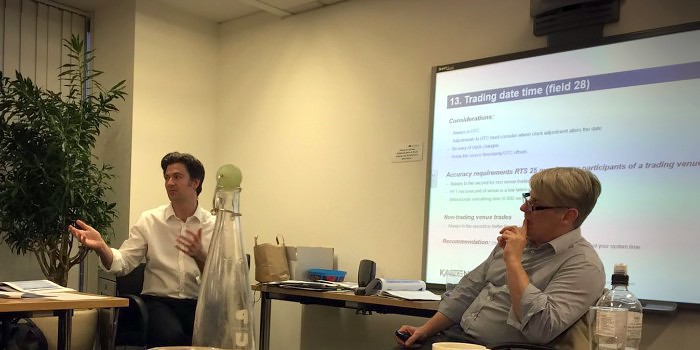
    At Kaizen, we believe effective training is an essential element in ensuring complete and accurate transaction reporting. We offer a half day CPD-accredited training course, endorsed by the Chartered Institute for Securities and Investment (CISI), which gives candidates a core understanding of the transaction reporting requirements and the fields that comprise a transaction report. The course can be taken at Kaizen HQ or at your own offices and is accompanied by an exam which enables you to demonstrate your understanding of the reporting requirements. Similar courses are available for EMIR trade reporting and SFTR. Visit our training page for further details and to book your place on one of our upcoming scheduled dates. 

    Are you a Transaction Reporting guru? Why not take part in #TransactionReportingTuesday over on LinkedIn.

    Every Tuesday, on the Kaizen LinkedIn we will be publishing a MiFIR Transaction Reporting question from our training exam. The answer will be posted a week later along with a new question. 


    ¹ FCA Final Notice to Goldman Sachs

  • Second fine for transaction reporting breaches in two weeks is a record £34.3m

    Second fine for transaction reporting breaches in two weeks is a record £34.3m

    The FCA has issued a record fine of £34.3m for incorrect transaction reporting, hot on the heels of a fine two weeks ago for similar breaches. 

    According to the FCA, the firm in question failed to provide accurate and timely reporting relating to 220.2 million transaction reports between November 2007 and March 2017.

    If any firm doubts the FCA’s resolve in its pursuit of complete and accurate transaction reporting, they need to take note of these fines and the accompanying warning from Mark Steward, the FCA’s Director of Enforcement:

    ‘The failings in this case demonstrate a failure over an extended period to manage and test controls that are vitally important to the integrity of our markets. These were serious and prolonged failures. We expect all firms will take this opportunity to ensure they can fully detail their activity and are regularly checking their systems so any problems are detected and remedied promptly, unlike in this case.’

    The two recent fines are almost double the amount of the previous 12 fines for MiFID reporting combined.

    What went wrong?

    The FCA’s Final Notice tells a very familiar tale of what happens when a complex organisation, acting in good faith, attempts to deliver upon these very complex regulatory obligations; a significant, material, and widespread set of issues left undetected for many years.

    The key message is that these errors result from inadequate systems and controls over transaction reporting. In particular, the FCA found issues with:

    1. Change management
    2. Accuracy and completeness controls – again signalling issues with an approach that only tests data samples
    3. Reference Data – identification of counterparties

    The FCA is evidently tired of sounding like a broken record as these three control issues continually result in transaction reporting failings. The message should be familiar to firms and their SMCR managers responsible for reporting.  It’s not a secret that if firms don’t test the accuracy of their reporting, don’t test their reference data and change management processes, and don’t have adequate reconciliation from front office systems to the reports received by the FCA, then they cannot have confidence their reporting is correct.

    Lessons for MiFIR transaction reporting

    It is important to note that both fines are for failures under the previous MiFID transaction reporting regime. It is possible that this now marks the end of sanctions for the MiFID reporting regime and that the FCA’s focus will turn to the MiFIR reporting regime which is considerably more complex than the MiFID reporting regime. The FCA has already warned about the unsatisfactory quality of some transaction reporting under the new regime and the potential future consequences. There are many more things that can go wrong under the new regime and it is essential that firms are confident that they have adequate controls over their transaction reporting. Firms need to take note that the reference period for this fine’s transaction reporting breaches started on 5 November 2007 – the very first day of the MiFID transaction reporting; no grace period. 

    Get peace of mind in your reporting quality

    Our blog about the fine two weeks ago asks ‘could it have been you?’ and if you have any doubt, it is important to act now.  These two fines should be a wake up call for senior managers to get their reporting controls up to standard – and fast. This is exactly what we here at Kaizen exist to do.  We have a proven track record in helping firms tackle their trade and transaction reporting issues and risks head on – and helping them to avoid censure whether it is for MiFIR, EMIR, Dodd-Frank or another G20 regulation.

    Our ReportShield™ quality assurance service marries our regulatory expertise with data science, and uniquely tests every single record at source avoiding the pitfalls of testing only a sample of data.  The service includes everything you need for reporting assurance including a bespoke control framework, quality assurance testing, reference data testing, advanced reconciliation and training. Please contact us for a discussion with one of our regulatory experts to find out how we can give you peace of mind in your reporting quality. 

  • Book now! Kaizen launches regulatory reporting training service led by industry expert David Nowell

    Book now! Kaizen launches regulatory reporting training service led by industry expert David Nowell

    FOR IMMEDIATE RELEASE

    23  October 2018, London: Leading regulatory technology firm Kaizen Reporting today announced that it is launching a training service led by the company’s new Senior Regulatory Reporting Specialist, David Nowell. The training will initially focus on MiFIR transaction reporting before expanding to include EMIR trade reporting and the upcoming Securities Financing Transaction Regulation (SFTR).

    A former regulator, Nowell has 30 years’ financial services experience. Having previously worked as a transaction reporting technical specialist at the UK FSA, as head of transaction reporting for a tier-1 investment firm and head of compliance for an Approved Reporting Mechanism and Trade Repository, David has a thorough understanding of both the importance and the challenges in meeting the regulatory reporting requirements. He also has extensive experience of client training on both MiFIR transaction reporting and EMIR trade reporting.

    Dario Crispini, CEO of Kaizen, commented: “David is widely seen as a leading authority in the industry. The FCA frequently warns about the risk to institutions of inadequately trained regulatory reporting teams and in many of its warning notices cites a lack of training as a factor in its decision to censure a firm for incorrect reporting.  Expanding our services to include training makes sense for us, and we are looking forward to helping our clients improve their knowledge in this space.”

    David Nowell, Senior Regulatory Reporting Specialist at Kaizen, commented: “Training is an integral part of the systems and controls that firms need in place to be reporting accurately. It’s impossible to get your regulatory reporting correct unless you understand the legislation from the Level 1 text down to the regulatory technical standards, guidelines, Q&A and validations. Our new courses are designed to help get our clients up to speed quickly, allowing them to understand what needs to be done to report correctly as soon as possible.”

    David adds, “Ensuring your staff are properly trained on the reporting regulations can save costs in the long run as it will increase a firm’s chances of avoiding regulatory sanctions for incomplete or inaccurate reports and the additional expense of costly back reporting exercises.”

    The training service includes four-hour classroom-style workshops as well as in-house sessions for financial institutions. 

    (Ends) 

    For more information please visit our training page or for inquiries about the service please email training@kaizenreporting.com

    For media inquiries, please contact Fiona Wilde at media@kaizenreporting.com or +44 (0) 20 3912 3271.

  • Workshop: MiFID II Guidelines and common scenarios 2

    Workshop: MiFID II Guidelines and common scenarios 2

    Our MiFID II trading scenarios workshop is back following a sold-out course at the BBA in February. 

    Delivered by our CEO, former regulator Dario Crispini and Senior Advisor Ian Rennie, this one-day course explores the challenges that the final transaction reporting guidance and its corresponding scenarios present. Building upon the learning from our Understanding your Obligations workshop, this one-day workshop will delve into the detail of the reporting guidance and how this applies in various scenarios to ensure the highest level of compliance with MiFID II obligations.

    There will be an opportunity for delegates to submit their own reporting scenarios beforehand to work through on the day, as well as covering off some of the most common scenarios.

    Kaizen’s CEO Dario Crispini, says, “ESMA has made it clear that it expects the quality of MiFID II/MIFIR reporting to be high from go-live in January 2018.  It is essential that investment firms understand the guidelines and factor their direction into the design, build and control of their transaction reporting solution”.

    This workshop is open only to financial regulated firms.

    Date: 8 May 2017
    Venue: British Banker’s Association,Pinners Hall, 105-108 Old Broad Street, London, EC2N1EX

    Find out more/book here.

  • Workshop: MiFID II Guidelines and Common Scenarios

    Workshop: MiFID II Guidelines and Common Scenarios

    FULLY BOOKED.

    We’ve joined forces with the BBA again to deliver a new training workshop, this time focused on MiFiD II training scenarios.

    This workshop will explore the challenges that the final transaction reporting guidance and its corresponding scenarios present. Building upon the learning from the Understanding your Obligations workshop, this one-day training session will delve into the detail of the reporting guidance and how this applies in various scenarios to ensure the highest level of compliance with MiFID II obligations.

    There will be an opportunity for delegates to submit their own reporting scenarios beforehand to work through on the day, as well as covering off some of the most common scenarios.

    ESMA has made it clear that it expects the quality of MiFID II/MIFIR reporting to be high from go-live in January 2018.  It is essential that investment firms understand the guidelines and factor their direction into the design, build and control of their transaction reporting solution.

    This workshop is open only to financial regulated firms.

    Date: 2nd February 2017
    Venue: London Institute of Banking & Finance, 8th Floor, Peninsular House, 36 Monument Street, London, EC3R8LI

    Book and find out more.