Category: Insights

  • White Paper: The Evolving Challenge of CFTC Reporting

    White Paper: The Evolving Challenge of CFTC Reporting

    CFTC swap data reporting has improved significantly since the ReWrite went live in 2022. Clearer rules, more stringent validations and more structured reporting have helped remove many obvious errors.

    But the data quality challenge hasn’t gone away. 

    Many remaining issues are no longer straightforward validation failures. They are valid, accepted and still wrong and this makes them much harder for firms to detect through standard controls.

    In this white paper, Alan McIntyre, Kaizen’s North America Reporting Director, explores what Kaizen’s testing data shows about how CFTC reporting issues have evolved, why “valid but wrong” errors persist, and what firms should consider as reporting quality expectations continue to develop.

    In this white paper, we cover:

    • How CFTC swap data quality has changed before and after the ReWrite
    • Why stronger validation has reduced obvious errors but left harder-to-detect issues
    • Examples of “valid but wrong” reporting, including timestamps, LEIs, FX rates and population inconsistencies
    • Why interpretation drift and system changes can create silent reporting issues
    • Why firms may need to rethink how they prioritise remediation.
    Download the white paper to understand how the CFTC reporting challenge is evolving and why the hardest issues may now be the ones that pass validation.
     

    Links:

  • INTC or not INTC? FCA expectations for aggregate client accounts under MiFIR Transaction Reporting

    INTC or not INTC? FCA expectations for aggregate client accounts under MiFIR Transaction Reporting

    One MiFIR transaction reporting convention that continues to trip firms up is the aggregate client account: INTC. In this blog, we take a deep dive into how INTC is supposed to work and why regulators keep coming back to it.

    INTC isn’t obscure. It’s everywhere:

    • 108 references in ESMA reporting examples
    • a clear legal basis in RTS 22
    • detailed direction in the ESMA Guidelines
    • repeated warnings in FCA Market Watch 62 and 70, and 
    • extensive coverage again in the FCA’s discussion and consultation papers.

    So why does it still go wrong so often?

    The legal foundation for INTC: RTS 22

    RTS 22, Article 11 is clear about the objective of INTC: to enable effective market monitoring, transaction reports must include exact information on any change in position of the investment firm or its client at the time the transaction took place. Firms must therefore report related fields consistently, and report different legs of a transaction such that their reports, collectively, provide a clear overall picture that accurately reflects changes in position.

    INTC is one of the conventions that allows firms to meet this objective, but only when used exactly as intended. ESMA fills in the “how” in the Guidelines.

    What INTC actually is (and isn’t) under MiFIR

    The ESMA guidelines define INTC clearly: the aggregate client account (INTC) is a reporting convention used to provide a link between the market side and client side of transactions.

    It therefore:

    • is not “real”
    • does not represent ownership
    • does not indicate internal position-taking
    • must never introduce a net position.

    When a firm aggregates multiple client orders and executes them in the market, INTC provides the bridge that allows a regulator to connect the market execution and the allocations to the underlying clients.

    That bridge must be temporary. Any movement through INTC must net to zero within the same business day.

    When INTC may be used in transaction reporting

    When reporting with INTC, there must always be:

    • a market-side transaction(s) into or out of INTC, and
    • corresponding client-side transactions out of or into INTC

    The ESMA guidelines are unambiguous: INTC should only be used in the circumstances set out in the guidelines. It shouldn’t be used for:

    • an order for one client executed in a single execution, or
    • an order for one client executed in multiple executions.

    And where there is a transfer into INTC, there must be a corresponding transfer out within the same business day, so the aggregate client account is flat.

    FCA Market Watch: repeated warnings

    The FCA has been flagging misuse for years. In Market Watch 62, the FCA highlighted firms:

    • using INTC for single-client orders, and
    • reporting flows that did not net off on the same business day.

    In Market Watch 70, three years later, the same issues remained:

    • one client, multiple fills reported via INTC
    • INTC used to signal an internal trading account, and
    • missing the market-side or client-side leg altogether.

    The underlying message is consistent: INTC is not a convenience field. It is a controlled linking convention.

    The scale of the problem: FCA policy papers

    The recent FCA discussion and consultation papers add numbers to what had previously been more of a supervisory narrative.

    The regulator’s analysis shows

    • one in five firms had INTC imbalances
    • seven per cent of all INTC reports contributed directly to those imbalances.

    Across the most recent full year of FCA analysis (2023):

    • 342 million reports used INTC
    • 447 firms used INTC.

    The FCA considered whether to introduce more precise linkage mechanisms between market and client side. The direction of travel in the consultation is to rule that out because implementation costs would outweigh benefits and increasing complexity could worsen data quality.

    In other words: the regulator is not planning to redesign INTC for firms but it does expect firms to use it properly.

    Why the FCA cares so much about INTC

    INTC errors are not cosmetic. When INTC does not net to zero – or is used incorrectly – the consequences are material:

    • regulators see phantom positions
    • ownership appears to pass through firms incorrectly
    • market abuse surveillance becomes distorted
    • aggregation logic breaks down.

    In short: market reconstruction fails.

    What firms should be doing now

    For MiFIR firms, the message is clear. The regulator has acknowledged that structural change may not be beneficial which means it will expect higher accuracy within the existing framework.

    1. Re-validate your INTC logic:
    • is INTC used only for genuine aggregation across multiple clients?
    • does it net to zero by instrument, per day?
    • do your reporting scenarios adhere to the guidelines?

    2. Expect supervisory scrutiny:

    • the FCA is clearly focusing on INTC
    • guidance will be reviewed, but the existing expectations already apply
    • less complexity in the regime means the regulator will expect greater precision, not less.

    Four simple letters – ‘INTC’ – have an outsized impact. Getting it right is one of the simplest ways to materially improve transaction reporting quality – and one of the easiest ways to stand out for the wrong reasons if you don’t. 

    While you are driving home for Christmas or taking your chance on the trains, worrying that you’ll be getting a FCA letter about INTC, please get in touch. Our award-winning ReportShield quality assurance highlights any issues you may have with INTC and once you know you have a problem, you can put it right before the FCA gets in touch.

  • ESMA’s SFTR Data Quality Indicators: Progress with Limitations

    ESMA’s SFTR Data Quality Indicators: Progress with Limitations

    The New Framework 

    ESMA finalised its 23 SFTR Data Quality Indicators (DQIs) during 2024 and published them last month together with a “Framework for provision of data and follow-up on SFTR data quality issues“. The framework laid out how results of the DQIs are identified and expressed at the EU level, discussed at the Repositories Task Force (RTF) and shared with National Competent Authorities (NCAs) at the entity level.

    NCAs are now expected to follow up with the entities and provide feedback to ESMA. ESMA then reviews the feedback and performs a rerun to confirm the issue has been resolved, this is then shared with the RTF with any follow-ups deemed necessary. Given how variable and sporadic SFTR supervision has been across Europe, these are very positive developments. 

    Understanding the 23 DQIs: Not All Created Equal 

    Ask an ESMA official and all 155 SFTR reporting fields were created equal, however, I suspect that there is a very different view on the ground in the regulatory reporting oversight offices of the 30 NCAs and two European Supervisory Authorities (ESAs). Under SFTR, predominantly but not exclusively a systemic risk monitoring regulation, trade economics are king.  

    In summary, while the DQIs will provide the less sophisticated NCAs with a means of challenge their regulated entities in at least a minimal way, for others unfortunately at this stage, they may be little more than a distraction in performing their valuable work in keeping their domestic economies from harm. ie. time spent reviewing ESMA findings and coordinating responses may actually be better placed analysing genuinely systemic issues in that jurisdiction. 

    Two-Sided Reconciliation Tests (8 DQIs): Eight of the 22 DQIs rely on a fundamental assumption: that SFTR reports are genuinely two-sided. This means both parties have reporting obligations, are in the same jurisdiction, haven’t delegated their reporting, and their data comes from independent sources rather than shared systems. In theory, this creates a true representation of each firm’s books and records. However the reality is very different. These DQIs are flawed because so few reports are genuinely, independently two-sided. Most data ultimately comes from a single source – whether through shared systems, data vendors, or reporting delegation. In our experience, time and time again, two wrongs really do make a wrong when you’re trying to reconcile reports that originated from the same place.

    Reporting Discipline Issues (10 DQIs): A further 10 of the DQIs cover essentially SFTR reporting discipline issues rather than material economics. These include the number of rejected reports (NACKs), late reporting, missing variation margin reports on CCP cleared trades, client codes used in place of LEIs, missing issuer LEIs, incorrect reporting counterparty classification x 3, duplicate reports and not updated event dates. 

    The One with Potential: DQI 11A Anomalies 

    There is just one SFTR DQI that appears to have the potential to be truly powerful. Unfortunately like many things SFTR, it is rather loosely defined. DQI 11A Anomalies uses statistical approaches to identify abnormal/anomalous values in listed fields but encouragingly, in ratios between relevant fields too. This DQI spans 20 SFTR fields covering repo, securities lending and margin lending across loan values, collateral values, market values, lending fees, haircuts, CCP margins, collateral reuse and cash reinvestment (for securities lending). Arguably this should really be broken down into hundreds of sub and specific DQIs per type of SFT and nature of the test, such that there is a thorough understanding of the parameters and expectations. It would also enable firms to implement these indicators in their own controls frameworks. Unfortunately there are no further details or definition, such that both NCAs and reporting counterparties are left to guess the precise nature of the tests. 

    The Bigger Picture Problems 

    Aside from the limited instances of true independent two-sided reporting and an over-emphasis on reporting discipline, many of the tests also focus on the number of reports or instances, not their economic value. Also considering that in terms of market size and risk exposure, in excess of 75% of the SFT market in the EU is repo and the closely related buy-sellback market, it is something of a concern that the lion’s share of DQIs are focused on the securities lending. As primarily macro-systemic regulation, this is disappointing. 

    Looking Forward 

    It’s easy to pick holes in the new SFTR DQIs but for the forgotten stepchild of EMIR, they are certainly a move in the right direction. While at this stage it appears to be something of an opportunity squandered, firms should be painfully aware that they are on notice to up their game in terms of SFTR data quality. Those NCAs that have kept quiet and have been lurking in the shadows are highly likely to let their presence be felt once they start receiving DQI queries from ESMA that require their attention. 

    Kaizen’s quality assurance testing includes checking for all issues included in ESMA’s DQIs and many more. For a conversation with Jonathan or one of our regulatory experts about your SFTR data quality, please get in touch.

  • ESMA’s Data Quality Report 2024: MiFiR transaction reporting remains a key focus

    ESMA’s Data Quality Report 2024: MiFiR transaction reporting remains a key focus

    ESMA’s fifth report on data quality (published 30th April) – like last year’s – seemed light on a first read for MiFIR. But a second read alongside another ESMA document, the “Data Quality Engagement Framework (DQEF) for MiFIR’ published a week after the report, reminds us that MiFIR transaction reports and their data quality remain a key focus for ESMA and EU National Competent Authorities (NCAs).

    The purpose of MiFIR transaction reporting

    In the data quality report (DQR) ESMA reinforces, should we have forgotten, that data supports the day-to-day activities of financial regulators and remains essential for them to achieve their primary mandates of financial stability, orderly markets and market integrity.

    “Reduce the reporting obligations on firms”

    The DQR provides a number of use cases, introduces the DQEF and gives a significant mention to the role of transaction reports in the transparency and volume cap calculations that will reduce the reporting obligations on firms.  In case you missed it – “reduce the reporting obligations on firms”. The proof of concept (PoC) to prove the role of reports in these calculations determined that data quality is good but the DQEF being introduced is designed to address the critical data quality issues that became apparent during the exercise. 

    Improved tooling for increased scrutiny

    Furthermore, the DQR mentions that ESMA and NCAs now have improved tooling for monitoring markets. This includes details on the ESMA Data Platform (EDP) where regulators can share reported data and access predefined analytics to support them in their work.  As we highlighted last year – firms contributing reports to these calculations that are lacking data quality can expect their NCA to give them an opportunity to discuss the issues found.

    Delving into the details

    At a macro level, reported data under MiFIR is used to monitor overall trends and key market-level developments.  NCAs use the data in national financial stability reporting and sectoral updates whilst some have established systems to monitor trading venue activity or to rank firms based on their risk profiles.

    For the detection of market abuse, NCAs have developed a variety of automated alerting tools to highlight behaviours that could threaten market integrity for follow up by surveillance staff.  Data from different regimes is combined to identify cases of potential market abuse. 

    New tests to enhance data quality

    The PoC to test the potential for using MiFIR data for transparency and volume cap calculations achieved > 95% accuracy and hence will replace the existing systems (FITRS and DVCAP) and reduce the reporting burden for firms.  The discrepancies found will be addressed via the newly established DQEF based on ESMA’s existing transaction data validation rules and the TREM (Transaction Reporting Exchange Mechanism) DQEF tests, with new completeness, accuracy and consistency tests introduced to enhance data quality.

    The aim is to launch the DQEF in the first half of 2025 to allow NCAs and firms to address the quality issues found – ahead of the go live of the new transparency and volume cap system.   

    Conclusion

    We are often asked, ‘do regulators actually use the data?’ and the DQR provides clear evidence that they do. ESMA’s reuse of MiFIR transaction data for transparency and volume cap calculations demonstrates its commitment to reducing duplicative reporting – something the industry has long requested. However, increased data usage means increased scrutiny. Firms submitting poor quality data can expect to be contacted, remediation expected, warnings given and potential enforcement action.

    Firms often approach us for quality assessments after the regulator has challenged their data. This puts them in damage control mode.  The better approach is proactive quality assurance that identifies problems before regulators do. Please don’t hesitate to reach out to us at Kaizen to see how we can help.

  • ESMA’s 2024 Data Quality Report: EMIR Refit under the Microscope

    ESMA’s 2024 Data Quality Report: EMIR Refit under the Microscope

    ESMA released the fifth iteration of its Report on Quality and Use of Data (DQR) late last month, which highlights the use of reported data across multiple regimes, critiques submission quality, and references some of the enforcement actions carried out in 2024. This analysis focuses on the DQR’s EMIR data quality findings and their implications for firms. We have also published our SFTR analysis of the report.

    Focus on EMIR Refit

    Last year’s DQR placed a heavy emphasis on the potential for the EMIR Refit reporting changes to improve data quality. 12 months later, ESMA provides a mixed assessment:

    • ‘Positive assessment of go live’ in April 2024
    • Concerns regarding preparedness of Trade Repositories and reporting entities
    • Ongoing ‘need for further engagement for corrective actions’.

    EMIR Reporting was described by ESMA in last year’s DQR webinar as being ‘much more complicated’ under EMIR Refit. From Kaizen’s view of post-Refit reporting, many firms still have significant work to do to uncover hidden reporting issues and apply successful remediation procedures. This report may still be too early to provide a true reflection of data quality under the EMIR Refit regime.

    Limited Data Quality Indicators (DQIs)

    The EMIR metrics provided in the report give a limited and somewhat lacklustre view on where EMIR data quality currently rests.  Of the seven DQI metrics displayed:

    • Six show a mild improvement in data quality metrics (such as the Number of Outstanding Trades in Chart 3)
    • One indicates declining quality – percentage of missing valuations (Chart 7).

    A more comprehensive analysis of all the EMIR DQIs would be extremely useful for the industry and help us to gain a more accurate evaluation of data quality. ESMA’s Data Quality Dashboard for EMIR Refit document details (approximately) an additional 18 DQIs (c.25 in total) that are being actively monitored and discussed between supervisory authorities. The DQIs are a key tool within their regulatory arsenal and it is disappointing only a small number appear in the public report.

    Key DQI findings

    Rejection rates

    ESMA highlights the rejection rate of derivatives, which sits at approximately 1-2.5% across EU submitters. The rejection rate is described as ‘critical for authorities’ to ensure data is complete and accurate. ESMA’s expectation is for a ‘close to zero’ rejection rate.

    For me, the late report statistic is far more important, as firms are required to report trades in a timely and accurate fashion. Late submissions by some counterparties can lead to the view of unpaired submissions that distort the visibility of derivative exposure. Firms are required to report by end of day T+1, and are not in breach of any regulatory requirements if they resubmit a rejected derivative within that timeframe. In the absence of any material increases in this statistic, I question the value of emphasising it.

    Legacy format upgrades

    The DQR states that ‘36 million’ submissions needed upgrading to the new EMIR Refit format within 180 days from April 2024. At the end of February 2025, 2% of those submissions had not been converted. Firms with a UK EMIR reporting obligation should take note of the focus on updating old submissions and enforcing the strict schemas under EMIR. ESMA states firms should ensure ‘swift upgrading’ of any old format derivatives.

    Maturity date issues

    Abnormal or blank maturity dates continue to cause confusion (as shown in Chart 6), despite a small reduction to approximately 10% of submissions. Due to products such as CFDs, the maturity date fields have not been mandatory under EMIR Reporting’s validation rules, long prior to EMIR Refit. Regulators fully expect these ‘optional’ fields to be populated where applicable to the derivative. It is worth repeating:

    Optional fields do not mean the entity has a choice as to whether they are populated or not.

    Abnormal or blank maturity dates is a relatively high figure at 10% and ESMA explicitly expects a ‘lower percentage going forward’. Firms must ensure that this data point, and all further ‘optional’ fields are fully reviewed and are being reported for all submissions in a timely and consistent manner.

    Missing valuations

    Chart 7 shows that missing valuations are increasing (currently at 12.36%), even though daily valuations are required for a large majority of EMIR reporters and have been since August 2014. 

    Entity Responsible for Reporting (ERR)

    The DQR also places emphasis on a new field from EMIR Refit, the Entity Responsible for Reporting (ERR). This OTC field is described as a ‘crucial addition under EMIR Refit’ and ESMA appears dissatisfied with the volume of misreporting of this field (as shown in Chart 6).

    Trade Repositories’ (TRs) challenges

    ESMA gives mention to the reporting difficulties of TRs as well as entities, including issues such as:

    • Difficulty with reporting portability
    • LEI updates from M&A activity
    • Inter-TR reconciliation delays
    • Challenges providing complete reports to the NCAs.

    In my opinion, this highlights the complexity of EMIR Refit for firms and TRs alike, notably given the vast range of reportable products and lifecycle events, under a complicated reporting regime.

    The simplification paradox

    ESMA makes efforts to explain its desire to simplify reports and reduce the regulatory burden for firms. Very few firms will agree that this objective has been achieved in practice or in the spirit of the regulation. While many aspects of reporting have received welcome clarification, additional reporting requirements have been introduced and made the overall regulatory regime much more complex.

    What does this mean for firms?

    Based on the DQR findings, firms should focus on:

    1. Ensuring proper population (where applicable) of maturity data fields
    2. Valuation reporting – review processes to stop the increasing trend of missing valuations
    3. ERR field accuracy – verify the correct implementation of this ‘crucial’ addition
    4. Legacy migrations – complete any remaining pre-Refit format submission upgrades
    5. Rejection rates vs late reporting – while ESMA focuses on rejection rates, firms should also prioritise timeliness.

    Assessment

    Overall, I welcome the DQR’s attention to data quality critique and its motivation to help firms achieve regulatory compliance through complete, accurate and timely reporting. The justification of how data is used is particularly valuable, as this large operational burden is often questioned by firms.

    Going forward, the DQR would benefit from further transparency and metrics across the full suite of DQIs. This would help firms understand how their reporting is being reviewed by supervisory authorities and allow them to focus their limited remediation resources on improving the most material parts of EMIR Reporting.

    Better guidance and clarity would also ensure firms are better equipped to ensure reporting is complete and accurate at point of submission, negating the need for costly remedial action for firms and regulators alike.

    Concerned about the quality of your EMIR Reporting data? More than 200 firms from tier 1 banks to small fund managers rely on Kaizen’s quality assurance to meet – and exceed – their regulatory obligations. Contact us to request a demo or for a conversation with one of our regulatory experts. 

  • ESMA’s 2024 Data Quality Report: Increased Focus on SFTR Data Quality

    ESMA’s 2024 Data Quality Report: Increased Focus on SFTR Data Quality

    ESMA’s Report on Quality and Use of Data for 2024 (published 30 April 2025), delivers a clear message: “ESMA expects that reporting entities increase the quality of their reported data significantly” and “the quality of the SFTR data still has large margins of improvements.”

    A particularly encouraging development is the “enhanced cooperation with BaFin,” where ESMA and BaFin established “an enhanced periodic engagement” with BaFin stepping up their approach and increasing targeted efforts. This marks positive progress in what had previously appeared to be somewhat polarised regulatory scrutiny across the EU.

    SFTR Data Quality Indicators Now Fully Implemented

    ESMA finalised its Data Quality Indicators (DQI) approach for SFTR in 2024, following their successful introduction for EMIR in 2022. Prior reports highlighted concerns, most notably the overstatement of open term securities loans values during 2021-2023, but there was relatively little structured analysis before the DQIs. ESMA notes that “a TR issue due to which inflated market values were observed has been resolved with the pending correction of historical data being monitored,” likely referring to reporters’ failure to send terminations or add maturity/end dates to open term securities loans.

    Key SFTR Data Quality Indicators Revealed

    Missing Valuations (DQI 5a)

    This metric shows significant improvement, falling from 26.3% in March 2023 to 8.5% by December 2024, though still above ESMA’s 5% threshold. The “dramatic” improvement was due to “amelioration of reporting by a few of the major reporting entities.”

    Outdated Valuations (DQI 5b)

    Of all DQIs, this remains “the worst among depicted DQIs,” despite falling from 41.4% in March 2023 to 26% by December 2024. ESMA emphasises: “Having updated information in times of adverse market movements and crises is crucial for authorities” and it is “imperative for counterparties to swiftly follow on the identified issues with outdated valuation.”

    Trade Reporting Discrepancies (DQI 1a)

    This indicator shows an average of 35% mismatch in outstanding SFTs between counterparty pairs – far above the 5% threshold and higher than EMIR’s 20.5%. This is remarkable considering that many SFTR reports are single-sided, and many dual-sided reports are generated by a single party with pre-matching and third-party data enrichment.

    Position-Level Discrepancies (DQI 1b)

    This indicator measures differences in position-level reporting between counterparties. While ESMA highlights this metric, position-level reporting is relatively uncommon in SFTR, making its prominence in the report somewhat curious.

    Entity Responsible for Reporting (DQI 9a)

    This field identifies who is responsible for reporting (UCIT managers for funds, AIFMs for AIFs, etc.). Though important for attributing data quality errors to the correct entity, this metric showed modest issues at 1.9% by end of 2024.

    Regulatory Expectations Rising

    ESMA’s commitment to data quality is clear: “ESMA always encourages the amelioration of reporting even in cases where the error rate is below the DQEFs which govern actions taken to tackle data quality.”

    Our Perspective

    At Kaizen, we welcome the increased focus on SFTR data quality five years after implementation. The publication of the Data Quality Engagement Framework and DQIs provide important steps toward greater regulatory certainty.

    However, we are cautious about equating matched reports with high-quality data. We would also challenge the focus on securities lending data elements and the relative absence of repo data given its greater systemic risk significance.

    Is your SFTR reporting in good shape? Can you evidence this? Kaizen provides comprehensive quality assurance for accurate, complete and timely SFTR reporting.  We also provide Daily Controls for SFTR delegated reporting arrangements.

    Contact us to request a demo or for a conversation with Jonathan or one of our regulatory experts.

  • FCA issues its first transaction reporting fine under MiFID II

    FCA issues its first transaction reporting fine under MiFID II

    The FCA has issued its first enforcement notice for a breach of transaction reporting requirements since MiFID II went live in 2018. A UK-based broker was fined just under £100,000 by the FCA for failing to submit more than 46,000 single-stock contracts for difference (CFD) transaction reports between October 2022 and March 2023.

    Why was the firm fined? 

    Firms take note – what is interesting about this fine is that even though the broker had identified its failure to submit the transaction reports following a third-party review, it did not proactively report the breach to the FCA. It was the regulator that independently identified the discrepancy in transaction data.

    The expectation from the FCA is that as soon as firms identify issues with their reporting, they need to let the FCA know via an error and omissions notification. This then demonstrates to the regulator that they have the right systems and controls in place. 

    The value of the fine

    The high-risk nature of single-stock CFDs with regards to potential market abuse, and the firm’s failure to quickly bring the breach to the FCA’s attention, meant that it was initially fined more than £141,000. The broker received a 30% discount on the penalty for early resolution. The FCA initially allocated a value of £2.00 for each of the broker’s missing transaction reports (a step up from the £1.50 amount in the previous final notice from 2019). However because the FCA deemed that the broker had not acted deliberately or recklessly and there was no or little loss or risk of loss to consumers, investors or other market users this was further reduced as per the existing framework.

    Subsequently under step 4 of their determination the FCA concluded that the “absolute value of the penalty is too small in relation to the breach to meet the Authority’s objective of credible deterrence” and hence multiplied the amount by seven, to avoid “firms being tempted to see any fines imposed because of transaction reporting breaches as a cost of doing business.” This is clearly an area of FCA focus. Firms should review their current processes and governance and take note of the regulator’s less conciliatory stance.  

    What is the background to the fine?

    The general temperature of regulatory scrutiny around transaction reporting has been rising recently, and via Market Watch 81 the FCA was clear in its expectations of firms that they needed to improve their transaction reporting controls and review weaknesses in their processes.

    What did the final notice say?

    The FCA highlighted weaknesses in the firm’s change management processes and potentially a lack of subject matter expertise within the brokerage when it established and operated a new line of business in single-stock CFDs. The FCA notes, “it was the responsibility of a single individual…to manually identify which financial instruments were reportable when new business was commenced”.  It also noted that the firm “did not put in place any steps to scrutinise this process or any checks to ensure that the correct trades had been identified as reportable”. This points to a lack of effective reconciliation, which is expected under Article 15, RTS 22 of MiFIR.

    And while a third party review identified that the broker had not reported the transaction data, as mentioned earlier in this blog, the broker did not proactively contact the FCA regarding the breach. The final notice reiterated that the regulator expects to be notified quickly and not just once prompted.

    What does the fine mean for firms?

    This fine should stand as a warning for firms and a stark reminder to act now and review current processes and governance around transaction reporting. It is important to note the change in temperature from the regulator. The FCA is paying close attention to the transaction reports firms are submitting (and not submitting) and expects firms’ systems and controls to be robust where they do identify breaches.

    Our ReportShield™ quality assurance solutions are designed to give firms peace of mind in meeting regulatory expectations on MiFID II transaction reporting. Available on our easy-to-use dashboard, our solutions are unique in testing every single record at source so that all errors including under and over reporting are detected. Through our experienced team of regulatory experts, we can also advise firms on communication with the FCA and other regulators, and provide training on the reporting requirements. Please contact us for a discussion about your reporting challenges. 

  • What’s on the horizon for Securities Financing Transaction (SFT) Reporting in 2025?

    What’s on the horizon for Securities Financing Transaction (SFT) Reporting in 2025?

    Approaching the final act of 2024, the world remains in a perilous place, economic growth is faltering, interest rates have been slow to ease but inflation also remains sticky and prone to energy price shocks. In this environment, money market and securities finance transaction (SFT) reporting moves closer to the top of the Treasury’s and Central Bank’s toolkit as they seek to establish the effectiveness and transmission of monetary policy together with any signs of external factors impacting the order and robustness of broader capital markets.

    New US regimes and SFTR Review

    2024 will draw to a close in the money markets and SFT reporting space with the introduction of daily US Non-Centrally Cleared Bilateral Repo Market reporting to the Office of Financial Research (OFR) for major securities/government bond brokers and dealers, on 2 December. OFR Phase 2 on 1 April 2025 will see reporting expanded to cover ‘Category 2’ major ‘Buyside’ Non-Centrally Cleared Bilateral Repo market participants.

    Elsewhere though, 2025 looks potentially like a year of delays. US securities lending reporting under SEC 10c-1a and administered by FINRA as Rule 6500 SLATE reporting is politically a very hot potato, facing a number of amendments and potential delays with the SEC postponing their approval of the FINRA rule until January, corresponding with Gary Gensler’s departure. Additionally, US trade associations are potentially launching other legal challenges. It might still go ahead on 2 January 2026 though!

    The SFTR Review also appears to be subject to further delay, with no sign of it appearing on the ESMA 2025 schedule of work.

    Where to focus for 2025

    However, while many eyes may be pointing at the shiny new regulations, in practical reality, it’s the seasoned, mature regulatory reporting regimes that compliance officers want to worry about.

    Regulators make allowances for new regulations, they let them bed in and teething troubles are tolerated – not so once a regime has been live for five years.    

    Unfortunately, almost five years in, data quality in the SFTR space continues to let it down. It has perhaps not helped that (new UK validation rules – live on 25 November 2024 aside – which are largely a replay of ESMA’s March 2023 rules), SFTR has been somewhat untouched for an extended period now. The last SFTR Q&A was published in June 2023.

    Of late, we’ve heard anecdotes of new NCAs entering into the fray with challenging questions and investigations following concerted pressure from ESMA and potential signs of a delegated reporting timebomb too. While the SFTR Review may be subject to further delay, regulators such as the UK FCA have been keen to draw our attention to SFTR.

    FCA Market Watch 81 – what does it mean for SFTR?

    Earlier this month, the FCA released Market Watch 81 which primarily focused on MiFID transaction reporting requirements however it made it clear that it would also be of interest to firms subject to UK EMIR and SFTR. 

    The newsletter contains a rich seam of statements that in our anecdotal experience apply equally to SFTR. To let Market Watch do the talking…

    “We continue to identify incomplete and inaccurate transaction reports,” with complaints about issues re-occurring post remediation, poor change management, data governance, control frameworks and oversight.

    Perhaps most poignant of all from an SFTR perspective was the statement:

    “Data quality issues can also emerge where change processes are outsourced to third parties, and there is inadequate oversight over the scope of deliverables. This can be worsened by the absence of transaction reporting subject matter expertise within the firm.”

    Furthermore: “We have identified firms who have excluded services and data provided by third parties from their control and reconciliation framework. This can create gaps in monitoring and prevent firms from identifying issues originating outside the firm.”

    The FCA also stated:

    “Limited compliance oversight over transaction reporting can hinder firms from improving their reporting processes through independent advice and challenge.”

    Of course, a layer of independent quality assurance through regulatory testing (such as our ReportShield Accuracy Testing) would ensure that regulatory reports are subject to a fully independent challenge.

    “Staff turnover and absences can also affect data quality. We have identified data quality issues including failure to report transactions where key staff dependencies exist, and there are not clear policies and procedures to manage reporting in their absence.”

    Again, outsourcing elements of your controls environment and oversight not only helps counteract key person dependencies but also mitigates against any inadequacies in policies, procedures and change management.  

    Don’t rest on your laurels

    Governments and regulators are currently on edge for understandable reasons. Excuses for incomplete or inaccurate reporting of the very regulations (SFTR, EMIR, CFTC etc) implemented in mitigation of the global financial crisis have been exhausted. The onus is now on firms to ensure complete, accurate and timely reporting or start to face the wrath of emboldened regulators across Europe, North America and globally. This is no time for resting on your laurels.  

    Our ReportShield solutions are designed to directly address the controls issued raised in Market Watch 81 – to request a demo or for a conversation with one of our regulatory experts, please get in touch.

  • ESMA MiFIR Review: Key changes proposed to MiFIR Transaction Reporting (RTS 22)

    ESMA MiFIR Review: Key changes proposed to MiFIR Transaction Reporting (RTS 22)

    ESMA has launched a consultation on Level 2 measures under the MiFIR Review, seeking feedback on transaction data reporting (amended RTS 22) and order book data (amended RTS 24).

    What’s the background to the consultation?

    ESMA published a report in March 2021 on the functioning of the transaction reporting regime under Article 26 of the Markets in Financial Instruments Regulation (MiFIR). This led to a set of legislative proposals included in the review of MiFIR. The final legislative amending text of the ‘MiFIR Review’ was published in the Official Journal of the European Union and entered into force on 28 March this year. This included an updated version of the provisions for transaction reporting (Article 26).

    In this latest regulatory milestone, ESMA is asking for input on its amendments to the regulatory technical standards (RTS) 22, the section of MiFIR which sets out the transaction reporting obligations and reportable fields. The deadline to submit comments is 3 January 2025. We are certain that clients will want to engage with their trade associations and also respond themselves.

    Some of these proposals are far reaching and will be complex to implement. This now feels almost as significant a package of change as the shift from MiFID to MiFID II in 2018.

    From first sight of the initial report through to the publication in the Official Journal, we said that the devil will be in the detail. 

    What are the key changes proposed to RTS 22?

    1. Instrument Scope

    Not a major change but for OTC Derivatives where the underlying is not ToTV or an index made up of instruments that are ToTV then these will only have to be reported if Traded on a Trading Venue unless they are specifically included in Article 8a(2) of the revised MiFIR Text. The consultation includes two diagrams that makes this scope easy to visualise. For firms understanding exactly what is in and out of Article 8a(2) will be the challenge.

    2. Additional Field – Effective Date

    Further details will become clear after consultation but so far for debt instruments, the effective date should be the date when the transaction will be settled and for derivatives it should be the date when the obligation under the contract becomes effective, which may be in the future (forward starting date).

    3. Additional Field – Entity subject to the reporting obligation

    The field will provide added value in the limited instances where the executing and submitting entity differs from the firm with the obligation to report.

    4. TIC or TVTIC, that is the question

    Here is where we start to see significant implementation challenges – the existing challenges of TVTIC will remain i.e. what format and where is the venues “TVTIC” to be found and there is to be more legislation for the extension of “TVTIC” to “negotiated” trades, a new “TIC” for trades executed on Non EEA trading venues. ESMA is also consulting on a proposal for the generation and dissemination of a “TIC” across the entities involved in OTC/XOFF transactions.

    5. Improvements to INTC

    There are proposals to introduce a new identifier to link market side executions to the ultimate fills to multiple clients where a firm aggregates client orders. Fortunately this requirement begins and ends with the executing firm – there is no mention of sharing this code with the clients themselves. So far so good, but ESMA doesn’t stop there.

    6. A new code to link to the same sequence of report chains resulting in the execution of a transaction

    A catchy title with a less than catchy implementation challenge. ESMA proposes to include a new and unique code (Chain Identifier) that is transmitted across all counterparties involved in a chain. All involved parties must make sure to transmit the code to its direct counterparty until the ultimate reporting entity. The introduction of such new identifier would also imply the identification of the primary entity responsible for the creation of the code and responsible for disseminating it. We assume though only to its immediate counterparty.

    The code should be transmitted across the counterparties along with the sequence of confirmations chains. The firm executing the transaction would have the obligation to pass the code down the chain. The firm executing the order should provide a unique code to the client that pertains to the executed transaction that allows the client to produce its own transaction report. Again, more detail will come in the Level 3 (L3) so firms won’t really know what they don’t know until it is completed.

    7. Less complex new asks but more data will be required:

    • Date transactions should be reported – fortunately this is to be a “fixed” date which will be equal to the date of application of the revised RTS 22.  Here ESMA adds further detail “The application date should also ensure sufficient time for implementation, which… should be ideally 12 months from when the technical documentation is available”. Our question is does the “technical documentation” include all Level 3 – as a lot of Level 3 will be required to clarify some of the additional requirements specifically relating to the TIC/Chain and INTC requirements.
    • Additional data to identify indexes, aligns to the benchmark regulation and splits the field into two components.
    • Alignment of Buyer /Seller /Price /Complex trades and packages to EMIR. There is a lot of detail as to the changes required for Buyer/Seller identification for derivative transactions which at least if aligned to EMIR, firms will be able to cross reference interpretation already recently undertaken for EMIR Refit.
    • Inclusion of a DLT identifier in transaction reports for financial instruments that are natively issued on a blockchain and for financial instruments that are re-issued in a tokenised form.
    • Client categorisation.

    There are a number of other changes as to Order Transmission/exclusion of some additional transaction types and some adjustments to field definitions and names, but I leave you with this one hidden in the revised text of the RTS:

    8. No 1st Priority Identifier – No Trade

    “The highest priority identifier shall be obtained by the investment firm from the client/relevant party prior to trading”. This is the MiFIR Review equivalent of ‘No LEI No Trade‘ of 2018. We know firms do and have made significant efforts to capture Level 1 identifiers but have relied on the fall back if they don’t have it. ESMA is proposing to remove that fall back altogether.

    What happens next?

    Following the consultation period, ESMA will publish a final report and submit the draft RTS to the European Commission for adoption in Q1 2025. 

    For Kaizen clients, our ReportShield quality assurance testing will continue on the basis of the current regulations, rules and guidance. We will be following the consultation process closely with our clients and partners and will provide further updates as the changes crystalise in early 2025. 


  • Commentary – managing the upcoming money markets reporting obligations

    Commentary – managing the upcoming money markets reporting obligations

    Kaizen’s Money Markets Reporting Director, Jonathan Lee shares his insights on the upcoming reporting obligations in the SFT and money markets reporting space in a commentary written for the Securities Finance Times and Asset Servicing Times.

    “We are entering a period of significant change in the money markets and securities financing regulatory reporting space. Extraterritoriality in the FINRA SLATE rules for US securities lending, the likelihood of growing requirements in Europe in the SFTR Review/Refit, further new but smaller requirements for uncleared bilateral repo reporting to the OFR in the US, and the potential for further global and European divergence, are all likely to feature over the next couple of years.”

    Read the full article on the Securities Financing Times Website. 

  • Three top tips for implementing regulatory reporting rewrites

    Three top tips for implementing regulatory reporting rewrites

    Implementing regulatory change projects is never a straightforward journey and although the list of tasks may seem never ending, it can sometimes benefit a firm to pause and assess how their implementation is going. A key area of focus can be how the current project integrates new information. We have seen numerous examples of this in the past few months. In March, ASIC scoped in seven additional data elements from CP361. In May, MAS finalised its OTC derivatives reporting regulations which contained differences from its original consultation and more recently published its FAQ and Guidelines.  

    If this process is left unchecked, this can often derail project delivery and risk regulatory breach. 

    Here are our top three tips to thrive in this environment.

    1. Monitor ongoing changes

    Although regulators have provided the core requirements on rewrites, firms still need to remain attentive to any late changes. This can be achieved by connecting with industry working groups, trade associations and signing up for notifications at respective NCA websites. However, attending the meetings and analysing all of the variable outcomes from industry discussions can be time consuming. Committing adequate resources to this task will enable a firm to gather and evaluate new information prior to translating them into new requirements where necessary.

    1. A consistent approach

    Whenever new requirements do surface, firms are forced to decide whether to include or exclude for go live. Choosing to delay means firms go live with a reporting process that contravenes the rules. Conversely, adding new requirements midway can also jeopardise the final delivery. When any decision could lead to potentially undesirable outcomes, it’s the criteria rather than the decision that increases in importance. There can be many ways of doing this, ie. trading volumes, field materiality, IT effort, source system dependencies or anything else a firm feels appropriate. Whatever that may be, applying this framework consistently will help with prioritising work in line with a firm’s risk appetite within the context of regulatory reporting.

    1. Spotlight the issues

    Design a project status dashboard that provides transparency on how new requirements impact project deliverables. When issues do arise, make them stand out within the project status summaries so that project stakeholders automatically give their attention to the most pressing issues. This allows them to quickly identify situations that may require intervention or escalation to senior management. The key here is that the issues are effectively disseminated to the people that are empowered to make key decisions in relation to resourcing or even approving a risk accepted strategy.

    The bottom line is that firms have a clear go live date and there is always new information that needs to be evaluated. Firms that have a strategy to evaluate changes consistently will allow new issues to quickly come to light and remedied in time for go live. This can only increase their chances of success in achieving regulatory compliance at go live.  

    To find out more about how we can help you prepare for the upcoming UK EMIR Refit, MAS or ASIC ReWrites, please get in touch.

  • SEC Rule10c-1 and FINRA’s Securities Lending Transparency Engine (SLATE)

    SEC Rule10c-1 and FINRA’s Securities Lending Transparency Engine (SLATE)

    Securities Loan? Put it on the SLATE

    The Financial Industry Regulatory Authority (FINRA) published a proposed rule change to adopt the FINRA Rule 6500 Series (Securities Lending and Transparency Engine) ‘SLATE’ on 1 May 2024.

    US Securities Lending Reporting Takes Shape

    SLATE proposals take the SEC’s Final Rule 10c-1a of 13 October 2023 and start to map out what the securities lending transparency regime will look like in the USA once it goes live on 2 January 2026 (assuming no delay by the SEC). This in turn will lead to the publication of individual loan and aggregated securities lending data by FINRA from 2 April 2026. The FINRA rule is subject to a consultation, albeit scheduled to end on 28 May – a mere 21 days after its appearance in the Federal Register. At this stage, we have quite a detailed text outline but no schemas, validation rules or exacting field specifications.

    Requirements for Trade Reporting ++

    The industry has been somewhat surprised by the proposed rule. What first appeared ahead of the FINRA announcement to be simple trade reporting of approximately 12 data elements is shaping up to be a great deal more complex and expensive to implement and report under. This is end of day transaction and lifecycle reporting (on T) by the lender or their agent and subsequent significant loan transparency on T+1. 

    Elements of the scope remain TBC

    The exact scope, potential extra-territoriality and potential dual reporting (to FINRA and the OFR) remain somewhat uncertain. FINRA have identified 609 ‘Covered persons’ who will need to register and report to SLATE, broken down as 434 persons effecting a loan as lender without intermediary, 34 broker dealers borrowing excess margin securities, 4 broker dealer intermediaries, 31 non-broker intermediaries, 97 broker dealers acting as reporting agents and 9 clearing agencies acting as reporting agents. There is no further detail as to who they are or how they came to this estimate.

    Devil will be in the detail regarding reporting taxonomy

    The reporting requirements break down into around 15 public data fields, together with confidential fields relating to identifiers for parties to the loan, indications where securities are sourced from broker/dealer inventory and whether the loan is being used to close out a fail. Depending upon how you count them, we can see effectively up to 45 reportable fields.

    It is the conditional fields (referred to as modifiers and identifiers), full disclosure of all lifecycle events with sequencing, the need to report all modifications (changes and terminations) and the requirement to ingest FINRA generated unique trade identifiers (UTI) and reuse them for all subsequent lifecycle reporting that ramp up the complexity.

    Same day reporting

    Unfortunately for “covered person” reporters, FINRA requires not only the end of day snapshot of any modification but individual reports for each and every change to the terms of the transaction. All by 8pm ET on trade date (if ‘effected’ by 7:45pm ET).

    The modifiers and identifiers required are: Exclusive Arrangements (the lender has with a borrower or intermediary), Loan to Affiliate, Unsettled Loan, Terminated Loan and Rate or Fee Adjustment. To an SFTR veteran, these have the look and feel of counterparty fields in the case of the first two, an error action type (where the loan ultimately wasn’t good), a termination report and a modification of the rebate rate field or lending fee field. It may make the reporting more intuitive to frame these as optional fields (where applicable) and action types (new, modify, error or terminate) or similar, rather than “modifiers and identifiers.”

    Security Lending Data Published T+1

    The public data will be shared by FINRA during the morning of T+1 (excluding the loan amount) at both the individual loan level and in the form of daily loan statistics (e.g. aggregate loan activity and the distribution of loan rates). This data will incorporate both new loans and loan modifications. On T+20, loan amounts will also be shared. This data will be on the FINRA website free of charge for personal, non-commercial use only. For other uses, FINRA will require fees to obtain SLATE data.   

    Reporting requirements exceed remit and could jeopardize effective transparency

    The Financial Stability Board’s (FSB) 2015 proposals around securities financing data collection globally generally were to focus on periodic, settled, position level reporting. The primary objective here (and the substance behind the majority of the c.2000 consultation responses received by the SEC) was to provide greater retail level transparency around the securities lending market and how this market in turn facilitates short sellers in the US equity market. By insisting on pre-settlement trade level data, every modification, incorporating loans that never actually conclude and the modifiers and identifiers (rather than simply excluding biased data from the daily tape) runs the risk of blinding the public with science rather than in providing an invaluable level playing field of transparency with enhanced competition.

    If you are concerned about your reporting obligations under SEC 10c-1, the OFR’s Uncleared Bilateral Repo Reporting requirements or other global money market reporting obligations generally, please get in touch.

  • ESMA Data Quality Report 2023: What does it say about EMIR?

    ESMA Data Quality Report 2023: What does it say about EMIR?

    As well as seeing the much discussed EMIR Refit, 2024 also marks 10 years of EMIR reporting. That’s 10 years of submissions, rejections, errors, omissions, reconciliations, assurance checks, process improvements, revised rules, webinars, seminars, conferences etc. 

    As a general trend, Kaizen has seen (and helped facilitate) the improvement of reporting data quality, via assurance controls, improving industry understanding, checks and balances implemented, explanatory guidance and improvements to the validation rules. Yet this year’s 2023 Report on the Quality and Use of Data (DQR) focuses on the most basic of data quality concepts that firms should easily adhere to by now, accompanied with equally lacklustre expectations for meeting those reporting requirements. Whilst Kaizen are supportive of the DQR findings, we feel ESMA could have gone further.

    Data quality indicators 

    Many EMIR reporting firms will find this year’s DQR useful, as ESMA includes a reasonable range of data quality issues under scrutiny such as large notional amounts, incorrect maturity dates, mismatch of trades and positions between counterparties, and even late or missing valuations. Helpfully ESMA has also included a description of its implemented 19 Data Quality Indicators (DQIs) in Appendix 6.1.1, although reporting counterparties would greatly benefit from a little more granularity to quantify the empirical checks used, but for now, this is a good start.

    The DQR provides useful descriptions and examples of how EMIR reporting is used in practice by national competent authorities (NCAs) as shown in Section 3. ESMA describes how the data influences a wide range of policy decisions, interestingly many of which differ from its original intended use of monitoring risk and derivative exposure. Critics that still question the benefits of EMIR reporting may take comfort in the non-exhaustive list of documents in Appendix 6.3 which show ways in which the derivative data is used.

    Reconciliation issues

    Firms should however not take comfort in the differing volume of outstanding transactions between counterparties. This notion of the number of open transactions between the two counterparties to the trade, is very basic, and after 10 years, firms should be getting this right. Reporting firms should have suitable reconciliations in place to monitor and remediate both the execution of derivatives vs those reported and to monitor the Inter-TR reconciliation reports, which highlights such discrepancies. The same can be said for position level submissions reported differences between counterparties. The submission of derivatives and agreement of how many trades or positions are to be reported is arguably the most basic part at the very origin of a firm’s reporting journey. Market participants, reporting vendors and ESMA (with regulatory oversight) should expect more, namely that firms are far more able to report matched reports to a trade repository.

    Valuations and collateral

    Valuations and collateral continue to be a data quality theme, as seen in all previous DQR iterations. ESMA notes a positive reduction in late and missing valuations, but again, such an improvement on a very basic aspect of EMIR reporting should not be applauded, but expected to be held at a higher standard to ensure the completeness, accuracy and usability of reported data. ESMA and NCAs should be asking why, after 10 years, can the simple notion of “daily valuation updates” not be easily achieved?  In previous years, ESMA used a 15-day calculation as an indication of late valuations in order to judge the change in data quality, rather than calculate using true daily updates required, and it would be useful to have a little more calculation transparency here too.

    Maturity dates

    ESMA comments on the issue of abnormal maturity dates, which admittedly is a little more advanced than some of the other data quality issues described. For maturity dates, the findings are not quite so favourable, as the abnormal maturities are not falling at a rapid rate, indicating data quality is not correspondingly rising for this statistic. ESMA does however miss a useful opportunity to mention EMIR reporting’s confusing notion of ‘optional fields’, of which ‘maturity date’ is one such example. Optional fields do not mean the reporter has a choice to complete that field, but that the field should be populated where relevant to the derivative executed. Optional fields are often (incorrectly) chosen not to be reported, and cause confusion over the true requirements of an already complicated reporting regime. Notably, ESMA also apportions blame for the notional values differences and number of trades outstanding between clearing members and CCPs on to this maturity date field on page 17.

    Great expectations

    The DQR describes overall NCA activity and targets of data quality discrepancies over the last 12 months. Unfortunately, expected standards are not necessarily shown to be any more rigorous.  For example, ESMA explains that when NCAs addressed with firms, only 34 of 163 identified issues were resolved. Then, to add insult to injury, of 116 issues not resolved, ESMA describes ‘substantial improvement’ in 15% of issues. Both statistics seem pretty mediocre, notably when, these are issues being actively chased by the regulators.

    Such statistics erode confidence and motivation of market participants to pursue a high standard of data quality. However with the introduction of the EMIR Refit, firms can expect this to change and will see a much higher level of scrutiny for their EMIR reporting going forward.  

    Over and under reporting

    And finally, another reoccurring theme is the issue of over and under reporting when trade repositories relay reported data to ESMA. Whilst ESMA acknowledges this is a key issue, such occurrences must be stamped out. Market participants spend a huge amount of time, money and other resources to report these required derivatives, and as a minimum should have confidence that the reports will be routed correctly, according to agreed reporting mandates.

    What’s next?

    Overall, the detail included in the latest DQR is most welcome, and shows whilst there are some data quality improvements, such improvements have only been seen on the most basic of reporting requirements. As we head into year 11 of EMIR reporting and get to grips with the wholesale change under EMIR Refit, market participants should expect a high level of data quality scrutiny to be analysed, commented on and enforced by those with regulatory oversight.

    • Read our analysis of the MiFIR aspect of the report from Matthew Vincent or the SFTR angle from Jonathan Lee.
    • EU EMIR Refit is now live.  But is your reporting accurate? For an independent, forensic review of your firm’s new EMIR reporting, please get in touch.
  • ESMA Data Quality Report 2023: What does it say about SFTR?

    ESMA Data Quality Report 2023: What does it say about SFTR?

    ESMA published its 2023 Report on the Quality and Use of Data earlier this month. In this blog, we focus on the SFTR elements of the report and we also look at another ESMA report published the same week, the ESMA Market Report: EU Securities Financing Transactions Markets 2024.

    The week of 8 April 2024 was an embarrassment of riches in the world of SFTR with not one but two reports relating to securities financing transactions regulation reporting, each highlighting serious issues with reporting data quality. 

    SFTR ‘severe misreporting’ – fine?

    Not once, not twice, but on three consecutive occasions, ESMA has raised the botheration of “severe misreporting” through a failure to close out outstanding securities loans through either modification of the open term field to false and addition of a maturity date/end date or booking of an early termination. This overreporting significantly distorts the regulator’s view of the SFT market and its ability to monitor and tackle genuine systemically significant issues or clear cases of market manipulation and abuse.

    In the 2021 Data Quality Report, it was noted that the value of open SFTs was constantly increasing until November 2021 when an NCA took action against one counterparty that saw them book backloaded early terminations. The outstanding number of open SFT reports more than halved from c.7.5 million to <3 million by December 2021. This also resulted in a notable drop in the proportion of open SFTs made up by SLEBs from as much as c.85% down to c.65% between October 2020 and October 2021.

    In the 2022 Data Quality Report, there were up to three entities in a single jurisdiction reporting ‘implausibly high values in the field 2.56 ‘loan value’ reported for the securities lending transactions’. This issue, while not fully resolved by the end of 2022 nevertheless saw total SLEB loan value fall from c.€250 trillion !!! to c.€10 trillion.

    Three strikes and you’re out?

    No fines, public disclosures and an apparent lack of regulatory jeopardy and sadly lessons do not appear to be learnt. Perhaps lightning does strike three times! This year’s (2023) data quality report highlighted that one entity was still overreporting during the first half of 2023. Their SLEB loan value represented 55% of the total market value until ESMA contacted the relevant NCA and oversaw the resolution plan and corrective actions. This saw their SLEB loan value market share drop to a relatively immaterial amount (based on ESMA’s chart).

    Furthermore, ESMA noted that one counterparty was reporting repo principal amounts that accounted for c.15% of the overall market, reaching its peak in November 2022 at around €3 trillion. This entity was also populating the triparty agent field in error with the same LEI as the reporting counterparty. As remediation takes place, the market share of this reporting counterparty has dropped completely off the chart…

    ESMA Market Report – data quality observations

    In the meantime, the inaugural report on EU SFT markets (primarily focused on the repo market) was a welcome addition to ESMA’s market reports series.  

    However, it’s important to highlight that issues with outliers, stale reports, missing maturity dates and implausible collateral to loan ratios meant that ESMA had to exclude up to 36% of overall collateral market value from their analysis. Neither the scale of the data exclusion, nor the implications for data quality appear to have been fully acknowledged by this report.  

    The measure taken by ESMA to set thresholds for outliers based on “relevant monetary variable(s)” four standard deviations outside the median value indicate quite severe data quality issues. Setting the threshold so wide, I wonder how many values in the sample fell even two standard deviations outside the median. This measure resulted in a 4k reduction of the number of records in the sample, (0.6% of records) but a 19% or €2 trillion reduction in notional amount.

    The removal of stale reports, including mismatched but paired double-sided trades and records with an event date older than one year resulted in another 97k records (7% of records) being excluded, resulting in a cumulative 25% reduction in collateral market value. The need to exclude 97k records does not bode well either for the desirability of two-sided reporting, nor having overly stringent reconciliation requirements encompassing so many fields with such limited (or non-existent) tolerances. In fact if you were to exclude two-sided records from a single source (delegated reporting and a single vendor enrichment), then the negative effects would be even more evident.

    Finally, removal of term repos without maturity date and the exclusion of records with implausible collateral-to-loan ratios resulted in the loss of a further 5k records (1% of the total records) and a total of 36% reduction in overall collateral market value.

    When data quality issues appear to have such an adverse effect on data analysis, measures of stability, regulatory oversight and transparency, maybe it’s time to revisit the rulebook and terms of engagement with reporting counterparties?

    • Read our analysis of the MiFIR and EMIR angles of the 2023 Report on the Quality and Use of Data.
    • For an independent, forensic review of your firm’s reporting data quality, please get in touch.
  • ESMA Data Quality Report 2023: What does it say about MiFIR?

    ESMA Data Quality Report 2023: What does it say about MiFIR?

    ESMA published its 2023 Report on the Quality and Use of Data earlier this month. In this blog, we focus on the MiFIR elements of the report. 

    In June 2023, ESMA updated its data strategy defining how data will be used to support its objectives and reiterated that data plays a critical role in the day-to-day processes of NCAs, central banks (such as the European Central Bank (ECB)) and ESMA. Data is used extensively allowing financial regulators to fulfil their obligations under their key mandates to maintain financial stability, orderly markets, and market integrity.

    How ESMA is using ARM and APA data

    In the context of supervision of data reporting service providers (DRSPs), ESMA notes in the report that it uses metrics relating to the timeliness, completeness, availability and integrity of data received by approved reporting mechanisms (ARMs) and approved publication arrangements (APAs). It draws attention to the fact that the number of files rejected by ARMs has fallen significantly, suggesting better quality of data. ESMA conducted a comparison of transactions reported to ARMs with those published by APAs, evidencing issues around APA data access and aggregation, which triggered follow-up actions from a supervisory and policy perspective. ARM transaction data was also used to detect and investigate one case of significant overreporting relevant for the MiFIR transparency calculations. 

    ESMA notes that the observations drawn from its analysis lead to new validation rules, enhancements of test methodologies and guidance in the definition of reporting fields. In the report, it publishes a list of publicly available reports detailing how regulatory reporting data has been used to support the analysis. It uses examples such as the evolution of EEA share market structure since MiFID II published in October 2023, and a study by the AMF in France that used MiFIR data to analyse the profiles of individuals conducting retail investor activity.

    Comparison between transaction and transparency data

    The report also details that ESMA assessed the consistency between transaction data reported by ARMs and transparency data published by APAs. It found that reports common to both datasets exhibit a reasonable level of price consistency, whilst the use of machine learning (clustering) allowed the identification of misreporting patterns which have been notified to reporting entities. One result of the comparison between transparency and transaction data allowed ESMA to identify an incorrect reporting practice used by multiple organised trading facilities, leading to duplication in the transparency system.

    As per last years’ report, it is clear that data remains a priority for ESMA and with that, data accuracy. Regulators are clearly using the data to support their statutory objectives and outliers in the data will be identified, action taken and importantly for firms, data quality issues will be raised with the reporting firms themselves.

    • Read the ‘2023 Report on the Quality and Use of Data’ in full on ESMA’s website.
    • Read our blogs on the 2023 Data Quality Report on EMIR and SFTR.
    • For a free heathcheck of your MiFIR reporting (transaction, post-trade transparency or RTS 23 instrument) please get in touch.
  • Unleashing AI to Transform Regulatory Compliance

    Unleashing AI to Transform Regulatory Compliance

    Our Chief Product Officer Rory McLaren recently gave a presentation at EmTech Global in London on the hot topic of Generative AI (GenAI).  He shared a five-step plan for businesses to take a strategic approach, giving examples of what we are doing at Kaizen. Rory emphasised the importance of being careful with IP and uncompromising about the security of customer data.

    (Please note, the images featured in this blog are generated by GenAI with the prompt used below the image.)

    What is GenAI?

    Generative artificial intelligence focuses on generating new content which could be text, audio, images and video. It has the potential to significantly impact regulatory compliance in the financial services industry. It can help with streamlining tasks, enhancing detection of suspicious activities, ensuring compliance, assessing the impact of regulatory requirements, and future proofing risk and compliance.

    However, GenAI is already causing concerns about privacy and questions about the integrity and accuracy of the information being created. There is also fear that GenAI might change jobs and society. As the ancient proverb goes, GenAI is like a tiger – it’s bloody dangerous in the wrong hands.

    Here’s Rory’s five step approach for taming the tiger.

    1. Approach the Tiger

    It’s important to get started and engage with GenAI to understand how it can be used. We recommend starting with simple, safe use cases using public data only. Blocking access within your company has limited long-term benefit. Instead, focus on crafting prompts and understanding how to use GenAI, as learning how to use and understand it is a critical skill we must all get to grips with.

    A monk crouching in front of and looking at a tiger
    Prompt: Draw an image in the style of the Japanese artist Hokusai of a novice monk approaching a crouching fearful looking tiger.

    2. Don’t get eaten

    There are important precautions that need to be taken to avoid getting eaten by the GenAI beast. Firms need to be careful with company-sensitive information and personally identifiable data. Firms should also be cognisant of the regulatory landscape, including the US Executive Order (October 2023), The Bletchley Park Declaration (November 2023), and the EU’s AI Act (December 2023). The technology is changing so quickly so be aware of SAAS software with continually evolving features which may add GenAI without your knowledge.

    A monk carefully placing his head inside the gaping mouth of a very large fierce looking tiger
    Prompt: Draw an image in the style of the Japanese artist Hokusai of a novice monk placing his head in the mouth of a savage looking tiger.

    3. Unleash the Power

    To unleash the power of GenAI, it’s important to focus on areas where it can make a significant difference. There is no point in using it to make small improvements that won’t make an impact on day-to-day work.

    There are examples already where GenAI is making or has the potential to make a large impact. In knowledge management, natural language processing, inference and summarisation can be used to leverage untapped resources, discover best practices and make a consistent approach available to all. This could be wealth managers accessing previous advice for new scenarios, tax companies connecting decades worth of data to gain insights via LLMs (Large Language Models), and law firms tapping into regulatory interpretation and advice they’ve previously provided. Data analysis and pattern matching can also be used to review large data sets quickly, identify patterns and surface possibilities for human review.

    The sweet spot is amplifying humans with AI, not replacing them. We need to see GenAI as a useful coach or another team member that helps us to do our jobs better.

    Fierce looking tiger leaping above waves
    Prompt: Draw an image in the style of Japanese artist Hokusai of a savage looking tiger, leaping in an explosive and powerful manner.

    4. Master the Stripes

    To master the stripes of the GenAI beast, new ways of thinking about problems are required to fully take advantage of the technology. It’s as much about training staff and changing working practices as it is about selecting the right technology. Understanding how to price the value of GenAI will be critical for both customers and suppliers. Not all AI adoption will be through adding a prompt to a product.

    Profile of a tiger's head stylised with geometric stripes
    Prompt: Draw an image in the style of Japanese artist Hokusai of a side on view of a savage looking tiger. The stripes on the tiger should look as natural as possible, whilst at the same time looking like there is some sort of maze or hidden pattern within them.

    5. Live in Harmony

    To live in harmony with GenAI, it’s important to remember that it’s just another tool for people to use. It augments humans, it doesn’t replace them. Firms can successfully integrate GenAI into their processes and workflows if they think strategically about where it can make the biggest difference. It is important to strike a balance and not apply it to all tasks. Junior analysts, developers, and lawyers all need tasks in order to become senior versions of these roles. How will this happen if AI does these tasks? Who will train the models and validate the output if we become too reliant? Where will that leave us?

    A large tiger sitting beside a young monk deep in meditation
    Prompt: Draw an image in the style of Japanese artist Hokusai of a savage looking tiger sitting peacefully next to a novice monk who is sitting in the lotus position with eyes closed.

    Where to from here?

    GenAI is so fast moving, it can be challenging to know where to begin and the best way to approach it.  To summarise:

    1. Approach GenAI now to gain experience and control the way it will transform your business
    2. Ensure you are aware of the legal and regulatory obligations for using the technology
    3. Find the area that has maximum impact for you
    4. Understand how your business and people will change
    5. Embrace the change, understand the ethical implications.
    • Interested to hear more about Kaizen’s experiences with AI?  Please get in touch to arrange a call with Rory. 

    • EmTech Global is the showcase event of Engine, the Investment Association’s FinTech hub.
  • Money market regulation – what’s in store for 2024/25?

    Money market regulation – what’s in store for 2024/25?

    In the world of transaction reporting, we’re always slave to events – economic crises, major fines, unexpected guidelines or Q&As. However, the path of wholesale regulatory development, new regulations and change tends to be slightly better signposted with official announcements, effective dates, regulations coming into force and reporting go-live dates. Relative to the world of derivatives, the regulatory landscape for money markets and SFTR looks significantly quieter in 2024.

    However, this may prove to be the calm before the storm. 2025 and 2026 are set to host two brand new reporting regimes in the USA and it’s highly likely that these will coincide with the onset of the SFTR Review and subsequent Refit.  

    SEC 10c-1a Securities Lending Reporting

    Coming back to 2024: The next known change is the US deadline for the Financial Industry Regulatory Authority (FINRA), the sole Registered National Securities Association (RNSA) to publish implementation rules for SEC 10c-1a Securities Lending reporting. According to the proscribed timeline, this must occur by 2 May 2024. The clock will also be ticking for reporting itself to commence on 2 January 2026. These rules will set out how US securities lenders or their agents will be required to report 12 data elements relating to those loans. We will discover just how many reportable fields those 12 data elements translate into (I would suggest that while not of SFTR proportions it’s likely to be rather more than 12). In instances where a covered securities loan consists of a broker or dealer borrowing fully paid or excess margin securities, only the broker or dealer (the borrower) is required to report and not the lender. The final deadline is 2 April 2026, when FINRA will be required to publish aggregated transaction activity and the distribution of loan rates for each security.  

    OFR’s Bilateral Uncleared Repo Reporting

    The timing is less certain on the next most imminent regulation – it’s now more than 12 months since a 60-day consultation was announced by the Office of Financial Research (OFR) department of the US Treasury on proposed data collection for the bilateral uncleared repo market. In spite of this, we still await the final rule which remains imminent. This regime was successfully piloted in 2022. The reporting requirements are more extensive than 10c-1 and are likely to be a major burden to plan, build, implement and control ahead of a 2025 or 2026 go-live. There are 33 proposed data elements including haircut, rate and optionality. Mooted by the OFR as “The last segment of the US SFT market lacking a transaction-level data source.” They expect approximately 40 reporting institutions, made up of brokers, dealers and other financial companies with large exposures ($10bn+) to the non-centrally cleared bilateral repo market to have to report daily to the OFR.       

    Expansion of Money Market Statistical Reporting (MMSR) in Europe

    Returning to Europe: On 1 July 2024, an additional 24 banks will add to the ranks of Money Market Statistical Reporting (MMSR) institutions, on top of the 45 existing reporters. This follows the first major extension of scope. Following LIBOR decommissioning and a less benign interest rate environment, the regulation has seen greater scrutiny from the European System of Central Banks members in recent months. The new reporters were expected to implement a soft go-live at the beginning of 2024 ahead of a more formal adoption in July. These reports, due 7am CET on T+1 pertain to the four money market segments of Unsecured, Secured, FX Swaps and OIS markets. As the sole mechanism for calculating the benchmark Euro Short Term Rate (€STR) and the principle means for the ECB to monitor the market transmission of monetary policy, it is very apparent that data quality is critical and effective controls, paramount.

    Closer scrutiny on SFTR in 2024

    Last, but certainly not least, ESMA’s SFTR review and subsequent Refit planning is not expected until 2025. Nevertheless, a number of National Competent Authorities (NCAs) appear to be paying closer attention to data quality and compliance in 2024 as SFTR takes its place as a more mature and topical regulation in the current geo-political environment.

    • If you have any concerns about existing or impending money market/securities financing regulation on either side of the Atlantic, please do not hesitate to get in touch with our team of regulatory experts at Kaizen.   
  • APAC Derivative Reporting ReWrites: An Overview

    APAC Derivative Reporting ReWrites: An Overview

    The year ahead promises to be a busy one for firms caught under OTC derivatives reporting regimes in APAC. Here’s a quick overview of some key dates and some of the more substantive changes that are being introduced by regulators in Japan, Australia, Singapore and Hong Kong.

      JFSA (Japan) ASIC (Australia) MAS (Singapore) HKMA (Hong Kong)
    Timeline / Go-live date 1 April 2024 21 October 2024 21 October 2024 Q3 2025
    NEW ISO 20022 XML format ✓ ✓ ✓ Expected to align
    Unique Product Identifier Field (UPI) Only required from 7 April 2025 ✓ ✓ Expected to align
    Valuation Reporting Fields NEW In Situ In Situ Expected to align
    Margin Reporting Fields NEW Increases substantially NEW Expected to align
    NEW Action Type(s) & Event Type(s) ✓ ✓ ✓ Expected to align
    NEW Repeatable Date and Payment schedules ✓ ✓ ✓ Expected to align


    The impact of some of these changes are significant and very nearly on par as when dealing with a brand new reporting regime. So why now? How will this impact firms and what else do firms need to consider beyond what’s obvious?

    Global harmonisation

    When OTC derivatives transaction reporting was first introduced, each region established their own form of reporting structure and format. Although there was a common purpose to monitor systemic risk in financial markets, each region did so in an independent fashion. This was particularly evident when one looked at each regime’s reporting template.

    Admittedly, designing an all-encompassing report template can be highly complex. Not a simple task, given the variety of data points that may or may not be relevant given the type of derivative and differing underlying asset(s) it can reference.

    The overhaul(s) that are taking place aims to reform existing reporting regimes towards global harmonisation to crucially, lead to higher quality data for regulators to monitor and act upon. The ReWrites do this by incorporating many of the Critical Data Elements from the Technical Guidance on the Harmonisation of Critical Data Elements issued by the Regulatory Oversight Committee (ROC).

    A global cause but unitary implementation

    Say the words ‘global harmonisation’ uttered in the context of regulatory reporting and one would be hard pressed to receive objections of any kind from market participants. Everyone is onboard with this collective goal but at the risk of stating the obvious, accomplishing it remains a unitary effort.

    Each affected entity must make their own individual evaluations to ensure that they are able to meet the revised reporting obligations within its respective regime.

    The table shown above is by no means exhaustive but aims to highlight the multi-faceted nature of these changes. Firms will be busy allocating resources to:

    • Create or procure the right technological capabilities to process data in ISO 20022 XML format
    • Identify their ‘UPI’ strategy and implement its corresponding solution which sounds fairly straightforward but firms should not underestimate the magnitude of this task. For more on this see our UPI Explained blog
    • Conduct in-depth business analysis to understand and map internal system workflows to its respective ‘Action Type’ and ‘Event Type’ combination(s)
    • Establish the gap between the requirements of new data fields against internal systems to ultimately build reporting capabilities that adheres to the ReWrite.

    In addition to all of the above, firms need to navigate any potential last minute changes as we have seen thus far with the latest follow-on consultation that was released by ASIC in November. Not an easy task given that many firms are likely to be in their development phase with the majority of specification requirements already finalised.

    Last but not least!

    Whilst firms should rightly devote high focus towards the new build(s) for the ReWrites, they would be remiss to think that their work ends there.

    Firms will have to review and recalibrate existing control frameworks to ensure that they remain fit for purpose. Although the harmonisation in standards should in theory help to simplify the whole reporting process, firms will now be reporting on a larger expanded set of data elements with some of these data elements themselves potentially being derived from complex processes (think UPI).

    After all, this is hardly a new concept and market participants have had time to encounter the various nuts and bolts that go towards securing a robust regulatory reporting framework. It’s crucial that firms do not approach control frameworks as an afterthought and to have the necessary controls in place to ensure that their reported data is accurate and complete.

    • For a conversation with one of our regulatory specialists on the upcoming ReWrites outlined above, please get in touch. 
  • Commentary – CFTC ReWrite marks its first anniversary

    Commentary – CFTC ReWrite marks its first anniversary

    First Published in FOW.

    December 5 marks one year since the reworking of the US swap data reporting rules, known as the CFTC ReWrite, went live. Coming nearly ten years after the Dodd-Frank reforms led to OTC derivative reporting being introduced, the ReWrite implementation was a wholesale overhaul of the reporting rules. But the changes are by no means done yet. In this article, we will review how it’s going so far and what lies ahead.

    More reporting clarity

    The original CFTC reporting implementation involved ‘principles based’ standards where the regulator published the minimum key fields (primary economic terms) that should be reported and largely left the industry to determine the remainder of fields and values that should be reported. The 2022 ReWrite flipped this on its head. The CFTC published detailed message specifications, outlining the fieldnames, definitions, permitted values and the conditionality/applicability of each of the 128 fields. Additional guidance provided further clarity and solidified the transition to a very prescriptive reporting standard.

    This has been beneficial for reporting firms as there is more clarity around what the regulators are expecting.

    However, as is often the case, the devil is in the details and three main issues persist:

    • Errors or contradictions in the technical specification requiring either the CFTC to update the specification or trade repositories to implement temporary workarounds
    • Interpretation issues where different people can read the same text as meaning very different things
    • The technical specifications were only intended as the bare minimum of rules to be met but this can lead to a mindset that anything additional isn’t required

    Under Pressure – Part 49

    The CFTC deliberately upped the ante with the ReWrite by including the much-discussed Part 49 rules. These rules are aimed at enforcing high data quality and ensuring firms proactively remediate reporting issues through:

    • Verification of the accuracy and completeness of their reported data
    • Correction of any issues within seven days
    • Notification to the CFTC of any issues where correction is not possible within seven days

    Other regulators have error and notification requirements but the CFTC’s Part 49 rules are without a doubt the most formidable. However the lack of any materiality around what constitutes a serious enough issue to warrant a CFTC notification has led to much stress and debate.

    There has been a lot of discussion around what the CFTC is doing with all the notifications it must be receiving and whether its staff are prepared to deal with the increased workload. Kaizen recently conducted an industry survey regarding how firms interpret and operationally deal with the Part 49 rules. Some 73% of the swap dealers that participated had not received any feedback or questions from the CFTC on the notifications they had submitted to date.

    But then perhaps the threat of having to submit a notification to the CFTC was the point in itself. Fix your reporting data quickly or tell us why not, will inherently put firms under pressure to prioritise anything related to improving the data quality of their reporting.

    Serious about enforcement

    The CFTC has been by far the most active regulator in the derivative reporting space when it comes to enforcement actions. Where some of its peers are relying on admonishing firms behind closed doors, the CFTC has publicly fined more firms for swap data reporting issues than the rest of the regulators collectively. The recent eight-figure fines have caught the attention of the industry and signalled that the US regulator isn’t messing around.

    The CFTC also recently announced enhanced enforcement powers that include;

    • Civil Monetary Penalties – increasing fines to achieve deterrence, especially when the penalty is to a repeat offender.
    • Admissions – removal of “neither-admit-nor-deny settlements”.
    • Monitors and Consultants – the Commission can appoint a third-party to oversee remediation efforts.

    Remediation and increasing compliance are very costly, difficult, and often lengthy programmes. The prospect of having a CFTC mandated third party on-site looking over a firm’s shoulder and saying “that’s not good enough” will be an alarming prospect for many firms.

    The road ahead

    Despite the past year’s mammoth changes, more is to come:

    • January 29 2024: Next month sees the implementation of the long-awaited Unique Product Identifier (UPI) in the CFTC ReWrite Phase 2. This completely overhauls the taxonomies for how to describe the various swap derivative products.
    • July 1 2024: The delayed Block Trade Size and Capping Rule amendments for CFTC Part 43 following a recent No Action Relief letter.
    • Further ahead is the adoption of UPI for the commodities asset class. This was de-scoped for the January 29 release. We assume this is at least a year away.
    • Presumably around the same time is the introduction of ISO 20022 messaging. Also de-scoped from the January 29 release, the CFTC wanted to wait for UPI to be supported on commodities as well as the other asset classes.
    • The CFTC also circulated a technical specification update to trade associations earlier this year containing 47 newly proposed fields. Somewhat counterintuitively after just harmonising its reporting to internationally agreed standards, the CFTC appears to be considering adding a large number of fairly bespoke data fields into the mix.

    Happy first birthday CFTC ReWrite 

    After a great deal of preparation and implementation effort, the CFTC ReWrite reaches its first birthday. The clarity and specificity of the technical specification gives reporting firms a much clearer understanding of what the regulator wants to see. The onerous Part 49 rules combined with the CFTC’s increasing usage of its enforcement powers will encourage firms to continually strive to improve their reporting. It’s also clear that the job is by no means done with four or five more major changes lined up over the next couple years.

    Happy first birthday CFTC ReWrite. Fingers crossed this time next year doesn’t signal the onset of the terrible twos!

    • To discuss upcoming regulatory reporting changes with Alan or one of our regulatory specialists, please contact us. 
  • SEC adopts Rule 10c-1a on reporting securities lending trades

    SEC adopts Rule 10c-1a on reporting securities lending trades

    The countdown begins! Securities lending reporting in the United States is set to go live in 2025, after the US Securities and Exchange Commission (SEC) published the ‘Final Rule on Reporting of Securities Loans’ on Friday 13 October 2023. We’ll have more precise timing as soon as the adopting release is published in the Federal Register (not less than 30 days following the publication of the Final Rule). Securities lending reporting could be upon us as soon as January 2025.

    Our view on the Final Rule 

    Following more than 2,000 consultation responses to the proposed rule from every spectrum of investor and market participant, it seems the SEC has listened and allayed many concerns. It was always going to be a fine balance between satisfying the requirements to monitor, supervise and ensure an efficient, orderly market while providing much greater transparency and a more level playing field, while not appearing punitive towards market professionals or creating an operationally unworkable regime.       

    The final report appears to be less alarming and less onerous than the draft rule published back in November 2021.

    In particular, the proposal that securities lenders would be required to disclose details of securities “available to loan” and securities “on loan” to the registered national securities association (being FINRA – Financial Industry Regulatory Authority) which would be required to publish this information to the general public have both been removed. Also, the most sensitive aspects relating to transaction level loan amounts and individual loan and security identifying information will now be subject to a 20-day deferral period prior to publication.

    Finally, much to the relief of securities lending operations teams across the USA, the 15-minute reporting proposal has been shelved, replaced by “the end of the day on which the covered securities loan is effected.” End of day reporting will be required for new loans and loan modifications.

    Implementation and firms in scope

    FINRA is the organisation that will implement the rules regarding the format and manner to administer collection of information. They must propose rules within four months of the effective date of Rule 10c-1a (with the effective date set 60 days following the publication of the adopting release in the Federal Register).

    Scope of the reporting: 

    • Single-sided reporting from lenders only
    • Any person/entity who loans a security on behalf of itself or another ‘person’ 
    • Alternatively, reporting may be submitted by banks, clearing agencies, brokers, dealers, intermediaries (such as agent lenders) who act on behalf of beneficial owners.

    What must be reported?

    The Final Rule identifies 12 reportable data elements. We anticipate FINRA’s implementation may involve more than 12 fields but the data elements required to report are as follows:

    1. Legal name of the security issuer, and the LEI (Legal Entity Identifier) of the issuer, if the issuer has a non-lapsed LEI
    2. Ticker symbol, ISIN, CUSIP, or FIGI of the security, if assigned, or other identifier
    3. Date the loan was effected
    4. Time the loan was effected
    5. Name of the platform or venue for loans executed on a venue or platform
    6. Amount, such as size, volume, or both, of the reportable securities loaned
    7. Securities lending fee or rate, or any other fee or charges for loans not collateralised by cash
    8. Type of collateral used to secure the loan of securities
    9. Rebate rate or any other fee or charges for a loan collateralised by cash
    10. Percentage of collateral to value of loaned reportable securities required to secure such loan
    11. Termination date of the loan, if applicable
    12. Whether the borrower is a broker or dealer, a customer (if the person lending securities is a broker or dealer), a clearing agency, a bank, a custodian, or other person.
    • Read the press release on the new rule on the SEC’s website 
    • For background read Jonathan’s previous blog 
    • For a conversation with Jonathan on what this new rule means for your reporting, or for a discussion on your data quality concerns, contact us.
  • January 2024 – UPI and CFTC ReWrite Phase 2

    January 2024 – UPI and CFTC ReWrite Phase 2

    The bad news

    January 2024 kickstarts a truly tumultuous year for transaction reporting. January 29 more precisely sees the implementation of the CFTC ReWrite Phase 2 which means the adoption of UPI (Unique Product Identifier). After many years in the making the UPI might be having its debutants ball in the USA but that really just gets the ReWrite/Refit party circuit started.

    At the time of writing, the calendar for 2024 also entails implementation go-lives for:

    Jurisdiction  Regulator Status Description Date
    Japan JFSA Confirmed ReWrite 1 April 2024
    EU ESMA Confirmed EMIR Refit 29 April 2024
    UK FCA Confirmed EMIR Refit  30 September 2024
    Australia ASIC Confirmed ReWrite 21 October 2024
    Singapore MAS Expected ReWrite “October 2024”
    Canada CSA Expected ReWrite Q1 2025
    Hong Kong HKMA Expected ReWrite  Q3 2025


    The (somewhat) good news

    Back in 2015 I wrote an article describing transaction reporting as “the gift that keeps giving”. With eight major implementations planned for next year that’s as true today as it was back then. The 2024/5 reporting ReWrites’ schedule is without a shadow of a doubt the toughest we’ve seen since the inception of OTC derivative transaction reporting. But it’s not all bad news. Challenging as this will be there is some good news. The purpose driving all these implementations is harmonisation and they, for the most part, share a lot in common including the adoption of:

    • UPI to provide a consistent product taxonomy for reporting derivative products
    • CDE (Critical Data Elements) to globally agree the fields, the values and the definitions
    • ISO 20022 XML messaging standards for submitting to trade repositories
    • Global UTI standards to enforce common transaction identifiers across the various reporting regimes.

    Therefore the difficulties of managing multiple implementations across various reporting regulations is somewhat offset by the fact the reporting requirements are becoming more standardised and many of the data elements are converging on common globally agreed definitions. Reporting solutions, data dictionaries, analysis and reporting flows in theory become a bit simpler to manage. In theory at least.

    What does UPI mean for reporting?

    Anyone hoping that reporting with UPIs means simply replacing the current product identifier taxonomies with a new shiny UPI and sitting down with a nice cup of tea is going to be sorely disappointed.

    Reporting firms need to map all their current product attributes and then use these attributes to source a UPI from ANNA-DSB for each product. They’ll need to do this for all the product types they currently trade and any open positions previously reported to a trade repository (TR) or swap data repository (SDR).

    Some firms may opt to integrate the UPI data in their reporting solution only. Whereas others may integrate it further upstream in their trading, confirmation and associated systems as well. Either way, care will need to be taken to ensure the correct products are mapped to the correct UPIs. Unlike the current simple taxonomies such as FX Forward, the UPI is comparatively opaque and as such it won’t be easy for a human to see if the wrong UPI is on the trade without first looking up the reference data behind that UPI.

    Finally, firms will need to take a lot of care to ensure the other fields being reported on any given transaction are consistent with the UPI’s product characteristics. For example, if your UPI relates to a GBP/USD FX Forward then you need to ensure Notional Currency Leg 1&2 also contain GBP & USD.

    What does 29 January 2024 look like for CFTC & UPI?

    CFTC Rewrite Phase 2 contains two items of good news:

    1. The CFTC descoped UPI for commodity asset class. So UPI is being implemented for credit, equity, FX and interest rates but not commodity
    2. The CFTC also descoped ISO 20022 messaging because they wanted to wait until UPI is also ready for commodities.

    Some may argue it’s only postponing the pain as the above postponements will result in a Phase 3, likely in 2025, but for the time being given the evident confusion around UPI, this is probably best for most firms reporting to the CFTC.

    Once firms have designed and implemented a functioning UPI process, they will have the joy/pain of ensuring that UPI info is accurately incorporated into regulatory reporting processes given that:

    1. UPI will be required on all* Part 43/PPD submissions to the SDR
    2. UPI will be required on all* Part 45 trade submissions to the SDR
    3. UPI will be required on all Part 45 valuation submissions to the SDR.

    *Terminations and Erroring out (Action Types TERM & EROR) will not require UPI for either Part 43 PPD or Part 45 trade submissions. This is to accommodate removing previous submissions that may have been reported prior to UPI being applicable.

    Looking at the message specifications for one leading SDR, a handful of previously submittable fields have been deprecated. For example, Underlier ID is no longer required as this information is now embedded within the UPI.

    A new paradigm

    More interestingly there are fields which will be reported to the CFTC based on data that is derived from the UPI but are not submitted by the reporting firm, such as UPI Status, UPI Instrument Type and UPI Delivery Type. This is essentially a new paradigm for transaction reporting where a range of fields will be sourced from an external data provider (ANNA-DSB) and reported to the regulators despite not being submitted into the SDR by the reporting firm.

    This will also impact firms’ control frameworks as they need to ensure that the various product attributes within their systems are aligned to the correct UPI which they’ll submit to the SDR. They’ll also need to consider reconciling fields the SDR derived from the UPI to their source systems despite not having actually submitted these fields.

    Conclusion

    The CFTC may be the first off the mark with UPI in January next year but there are several other implementations coming, not least for both the EU & UK versions of EMIR. With only four months to go there is a worrying amount of confusion around UPI. Hopefully the UAT process will help to iron out the kinks and figure out the edge cases. Whether UPI achieves the regulatory aims of standardisation and interoperability, time will tell. Meantime 2024 is looking like a doozy for many reporting firms, ourselves at Kaizen included.

    • To understand the fundamentals of UPI, read Alan’s recent guide, UPI Explained
    • Still scratching your head over UPI?  For a conversation with Alan or one of our regulatory specialists, please get in touch. 
  • How to navigate UK and EU EMIR Refit reporting changes

    How to navigate UK and EU EMIR Refit reporting changes

    EMIR Refit introduces wholesale change at a granular level for EMIR reporting. Firms must be compliant with the new standards from 29 April 2024 in the EU and 30 September 2024 in the UK. Each of these implementations is a large lift, and a headache for all firms concerned.

    Even the lucky firms with just a single UK obligation will need to source regulation from a whole new set of documents and sources. With this comes inefficiency in navigating the material, as well as potential divergence created in the final drafting.

    The main potential source of divergence is in the reporting guidelines themselves. The EU document was published in December 2022 and is currently being digested by firms. We expect the FCA to publish a series of smaller guideline articles for the UK, in contrast to the sizeable Reporting Guidelines published by ESMA in December 2022.  The FCA will use feedback from its industry engagement working groups to help steer the topics and direction of the aforementioned guideline articles.

    Many of those who work within transaction reporting in the UK will only have worked with EU documentation up until this point. Due to the different approaches of publishing documentation between the EU and UK regulators, it can leave compliance and reporting teams asking questions such as “where are the field requirements for the UK?”, “where are the requirements in the FCA handbook?” or, even “how does the UK differ from the EU”?

    The Single Rulebook platform hosts the latest UK and EU EMIR Refit rules, guidance and related documentation. Its intelligent literal and semantic search functionality means that the relevant UK and EU EMIR Refit rules can be located in seconds with the functionality to also find the corresponding UK or EU rule at the same time.

    What are the key changes of EMIR Refit?

    The new regulation will standardise messaging on the ISO 20022 format, implement UPI for more robust product identification, clarify the UTI generation waterfall and crucially, increase the number of reportable fields to 204 in the UK and 203 in the EU.

    How will the UK publish rules for UK EMIR Reporting?

    UK EMIR reporting falls under the FCA’s remit and all new rulemaking is published via policy statements and legal instruments. The following publications relate to UK EMIR Refit:

    • PS23/2 – Changes to reporting requirements, procedures for data quality and registration of Trade Repositories under UK EMIR
    • FCA 2023/3 – EMIR Rules (Procedures for Ensuring Data Quality) Instrument 2023
    • FCA 2023/4 – FCA Standards Instrument: The Technical Standards (EMIR Reporting and Data Quality and Miscellaneous Amendments) Instrument 2023
    • FCA 2023/5 – Technical Standards (EMIR Registration of Trade Repositories and Miscellaneous Amendments) Instrument 2023

    Where are these rules available in the FCA Handbook?

    These rules are not currently available in the FCA Handbook; they will only be published when they enter into force. For the interim period, these PDFs are the only published versions of the new requirements. When published, the main guidance will appear in two places.

    • EMIRR will be published as a new “Specialist Sourcebook”. This contains rules applicable to trade repositories.      
    • Two new FCA Technical Standards will be created:
      • Technical Standards on the Standards, Formats, Frequency and Methods and Arrangements for Reporting
      • Technical Standards on the Minimum Details of the Data to be Reported to Trade Repositories  

    There are also a number of less substantive amendments that will be made to the FCA Handbook, for example adding definitions to the glossary.

    Finally, FCA 2023/4 and FCA 2023 make changes to other “onshored” FCA technical standards. The complete extract is as below.

    Legal Instrument

    Change

    Comment

    FCA 2023/3

    The Glossary of definitions is amended in accordance with the Annex A to this Instrument.

    Add EMIRR definition

    FCA 2023/3


    The General Provisions sourcebook (GEN) is amended in accordance with the Annex B to this instrument.

    Legal administrative update

    FCA 2023/4


    The FCA revokes the following technical standards insofar as they apply in all cases, except in the case of central counterparties:

    (1) Commission Implementing Regulation (EU) No 1247/2012

    and,

    (2) Commission Delegated Regulation (EU) No 148/2013 of 19 December 2012 supplementing Regulation (EU) No 648/2012.

    Partial disapplication of previous rules


    The FCA amends the following technical standards in accordance with the relevant Annexes to this instrument:

    ●       Commission Delegated Regulation (EU) No 149/2013 of 19 December 2012 supplementing Regulation (EU) No 648/2012

    ●       Commission Delegated Regulation (EU) No 151/2013 of 19 December 2012 supplementing Regulation (EU) No 648/2012

    ●       Commission Delegated Regulation (EU) No 2016/957 of 9 March 2016 supplementing Regulation (EU) No 596/2014

    Administrative updates to document references and updates to ensure consistency of field names and action types.

    FCA 2023/5

    The following technical standards are amended in accordance with the Annexes to this instrument.

    ●       Commission Delegated Regulation (EU) No 150/2013 of 19 December 2012 supplementing Regulation (EU) No 648/2012

    ●       Commission Implementing Regulation (EU) No 1248/2012

    ●       Commission Delegated Regulation (EU) No 151/2013 of 19 December 2012 supplementing Regulation (EU) No 648/2012

    Administrative updates to document references and updates to operational risk and control requirements for trade repositories.


    To date, changes to onshored RTS and ITS have not been made available in consolidated form by the UK Government. As a result, firms will need to establish other ways of navigating and retaining control over this type of change.

    You can now find these documents on the FCA’s website by setting a future date and navigating through the folders.

    The EMIRR specialist sourcebook can be found here by opening the Specialist Sourcebooks folder.

    The new technical standards can be found here by opening the European Markets Infrastructure Regulation > 2023 folder.

    Mapping UK to EU rules

    As the rules were drafted within similar timeframes, we can build a map of the rules in the UK with the corresponding EU rules. This helps firms ensure that their reporting is aligned from day one. Firms will also need to monitor and manage the impact of future divergence between these requirements.

    Document

    UK

    EU

    TR Validations and inter-TR reconciliation

    FCA 2023/3

    Annex C

    (EMIRR Sourcebook)

    RTS 2022/1858

    Minimum Details of the Data to be Reported to Trade Repositories

    FCA 2023/4

    Annex A

    RTS 2022/1855

    Standards, Formats, Frequency and Methods and Arrangements for Reporting

    FCA 2023/4

    Annex B

    ITS 2022/1860


    In order to demonstrate control and compliance in both jurisdictions, it is also important to map the rules at a more granular level which the Rule Maps functionality in the Single Rulebook platform can provide. 

    Other Content that You Will Need

    The rules themselves are not enough to complete the migration. The full suite of ancillary regulatory documents is below. Firms will also need to refer to the documentation published by their chosen repository and follow their precise instructions.

    Document

    UK

    EU

    Guidelines


    EMIR Refit Reporting Guidelines

    Validation Rules

    UK EMIR Validations

    EU EMIR Validations*

    xml Schemas

    Incoming Messages

    Outgoing Messages

    Incoming Messages*

    Outgoing Messages*

    Mapping Table


    Mapping table

    Breach Notification

    UK European Market Infrastructure Regulation (UK EMIR) – reporting errors and omissions notification form (fca.org.uk)

    Contained within EU EMIR Validations

    * Please note that the EU Validations, Incoming Messages and Outgoing Messages were updated by ESMA on 6th September 2023 but the version number of each zip file remains 1.0.0.


    Conclusion

    Implementing the EMIR Refit transaction reporting changes will require close attention to the fine detail of the changes between EU and UK jurisdictions. Subject matter expertise will again be in short supply and firms will need to plan their project well to decrease the risk of reporting errors and non-compliance.

    Kaizen’s EMIR Refit Toolkit provides support at every stage of your project:

    1. Validations – Firms can test the validity of their submission files to ensure that reports meet the validation rules as defined by the regulator.
    2. Accuracy on Demand –  A new service, ‘Accuracy on Demand’ utilises Kaizen’s award-winning testing methodology to check whether your TR submissions are not only valid but accurate.
    3. Accuracy Testing – Kaizen’s flagship product is the gold standard in regulatory assurance, delivering a complete set of testing, down to every field of every record, tailored to your business.
    4. Single Rulebook – in addition to providing the regulatory content, Single Rulebook’s online platform also provides visual rule maps, traceability and annotation tools for EMIR Refit that can help firms manage the regulatory change brought about by the revised regulation.
    5. EMIR Refit Core Training – Training is an integral part of the systems and controls required for accurate reporting. Our interactive half-day course provides a comprehensive understanding of the EMIR Refit reporting requirements.
    • For a conversation with Chris Dingley on how to navigate your EMIR Refit reporting changes, contact us.
  • UPI – Unique Product Identifier Explained

    UPI – Unique Product Identifier Explained

    The Unique Product Identifier (UPI) is the long-awaited new taxonomy for better describing OTC derivative products and the various characteristics of how each derivative is structured.

    At its simplest level the UPI replaces the current simplistic OTC derivative taxonomy values such as “FX Forward” or ISDA’s “ForeignExchange:Forward” with an identifier mapped to far more granular attributes in a centralised database.

    That database is run by ANNA-DSB and much like ISIN codes, will mean that various parties can be sure they are talking about the same OTC derivative because they can look up that UPI in the database and all see the same attributes.

    ROCking out with ANNA

    Alphabetti spaghetti time for the acronyms.

    The ROC gave the mandate to ANNA to establish and run the DSB for UPI.

    Clear?

    No?

    Ok. The Regulatory Oversight Committee (a supranational group of financial market regulators and authorities that amongst other duties oversees the LEI framework) is leading the global rollout of UPI. As well as helping to establish the UPI protocols and taxonomy, the ROC has mandated the Association of National Numbering Agencies (ANNA) with establishing and operating a facility for obtaining and maintaining UPIs. This facility is called the Derivatives Service Bureau (DSB) and is essentially a paid-for service where users can obtain an existing UPI if one already exists or have a new UPI generated if it doesn’t. Think of it as a big centralised Excel spreadsheet that debits your credit card every time you glance in its direction.

    Taxonomies? Attributes? What?

    This stuff is admittedly hard to visualise so let’s break it down with examples.

    Let’s take good old Credit Default Swaps (CDS). Because had they not crashed the world’s economy in 2008 we wouldn’t be here today discussing UPI as part of the remedy for that misadventure.

    A firm has a CDS in its systems with various product attributes that describe things like what the underlying asset the CDS is based on and it wants to obtain the UPI for that CDS.

    The firm submits a query to ANNA-DSB with various inputs describing the CDS.

    The UPI query inputs for a CDS on a corporate bond are shown below:
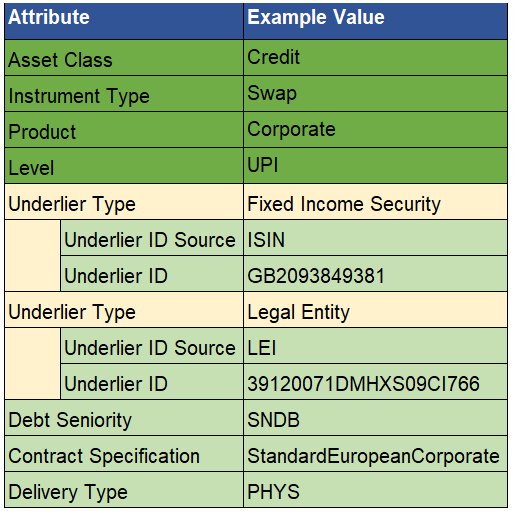
                                         

    ANNA-DSB searches the UPI database to see if a UPI already exists for a CDS matching these various inputs. If no UPI exists, the DSB will assign a new UPI and create a new record in the database for subsequent users to see.

    The DSB then responds to the query with the resulting UPI (highlighted) and additional characteristics as shown below.
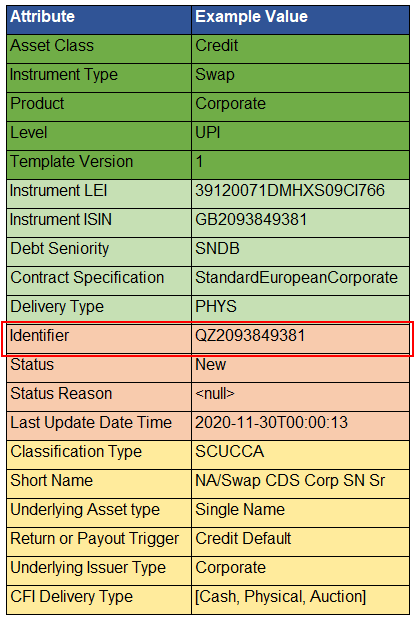
                                         

    Now whenever the firm communicates with another firm, regulator or party they can all use DSB data to know that UPI QZ2093849381 refers to a Credit Default Swap on a European corporate bond with ISIN GB2093849381, with CFI code SCUCCA and issued by LEI 39120071DMHXS09CI766.

    So similarly to the LEI where the database maintained by GLEIF means that firms can use an LEI code to ensure that they are talking about the exact same legal entity, the rationale behind UPI is that a central database of products provides clarity that firms are talking about the exact same OTC derivative product.

    FX Example

    The UPI query inputs and outputs vary based on the asset class and product type.

    If we consider Foreign Exchange then, if a firm has an FX Option in its systems and it wants to obtain the UPI for that FX Option.

    The firm submits the below query to ANNA-DSB with various inputs describing the various characteristics of the FX Option.
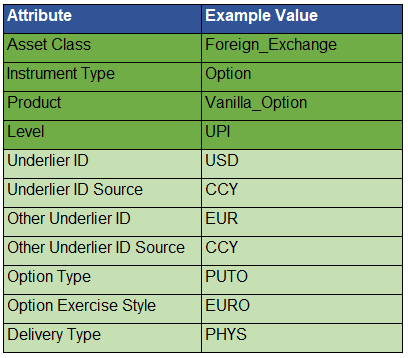
                                           

    DSB then responds to the query with the resulting UPI (highlighted) and additional characteristics as shown below.
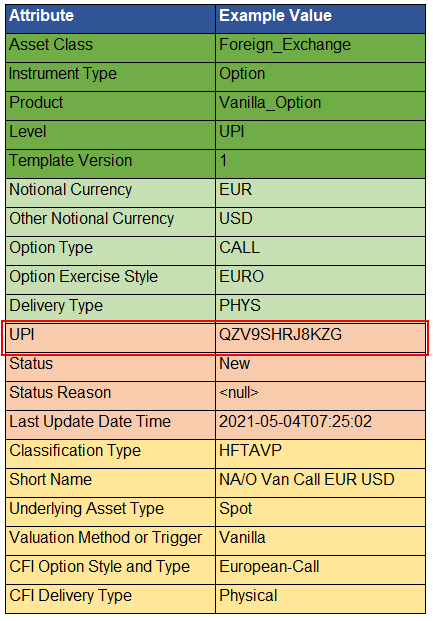
                                           

    Now all parties can use DSB data to know that UPI QZV9SHRJ8KZG refers to an FX Option on a EUR vs USD, with CFI code HFTAVP, that’s a European-style physically settled call option.

    Interest Rates Example

    Next if we look at interest rates, if a firm has a cross-currency fixed-float swap and it wants to obtain the UPI for that swap.

    The firm submits the below query to ANNA-DSB describing the rates swap.
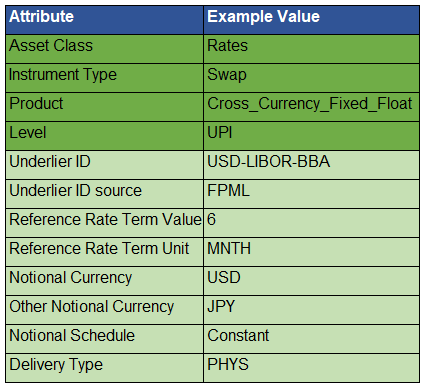
                                           

    DSB then responds to the query with the resulting UPI (highlighted) and additional characteristics as shown below.
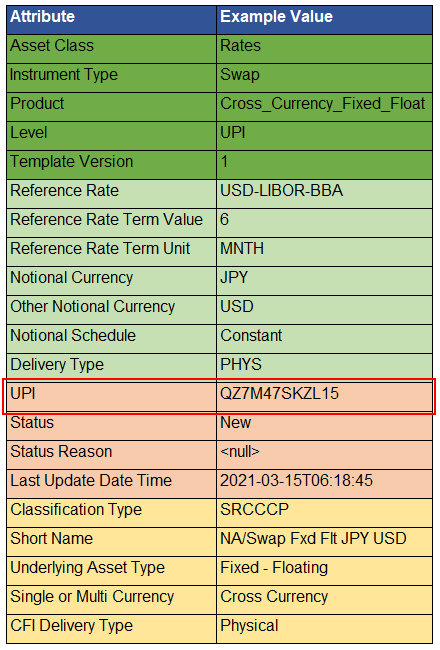
                                             

    Now all parties can use DSB data to know that UPI QZ7M47SKZL15 refers to an cross-currency fixed-float swap on USD vs JPY, with CFI code SRCCCP that’s physically settled.

    So UPI is like an ISIN then?

    UPI essentially sits between a CFI code and an ISIN in terms of how granular or specific it gets.

    The CFI code describes the basic attributes but does not get as far as underlying assets, currencies etc.

    Taking the CFI from the previous rates example, we see that SRCCCP is the CFI code for a physically settled, cross-currency, fixed-floating, rates swap.

    Diagram below generated using ISDA’s CFI Code Generator:

                     

    The UPI takes it to the next level of granularity by telling us this rates swap is also based on USD vs JPY, uses the USD-LIBOR-BBA floating rate and has a six-month period for that reference rate. So the UPI is far more specific than the CFI which just outlines the broad characteristics.

    ISIN would take it even further in terms of granularity because ISIN also tends to reference the trading venue where it traded and any venue specific characteristics such as the currency it’s traded/priced in.

    Why not just use ISIN?

    Two main reasons…

    1. The more forgiving reason is that since ISINs are often specific to the trading venues this means that using ISINs makes it more difficult to aggregate products with the same characteristics that are traded on different venues. Given the whole OTC derivative reporting framework is geared towards systemic risk, the regulators want the ability to aggregate transactions at product level, rather than venue level, when examining counterparty exposure. So UPI being venue agnostic is beneficial for this surveillance.
    2. The less forgiving answer is that outside of EMIR (EU & UK versions) no other regulators use ISINs for OTC derivatives. EU and UK reporting is therefore the outlier and much like the reporting of Exchange Traded Derivatives (ETDs) that underpins it, the use of ISINs for OTC was widely considered crazy but nonetheless made it into the rulebooks.

    So whilst ESMA and the FCA pushed ahead with ISINs for OTC derivatives the remainder of the regulators globally have patiently waited for UPI to be ready as a global solution much like the LEI.

    UPI Pay to Play

    Unlike LEIs (where the legal entity obtaining an LEI has to pay an annual fee for that LEI but the database and data is essentially free to all), ANNA-DSB will charge users for creating UPIs and accessing the UPI data in general. This is a little more controversial as UPI’s adoption across many of the OTC derivative reporting regimes amongst other use-cases means that many firms will have no alternative other to register with ANNA-DSB and pay for the privilege.

    Time will tell whether other cottage industries and resources pop up around UPI data in much the same way as you see a plethora of LEI websites and utilities whenever you search for an LEI these days. I personally hope so because ANNA-DSB needs remuneration for creating and maintaining the UPI services, that much is reasonable. But everyone having to repeatedly pay to access the same data seems a lot less reasonable in the long run.

    Similarly to the LEI rollout, we’d expect an explosion of new UPIs at the start (when the CFTC goes live with UPI in January) and another explosion when EMIR Refit follows in April next year. But that growth in new UPI population will theoretically tail off and eventually slow right down where only exotic edge-case UPIs are requested, or UPIs on newly created credit or equity underlying instruments.

    Conclusion – The Big Short rerun

    The UPI is a good concept in general and, after what seems like a very long time in the making, it is finally becoming a reality. It should help to improve clarity and consistency across the industry and for regulatory reporting in general. However we see a great deal of confusion around what UPI really means and with six months to go until the CFTC UPI go live, this is concerning. 

    If the UPI allows various regulators to aggregate similar derivative contracts together to better assess the systemic risk then that can only be a good thing. I’ll happily watch the excellent The Big Short film again but I don’t need to relive the crisis itself. There is clearly a great deal of work ahead to get UPI up and running and fully integrated across many firms and many systems.

    Tables (apart from ISDA’s) sourced from ANNA-DSB.

    • Still scratching your head over UPI?  For a conversation with Alan or one of our regulatory specialists, please get in touch. 
    • Is your firm prepared for EMIR Refit? To find out more about our EMIR Refit Toolkit, please contact us.
  • How-to Guide: SFTR repo day-count conventions

    How-to Guide: SFTR repo day-count conventions

    Day-count conventions – a land of confusion

    Anecdotal evidence from regulatory testing, reported data, questions we’re asked and the helpdesk queries we receive indicate that confusion reigns when it comes to repo market day-count conventions. This is an issue both in terms of ensuring SFTR reports are accurate but also an issue as a matchable field reconcilable at the Trade Repository (TR).

    Market craves standards and best practice

    The problems arise primarily from two factors:

    1) A tendency to report the underlying collateral bond interest accrual day-count convention instead of the correct repo interest convention.

    2) The prevalence of a large number of irrelevant conventions (in the context of SFTs) on the ESMA/FCA validation rules list of options including many bond coupon conventions and derivative interest conventions too.

    Very tellingly, the latest proposals from the Office of Financial Research in the US state that they believe the ISO 20022 definitions to be too broad and that they were going to insist on everything being reported on the US market convention Actual/360 basis.

    Until now, there simply has not been a definitive guide to which day-count conventions to use in which markets.

    Only two repo day-count conventions in regular use

    In the vast majority of cases, we foresee only two of the listed day-count conventions being relevant and correct when reporting repo transactions. While not all market participants will necessarily follow the market convention associated with the particular market in question, nevertheless, they tend to abide by Actual/360 or Actual/365. In rarer cases, we see Actual/Actual (notably in Russia). We would also expect these to be repo market specific conventions and not derivatives related ISDA ones for example. Indeed, if the SFTR reported convention is not A004 or A005 and it is a major market, the reported convention is quite probably incorrect.

    Actual/360 covers Euro, USD, JPY (international) and CHF

    In the Euro, USD, CHF and international repo markets in Japan, Canada, Australia and New Zealand, the standard convention is Actual/360 , the actual number of days interest (the numerator), divided by an assumed 360 days in a year (the denominator). This is denoted under SFTR as A004.

    Actual/365 covers Euro, USD and JPY (domestic) 

    In the UK and Japanese, Canadian, Australian and New Zealand domestic markets the convention is Act/365 Fixed, the actual number of days interest divided by 365 days in a year, regardless of leap-years. This is denoted by A005.

    Japan, Australia, New Zealand and Canada conventions differ between international and domestic. Do not be surprised to see repo trading under the international (Actual/360) convention in the repo markets in any of these jurisdictions.

    There are some smaller markets such as Brazil (that uses a business day convention) and Burundi, Ethiopia and Rwanda that use an Actual/364 convention that would need to be reported using the free-text option. This option should only be used when reporting activities in smaller, non-standard markets. The ICMA provide some guidance on the reporting of unlisted conventions in recommendation 5.17 of its recommendations for reporting under SFTR. Using this as a context for the reporting of non-standard conventions should limit instances of TR reconciliation breaks on this field too.

    NB: When referencing domestic repo markets, this relates to trades between two onshore counterparties, potentially on a domestic platform or venue, settling in the domestic location, often using a domestic interest rate, e.g. Tibor in Japan. International repo trades are typically cross-border, off-exchange (although some is now exchange traded), cleared through an  International Central Securities Depository (iCSD) such as Euroclear and executed using an internationally recognised common rate standard.

    Day-count conventions and SFTR codes per jurisdiction

    Actual/365F (A005 SFTR)

    Actual/360 (A004 SFTR)

    Actual/Actual (A006)

    UK

    US

    Russia

    Japan (domestic)

    EUR


    Australia (domestic)

    Japan (international)


    Canada (domestic)

    China


    Israel

    Switzerland


    India

    Sweden


    New Zealand (domestic)

    Denmark


    Singapore

    Norway


    South Africa

    Australia (international)


    South Korea

    New Zealand (international)


    Taiwan

    Canada (international)


    Thailand

    Turkey


    Sri Lanka

    Mexico


    Kenya

    Argentina


    Kuwait

    Algeria


    Malawi

    Angola


    Malaysia

    Bahrain


    Mauritius

    Barbados


    Pakistan

    Botswana


    Poland

    Bulgaria


    Tanzania

    Chile


    Zambia

    CFAF


    Colombia


    Congo DRC


    Czechia


    Egypt


    Hungary


    Iceland


    Indonesia


    Morocco


    Oman


    Philippines


    Qatar


    Romania


    Saudi Arabia


    UAE


    Vietnam


    WAMU


    • If you have any concerns about the quality of your firm’s SFTR reporting or require training, please contact us to discuss your requirements.
    • Many thanks to Richard Comotto for his assistance in compiling this list. 
  • Transaction Reporting How-to Guide: Personal Identifiers

    Transaction Reporting How-to Guide: Personal Identifiers

    The FCA recently released Market Watch 70 providing a reminder to firms of the importance it attaches to the transaction reports it receives.  Transaction reports are used to help them detect and investigate cases of market abuse, combat financial crime, support conduct supervision and examine market events.  For the regulator to be able to do that efficiently, reported data must be complete, accurate and sent on time.

    Despite MiFIR heading for its 5th birthday in January 2023, Kaizen’s testing is still finding a high number of personal identifier errors within transaction reporting, something also highlighted in Market Watch 70:

    • Buyer/Seller identifiers
    • Buyer/Seller decision maker identifiers
    • Investment decision within firm
    • Execution within firm

    These codes are essential to regulators for their work in detecting market abuse.  Harmonisation of the population of this field is vital for regulators attempting to identify individuals insider dealing through several trading accounts held at a number of different firms.  Regulators can only attempt to detect such activity if all the firms use the same and correct code to identify these unscrupulous types. 

    Personal Identifier Essentials

    The first thing to remember is that all personal identifiers start with the ISO two character country code of the individual’s nationality (e.g. ‘GB’, ‘US’, ‘FR’ etc.) followed by the national identifier relevant to that country.  Kosovo being the one outsider here in that it doesn’t have an official ISO-3166 code but its unofficial “XK” is now being recognised by competent authorities.

    National identifier taxonomies

    A list of the national identifier taxonomies can be found in the RTS 22 Annex.  For some countries, there is a single taxonomy; for example, for German nationals, only the ‘CONCAT’ can be used. For other countries, there are up to three taxonomies.

    In all cases you can only use the ’Priority 2’ taxonomy if the ‘Priority 1’ taxonomy is not applicable to that individual.  For example, the ‘Priority 1’ taxonomy for UK individuals is the National Insurance Number (NINO) and priority 2 is ‘CONCAT’.  So if you are identifying a British person, you should only use a ‘CONCAT’ if that person does not have a National Insurance Number.  In theory every British person over the age of 16 is issued with a National Insurance number so for the purposes of transaction reporting you should not be identifying any British person over the age of 16 with a CONCAT code.

    What is ‘CONCAT’?

    ‘CONCAT’ is the concatenation of the following four elements:

    • 2 character ISO country code (as for all personal identifiers)
    • Birth date – in the format YYYYMMDD
    • First five characters of first name (right pad with hashes if less than 5 characters)
    • First five characters of surname (removing prefixes and right pad with hashes)

    Further rules:

    • For the name elements, there is a conversion/removal of diacritic characters, apostrophes, hyphens, spaces etc using the transliteration table in ESMA’s Guidelines
    • Prefixes to surnames must be removed unless they are ‘attached’
      e.g. ‘Von der Leyen’ is ‘LEYEN’; McNeil is ‘MCNEI’ (rather than ‘NEIL#’)
    • The individual’s full name should form the basis of the CONCAT – incorrect abbreviations or nicknames must not be used (e.g. ‘JAMES’ rather than ‘JIM##’)
    • Titles (e.g. ‘Prof’, ‘Dame’ etc) should be removed
    • All UPPER CASE

    So, for example, the CONCAT code for that well known French chanteur Jacques Dutronc, born 28 April 1943, would be: FR19430428JACQUDUTRO.

    What about joint nationalities?

    • If both countries are within the EEA, use the country code of the first nationality when sorted alphabetically by its ISO 3166-1 alpha-2 code
    • If one country is within the EEA and one outside, use the EEA code
    • If both countries are outside the EEA, use the country whose ISO 3166 code is first when sorted alphabetically

    So if it’s joint German and French – use the German taxonomy as ‘DE’ comes before ‘FR’.

    For joint Swiss and French – use French taxonomy even though ‘CH’ comes before ‘FR’ (as Switzerland is outside the EEA).

    Post Brexit reporting to an EU NCA

    So post-Brexit, for the purposes of reporting to an NCA based in the EU, the UK is now outside of the EEA which impacts two things: 

    • Joint nationalities, see above
    • And, as the UK now falls into the category of “All Other Countries”, according to RTS 22 Annex II, UK individuals can no longer be identified using their National Insurance number, the passport number becomes the 1st priority identifier and CONCAT the 2nd priority identifier.

    One final pitfall – the code type

    Because these are XML fields, you need to identify the ‘code type’.  This might vary from ARM to ARM, but the standard code types are as follows:

    ‘CCPT’       – if you’re using the passport

    ‘CONCAT’   – if it is a CONCAT code

    ‘NIDN’    – for any other national identifier

    Where to go to for help

    If you are unsure about any of the reporting standards or just need a refresher, join our upcoming MiFIR core training course which will help ensure you are interpreting the MiFIR transaction reporting requirements correctly.

    Our ReportShield™ Accuracy Testing identifies all transaction reporting errors including those related to personal identifiers, providing a regular health check of all your reported data. 

    • To find out more or for a conversation with one of our regulatory specialists, please contact us.
  • Shareholding Disclosure Case Study: UK Takeover Panel

    Shareholding Disclosure Case Study: UK Takeover Panel

    How we helped a tier 1 investment bank under the scrutiny of the UK Panel on Takeovers and Mergers

    The challenge

    A tier 1 investment bank came under scrutiny after the UK Panel on Takeovers and Mergers identified that the bank was breaching the Takeover Code by submitting incorrect disclosures of its transactions/dealings. 

    The bank was told it must improve its reporting immediately or else it would face considerable sanctions. 

    How we solved it

    Through our expertise and practical experience we were able to resolve the issues faster and more cost effectively than they could have achieved internally. The bank benefited from our Shareholding Disclosure Service through our hands-on assistance with its internal data, as well as a ready-made process and system which resolved its regulatory issues.

    The bank is now able to make accurate and timely disclosures and the Takeover Panel has taken no further action.

    Read the full case study

  • Shareholding Disclosure Case Study: Global Asset Management Firm

    Shareholding Disclosure Case Study: Global Asset Management Firm

    How we helped a global asset management firm under the scrutiny of its internal audit department

    The challenge

    The internal audit department of a global asset management firm identified considerable inefficiencies in its Compliance Department’s disclosure processes, including an ageing internal system, lack of country coverage and an absence of understanding of the rules.

    How we solved it

    We applied our in-house experience and expertise in shareholding rules to conduct a review and analysis which found a number of monitoring and reporting deficiencies.

    Our experts worked closely with the client to rectify the reporting failures, resulting in the avoidance of any regulatory censure. We also put in place a robust process for future compliance with global shareholding rules.

    Read the full case study

  • Transaction Reporting How-to Guide: ‘Venue’ Field

    Transaction Reporting How-to Guide: ‘Venue’ Field

    On the face of it, the ‘Venue’ field in transaction reporting seems to be fairly straightforward – as the RTS states, it is simply the “identification of the venue where the transaction was executed.” Unfortunately, it is not quite as simple as it first seems and we detect a large number of errors with this field in our ReportShield™ Accuracy Testing.

    Why is the ‘Venue’ field so important?

    Every field is important to the regulators and Article 26 of MiFIR demands complete and accurate reporting. However, accurate population of the Venue field is particularly important for firms due to the impact it has on the population of associated fields. If it is populated incorrectly, it could result in a ‘CON 412’ error from the regulator and your report will be rejected.  It also impacts how ‘TVTIC’, ‘Trading date time’, ‘Country of branch membership’ and fields 41-56 need to be populated. So it is essential that you fully understand the intricacies of this field and don’t fall into any of the following traps.

    ‘Segment’ versus ‘Operating’ level MICs

    The Market Identifier Code (‘MIC’) used to be a straightforward standard – you had one exchange and one four character code to identify it. For example, ‘XLON’ was the sole identifier for the London Stock Exchange. However, this was far too easy and exchanges are increasingly moving to a segment level structure resulting in a MIC for each segment. For example, the London Stock Exchange has ‘XLON’ as its ‘operational level’ MIC, but also has the following ‘segment level’ MICs:

    • AIMX – London Stock Exchange, AIM MTF
    • XLOD – London Stock Exchange, Curve Global Markets
    • XLOM – London Stock Exchange, MTF,
    • XLON – London Stock Exchange

    Golden Rules:

    1. Use the segment level MIC for transactions executed on a trading venue, systematic internaliser or non-EEA trading platform.
    2. Only use the operational level MIC where the segment level MIC does not exist.

    This is so important because if you used the operational level MIC by mistake, it will sail through ARM validation, but will probably result in a CON 412 error from the regulator. This is because the ISIN you have used in field 41 doesn’t only have to be on FIRDS on the trading date – it also has to be with the correct segment level MIC. So if you have traded an AIM stock, populated the ISIN correctly but have populated the Venue field with ‘XLON’ rather than ‘AIMX’, it will be rejected.

    The ‘XOFF’ versus ‘XXXX’ conundrum

    Another common error made by firms is in the use of ‘XOFF’ instead of ‘XXXX’ and vice versa. This is understandable as they sound similar and are both used for off market trades. In an effort to be precise, some of the language in the RTS can also appear confusing. It is absolutely essential that you understand the difference between the two as it can have a major impact on whether you need to populate the instrument identifier.

    Golden Rules:

    1. Use ‘XOFF’ for instruments that are tradeable on an EEA trading venue but where the trade has been made off market (i.e. not executed on a trading venue, SI or non-EEA platform).
    2. Use ‘XXXX’ for instruments that are not tradeable on an EEA trading venue and are traded off market (i.e. not traded on a non-EEA platform).

    Exchange MIC or ‘XOFF’/’XXXX’

    Another thorny issue we’ve discovered is the use of an exchange MIC when the trade was actually made off market. The Venue field should only be populated with the exchange MIC if the transaction was executed on a Trading Venue. Section 5.4 in the ESMA Guidelines document is a little complicated, but the key statement is “Where an Investment Firm is not the direct market facing entity the Investment Firm is not regarded as executing on the Trading Venue for the purposes of transaction reporting.” So if you are making a transaction against a broker and that broker makes a trade on the London Stock Exchange to facilitate the trade, you should populate the venue field with ‘XOFF’ rather than ‘XLON’ as you are not the direct market facing entity.

    How we help

    Firstly, if you are unsure about any of the reporting standards, or just need a refresher, we would heartily recommend our core training course which will help ensure you are interpreting the MiFIR transaction reporting details correctly.

    If you have any doubt about whether you have been reporting correctly, this is what our Accuracy Testing is designed for. We can take all the transaction reports you have submitted over any given period and apply multiple tests for each data field that comprises a report. As many firms have discovered to their cost, there is no point hoping for the best when it comes to reporting. You need to have total confidence that your reporting is complete and accurate to avoid costly remediation and regulatory scrutiny. 

    • Please contact us for further details on our quality assurance, reconciliation, governance and training services.
  • White Paper – Brexit can damage your MiFIR transaction reporting and EMIR trade reporting

    White Paper – Brexit can damage your MiFIR transaction reporting and EMIR trade reporting

    UPDATED – 19 February 2019

    As we get closer to the withdrawal date, we have seen a flurry of statements from ESMA and the FCA on the impact of a hard Brexit on MiFIR and EMIR reporting obligations. As a result, we have revised our Brexit White Paper to take account of the recent statements.

    One of the most interesting developments was the statement from ESMA that EMIR trades and positions submitted to an EU trade repository by a UK counterparty would not need to be modified or updated post 29 March. The onus will be on the trade repositories to terminate these reports in the event of a hard Brexit. Before UK firms start celebrating, it should also be noted that these trades and positions could be ported to the newly established UK trade repositories and it is expected that firms will have to update and modify these trades as per usual. In effect, it is quite a seamless solution for firms and regulators alike. 

    As we’ve all discovered, Brexit is a fantastic opportunity to upset friends and family by sharing our expert views on the subject.

    Unfortunately, it will also have a profound effect on MiFIR transaction reporting and EMIR trade reporting.

    If there weren’t enough things to consider, we need to assess the impact it could have on branches, delegated reporting, outstanding trades, reportable instruments and personal data standards, just to name a few.

    Whilst it is tempting to bury our heads and wait for it all to blow over, the sad fact is that the impact on reporting could be brutal.

    We recommend that you put on your tin hats, batten down the hatches and prepare for a bumpy ride. What better way to start than reading our revised White Paper on the potential impact Brexit could have on your reporting?