Tag: Shareholding Disclosure

Discover all of Kaizen Reporting’s SDS resources. Learn more about global regulatory reporting from our team of specialists, covering FCA, ESMA and SEC.

  • This Valentine’s Day, the SEC is sending very little love to 13D Filers …

    This Valentine’s Day, the SEC is sending very little love to 13D Filers …

    Instead, for 2024 the language of love comes in the shape of accelerated deadlines, expanded derivative inclusion and data formatting obligations, in some big changes for beneficial ownership in the US, fit for a machine’s eyes only.

    February deadlines 

    February will stage the first phase of the amendments to Sections 13(d) and 13(g) of the Securities Exchange Act of 1934 (The Exchange Act) by halving the initial reporting deadline to five business days for Schedule 13D filers and two business days to file any amendments. As the reduced deadline is effective from 5 February, the new rules for disclosures mean investors have until 12 February for their initial filings to reach the SEC and any amendments to these submissions to be filed by 14 February. This will result in visibility and transparency of beneficial ownership much sooner to the market than was previously the case.

    Cash settled derivatives added to 13D reporting

    A more complex addition to 13D reporting is the US expansion of the inclusion of cash settled derivatives. Although it is largely understood that derivatives settled exclusively in cash indicate a pure economic interest, our experience is that this isn’t always how and why these derivatives are held. The SEC has now put greater emphasis and clarity on certain circumstances which could result in a holder having voting / investment power or deemed to be a beneficial owner. We therefore urge investors to carefully consider the terms of their derivative contracts to ensure these are not inadvertently subject to the disclosure requirements under the Rule 13d-3.

    Furthermore, 13D filers are now burdened with the task of including cash settled interests within item 6 of Schedule 13D. Here, the requirement to notify “any contracts, arrangements, understandings or relationships with respect to any securities of the issuer,” will now extend to including information concerning cash settled interests and disclosable on a Schedule 13D.

    XML from December 2024

    The amendments impose structured data requirements on those investors who would have typically utilised the more basic platforms for filing reports for Schedule 13D. These will no longer be adequate as the SEC leads investors towards its approved structured, machine-readable XML-based language, effective from December 2024.  Within this short timeframe, investors and Schedule 13D filers will need to undertake technical development and resource given that the XML process requires experience in producing, translating, and generating XML to be consumed correctly.

    Our Shareholding Disclosure system not only has this XML expertise, but it can fully automate the conversion of 13D disclosure information from its standard form into the language readily available for EDGAR consumption, saving you time and the risk of incorrectly filing with the SEC.

    Managing expanded ownership requirements

    These changes demonstrate the SEC’s continuous focus on the transparency of beneficial ownership. They also show the importance of the markets and investors having accessibility to, and visibility of the ownership of shares, and the promptness of this relevant and material information in what is a very fast paced market. 

    With this focus in mind, let’s not forget the changes implemented for those 13G filers scheduled for later this year as a result of the amendments to Sections 13(d) and 13(g) of the Securities Exchange Act of 1934, and Rule 13f-2 which introduces a gross short position regime, causing significant changes to disclosure obligations for investment managers in early 2025.

    Put simply, these adoptions magnify the need for an accurate automated reporting tool to capture these expanded ownership requirements and generate an auto-populated disclosure form within the new tighter deadlines. Kaizen’s platform deals with all these issues, supported by subject matter experts like myself, who have a background in filing global disclosures on behalf of tier one financial institutions. 

    • For more background to the changes, please visit the SEC’s website.
    • To learn more about Kaizen’s Shareholding Disclosure system and service, please get in touch. 


  • What took so Elon-g?

    What took so Elon-g?

    A breakdown of Twitter shareholding lawsuit

    Elon Musk is being sued due to his delayed shareholding disclosure of a large stake in Twitter from March 2022.  Under US law, anyone who acquires more than 5% of a class of voting equity securities must disclose their holdings to the SEC within ten calendar days, Musk failed to do this and only disclosed 21 days after acquiring the disclosable amount, taking more than double the length of time required by law. 

    Twitter share price jump

    Once Musk announced his 9.2% stake, the share price jumped 27% from US$39.31 to $49.97.  This indicated two things about the 11 days preceding Musk’s eventual disclosure:

    • Musk was able to continue to buy shares at a lower share price, amassing his stake for a cheaper price. It has been estimated that he saved approximately $200 million as a result of this
    • Anyone selling shares during this time would have sold them for below their true value.

    Earlier this week Musk asked a US judge to throw out the lawsuit, denying that this was a deliberate attempt to defraud.  The case is still ongoing.

    What the Elon Musk case tells us about shareholding disclosures

    We can see from this example why disclosing on time is important, however shareholding disclosures are important for many other reasons. They provide transparency to the market, the issuer, and the relevant regulator, about positions and voting rights that are being accumulated. 

    These regulations have a common purpose but differ greatly across the world.  In the US, shareholders are to calculate exposure through shares and some physically settled derivatives of the same class (excluding put options and anything that isn’t exercisable within the next 60 days) and report anything above 5% within ten calendar days.  This is a longer time frame than many other countries such as Hong Kong, Japan, China and most European, where the reporting deadline is normally between two-five business days.  These countries also include cash-settled derivatives in their holding calculations, something that was brought about after the Volkswagen short squeeze in 2008. The SEC has made some proposals to bring the US requirements in line with those of its international peers including shortening the disclosure deadline to five days and the inclusion of cash-settled derivatives.  These proposals are currently under consideration following the public comment period.

    Better monitoring for Musk

    Musk has made it known that he has fulfilled these obligations in the past for other issuers, including Tesla Inc, on multiple occasions, and is claiming this late filing was ‘inadvertent’.  If this is the case, we can only suggest that Musk puts better monitoring in place to prevent this from happening again in the future.

    At Kaizen our fully automated, customisable solution will calculate your holdings under each jurisdiction, allowing for increased efficiency and accuracy. Our service processes your position and trade data and alerts you to your disclosure obligations. We also provide the option to export your disclosable holding on to the relevant regulators forms. Using our solution means that you save time and remove the risk of human error and late reporting.

    Did you know there are over 100 countries globally that have a form of Substantial Shareholding Disclosure requirements?  We cover those too.

    • For a demo of our Shareholding Disclosure Service, or for a conversation with Sam or one of our regulatory specialists, please contact us.
  • Join us at the Asset Management Derivatives Forum 2023 in California

    Join us at the Asset Management Derivatives Forum 2023 in California

    Join the Kaizen team in person at the eighth Asset Management Derivatives Forum, hosted by FIA and SIFMA in California on 8-10 February 2023. The conference will take place at The Ritz-Carlton, Laguna Niguel in Dana Point, California and offers a comprehensive review of the most critical derivatives issues across a series of panel discussions, keynote addresses and roundtables.

    We look forward to seeing you there.

    Register here

  • UK Takeover Panel change: Miscellaneous Code Amendments

    UK Takeover Panel change: Miscellaneous Code Amendments

    The UK Takeover Panel released its response Statement on Miscellaneous Code Amendments on 5 May 2022.  From a shareholding disclosure perspective, the main change is the exclusion of custody and depository positions, which will take effect on 13 June 2022.

    “A custodian or depository acting in the normal course of its business will not be treated as having an interest in the securities it holds as a result of that activity” Source: RS 2021/1, 5 May 2022 published by The Takeover Panel. 

    Complex Reporting

    UK Takeover Code Rule 8 is complex to comply with; especially if your business is connected to a Takeover deal or has a structure including both investment banking and asset management activity. 

    Understanding which disclosure form applies to a specific deal and trading activity is complicated, due to the many factors affecting which disclosure form you should be using for your disclosure submission. These include:

    • Are you connected to the deal?
    • What business type is holding the position?
    • Was it a proprietary trade?
    • Do you have recognised intermediary status?
    • Is the trade for a discretionary or non-discretionary client?
    • Do you have EPT status?
    • Do you have EFM status?

    Source:  UK Takeover Panel Website

    In addition, the submission deadlines themselves are difficult to comply with, especially if you are utilising a manual process. If you are connected to a deal you must disclose by no later than 12pm on the following business day, otherwise the deadline is 3:30pm.

    Automate your position and trade data

    Kaizen has a fully automated solution that will remove the decision making process for you, allowing for increased efficiency and accuracy. Our service processes your position and trade data and alerts you to your disclosure obligation in the format of the relevant Takeover Panel form. This means that you are ready to disclose first thing in the morning; simply click on “generate disclosure” and away you go! 

    Using our solution means that you save time and remove the risk of human error and late reporting.

    Did you know there are over 20 countries globally that have a form of Takeover Reporting requirement?  We cover those too. 

    • For a conversation with Lucy or one of our regulatory specialists about the topics mentioned above, please contact us.
  • Kaizen’s Angie Huff selected for Women in FinTech Powerlist 2021

    Kaizen’s Angie Huff selected for Women in FinTech Powerlist 2021

    London, 15 March 2022 – Leading regulatory technology firm, Kaizen Reporting today announced that its Regulatory Advisory Director, Angie Huff has been selected for Innovate Finance’s Women in FinTech Powerlist 2021 under the Policymakers & Regulatory Experts category. A panel of independent industry judges chose the top 250 women across nine categories from thousands of entries.

    The Women in FinTech Powerlist 2021 focuses on the women leading innovation in financial services. Now in its 7th year, the Powerlist has increasingly attracted a global audience, resulting in applications and nominations from around the world.

    Angie said, “It is an honour to have been included in Innovate Finance’s Women in FinTech Powerlist 2021 alongside so many inspiring women. Thank you to Innovate Finance and to the judges for shining a spotlight on the contribution of women in this important sector and for showing that we are really making a difference to the industry at large.”

    Parveen Dhanda, Ecosystem Director, Innovate Finance said, “What a privilege and honour it was to read such phenomenal stories from across the globe on the achievements of women in FinTech. The women in this powerlist have not only demonstrated how they have contributed above and beyond their role but have also gone beyond supporting diversity and inclusion in their workplace and the wider ecosystem. What surprised me about the applications was that there were so many firsts. ‘I was the first female on a board/first female in the executive team/first female on the tech team’. Today is a great celebration yet we still have a long way to go so the narrative changes from ‘I was the first female’.”

    Angie is a pioneer in regulatory technology, leaving her director role at a tier 1 bank in 2013 to become an entrepreneur and develop a system solution to solve the challenge of shareholding disclosure monitoring and reporting. Angie designed and built a system to address all the challenges she had faced during her career in shareholding disclosures at four tier 1 banks. The service was acquired by Kaizen Reporting in 2020 and Angie continues to spearhead it, aiming to further improve it for clients and expand globally.  

    In 2007 Angie also advised on the design of the aosphere Rulefinder shareholding disclosure product from global law firm Allen and Overy.

  • SEC proposes new short position reporting disclosure

    SEC proposes new short position reporting disclosure

    As we have seen, shareholding disclosures are already off to a busy start in 2022 and here we go again!  The US Securities Exchange Commission (SEC) has released another disclosure proposal, however this is not an amendment to an existing disclosure rule. This time it is for a new short position reporting rule; Exchange Act Rule 13f-2 and amendments to regulations SHO and CAT to increase market transparency regarding short selling.

    More transparency to short-selling

    On 25 February 2022 the SEC unanimously voted to propose rules and amendments to broaden the scope of short sale-related data available to the investing public and to regulators.  After the 2008 financial crisis, Congress directed the SEC to bring more transparency to short selling. The proposed changes are a response to Congress’s mandate under Section 13f-2 of the Securities Exchange Act, added under Section 929X of the Dodd-Frank Wall Street Reform and Consumer Protection Act, to make certain short sale data publicly available. The SEC states that the proposed rule will help them address future market events, striking a balance between the need for transparency and the price discovery process. This new data will supplement the short sale data that is currently publicly available from FINRA and stock exchanges.

    As we saw with the proposed changes to 13D and 13G beneficial ownership reporting, again the US is not going as far as the EU, UK and certain Asian jurisdictions, which have daily short selling position reporting obligations with thresholds as low as -0.1%. 

    What is proposed?

    Proposed Rule 13f-2 would require institutional investment managers exercising investment discretion over short positions to file the confidential Proposed Form ‘SHO’ with the SEC via EDGAR. The requirement would be to do this within 14 calendar days after the end of each calendar month, with regard to each equity security and all accounts over which the manager meets or exceeds either of the following thresholds:

    1. For any equity security of an issuer in which the manager meets or exceeds either:
      • a gross short position in the equity security with a US dollar value of $10 million or more at the close of any settlement date during the calendar month, or
      • a monthly average gross short position as a percentage of shares outstanding in the equity security of 2.5 percent or more; or
    2. For any equity security of an issuer that is not a reporting company issuer as described above in which the manager meets or exceeds a gross short position in the equity security with a US dollar value of $500,000 or more at the close of any settlement date during the calendar month.

    What detail would they report?

    • the name of the eligible security
    • end of month gross short position information
    • daily trading activity that affects a manager’s reported gross short position for each settlement date during the calendar month reporting period.

    The SEC would aggregate the data by security, maintaining the confidentiality of the reporting managers, and publicly disseminate the data to all investors. 

    What is EDGAR?

    EDGAR is the SEC’s Electronic Data Gathering, Analysis, and Retrieval system.  It is their primary system for submitting documents under the Securities Act of 1933, the Securities Exchange Act of 1934, the Trust Indenture Act of 1939, and the Investment Company Act of 1940. 

    When does the consultation close?

    In light of Proposed Rule 13f-2, the SEC reopened the comment period for Proposed Exchange Act Rule 10c-1. Comments should be received on or before 30 days after publication in the Federal Register or 26 April 2022 (which is 60 days after issuance), whichever is later. 

    How can Kaizen help?

    Kaizen will be closely monitoring these proposals and ensuring our shareholding disclosure monitoring and reporting system is ready for this new reporting regime immediately upon implementation. 


    • To read more on the proposal, visit the SEC website
    • To discuss the proposed new rule with one of our regulatory specialists or for a demo of our system, please contact us.
     
  • Shareholding Disclosure: What’s the issue with Issuer Requests?

    Shareholding Disclosure: What’s the issue with Issuer Requests?

    Issuer Requests can be a nuisance for those of us working in shareholding disclosures.  Large financial institutions can receive more than 50 of these notices a week.  At least this was my experience when I was responsible for shareholding disclosure monitoring and reporting at UBS and Morgan Stanley.

    Earlier this month, the FSA of the Isle of Man issued a consultation paper on sanctions for non-compliance with the Beneficial Ownership Act.  Although the Isle of Man has no legal requirements for investors to disclose substantial shareholdings (in Isle of Man incorporated companies), the FSA do require compliance with what is referred to more broadly as an “Issuer Request”.

    What is an Issuer Request?

    In some jurisdictions, a legal obligation exists for an ultimate beneficial owner to provide details of their shareholdings (and on occasions including details of ‘other’ interested parties). This request can be made in the form of a letter by the Issuer itself or an investor relations representative.  The aim of these requests is to provide the issuer with transparency of their shareholders on request, without having crossed a particular threshold. 

    What is challenging about them?

    The calculation basis for an Issuer Request can be entirely different to that of a substantial shareholding (also referred to as beneficial ownership, major shareholding, or long) disclosure.  In many jurisdictions there is little to no direction on exactly which financial instruments are included, what type of holdings are included, whether netting instruments is allowed and if the percentage is based on a notional number or votes held etc. 

    There is also the serious risk of reporting sensitive or client confidential information where there is no obligation to respond; several investor relations companies send out requests for information where there is no legal requirement.  If you are including positions held by your clients in any external disclosure, it is critical that you know if you are legally required to provide the information, otherwise you could be breaching contractual agreements.

    Where are the most frequent requests from?

    The most prevalent requests are the UK Section 793 Companies Act and Australian Section 672 Corporations Act notices.  In addition to volumes, many internally-built disclosures systems do not include the functionality to automate a response to these notices.  

    What is the Isle of Man FSA proposing?

    The Isle of Man FSA intends to broaden the scope of contraventions and offences for which a civil penalty can be considered (Draft Beneficial Ownership (Civil Penalties) Regulations 2022), including those where currently only criminal sanctions are available. 

    Within their consultation paper the FSA note that the topic of beneficial ownership is attracting increasing scrutiny from international parties.  It is expected that we will see more jurisdictions increasing disclosure obligations and the sanctions imposed, as this focus increases.   Aosphere (the leading providers of shareholding disclosure rules and used as part of the Kaizen Shareholding Disclosure Service) noted that in a 12 month period last year, 15 jurisdictions published 68 sanctions, not including all those private fines that are administered.

    Take the pain away from Issuer Requests

    Our regulatory subject matter experts can provide a suggested calculation methodology addressing all the grey areas highlighted above which is then teamed with our simple-to-use automated shareholding disclosure interface. 

    All you need to do is select the legal obligation on the platform and provide the issuer’s identifier and hey presto! just like magic, you have a response created for you. 

    Further features:

    • We can upload your own preferred template response letter or provide connections to investor relations portals.
    • Select an investor relations company from the platform’s drop down which includes their details into the response, reducing that manual effort and reducing time spent on these requests to a nominal amount, giving you confidence in the response itself and increasing efficiency.
    • Built in functionality that only allows responses to permitted requests to be created.  This will remove the risk of responding to requests where no legal requirement exists, eliminating the risk of confidential client information being incorrectly disclosed.
    • Our flexible rules configuration engine allows your own legal or in-house interpretation of the calculation methodology.


    Because we designed the system from our own in house experiences, we know the importance of tailoring the configuration of the rules to your requirements.  This is what makes our system work so well for our clients.


    • If you would like to hear more or have a demonstration of this feature, please get in touch.
    • Additionally, if you would like more information on the consultation mentioned above, please contact us (feedback has been requested by 28 February 2022).
  • SEC proposes significant amendments to beneficial ownership reporting

    SEC proposes significant amendments to beneficial ownership reporting

    The US Securities and Exchange Commission (SEC) has proposed significant changes to beneficial ownership reporting (Schedule 13D & 13G reporting).  These shareholding disclosure rules have not changed since the 1970s so the proposals are long overdue and something to be welcomed.

    What’s the background?

    Looking back, there may have been hints that the SEC was looking to review the 13d and 13g reporting requirements. In March 2021, the non-profit organisation ‘Americans for Financial Reform’ wrote to Allison Herren Lee, the acting chair of the SEC, urging for change to one of the US regimes, 13F. US reporting has long faced criticism for its lengthy deadlines and simplistic view on the inclusion of certain financial instruments. This has resulted in reports that are of little value to issuers or the market at large – and seemingly the SEC themselves: in their Review of the SEC’s Section 13(f)’s Reporting Requirements in August 2021, the regulator confessed that “…no SEC division or office conducts any regular or systematic review of the data filed on Form 13F”.

    They are now ready to address similar issues with Schedule 13D and 13G reporting, stating that changes in financial markets and technology now require them to reassess and modernise their reporting.

    What are the new SEC reporting requirements?

    The SEC has proposed expanding Schedule 13D & 13G reporting to include certain cash-settled derivatives.  This will bring the US more in line with European and some Asia-based regimes, which have included cash-settled derivatives for a number of years.  Holders of cash-settled derivatives, with the exception of an equity swap, will be deemed to be the beneficial owner of the underlying equity securities.

    The new Schedue 13G reporting requirements (ie. qualified institutional investors and exempt investors), would shorten the initial filing deadline from 45 days after year-end to five business days after the end of the month in which the investor beneficially owns more than five per cent.  In addition, the new SEC 13D reporting requirements would shorten the initial filing deadline from 10 days to five days for 13D reporting and any amendments to the holding would need to be filed within one business day.

    The proposals include beneficial owners reporting using a structured, machine-readable data language, which the SEC believes will make compiling and analysing the information disclosed on the 13D and 13G reports easier.

    The consultation period is open for 60 days following publication of the proposed change on the SEC’s website or 30 days following publication of the proposing release in the Federal Register, whichever period is longer.

    What is Schedule 13D and Schedule 13G reporting?

    This is a shareholding disclosure obligation that requires that an investor who beneficially owns more than five per cent of a covered class of equity securities to publicly file either a 13D or a 13G form.

    13D is intended to provide transparency to the market about shareholders and their intentions for taking a significant stake in an issuer.  A 13G disclosure is a shorter version of the 13D and can be filed in lieu of a 13D if certain exemptions apply to the beneficial owner.

    Automated beneficial ownership reporting

    Kaizen continuously monitors and implements all changes to global shareholding disclosure including beneficial ownership rules, so that our service and technology platform are primed and ready to go with alerts and automated reports, ensuring your compliance from day one of the change.  In addition, our team of shareholding disclosure subject matter experts work with our clients to help them understand the requirements and the subsequent amendments to regulation.

  • What’s coming up next in shareholding disclosure?

    What’s coming up next in shareholding disclosure?

    One of our Shareholding Disclosure Service’s main points of difference is the regulatory expertise that develops and supports the system. We are delighted to welcome Senior Regulatory Reporting Specialist Michelle Rowe who recently joined Kaizen’s Shareholding Disclosure Team from a tier 1 investment bank. 

    We caught up with her to find out about the latest in the shareholding disclosure space, and more about her background and career to date. 

    What developments are we seeing in the world of shareholding disclosure?

    We have seen a noticeable increase, since the COVID-19 global pandemic, in foreign investment restrictions and increased short selling position reporting. We are seeing this continuing into 2022; in the UK we have the introduction of the National Security and Investment Act (NSIA), in France there are restrictions in ownership of the renewable energy industry, and reforms in Australia regarding foreign direct investment (FDI). I believe we will continue to see these type of sensitive industry and foreign ownership reporting and pre-approval regulatory changes as the global economy strives to recover from the effects of the pandemic.

    What makes shareholding disclosure so challenging?

    The world of shareholding disclosures is a highly complex, pressured, challenging and at times a very stressful environment to work in, particularly when things go wrong. Things can be turned upside down very quickly when a disclosure is missed, incorrectly filed, or even triggered in unfamiliar territory. Trying to build monitoring systems in-house has been a considerable challenge – I have been a part of such projects. When you are trying to do this as a side project to your day-to-day role of complying with shareholding disclosure rules, it’s almost impossible and projects often fail.

    I am excited to be working for a firm that has an impressive existing disclosure system, which even those key players within the banking sector struggle to achieve. Kaizen Reporting has a true depth of knowledge which is invaluable in this space.

    Tell us a bit about your background…

    It all started from completing a law degree and the drive to initially practice law. Completing my Legal Practice Course (LPC) at London’s Inns of Court helped steer me into the world of compliance, soon realising that I was much more focused on the corporate side of law and the regulations governing the business and financial sectors. Shortly after the completion of my LPC, I was lucky enough to land a position within compliance at tier 1 investment bank, Morgan Stanley. This was a fantastic learning experience and I started my career in shareholding disclosures there. I then went on to work at two other top tier investment banks, Barclays and Deutsche Bank.

    Why did you join Kaizen?

    The thought of moving away from my career of 14 years in investment banking compliance wasn’t an easy decision, but I very quickly knew it was the right one. This year I decided to seize the opportunity to work for Kaizen; I was excited to put all my in-house experience into making a difference and being able to share that experience with a large client base.

    For me, Kaizen’s experienced team and its vision of continuous improvement was the main driver – to always change, evolve and improve.

    It is exciting to be part of something which doesn’t want to simply provide a ‘tick box IT solution’, but one which wants to create a timeless solution for all types of clients, to interpret and automate its way past those never ending ‘grey’ areas. We want to have a positive effect on those shareholders who want to expand into new jurisdictions, new products, new business strategies, knowing that they will be fully compliant with the shareholding disclosure rules.

  • WATCH: An Introduction to Kaizen Reporting

    WATCH: An Introduction to Kaizen Reporting

    Watch Kaizen’s CEO Dario Crispini explain what led him to set up Kaizen Reporting, what makes our quality assurance services unique, and how we are helping financial firms achieve accurate and complete reporting.

  • WATCH: Why Shareholding Disclosures matter to your firm

    WATCH: Why Shareholding Disclosures matter to your firm

    Kaizen’s Regulatory Advisory Director Angie Huff and aosphere’s Fiona O’Shea are joined by BlackRock’s Samantha Withers to cover the complexities of shareholding disclosure and what you need to be doing to comply with the latest rules and regulations.

    Topics they cover include:

    • What are shareholding disclosures?
    • If I am a UK company do rules in other jurisdictions apply to me?
    • Why are these rules so complex?
    • If we have multiple legal entities do we disclose each position separately?
    • What are the sanctions if we do not comply?
    • Has Brexit changed the UK regime? What do I need to do?


  • Short position reporting enforcement by the UK’s FCA

    Short position reporting enforcement by the UK’s FCA

    The UK’s Financial Conduct Authority (FCA) has taken its first enforcement action for a breach of the Short Selling Regulation (SSR) which require holders of short positions to disclose to the FCA and the issuer. The FCA fined a Hong Kong based hedge fund, £873,118 for their failure to disclose their short positions in Premier Oil plc, a UK incorporated and listed company. Premier Oil announced its proposed merger with Chrysaor Holdings Limited on 6 October after a reduction in its share price since 2017.

    The hedge fund said it hadn’t realised it had built up a short position of 16.9% of the issued share capital of Premier Oil and reported it as soon as it was aware. In total the hedge fund had missed 155 mandatory net short position disclosure filings.

    The FCA reduced the fine by 30% for good behaviour during the investigation. The FCA told Securities Lending Times, “That makes this a substantial fine, given there was no profit, which reflects how seriously we take this type of misconduct.”

    Short selling position disclosure obligations

    The obligation to report short positions began in 2008 as a result of the financial crisis. Since then, more countries have implemented short position reporting.  This was introduced to identify those building short positions which could damage the stability of the financial markets. In comparison to other shareholding reporting obligations, the thresholds for short position reporting are very low.  Across Europe, the reporting threshold begins at -0.2%, however as a result of COVID-19, ESMA issued a decision in March this year lowering the reporting threshold to 0.1%.  Other changes are afoot for the UK reporting regime as it leaves the EU on completion of the Brexit transition period on 31 December 2020.

    How could the hedge fund not be aware of such a substantial short position?

    It may seem strange that the hedge fund was not aware it had built up such a large short position of 16.9%.  However this IS possible, as those responsible for reporting are often part of Compliance or Operations functions of financial organisations and therefore are not aware of the investment decisions made by traders or fund managers, unless they have access to an automated system that calculates positions in the many different ways that are required by each reporting regime and in each different jurisdiction.

    Those responsible for reporting require knowledge of the myriad of global shareholding disclosure rules and subsequent changes to those rules.  Managing shareholding disclosure obligations is not an easy task; I know because I have managed it for some the largest global financial institutions.

    How important is it to understand and comply with these regimes?

    The complexity of these disclosures is often misunderstood as purely being a case of monitoring thresholds.  When in fact each shareholding disclosure requirement, whether it be the major shareholding* obligations or the short selling disclosures, all require different derivatives to be included, different netting to apply, different aggregation methodology and different exemptions. Even within the EU short position reporting regime, there are netting differences applied to those who hold a position as a fund manager compared to those on the trading desk of an investment bank.

    Mark Steward, the FCA’s executive director of enforcement and market oversight, highlighted the importance of compliance with these shareholding disclosure regimes when he said, “Failure to report disclosable short positions undermines the integrity and efficiency of financial markets”.

    This fine clearly marks the importance of monitoring global shareholding rules and the dangers of not doing so. 

    Kaizen can offer peace of mind with our easy-to-use platform and hosted customised rules engine incorporating aosphere LLP’s (an affiliate of Allen & Overy LLP) shareholding disclosure rules library as a basis for the service.  The system further enhances and interprets this with our regulatory expertise, alerting you of your reporting obligations so you do not miss these critical filing deadlines.

    *also referred to as substantial or long reporting.

    • Find out more about our automated Shareholding Disclosure System and watch our video here or for a conversation with Angie, please contact us.


  • Why mandatory shareholding disclosures matter to your firm

    Why mandatory shareholding disclosures matter to your firm

    In a previous blog we provided a summary of what shareholding disclosures are; now we will explain why these matter to your firm.  The “in a nutshell” answer is sanctions!  Having worked in the financial industry managing this process myself I have seen the pain that firms suffer with sanctions for incorrect or late disclosure filings, where they not only have a regulator breathing down their neck but all the attention of senior management who want to know what/where/why and who’s head will roll. 

    Sanctions in the shareholding disclosure world are often a result of simple human error, a manual process, or a lack of resource or a combination of all three!  In such a complex world, where so many things can go wrong, there are some very serious sanctions.  Across Europe the Amended Transparency Directive suggested non-compliance should result in fines of up to 10m euros or 5% of annual turnover, suspension of voting rights and public statements.  There are even more serious sanctions, for example, in Switzerland, Vietnam, Hong Kong, Belgium, Israel, and Japan where non-compliance is a criminal offence.


    Why is this significant? 

    Being publicly sanctioned can cause significant reputational damage to your firm and this is something that many financial institutions try hard to avoid.  Whilst there are some significant fines that have been reported in the media for breaches of shareholding rules many sanctions occur behind closed doors, therefore the real number of those who have been subject to penalties is not in the public domain. 

    In my 13 years working in Compliance within the financial industry I have dealt with a number of regulators regarding sanctions, I have fought against the removal of a Head of the Compliance department’s passport by the Vietnamese regulator, have been interviewed by investigators and lawyers and have been in the uncomfortable position of reporting on these censures to Boards of Directors. These sanctions are not uncommon across the financial industry; I have spoken to many peers at industry meetings or socially where we shared our woes of facing off to a regulator.

    Although some regulators have more punitive sanctions others require very strict compliance to their rules and regularly censure and it’s those regulators that cause firms the most concern.   Some regulators make use of these sanctions more often; for example, the German regulator, BaFin, is renowned for fining for some of the smallest of issues.    

    Whilst on occasion incorrect disclosures may be the result of some fraudulent activity, more often than not they are a result of lack of resource, difficulty in interpreting the rules, lack of understanding of the derivative products and the data, a lack of automated processes and the result of manual error.  I left the financial world to design and build a solution for the industry to solve the many issues faced when trying to comply with the hundreds of global shareholding rules.  Whilst it may be impossible to avoid every sanction, if you can automate your disclosure process you can reduce significant risks; key-man, human, resource, operational, data and market. 


    Our SDS Service

    Kaizen’s Shareholding Disclosure Service “SDS” allows you to automate a process that is incredibly complex.  If you try to manage this process manually then there are number of issues you will face:

    • A lack of in house knowledge of the rules globally
    • applying complex rules that are different across each of the 95+ jurisdictions
    • ensuring each rule has its own calculation methodology (which products you include, exemptions, various holdings capacities, different denominators etc)
    • manually calculating a holding / calculation error
    • tracking and updating these rules
    • alerting users to disclosures
    • managing internal data and market data
    • late disclosure
    • management oversight

    All of the above opens a firm up to the risk of getting it wrong and left facing sanctions.  Kaizen’s SDS uses aosphere LLP’s (an affiliate of Allen & Overy LLP) shareholding disclosure rules library as a basis for the service and further enhances and interprets this with our regulatory expertise to apply the rules to a firm’s specific business model.  This can help a client where this kind of expertise may be absent within their department.  Automated processing of data files against these rules means that calculations are consistent, easily updated and are calculated quickly.  Users are immediately alerted to a disclosure that requires filing and automated disclosure forms means there is no room for manual error.   In addition, the user interface is packed full of useful tools to ease the process and make it as simple as ABC, protecting you and your organisation from these sanctions.


    • Please contact us if you would like to learn more about our Shareholding Disclosure Service.


  • How is the Covid-19 pandemic affecting shareholding disclosures?

    How is the Covid-19 pandemic affecting shareholding disclosures?

    Covid-19 may not be having quite the impact on shareholding disclosures that the 2008 financial crisis did, however it has had an impact, and this has been at the same time as the world is dealing with something quite extraordinary. The financial services industry has had to move quickly to get entire workforces working from home safely and securely, and this had its own challenges. During a time of much in-work and out-of-work stress, compliance and operations teams are having to respond quickly to changes in shareholding disclosure rules globally as a result of the financial impact Covid-19 is having on the financial markets. 

    40 changes to rules within one month of lockdown

    Many regulators swiftly implemented changes to the shareholding rules in order to safeguard certain industries/issuers from the impact of the volatile stock markets around the world. These changes were announced with no consultation and took immediate effect. Within the first month of the lockdown there were over 40 changes to shareholding disclosure rules.  We saw the focus of the change being on lowering the percentage thresholds for substantial shareholding* and short selling disclosure reporting, additional disclosure of details of intention, and there were also outright bans on short selling.  The lowering of thresholds provided greater transparency to the market and respective regulators whilst the short selling bans prevented the kind of activity that was witnessed in 2008 during the financial crisis where companies were shorted until their share price nose-dived. 

    How are we helping our clients during this difficult time?

    We continually monitor and update our rules library. We react very quickly to inform our clients and make any necessary changes to our monitoring and reporting service. We have seen changes globally including but not limited to the European Union, Italy, South Korea, Belgium, Malta, France, Greece, Spain, U.K, Malaysia, UAE, Bulgaria, Jordan, Jersey, Bahamas, Croatia, Japan, Monaco, India, Nigeria, Ghana, Germany, Taiwan, Australia, Oman and the Philippines. Regulators have little sympathy for non-compliance even in these globally challenging times.

    Rule changes on your behalf

    As our clients were already using our service, their life was already made simpler as the system is accessed through a web browser there were no issues with them accessing this from home (even with the normal security procedures for accessing the service). With our monitoring of any shareholding disclosure rule changes our clients had peace of mind that we were continually monitoring any rule changes on their behalf and due to our ability to make these changes on their behalf, there was little they needed to do to respond to these rule modifications. If they had been using an internal system it would have been more challenging for them. During times of additional stress our service really can provide you with additional comfort that your business is still compliant despite the speed of change. 

    Even though we are now many months into the pandemic, we are seeing some of the emergency legislation being extended as the markets are still very fragile and it is still impacting on the global financial markets.  We are likely to see its impact more permanently in the shareholding disclosure world, in particular as governments look to protect their key industries. 

    *also known as major shareholding or long disclosure reporting

    • For more information about our Shareholding Disclosure Service or to watch our short introductory video, visit our SDS service page.
    • For a demonstration of the system or a conversation with Angie Huff about your shareholding disclosure challenges, please contact us. 
  • Shareholding Disclosure Case Study: UK Takeover Panel

    Shareholding Disclosure Case Study: UK Takeover Panel

    How we helped a tier 1 investment bank under the scrutiny of the UK Panel on Takeovers and Mergers

    The challenge

    A tier 1 investment bank came under scrutiny after the UK Panel on Takeovers and Mergers identified that the bank was breaching the Takeover Code by submitting incorrect disclosures of its transactions/dealings. 

    The bank was told it must improve its reporting immediately or else it would face considerable sanctions. 

    How we solved it

    Through our expertise and practical experience we were able to resolve the issues faster and more cost effectively than they could have achieved internally. The bank benefited from our Shareholding Disclosure Service through our hands-on assistance with its internal data, as well as a ready-made process and system which resolved its regulatory issues.

    The bank is now able to make accurate and timely disclosures and the Takeover Panel has taken no further action.

    Read the full case study

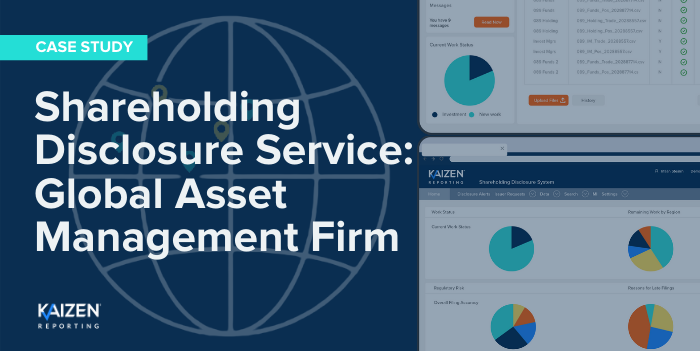
  • Shareholding Disclosure Case Study: Global Asset Management Firm

    Shareholding Disclosure Case Study: Global Asset Management Firm

    How we helped a global asset management firm under the scrutiny of its internal audit department

    The challenge

    The internal audit department of a global asset management firm identified considerable inefficiencies in its Compliance Department’s disclosure processes, including an ageing internal system, lack of country coverage and an absence of understanding of the rules.

    How we solved it

    We applied our in-house experience and expertise in shareholding rules to conduct a review and analysis which found a number of monitoring and reporting deficiencies.

    Our experts worked closely with the client to rectify the reporting failures, resulting in the avoidance of any regulatory censure. We also put in place a robust process for future compliance with global shareholding rules.

    Read the full case study

  • Media release: Kaizen Reporting acquires MDM Compliance Systems

    Media release: Kaizen Reporting acquires MDM Compliance Systems

    Launch of Kaizen’s Shareholding Disclosure Service

    London, Tuesday 8 September 2020 – Leading regulatory reporting assurance firm Kaizen Reporting (Kaizen), developer of the multi-award-winning assurance service, ReportShield™, today announced the acquisition of MDM Compliance Systems, the premier service for shareholding disclosure management. The price of the transaction was not disclosed.

    MDM Compliance Systems (MDM) provide a shareholding monitoring and reporting solution to financial institutions who are exposed to disclosure requirements. Founded in 2012, MDM provides an unparalleled service combining the latest software for monitoring shareholdings and updating disclosure rules with the deep knowledge and expertise of its industry specialists. The service is a fully automated monitoring and flexible reporting system covering more than 95 countries that addresses the challenges of over 400 global shareholding disclosure rules and requirements including the complex takeover rules.

    The newly named ‘Shareholding Disclosure Service’ (SDS) will sit alongside Kaizen’s existing reporting quality assurance services which provide the controls firms need to ensure they effectively meet their reporting quality and control obligations.  

    Dario Crispini, CEO of Kaizen Reporting, commented: “The expansion into shareholding disclosure demonstrates our commitment to providing our clients with the services they need. The new service complements our existing reporting services and affects many of the firms that are already long term Kaizen clients, making it a natural fit with the data and reporting expertise that Kaizen delivers today. With the complexity, time and costs that firms face, it’s vital that they have the confidence in the services they are using and we will continue to grow and invest in the Shareholding Disclosure Service to ensure it provides everything our clients need.”

    Angie Huff, Regulatory Advisory Director of Kaizen’s Shareholding Disclosure Service, commented:

    “We are delighted to be part of Kaizen. By bringing the two businesses together, our existing shareholding disclosure service can now leverage the vast data assurance services that Kaizen offer to improve our clients’ experience. What sets us apart from other firms is our expertise, and our ability to adapt our shareholding disclosure service to a firms specific needs rather than a one-system-fits-all solution. By becoming part of a bigger organisation we will be able to share and expand on that expertise and clients will benefit from the economies of scale.”

     (ends)

    For media inquiries, please contact James Dunseath at media@kaizenreporting.com or +44 (0)7557 955 795.

    • For more information about our Shareholding Disclosure Service or to watch our short introductory video, visit our SDS service page.
    • For a demonstration of the system or a conversation with Angie Huff, please contact us. 
  • My career in shareholding disclosures and the lessons I have learned

    My career in shareholding disclosures and the lessons I have learned

    Let me introduce myself, my name is Angie Huff and if you are reading this then the chances are that I have been in your position at some point during my career.

    Starting out

    I started my career at UBS investment bank in 2000. When I first started in shareholding disclosures there were no vendors in the market offering a solution and accessing the rules globally was a particular challenge. Our team compiled the disclosures not only for the investment bank but also on behalf of the asset management and private wealth management arm of the parent company. At this point I did not really understand what the different derivatives were, which of these derivatives should be included in the calculation or the different ways you could have exposure to shares and derivatives. There was very little information in the market to help with this and no training courses. It was difficult internally calculating the global positions across such a large organisation.

    Meeting the strict disclosure deadlines was a significant challenge. I faced many of the issues you have probably faced or are facing; regulatory enquiries/ investigations, sanctions, internal audits, reporting to the Board, issues with tripping a sensitive industry threshold, coping with a manual process, building out a global solution and interpreting legal rules and much more. 

    Takeover Directive and Transparency Directive

    During my time at UBS there was considerable change in the world of shareholding disclosures with the European implementation of the Takeover Directive and the Transparency Directive.  Whilst it was initially welcomed as it was believed this would harmonise shareholding rules across Europe, sadly this was not in fact the case.  As directives and not regulation, there remained many variations in the shareholding rules from country to country.  It also meant that I had to personally face the challenge of implementing all these rules within a short timeframe.  I think we’ve probably all been there – many long days and nights in the office scrambling to find a solution to complying with the new rules!  

    In 2007 I was head-hunted by Morgan Stanley, then later by Barclays Capital and finally Deutsche Bank.  I faced many of the same challenges at each organisation and throughout my collaborations with peer banks, it became clear this was an industry-wide issue. 

    Financial crisis

    At Morgan Stanley I faced the challenge in 2008 (in the midst of the financial crisis) of the overnight (and I mean literally overnight) introduction of net short position disclosures.  It was a very challenging time as these were introduced without warning, there was no consultation, no FAQs, and no real detail on how to comply, but it was clear that immediate compliance was expected. There was no such short disclosure requirement before this time, therefore our systems and processes were not set up to handle such different calculations.

    I remember sitting at home on the weekend with Google alerts set up, so that I was immediately aware of those other countries who introduced a similar short position disclosure requirement over that fateful weekend. Myself, my team and our IT department worked around the clock to ensure that we complied with the rules. 

    Working with aosphere

    It was during my time at Morgan Stanley that I had conversations with an affiliate of Allen & Overy called aosphere and joined their advisory board to opine on the needs in this area for the financial services industry.  It was a fantastic collaboration with a few others in the industry and out of this was born their shareholding disclosure Rulefinder service. Kaizen’s Shareholding Disclosure Service uses this as a basis to our rules library in the service we offer.  This offering from aosphere made a real difference to me and the industry. We finally had one place where we could access shareholding rules globally. However, to truly apply this to your business and positions you needed considerable understanding of many factors including derivative products, methods of trading/holding positions, corporate structures, and legal and industry terminology.  And there was still another thing missing  – a system solution to the shareholding disclosure challenge. 

    At Barclays Capital I faced another challenge of managing this area globally and at Deutsche Bank I had the challenge of implementing the changes in the German rules shortly after my arrival with little lead time which again meant many hours spent in the office.  

    Challenges I’ve faced

    Throughout my career I have faced many challenges including implementing solutions internally, looking for vendors (many of whom didn’t have any direct experience at the coal face), dealing with the issues resulting from human error with a manual process, answering regulatory enquiries, dealing with the fall-out of regulatory sanctions and reading and implementing the rules myself (where my law degree did come in handy).  You cannot really work in shareholding disclosures without becoming heavily involved in data. Each financial institution has their own data issues and nuances. Market data is also another challenge for shareholding disclosures which has to be taken into consideration in any monitoring and reporting solution.

    All of these challenges really shaped me and gave me greater insight into the needs of those within shareholding disclosure compliance/operations teams. 

    A new start as an entrepreneur

    In 2013 I left the industry to become an entrepreneur and build a solution for all my peers in the shareholding disclosure space. I worked closely with Adam Stearn, our technical architect and lead developer, to design and build a system incorporating solutions to all the problems I had met along the way.  Adam has 19 years’ experience in designing and implementing complex data processing systems and has a background in military IT projects and with that, a real understanding of the security required by our clients. 

    In your shoes

    My 13 years’ of in-house shareholding disclosure compliance experience has been applied to every part of our service to make life simple for you. I truly understand those deadlines and how important it is to quickly react to regulatory change. With our service you can be rest assured that we understand the challenges you are facing.

    Our aim is to take away the pain and stress of shareholding disclosures, to streamline the process, to make compliance with the rules globally simple and make reacting to regulatory change a fast and simple experience.

    With our integration with Kaizen we can really leverage their multi-award winning services and technologies to further improve the service for our clients.

    We offer more than just a system within our service – we have genuine expertise of sitting where you are. For more information about our Shareholding Disclosure Service or to watch our short introductory video, visit our SDS service page.

    For a demonstration of the system or a conversation with Angie Huff, please contact us. 

     
  • What is shareholding disclosure compliance?

    What is shareholding disclosure compliance?

    Shareholding disclosure rules and the compliance that goes with them are not a new challenge by any means; there have been rules in some jurisdictions for over 50 years. However, the number of jurisdictions requiring compliance, the complexity of the rules and the sanctions for non-compliance are ever-increasing. 

    What are shareholding disclosures rules? 

    There are a number of different types of rules and they serve different purposes;

    • Substantial shareholding rules (also referred to as major shareholding and long disclosures) – these are designed to provide transparency to the market, the issuer, and the relevant regulator, about positions that are being accumulated, provide information on who can vote at the company’s AGM or who has access to voting rights.
    • Short position disclosures – these were first introduced in 2008 as a direct and immediate result of the financial crisis and in particular the HBOS rights issue whose share price was targeted by a shorting strategy resulting in a failed rights issue. These disclosures were designed as a way for regulators to have transparency of those responsible for shorting an issuer. 
    • Takeover disclosures – these were first introduced in the UK in 1968 to oversee the takeover and mergers of issuers as a result of the devastating consequences of dawn raids on issuers. Nowadays more and more jurisdictions have introduced these disclosure requirements, which allow additional transparency whilst a company is under offer to ensure fair treatment of shareholders.
    • Issuer Requests – in some jurisdictions issuers or their investor relations representatives are able to legally request disclosure of your holdings in their issuer and the identity of other parties to that position. This provides the issuer with transparency of their shareholders. 
    • Sensitive Industry – this can often be a pre-approval requirement before you trade in a certain industry above a certain threshold. These are industries that a government want to protect.  These often include the financial industry, defence, and aviation but other industries are affected too.  Restrictions on foreign ownership of issuers can also apply.
    • Articles of Association – companies may include lower thresholds for disclosure within their company’s articles of association and include their own sanctions for non-compliance.

    There are now over 95 jurisdictions that have some type of disclosure rules.  

    Who is subject to these shareholding disclosure rules? 

    Anyone who holds shares or derivatives of these shares (also referred to as financial instruments) can be subject to these disclosure rules.  These can be held in a number of different ways such as, but not limited to; nominee, custodian, prime broker, trading book, as a hedge to client trade, proprietary holdings, on a discretionary or non-discretionary basis for an asset management client.  Borrowed shares and those subject to a repurchase agreement can also fall subject to these rules. 

    Do shareholding disclosure rules in other countries apply to me?

    The short answer is yes!  The rule generally is if you invest in an issuer incorporated in another country you are likely to be subject to their disclosure rules.  There are other concepts involved such as Home and Host Member State, country of listing and country of primary exchange. 

    Are cash settled derivatives captured by these disclosure rules?

    Over the years’ regulators have become more concerned about cash settled derivatives and you will find they are increasingly included in a large number of rules. 

    What are the implications for non-compliance with the shareholding disclosure rules?

    Compliance with these rules is a necessity as the sanctions can be quite considerable.   There are public examples of sanctions as a result of non-compliance, however many sanctions are served privately and therefore they are never known to the wider public.  Here are some examples of the sanctions for non-compliance with shareholding disclosure rules; across much of Europe the sanctions include fines of up to €10 million or 5% of the annual turnover of the discloser and a suspension of voting rights for both the legal and beneficial owners. In Switzerland non-compliance is a criminal office and monetary penalties are up to CHF 10,000,000 (approx. €9.3m).  In South Korea non-compliance is a criminal offence and sanctions include fines, suspension of voting rights and imprisonment of up to 3 years for failure to disclosure and 5 years imprisonment for a disclosure that is false or omits any material information.  The sanctions in Hong Kong are similar but they also include personal liability of a company’s officers. 

    How do I comply with these rules?

    A mis-perception can be that the only difference in the rules are the percentage thresholds that trigger a disclosure, however there is much more to consider.  These rules are complex, and the methods used to calculate your exposure/holding  varies significantly from rule to rule from jurisdiction to jurisdiction. No two rules are the same. Accurate and timely disclosures are key to compliance in this area.  

    In order to comply you need access a global rules library, you also need to have a methodology for tracking and implementing rule changes. Once you have access to the rules you then need a way to calculate your exposure/position specific to each individual rule.  Because there are so many components to these rules the most effective way to reduce your operational and technical risk is to use a configurable rules engine for calculating your global disclosure obligations.  Any rules engine you chose needs to be flexible as there is no “one size fits all” in the world of shareholding disclosures, the solution needs to meet your specific corporate structure, exemptions that apply specifically to your business and any bespoke requirements your firm have, which can be a result of a number of factors including the application of specific legal advice you have received as there is no “one size fits all” in the world of shareholding disclosures.

    Compliance with these shareholding rules is not an easy task; however with our expertise in this specific niche area and industry experience (we’ve been in your shoes) we offer you with a solution that meets your needs and gives you peace of mind. 


    • For more information about our Shareholding Disclosure Service or to watch our short introductory video, visit our SDS service page.
    • For a demonstration of the system or a conversation with Angie Huff, please contact us.