Tag: SFTR reporting

  • ESMA’s 2024 Data Quality Report: Increased Focus on SFTR Data Quality

    ESMA’s 2024 Data Quality Report: Increased Focus on SFTR Data Quality

    ESMA’s Report on Quality and Use of Data for 2024 (published 30 April 2025), delivers a clear message: “ESMA expects that reporting entities increase the quality of their reported data significantly” and “the quality of the SFTR data still has large margins of improvements.”

    A particularly encouraging development is the “enhanced cooperation with BaFin,” where ESMA and BaFin established “an enhanced periodic engagement” with BaFin stepping up their approach and increasing targeted efforts. This marks positive progress in what had previously appeared to be somewhat polarised regulatory scrutiny across the EU.

    SFTR Data Quality Indicators Now Fully Implemented

    ESMA finalised its Data Quality Indicators (DQI) approach for SFTR in 2024, following their successful introduction for EMIR in 2022. Prior reports highlighted concerns, most notably the overstatement of open term securities loans values during 2021-2023, but there was relatively little structured analysis before the DQIs. ESMA notes that “a TR issue due to which inflated market values were observed has been resolved with the pending correction of historical data being monitored,” likely referring to reporters’ failure to send terminations or add maturity/end dates to open term securities loans.

    Key SFTR Data Quality Indicators Revealed

    Missing Valuations (DQI 5a)

    This metric shows significant improvement, falling from 26.3% in March 2023 to 8.5% by December 2024, though still above ESMA’s 5% threshold. The “dramatic” improvement was due to “amelioration of reporting by a few of the major reporting entities.”

    Outdated Valuations (DQI 5b)

    Of all DQIs, this remains “the worst among depicted DQIs,” despite falling from 41.4% in March 2023 to 26% by December 2024. ESMA emphasises: “Having updated information in times of adverse market movements and crises is crucial for authorities” and it is “imperative for counterparties to swiftly follow on the identified issues with outdated valuation.”

    Trade Reporting Discrepancies (DQI 1a)

    This indicator shows an average of 35% mismatch in outstanding SFTs between counterparty pairs – far above the 5% threshold and higher than EMIR’s 20.5%. This is remarkable considering that many SFTR reports are single-sided, and many dual-sided reports are generated by a single party with pre-matching and third-party data enrichment.

    Position-Level Discrepancies (DQI 1b)

    This indicator measures differences in position-level reporting between counterparties. While ESMA highlights this metric, position-level reporting is relatively uncommon in SFTR, making its prominence in the report somewhat curious.

    Entity Responsible for Reporting (DQI 9a)

    This field identifies who is responsible for reporting (UCIT managers for funds, AIFMs for AIFs, etc.). Though important for attributing data quality errors to the correct entity, this metric showed modest issues at 1.9% by end of 2024.

    Regulatory Expectations Rising

    ESMA’s commitment to data quality is clear: “ESMA always encourages the amelioration of reporting even in cases where the error rate is below the DQEFs which govern actions taken to tackle data quality.”

    Our Perspective

    At Kaizen, we welcome the increased focus on SFTR data quality five years after implementation. The publication of the Data Quality Engagement Framework and DQIs provide important steps toward greater regulatory certainty.

    However, we are cautious about equating matched reports with high-quality data. We would also challenge the focus on securities lending data elements and the relative absence of repo data given its greater systemic risk significance.

    Is your SFTR reporting in good shape? Can you evidence this? Kaizen provides comprehensive quality assurance for accurate, complete and timely SFTR reporting.  We also provide Daily Controls for SFTR delegated reporting arrangements.

    Contact us to request a demo or for a conversation with Jonathan or one of our regulatory experts.

  • Kaizen joins the Securities Finance Symposium

    Kaizen joins the Securities Finance Symposium

    Date: 12 November | Location: One Great George Street, Westminster, SWIP 3AA 

    Kaizen is returning to Securities Finance Symposium taking place in Westminster on 12 November.  The event is the repo’s industry leading technology event.

    Our SFTR Reporting Director, Jonathan Lee will join the first panel discussion of the day to discuss regulation. 

    You’ll also find the Kaizen team at our exhibit stand.  We hope you can join us at the conference. 

    Register


  • WATCH: Jonathan Lee speaks to Securities Lending Times: Beware of ‘valid but wrong’ SFTR reports

    WATCH: Jonathan Lee speaks to Securities Lending Times: Beware of ‘valid but wrong’ SFTR reports

    SFTR reports will need to be compliant with validation rules – there’s no doubt about that. However valid data is not necessarily correct data. Just because the report has been validated doesn’t mean the actual data within the fields is accurate.  

    Our Senior Regulatory Reporting Specialist Jonathan Lee spoke to the Securities Lending Times to explain what we call the ‘valid but wrong’ problem and how Kaizen can help firms make sure that data quality is established and maintained once SFTR is a live reporting regime.


    For further details of how we can help you prevent ‘valid but wrong’ reporting, please contact us.


  • ESMA and the European Commission clarify treatment of Alternative Investment Funds (AIFs) under SFTR

    ESMA and the European Commission clarify treatment of Alternative Investment Funds (AIFs) under SFTR

    The European Commission and ESMA have both dispelled any concerns that non-EU AIFs were being brought into scope for SFTR reporting if their AIFMs were EU-based.

    A paragraph in the Final Report that accompanied the Level 3 Guidelines on SFTR reporting on 6 January, raised concerns as it appeared to bring non-EU AIFs into scope for SFTR reporting if their Alternative Investment Fund Manager (AIFM) was based in the EU. This statement, while apparently contradicting elements of SFTR Level 1 (the regulation itself), Level 2 (the regulatory and implementation technical standards (RTS & ITS)) and other elements of the guidelines, nevertheless raised fears that extra territoriality was sought by EU regulators.

    In response to trade association concerns, both ESMA and the Commission have responded in letters stating that non-EU AIFs will not come into scope for SFTR reporting regardless of where their AIFM is based.

    Furthermore, ESMA provides further clarification about the nature of the Final Report and how to distinguish it from the Guidelines themselves. The Final Report provides feedback on the consultation responses, a summary of proposals in the consultation paper and an assessment of the feedback. They hasten to add that while some of the feedback resulted in amendments to the guidelines, other elements were discarded. They further emphasise that reporting parties should focus on the Guidelines and not the Final Report as it is the Guidelines that contain all the clarifications and examples to enable reporters to be compliant with the Level 1 SFTR regulation.

    The Commission in its response, re-states that SFTR Article 2(1) limits the application of the regulation to “(a) a counterparty to an SFT that is established (i) in the Union, including all its branches irrespective of where they are located; (ii) in a third country, if the SFT is concluded in the course of the operations of a branch in the Union of that counterparty.” Therefore, an AIF not established in the Union is not subject to the obligations set out in Article 4(1) SFTR.    

    Now we can only hope for such definitive feedback from the Commission and ESMA in relation to settlement finality and the reporting of bilateral variation margins…to be continued!

    You can read the letters here.

    We are helping a number of investment firms prepare to report accurately for SFTR.  Please contact us for a complementary consultation with one of our regulatory experts. 

  • SFTR reporting final guidelines – ready, steady….go!

    SFTR reporting final guidelines – ready, steady….go!

    In this blog, we explain the securities financing transactions reporting final guidelines

    It was good news last week for those of us who’ve been waiting for ESMA to publish the final guidelines for SFTR reporting. The overriding principle of the regulation which these new guidelines reinforce, is that reporting firms are expected to populate the database in as comprehensive, timely and accurate basis as possible. These guidelines, the final report (responding to consultation feedback), updated validation rules and a statement on non-EU issuer LEIs offer some contradictions and will not please all market participants but do provide much of this framework.

    Of course this blog is no substitute for reading the guidelines but here are some of the highlights:

    Timeline

    ESMA confirmed reporting obligations for credit institutions and investment firms (banks) go-live on Monday 13 April (for EU jurisdictions that do not observe Easter Monday as a public holiday) or Tuesday 14 April for those that do. In either case, reporting firms are required to send reports for any SFTs executed on or after Saturday 11 April. Market infrastructures will follow accordingly on 13 July, buy-side on 12 October and non-financial counterparties on 11 January 2021.

    Non-EU issuer LEIs

    ESMA acknowledged that only 30% of non-EU issued securities currently have an issuer LEI and therefore have removed the need to populate these security loan and security collateral issuer LEI fields for non-EU issued securities until 13 April 2021.

    Third party executed reportable trades

    ESMA have provided clarity on which SFTs executed on behalf of the reporting counterparty through powers of attorney are reportable under SFTR. The following are reportable:

    • CSD fails curing transactions in which securities are automatically borrowed. Credit or securities provided to avoid settlement fails are collateralised with the securities account of the borrowing CSD participant
    • Auto-collateralisation transactions where payment banks or their clients are counterparties.
    • CREST client auto-collateralisation trades.

    However, CCP “daylight lending facilities”, auto-collateralisation trades with an ESCB counterparty and intraday credit/overdrafts resulting from fails-curing transactions are all out of scope.

    Third country reporting obligations

    ESMA has advised that in bringing SFTR into line with EMIR, for a transaction to be in-scope for reporting by an EU branch of a 3rd country entity, the term ‘conclusion’ relates only to instances in where they are a counterparty to the trade. i.e. the counterparty where the SFT is booked. References to the EU branch merely supervising trading in a third country entity have been removed.

    Settlement fails reporting

    The guidelines require reporting parties to modify the maturity date (roll it forward to the next day or an expected settlement date) in the reports they send on settlement date +1 if a transaction is failing. It must be modified on this day because going forwards without modification it will be closed and not possible to re-open it. Providing this feedback loop on settlement status is going to be tricky.

    However, the treatment of partial returns is different where “a delayed settlement that does not result in a cancellation of the partial return, should not be reported.” 

    UTI failure

    There is no prescribed approach in the guidelines about what to do if your counterparty – responsible for creating and sharing the UTI – fails to provide it ahead of the COB T+1 reporting deadline. It simply states that “counterparties should ensure a timely solution.” Essentially reporting parties must chase and not report anything until the UTI has been shared, and document all of the steps taken to obtain the UTI.

    Valuation considerations / market values

    Market values should be reported as of close of business each working day. The values used for collateral and exposure management purposes should use most recent market prices or bilaterally agree valuations with counterparties if none are readily available. This requirement to agree values contradicts with a further statement about the unavailability of price information. This relates to some suspended shares and illiquid fixed income securities where counterparties should report the valuation contractually agreed upon conclusion of an SFT. Only then should the market value be updated with a valuation, when new price information becomes available.

    ECB FX rates should be used for valuations or bilaterally agreed rates if none exists. The need to align FX rates is a concern for the industry, given many reporting parties use an enterprise rate, not only for SFTs but across their businesses.

    Re-use reporting with delegated reports

    If reporting has been delegated, the counterparty to which reporting has been delegated is not responsible for the reporting of the estimated re-use of the collateral. NFCs are responsible for calculating the estimated re-use themselves and in providing the estimate to the counterparty in charge of reporting in a timely manner.

    CFI sourcing

    The guidelines state that counterparties should retrieve CFIs from ANNA, National Numbering Agency (NNA) or, if not available, request it at the relevant NNA of the instrument. Unfortunately by acknowledging that it is reconcilable, they contradict themselves by saying that if it doesn’t exist in the official sources then it should be agreed between counterparties. It certainly seems that official sources should be exhausted and CFIs should be requested from the NNA before attempting to derive CFIs.

    Security / collateral quality

    Ratings should be instrument-based and use internal assessments of credit quality rather than mechanistic reliance on credit rating agencies, who use measurements such as local vs foreign currency, short vs long term investment to reflect security specifics. ESMA acknowledge the resultant higher rate of reconciliation breaks. However, they fail to acknowledge sensitivity around sharing any aspect of internal ratings and the fact that many counterparties will not have fully on-boarded many securities that appear on settlement date in collateral baskets. This is likely to require some industry driven solutions.

    Variation margining 

    There is fresh guidance on how to report the collateral given or taken on a net exposure basis through post on-leg, value date, variation margin calls to complement the original trade level collateral. Counterparties should send single collateral update messages to reflect these bilateral variation margin calls. The direction of the collateral should be expressed with a sign against its market value i.e. negative for rows of collateral given and positive for collateral taken.

    Floating rate transactions

    When reporting floating rates, counterparties should indicate the relevant rate and the applicable spread. They should only provide updates when they agree to change the rate or the spread but not on a daily basis.

    Report tracking numbers (RTN) and open offer trades

    In reporting trades executed on venues where execution is contingent on central clearing (open offer basis), including DBV trades, reporting firms are not required to populate the report tracking number (RTN).  It is important to note that the clearing time and execution time would be expected to match.

    In instances in which a trade is bilaterally executed and subsequently subject to clearing (even same day), it requires the prior UTI to be reported as the RTN.

    Our view of the guidelines is that they do provide some clarity and are a step forward from where we were. However they do not provide all the answers and contradict in some places. Because of the diverse scope of the regulation, one size doesn’t fit all and it’s now for the market to interpret as best we can. Good luck and let us know how you’re getting on. 

    Kaizen’s ReportShield™ accuracy testing, advanced regulatory reconcilation and reference data testing services will help ensure your reporting is accurate from day 1 of go-live.  

    Contact us to find out more about how you can make a smooth transition to SFTR reporting.

  • SFTR validation rules and schemas from the ESMA cauldron…

    SFTR validation rules and schemas from the ESMA cauldron…

    Halloween saw some new ghoulish delights appear from the ESMA cauldron with the publication of SFTR validation rules (revised following the summer consultation) and XML schemas for reporting. ESMA has released four documents covering:

    1. SFTR report validation rules
    2. Counterparty and Trade Repository (TR) data exchange XML schema
    3. Intra-TR data exchange XML schema
    4. TR to authority data exchange XML schema.

    We have created a marked changes version of the latest validation rules to highlight the differences.

    Tighter but more logical 

    The validation rules have been tightened up to reflect instances in which fields that business logic dictates should be mandatory or conditional are no longer optional. For example, the loan field ‘security quality’ is now conditional rather than optional for new securities lending transactions. In other instances, fields that were not rationally mandatory (e.g. ‘maturity {date} of the security’ fields for both loan and collateral) are now conditional. The rules generally make more sense, particularly in relation to the two changes noted below.

    Full reporting – not delta reporting

    Modifications and corrections at both trade and position level now require all of the original counterparty table fields to be populated. In most cases, they also require the same fields to be populated in the loan and collateral table as in the original NEWT report in accordance with the same mandatory and conditional rules as the original report. This requirement for full reporting of modifications and corrections should be clarified in the level three guidelines when published by ESMA later this quarter.

    Bilateral Margining Simplified

    The ‘counterparty side’ is no longer required for collateral updates, making bilateral margin reporting simpler. Since stating whether the reporting party is a collateral giver or collateral taker is no longer a pre-requisite of providing a bilateral margining collateral update (COLU) or any other COLU report, it is much more straightforward to report instances of collateral flowing in both directions with the same other counterparty.

    The references to negative values of securities in the ‘counterparty side’ validation field notes on format and content have also been removed (in addition to this field being no longer required for COLU reports). Instead, the ‘collateral quantity or nominal amount’ is now permitted to be negative, enabling you to report collateral moves in either direction – as a margin giver or taker for example. You are also now permitted to use negative values in the ‘price per unit’ field. Again, we hope for further clarification when the reporting guidelines are released.

    The publication of schemas, the cementing of validation rules and a number of key clarifications (as highlighted) puts the industry in a much greater state of readiness for reporting – now only five months away.  Our advice?  Don’t now wait for final reporting guidelines (due later in Q4) but focus full steam ahead on implementation, testing and establishing your controls environment.  And if you’d like to discuss how we can ensure you are compliant with SFTR reporting rules, please don’t hesitate to contact us.

    The new validation rules and schemas are available on the SFTR section of our website.


  • The scariest regulatory reporting changes facing you this Halloween

    The scariest regulatory reporting changes facing you this Halloween

    It’s Halloween! And what better time to cover off some of the scariest regulatory reporting changes that you need to keep very very close to, following the full-moon…

    Quoting Macbeth’s three witches, “By the pricking of my thumbs, something wicked this way comes”, here are three key regulations affecting everyone in the coming months:

    In Thunder comes Brexit

    31 October was always going to be a horror Halloween show but the EU have prolonged the agony for another three months to 31 January. The good news is that most firms have prepared for the October exit but do keep an eye on any unknown regulatory changes in the coming months – or read our Brexit White Paper to help with your preparations.  

    In Lightning comes SMCR

    Ghosting quietly in, don’t forget if you’re an Core or Enhanced Firm, as categorised by the FCA, your CF Approved Persons change to SMFs under the Senior Managers and Certification Regime (SMCR) on 9 December. Encouraging a culture of taking responsibility for actions and demonstrating a clear understanding of where that responsibility lies, are the key messages. You can’t use a magic wand to sign-off on the accuracy of your regulatory reporting, a key task for your SMFs.

    In Rain comes SFTR

    As we speak on the day of the devil, SFTR is only 166 days away.  This is frighteningly close.  Are you prepared and testing in UAT for this new reporting regime coming into effect on 14 April 2020? Contacting our very own SFTR expert Jonathan Lee is much less scary than a letter from the regulator.

    When the hurly-burly’s done, when the battle’s lost and won, Kaizen is here to help with the most scary of regulatory reporting challenges. Please contact us if you’re worried about any of the above and we can turn your regulatory reporting obligations from a trick to a treat!

    Author: Chris Machinbeth

  • Join us at Infoline’s Trade and Transaction Reporting Conference in Stockholm

    Join us at Infoline’s Trade and Transaction Reporting Conference in Stockholm

    We are delighted to be able to offer 30% off tickets. Use code FKM63769KAIZEN.

    Register


    Calling all investment firms, securities firms, banks and trading venues impacted by the reporting and disclosure obligations of SFTR, MiFIR and EMIR! Please join us at this one day conference in Stockholm. Don’t miss our Senior Regulatory Reporting Specialist, Jonathan Lee, discussing SFTR Reporting best practice and how to prepare for the April 2020 go-live at 10:30am. Followed by Senior Regulatory Reporting Specialist, David Nowell, on a panel to discuss the ongoing challenges with MiFID II Transaction Reporting and EMIR Trade Reporting. 

  • Cappitech and Kaizen Reporting publish findings of SFTR implementation survey

    Cappitech and Kaizen Reporting publish findings of SFTR implementation survey

    FOR IMMEDIATE RELEASE

    17 September 2019, London and Tel Aviv: Cappitech and Kaizen Reporting today published the findings of the SFTR implementation survey conducted by Cappitech, a leading provider of regulatory reporting and intelligence solutions for the financial services industry, and analysed by Kaizen Reporting, global leaders in quality and accuracy for regulatory reporting, in which securities financing market participants were asked to help establish the industry’s state of readiness.

    While there is a greater state of readiness among the banks (due to go live in the first phase, April 2020) of reporting, the survey shows that 56% of banks are still only in the pre-implementation planning stages. The survey concluded that overall only 37% of the securities lending industry has started or completed SFTR implementation and expect to be ready in time when the regulation comes into force in phase one. 11.5% have not even begun to plan. While some allowance can be made for the fact that a number of respondents have later go-live dates, this is somewhat concerning.

    The current lack of readiness across the industry for this new and complex regulation is highlighted by the survey. Both Cappitech and Kaizen Reporting believe industry participants need to prioritise planning, implementation and testing of robust processes for SFTR, to ensure timely implementation.

    Jonathan Lee, Senior Regulatory Reporting Specialist (SFTR) at Kaizen Reporting said, “The findings from the SFTR survey make it clear that many companies are not as prepared as they should be at this stage. In order for firms to be ready by April 2020 there is a need to accelerate their plans and make sure that they allow enough time for testing and implementation.”

    Ronen Kertis, Founder and CEO of Cappitech comments, “Reporting firms who aren’t ready, especially those that haven’t started planning, will need to prioritise this in the coming months. Where possible, an extension of their existing technology may provide an easier and more seamless transition.”

    Reporting firms highlighted a number of additional concerns with SFTR including, most significantly, the issue of UTI matching; 54% of respondents felt they will need to implement UTI matching, with another 33% still considering it.

    40% of survey respondents are also still undecided regarding which trade repository (TR) they are intending to use, bringing additional readiness to test. While tier 1 firms often decide based on board seats and shareholdings, for the rest of the market pricing will be key and most TRs have not yet published detailed pricing data.

    Additional findings from the report include:

    Vendor Selection: This is an ongoing process, with 58% of respondents planning to implement extensions of their current reporting tools.  

    Delegated reporting: 51% of the banks surveyed are committed to providing delegated reporting. “Delegated reporting brings real challenges, not least of which is the need for clients to have control of and access to their reporting data to meet their regulatory requirements. Specific delegated reporting solutions  solve this challenge for banks when they offer delegated or assisted reporting to their clients,” says Mr. Kertis.

    UAT testing: The report also shows that despite its importance, UAT testing has not been fully embraced by the industry. Approximately 54% plan to test in the three months prior to go-live but Kaizen and Cappitech experience proves that many regulatory programme deliveries are delayed, leaving minimal time for testing. This has a knock on negative impact on data quality and regulatory compliance. For the 11% who are planning not to do any testing, and the 7% whose planning only incorporates testing one month before, these risks are greater with Mr. Lee stating, “We would caution that three months will not necessarily prove sufficient to launch such a large and complex reporting regime.”

    For a full copy of the report and to access further findings, please download it here.

    (ends)

    For media inquiries, please contact Fiona Wilde on media@kaizenreporting.com or +44 (0) 20 3912 3271.

  • 10 Lessons from industry responses to the ESMA Guidelines Consultation

    While not an exhaustive list, here are our key takeaways from reading the ESMA SFTR Guidelines consultation responses. The overall level of engagement in relation to the consultation was substantial, with 49 files published by ESMA following the consultation period.

    1. Reporting certainty

    A few fundamental questions are key to providing clarity to support a timely build for SFTR reporting. Banks and credit institutions (due to report from April 2020) need answers to some of the these questions well in advance of the self-imposed Q4 2019 deadline set by ESMA.

    In particular, question 25, whether to provide full reports or the delta of changes for modifications and corrections – respondents overwhelming voted for full reporting.

    2. Reportability of intraday market infrastructures executed SFTs

    Which intraday transactions executed on behalf of firms by CSDs and CCPs remain in-scope for reporting? While T2S Auto-collateralisation transactions are explicitly excluded from reporting, does this also cover UK Crest Auto-collateralised repos? Extracting and reporting this data presents unique challenges.

    3. Scope and third country considerations

    The approach to determining the ‘conclusion’ of a transaction by a branch is far reaching and strays from the EMIR definition. It appears to focus on the activities of individuals rather than risk held in the EU. The practical challenges of reporting SFT activities of non-EU entities where traders are supervised by EU branches are immense and likely to lead to significant confusion in relation to areas such as bilateral margining and reuse.

    Concerns were raised where SFTR does not require non-EU AIFs managed by EU AIFMs to be reported (unlike EMIR), while EU AIFs must be reported regardless of whether the AIFM is based in the EU (again unlike EMIR).

    4. Why are buy-sell backs still treated differently?

    ESMA have specified that documented buy-sell backs should be reported as buy-sell backs listing the master agreement, but it is still unclear why the reporting requirements differ from repo. The inability to apply a repo rate, forward breakeven yield or forward price on a buy-sell back is a particular issue.

    5. Is fails reporting really required?

    There has been some confusion about the reporting of settlement fails (general consensus was that perfect settlement would be assumed unless both parties chose to modify a transaction to reflect a default or extended fail).

    6. How to report bilateral variation margining

    Concerns continue to surround the reporting of bilateral variation margins for repo. Given these margin calls at the counterparty portfolio level are entirely separate from the trade level collateral, there should be a separate end of day collateral update report to reflect bilateral margining. They cannot, as ESMA examples suggest, be incorporated with trade level collateral updates.

    7. Failure to transmit Unique Trade Identifiers (UTI)

    The issue of what to do if a counterparty is responsible for providing the UTI fails to provide it in a timely manner for reporting, remains an open question. The real question is how the party subject to late notification of the UTI by their counterparty can be excused from their obligation to submit timely reports.

    8. Availability & consistency of reportable data

    There are many concerns about the availability of data for reporting. The FSB themselves highlighted in their May 2019 document Thematic Review on Implementation of the Legal Entity Identifier that on aggregate only 55% of all financial instruments in scope have an LEI code (representing 78% of outstanding amounts) and that only 11% of all firms that are issuing securities have so far obtained an LEI. Mandating usage of issuer LEIs when firms that use securities as collateral have no contractual relationship with the issuer of the securities, appears a step too far. Solutions are to make the field conditional or apply a standard dummy issuer LEI.

    Other concerns persist around missing official CFI codes, ISIN codes, differences in credit rating assessments between firms and the collateral type field.

    9. The removal of ESCB transactions from the calculation

    Trade associations reiterated that removing ESCB transactions from both sides of estimated re-use calculations will be both difficult and misleading. Nonetheless, this is understood to be an FSB requirement rather than ESMA specific.

    10. Uncertainly around in-scope commodities financing transactions

    A number of trade associations and other respondents commented on the significant uncertainty felt by the commodities trading industry around the SFTR reporting scope of any of their transactions. Concerns were raised that while commodities financing transactions share attributes with SFTs, they are not executed for financing purposes. Disagreement exists as to which transactions constitute repos and which buy-sell backs, in general they were deemed hard to define under existing SFT definitions. There are also concerns that certain commodity transactions, believed to best fit the repo definition use pledge arrangements and not title transfer. Some power and gas contracts may also be reportable under SFTR as well as REMIT. While exclusions are in place for EMIR, they are not in place for REMIT.

    Did you know Jonathan provides CPD-accredited, CISI-endorsed training on the SFTR reporting requirements? Book your place on one of our upcoming courses here or get in touch for bespoke, in-house training.   

  • Collaborative reporting expected to be in demand for SFTR

    Collaborative reporting expected to be in demand for SFTR

    There is likely to be a high demand for collaborative reporting –  and other forms of delegated reporting – under SFTR, according to the results of our recent webinar with UnaVista. In this blog, we cover the results of the three polling questions asked during the webinar and what they mean for the industry.

    Q: About which of these are you the most concerned with regards to cleared trade reporting?

    1. Timelines of data from the CCP (25%)
    2. Market data availability (20%)
    3. Matching tolerances on collateral valuations (32%)
    4. Accuracy of Margin Reporting (11%)
    5. Correct application of RTNs (11%)

    Cleared trades are by nature significantly more likely to be consistently booked and subsequently reported. The benefits of clearing in counterparty risk reduction and in providing a single data set for many of the reporting fields seems likely to outweigh a number of concerns about the availability of data from CCPs. Nevertheless, pricing anomalies (resulting in concerns by 32% of participants about matching tolerances on collateral valuations) are common among SFT market participants even across different lines of the same business and these differences are likely to promote standardisation, best practices and efficiencies going forward.

    Q: Do you use any form of delegated reporting for other regulatory reporting regimes?

    1. Yes, we use delegated reporting for other regimes (e.g. MiFIR or EMIR) (55%)
    2. No, we have never used delegated reporting (32%)
    3. We have only used assisted reporting (14%)

    Again, interesting to see that 69% of participants use (or claim to use) some form of delegation. It adds weight to the recommendation that these parties focus on the quality of reporting to ensure that they are compliant with the regulation and keeping their reporting counterparty under appropriate scrutiny regarding the service provided.

    Q: How comfortable are you offering optional delegated reporting for SFTR?

    1. Entirely comfortable; this is a mature service for other regimes that we will simply extend to SFTR (37%)
    2. Will reluctantly offer; due to commercial pressures from client dictate we must offer it (23%)
    3. Will offer but not full delegation (7%)
    4. Will not offer any delegated reporting (33%)

    The proportion of participants that stated they were “entirely comfortable” was surprising, particularly given the challenges associated with populating the re-use table for third parties. The “will offer but not full delegation,” option seems more likely where clients use facilities offered by the trade repositories to provide a mirror of the broker dealer’s report to enable ease of reporting but only 7% responded in this way. The 33% stating they will not offer any delegated reporting maybe a little misleading given the mixed nature of participants (both buy-side and sell-side) and the commercial pressures that are likely to fall as reporting deadlines approach.

    In practice, to offer some form of delegated reporting under SFTR is likely to prove a must-do commercially on the sell-side but few operations managers will take it on with much enthusiasm (or resource). We think both parties should be focussed on data quality. The client should ensure that they are meeting their legal obligations (over the completeness, accuracy and timeliness of their reporting – that they cannot delegate). The reporting party should ensure that reports are correct (for both parties) and they do not only meet the trade repository validation, pairing and matching requirements. Two wrongs after all do not make a right! 

    If you’d like support with your SFTR preparation, we can help. Led by our SFTR Reporting Specialist Jonathan Lee, our pre go-live services include programme design and implementation, development of an appropriate controls environment, pre go-live testing of your reporting data and training on the reporting requirements.  Please contact us to find out more or visit our SFTR reporting page for more details.

  • Sunny ESMA provides some SFTR relief

    Sunny ESMA provides some SFTR relief

    ESMA published a Consultation paper “Guidelines for reporting under Articles 4 and 12 SFTR,” together with the latest consolidated SFTR validation rules. The deadline for responses is 29 July 2019. ESMA plan to consider feedback during Q3 2019 and the final report is scheduled to be published in Q4 2019. This does not give a lot of time, particularly for the 1st phase of reporting counterparties (Banks), due to go-live in April 2020.

    Nevertheless, ESMA provided clarity on many issues and gave reason to be cheerful as many SFTs executed on behalf of financial institutions through powers of attorney during the course of daily clearing, custody and settlement activities at CCPs, CSDs and ICSDs were ruled out of scope. This has undoubtedly removed a major operational headache from the SFTR reporting requirements and will assist regulatory authorities in gaining a better understanding of the data (as they will be significantly less overwhelmed with noise).

    • In particular, Chapter 5 (General Principles), paragraphs 25-27 rule out any reporting of short term credit lines for custody or CCP clearing.
    • Paragraphs 36-41 rule out reporting of any transactions relating to “fails-curing” services offered by CSDs.
    • Paragraph 43 rules out the need to report any transactions associated with Target 2 Securities Auto-Collateralisation.

    The guidelines also clarify the exclusion of the need to report under SFTR in relation to: Retail client lending (except when it is against an irrevocable trust), private banking & Lombard loans, syndicated lending and other corporate lending for commercial purposes, intermediate give-ups and take-ups (in the execution & clearing chain) and transactions involving emission allowances.

    In further points of clarification:

    • Buy-sellbacks and Sell-buybacks should be reported as such with the appropriate master agreement detail where applicable (overruling the original SFTR regulation) (paragraph 61).
    • Margin Loan reporting only applies to Prime Brokerage business (paragraph 11).
    • Modifications that are agreed but have not taken place should not be reported until the actual modification takes place (paragraph 117).
    • Margin loans – where the value of an existing margin loan hits zero, the transaction should be modified (MODI action type) rather than terminated (ETRM action type) (paragraph 83).
    • Securities lending and borrowing transactions can only involve a single ISIN being transferred between a given pair of counterparties (paragraph 65).
    • Backloading: ESMA advises that they like the idea of reporting all open and term transactions executed prior to the date of application whether they meet the requirements for backloading or not. This approach is seen as operationally simpler for many reporting parties and provides authorities with greater information in relation to variation margining (paragraphs 167-170).
    • When trading with sub-funds, each sub-fund should be treated as a counterparty if they have their own LEI (paragraph 52)
    • For cleared SFTs, each SFT between the CCP, its clearing members and the clients of those clearing members should be treated as separate SFTs with different UTIs (paragraph 53).
    • In relation to Repos, collateralised loans in more than one currency constitute separate SFTs. This doesn’t preclude a single SFT having collateral denominated in multiple currencies though
    • Small & medium sized non-financial counterparties trading with a non EU third country entity must either trade with an entity that has been granted equivalence (in which case there is no reporting obligation under SFTR), else they will need to delegate or self-report the transaction/s (paragraph 93).
    • Execution by a branch was clarified to cover the following: a) for a client in accordance with a discretionary mandate given to it by the client; b) where the branch has supervisory responsibility for the person responsible for the investment decision concerned; c) where the branch has supervisory responsibility for the person responsible for execution of the transaction; d) where the transaction was executed on a trading venue or an organised trading platform located outside the Union using the branch’s membership of that trading venue or an organised trading platform (paragraph 102).
    • Counterparties should not report the LEI of the CSD in which they are either a direct or indirect participant (paragraph 122) in the CSD participant field.
    • ESMA acknowledged that updating valuations of securities on loan or used as collateral may not be possible where pricing becomes stale. This can affect suspended shares and some illiquid fixed income securities. In these instances, reporting parties should use contractually agreed values and only update them if new price information becomes available (paragraph 155).
    • ESMA advises counterparties should always use official sources for CFI codes. Those who felt that it would be sufficient to just populate the first 2 characters are likely to be disappointed as ESMA states that X should only be used when a character is not applicable (paragraph 163).
    • Non-bank entities are permitted to start reporting earlier than their date of application if they find it easier (paragraph 188).   

    The consultation also contains an extensive set of sample reports for many different scenarios, detailing how each of the 4 reporting tables should be populated. Once we’ve had the opportunity to review these samples and the latest trade repository validation rules, we will produce a follow-up blog.

  • SFTR Regulatory Technical Standards published in the Official Journal

    SFTR Regulatory Technical Standards published in the Official Journal

    Click to enlarge

    We now have legal certainty around the SFTR Article 4 reporting timelines as the ten delegated acts, implementing regulations and annexes have been published in today’s Official Journal of the European Union. Each respective delegated regulation is available here. These requirements appear to be unchanged from those published and adopted by the European Commission on 13th December 2018.

    Timelines

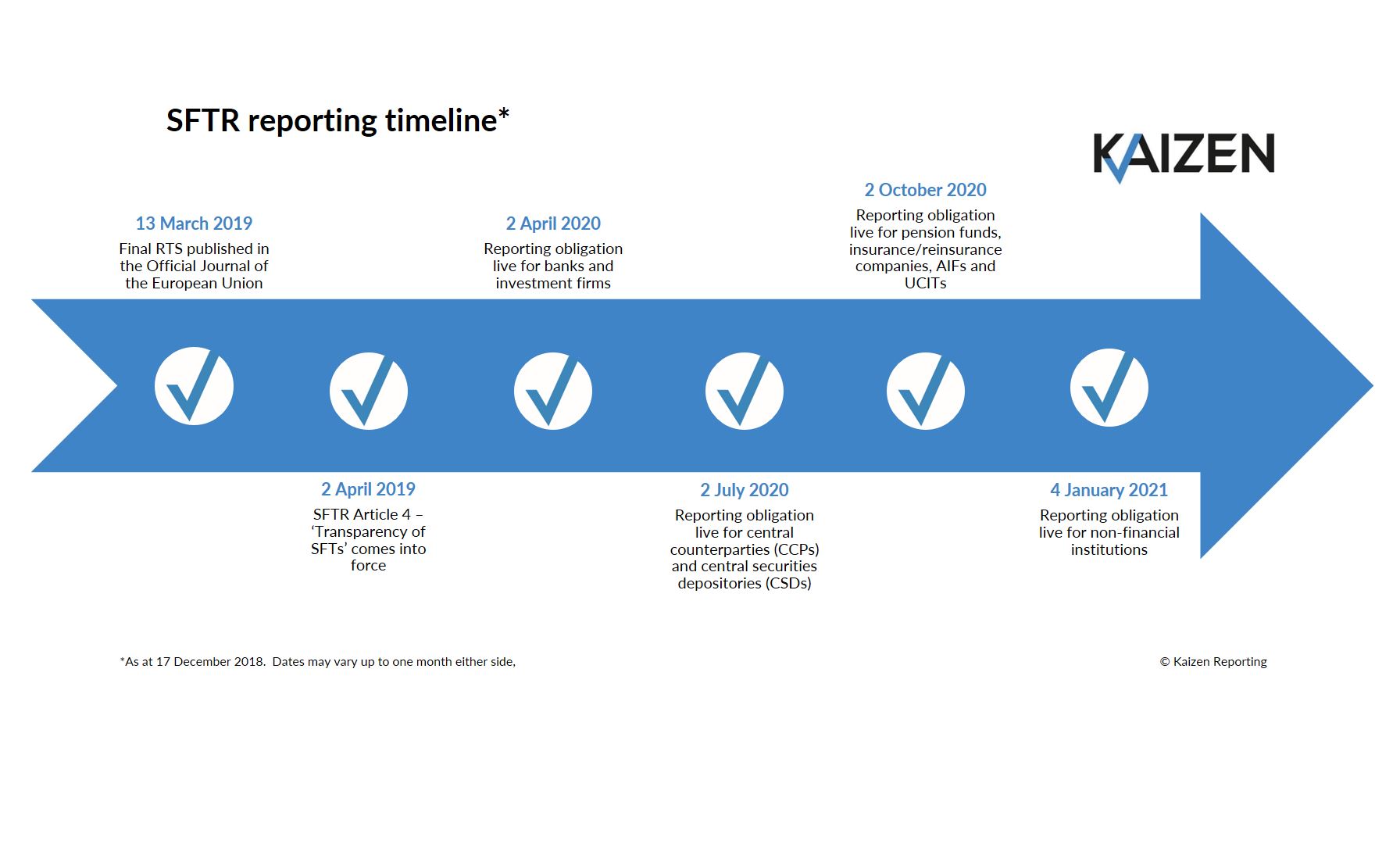
    The SFTR Regulatory Technical Standards (RTS) and Implementing Technical Standards (ITS) come into force 20 days after publication (11th April 2019). This provides the basis behind reporting obligations becoming live on the following dates:

    • Monday 13th April 2020 – Credit Institutions (Banks) & Investment Firms
    • Monday 13th July 2020 – CCPs & CSDs
    • Monday 12th October 2020 – Pension Funds, Insurance/Reinsurance Companies, AIFs & UCITs (Buy-side)
    • Monday 11th January 2021 – Non-Financial Institutions.

    It’s time to get ready…

    Now that we have legal certainty, firms should be fully engaged in SFTR planning, building, testing and controls initiatives in readiness for go-live. We can help to meet your training, scoping, pre-go live testing, vendor selection, controls agenda and post go-live quality assurance to ensure reporting accuracy for this most complex of reporting requirements.  Please contact us for a complementary consultation or find out more in our SFTR section of our website.

  • In the news: Jonathan Lee speaks to BobsGuide

    In the news: Jonathan Lee speaks to BobsGuide

    Our Securities Financing Transaction Regulation (SFTR) reporting specialist Jonathan Lee recently spoke with Rebekah Tunstead at Bobs Guide to highlight the pressure that tier one banks are putting on trading venues to provide a much more compliant SFTR confirmation file from the beginning. 

    “Pretty much everyone in the chain is looking for ways in which to cut costs and to some extent pass on the onus and responsibility to others. Even among the tier one banks, they are looking to trading venues that will provide more of the reportable field in the appropriate format such that they don’t need to collate and process that data themselves,”  Lee says.

    Read the full interview.

  • Santa’s SFTR gift extends to EMIR

    Santa’s SFTR gift extends to EMIR

    Santa delivered the long-awaited SFTR technical standards just in time for Christmas to delight SFTR specialists everywhere. But there also appeared to be something at the bottom of Santa’s sack for EMIR trade reporting specialists because the SFTR implementing technical standards also amended the EMIR trade reporting ITS. However, now we’ve taken the wrapping paper off this present, there doesn’t seem to be anything of value inside…

    No real change

    The reference to “Implementing Regulation (EU) No 1247/2012” seems curious as this is the old ITS that has already been amended by the shiny new Implementing Regulation (EU) 2017/105. Putting that aside, the changes appear meaningless. In a nutshell, the only taxonomy that can be used to classify an instrument is the CFI (as the ‘UPI’ alternative doesn’t exist and wouldn’t be a classification taxonomy if it did exist). This is not a real change as ESMA’s validation scheme already ensured only the CFI could be used – NB: the validation scheme is a really (under)handy mechanism to tweak the technical standards without having to bother with tiresome process.

    Annoyingly, Annex II of the SFTR ITS replaces Annex to the EMIR trade reporting ITS (Regulation (EU) 2017/105 rather than the stated (EU) 1247/2012). This is a tricky case of spot the difference – even the amusing typos in the formats of the ‘Collateral portfolio code’ and the ‘Trade ID’ have been persisted. The only changes I could find were on ‘Product classification type’ (only ‘C’ for CFI allowed), ‘Product classification’ (has to be a CFI) and the UPI is no longer referenced as a possible ‘Underlying identification type’ or ‘underlying identification’.

    SONIA

    At a micro detail level, I was disappointed that SONIA wasn’t allowed to join the floating rate index club, despite being set to become a key benchmark. The publication of the ‘new’ ITS annex might have been an ideal time to add it to the list of permitted codes for floating rate indices alongside other key benchmarks such as JIBAR and BUBOR. As a paranoid Briton, I like to think of it as a slight against UK standards, but maybe we were nebulous in just not asking for it. Still, it might be a good one for firms to remember if they ever get lectured by the regulators on the importance of putting “EONA” in their floating rate fields instead of “EONIA”.

    We will be providing EMIR trade reporting half-day training courses from early next year.  Please contact us to register your interest and for further details. 

  • SFTR: The final countdown

    SFTR: The final countdown

    UPDATED 18 December with additional links and further details on timelines for trade repository reconciliations for certain fields.

    Now that the ITS and RTS have been released, we have greater clarity on the nature of the European Commission standards for SFTR as well as the timelines. Our SFTR specialist Jonathan Lee highlights the key changes and the timeline for implementation. 

    On Thursday 13 December 2018, the European Commission (EC) adopted Regulatory Technical Standards (RTS) and Implementation Technical Standards (ITS) covering Article 4 ‘Transparency of SFTs’ reporting requirements under Securities Financing Transaction Reporting (SFTR). This critical step puts the wheels in motion for SFTR to become a live reporting obligation and sets an increasingly clear timeframe for the reporting to start from April 2020.

    Official links: EC RTS, RTS Annex 1, and EC ITS and ITS Annex 1 and RTS for Trade Repositories (TR), RTS for TR Annexes and RTS for Access to details of SFTs held in TRs.

    SFTR go-live timeline 

    The RTS and ITS have been subject to some minor revisions since the ESMA publication, therefore we can confirm that it will be subject to a three month scrutiny period by the European Parliament & Council (not the one- month period for an unchanged RTS, nor the six-month period for an RTS subject to significant, material change). Following this scrutiny, it will be published in the Official Journal of the European Union.

    The timeline from here is as follows in the graphic below, although experience tells us to leave approximately one month leeway around these dates:

    SFTR reporting timeline infographic
    Click image to enlarge

    Changes to the RTS

    While this announcement was much more about certainty of timing (after an extended delay), enabling European SFT counterparties to plan and budget for implementation, nonetheless there are some changes of note relative to the 31st March 2017 ESMA text. We can confirm that:

    1. It will be possible to include agent lenders on repo trades.
    2. There is a not-applicable option on termination optionality for repo and securities lending trades.
    3. There is more substantive guidance on the Unique Trade Identifier (UTI) creation waterfall (see Article 3, page 4 of the ITS).
    4. Timelines for Trade Repository reconciliations for certain fields have changed. The following fields in the Transaction Data table Loan section: Security quality, Maturity of the security, Jurisdiction of the issuer, LEI of the issuer and Security type  – have been brought forward to Day 1. They were previously Day 1 +24 months in the 2017 ESMA text. This will present a more pressing data quality challenge. As a small concession in Transaction Data Collateral section: Collateral unit of measure, Price currency, Price per unit and Collateral market value have been pushed back from Day 1 to Day 1 +24 months. This brings the importance of independent reference data testing to the fore. 
    5. Finally and perhaps most significantly, any bad blood between the EC and ESMA over the adoption of UTIs and branch LEIs appears to have ended. The EC has stated that that once standards are finalised and considered suitable for the purposes of reporting SFTs, the regulation will be amended accordingly. In the interim, ISO codes should be used to identify branches and bilaterally agreed UTIs should be used to identify SFTs.    

    We can help you put the right controls in place

    As we look forward to the festive season and find time to step away from all this talk of SFTR, we would encourage you to ensure that projects are now underway. Now is the time to start SFTR budgeting, hiring, planning, building and thinking about testing, controls and governance if your project has not already begun. 

    Need some help with your SFTR reporting implementation? Contact us for a consultation to find out how you can put the right controls in place to ensure accurate and effective reporting from day one. We are also rolling out an SFTR training course early in 2019 so again, please get in touch to register your interest or find out more.

  • SFTR – the countdown to compliance begins

    SFTR – the countdown to compliance begins

    Commenting on the adoption of the Regulatory Technical Standards for SFTR, our Senior Regulatory Reporting Specialist, Jonathan Lee said,

    “The European Commission’s decision to adopt the Regulatory Technical Standards (RTS) and Implementation Technical Standards (ITS) for Securities Financing Transaction Reporting (SFTR) on 13th December 2018 presents the final piece in the puzzle of certainty around the Article 4 regulatory reporting obligation go-live. It also dictates the timeline to implementation. The European Parliament and Council of Ministers now have a three-month scrutiny period, followed by publication in the Official Journal of the European Union, a further 20 days will pass and the regulation comes into force. Once in force, Credit Institutions (Banks) and Investment Firms have 12 months to implement reporting, Central Counterparties (CCPs) and Central Securities Depositories (CSDs) have 15 months, Pension Funds, Insurance/Reinsurance Companies, AIFs and UCITs have 18 months and Non-Financial Counterparties have 21 months. On that basis, reporting will start in earnest in April (possibly May) 2020 for Banks with the others to follow in three month increments.     

    “At present, the actual content of the RTS and ITS have only been released to a select few (it is not yet public) but we understand that few changes have been made from the ESMA 31st March 2017 and EC July 2018 versions. Now is the time to start SFTR budgeting, hiring, planning, building and thinking about testing, controls and governance if your project has not already kicked off.”

    Need some help with your SFTR reporting implementation? Contact us for a consultation to find out how you can put the right controls in place to ensure accurate and effective reporting. 

  • SFTR RTS endorsement is still wait and see

    SFTR RTS endorsement is still wait and see

    Wednesday’s Trade & Transaction Reporting Northern Europe conference delivered updates from the European Commission (EC) and ESMA on the state of play for SFTR. It was a useful refresher course but did not deliver anything more tangible on reporting go-live timescales.

    European Commission Policy Officer Gerd Heinen said the delay in the EC’s adoption of the SFTR Regulatory Technical Standards (RTS) is the result of relatively minor technical legal concerns. He said they were highly motivated to endorse the RTS before year end but the EC did not agree with ESMA’s assertion that it was sufficient for them to endorse common standards for UTIs and branch LEIs for these fields to come into force, rather than amending the RTS itself. Once the RTS is endorsed by the EC, there is a three-month period for the European Parliament and the Council to adopt, followed by publication into the Official Journal. A further 20 days later, the RTS will come into force, consistent with a late Q1 2020 reporting go live for banks and investment firms. Market infrastructures (including CCPs), funds and large non-financial counterparties will follow at subsequent three-month intervals.

    ESMA Senior Policy Officer Nikolay Arnaudov reiterated that there were seven technical standards under SFTR (*). He highlighted that this was an EU transparency regime aimed at enhancing financial stability and contributing to the global securities financing transactions data collection exercise. He revisited the EMIR foundations of the report and the four data tables as building blocks (counterparty, loans & collateral, margin, and re-use). However, he would not be drawn any further on go-live dates beyond saying that the RTS amendments by the EC and the subsequent rejection of those amendments by ESMA, were in line with standard procedures.

    We continue to believe that an RTS (likely to be little different in substance from the March 2017 ESMA RTS) will be endorsed by the EC during November or December 2018. This would mean the reporting requirement goes live for banks and investment firms during the latter stages of Q1 2020, with an outside chance that it falls into April 2020.

    (*) The seven technical standards are:

    • RTS and ITS on SFT reporting
    • RTS and ITS on registration and extension of registration of trade repositories
    • RTS on data collection
    • RTS on data availability and access levels
    • ITS on exchange of data between authorities
  • Join us in Stockholm for the Trade and Transaction Reporting Conference

    Join us in Stockholm for the Trade and Transaction Reporting Conference

    We are very pleased to be taking part in the Infoline Trade and Transaction Reporting Northern Europe Conference on 17 October in Stockholm. The conference is aimed at investment and securities firms, banks and trading venues impacted by the reporting and disclosure obligations of EMIR, MiFID II,and SFTR.   

    On the agenda are our very own Senior Regulatory Reporting Specialists David Nowell and Jonathan Lee who will give practical insight on EMIR and MiFIR reporting data quality (David) and taking the pain away from SFTR transaction reporting implementation (Jonathan).

    We’d be delighted to see you there and would love to pass on a 30% saving on your conference pass (please quote FKM63655KR). 

    Event details:

    For more information, please don’t hesitate to contact us.

  • Five things we learned at the Regis-TR SFTR workshop

    Five things we learned at the Regis-TR SFTR workshop

    We were delighted to attend the Regis-TR SFTR workshop in Frankfurt yesterday.  Here’s a quick summary of the key insights we picked up: 

    1. Data sourcing was perhaps seen as the greatest challenge, with c.40% of reportable fields not readily available from risk management and trading systems
    2. It is a significant logistical challenge to obtain data from so many sources (siloed businesses acting independently, tri-party agents, agent lenders, CSDs, legal and reference data hubs etc)
    3. Realisation that reporting hard-to-obtain data from such a large and disparate range of sources is an inherently risky business necessitating a rigorous controls environment (something Kaizen can help with) 
    4. Education is key, recent MiFID II experience and industry discussions indicate that many eligible reporting parties are thought to be blissfully unaware of their obligations under SFTR
    5. Pairing and matching obligations at trade repositories mean that firms need to become better at communicating with their counterparties to reap the benefits of a greater level of standardisation and operational efficiency while becoming ever more regulatory compliant.

    For a consultation on your SFTR reporting preparation, please contact us.  

    SFTR: Challenges of implementation

  • In the news: Jonathan Lee speaks to Inside Data Management

    In the news: Jonathan Lee speaks to Inside Data Management

    Our SFTR reporting specialist Jonathan Lee recently spoke with Amelia Axelsen at Waters Technology about the challenges of SFTR implementation.

    “Implementing the necessary controls around accuracy and completeness is going to be arduous,” he says.

    Read the full article: Illuminated data – SFTR may reach too far

    Read Jonathan’s blog on the challenges of SFTR implementation. 

    Contact us for an initial conversation about getting ready for SFTR reporting. 

  • In the news: Jonathan Lee speaks to the International Financial Law Review

    In the news: Jonathan Lee speaks to the International Financial Law Review

    Our SFTR reporting specialist Jonathan Lee spoke to reporter Sharon Kimathi at the International Financial Law Review (IFLR) about the challenges firms are facing with the implementation of SFTR.

    Here’s an extract from the article:

    Securities lending desks and trade repositories feel that the new regulation’s 153 data fields are cumbersome, with significant potential for errors and duplication. The UTI requirement is a particular headache.

    “There are a large number of fields to complete, not only in terms of the initial transaction but also covering lifecycle events that take place during the course of the transaction,” says Jonathan. 

    Read the full article.