We’re excited to announce that the Kaizen team has moved offices. Our new office address is:
30 St Mary Axe (The Gherkin)
London
EC3A 8BF
United Kingdom
We are looking forward to welcoming you to our new offices soon!

We’re excited to announce that the Kaizen team has moved offices. Our new office address is:
30 St Mary Axe (The Gherkin)
London
EC3A 8BF
United Kingdom
We are looking forward to welcoming you to our new offices soon!
Our Chief Product Officer Rory McLaren recently gave a presentation at EmTech Global in London on the hot topic of Generative AI (GenAI). He shared a five-step plan for businesses to take a strategic approach, giving examples of what we are doing at Kaizen. Rory emphasised the importance of being careful with IP and uncompromising about the security of customer data.
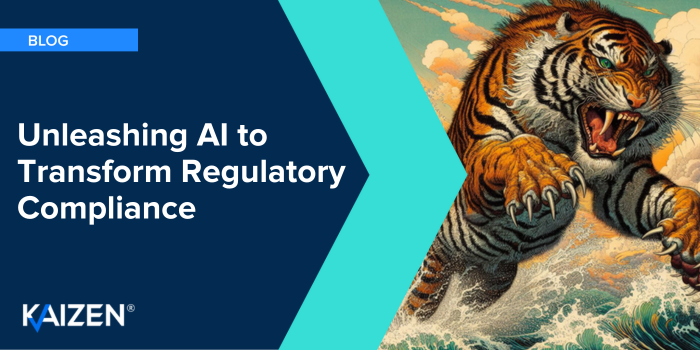
(Please note, the images featured in this blog are generated by GenAI with the prompt used below the image.)
Generative artificial intelligence focuses on generating new content which could be text, audio, images and video. It has the potential to significantly impact regulatory compliance in the financial services industry. It can help with streamlining tasks, enhancing detection of suspicious activities, ensuring compliance, assessing the impact of regulatory requirements, and future proofing risk and compliance.
However, GenAI is already causing concerns about privacy and questions about the integrity and accuracy of the information being created. There is also fear that GenAI might change jobs and society. As the ancient proverb goes, GenAI is like a tiger – it’s bloody dangerous in the wrong hands.
Here’s Rory’s five step approach for taming the tiger.
It’s important to get started and engage with GenAI to understand how it can be used. We recommend starting with simple, safe use cases using public data only. Blocking access within your company has limited long-term benefit. Instead, focus on crafting prompts and understanding how to use GenAI, as learning how to use and understand it is a critical skill we must all get to grips with.

There are important precautions that need to be taken to avoid getting eaten by the GenAI beast. Firms need to be careful with company-sensitive information and personally identifiable data. Firms should also be cognisant of the regulatory landscape, including the US Executive Order (October 2023), The Bletchley Park Declaration (November 2023), and the EU’s AI Act (December 2023). The technology is changing so quickly so be aware of SAAS software with continually evolving features which may add GenAI without your knowledge.

To unleash the power of GenAI, it’s important to focus on areas where it can make a significant difference. There is no point in using it to make small improvements that won’t make an impact on day-to-day work.
There are examples already where GenAI is making or has the potential to make a large impact. In knowledge management, natural language processing, inference and summarisation can be used to leverage untapped resources, discover best practices and make a consistent approach available to all. This could be wealth managers accessing previous advice for new scenarios, tax companies connecting decades worth of data to gain insights via LLMs (Large Language Models), and law firms tapping into regulatory interpretation and advice they’ve previously provided. Data analysis and pattern matching can also be used to review large data sets quickly, identify patterns and surface possibilities for human review.
The sweet spot is amplifying humans with AI, not replacing them. We need to see GenAI as a useful coach or another team member that helps us to do our jobs better.

To master the stripes of the GenAI beast, new ways of thinking about problems are required to fully take advantage of the technology. It’s as much about training staff and changing working practices as it is about selecting the right technology. Understanding how to price the value of GenAI will be critical for both customers and suppliers. Not all AI adoption will be through adding a prompt to a product.

To live in harmony with GenAI, it’s important to remember that it’s just another tool for people to use. It augments humans, it doesn’t replace them. Firms can successfully integrate GenAI into their processes and workflows if they think strategically about where it can make the biggest difference. It is important to strike a balance and not apply it to all tasks. Junior analysts, developers, and lawyers all need tasks in order to become senior versions of these roles. How will this happen if AI does these tasks? Who will train the models and validate the output if we become too reliant? Where will that leave us?

GenAI is so fast moving, it can be challenging to know where to begin and the best way to approach it. To summarise: