Tag: European Commission

  • Kaizen and RegGenome Announce Strategic Partnership using AI to expand regulatory content on Single Rulebook

    Kaizen and RegGenome Announce Strategic Partnership using AI to expand regulatory content on Single Rulebook

    London, December 3, 2024 – Kaizen, a leading provider of regulatory compliance solutions for global financial institutions, announced today that it has entered into a strategic partnership with RegGenome, a UK based provider of global financial regulatory data, to use artificial intelligence (AI) to vastly expand the coverage and content of Kaizen’s Single Rulebook platform including new jurisdictions and regulatory domains.

    The collaboration between Kaizen and RegGenome will support the digitisation of regulation where both parties will work together to provide fast and efficient access to a vast array of global regulatory rules, jurisdictions and taxonomies on the Single Rulebook platform. By combining Single Rulebook’s front end user interface with RegGenome’s AI powered regulatory data and information structures, the firms will provide clients with a new standard of regulatory intelligence and change management.

    Many financial institutions operate across multiple locations and global regulatory jurisdictions. Today’s announcement means that firms will be able to navigate and respond quickly to the complex landscape of regulatory change and divergence more easily and efficiently.

    In early 2025, Single Rulebook clients will be able to access regulatory content covering all major global financial markets. This includes coverage of US federal regulators and agencies, European national law and global G20 members.

    In addition to core financial services regulations, Single Rulebook users will also be able to investigate emerging compliance requirements for cryptocurrency, cyber security and digital operational resilience.

    Mark Johnston, CEO, RegGenome commented: “We are delighted to announce our strategic partnership with Kaizen’s Single Rulebook. This collaboration will make RegGenome’s comprehensive structured regulatory data available through Single Rulebook’s innovative platform. By combining our extensive regulatory content with Single Rulebook’s advanced search and analytics capabilities, we’re enabling financial institutions to better navigate the complex regulatory landscape.”

    Chris Dingley, CEO, Single Rulebook said: “We’re excited to announce our partnership with RegGenome today. Working with RegGenome’s AI solution for regulatory data and information means that we will be able to expand the Single Rulebook platform and content rapidly for our clients, continuing and enhancing our efforts to support them with the burden of managing global regulation.”

    RegGenome processes global regulation using artificial intelligence (AI) to transform what is human-readable into machine-readable and machine-consumable data. It is part of the Regulatory Genome Project (RGP), a public-private initiative between the University of Cambridge, Judge Business School, and RegGenome. RGP aims to build and review a set of open-access regulatory information structures, known as the Cambridge Regulatory Genome (CRG), and make available a global repository of aggregated, structured regulatory data.  

    Single Rulebook is Kaizen’s digital solution for searching and navigating global regulation. The platform helps firms manage regulatory change with front end functionality such as rule maps, labels and annotations which can be pinned to regulatory rules and shared across global organisations.

    About RegGenome

    RegGenome is a regulatory data technology company and a leader in computational regulation, changing how the world produces and consumes regulatory information. We process the world’s regulation using AI to transform what is human-readable into machine-readable and machine-consumable data. 

    www.reg-genome.com

    For more information, please contact James Dunseath, Communications Director, on +44 (0) 7557 955795 or media@kaizenreporting.com

  • ESMA and the European Commission clarify treatment of Alternative Investment Funds (AIFs) under SFTR

    ESMA and the European Commission clarify treatment of Alternative Investment Funds (AIFs) under SFTR

    The European Commission and ESMA have both dispelled any concerns that non-EU AIFs were being brought into scope for SFTR reporting if their AIFMs were EU-based.

    A paragraph in the Final Report that accompanied the Level 3 Guidelines on SFTR reporting on 6 January, raised concerns as it appeared to bring non-EU AIFs into scope for SFTR reporting if their Alternative Investment Fund Manager (AIFM) was based in the EU. This statement, while apparently contradicting elements of SFTR Level 1 (the regulation itself), Level 2 (the regulatory and implementation technical standards (RTS & ITS)) and other elements of the guidelines, nevertheless raised fears that extra territoriality was sought by EU regulators.

    In response to trade association concerns, both ESMA and the Commission have responded in letters stating that non-EU AIFs will not come into scope for SFTR reporting regardless of where their AIFM is based.

    Furthermore, ESMA provides further clarification about the nature of the Final Report and how to distinguish it from the Guidelines themselves. The Final Report provides feedback on the consultation responses, a summary of proposals in the consultation paper and an assessment of the feedback. They hasten to add that while some of the feedback resulted in amendments to the guidelines, other elements were discarded. They further emphasise that reporting parties should focus on the Guidelines and not the Final Report as it is the Guidelines that contain all the clarifications and examples to enable reporters to be compliant with the Level 1 SFTR regulation.

    The Commission in its response, re-states that SFTR Article 2(1) limits the application of the regulation to “(a) a counterparty to an SFT that is established (i) in the Union, including all its branches irrespective of where they are located; (ii) in a third country, if the SFT is concluded in the course of the operations of a branch in the Union of that counterparty.” Therefore, an AIF not established in the Union is not subject to the obligations set out in Article 4(1) SFTR.    

    Now we can only hope for such definitive feedback from the Commission and ESMA in relation to settlement finality and the reporting of bilateral variation margins…to be continued!

    You can read the letters here.

    We are helping a number of investment firms prepare to report accurately for SFTR.  Please contact us for a complementary consultation with one of our regulatory experts. 

  • Join us at Infoline’s Trade and Transaction Reporting Conference in Stockholm

    Join us at Infoline’s Trade and Transaction Reporting Conference in Stockholm

    We are delighted to be able to offer 30% off tickets. Use code FKM63769KAIZEN.

    Register


    Calling all investment firms, securities firms, banks and trading venues impacted by the reporting and disclosure obligations of SFTR, MiFIR and EMIR! Please join us at this one day conference in Stockholm. Don’t miss our Senior Regulatory Reporting Specialist, Jonathan Lee, discussing SFTR Reporting best practice and how to prepare for the April 2020 go-live at 10:30am. Followed by Senior Regulatory Reporting Specialist, David Nowell, on a panel to discuss the ongoing challenges with MiFID II Transaction Reporting and EMIR Trade Reporting. 

  • Cappitech and Kaizen Reporting publish findings of SFTR implementation survey

    Cappitech and Kaizen Reporting publish findings of SFTR implementation survey

    FOR IMMEDIATE RELEASE

    17 September 2019, London and Tel Aviv: Cappitech and Kaizen Reporting today published the findings of the SFTR implementation survey conducted by Cappitech, a leading provider of regulatory reporting and intelligence solutions for the financial services industry, and analysed by Kaizen Reporting, global leaders in quality and accuracy for regulatory reporting, in which securities financing market participants were asked to help establish the industry’s state of readiness.

    While there is a greater state of readiness among the banks (due to go live in the first phase, April 2020) of reporting, the survey shows that 56% of banks are still only in the pre-implementation planning stages. The survey concluded that overall only 37% of the securities lending industry has started or completed SFTR implementation and expect to be ready in time when the regulation comes into force in phase one. 11.5% have not even begun to plan. While some allowance can be made for the fact that a number of respondents have later go-live dates, this is somewhat concerning.

    The current lack of readiness across the industry for this new and complex regulation is highlighted by the survey. Both Cappitech and Kaizen Reporting believe industry participants need to prioritise planning, implementation and testing of robust processes for SFTR, to ensure timely implementation.

    Jonathan Lee, Senior Regulatory Reporting Specialist (SFTR) at Kaizen Reporting said, “The findings from the SFTR survey make it clear that many companies are not as prepared as they should be at this stage. In order for firms to be ready by April 2020 there is a need to accelerate their plans and make sure that they allow enough time for testing and implementation.”

    Ronen Kertis, Founder and CEO of Cappitech comments, “Reporting firms who aren’t ready, especially those that haven’t started planning, will need to prioritise this in the coming months. Where possible, an extension of their existing technology may provide an easier and more seamless transition.”

    Reporting firms highlighted a number of additional concerns with SFTR including, most significantly, the issue of UTI matching; 54% of respondents felt they will need to implement UTI matching, with another 33% still considering it.

    40% of survey respondents are also still undecided regarding which trade repository (TR) they are intending to use, bringing additional readiness to test. While tier 1 firms often decide based on board seats and shareholdings, for the rest of the market pricing will be key and most TRs have not yet published detailed pricing data.

    Additional findings from the report include:

    Vendor Selection: This is an ongoing process, with 58% of respondents planning to implement extensions of their current reporting tools.  

    Delegated reporting: 51% of the banks surveyed are committed to providing delegated reporting. “Delegated reporting brings real challenges, not least of which is the need for clients to have control of and access to their reporting data to meet their regulatory requirements. Specific delegated reporting solutions  solve this challenge for banks when they offer delegated or assisted reporting to their clients,” says Mr. Kertis.

    UAT testing: The report also shows that despite its importance, UAT testing has not been fully embraced by the industry. Approximately 54% plan to test in the three months prior to go-live but Kaizen and Cappitech experience proves that many regulatory programme deliveries are delayed, leaving minimal time for testing. This has a knock on negative impact on data quality and regulatory compliance. For the 11% who are planning not to do any testing, and the 7% whose planning only incorporates testing one month before, these risks are greater with Mr. Lee stating, “We would caution that three months will not necessarily prove sufficient to launch such a large and complex reporting regime.”

    For a full copy of the report and to access further findings, please download it here.

    (ends)

    For media inquiries, please contact Fiona Wilde on media@kaizenreporting.com or +44 (0) 20 3912 3271.

  • Santa’s SFTR gift extends to EMIR

    Santa’s SFTR gift extends to EMIR

    Santa delivered the long-awaited SFTR technical standards just in time for Christmas to delight SFTR specialists everywhere. But there also appeared to be something at the bottom of Santa’s sack for EMIR trade reporting specialists because the SFTR implementing technical standards also amended the EMIR trade reporting ITS. However, now we’ve taken the wrapping paper off this present, there doesn’t seem to be anything of value inside…

    No real change

    The reference to “Implementing Regulation (EU) No 1247/2012” seems curious as this is the old ITS that has already been amended by the shiny new Implementing Regulation (EU) 2017/105. Putting that aside, the changes appear meaningless. In a nutshell, the only taxonomy that can be used to classify an instrument is the CFI (as the ‘UPI’ alternative doesn’t exist and wouldn’t be a classification taxonomy if it did exist). This is not a real change as ESMA’s validation scheme already ensured only the CFI could be used – NB: the validation scheme is a really (under)handy mechanism to tweak the technical standards without having to bother with tiresome process.

    Annoyingly, Annex II of the SFTR ITS replaces Annex to the EMIR trade reporting ITS (Regulation (EU) 2017/105 rather than the stated (EU) 1247/2012). This is a tricky case of spot the difference – even the amusing typos in the formats of the ‘Collateral portfolio code’ and the ‘Trade ID’ have been persisted. The only changes I could find were on ‘Product classification type’ (only ‘C’ for CFI allowed), ‘Product classification’ (has to be a CFI) and the UPI is no longer referenced as a possible ‘Underlying identification type’ or ‘underlying identification’.

    SONIA

    At a micro detail level, I was disappointed that SONIA wasn’t allowed to join the floating rate index club, despite being set to become a key benchmark. The publication of the ‘new’ ITS annex might have been an ideal time to add it to the list of permitted codes for floating rate indices alongside other key benchmarks such as JIBAR and BUBOR. As a paranoid Briton, I like to think of it as a slight against UK standards, but maybe we were nebulous in just not asking for it. Still, it might be a good one for firms to remember if they ever get lectured by the regulators on the importance of putting “EONA” in their floating rate fields instead of “EONIA”.

    We will be providing EMIR trade reporting half-day training courses from early next year.  Please contact us to register your interest and for further details. 

  • SFTR: The final countdown

    SFTR: The final countdown

    UPDATED 18 December with additional links and further details on timelines for trade repository reconciliations for certain fields.

    Now that the ITS and RTS have been released, we have greater clarity on the nature of the European Commission standards for SFTR as well as the timelines. Our SFTR specialist Jonathan Lee highlights the key changes and the timeline for implementation. 

    On Thursday 13 December 2018, the European Commission (EC) adopted Regulatory Technical Standards (RTS) and Implementation Technical Standards (ITS) covering Article 4 ‘Transparency of SFTs’ reporting requirements under Securities Financing Transaction Reporting (SFTR). This critical step puts the wheels in motion for SFTR to become a live reporting obligation and sets an increasingly clear timeframe for the reporting to start from April 2020.

    Official links: EC RTS, RTS Annex 1, and EC ITS and ITS Annex 1 and RTS for Trade Repositories (TR), RTS for TR Annexes and RTS for Access to details of SFTs held in TRs.

    SFTR go-live timeline 

    The RTS and ITS have been subject to some minor revisions since the ESMA publication, therefore we can confirm that it will be subject to a three month scrutiny period by the European Parliament & Council (not the one- month period for an unchanged RTS, nor the six-month period for an RTS subject to significant, material change). Following this scrutiny, it will be published in the Official Journal of the European Union.

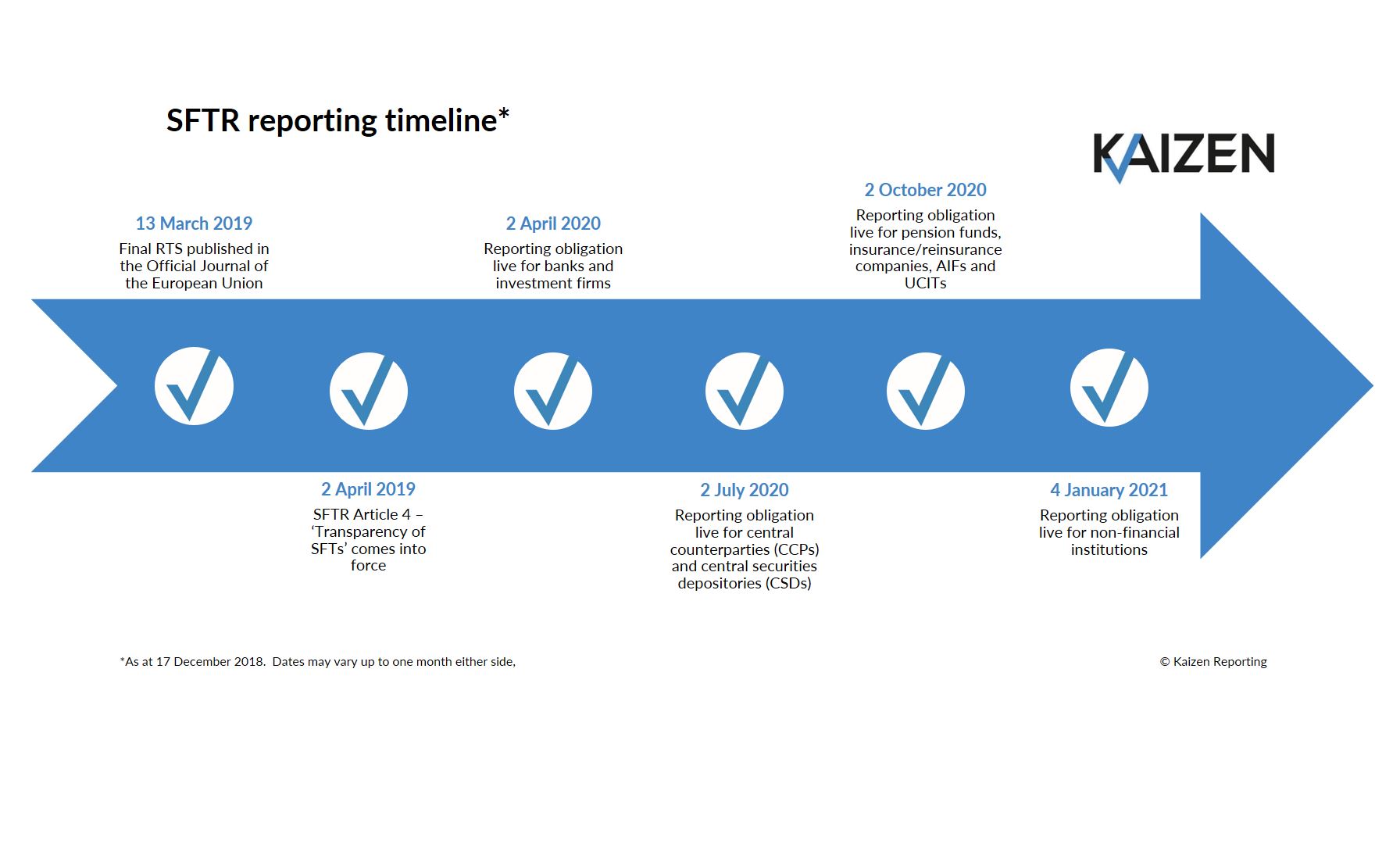
    The timeline from here is as follows in the graphic below, although experience tells us to leave approximately one month leeway around these dates:

    SFTR reporting timeline infographic
    Click image to enlarge

    Changes to the RTS

    While this announcement was much more about certainty of timing (after an extended delay), enabling European SFT counterparties to plan and budget for implementation, nonetheless there are some changes of note relative to the 31st March 2017 ESMA text. We can confirm that:

    1. It will be possible to include agent lenders on repo trades.
    2. There is a not-applicable option on termination optionality for repo and securities lending trades.
    3. There is more substantive guidance on the Unique Trade Identifier (UTI) creation waterfall (see Article 3, page 4 of the ITS).
    4. Timelines for Trade Repository reconciliations for certain fields have changed. The following fields in the Transaction Data table Loan section: Security quality, Maturity of the security, Jurisdiction of the issuer, LEI of the issuer and Security type  – have been brought forward to Day 1. They were previously Day 1 +24 months in the 2017 ESMA text. This will present a more pressing data quality challenge. As a small concession in Transaction Data Collateral section: Collateral unit of measure, Price currency, Price per unit and Collateral market value have been pushed back from Day 1 to Day 1 +24 months. This brings the importance of independent reference data testing to the fore. 
    5. Finally and perhaps most significantly, any bad blood between the EC and ESMA over the adoption of UTIs and branch LEIs appears to have ended. The EC has stated that that once standards are finalised and considered suitable for the purposes of reporting SFTs, the regulation will be amended accordingly. In the interim, ISO codes should be used to identify branches and bilaterally agreed UTIs should be used to identify SFTs.    

    We can help you put the right controls in place

    As we look forward to the festive season and find time to step away from all this talk of SFTR, we would encourage you to ensure that projects are now underway. Now is the time to start SFTR budgeting, hiring, planning, building and thinking about testing, controls and governance if your project has not already begun. 

    Need some help with your SFTR reporting implementation? Contact us for a consultation to find out how you can put the right controls in place to ensure accurate and effective reporting from day one. We are also rolling out an SFTR training course early in 2019 so again, please get in touch to register your interest or find out more.

  • SFTR – the countdown to compliance begins

    SFTR – the countdown to compliance begins

    Commenting on the adoption of the Regulatory Technical Standards for SFTR, our Senior Regulatory Reporting Specialist, Jonathan Lee said,

    “The European Commission’s decision to adopt the Regulatory Technical Standards (RTS) and Implementation Technical Standards (ITS) for Securities Financing Transaction Reporting (SFTR) on 13th December 2018 presents the final piece in the puzzle of certainty around the Article 4 regulatory reporting obligation go-live. It also dictates the timeline to implementation. The European Parliament and Council of Ministers now have a three-month scrutiny period, followed by publication in the Official Journal of the European Union, a further 20 days will pass and the regulation comes into force. Once in force, Credit Institutions (Banks) and Investment Firms have 12 months to implement reporting, Central Counterparties (CCPs) and Central Securities Depositories (CSDs) have 15 months, Pension Funds, Insurance/Reinsurance Companies, AIFs and UCITs have 18 months and Non-Financial Counterparties have 21 months. On that basis, reporting will start in earnest in April (possibly May) 2020 for Banks with the others to follow in three month increments.     

    “At present, the actual content of the RTS and ITS have only been released to a select few (it is not yet public) but we understand that few changes have been made from the ESMA 31st March 2017 and EC July 2018 versions. Now is the time to start SFTR budgeting, hiring, planning, building and thinking about testing, controls and governance if your project has not already kicked off.”

    Need some help with your SFTR reporting implementation? Contact us for a consultation to find out how you can put the right controls in place to ensure accurate and effective reporting. 

  • Stockholm conference: New regulatory insights on EMIR and MiFIR reporting

    Stockholm conference: New regulatory insights on EMIR and MiFIR reporting

    It was great to be a part of last week’s Trade and Transaction Reporting Northern Europe Conference in Stockholm and in particular, hear insights from the European Commission and the Dutch and Finnish National Competent Authorities (NCAs) on EMIR and MiFIR, as well as the latest on SFTR reporting timelines. 

    European Commission’s Fitness Check

    Gerd Heinen, Policy Officer at the European Commission, spoke about the Commission’s ‘Fitness Check’ on supervisory reporting. The objective of the Commission’s project is to “identify areas where the cost and burden of supervisory reporting can be reduced without compromising the objectives of financial stability, market integrity, and consumer protection”. I’m sure both the reporting firms and the recipient regulatory bodies would agree this is a worthy and valuable project. However, the two sides certainly didn’t agree in their responses to the Commission’s public consultation, particularly on whether the reporting requirements were fit for purpose.

    The Commission published a summary report following its consultation, which contains some fascinating statistics and cost estimates. My particular favourite is that only four per cent of respondents thought that all the existing supervisory reporting requirements were relevant for maintaining financial stability and upholding market integrity and investor protection. I also enjoyed the Commission’s observation that “out of 391 responses received, 258 came from industry stakeholders (all of which were in the same sector and from the same member state), who provided very similar responses to sections 1 and 3”.

    The Commission expects to publish its conclusions of its Fitness Check in the first half of 2019 and ‘if necessary’ follow publication with recommendations to streamline and simplify supervisory reporting.

    MiFIR data quality issues in Europe

    I equally enjoyed a joint presentation from the Dutch and Finnish National Competent Authorities (NCAs) on their observations on MiFIR transaction reporting implementation. From a Brexit perspective, it was interesting to note that just over 50% of all transaction reports received by the Dutch NCA were from UK firms routed via the UK’s FCA. The corresponding figure for the Finnish NCA was even higher at roughly 80%.

    When it came to reporting quality issues, the Dutch and Finnish regulators presented the following areas of concern:

    • Gaps in reporting
    • Rejected transactions not corrected
    • Use of CONCAT instead of higher priority identifier
    • Incorrect national identifier format
    • Wrong trading venue identifier (On market vs XOFF) – Operator MIC instead of Segment MIC
    • LEI codes
    • Timestamp granularity
    • Default trading times
    • Trading place identifier
    • Price
    • Reporting of transaction chains
    • Non-flat ‘INTC’ end of day.

    There are some similarities here with the UK FCA findings presented in their summer forum. However, it is noticeable that this work extends beyond the relatively simple ESMA defined validations and firms need to be aware that the NCAs are now extending their quality assessment to ‘business validations’ such as ‘flat INTC accounts’ as well.

    At Kaizen, we believe you need to be a few steps ahead of the NCA in discovering errors in your transaction reports.  Even if reports pass through the ARM and NCA validation checks, it doesn’t mean that the data contained within them is correct. Our accuracy testing service carries out over 1000 tests on every transaction report to detect errors and give full transparency of the quality of your reporting so you don’t fall foul of the regulator. 

    For more information on Kaizen’s accuracy testing and how we can help solve your MiFIR (and EMIR) reporting challenges, please contact us.

  • SFTR RTS endorsement is still wait and see

    SFTR RTS endorsement is still wait and see

    Wednesday’s Trade & Transaction Reporting Northern Europe conference delivered updates from the European Commission (EC) and ESMA on the state of play for SFTR. It was a useful refresher course but did not deliver anything more tangible on reporting go-live timescales.

    European Commission Policy Officer Gerd Heinen said the delay in the EC’s adoption of the SFTR Regulatory Technical Standards (RTS) is the result of relatively minor technical legal concerns. He said they were highly motivated to endorse the RTS before year end but the EC did not agree with ESMA’s assertion that it was sufficient for them to endorse common standards for UTIs and branch LEIs for these fields to come into force, rather than amending the RTS itself. Once the RTS is endorsed by the EC, there is a three-month period for the European Parliament and the Council to adopt, followed by publication into the Official Journal. A further 20 days later, the RTS will come into force, consistent with a late Q1 2020 reporting go live for banks and investment firms. Market infrastructures (including CCPs), funds and large non-financial counterparties will follow at subsequent three-month intervals.

    ESMA Senior Policy Officer Nikolay Arnaudov reiterated that there were seven technical standards under SFTR (*). He highlighted that this was an EU transparency regime aimed at enhancing financial stability and contributing to the global securities financing transactions data collection exercise. He revisited the EMIR foundations of the report and the four data tables as building blocks (counterparty, loans & collateral, margin, and re-use). However, he would not be drawn any further on go-live dates beyond saying that the RTS amendments by the EC and the subsequent rejection of those amendments by ESMA, were in line with standard procedures.

    We continue to believe that an RTS (likely to be little different in substance from the March 2017 ESMA RTS) will be endorsed by the EC during November or December 2018. This would mean the reporting requirement goes live for banks and investment firms during the latter stages of Q1 2020, with an outside chance that it falls into April 2020.

    (*) The seven technical standards are:

    • RTS and ITS on SFT reporting
    • RTS and ITS on registration and extension of registration of trade repositories
    • RTS on data collection
    • RTS on data availability and access levels
    • ITS on exchange of data between authorities
  • Join us in Stockholm for the Trade and Transaction Reporting Conference

    Join us in Stockholm for the Trade and Transaction Reporting Conference

    We are very pleased to be taking part in the Infoline Trade and Transaction Reporting Northern Europe Conference on 17 October in Stockholm. The conference is aimed at investment and securities firms, banks and trading venues impacted by the reporting and disclosure obligations of EMIR, MiFID II,and SFTR.   

    On the agenda are our very own Senior Regulatory Reporting Specialists David Nowell and Jonathan Lee who will give practical insight on EMIR and MiFIR reporting data quality (David) and taking the pain away from SFTR transaction reporting implementation (Jonathan).

    We’d be delighted to see you there and would love to pass on a 30% saving on your conference pass (please quote FKM63655KR). 

    Event details:

    For more information, please don’t hesitate to contact us.

  • SFTR: ESMA dismissive of proposed amendments from European Commission

    SFTR: ESMA dismissive of proposed amendments from European Commission

    ESMA have now published their opinion on proposed amendments to SFTR technical standards. This mirrors the letter that they published, sent to the commission on 4 September.

    ESMA dismiss outright the proposed changes made by the European Commission, citing the importance of the original text and the limitations of the Commission’s proposed alternatives. ESMA are adamant that they must continue to include LEIs, ISINs and UTIs in order to be consistent with EMIR and international developments in global standards (Branch LEIs and UTIs). They also state the desire to “Future Proof” SFTR.

    It is fair comment to suggest that some of the EC proposals did water down some of the ESMA proposed data standards for SFTR and that ESMA have made a number of valid points. If ESMA had decided to carry through these proposals then it was likely to introduce some confusion over the timely adoption of UTIs (without which trade repository pairing and matching would have become an even greater challenge). It was also likely to slow the international adoption of branch LEIs. 

    All in all, this would appear to be much ado about nothing. The changes (or lack of changes) from the original “Final RTS” published by ESMA on 31st March 2017 will not have any material impact on the SFTR delivery. It is just unfortunate that the pragmatic steps that the EC proposed to incorporate the option of including agent lenders on repo trades and in providing a not-applicable option for termination optionality on repo and securities lending trades will also be omitted.

    In practical terms, there is likely to be a few additional weeks of delay to the publication of the SFTR RTS into the official journal of the European Union as negotiations between ESMA and the EC continue. The EC could potentially overrule ESMA on some of these matters. This delay is likely to push out the go-live for SFTR reporting further into Q1 2020, starting with the banks & investment firms.

    For a consultation on your SFTR reporting preparation, please contact us.

  • Transaction reporting tops concerns at MiFID II conference

    Transaction reporting was chief amongst concerns at today’s UK Finance MiFID II implementation conference, where Stephen Hanks from the FCA was keynote speaker.

    At one of the first conferences since the BBA merged with other financial trade associations, Stephen Hanks spoke widely on the expected MiFID II implementation issues, focusing on four main areas of interest:

    • The publication and content of the FCA policy document published 3 July
    • Recent European Commission and ESMA activity
    • Transaction reporting issues
    • Some shared thoughts on how the FCA intends to act over next six months.

    Policy document is technical not guidance

    The publication of the 1000-page policy document had been accompanied by a loud sigh of relief within the FCA but left financial journalists scratching their heads on where to start! Stephen explained that documentation’s primary purpose should be seen as a technical exercise of translating EU legislation, of both the MiFID and non-MiFID variety, into the FCA handbook. There is no significant inclusion of guidance in the document as the FCA wishes to deliver this through their participation in ESMA’s efforts.

    That said, Chapter 2 of the handbook outlines where the FCA is adding additional requirements over and above the EU legislation. The four main areas outlined by Stephen were:

    • Policy and taping of corporate financials and discretionary managers
    • Divergence with ESMA over the appropriate test
    • Research
    • Client classification.

    FCA to provide clarity on issues before 3 January 2018

    On the topic of the appropriate test, Stephen explained that the FCA has decided to ignore ESMA; a decision not taken lightly. Rather it is a decision taken based on the specific prevalence of UCITs and Investment trusts in the UK compared to the rest of Europe  and as such, the FCA will continue to follow to advice previously provided by ESMA’s predecessor, CESR in 2010.

    Over the coming months the FCA, with the European Commission (EC) and ESMA will be focusing on a number of issues to try and provide required clarity before go live on 3rd January 2018. On both share and derivative equivalence, expect further consultation between NCAs, ESMA, EC and the industry and subsequent publications of Q&As. . The topic of commodity limits is taking up considerable time and effort at the FCA with a focus on arriving at the appropriate level of limits. The FCA is placing reliance of ESMA guidelines on how entities should determine trading venue status but are taking  wide and varied soundings from UK firms on whether they should be treated as a trading venue  or a brokerage model.

    FCA has significantly enhanced ability to detect data issues

    Stephen made special reference to transaction reporting highlighting that Zen’s replacement Market Data Processor (MDP) went live with industry testing on the 3rd July with ARMs, to be followed swiftly with APAs and trading venues. He described transaction reporting as a “particular challenge” and recognised that there will “be serious challenges” but made it clear that the “FCA wanted to work with the industry”. That said he explained that MDP will have in-built business testing, similar to that run by Kaizen, to detect data quality issues. In short the FCA ability and capacity to identify data quality issues will be significantly enhanced with the introduction of functionality provided by MDP.

    During the 200 days left to go for MiFID II go-live the message from the FCA was to take all reasonable steps to comply with the obligations, that the FCA recognised the material increase in complexity that MiFID II brings and that these two points will shape the supervisory environment in 2018. If firms do have significant or expect to have significant issues they should be flagged to the regulator as soon as possible and before go-live.

  • Significant changes proposed for EMIR reporting

    Significant changes proposed for EMIR reporting

    The European Commission has published its legislative proposals to amend European Market Infrastructure Regulation (EMIR).

    If implemented, they will result in significant changes to the current reporting obligations.

    Here is a quick rundown of the key changes being proposed:

    • Good news if you have not reported your historic trades – they are no longer needed
    • ETD reporting is going single sided, with the central counterparties (CCPs) picking up the burden.  The question remains for non-EU CCPs though.
    • Similarly, small non-financial counterparties (NFCs) will be able to rely upon financial counterparties (FCs) to take up the reporting burden.
    • Finally, trade repositories are going to be asked to ensure the quality of the data.

    The proposals follow on from a public consultation on EMIR and the Call for Evidence on financial regulation.  They also form part of the 2016 Commission’s Regulatory Fitness and Performance programme (REFIT).

    Yesterday the Commission also said it intended to present further proposed changes to EMIR on derivatives clearing as its scale and importance grows.

    We’ll be writing a more in-depth analysis of the proposals in the coming weeks.

    More information can be found on the European Commission’s EMIR webpage.

  • UPDATE: Why populating the clearing obligation field won’t be so easy

    UPDATE: Why populating the clearing obligation field won’t be so easy

    UPDATED 9 September 2016

    Thomson Reuters Accelus has published an opinion piece by our CEO Dario Crispini.

    The article, Why populating the clearing obligation field won’t be so easy, comes off the back of the European Commission’s endorsement of the delegated regulation for mandatory clearing of interest rate swaps denominated in SEK, PLN and NOK currencies in June.

    The regulation extends the clearing obligation from the currency scope of certain EUR, GBP, JPY and USD Interest Rate Swaps and CDSs on the iTraxx main and crossover indices.

    Dario’s article takes a look at what contracts are caught by the clearing obligation and makes the point that completing the field will require great care as there are some hidden complexities.


    The full article is available at Thomson Reuters Accelus, a subscription only service.  If you’re not a subscriber, please download a copy here.

    Article 4 of EMIR introduces the clearing obligation for certain in-scope entities. Earlier this year ESMA published revised EMIR Q&As to give firms more information on how to complete the clearing obligation field which tells ESMA whether or not the contract entered into is subject to mandatory clearing. 

  • Continued uncertainty around future transparency under MiFID II

    Continued uncertainty around future transparency under MiFID II

    The European Commission’s late pushback on MiFID II will cause the industry further headaches and has not surprisingly frustrated ESMA.

    Last week, the Commission rejected three of the 28 MiFID II technical standards asking ESMA to take another look at them.

    ESMA has responded in three open letters, saying it will get to work straight away but has made it clear that the Commission has not followed procedure and should’ve got back to it by the end of December, not nearly three months later.

    One of the issues the Commission has asked for a rethink on are ESMA’s proposals for bringing more transparency to the bond markets – something we here at Kaizen are particularly interested in.

    Damage to liquidity

    The Commission’s concerns around bond market transparency are consistent with the views of the industry. The minutes of the FCA’s recent trade association roundtable highlighted not just worries from a bond market perspective but whether appropriate and equal consideration is being applied to the other asset classes coming into scope for transparency under MiFID II such as derivatives. The new regulation is clearly attempting to remove the opaque nature of these sectors. However arguments continue that the MiFID II RTS as currently drafted would potentially damage liquidity and would in fact be harmful to liquidity providers. The Commission has clearly acknowledged these concerns and ESMA is now revising its approach.

    Further challenges for implementation

    Although a rethink on MiFID II transparency may initially appear positive, for the industry as a whole it creates further problems. Without clarity on these standards, firms will have to make broad assumptions around the current guidance as they progress with MiFID II implementation. It is unclear how long it will take ESMA to review, but the European Parliament has been clear that further delays beyond 3rd Jan 2018 are not an option and the deadline must be met.

    Considerable challenges

    ESMA’s response not surprisingly has highlighted the ongoing frustrations that exist in this extremely delicate and challenging area.

    ESMA’s letter reveals that the Commission views the current transparency proposals on calculating liquidity inappropriate and that more frequent, timely calculations are required. It is understandable given that within the new market sectors liquidity fluctuates dramatically over short periods and a liquid security can rapidly move to being illiquid. ESMA has already faces considerable challenges sourcing the data to calibrate the regime as the MiFID only gives them the power to obtain transparency data post MiFID go-live.  In recognition of this conundrum the draft text proposes all FX derivatives be classified as illiquid for the transparency reporting obligations until such time as ESMA is able to source and assess more meaningful data.

    Developments here will need to be closely monitored as small changes in the regulations have the ability to create a major impact on MiFID II projects.