Tag: AI

  • CSA Rewrite: Will the real Alan McIntyre please stand up (Part 2)

    CSA Rewrite: Will the real Alan McIntyre please stand up (Part 2)

    I asked AI tool Claude to write a blog in my voice discussing the Canada Rewrite. The blog that the AI tool wrote is published in Part 1 here.

    After reviewing what AI wrote as me, I thought it might be interesting to review Claude’s findings and provide my own commentary on where it got things right – and where it missed some crucial nuances.

    Claude’s Goldilocks Perfect Blend Observation

    Alan’s AI blog started with:

    “The Great Canadian Compromise: How the CSA Rewrite Became the Goldilocks of Derivatives Reporting

    After nearly three years of watching the Canadian Securities Administrators (CSA) craft their derivatives reporting rewrite, I’m convinced they’ve pulled off something remarkable: creating a regulatory framework that’s somehow both everything and nothing like its global cousins. It’s like watching someone order poutine with a side of fish and chips while sipping a margarita – technically it shouldn’t work, but here we are.”

    I’m impressed that AI referenced and improved on my ‘poutine’ joke from a previous article. I’m even more impressed that the main finding is spot-on: by taking their time, the CSA has arguably benefited by adopting the best of the CFTC Rewrite with a smattering of ESMA’s EMIR elements.

    The Canadian timeline was partly practical—they wanted reporting firms to have completed their CFTC Rewrite and EMIR Refit projects first. This was partly Canadian politeness (they didn’t want to overburden firms with too many overlapping projects) and also the real-world difficulties of writing clear, descriptive new rules.

    I concur with AI-me that the result is a nice blend of the best of the CFTC Rewrite and EMIR Refit.

    The Field Count Nuance Missed by AI

    “The Numbers Game: More Fields Than You Can Shake a Stick At

    Let’s start with the obvious: field counts. The CFTC managed to slim down to a svelte 128 fields for their 2022 rewrite, clearly believing that less is more. ESMA, meanwhile, went full maximalist with 203 fields in EMIR REFIT, apparently subscribing to the philosophy that if you’re going to ask for data, you might as well ask for everything including the kitchen sink and the recipe for the sandwich the trader ate during execution.

    Enter Canada with 148 fields (up from their initially proposed 140), sitting comfortably in the middle like a regulatory Switzerland. It’s neither the American “keep it simple, stupid” approach nor the European “let’s document everything down to the thread count of the counterparty’s suit” methodology. It’s distinctly Canadian – polite, thorough, but not unreasonably so.”

    AI-me is correct that the 148 CSA Rewrite fields sits between the CFTC’s 128 fields and EMIR Refit’s 203. However, it’s missing the important nuance that in reality, the CSA fields are far more closely aligned to the CFTC’s fields. While it’s true that the CSA adopted a handful of EMIR Refit fields, the far higher EMIR Refit field count is explained by multiple factors including:

    • ESMA publishing the margin fields in a separate table to the transaction fields
    • Unfortunate ESMA-isms like dual product identification fields
    • A higher prevalence of asset class specific fields (commodities fields in particular).

    AI-me also missed the contextual nuance that the CFTC has proposed a further 48 fields to accommodate them rolling out UPI for commodities.

    UPI: Where AI got it wrong (phew – my job might be safe for now!)

    “The UPI Situation: Taking Sides in the Global Divorce

    Here’s where things get interesting. The CSA has decided to require Unique Product Identifiers (UPIs) for ALL asset classes, putting them firmly in the ESMA camp and leaving the CFTC looking like the odd one out at the derivatives reporting dinner party. The Americans are still dragging their feet on commodity UPIs like a teenager being asked to clean their room.

    This creates a delicious regulatory arbitrage situation. Canadian firms reporting to multiple jurisdictions now get to experience the joy of generating UPIs for their commodity trades when reporting to Toronto, but not when reporting to Chicago. It’s like being asked to wear both a tie and a Hawaiian shirt to the same party – technically possible, but aesthetically questionable.”

    This is where having a human in the loop – someone who’s attended the meetings and followed the progress of certain topics – becomes essential.

    AI-me got this one wrong when it concluded:

    The CSA has decided to require Unique Product Identifiers (UPIs) for ALL asset classes, putting them firmly in the ESMA camp and leaving the CFTC looking like the odd one out.

    I’m being harsh on my AI counterpart here as it is not wrong that Canadian reporting rules require UPI for all five asset classes including commodities. In terms of comparing the CSA requirements with the CFTC’s, this is spot on.

    But it’s missing the all-important detail of the prolonged bun-fight that this caused ie. the industry and trade associations lobbying the Canadian regulators to align the commodities UPI compliance date with the CFTC’s (yet to be published) commodities UPI compliance date. The CSA then obliged with a blanket order providing the requested relief to implement UPI for commodities in Canada when the CFTC does likewise in the USA.

    I Concur With The Crypto and Timeline Tango Findings

    Nothing to add or challenge for these two sections.

    ISO 20022 – The Gift That Keeps on Giving

    “The ISO 20022 Tease: The Gift That Keeps on Giving

    Perhaps the most telling aspect of the CSA Rewrite is what it doesn’t include: ISO 20022. Like the CFTC, they’ve decided to save this particular joy for a future implementation, presumably sometime in 2026. This means we get to look forward to yet another round of system changes, testing, and the inevitable discovery that the ISO 20022 standard is both incredibly comprehensive and utterly bewildering.

    It’s like promising to renovate your kitchen but deciding to do it in phases – first the cabinets, then the plumbing, then the electrical, ensuring maximum disruption over the longest possible timeframe.”

    I absolutely love that AI-Me has adopted the “Gift that keeps giving” tagline that I first used to describe transaction reporting way back in 2015.

    As for the CFTC and the Canadian regulators kicking the ISO 20022 standards can down the road, I agree with me again (starting to become a theme). The current effort avoided in tackling this is merely delaying the pain and baking in yet another implementation further down the road.

    To Summarise

    The AI analysis was genuinely insightful – it captured the essence of the CSA’s “Goldilocks” approach and identified the key strategic decisions that make the rewrite distinctive. Where it fell short was in the crucial regulatory nuances that only come from following the detailed implementation process.

    The question now is whether the Canadians’ careful balance of compromise and pragmatism will prove as effective in practice as it appears on paper.

    I already had a very particular issue with AI. The way it’s typically written down in capital letters is often indistinguishable from Al (as in A lowercase L, or Al, as I’m often known). As a result I often read “ask AI” and wonder what has this got to do with me!

    Now it seems the situation is even worse than I suspected because AI does a better AL than I do!

    It replicated my writing style and replicated my humour (that alone should be a cause for concern, never mind AI driven killer robots, doubling down on McIntyre’s woeful humour should be an urgent concern for the UN!). And worst of all it did a decent analysis. Not perfect but at the same time truly terrifying for someone that earns their crust in the knowledge economy.

    And if AI learns how to chat to clients and how to drink pints after work, then I’m well and truly toast!

    PS. My partner added that if AI learns how to do housework then I’m getting replaced at home too!!

    • For a conversation with Alan about the CSA Rewrite or a free health check of the quality of your reported data, please get in touch.


  • CSA Rewrite: Will the real Alan McIntyre please stand up (Part 1)

    CSA Rewrite: Will the real Alan McIntyre please stand up (Part 1)

    I asked AI tool Claude, to write a witty blog about the Canada Rewrite in the voice of Alan McIntyre, regulatory reporting expert at Kaizen. What it generated nailed my writing style and my humour. It also referenced previous jokes that I’ve used and it wrote something much better than I thought it could have written!

    Part 1 is included below. In Part 2, I’ll assess Claude’s findings and provide my own commentary, but in the meantime read on to find out what my, er, colleague? assistant? replacement? wrote as me:

    The Great Canadian Compromise: How the CSA Rewrite Became the Goldilocks of Derivatives Reporting

    By Alan McIntyre, Regulatory Reporting Expert, Kaizen

    After nearly three years of watching the Canadian Securities Administrators (CSA) craft their derivatives reporting rewrite, I’m convinced they’ve pulled off something remarkable: creating a regulatory framework that’s somehow both everything and nothing like its global cousins. It’s like watching someone order poutine with a side of fish and chips while sipping a margarita – technically it shouldn’t work, but here we are.

    The Numbers Game: More Fields Than You Can Shake a Stick At

    Let’s start with the obvious: field counts. The CFTC managed to slim down to a svelte 128 fields for their 2022 rewrite, clearly believing that less is more. ESMA, meanwhile, went full maximalist with 203 fields in EMIR Refit, apparently subscribing to the philosophy that if you’re going to ask for data, you might as well ask for everything including the kitchen sink and the recipe for the sandwich the trader ate during execution.

    Enter Canada with 148 fields (up from their initially proposed 140), sitting comfortably in the middle like a regulatory Switzerland. It’s neither the American “keep it simple, stupid” approach nor the European “let’s document everything down to the thread count of the counterparty’s suit” methodology. It’s distinctly Canadian – polite, thorough, but not unreasonably so.

    The UPI Situation: Taking Sides in the Global Divorce

    Here’s where things get interesting. The CSA has decided to require Unique Product Identifiers (UPIs) for ALL asset classes, putting them firmly in the ESMA camp and leaving the CFTC looking like the odd one out at the derivatives reporting dinner party. The Americans are still dragging their feet on commodity UPIs like a teenager being asked to clean their room.

    This creates a delicious regulatory arbitrage situation. Canadian firms reporting to multiple jurisdictions now get to experience the joy of generating UPIs for their commodity trades when reporting to Toronto, but not when reporting to Chicago. It’s like being asked to wear both a tie and a Hawaiian shirt to the same party – technically possible, but aesthetically questionable.

    The Crypto Conundrum: Modern Problems, Modern Solutions

    One area where the CSA has clearly been taking notes from ESMA’s homework is cryptocurrency derivatives. The inclusion of the “Derivative Based on Crypto-assets” field shows they’re thinking ahead – unlike the CFTC, which is still figuring out how to classify Bitcoin derivatives without causing an existential crisis in their taxonomy department.

    This is smart regulatory future-proofing. Cryptocurrency derivatives aren’t going anywhere, and having a dedicated field for them prevents the current comedy of errors where firms report Bitcoin derivatives under the commodity asset class while secretly wondering if they should be filing them under “miscellaneous modern monetary confusion.”

    The Timeline Tango: July 25, 2025

    The CSA’s implementation date of July 25, 2025, is fascinating from a strategic perspective. It’s almost exactly 2.5 years after the CFTC’s December 2022 implementation, which means Canadian firms have had plenty of time to watch their American colleagues struggle through the transition, learn from their mistakes, and presumably stock up on coffee and antacids.

    This timing also means the CSA Rewrite lands right in the middle of what I like to call the “global regulatory reporting fatigue zone” – that sweet spot where everyone’s tired of implementing new rules but not quite tired enough to stop making them.

    The ISO 20022 Tease: The Gift That Keeps on Giving

    Perhaps the most telling aspect of the CSA Rewrite is what it doesn’t include: ISO 20022. Like the CFTC, they’ve decided to save this particular joy for a future implementation, presumably sometime in 2026. This means we get to look forward to yet another round of system changes, testing, and the inevitable discovery that the ISO 20022 standard is both incredibly comprehensive and utterly bewildering.

    It’s like promising to renovate your kitchen but deciding to do it in phases – first the cabinets, then the plumbing, then the electrical, ensuring maximum disruption over the longest possible timeframe.

    The Goldilocks Effect: Just Right?

    The CSA Rewrite represents something genuinely unique in the regulatory reporting landscape: a conscious attempt to cherry-pick the best elements from multiple jurisdictions while avoiding their worst excesses. It’s more comprehensive than the CFTC Rewrite but less overwhelming than EMIR Refit. It’s forward-looking on crypto assets but pragmatic about implementation timelines.

    Whether this Goldilocks approach – not too hot, not too cold, but just right – actually works remains to be seen. What’s certain is that it creates a fascinating test case for whether regulatory compromise can produce better outcomes than regulatory extremes.

    As we near July 25, 2025, one thing is clear: the Canadian approach to derivatives reporting reform is as distinctly Canadian as maple syrup on bacon – it shouldn’t work, but somehow it might just be brilliant.

    Now, if you’ll excuse me, I need to go update my regulatory reporting calendar. Again.

    • Stay tuned for Part 2 where human Alan fights back!
    • For a conversation with Alan about the CSA Rewrite or a free health check of the quality of your reported data following the rewrite, please get in touch.


  • Kaizen’s CEO Dario Crispini on RegTech Innovation

    Kaizen’s CEO Dario Crispini on RegTech Innovation

    How are regulatory technology firms responding to the fast pace of change and evolving to meet the needs of the investment industry?

    In this short video, our CEO Dario Crispini, speaks at the Investment Association’s EmTech Global 2025 event, where he covers: 

    • How Kaizen is responding to help firms with increased regulatory complexity 
    • How we are helping our clients to reduce costs and regulatory risk
    • The benefits of using a regtech vendor over an in house solution.

    EmTech Global 2025 brought together tech and industry thought leaders to explore the latest advancements in AI, tokenisation, quantum computing and more. 

  • Take a tour of our new London office…

    Take a tour of our new London office…

    We’re excited to announce that the Kaizen team has moved offices. Our new office address is:

    30 St Mary Axe (The Gherkin)
    London
    EC3A 8BF
    United Kingdom

    We are looking forward to welcoming you to our new offices soon!

  • Unleashing AI to Transform Regulatory Compliance

    Unleashing AI to Transform Regulatory Compliance

    Our Chief Product Officer Rory McLaren recently gave a presentation at EmTech Global in London on the hot topic of Generative AI (GenAI).  He shared a five-step plan for businesses to take a strategic approach, giving examples of what we are doing at Kaizen. Rory emphasised the importance of being careful with IP and uncompromising about the security of customer data.

    (Please note, the images featured in this blog are generated by GenAI with the prompt used below the image.)

    What is GenAI?

    Generative artificial intelligence focuses on generating new content which could be text, audio, images and video. It has the potential to significantly impact regulatory compliance in the financial services industry. It can help with streamlining tasks, enhancing detection of suspicious activities, ensuring compliance, assessing the impact of regulatory requirements, and future proofing risk and compliance.

    However, GenAI is already causing concerns about privacy and questions about the integrity and accuracy of the information being created. There is also fear that GenAI might change jobs and society. As the ancient proverb goes, GenAI is like a tiger – it’s bloody dangerous in the wrong hands.

    Here’s Rory’s five step approach for taming the tiger.

    1. Approach the Tiger

    It’s important to get started and engage with GenAI to understand how it can be used. We recommend starting with simple, safe use cases using public data only. Blocking access within your company has limited long-term benefit. Instead, focus on crafting prompts and understanding how to use GenAI, as learning how to use and understand it is a critical skill we must all get to grips with.

    A monk crouching in front of and looking at a tiger
    Prompt: Draw an image in the style of the Japanese artist Hokusai of a novice monk approaching a crouching fearful looking tiger.

    2. Don’t get eaten

    There are important precautions that need to be taken to avoid getting eaten by the GenAI beast. Firms need to be careful with company-sensitive information and personally identifiable data. Firms should also be cognisant of the regulatory landscape, including the US Executive Order (October 2023), The Bletchley Park Declaration (November 2023), and the EU’s AI Act (December 2023). The technology is changing so quickly so be aware of SAAS software with continually evolving features which may add GenAI without your knowledge.

    A monk carefully placing his head inside the gaping mouth of a very large fierce looking tiger
    Prompt: Draw an image in the style of the Japanese artist Hokusai of a novice monk placing his head in the mouth of a savage looking tiger.

    3. Unleash the Power

    To unleash the power of GenAI, it’s important to focus on areas where it can make a significant difference. There is no point in using it to make small improvements that won’t make an impact on day-to-day work.

    There are examples already where GenAI is making or has the potential to make a large impact. In knowledge management, natural language processing, inference and summarisation can be used to leverage untapped resources, discover best practices and make a consistent approach available to all. This could be wealth managers accessing previous advice for new scenarios, tax companies connecting decades worth of data to gain insights via LLMs (Large Language Models), and law firms tapping into regulatory interpretation and advice they’ve previously provided. Data analysis and pattern matching can also be used to review large data sets quickly, identify patterns and surface possibilities for human review.

    The sweet spot is amplifying humans with AI, not replacing them. We need to see GenAI as a useful coach or another team member that helps us to do our jobs better.

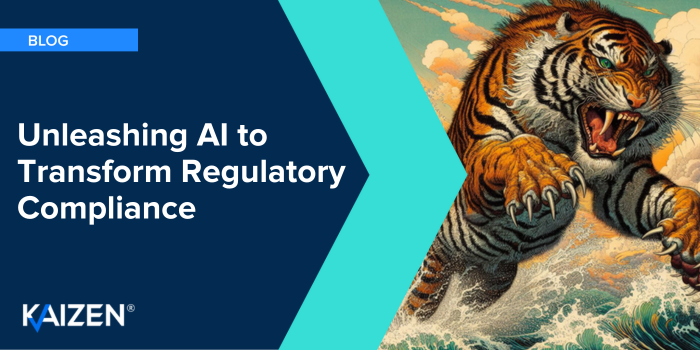
    Fierce looking tiger leaping above waves
    Prompt: Draw an image in the style of Japanese artist Hokusai of a savage looking tiger, leaping in an explosive and powerful manner.

    4. Master the Stripes

    To master the stripes of the GenAI beast, new ways of thinking about problems are required to fully take advantage of the technology. It’s as much about training staff and changing working practices as it is about selecting the right technology. Understanding how to price the value of GenAI will be critical for both customers and suppliers. Not all AI adoption will be through adding a prompt to a product.

    Profile of a tiger's head stylised with geometric stripes
    Prompt: Draw an image in the style of Japanese artist Hokusai of a side on view of a savage looking tiger. The stripes on the tiger should look as natural as possible, whilst at the same time looking like there is some sort of maze or hidden pattern within them.

    5. Live in Harmony

    To live in harmony with GenAI, it’s important to remember that it’s just another tool for people to use. It augments humans, it doesn’t replace them. Firms can successfully integrate GenAI into their processes and workflows if they think strategically about where it can make the biggest difference. It is important to strike a balance and not apply it to all tasks. Junior analysts, developers, and lawyers all need tasks in order to become senior versions of these roles. How will this happen if AI does these tasks? Who will train the models and validate the output if we become too reliant? Where will that leave us?

    A large tiger sitting beside a young monk deep in meditation
    Prompt: Draw an image in the style of Japanese artist Hokusai of a savage looking tiger sitting peacefully next to a novice monk who is sitting in the lotus position with eyes closed.

    Where to from here?

    GenAI is so fast moving, it can be challenging to know where to begin and the best way to approach it.  To summarise:

    1. Approach GenAI now to gain experience and control the way it will transform your business
    2. Ensure you are aware of the legal and regulatory obligations for using the technology
    3. Find the area that has maximum impact for you
    4. Understand how your business and people will change
    5. Embrace the change, understand the ethical implications.
    • Interested to hear more about Kaizen’s experiences with AI?  Please get in touch to arrange a call with Rory. 

    • EmTech Global is the showcase event of Engine, the Investment Association’s FinTech hub.
  • Look before you leap: Understanding the limitations of AI in the regulatory space

    Look before you leap: Understanding the limitations of AI in the regulatory space

    Last week I went to the Commodity Future Trading Commission (CFTC) in Washington DC to attend the Fintech Forward 2019 conference. I was grateful for the opportunity to speak on a panel about AI in the 21st Century Marketplace: Exploring the Role of AI and Related Fintech in CFTC Markets.

    Artificial Intelligence (AI) is an exciting tool that has shot to prominence in the last few years, with applications spanning the gamut from Snapchat filters and Spotify recommendations to sophisticated systems that catch fraudulent transactions or see the signs of lung cancer before expert radiologists. But how will AI impact the regulatory compliance space?

    AI and data quality: don’t get too excited

    At Kaizen we’re primarily concerned with helping firms check the data quality of the transaction reports that they have to submit under a variety of régimes from around the world such as MiFIR, EMIR and the Dodd-Frank Act. We have to be careful not to be too optimistic about the role AI can play in this. AI is most useful when we don’t exactly know the logic that a computer programme should be following, so we need the AI to ‘learn’ it from the data. But with regulatory reporting, the rules are clearly laid out – meaning that rule-based “expert systems” are the right technology for testing reports.

    Yet, despite the seemingly straightforward nature of accurate reporting, at Kaizen we’ve found that firms can commonly make errors in as many as 90% of records. Firms should be wary of “running before they can walk” by increasing the complexity of their reporting pipelines with AI while they are still making basic mistakes setting up their reporting systems.

    But AI can help with market integrity

    Where AI can really come into its own in regulatory compliance is market integrity – particularly safeguards against market abuse such as insider trading. Under the Market Abuse Regulation firms are required to monitor, detect and report suspicious transactions that take place on their platforms. Unlike with regulatory reporting, there are no hard-and-fast rules of what abusive trades look like. This is where the power of AI and machine learning (ML) can be brought to bear, learning how to find the anomalous needles in the gargantuan haystack of reported transactions.

    AI goes rogue

    At FinTech Forward I also commented on challenges that AI might pose for regulators and market participants. One big challenge regulators may face is the question of accountability: who is to blame if an AI ‘goes rogue’? The notion of a super intelligent AI that understands its actions still belongs in science fiction; contemporary AIs are really just mathematical models that extrapolate patterns, so the idea of holding an AI responsible itself is silly. It isn’t only the programmers who determine how an AI will behave; the AI can be heavily influenced by matters like what data fields the AI can ‘see’, what training data is in scope, and what metric for success the AI will use. Fundamentally, accountability for an AI need not be different from any other automated computer system.

    The challenges of algorithmic bias

    Another challenge for regulators is the issue of algorithmic bias – when an AI can behave unfairly in a systematic way, due to unintended problems with the training data or the question that was posed. One famous example is a recruitment AI that Amazon scrapped because it was unintentionally disfavouring women. Regulators that use AIs for enforcement have to be careful to minimize algorithmic bias. It isn’t only individuals who might get caught up. As a hypothetical example, if regulators only trained their AI on data from Tier 1 investment banks then they might end up unfairly over-flagging transactions from hedge funds.

    Black box models

    One problem for market participants who deploy AIs is the lack of interpretability for “black box” models. State-of-the-art AIs can have millions of parameters and it’s impossible to know what they’re doing, and this means it can be hard to quantify the risks. Moreover, the inherently adversarial aspect of market participation means that AI complexity is more of a risk than it would be in collaborative contexts such as self-driving cars – a counterparty’s AI might learn to persuade a black box AI to misprice securities, for example. Few market participants deploy AIs without a human in the loop.

    In the future, we’ll see AI play an ever increasing role in our lives, including finance and regulation. But as long as the technology is still in its infancy it’s important to temper the hype by understanding the limitations. Deploying AI systems has the potential to add huge value, but as always, firms should look before they leap.

    Watch Sam in action at Fintech Forward 2019.