Category: Guide

  • January 2024 – UPI and CFTC ReWrite Phase 2

    January 2024 – UPI and CFTC ReWrite Phase 2

    The bad news

    January 2024 kickstarts a truly tumultuous year for transaction reporting. January 29 more precisely sees the implementation of the CFTC ReWrite Phase 2 which means the adoption of UPI (Unique Product Identifier). After many years in the making the UPI might be having its debutants ball in the USA but that really just gets the ReWrite/Refit party circuit started.

    At the time of writing, the calendar for 2024 also entails implementation go-lives for:

    Jurisdiction  Regulator Status Description Date
    Japan JFSA Confirmed ReWrite 1 April 2024
    EU ESMA Confirmed EMIR Refit 29 April 2024
    UK FCA Confirmed EMIR Refit  30 September 2024
    Australia ASIC Confirmed ReWrite 21 October 2024
    Singapore MAS Expected ReWrite “October 2024”
    Canada CSA Expected ReWrite Q1 2025
    Hong Kong HKMA Expected ReWrite  Q3 2025


    The (somewhat) good news

    Back in 2015 I wrote an article describing transaction reporting as “the gift that keeps giving”. With eight major implementations planned for next year that’s as true today as it was back then. The 2024/5 reporting ReWrites’ schedule is without a shadow of a doubt the toughest we’ve seen since the inception of OTC derivative transaction reporting. But it’s not all bad news. Challenging as this will be there is some good news. The purpose driving all these implementations is harmonisation and they, for the most part, share a lot in common including the adoption of:

    • UPI to provide a consistent product taxonomy for reporting derivative products
    • CDE (Critical Data Elements) to globally agree the fields, the values and the definitions
    • ISO 20022 XML messaging standards for submitting to trade repositories
    • Global UTI standards to enforce common transaction identifiers across the various reporting regimes.

    Therefore the difficulties of managing multiple implementations across various reporting regulations is somewhat offset by the fact the reporting requirements are becoming more standardised and many of the data elements are converging on common globally agreed definitions. Reporting solutions, data dictionaries, analysis and reporting flows in theory become a bit simpler to manage. In theory at least.

    What does UPI mean for reporting?

    Anyone hoping that reporting with UPIs means simply replacing the current product identifier taxonomies with a new shiny UPI and sitting down with a nice cup of tea is going to be sorely disappointed.

    Reporting firms need to map all their current product attributes and then use these attributes to source a UPI from ANNA-DSB for each product. They’ll need to do this for all the product types they currently trade and any open positions previously reported to a trade repository (TR) or swap data repository (SDR).

    Some firms may opt to integrate the UPI data in their reporting solution only. Whereas others may integrate it further upstream in their trading, confirmation and associated systems as well. Either way, care will need to be taken to ensure the correct products are mapped to the correct UPIs. Unlike the current simple taxonomies such as FX Forward, the UPI is comparatively opaque and as such it won’t be easy for a human to see if the wrong UPI is on the trade without first looking up the reference data behind that UPI.

    Finally, firms will need to take a lot of care to ensure the other fields being reported on any given transaction are consistent with the UPI’s product characteristics. For example, if your UPI relates to a GBP/USD FX Forward then you need to ensure Notional Currency Leg 1&2 also contain GBP & USD.

    What does 29 January 2024 look like for CFTC & UPI?

    CFTC Rewrite Phase 2 contains two items of good news:

    1. The CFTC descoped UPI for commodity asset class. So UPI is being implemented for credit, equity, FX and interest rates but not commodity
    2. The CFTC also descoped ISO 20022 messaging because they wanted to wait until UPI is also ready for commodities.

    Some may argue it’s only postponing the pain as the above postponements will result in a Phase 3, likely in 2025, but for the time being given the evident confusion around UPI, this is probably best for most firms reporting to the CFTC.

    Once firms have designed and implemented a functioning UPI process, they will have the joy/pain of ensuring that UPI info is accurately incorporated into regulatory reporting processes given that:

    1. UPI will be required on all* Part 43/PPD submissions to the SDR
    2. UPI will be required on all* Part 45 trade submissions to the SDR
    3. UPI will be required on all Part 45 valuation submissions to the SDR.

    *Terminations and Erroring out (Action Types TERM & EROR) will not require UPI for either Part 43 PPD or Part 45 trade submissions. This is to accommodate removing previous submissions that may have been reported prior to UPI being applicable.

    Looking at the message specifications for one leading SDR, a handful of previously submittable fields have been deprecated. For example, Underlier ID is no longer required as this information is now embedded within the UPI.

    A new paradigm

    More interestingly there are fields which will be reported to the CFTC based on data that is derived from the UPI but are not submitted by the reporting firm, such as UPI Status, UPI Instrument Type and UPI Delivery Type. This is essentially a new paradigm for transaction reporting where a range of fields will be sourced from an external data provider (ANNA-DSB) and reported to the regulators despite not being submitted into the SDR by the reporting firm.

    This will also impact firms’ control frameworks as they need to ensure that the various product attributes within their systems are aligned to the correct UPI which they’ll submit to the SDR. They’ll also need to consider reconciling fields the SDR derived from the UPI to their source systems despite not having actually submitted these fields.

    Conclusion

    The CFTC may be the first off the mark with UPI in January next year but there are several other implementations coming, not least for both the EU & UK versions of EMIR. With only four months to go there is a worrying amount of confusion around UPI. Hopefully the UAT process will help to iron out the kinks and figure out the edge cases. Whether UPI achieves the regulatory aims of standardisation and interoperability, time will tell. Meantime 2024 is looking like a doozy for many reporting firms, ourselves at Kaizen included.

    • To understand the fundamentals of UPI, read Alan’s recent guide, UPI Explained
    • Still scratching your head over UPI?  For a conversation with Alan or one of our regulatory specialists, please get in touch. 
  • How to navigate UK and EU EMIR Refit reporting changes

    How to navigate UK and EU EMIR Refit reporting changes

    EMIR Refit introduces wholesale change at a granular level for EMIR reporting. Firms must be compliant with the new standards from 29 April 2024 in the EU and 30 September 2024 in the UK. Each of these implementations is a large lift, and a headache for all firms concerned.

    Even the lucky firms with just a single UK obligation will need to source regulation from a whole new set of documents and sources. With this comes inefficiency in navigating the material, as well as potential divergence created in the final drafting.

    The main potential source of divergence is in the reporting guidelines themselves. The EU document was published in December 2022 and is currently being digested by firms. We expect the FCA to publish a series of smaller guideline articles for the UK, in contrast to the sizeable Reporting Guidelines published by ESMA in December 2022.  The FCA will use feedback from its industry engagement working groups to help steer the topics and direction of the aforementioned guideline articles.

    Many of those who work within transaction reporting in the UK will only have worked with EU documentation up until this point. Due to the different approaches of publishing documentation between the EU and UK regulators, it can leave compliance and reporting teams asking questions such as “where are the field requirements for the UK?”, “where are the requirements in the FCA handbook?” or, even “how does the UK differ from the EU”?

    The Single Rulebook platform hosts the latest UK and EU EMIR Refit rules, guidance and related documentation. Its intelligent literal and semantic search functionality means that the relevant UK and EU EMIR Refit rules can be located in seconds with the functionality to also find the corresponding UK or EU rule at the same time.

    What are the key changes of EMIR Refit?

    The new regulation will standardise messaging on the ISO 20022 format, implement UPI for more robust product identification, clarify the UTI generation waterfall and crucially, increase the number of reportable fields to 204 in the UK and 203 in the EU.

    How will the UK publish rules for UK EMIR Reporting?

    UK EMIR reporting falls under the FCA’s remit and all new rulemaking is published via policy statements and legal instruments. The following publications relate to UK EMIR Refit:

    • PS23/2 – Changes to reporting requirements, procedures for data quality and registration of Trade Repositories under UK EMIR
    • FCA 2023/3 – EMIR Rules (Procedures for Ensuring Data Quality) Instrument 2023
    • FCA 2023/4 – FCA Standards Instrument: The Technical Standards (EMIR Reporting and Data Quality and Miscellaneous Amendments) Instrument 2023
    • FCA 2023/5 – Technical Standards (EMIR Registration of Trade Repositories and Miscellaneous Amendments) Instrument 2023

    Where are these rules available in the FCA Handbook?

    These rules are not currently available in the FCA Handbook; they will only be published when they enter into force. For the interim period, these PDFs are the only published versions of the new requirements. When published, the main guidance will appear in two places.

    • EMIRR will be published as a new “Specialist Sourcebook”. This contains rules applicable to trade repositories.      
    • Two new FCA Technical Standards will be created:
      • Technical Standards on the Standards, Formats, Frequency and Methods and Arrangements for Reporting
      • Technical Standards on the Minimum Details of the Data to be Reported to Trade Repositories  

    There are also a number of less substantive amendments that will be made to the FCA Handbook, for example adding definitions to the glossary.

    Finally, FCA 2023/4 and FCA 2023 make changes to other “onshored” FCA technical standards. The complete extract is as below.

    Legal Instrument

    Change

    Comment

    FCA 2023/3

    The Glossary of definitions is amended in accordance with the Annex A to this Instrument.

    Add EMIRR definition

    FCA 2023/3


    The General Provisions sourcebook (GEN) is amended in accordance with the Annex B to this instrument.

    Legal administrative update

    FCA 2023/4


    The FCA revokes the following technical standards insofar as they apply in all cases, except in the case of central counterparties:

    (1) Commission Implementing Regulation (EU) No 1247/2012

    and,

    (2) Commission Delegated Regulation (EU) No 148/2013 of 19 December 2012 supplementing Regulation (EU) No 648/2012.

    Partial disapplication of previous rules


    The FCA amends the following technical standards in accordance with the relevant Annexes to this instrument:

    ●       Commission Delegated Regulation (EU) No 149/2013 of 19 December 2012 supplementing Regulation (EU) No 648/2012

    ●       Commission Delegated Regulation (EU) No 151/2013 of 19 December 2012 supplementing Regulation (EU) No 648/2012

    ●       Commission Delegated Regulation (EU) No 2016/957 of 9 March 2016 supplementing Regulation (EU) No 596/2014

    Administrative updates to document references and updates to ensure consistency of field names and action types.

    FCA 2023/5

    The following technical standards are amended in accordance with the Annexes to this instrument.

    ●       Commission Delegated Regulation (EU) No 150/2013 of 19 December 2012 supplementing Regulation (EU) No 648/2012

    ●       Commission Implementing Regulation (EU) No 1248/2012

    ●       Commission Delegated Regulation (EU) No 151/2013 of 19 December 2012 supplementing Regulation (EU) No 648/2012

    Administrative updates to document references and updates to operational risk and control requirements for trade repositories.


    To date, changes to onshored RTS and ITS have not been made available in consolidated form by the UK Government. As a result, firms will need to establish other ways of navigating and retaining control over this type of change.

    You can now find these documents on the FCA’s website by setting a future date and navigating through the folders.

    The EMIRR specialist sourcebook can be found here by opening the Specialist Sourcebooks folder.

    The new technical standards can be found here by opening the European Markets Infrastructure Regulation > 2023 folder.

    Mapping UK to EU rules

    As the rules were drafted within similar timeframes, we can build a map of the rules in the UK with the corresponding EU rules. This helps firms ensure that their reporting is aligned from day one. Firms will also need to monitor and manage the impact of future divergence between these requirements.

    Document

    UK

    EU

    TR Validations and inter-TR reconciliation

    FCA 2023/3

    Annex C

    (EMIRR Sourcebook)

    RTS 2022/1858

    Minimum Details of the Data to be Reported to Trade Repositories

    FCA 2023/4

    Annex A

    RTS 2022/1855

    Standards, Formats, Frequency and Methods and Arrangements for Reporting

    FCA 2023/4

    Annex B

    ITS 2022/1860


    In order to demonstrate control and compliance in both jurisdictions, it is also important to map the rules at a more granular level which the Rule Maps functionality in the Single Rulebook platform can provide. 

    Other Content that You Will Need

    The rules themselves are not enough to complete the migration. The full suite of ancillary regulatory documents is below. Firms will also need to refer to the documentation published by their chosen repository and follow their precise instructions.

    Document

    UK

    EU

    Guidelines


    EMIR Refit Reporting Guidelines

    Validation Rules

    UK EMIR Validations

    EU EMIR Validations*

    xml Schemas

    Incoming Messages

    Outgoing Messages

    Incoming Messages*

    Outgoing Messages*

    Mapping Table


    Mapping table

    Breach Notification

    UK European Market Infrastructure Regulation (UK EMIR) – reporting errors and omissions notification form (fca.org.uk)

    Contained within EU EMIR Validations

    * Please note that the EU Validations, Incoming Messages and Outgoing Messages were updated by ESMA on 6th September 2023 but the version number of each zip file remains 1.0.0.


    Conclusion

    Implementing the EMIR Refit transaction reporting changes will require close attention to the fine detail of the changes between EU and UK jurisdictions. Subject matter expertise will again be in short supply and firms will need to plan their project well to decrease the risk of reporting errors and non-compliance.

    Kaizen’s EMIR Refit Toolkit provides support at every stage of your project:

    1. Validations – Firms can test the validity of their submission files to ensure that reports meet the validation rules as defined by the regulator.
    2. Accuracy on Demand –  A new service, ‘Accuracy on Demand’ utilises Kaizen’s award-winning testing methodology to check whether your TR submissions are not only valid but accurate.
    3. Accuracy Testing – Kaizen’s flagship product is the gold standard in regulatory assurance, delivering a complete set of testing, down to every field of every record, tailored to your business.
    4. Single Rulebook – in addition to providing the regulatory content, Single Rulebook’s online platform also provides visual rule maps, traceability and annotation tools for EMIR Refit that can help firms manage the regulatory change brought about by the revised regulation.
    5. EMIR Refit Core Training – Training is an integral part of the systems and controls required for accurate reporting. Our interactive half-day course provides a comprehensive understanding of the EMIR Refit reporting requirements.
    • For a conversation with Chris Dingley on how to navigate your EMIR Refit reporting changes, contact us.
  • UPI – Unique Product Identifier Explained

    UPI – Unique Product Identifier Explained

    The Unique Product Identifier (UPI) is the long-awaited new taxonomy for better describing OTC derivative products and the various characteristics of how each derivative is structured.

    At its simplest level the UPI replaces the current simplistic OTC derivative taxonomy values such as “FX Forward” or ISDA’s “ForeignExchange:Forward” with an identifier mapped to far more granular attributes in a centralised database.

    That database is run by ANNA-DSB and much like ISIN codes, will mean that various parties can be sure they are talking about the same OTC derivative because they can look up that UPI in the database and all see the same attributes.

    ROCking out with ANNA

    Alphabetti spaghetti time for the acronyms.

    The ROC gave the mandate to ANNA to establish and run the DSB for UPI.

    Clear?

    No?

    Ok. The Regulatory Oversight Committee (a supranational group of financial market regulators and authorities that amongst other duties oversees the LEI framework) is leading the global rollout of UPI. As well as helping to establish the UPI protocols and taxonomy, the ROC has mandated the Association of National Numbering Agencies (ANNA) with establishing and operating a facility for obtaining and maintaining UPIs. This facility is called the Derivatives Service Bureau (DSB) and is essentially a paid-for service where users can obtain an existing UPI if one already exists or have a new UPI generated if it doesn’t. Think of it as a big centralised Excel spreadsheet that debits your credit card every time you glance in its direction.

    Taxonomies? Attributes? What?

    This stuff is admittedly hard to visualise so let’s break it down with examples.

    Let’s take good old Credit Default Swaps (CDS). Because had they not crashed the world’s economy in 2008 we wouldn’t be here today discussing UPI as part of the remedy for that misadventure.

    A firm has a CDS in its systems with various product attributes that describe things like what the underlying asset the CDS is based on and it wants to obtain the UPI for that CDS.

    The firm submits a query to ANNA-DSB with various inputs describing the CDS.

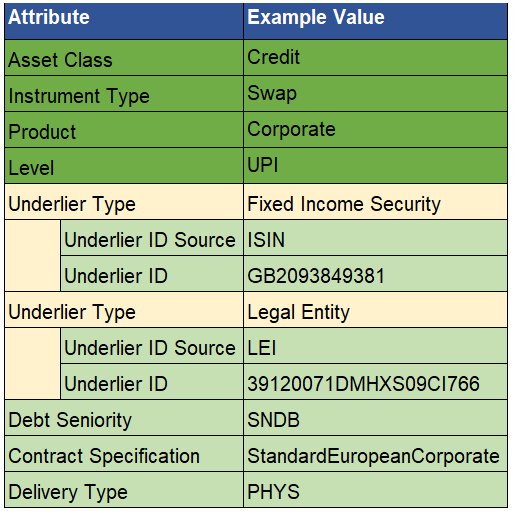
    The UPI query inputs for a CDS on a corporate bond are shown below:


    ANNA-DSB searches the UPI database to see if a UPI already exists for a CDS matching these various inputs. If no UPI exists, the DSB will assign a new UPI and create a new record in the database for subsequent users to see.

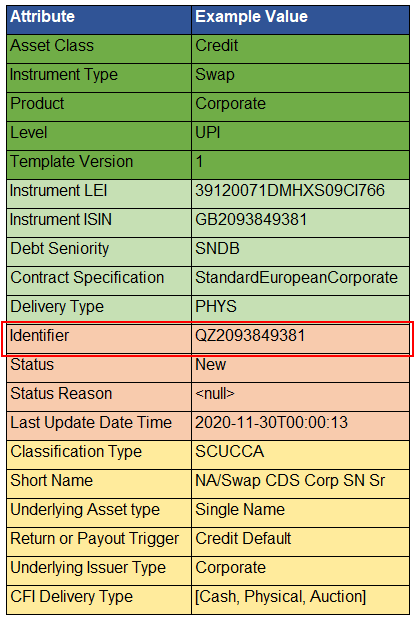
    The DSB then responds to the query with the resulting UPI (highlighted) and additional characteristics as shown below.


    Now whenever the firm communicates with another firm, regulator or party they can all use DSB data to know that UPI QZ2093849381 refers to a Credit Default Swap on a European corporate bond with ISIN GB2093849381, with CFI code SCUCCA and issued by LEI 39120071DMHXS09CI766.

    So similarly to the LEI where the database maintained by GLEIF means that firms can use an LEI code to ensure that they are talking about the exact same legal entity, the rationale behind UPI is that a central database of products provides clarity that firms are talking about the exact same OTC derivative product.

    FX Example

    The UPI query inputs and outputs vary based on the asset class and product type.

    If we consider Foreign Exchange then, if a firm has an FX Option in its systems and it wants to obtain the UPI for that FX Option.

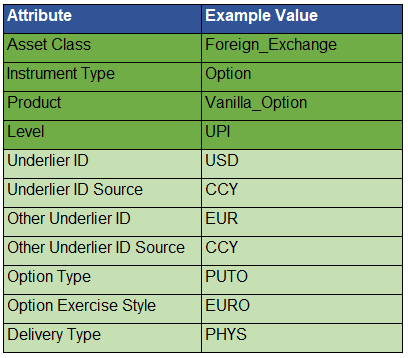
    The firm submits the below query to ANNA-DSB with various inputs describing the various characteristics of the FX Option.


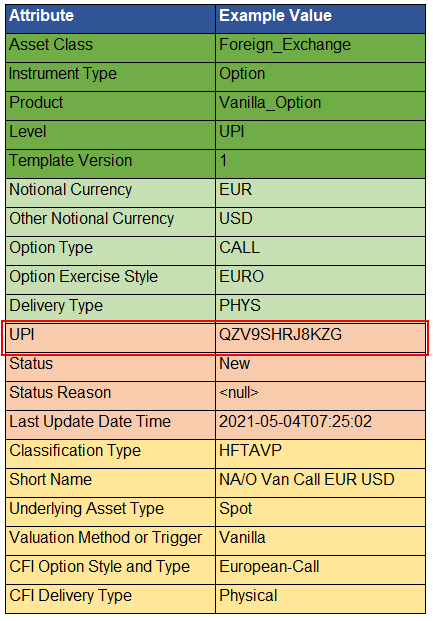
    DSB then responds to the query with the resulting UPI (highlighted) and additional characteristics as shown below.


    Now all parties can use DSB data to know that UPI QZV9SHRJ8KZG refers to an FX Option on a EUR vs USD, with CFI code HFTAVP, that’s a European-style physically settled call option.

    Interest Rates Example

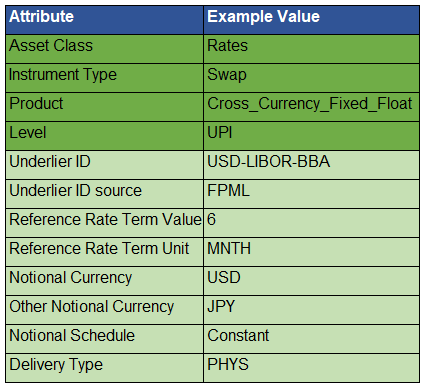
    Next if we look at interest rates, if a firm has a cross-currency fixed-float swap and it wants to obtain the UPI for that swap.

    The firm submits the below query to ANNA-DSB describing the rates swap.


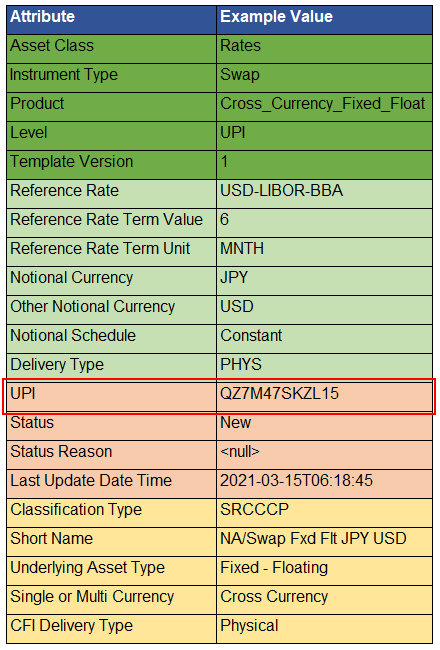
    DSB then responds to the query with the resulting UPI (highlighted) and additional characteristics as shown below.


    Now all parties can use DSB data to know that UPI QZ7M47SKZL15 refers to an cross-currency fixed-float swap on USD vs JPY, with CFI code SRCCCP that’s physically settled.

    So UPI is like an ISIN then?

    UPI essentially sits between a CFI code and an ISIN in terms of how granular or specific it gets.

    The CFI code describes the basic attributes but does not get as far as underlying assets, currencies etc.

    Taking the CFI from the previous rates example, we see that SRCCCP is the CFI code for a physically settled, cross-currency, fixed-floating, rates swap.

    Diagram below generated using ISDA’s CFI Code Generator:


    The UPI takes it to the next level of granularity by telling us this rates swap is also based on USD vs JPY, uses the USD-LIBOR-BBA floating rate and has a six-month period for that reference rate. So the UPI is far more specific than the CFI which just outlines the broad characteristics.

    ISIN would take it even further in terms of granularity because ISIN also tends to reference the trading venue where it traded and any venue specific characteristics such as the currency it’s traded/priced in.

    Why not just use ISIN?

    Two main reasons…

    1. The more forgiving reason is that since ISINs are often specific to the trading venues this means that using ISINs makes it more difficult to aggregate products with the same characteristics that are traded on different venues. Given the whole OTC derivative reporting framework is geared towards systemic risk, the regulators want the ability to aggregate transactions at product level, rather than venue level, when examining counterparty exposure. So UPI being venue agnostic is beneficial for this surveillance.
    2. The less forgiving answer is that outside of EMIR (EU & UK versions) no other regulators use ISINs for OTC derivatives. EU and UK reporting is therefore the outlier and much like the reporting of Exchange Traded Derivatives (ETDs) that underpins it, the use of ISINs for OTC was widely considered crazy but nonetheless made it into the rulebooks.

    So whilst ESMA and the FCA pushed ahead with ISINs for OTC derivatives the remainder of the regulators globally have patiently waited for UPI to be ready as a global solution much like the LEI.

    UPI Pay to Play

    Unlike LEIs (where the legal entity obtaining an LEI has to pay an annual fee for that LEI but the database and data is essentially free to all), ANNA-DSB will charge users for creating UPIs and accessing the UPI data in general. This is a little more controversial as UPI’s adoption across many of the OTC derivative reporting regimes amongst other use-cases means that many firms will have no alternative other to register with ANNA-DSB and pay for the privilege.

    Time will tell whether other cottage industries and resources pop up around UPI data in much the same way as you see a plethora of LEI websites and utilities whenever you search for an LEI these days. I personally hope so because ANNA-DSB needs remuneration for creating and maintaining the UPI services, that much is reasonable. But everyone having to repeatedly pay to access the same data seems a lot less reasonable in the long run.

    Similarly to the LEI rollout, we’d expect an explosion of new UPIs at the start (when the CFTC goes live with UPI in January) and another explosion when EMIR Refit follows in April next year. But that growth in new UPI population will theoretically tail off and eventually slow right down where only exotic edge-case UPIs are requested, or UPIs on newly created credit or equity underlying instruments.

    Conclusion – The Big Short rerun

    The UPI is a good concept in general and, after what seems like a very long time in the making, it is finally becoming a reality. It should help to improve clarity and consistency across the industry and for regulatory reporting in general. However we see a great deal of confusion around what UPI really means and with six months to go until the CFTC UPI go live, this is concerning. 

    If the UPI allows various regulators to aggregate similar derivative contracts together to better assess the systemic risk then that can only be a good thing. I’ll happily watch the excellent The Big Short film again but I don’t need to relive the crisis itself. There is clearly a great deal of work ahead to get UPI up and running and fully integrated across many firms and many systems.

    Tables (apart from ISDA’s) sourced from ANNA-DSB.

    • Still scratching your head over UPI?  For a conversation with Alan or one of our regulatory specialists, please get in touch. 
    • Is your firm prepared for EMIR Refit? To find out more about our EMIR Refit Toolkit, please contact us.
  • How-to Guide: SFTR repo day-count conventions

    How-to Guide: SFTR repo day-count conventions

    Day-count conventions – a land of confusion

    Anecdotal evidence from regulatory testing, reported data, questions we’re asked and the helpdesk queries we receive indicate that confusion reigns when it comes to repo market day-count conventions. This is an issue both in terms of ensuring SFTR reports are accurate but also an issue as a matchable field reconcilable at the Trade Repository (TR).

    Market craves standards and best practice

    The problems arise primarily from two factors:

    1) A tendency to report the underlying collateral bond interest accrual day-count convention instead of the correct repo interest convention.

    2) The prevalence of a large number of irrelevant conventions (in the context of SFTs) on the ESMA/FCA validation rules list of options including many bond coupon conventions and derivative interest conventions too.

    Very tellingly, the latest proposals from the Office of Financial Research in the US state that they believe the ISO 20022 definitions to be too broad and that they were going to insist on everything being reported on the US market convention Actual/360 basis.

    Until now, there simply has not been a definitive guide to which day-count conventions to use in which markets.

    Only two repo day-count conventions in regular use

    In the vast majority of cases, we foresee only two of the listed day-count conventions being relevant and correct when reporting repo transactions. While not all market participants will necessarily follow the market convention associated with the particular market in question, nevertheless, they tend to abide by Actual/360 or Actual/365. In rarer cases, we see Actual/Actual (notably in Russia). We would also expect these to be repo market specific conventions and not derivatives related ISDA ones for example. Indeed, if the SFTR reported convention is not A004 or A005 and it is a major market, the reported convention is quite probably incorrect.

    Actual/360 covers Euro, USD, JPY (international) and CHF

    In the Euro, USD, CHF and international repo markets in Japan, Canada, Australia and New Zealand, the standard convention is Actual/360 , the actual number of days interest (the numerator), divided by an assumed 360 days in a year (the denominator). This is denoted under SFTR as A004.

    Actual/365 covers Euro, USD and JPY (domestic) 

    In the UK and Japanese, Canadian, Australian and New Zealand domestic markets the convention is Act/365 Fixed, the actual number of days interest divided by 365 days in a year, regardless of leap-years. This is denoted by A005.

    Japan, Australia, New Zealand and Canada conventions differ between international and domestic. Do not be surprised to see repo trading under the international (Actual/360) convention in the repo markets in any of these jurisdictions.

    There are some smaller markets such as Brazil (that uses a business day convention) and Burundi, Ethiopia and Rwanda that use an Actual/364 convention that would need to be reported using the free-text option. This option should only be used when reporting activities in smaller, non-standard markets. The ICMA provide some guidance on the reporting of unlisted conventions in recommendation 5.17 of its recommendations for reporting under SFTR. Using this as a context for the reporting of non-standard conventions should limit instances of TR reconciliation breaks on this field too.

    NB: When referencing domestic repo markets, this relates to trades between two onshore counterparties, potentially on a domestic platform or venue, settling in the domestic location, often using a domestic interest rate, e.g. Tibor in Japan. International repo trades are typically cross-border, off-exchange (although some is now exchange traded), cleared through an  International Central Securities Depository (iCSD) such as Euroclear and executed using an internationally recognised common rate standard.

    Day-count conventions and SFTR codes per jurisdiction

    Actual/365F (A005 SFTR)

    Actual/360 (A004 SFTR)

    Actual/Actual (A006)

    UK

    US

    Russia

    Japan (domestic)

    EUR


    Australia (domestic)

    Japan (international)


    Canada (domestic)

    China


    Israel

    Switzerland


    India

    Sweden


    New Zealand (domestic)

    Denmark


    Singapore

    Norway


    South Africa

    Australia (international)


    South Korea

    New Zealand (international)


    Taiwan

    Canada (international)


    Thailand

    Turkey


    Sri Lanka

    Mexico


    Kenya

    Argentina


    Kuwait

    Algeria


    Malawi

    Angola


    Malaysia

    Bahrain


    Mauritius

    Barbados


    Pakistan

    Botswana


    Poland

    Bulgaria


    Tanzania

    Chile


    Zambia

    CFAF


    Colombia


    Congo DRC


    Czechia


    Egypt


    Hungary


    Iceland


    Indonesia


    Morocco


    Oman


    Philippines


    Qatar


    Romania


    Saudi Arabia


    UAE


    Vietnam


    WAMU


    • If you have any concerns about the quality of your firm’s SFTR reporting or require training, please contact us to discuss your requirements.
    • Many thanks to Richard Comotto for his assistance in compiling this list. 
  • Transaction Reporting How-to Guide: Personal Identifiers

    Transaction Reporting How-to Guide: Personal Identifiers

    The FCA recently released Market Watch 70 providing a reminder to firms of the importance it attaches to the transaction reports it receives.  Transaction reports are used to help them detect and investigate cases of market abuse, combat financial crime, support conduct supervision and examine market events.  For the regulator to be able to do that efficiently, reported data must be complete, accurate and sent on time.

    Despite MiFIR heading for its 5th birthday in January 2023, Kaizen’s testing is still finding a high number of personal identifier errors within transaction reporting, something also highlighted in Market Watch 70:

    • Buyer/Seller identifiers
    • Buyer/Seller decision maker identifiers
    • Investment decision within firm
    • Execution within firm

    These codes are essential to regulators for their work in detecting market abuse.  Harmonisation of the population of this field is vital for regulators attempting to identify individuals insider dealing through several trading accounts held at a number of different firms.  Regulators can only attempt to detect such activity if all the firms use the same and correct code to identify these unscrupulous types. 

    Personal Identifier Essentials

    The first thing to remember is that all personal identifiers start with the ISO two character country code of the individual’s nationality (e.g. ‘GB’, ‘US’, ‘FR’ etc.) followed by the national identifier relevant to that country.  Kosovo being the one outsider here in that it doesn’t have an official ISO-3166 code but its unofficial “XK” is now being recognised by competent authorities.

    National identifier taxonomies

    A list of the national identifier taxonomies can be found in the RTS 22 Annex.  For some countries, there is a single taxonomy; for example, for German nationals, only the ‘CONCAT’ can be used. For other countries, there are up to three taxonomies.

    In all cases you can only use the ’Priority 2’ taxonomy if the ‘Priority 1’ taxonomy is not applicable to that individual.  For example, the ‘Priority 1’ taxonomy for UK individuals is the National Insurance Number (NINO) and priority 2 is ‘CONCAT’.  So if you are identifying a British person, you should only use a ‘CONCAT’ if that person does not have a National Insurance Number.  In theory every British person over the age of 16 is issued with a National Insurance number so for the purposes of transaction reporting you should not be identifying any British person over the age of 16 with a CONCAT code.

    What is ‘CONCAT’?

    ‘CONCAT’ is the concatenation of the following four elements:

    • 2 character ISO country code (as for all personal identifiers)
    • Birth date – in the format YYYYMMDD
    • First five characters of first name (right pad with hashes if less than 5 characters)
    • First five characters of surname (removing prefixes and right pad with hashes)

    Further rules:

    • For the name elements, there is a conversion/removal of diacritic characters, apostrophes, hyphens, spaces etc using the transliteration table in ESMA’s Guidelines
    • Prefixes to surnames must be removed unless they are ‘attached’
      e.g. ‘Von der Leyen’ is ‘LEYEN’; McNeil is ‘MCNEI’ (rather than ‘NEIL#’)
    • The individual’s full name should form the basis of the CONCAT – incorrect abbreviations or nicknames must not be used (e.g. ‘JAMES’ rather than ‘JIM##’)
    • Titles (e.g. ‘Prof’, ‘Dame’ etc) should be removed
    • All UPPER CASE

    So, for example, the CONCAT code for that well known French chanteur Jacques Dutronc, born 28 April 1943, would be: FR19430428JACQUDUTRO.

    What about joint nationalities?

    • If both countries are within the EEA, use the country code of the first nationality when sorted alphabetically by its ISO 3166-1 alpha-2 code
    • If one country is within the EEA and one outside, use the EEA code
    • If both countries are outside the EEA, use the country whose ISO 3166 code is first when sorted alphabetically

    So if it’s joint German and French – use the German taxonomy as ‘DE’ comes before ‘FR’.

    For joint Swiss and French – use French taxonomy even though ‘CH’ comes before ‘FR’ (as Switzerland is outside the EEA).

    Post Brexit reporting to an EU NCA

    So post-Brexit, for the purposes of reporting to an NCA based in the EU, the UK is now outside of the EEA which impacts two things: 

    • Joint nationalities, see above
    • And, as the UK now falls into the category of “All Other Countries”, according to RTS 22 Annex II, UK individuals can no longer be identified using their National Insurance number, the passport number becomes the 1st priority identifier and CONCAT the 2nd priority identifier.

    One final pitfall – the code type

    Because these are XML fields, you need to identify the ‘code type’.  This might vary from ARM to ARM, but the standard code types are as follows:

    ‘CCPT’       – if you’re using the passport

    ‘CONCAT’   – if it is a CONCAT code

    ‘NIDN’    – for any other national identifier

    Where to go to for help

    If you are unsure about any of the reporting standards or just need a refresher, join our upcoming MiFIR core training course which will help ensure you are interpreting the MiFIR transaction reporting requirements correctly.

    Our ReportShield™ Accuracy Testing identifies all transaction reporting errors including those related to personal identifiers, providing a regular health check of all your reported data. 

    • To find out more or for a conversation with one of our regulatory specialists, please contact us.
  • Transaction Reporting How-to Guide: ‘Venue’ Field

    Transaction Reporting How-to Guide: ‘Venue’ Field

    On the face of it, the ‘Venue’ field in transaction reporting seems to be fairly straightforward – as the RTS states, it is simply the “identification of the venue where the transaction was executed.” Unfortunately, it is not quite as simple as it first seems and we detect a large number of errors with this field in our ReportShield™ Accuracy Testing.

    Why is the ‘Venue’ field so important?

    Every field is important to the regulators and Article 26 of MiFIR demands complete and accurate reporting. However, accurate population of the Venue field is particularly important for firms due to the impact it has on the population of associated fields. If it is populated incorrectly, it could result in a ‘CON 412’ error from the regulator and your report will be rejected.  It also impacts how ‘TVTIC’, ‘Trading date time’, ‘Country of branch membership’ and fields 41-56 need to be populated. So it is essential that you fully understand the intricacies of this field and don’t fall into any of the following traps.

    ‘Segment’ versus ‘Operating’ level MICs

    The Market Identifier Code (‘MIC’) used to be a straightforward standard – you had one exchange and one four character code to identify it. For example, ‘XLON’ was the sole identifier for the London Stock Exchange. However, this was far too easy and exchanges are increasingly moving to a segment level structure resulting in a MIC for each segment. For example, the London Stock Exchange has ‘XLON’ as its ‘operational level’ MIC, but also has the following ‘segment level’ MICs:

    • AIMX – London Stock Exchange, AIM MTF
    • XLOD – London Stock Exchange, Curve Global Markets
    • XLOM – London Stock Exchange, MTF,
    • XLON – London Stock Exchange

    Golden Rules:

    1. Use the segment level MIC for transactions executed on a trading venue, systematic internaliser or non-EEA trading platform.
    2. Only use the operational level MIC where the segment level MIC does not exist.

    This is so important because if you used the operational level MIC by mistake, it will sail through ARM validation, but will probably result in a CON 412 error from the regulator. This is because the ISIN you have used in field 41 doesn’t only have to be on FIRDS on the trading date – it also has to be with the correct segment level MIC. So if you have traded an AIM stock, populated the ISIN correctly but have populated the Venue field with ‘XLON’ rather than ‘AIMX’, it will be rejected.

    The ‘XOFF’ versus ‘XXXX’ conundrum

    Another common error made by firms is in the use of ‘XOFF’ instead of ‘XXXX’ and vice versa. This is understandable as they sound similar and are both used for off market trades. In an effort to be precise, some of the language in the RTS can also appear confusing. It is absolutely essential that you understand the difference between the two as it can have a major impact on whether you need to populate the instrument identifier.

    Golden Rules:

    1. Use ‘XOFF’ for instruments that are tradeable on an EEA trading venue but where the trade has been made off market (i.e. not executed on a trading venue, SI or non-EEA platform).
    2. Use ‘XXXX’ for instruments that are not tradeable on an EEA trading venue and are traded off market (i.e. not traded on a non-EEA platform).

    Exchange MIC or ‘XOFF’/’XXXX’

    Another thorny issue we’ve discovered is the use of an exchange MIC when the trade was actually made off market. The Venue field should only be populated with the exchange MIC if the transaction was executed on a Trading Venue. Section 5.4 in the ESMA Guidelines document is a little complicated, but the key statement is “Where an Investment Firm is not the direct market facing entity the Investment Firm is not regarded as executing on the Trading Venue for the purposes of transaction reporting.” So if you are making a transaction against a broker and that broker makes a trade on the London Stock Exchange to facilitate the trade, you should populate the venue field with ‘XOFF’ rather than ‘XLON’ as you are not the direct market facing entity.

    How we help

    Firstly, if you are unsure about any of the reporting standards, or just need a refresher, we would heartily recommend our core training course which will help ensure you are interpreting the MiFIR transaction reporting details correctly.

    If you have any doubt about whether you have been reporting correctly, this is what our Accuracy Testing is designed for. We can take all the transaction reports you have submitted over any given period and apply multiple tests for each data field that comprises a report. As many firms have discovered to their cost, there is no point hoping for the best when it comes to reporting. You need to have total confidence that your reporting is complete and accurate to avoid costly remediation and regulatory scrutiny. 

    • Please contact us for further details on our quality assurance, reconciliation, governance and training services.